

- Market Size (2026)
- USD 89.2 Bn
- Forecast (2036)
- USD 293.1 Bn
- CAGR (2026 to 2036)
- 12.6%
How big is B2B Telecommunication Market in 2026?
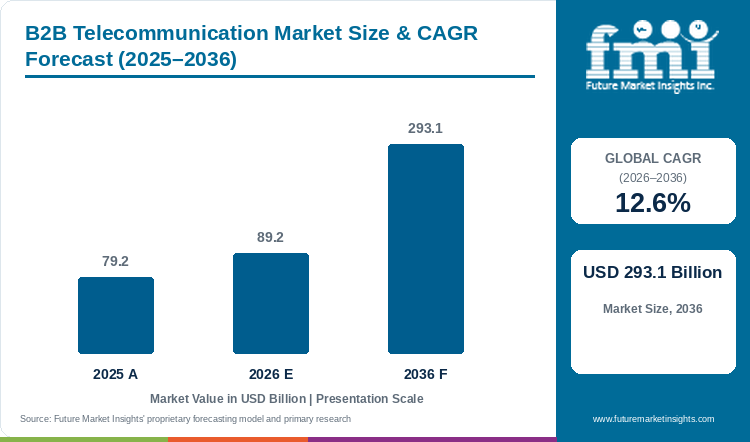
Demand is projected to expand at 12.6% CAGR from 2026 to 2036. Market value rises from USD 79.23 billion in 2025 to USD 89.23 billion in 2026 and USD 293.05 billion by 2036.
The market is estimated at USD 89.23 billion in 2026 and projected to reach USD 293.05 billion by 2036, at a CAGR of 12.6% from 2026 to 2036. Business telecommunications connects employees, applications and equipment across offices, facilities and cloud environments, with buyers increasingly evaluating the operating service around the connection. Cloud computing creates demand for reliable access to applications beyond a single company site, while industrial activity adds requirements for coverage and device connectivity within a facility. [1] These settings produce different purchasing tasks: managed SD-WAN can support a distributed network, whereas a private wireless installation addresses the conditions of a particular location. [2][3][4] Unified communication and collaboration combines several workplace interactions, and larger enterprises need services that can accommodate varied locations and workloads. Operators therefore compete through network design, visibility and support as well as access capacity. The useful service is one that fits the enterprise's actual applications and physical environment, including the response when a connection fails or a site changes. Over the forecast period, growth follows continuing digital operations and the work of maintaining a network that can support them, with managed capabilities and deployment expertise influencing the commercial relationship. [1][2][3][4]
Key Market Trends & Insights
- Enterprise offers increasingly combine connectivity with continuing management, allowing buyers to assess network visibility and support alongside the capacity of individual access links. [3]
- Private and non-public networks are designed around enterprise-specific uses, giving the physical site and connected applications a central role in the proposed architecture. [1][2]
- Onsite portfolios bring private wireless, neutral-host coverage and edge options together, addressing different connectivity needs within a factory, campus or other enterprise location. [4]
Regional Highlights
- Indian enterprises adding offices and industrial facilities need connectivity that fits a wider operating network, while Chinese factory and logistics sites add local device-coverage requirements to connections between businesses. [1][2]
- AT&T’s managed SD-WAN and Verizon’s onsite portfolio give US buyers distinct options for connecting branches and serving devices within a particular facility. [3][4]
- German production sites and Japanese supplier operations assess new network designs against equipment and applications already in use, making deployment planning and continuity of access relevant to purchasing. [1]
Market Size & Forecast
Table 1: Market Size and Forecast for B2B Telecommunication Market (USD billion and percentage), 2025 to 2036
| Metric | Value |
|---|---|
| 2025 market value | USD 79.23 billion |
| 2026 market value | USD 89.23 billion |
| 2036 market value | USD 293.05 billion |
| CAGR 2026 to 2036 | 12.6% |
| Revenue increase 2026 to 2036 | USD 203.82 billion |
| Market expansion 2026 to 2036 | 3.28 times |
The projected 12.6% CAGR from 2026 to 2036 reflects the continuing role of connectivity in business operations and the work required to maintain it across changing applications and sites. Software-defined wide area networking can give an enterprise a more manageable view of distributed connections, while onsite networks serve a defined physical environment. Suppliers can expand through services that translate those designs into usable operating support, with deployment and the response to network issues influencing the relationship beyond the initial contract. [1][2][3][4]
How do enterprise network architectures translate into managed services?
ITU describes non-public networks through enterprise-specific architectures, and GSMA examines the operator's role in private 5G services. AT&T's managed SD-WAN and Verizon's onsite portfolio show how those network concepts appear in commercial offerings. The sources support a distinction between connecting a distributed enterprise and providing coverage within a particular facility, with management and support forming part of both purchasing decisions. [1][2][3][4]
Table 2: Industry evidence relevant to the b2b telecommunication market
| Indicator | Data point or observation | Market relevance | Source |
|---|---|---|---|
| Architecture | ITU describes standalone and integrated non-public network options | The design follows the enterprise use and required connections | [1] |
| Managed WAN | AT&T offers managed SD-WAN and network visibility | The operator’s role extends beyond providing an access link | [3] |
| Onsite coverage | Verizon combines private 5G and neutral-host offerings | Facility-specific connectivity can involve different service functions | [4] |
Analyst Perspective
"The B2B telecommunication market is shifting toward managed network platforms where enterprises pay for reliability, security, and operational outcomes."
- Sudip Saha, Co-founder, FMI
How is the B2B Telecommunication Market segmented?
The market is segmented by Solution, End User, Vertical, and Region.
By solution, the market includes Unified Communication and Collaboration, VoIP, WAN, Cloud Services, M2M Communication. By end user, the market includes Small and Medium Enterprises, Large Enterprises. By vertical, the market includes BFSI, Healthcare, Media and Entertainment, Government, Energy and Utility, Retail, Transportation and Logistics, Others.
Why does the Unified Communication and Collaboration segment hold a strong position within the solution category?
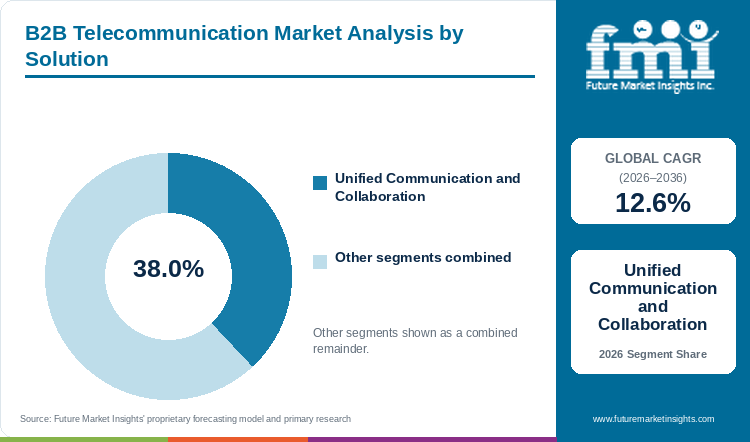
The Unified Communication and Collaboration segment is projected to account for 38.0% of solution demand in 2026.
Table 3: Solution Share for B2B Telecommunication Market (percentage share), 2026
| Solution | Estimated share (2026) |
|---|---|
| Unified Communication and Collaboration | 38.0% |
| Other solution segments | 62.0% |
| Total | 100.0% |
Table 4: Segment Position and Market Growth for B2B Telecommunication Market, 2026 to 2036
| Metric | Value |
|---|---|
| Global CAGR (2026 to 2036) | 12.6% |
| Profiled solution segment | Unified Communication and Collaboration |
Unified communication and collaboration brings functions such as voice, messaging and meetings into a coordinated working environment, giving enterprises a way to support interactions across locations. The purchasing requirement follows how employees actually communicate, including whether they move between sites or work remotely, and how those interactions connect with existing applications. Network access and service support affect the experience, making the telecom provider's role relevant alongside the software interface. [3] An enterprise can therefore assess the solution through the tasks it supports and the administration required to keep it available to employees. Demand is sustained when the service fits ordinary working routines and can adapt as teams, locations and communication requirements change over time. [4]
- The Unified Communication and Collaboration segment is projected to account for 38.0% of solution demand in 2026, as enterprises coordinate voice, messaging and meeting requirements across their locations and working arrangements.
- The useful service combination depends on employee routines and existing applications, with network access and support influencing the practical communication experience. [3][4]
Why does the Small and Medium Enterprises segment hold a strong position within the end user category?
The Small and Medium Enterprises segment is projected to account for 50.0% of end user demand in 2026.
Table 5: End User Share for B2B Telecommunication Market (percentage share), 2026
| End User | Estimated share (2026) |
|---|---|
| Small and Medium Enterprises | 50.0% |
| Large Enterprises | 50.0% |
| Total | 100.0% |
Small and medium enterprises need business connectivity and communication services while often maintaining a smaller internal technology team than a large organization. Their projected share reflects that broad customer base, with managed services providing one route to the network expertise required for everyday operations. [3] A buyer can assess the connections needed for its offices and applications alongside the support available when an issue affects employees or customers. Private-network options may also be relevant to a particular facility, with the design following its actual devices and coverage requirements. [1][2][4] The commercial appeal therefore depends on a service the business can deploy and sustain, including manageable administration and capacity to accommodate additional users, locations or applications as operating requirements change.
- The Small and Medium Enterprises segment is projected to account for 50.0% of end user demand in 2026, reflecting the substantial number of businesses requiring usable connectivity and communication with manageable internal administration.
- Managed services can provide network expertise and continuing support, helping a smaller business maintain connectivity as applications and operating requirements change. [2][3][4]
What are the drivers, restraints, and opportunities in the B2B Telecommunication Market?
The application may be common across several offices, but the network serving a factory, a branch and a remote employee faces different physical and operating conditions. Enterprise contracts consequently need to connect coverage and access design with practical service support, because the commercial value of connectivity is tested when an application becomes unavailable or a site changes. [1][2][3][4]
Driver
Business applications and connected equipment make network availability part of everyday operations, supporting demand for services that can connect sites and maintain access as requirements change. [3] Private 5G networks address a more localized need where an enterprise wants coverage and control suited to a facility's devices and applications. The driver is therefore the work performed through the connection, with operators able to support buyers through architecture, deployment and the continuing management of the network. [1][2][4]
Restraint
An enterprise may need to combine new connectivity with existing access links, applications and equipment, making deployment more complex than replacing a single service. The buyer also needs to understand where the operator's responsibility begins and ends when an application performs poorly or a site loses access. [1][2][3][4] These requirements can lengthen evaluation and implementation, particularly where several suppliers serve the same network, while the cost of change has to be considered alongside the operating benefit expected from the service.
Opportunity
Operators can expand through services that connect a clear network design with ongoing support for the enterprise’s actual applications and sites. [2][3][4] The allocation of security responsibilities matters when business applications exchange sensitive information, with API security adding requirements around the requests those applications receive. Network visibility can help the teams involved understand how an affected service is connected and where further investigation is needed. Commercial opportunities follow clear service ownership and a practical response to issues across distributed offices or a defined industrial location. [1]
Which country CAGRs are profiled in the B2B Telecommunication Market?
Table 6: Country CAGR Comparison for B2B Telecommunication Market (CAGR percentage), 2026 to 2036
| Country | CAGR | Forecast period |
|---|---|---|
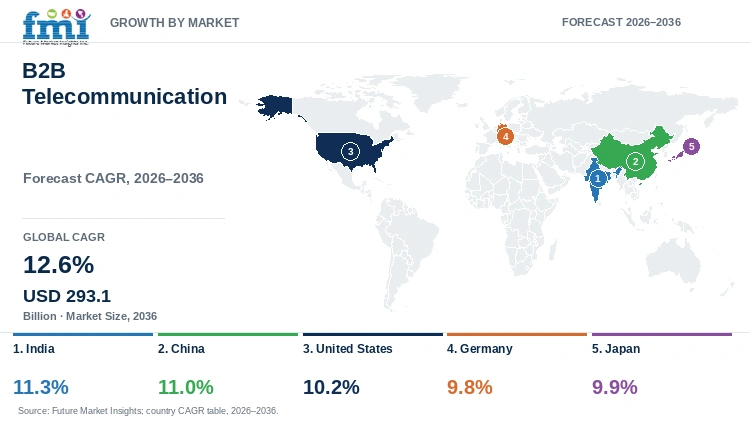
| India | 11.3% | 2026 to 2036 |
| China | 11.0% | 2026 to 2036 |
| United States | 10.2% | 2026 to 2036 |
| Germany | 9.8% | 2026 to 2036 |
| Japan | 9.9% | 2026 to 2036 |
Country-wise Analysis
India B2B Telecommunication Market Outlook (2026 to 2036)
Indian enterprises expanding across sites and adopting cloud applications need connectivity that can support a broader operating network, including offices, service locations and industrial facilities. A buyer may combine fixed and mobile access with managed network functions, making the relationship between individual connections and the service delivered across the business important to purchasing. [3] The market is projected at 11.3% CAGR from 2026 to 2036. For an industrial location, a private network presents a more specific requirement involving the devices, coverage and applications within the site. [1][2][4] Operators can therefore compete through a service suited to the enterprise's actual locations and workloads, with installation and ongoing support influencing whether a network addition can be used effectively as the organization grows.
China B2B Telecommunication Market Outlook (2026 to 2036)
China's manufacturing and logistics networks create a demand setting in which enterprise connectivity can extend from business offices into production and material movement. A site using connected equipment has different coverage and control requirements from a branch that mainly accesses cloud applications, giving private-network architecture and managed wide-area services separate roles. [1][3][4] Forecast demand expands at 11.0% CAGR from 2026 to 2036. An enterprise buyer can examine the traffic and devices that need to remain within a facility alongside the information shared with other locations or cloud services. This makes the network design relevant to the physical operation it supports, with operators needing to connect the proposed service to coverage, device access and the ongoing work of maintaining availability. [2]
United States B2B Telecommunication Market Outlook (2026 to 2036)
US enterprises can choose managed wide-area services and onsite wireless offerings from established operators, giving buyers different ways to address branch connectivity and facility-specific requirements. AT&T documents managed SD-WAN with centralized visibility, while Verizon's onsite portfolio combines private 5G, neutral-host networks and edge options. [3][4] The US outlook projects 10.2% CAGR from 2026 to 2036. Those services address different operating problems, so a multisite organization needs to distinguish the connection between locations from coverage and device access inside a particular facility. [1][2] Purchasing can consequently follow the applications and physical environment involved, with service support and the ability to assess network conditions important when a disruption affects employees, customers or production activity.
Germany B2B Telecommunication Market Outlook (2026 to 2036)
German industrial buyers have a practical reason to examine connectivity at the level of the factory, warehouse or engineering site, where equipment movement and application requirements can differ from ordinary office communication. Private-network architectures allow the design to follow a defined enterprise use, while a managed wide-area service connects the site with the rest of the organization. [1][2][3][4] Demand is projected at 9.8% CAGR from 2026 to 2036. The commercial assessment therefore includes the devices involved, coverage across the premises and the support required to maintain the service, with the chosen arrangement fitting the actual production or logistics task. This gives operators a role in translating a network design into a service the enterprise can use and monitor throughout its operating day.
Japan B2B Telecommunication Market Outlook (2026 to 2036)
Japan's enterprise demand combines established business communications with the requirements of connected industrial operations, making continuity during network changes an important purchasing consideration. A company moving an application or adding devices needs to understand how the new service will work with the sites and systems already in use. Managed SD-WAN can support a distributed network, while onsite wireless services address a more localized coverage and device requirement. [3][4] The forecast anticipates 9.9% CAGR from 2026 to 2036. Buyers can consequently compare the proposed architecture against the actual application and physical environment, with the operator's continuing service role relevant after deployment. The value of an upgrade follows the connection it provides between people, equipment and business processes across the enterprise. [1][2]
Who are the notable companies in the B2B Telecommunication Market?
AT&T; Verizon; China Mobile; BT Group; Orange Business
AT&T and Verizon illustrate managed wide-area and onsite network offerings, while China Mobile, BT and Orange Business add established enterprise connectivity portfolios. [3][4] These operators can serve different geographic and operating requirements, so buyers need to compare the actual locations, applications and service responsibilities within a proposal. A connection's capacity remains relevant, but the commercial assessment also includes deployment, network visibility and the support available when an issue affects the enterprise's normal operations.
Competitive Benchmarking: B2B Telecommunication Market
Table 7: Competitive positioning for the b2b telecommunication market
| Company | Positioning | Commercial distinction |
|---|---|---|
| AT&T | Managed enterprise connectivity | Managed SD-WAN connects sites with centralized visibility and continuing service support. [3] |
| Verizon | Enterprise networks and onsite wireless | On Site 5G and Edge includes private 5G and neutral-host options for enterprise premises. [4] |
| China Mobile | Enterprise telecommunications | Supplies business connectivity and related enterprise network services. |
| BT Group | Business network and communications services | Provides enterprise connectivity and managed communications offerings. |
| Orange Business | Enterprise network and digital services | Supplies business connectivity and associated managed enterprise services. |
Key Developments in the B2B Telecommunication Market
- AT&T currently combines managed SD-WAN with centralized visibility and multiple technology-partner options, giving enterprise buyers different configurations for distributed network requirements. [3]
- Verizon presents On Site 5G and Edge as a portfolio including private 5G and neutral-host networks, bringing several facility-specific connectivity options into one commercial offering. [4]
- GSMA’s private 5G whitepaper examines how mobile operators participate in enterprise-specific networks, including arrangements that relate private deployments to public infrastructure. [2]
Key Players in the B2B Telecommunication Market
Managed enterprise connectivity
- AT&T
Enterprise networks and onsite wireless
- Verizon
Enterprise telecommunications
- China Mobile
Business network and communications services
- BT Group
Enterprise network and digital services
- Orange Business
B2B Telecommunication Market - Report Scope
Table 8: Report Scope for B2B Telecommunication Market, 2026 to 2036
| Coverage field | Report scope |
|---|---|
| Market | B2B Telecommunication Market |
| Currency and unit | USD billion; market revenue |
| Historical reference year | 2025 |
| Base year | 2026 |
| Forecast period | 2026 to 2036 |
| Segmentation | Solution, End User, Vertical |
| Country profiles | India; China; United States; Germany; Japan |
| Competitive coverage | AT&T; Verizon; China Mobile; BT Group; Orange Business |
| Geographic coverage | North America; Latin America; Western Europe; Eastern Europe; East Asia; South Asia and Pacific; Middle East & Africa |
B2B Telecommunication Market - Research Methodology
Table 9: Research Methodology for B2B Telecommunication Market, 2026 edition
| Method | Approach |
|---|---|
| Market definition | The market covers enterprise telecommunications, managed connectivity and associated communication services, excluding consumer subscriptions, unrelated IT hardware and wholesale carrier interconnect revenue. |
| Desk research | Published FMI market data, official institutional material and direct manufacturer documentation form the research base. |
| Segment assessment | Solutions, enterprise end users and verticals are assessed independently, with published solution and customer shares kept distinct from provider company-share ranges. |
| Country assessment | Country profiles examine the local care, purchasing or operating conditions relevant to demand, with growth periods aligned to 2026–2036. |
| Competitive comparison | Documented offerings and commercial roles support comparison of the named companies, without assigning unsupported performance ratings. |
| Forecast assessment | Historical reference values, forecast endpoints and growth expectations are assessed consistently within the stated currency, units and market boundary. |
B2B Telecommunication Market by Segments
B2B Telecommunication Market segmented by Solution:
- Unified Communication and Collaboration
- VoIP
- WAN
- Cloud Services
- M2M Communication
B2B Telecommunication Market segmented by End User:
- Small and Medium Enterprises
- Large Enterprises
B2B Telecommunication Market segmented by Vertical:
- BFSI
- Healthcare
- Media and Entertainment
- Government
- Energy and Utility
- Retail
- Transportation and Logistics
- Others
B2B Telecommunication Market by Region
- North America
- United States
- Canada
- Latin America
- Brazil
- Mexico
- Argentina
- Chile
- Western Europe
- Germany
- France
- United Kingdom
- Italy
- Spain
- Benelux
- Nordics
- Eastern Europe
- Poland
- Czech Republic
- Romania
- Hungary
- East Asia
- China
- Japan
- South Korea
- South Asia and Pacific
- India
- ASEAN
- Australia and New Zealand
- Middle East and Africa
- GCC Countries
- South Africa
- Türkiye
- Israel
Research Sources and Bibliography
- [1] International Telecommunication Union. Accessed 15 October 2026. IMT applications and non-public networks: Report M.2527
- [2] GSMA. Accessed 15 October 2026. Exploring private 5G networks through the lens of MNOs
- [3] AT&T Business. Accessed 15 October 2026. Managed SD-WAN
- [4] Verizon Business. Accessed 15 October 2026. On Site 5G and Edge
This Report Answers
- How big is the b2b telecommunication market in 2026?
- What is the outlook for the b2b telecommunication market through 2036?
- Which solution category is profiled?
- Which countries are included in the growth comparison?
- Which companies are profiled?
Frequently Asked Questions
How big is the b2b telecommunication market in 2026?
The market is estimated at USD 89.23 billion in 2026, compared with USD 79.23 billion in 2025.
What is the outlook for the b2b telecommunication market through 2036?
Demand is projected to reach USD 293.05 billion by 2036, with 12.6% CAGR from 2026 to 2036.
Which solution category is profiled?
The Unified Communication and Collaboration segment is projected to hold 38.0% of solution demand in 2026.
Which countries are included in the growth comparison?
The comparison covers India, China, United States, Germany, Japan, with country or regional-market CAGRs for 2026–2036.
Which companies are profiled?
The report profiles AT&T, Verizon, China Mobile, BT Group, Orange Business and compares their relevant products or services.
Preview the report firsthand - request a free sample
Get SampleGet the brochure for pricing and purchase details.
Get PDFTable of Content
- Key Takeaways
- Market Size and CAGR
- Top Growth Driver
- Fastest Growing Segment
- Leading Region
- Key Companies
- Emerging Opportunities
- Executive Summary
- Global Market Outlook
- Demand-side Trends
- Supply-side Trends
- Technology Roadmap Analysis
- Analysis and Recommendations
- Analyst Perspective (What is happening? Why now? What should investors know?)
- Key Questions Answered
- How large is the market?
- What is the CAGR?
- What are key trends?
- Which region dominates?
- Who are the leaders?
- Market Overview
- Market Coverage / Taxonomy
- Market Definition / Scope / Limitations
- Research Methodology
- Chapter Orientation
- Analytical Lens and Working Hypotheses
- Market Structure, Signals, and Trend Drivers
- Benchmarking and Cross-market Comparability
- Market Sizing, Forecasting, and Opportunity Mapping
- Research Design and Evidence Framework
- Desk Research Programme (Secondary Evidence)
- Expert Input and Fieldwork (Primary Evidence)
- Tooling, Models, and Reference Databases
- Data Engineering and Model Build
- Quality Assurance and Audit Trail
- Market Background
- Market Dynamics (Drivers, Restraints, Opportunity, Trends)
- Scenario Forecast (Optimistic, Likely, Conservative)
- Impact Analysis
- AI Impact
- Sustainability Impact
- Regulatory Impact
- Technology Impact
- Consumer / Buyer Analysis
- Purchase Drivers
- Adoption Barriers
- Buyer Journey
- Opportunity Map Analysis
- Product Life Cycle Analysis
- Supply Chain Analysis
- Investment Feasibility Matrix
- Value Chain Analysis
- PESTLE and Porter's Analysis
- Regulatory Landscape
- Regional Parent Market Outlook
- Production and Consumption Statistics
- Import and Export Statistics
- Global Market Analysis and Forecast, 2021 to 2036
- Historical Market Size Value (USD Billion) Analysis, 2021 to 2025
- Current and Future Market Size Value (USD Billion) Projections, 2026 to 2036
- Y-o-Y Growth Trend Analysis
- Absolute $ Opportunity Analysis
- Global Market Pricing Analysis, 2021 to 2036
- Global Market Analysis and Forecast, By Solution, 2021 to 2036
- Introduction / Key Findings
- Historical Market Size Value (USD Billion) Analysis By Solution, 2021 to 2025
- Current and Future Market Size Value (USD Billion) Analysis and Forecast By Solution, 2026 to 2036
- Unified Communication and Collaboration
- VoIP
- WAN
- Cloud Services
- M2M Communication
- Y-o-Y Growth Trend Analysis By Solution, 2021 to 2025
- Absolute $ Opportunity Analysis By Solution, 2026 to 2036
- Global Market Analysis and Forecast, By End User, 2021 to 2036
- Introduction / Key Findings
- Historical Market Size Value (USD Billion) Analysis By End User, 2021 to 2025
- Current and Future Market Size Value (USD Billion) Analysis and Forecast By End User, 2026 to 2036
- Small and Medium Enterprises
- Large Enterprises
- Y-o-Y Growth Trend Analysis By End User, 2021 to 2025
- Absolute $ Opportunity Analysis By End User, 2026 to 2036
- Global Market Analysis and Forecast, By Vertical, 2021 to 2036
- Introduction / Key Findings
- Historical Market Size Value (USD Billion) Analysis By Vertical, 2021 to 2025
- Current and Future Market Size Value (USD Billion) Analysis and Forecast By Vertical, 2026 to 2036
- BFSI
- Healthcare
- Media and Entertainment
- Government
- Energy and Utility
- Retail
- Transportation and Logistics
- Others
- Y-o-Y Growth Trend Analysis By Vertical, 2021 to 2025
- Absolute $ Opportunity Analysis By Vertical, 2026 to 2036
- Global Market Analysis and Forecast, By Region, 2021 to 2036
- Introduction
- Historical Market Size Value (USD Billion) Analysis By Region, 2021 to 2025
- Current Market Size Value (USD Billion) Analysis and Forecast By Region, 2026 to 2036
- North America
- Latin America
- Western Europe
- Eastern Europe
- East Asia
- South Asia and Pacific
- Middle East & Africa
- Market Attractiveness Analysis By Region
- North America Market Analysis and Forecast, By Country, 2021 to 2036
- Historical Market Size Value (USD Billion) Trend Analysis By Market Taxonomy, 2021 to 2025
- Market Size Value (USD Billion) Forecast By Market Taxonomy, 2026 to 2036
- By Country
- United States
- Canada
- Mexico
- By Solution
- By End User
- By Vertical
- By Country
- Market Attractiveness Analysis
- By Country
- By Solution
- By End User
- By Vertical
- Key Takeaways
- Latin America Market Analysis and Forecast, By Country
- Historical Market Size Value (USD Billion) Trend Analysis By Market Taxonomy, 2021 to 2025
- Market Size Value (USD Billion) Forecast By Market Taxonomy, 2026 to 2036
- By Country
- Brazil
- Chile
- Rest of Latin America
- By Solution
- By End User
- By Vertical
- By Country
- Market Attractiveness Analysis
- By Country
- By Solution
- By End User
- By Vertical
- Key Takeaways
- Western Europe Market Analysis and Forecast, By Country
- Historical Market Size Value (USD Billion) Trend Analysis By Market Taxonomy, 2021 to 2025
- Market Size Value (USD Billion) Forecast By Market Taxonomy, 2026 to 2036
- By Country
- Germany
- United Kingdom
- Italy
- Spain
- France
- Nordic
- BENELUX
- Rest of Western Europe
- By Solution
- By End User
- By Vertical
- By Country
- Market Attractiveness Analysis
- By Country
- By Solution
- By End User
- By Vertical
- Key Takeaways
- Eastern Europe Market Analysis and Forecast, By Country
- Historical Market Size Value (USD Billion) Trend Analysis By Market Taxonomy, 2021 to 2025
- Market Size Value (USD Billion) Forecast By Market Taxonomy, 2026 to 2036
- By Country
- Russia
- Poland
- Hungary
- Balkan & Baltic
- Rest of Eastern Europe
- By Solution
- By End User
- By Vertical
- By Country
- Market Attractiveness Analysis
- By Country
- By Solution
- By End User
- By Vertical
- Key Takeaways
- East Asia Market Analysis and Forecast, By Country
- Historical Market Size Value (USD Billion) Trend Analysis By Market Taxonomy, 2021 to 2025
- Market Size Value (USD Billion) Forecast By Market Taxonomy, 2026 to 2036
- By Country
- China
- Japan
- South Korea
- By Solution
- By End User
- By Vertical
- By Country
- Market Attractiveness Analysis
- By Country
- By Solution
- By End User
- By Vertical
- Key Takeaways
- South Asia and Pacific Market Analysis and Forecast, By Country
- Historical Market Size Value (USD Billion) Trend Analysis By Market Taxonomy, 2021 to 2025
- Market Size Value (USD Billion) Forecast By Market Taxonomy, 2026 to 2036
- By Country
- India
- ASEAN
- Australia & New Zealand
- Rest of South Asia and Pacific
- By Solution
- By End User
- By Vertical
- By Country
- Market Attractiveness Analysis
- By Country
- By Solution
- By End User
- By Vertical
- Key Takeaways
- Middle East & Africa Market Analysis and Forecast, By Country
- Historical Market Size Value (USD Billion) Trend Analysis By Market Taxonomy, 2021 to 2025
- Market Size Value (USD Billion) Forecast By Market Taxonomy, 2026 to 2036
- By Country
- Kingdom of Saudi Arabia
- Other GCC Countries
- Turkiye
- South Africa
- Other African Union
- Rest of Middle East & Africa
- By Solution
- By End User
- By Vertical
- By Country
- Market Attractiveness Analysis
- By Country
- By Solution
- By End User
- By Vertical
- Key Takeaways
- Key Countries Market Analysis
- United States
- Pricing Analysis
- Market Share Analysis, 2025
- By Solution
- By End User
- By Vertical
- Canada
- Pricing Analysis
- Market Share Analysis, 2025
- By Solution
- By End User
- By Vertical
- Mexico
- Pricing Analysis
- Market Share Analysis, 2025
- By Solution
- By End User
- By Vertical
- Brazil
- Pricing Analysis
- Market Share Analysis, 2025
- By Solution
- By End User
- By Vertical
- Chile
- Pricing Analysis
- Market Share Analysis, 2025
- By Solution
- By End User
- By Vertical
- Germany
- Pricing Analysis
- Market Share Analysis, 2025
- By Solution
- By End User
- By Vertical
- United Kingdom
- Pricing Analysis
- Market Share Analysis, 2025
- By Solution
- By End User
- By Vertical
- Italy
- Pricing Analysis
- Market Share Analysis, 2025
- By Solution
- By End User
- By Vertical
- Spain
- Pricing Analysis
- Market Share Analysis, 2025
- By Solution
- By End User
- By Vertical
- France
- Pricing Analysis
- Market Share Analysis, 2025
- By Solution
- By End User
- By Vertical
- India
- Pricing Analysis
- Market Share Analysis, 2025
- By Solution
- By End User
- By Vertical
- ASEAN
- Pricing Analysis
- Market Share Analysis, 2025
- By Solution
- By End User
- By Vertical
- Australia & New Zealand
- Pricing Analysis
- Market Share Analysis, 2025
- By Solution
- By End User
- By Vertical
- China
- Pricing Analysis
- Market Share Analysis, 2025
- By Solution
- By End User
- By Vertical
- Japan
- Pricing Analysis
- Market Share Analysis, 2025
- By Solution
- By End User
- By Vertical
- South Korea
- Pricing Analysis
- Market Share Analysis, 2025
- By Solution
- By End User
- By Vertical
- Russia
- Pricing Analysis
- Market Share Analysis, 2025
- By Solution
- By End User
- By Vertical
- Poland
- Pricing Analysis
- Market Share Analysis, 2025
- By Solution
- By End User
- By Vertical
- Hungary
- Pricing Analysis
- Market Share Analysis, 2025
- By Solution
- By End User
- By Vertical
- Kingdom of Saudi Arabia
- Pricing Analysis
- Market Share Analysis, 2025
- By Solution
- By End User
- By Vertical
- South Africa
- Pricing Analysis
- Market Share Analysis, 2025
- By Solution
- By End User
- By Vertical
- United States
- Market Structure Analysis
- Competition Dashboard
- Competition Benchmarking
- Market Share Analysis of Top Players
- By Regional
- By Solution
- By End User
- By Vertical
- Emerging Startups
- Innovation Benchmarking
- Competition Analysis
- Competition Deep Dive
- AT&T
- Overview
- Product Portfolio
- Profitability by Market Segments
- Sales Footprint
- Strategy Overview
- Marketing Strategy
- Product Strategy
- Channel Strategy
- Verizon
- China Mobile
- BT Group
- Orange Business
- AT&T
- Case Studies
- Success Stories
- Recent Developments
- Competition Deep Dive
- Assumptions & Acronyms Used


