

- Industry Size (2026)
- USD 2.34 Tr
- Forecast (2036)
- USD 4.35 Tr
- CAGR (2026 to 2036)
- 6.40%
Telecommunications Services Market Size, Market Forecast and Outlook By FMI
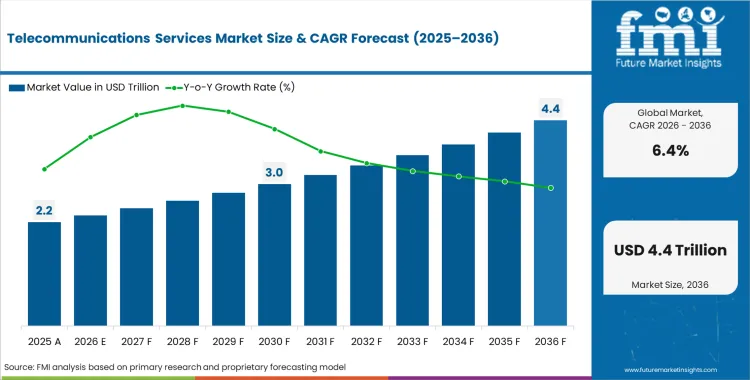
The telecommunications services market is expected to expand from USD 2.34 trillion in 2026 to USD 4.35 trillion by 2036. A 6.4% CAGR is anticipated during the forecast period as operators scale 5G core upgrades and managed broadband services. Banking Financial Services and Insurance is likely to lead with 22.3% share in 2026 as secure enterprise communication spending increases. Fixed-network services are projected to lead the service type segment as businesses and households require steadier broadband access.
Summary of the Telecommunications Services Market
- Demand and Growth Drivers
- Enterprise contracts are expected to favor 5G service guarantees as banks and manufacturers demand secure uptime.
- Broadband adoption is anticipated to rise as cloud work and video use raise data needs across enterprises.
- Government broadband programs are likely to expand access in underserved regions through fiber rollout and wireless coverage plans.
- Product and Segment View
- Banking Financial Services and Insurance is expected to lead end user demand as secure transactions require trusted connectivity.
- Healthcare is anticipated to increase service uptake as digital records and connected care tools require reliable networks.
- Fixed-network services are likely to gain preference as firms need stable bandwidth for cloud applications and remote work.
- Geography and Competitive Outlook
- India is expected to lead country-level expansion as affordable data plans and fiber backhaul deepen service use.
- China is anticipated to register strong adoption as 5G investment and enterprise network slicing increase operator revenue scope.
- Established operators are likely to protect share through 5G coverage and enterprise service bundles across mature telecom markets.
- Analyst Opinion
- Sudip saha, (Co-founder at Future Market Insights) suggests, “The telecommunications services market is likely to favor operators with stronger 5G execution and deeper enterprise connectivity portfolios. Banks and healthcare providers are expected to increase spending on secure service contracts as network performance expectations rise.”
- Telecommunications Services Market Value Analysis
- Telecommunications services are moving from basic connectivity sales toward enterprise contracts with clearer performance commitments.
- Demand is anticipated to rise as 5G core upgrades open higher-value managed network services for large enterprises.
- Fixed wireless access is expected to add revenue potential in areas with limited fiber economics.
- Operators with API monetization plans are likely to improve enterprise positioning across cloud and application developer channels.
Key Takeaways, Market Size, and Forecast
- The telecommunications services market is expected to reach USD 2.34 trillion in 2026 across licensed connectivity services.
- By 2036, the telecommunications services market is projected to reach USD 4.35 trillion through network modernization.
- From 2026 to 2036, the market is anticipated to expand at a 6.4% CAGR across global demand.
- Banking Financial Services and Insurance is likely to account for 22.3% share of the end user segment in 2026.
- Fixed-network services are anticipated to lead service type demand as enterprises prioritize resilient broadband and managed connectivity contracts.
- India is expected to record the fastest country-level expansion at 8.2% CAGR through 2036 within the global forecast.
Telecommunications Services Market Definition
The telecommunications services market encompasses the commercial provision of voice, data, video, and managed connectivity services to enterprise, government, and consumer end users via fixed-line, mobile, and satellite network infrastructure. The market includes revenues generated by licensed network operators and virtual network operators from subscription-based, usage-based, and managed-service contract structures across domestic and international network footprints.
Telecommunications Services Market Inclusions
The scope covers global and regional revenue from fixed-network services including DSL, cable, and fibre broadband; mobile telecom services spanning 4G LTE, 5G NR, and legacy 3G; enterprise managed connectivity services; and wholesale capacity arrangements between licensed carriers. Forecast includes revenues from network API monetisation, private 5G network contracts, and IoT connectivity platforms where delivered by licensed telecommunications operators.
Telecommunications Services Market Exclusions
The scope excludes over-the-top communication application revenues such as messaging platform subscriptions and video conferencing software licences, cloud infrastructure services provided by non-licensed entities, satellite direct-to-device consumer services operated outside traditional licensed spectrum frameworks, and downstream equipment hardware revenues reported separately from service subscriptions.
Telecommunications Services Market Research Methodology
Primary Research
Analysts engaged with procurement leads, technology officers, and operational specialists across the telecommunications services value chain to map adoption triggers, specification requirements, and contract structures that govern purchasing decisions.
Desk Research
Data collection phases aggregated regulatory filings, government programme announcements, company investor presentations, standards body publications, and trade association reports to establish the regulatory and commercial context framing demand.
Market-Sizing and Forecasting
Baseline values derive from a bottom-up aggregation of segment-level deployment volumes calibrated against publicly disclosed procurement data, applying region-specific adoption velocity curves to project forward demand trajectories through 2036.
Data Validation and Update Cycle
Projections are cross-validated against quarterly publicly reported revenue guidance from leading market participants and retested against regulatory calendar milestones that structurally alter adoption timelines within each geographic segment.
Semi-Annual Market Update
The below table presents the expected CAGR for the global Telecommunications Services market over several semi-annual periods spanning from 2026 to 2036. This assessment outlines changes in the memory interconnect industry and identify revenue trends, offering key decision makers an understanding about market performance throughout the year.
H1 represents first half of the year from January to June, H2 spans from July to December, which is the second half. In the first half (H1) of the year from 2026 to 2036, the business is predicted to surge at a CAGR of 5.8%, followed by a slightly higher growth rate of 6.5% in the second half (H2) of the same decade.
| Particular | Value CAGR |
|---|---|
| H1 | 5.8% (2026 to 2036) |
| H2 | 6.5% (2026 to 2036) |
| H1 | 5.6% (2026 to 2036) |
| H2 | 6.8% (2026 to 2036) |
Moving into the subsequent period, from H1 2025 to H2 2035, the CAGR is projected to increase slightly to 5.6% in the first half and remain higher at 6.8% in the second half. In the first half (H1) the market witnessed a decrease of 20 BPS and in the second half (H2), the market witnessed an increase of 30 BPS.
Key Industry Highlights
Rising demand for reliable broadband connections supports businesses and households in Fixed-Network Services
The increasing demand for reliable broadband connectivity is very critical for both businesses and households, as they are entirely dependent on fixed-network services. In the hyper-connected world, high-speed internet is a necessity and not a luxury when it comes to remote work, conducting online education, and doing digital commerce. Therefore, countries across the globe are focused on investment for energy resources into the expansion of broadband infrastructure.
For instance, USD 20.4 billion allocated by the USA Federal Communications Commission under the Rural Digital Opportunity Fund to expand broadband in underserved areas targeting 6 billion locations. The BharatNet project in India similarly works under the premise that the provision of broadband connectivity will touch nearly 250,000 village clusters and connect over 5.5 billion homes by 2025. The fast-tracking and the adoption of fixed-network services appropriates that the businesses and households seamlessly like high-speed internet access.
Proliferation of video streaming and cloud applications propels mobile data consumption
The usage of mobile data is continuously booming due to the wide-spread availability and access to streaming videos and applications on the cloud. With 63% of the world's video consumption are mobile users. Governments and telecom operators continuously upgrade their mobile networks to meet further increased mobile data traffic.
In 2023, China's Ministry of Industry and Information Technology (MIIT) reserved over USD 30 billion in infrastructure investment to build 5G in the country, with the result that data speeds have been enhanced by 40% for better seamless streaming. Cloud computing services also rely heavily on mobile data. Microsoft Azure announced a 70% increase in mobile access over the past two years.
Rising demand for secure communication in banking and healthcare for short message services
The need for secure communications is growing in areas such as banking and healthcare. SMS is increasingly being used for this purpose. SMS is an established medium through which two-factor authentication (2FA), transaction notices, and important healthcare notifications are sent. Security protocols have also been enforced by governments so that the data of consumers can be kept secure.
In Europe, customers are using SMS-based 2FA for a strong customer authentication and it is protected under the PSD2 regulation, which makes it mandatory. This is expected to reduce fraud cases by 15%-mostly in digital payments.
Similarly, the mission set up by the Indian government under Digital Health uses SMS for appointment and health status reminders and is expected to impact over 100 billion citizens by 2023. This verifies that the SMS continues to be one of the safest and most efficient communication means through which private materials can be secured.
Limited awareness in small and medium-sized enterprises about the benefits of Telecommunications Services
Building new towers and expanding existing ones, all of which require extensive capital investments in equipment and fiber-optic installations, are essentials for enabling advanced technologies such as 5G. The smaller telecom operators, especially working in less dense, and/or rural areas will face difficulties in availing funds for such large-scale projects.
Specialized equipment as well as more expensive technologies are required for transitioning from networks to new 5G networks, as smaller operators not be able to collect the financial means or capital necessary to compete with more established giants of the telecommunications market. It helps to creates a situation only the largest telecommunications companies will deploy 5G services while leaving the rest behind.
This will lead to difficulties for these smaller players in retention of a customer base who would prefer faster internet and better connectivity, thereby affecting their growth prospects in the long term.
2021 to 2025 Global Telecommunications Services Sales Outlook Compared to Demand Forecasts from 2026 to 2036
From the period 2021 to 2025, the global telecommunications services sales outlook will mark itself with a predictable growth trajectory due to the expansion of mobile networks, broadband services, and increasing demand for data. During this forecast period, the global telecommunications services market will realize an estimated growth rate CAGR 6.2%.
The global growth of this market will be contributed mainly by the migration to 5G, increased mobile data usage, and further reliance on cloud services. The worldwide telecom services revenue around USD 2,070.2 billion in 2025.
The demand predictions from 2026 to 2036 indicate a period with the highest growth rates, mainly prompted by the full rollout of 5G and the introduction of 6G technologies in the late 2021s. That will cause a further watershed in telecom services toward improved mobile broadband, IoT connectivity, and low-latency networks.
Demand for mobile data, especially driven by streaming, gaming, and IoT devices, is predicted to increase greatly. The global telecommunications market can expect a CAGR of 6.4% between the years 2025 and 2035, and possibly a total market revenue of USD 4,096.0 billion by 2035.
Market Concentration
Tier 1 vendor telecommunications services market globally reach more than 40 countries and also provide the entire range of voice, data, mobile, and broadband services for consumers. It includes some giant in the industry, which invest heavily into infrastructure and innovations and maintain several customers.
Tier 1 vendors include AT&T, Verizon Communications, Deutsche Telekom, Vodafone Group, China Mobile, Orange, Telefónica, and T-Mobile US. It caters around 45%-50% of the overall market. Their market power can be traced back to the multiplicity of nationwide and global services, including their own rollouts of a 5G network, large mobile data offerings, and broadband solutions.
Tier 2 typically operate in particular geographical areas or niche markets and provide services like mobile telecom, data transmission, as well as fixed network service. The vendors have a strong customer base in a specific area and therefore do not have an extensive worldwide presence such as in the case of Tier 1 vendors.
America Movil, BT Group, Telecom Italia, NTT, KT Corporation, and Softbank are some vendors of Tier 2 vendors. The companies account for around 15% - 20% of the global market share concerning the telecommunication services.
Companies with much lower sizes, operating in specific markets, and mostly found in providing niche mobile plans, fixed network services, or internet providers in small geographies. Tier 3 vendors generally tend to cover relatively limited geographic regions and provide economical alternatives to their customers.
Tier 3 vendors include Cogeco Communications, Wind Tre, and Telenor Group. The vendors cater around 25%-30% of the total market. It is focus relatively on small areas and meet local demands facing intense competition from Tier 1 and Tier 2 operators.
Country-wise InsightsÂ
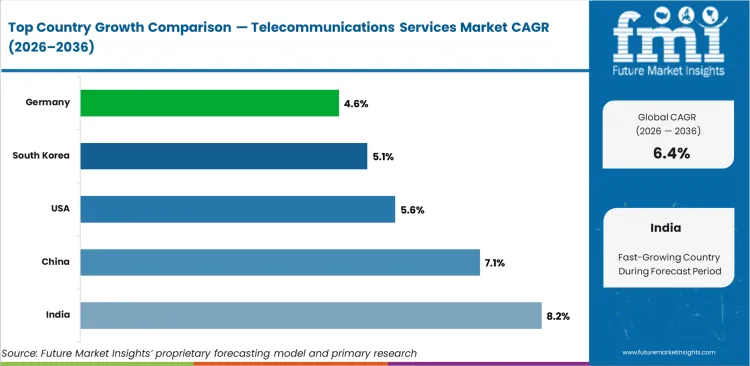
The section highlights the CAGRs of countries experiencing growth in the Telecommunications Services market, along with the latest advancements contributing to overall market development. Based on current estimates USA, India and China are expected to see steady growth during the forecast period.
.webp "Top Country Growth Comparison Telecommunications Services Market Cagr (2026 2036)")
| Countries | CAGR from 2026 to 2036 |
|---|---|
| India | 8.2% |
| China | 7.1% |
| Germany | 4.6% |
| South Korea | 5.1% |
| United States | 5.6% |
Demand for Data and Fax Transmission in the USA is fueled by the growing use of online services, telecommuting, and remote work
The demand for data and fax transmission in the US is stimulated by the growing dependence on online applications, telecommuting, and other workplace arrangements. More data is being consumed by US businesses and consumers due to the cloud applications and other forms of e-commerce, video conferencing, and digital communication.
Increasing dependence on reliable data and fax transmission throughout the United States has led to about 25% of the American workforce working from a location remote from the employer as of 2021, by the US-Bureau of Labor Statistics. Initiatives from the US government, such as the American Rescue Plan, have also promoted this trend-the plan allocated funds to support the improvement of broadband infrastructure in underserved areas, connecting more regions to fast reliable internet.
In 2023, the amount reported by the USA Federal Communications Commission (FCC) on investment toward improving broadband access was USD 50 billion. The advancement of 5G networks and the coming age of fiber-optic infrastructure are expected to benefit Data and Fax Transmission in the United States both in urban and remote areas.
As more firms move to a completely digital model, the need for safe and fast transmission services is expected to increase further, creating opportunities for telecom operators within the market. USA is anticipated to see substantial growth at a CAGR 5.6% from 2026 to 2036 in the Telecommunications Services market.
Rising adoption of Mobile Telephone Calls in India is supported by the demand for seamless communication in rural and urban areas
The widespread acceptance of mobile telephone calls in India will be attributed to the need for communication across borders in both rural and urban areas. The mobile user base in India is expected to cross the mark of 1.2 billion in 2023, with coverage and penetration values increasing across the country. It is the aggressive push for digital inclusion policy and Digital India program campaign by the Government to extend mobile infrastructure and services, particularly in the rural area.
By introducing very cheap mobile plans by major telecommunications operators Jio, Airtel, etc., the cost of mobile calls came down so much that it was affordable by a larger segment of the population. According to the Department of Telecommunications (DoT), India saw a 40% growth in mobile data usage in 2022 the direct outcome of increased mobile communication.
Many of them are already predicting 5G services in among the major cities by 2023, the delivery of quality Mobile Telephone Calls would surely enhance with speed and coverage. The technology advancement from 4G to 5G will provide a gateway to the telecom service providers in strengthening their infrastructure toward the provision of improved and highly reliable mobile services in a growing country with increased demands for mobile communication. India Telecommunications Services market is anticipated to expand from 119.3 Billion in 2025 to 262.4 Billion by 2035 and poised at a CAGR 8.2% during this period.
Mobile Telephone Calls offer growth potential with expanding 5G networks and IoT integration in China’s cities
China's mobile telephone calls has large growth potential as it predicts well with the trend of 5G networks mushrooming and the country adopting further IoT technologies in cities. China continues to lead in mobile subscriptions, with over 1.6 billion mobile connections, according to the China Ministry of Industry and Information Technology (MIIT) report 2023.
This progress in the rapidly rolled-out 5G infrastructure would be most beneficial for call quality, speed, and connectivity to the major cities of China, such as Beijing and Shanghai. According to the government, the number of 5G users in China reached 700 billion in 2023, and the government has crazy plans to increase this number. Moreover, IoT integration within China even more grows the demand for mobile services because of communication by more devices through mobile networks.
The government has thrown in its weight behind the spread of 5G by various funding and policy incentives: USD 9 billion worth of investment in 5G infrastructure. Mobile Telephone Calls are expected to increase both in volume, with 5G enabling superior communication services to consumers and businesses.
Convergence between mobile technology and IoT will also create new opportunities for telecom service providers in China. China is anticipated to see substantial growth from 2026 to 2036 at a CAGR 7.1% in Telecommunications Services market significantly holds dominant share of 56.9% in 2025.
Competition Outlook
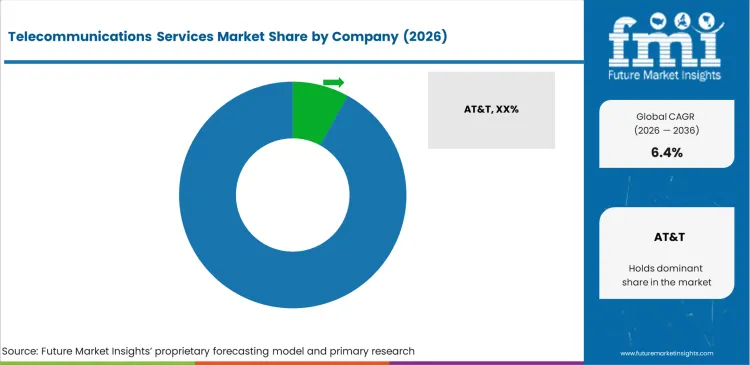
The competitive of the telecommunication service market is highly competitive that all the big players are very occupied in coming up with innovations to meet their customers' demand for speedy and secured connectivity. Their services include extending their mobile data and working on 5G expansion while incorporating advanced technologies such as IoT and cloud services.
The regional giants are collaborating with multinational telecommunication service providers to strengthen their positions in the market. The increased demand for digital transformation and connectivity services, the competition is expected to heat up as companies focus more on expanding their service portfolios and enhancing network infrastructure.
Industry Update
- In October 2025, Airtel Business had partnered with Vonage to launch an advanced business communications application. The collaboration helps to combine businesses enhanced voice, video, and messaging capabilities.
- In September 2025, Ericsson had partnered with telecom leaders to introduce unified network APIs help for enhancing the flexibility and interoperability of telecom networks. The collaboration helps to supports telecom operators in delivering more agile and efficient services to their customers.
- In March 2025, Tejas Networks had partnered with Telecom Egypt to enhance the country telecom infrastructure. The collaboration focuses on deploying advanced networking solutions and it will boost Telecom Egypt’s network capabilities.
Scope of the Report
| Metric | Value |
|---|---|
| Quantitative Units | USD 2.34 Trillion to USD 4.35 Trillion, at a CAGR of 6.4% |
| Market Definition | The telecommunications services market encompasses the commercial provision of voice, data, video, and managed connectivity services to enterprise, government, and consumer end users via fixed-line, m... |
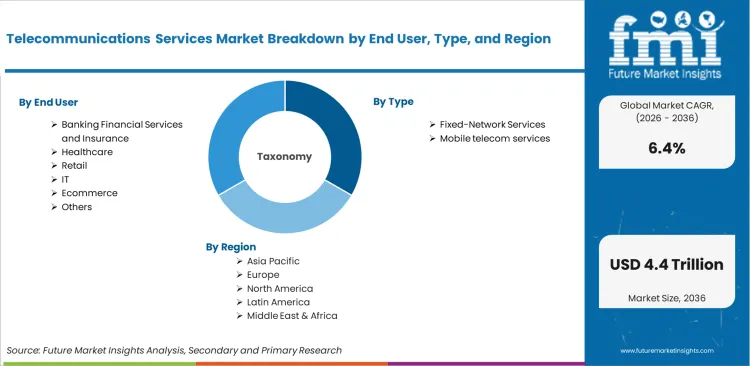
| End User Segmentation | Banking, Financial Services and Insurance, Healthcare, Retail, IT, Ecommerce, Others |
| Service Type Segmentation | Fixed-Network Services, Mobile Telecom Services |
| Regions Covered | North America, Latin America, Europe, East Asia, South Asia, Oceania, Middle East and Africa |
| Countries Covered | India, China, USA, Germany, France, UK, Japan, Brazil, and 40 plus countries |
| Key Companies Profiled | AT&T, Verizon Communications, China Mobile, Bharti Airtel, Vodafone Group, Telecom Egypt, T-Mobile, Orange S.A., Telefonica, Deutsche Telekom |
| Forecast Period | 2026 to 2036 |
| Approach | Bottom-up methodology applied to segment-level deployment data with cross-validation against publicly reported operator and manufacturer revenue disclosures |
Key Segmentation
By Type:
In terms of type, the segment is divided into Fixed-Network Services and Mobile telecom services.
By End User:
In terms of enterprise size, the segment is segregated into Banking, Financial Services, and Insurance (BFSI), Healthcare, Retail, IT, Ecommerce and Others.
By Region:
A regional analysis has been carried out in key countries of North America, Latin America, East Asia, South Asia & Pacific, Western Europe, Eastern Europe and Middle East and Africa (MEA).
Bibliography
- International Telecommunication Union. (2025, November). Measuring digital development: Facts and figures 2025. ITU. https://www.itu.int/en/ITU-D/Statistics/Pages/facts/default.aspx
- OECD. (2025, June). OECD communications outlook 2025. OECD Publishing. https://www.oecd.org/digital/ieconomy/communications-outlook.htm
- Federal Communications Commission. (2025, October). Fourteenth broadband deployment report. FCC. https://www.fcc.gov/reports-research/reports/broadband-progress-reports
- Bundesnetzagentur. (2025, August). Annual report 2025: Telecommunications market oversight. Federal Network Agency Germany. https://www.bundesnetzagentur.de
- Department of Telecommunications, Government of India. (2025, June). Annual report 2023-24: National telecommunications policy implementation. DoT India. https://dot.gov.in
- World Bank Group. (2025, September). Digital development partnership: Connectivity for all initiative update. World Bank. https://www.worldbank.org/en/topic/digitaldevelopment
This bibliography is provided for reader reference. The full Future Market Insights report contains the complete reference list with primary research documentation.
Frequently Asked Questions
How large is the demand for Telecommunications Services Market in the global market in 2026?
Demand for telecommunications services in the global market is estimated to be valued at USD 2.34 Trillion in 2026.
What will the Telecommunications Services Market size be by 2036?
The telecommunications services is projected to reach USD 4.35 Trillion by 2036.
What is the expected CAGR for the Telecommunications Services Market between 2026 and 2036?
Demand for telecommunications services is expected to grow at a CAGR of 6.4% between 2026 and 2036.
Which end user segment is poised to lead global sales in 2026?
Banking, Financial Services and Insurance accounts for 22.3% in 2026 as it commands the primary share of procurement across major end-use verticals.
Which country is projected to record the fastest growth in the Telecommunications Services Market?
India is projected to grow at 8.2% CAGR through 2036, supported by Jio-led 5G subscriber acquisition and Bharat Broadband Network expansion driving data ARPU uplift.
What is driving demand in China?
China demand is accelerating at 7.1% CAGR, driven by state enterprise 5G application layer deployments and cross-provincial fibre backbone upgrades.
Who are the key players profiled in the Telecommunications Services Market report?
Key companies profiled include AT&T, Verizon Communications, China Mobile, Bharti Airtel, Vodafone Group, and others detailed in the competitive landscape section.
What does FMI project as the incremental opportunity in the Telecommunications Services Market through 2036?
FMI analysts project an incremental market opportunity of USD 2.01 Trillion over the 2026 to 2036 forecast period.
Preview the report firsthand - request a free sample
Get SampleGet the brochure for pricing and purchase details.
Get PDFTable of Content
- Executive Summary
- Global Market Outlook
- Demand-side Trends
- Supply-side Trends
- Technology Roadmap Analysis
- Analysis and Recommendations
- Market Overview
- Market Coverage / Taxonomy
- Market Definition / Scope / Limitations
- Research Methodology
- Chapter Orientation
- Analytical Lens and Working Hypotheses
- Market Structure, Signals, and Trend Drivers
- Desk Research Programme (Secondary Evidence)
- Company Annual and Sustainability Reports
- Peer-reviewed Journals and Academic Literature
- Corporate Websites, Product Literature, and Technical Notes
- Earnings Decks and Investor Briefings
- Statutory Filings and Regulatory Disclosures
- Technical White Papers and Standards Notes
- Trade Journals, Industry Magazines, and Analyst Briefs
- Conference Proceedings, Webinars, and Seminar Materials
- Government Statistics Portals and Public Data Releases
- Press Releases and Reputable Media Coverage
- Specialist Newsletters and Curated Briefings
- Sector Databases and Reference Repositories
- FMI Internal Proprietary Databases and Historical Market Datasets
- Subscription Datasets and Paid Sources
- Social Channels, Communities, and Digital Listening Inputs
- Additional Desk Sources
- Expert Input and Fieldwork (Primary Evidence)
- Primary Modes
- Qualitative Interviews and Expert Elicitation
- Quantitative Surveys and Structured Data Capture
- Blended Approach
- Why Primary Evidence is Used
- Field Techniques
- Interviews
- Surveys
- Focus Groups
- Observational and In-context Research
- Social and Community Interactions
- Stakeholder Universe Engaged
- C-suite Leaders
- Board Members
- Presidents and Vice Presidents
- R&D and Innovation Heads
- Technical Specialists
- Domain Subject-matter Experts
- Scientists
- Physicians and Other Healthcare Professionals
- Governance, Ethics, and Data Stewardship
- Research Ethics
- Data Integrity and Handling
- Primary Modes
- Tooling, Models, and Reference Databases
- Data Engineering and Model Build
- Data Acquisition and Ingestion
- Cleaning, Normalisation, and Verification
- Synthesis, Triangulation, and Analysis
- Quality Assurance and Audit Trail
- Market Background
- Market Dynamics
- Drivers
- Restraints
- Opportunity
- Trends
- Scenario Forecast
- Demand in Optimistic Scenario
- Demand in Likely Scenario
- Demand in Conservative Scenario
- Opportunity Map Analysis
- Product Life Cycle Analysis
- Supply Chain Analysis
- Investment Feasibility Matrix
- Value Chain Analysis
- PESTLE and Porter’s Analysis
- Regulatory Landscape
- Regional Parent Market Outlook
- Production and Consumption Statistics
- Import and Export Statistics
- Market Dynamics
- Global Market Analysis 2021 to 2025 and Forecast, 2026 to 2036
- Historical Market Size Value (USD Trillion) Analysis, 2021 to 2025
- Current and Future Market Size Value (USD trillion) Projections, 2026 to 2036
- Y-o-Y Growth Trend Analysis
- Absolute $ Opportunity Analysis
- Global Market Pricing Analysis 2021 to 2025 and Forecast 2026 to 2036
- Global Market Analysis 2021 to 2025 and Forecast 2026 to 2036, By End User
- Introduction / Key Findings
- Historical Market Size Value (USD trillion) Analysis By End User , 2021 to 2025
- Current and Future Market Size Value (USD trillion) Analysis and Forecast By End User , 2026 to 2036
- Banking Financial Services and Insurance
- Healthcare
- Retail
- IT
- Ecommerce
- Others
- Banking Financial Services and Insurance
- Y-o-Y Growth Trend Analysis By End User , 2021 to 2025
- Absolute $ Opportunity Analysis By End User , 2026 to 2036
- Global Market Analysis 2021 to 2025 and Forecast 2026 to 2036, By Type
- Introduction / Key Findings
- Historical Market Size Value (USD trillion) Analysis By Type, 2021 to 2025
- Current and Future Market Size Value (USD trillion) Analysis and Forecast By Type, 2026 to 2036
- Fixed-Network Services
- Mobile telecom services
- Fixed-Network Services
- Y-o-Y Growth Trend Analysis By Type, 2021 to 2025
- Absolute $ Opportunity Analysis By Type, 2026 to 2036
- Global Market Analysis 2021 to 2025 and Forecast 2026 to 2036, By Region
- Introduction
- Historical Market Size Value (USD trillion) Analysis By Region, 2021 to 2025
- Current Market Size Value (USD trillion) Analysis and Forecast By Region, 2026 to 2036
- North America
- Latin America
- Western Europe
- Eastern Europe
- East Asia
- South Asia and Pacific
- Middle East & Africa
- Market Attractiveness Analysis By Region
- North America Market Analysis 2021 to 2025 and Forecast 2026 to 2036, By Country
- Historical Market Size Value (USD trillion) Trend Analysis By Market Taxonomy, 2021 to 2025
- Market Size Value (USD trillion) Forecast By Market Taxonomy, 2026 to 2036
- By Country
- USA
- Canada
- Mexico
- By End User
- By Type
- By Country
- Market Attractiveness Analysis
- By Country
- By End User
- By Type
- Key Takeaways
- Latin America Market Analysis 2021 to 2025 and Forecast 2026 to 2036, By Country
- Historical Market Size Value (USD trillion) Trend Analysis By Market Taxonomy, 2021 to 2025
- Market Size Value (USD trillion) Forecast By Market Taxonomy, 2026 to 2036
- By Country
- Brazil
- Chile
- Rest of Latin America
- By End User
- By Type
- By Country
- Market Attractiveness Analysis
- By Country
- By End User
- By Type
- Key Takeaways
- Western Europe Market Analysis 2021 to 2025 and Forecast 2026 to 2036, By Country
- Historical Market Size Value (USD trillion) Trend Analysis By Market Taxonomy, 2021 to 2025
- Market Size Value (USD trillion) Forecast By Market Taxonomy, 2026 to 2036
- By Country
- Germany
- UK
- Italy
- Spain
- France
- Nordic
- BENELUX
- Rest of Western Europe
- By End User
- By Type
- By Country
- Market Attractiveness Analysis
- By Country
- By End User
- By Type
- Key Takeaways
- Eastern Europe Market Analysis 2021 to 2025 and Forecast 2026 to 2036, By Country
- Historical Market Size Value (USD trillion) Trend Analysis By Market Taxonomy, 2021 to 2025
- Market Size Value (USD trillion) Forecast By Market Taxonomy, 2026 to 2036
- By Country
- Russia
- Poland
- Hungary
- Balkan & Baltic
- Rest of Eastern Europe
- By End User
- By Type
- By Country
- Market Attractiveness Analysis
- By Country
- By End User
- By Type
- Key Takeaways
- East Asia Market Analysis 2021 to 2025 and Forecast 2026 to 2036, By Country
- Historical Market Size Value (USD trillion) Trend Analysis By Market Taxonomy, 2021 to 2025
- Market Size Value (USD trillion) Forecast By Market Taxonomy, 2026 to 2036
- By Country
- China
- Japan
- South Korea
- By End User
- By Type
- By Country
- Market Attractiveness Analysis
- By Country
- By End User
- By Type
- Key Takeaways
- South Asia and Pacific Market Analysis 2021 to 2025 and Forecast 2026 to 2036, By Country
- Historical Market Size Value (USD trillion) Trend Analysis By Market Taxonomy, 2021 to 2025
- Market Size Value (USD trillion) Forecast By Market Taxonomy, 2026 to 2036
- By Country
- India
- ASEAN
- Australia & New Zealand
- Rest of South Asia and Pacific
- By End User
- By Type
- By Country
- Market Attractiveness Analysis
- By Country
- By End User
- By Type
- Key Takeaways
- Middle East & Africa Market Analysis 2021 to 2025 and Forecast 2026 to 2036, By Country
- Historical Market Size Value (USD trillion) Trend Analysis By Market Taxonomy, 2021 to 2025
- Market Size Value (USD trillion) Forecast By Market Taxonomy, 2026 to 2036
- By Country
- Kingdom of Saudi Arabia
- Other GCC Countries
- Turkiye
- South Africa
- Other African Union
- Rest of Middle East & Africa
- By End User
- By Type
- By Country
- Market Attractiveness Analysis
- By Country
- By End User
- By Type
- Key Takeaways
- Key Countries Market Analysis
- USA
- Pricing Analysis
- Market Share Analysis, 2025
- By End User
- By Type
- Canada
- Pricing Analysis
- Market Share Analysis, 2025
- By End User
- By Type
- Mexico
- Pricing Analysis
- Market Share Analysis, 2025
- By End User
- By Type
- Brazil
- Pricing Analysis
- Market Share Analysis, 2025
- By End User
- By Type
- Chile
- Pricing Analysis
- Market Share Analysis, 2025
- By End User
- By Type
- Germany
- Pricing Analysis
- Market Share Analysis, 2025
- By End User
- By Type
- UK
- Pricing Analysis
- Market Share Analysis, 2025
- By End User
- By Type
- Italy
- Pricing Analysis
- Market Share Analysis, 2025
- By End User
- By Type
- Spain
- Pricing Analysis
- Market Share Analysis, 2025
- By End User
- By Type
- France
- Pricing Analysis
- Market Share Analysis, 2025
- By End User
- By Type
- India
- Pricing Analysis
- Market Share Analysis, 2025
- By End User
- By Type
- ASEAN
- Pricing Analysis
- Market Share Analysis, 2025
- By End User
- By Type
- Australia & New Zealand
- Pricing Analysis
- Market Share Analysis, 2025
- By End User
- By Type
- China
- Pricing Analysis
- Market Share Analysis, 2025
- By End User
- By Type
- Japan
- Pricing Analysis
- Market Share Analysis, 2025
- By End User
- By Type
- South Korea
- Pricing Analysis
- Market Share Analysis, 2025
- By End User
- By Type
- Russia
- Pricing Analysis
- Market Share Analysis, 2025
- By End User
- By Type
- Poland
- Pricing Analysis
- Market Share Analysis, 2025
- By End User
- By Type
- Hungary
- Pricing Analysis
- Market Share Analysis, 2025
- By End User
- By Type
- Kingdom of Saudi Arabia
- Pricing Analysis
- Market Share Analysis, 2025
- By End User
- By Type
- Turkiye
- Pricing Analysis
- Market Share Analysis, 2025
- By End User
- By Type
- South Africa
- Pricing Analysis
- Market Share Analysis, 2025
- By End User
- By Type
- USA
- Market Structure Analysis
- Competition Dashboard
- Competition Benchmarking
- Market Share Analysis of Top Players
- By Regional
- By End User
- By Type
- Competition Analysis
- Competition Deep Dive
- AT&T
- Overview
- Product Portfolio
- Profitability by Market Segments (Product/Age /Sales Channel/Region)
- Sales Footprint
- Strategy Overview
- Marketing Strategy
- Product Strategy
- Channel Strategy
- Verizon Communications
- China Mobile
- Bharti Airtel
- Vodafone Group
- Telecom Egypt
- T-Mobile
- Orange S.A.
- Telefonica
- Deutsche Telekom
- AT&T
- Competition Deep Dive
- Assumptions & Acronyms Used


