

- Industry Size (2026)
- USD 849.7 Mn
- Forecast (2036)
- USD 1428.2 Mn
- CAGR (2026 to 2036)
- 5.4%
Smoke Ingredients for Food Market Size, Market Forecast and Outlook By FMI
In 2025, the smoke ingredients for food market surpassed a value of USD 806.2 million. Based on Future Market Insights’ analysis, demand is estimated to grow to USD 849.7 million in 2026 and USD 1,428.2 million by 2036. FMI projects a CAGR of 5.4% over the forecast period.
Regulatory compliance gates trigger immediate retrofit capex across the global food processing sector. Food conglomerates must swap legacy inputs for compliant alternatives within narrow windows, particularly as authorities impose strict phase-outs for eight major smoke flavourings. According to FMI's estimates, this urgency forces ingredient developers to launch comprehensive replacement collections containing advanced powders and liquids to capture fleeing customers.
As Professor Dave Baines, Director of Innovation (Executive Leadership), cautioned regarding imminent regulatory shifts, “Smoke flavourings will be gone completely from dairy, meat and fish by 2029. But they will be banned in seasonings and sauces even earlier, by July 2026, which is less than two years away, leaving little time for companies to reformulate products.” [9]
Summary of Smoke Ingredients for Food Market
- Smoke Ingredients for Food Market Definition
- The sector covers commercial aromatics designed to replicate traditional wood-smoking profiles in mass-produced foodstuff.
- Demand Drivers in the Market
- European legislative changes accelerate the adoption of alternative compliant formulations.
- Large-scale Asian protein processing demands standardized flavor consistency.
- Snack producers transition toward clean-label surface applications.
- Key Segments Analyzed in the FMI Report
- Meat and seafood application dominates global volume consumption.
- Liquid formats secure primary share due to superior industrial pumpability.
- Asian economies lead global growth metrics.
- Analyst Opinion at FMI
- Nandini Roy Choudhury, Principal Consultant for Food and Beverage, opines, "Mandatory phase-outs of traditional smoking agents force entire supply chains into rapid reformulation, demanding unprecedented agility from flavor houses."
- Strategic Implications/Executive Takeaways
- Transition portfolios toward approved condensed extracts immediately.
- Prioritize fluid formats for superior industrial blending.
- Expand application testing to ensure flavor stability in high-moisture proteins.
- Methodology
- Validated through first-hand corporate production and capacity data.
- Zero reliance on speculative third-party market research reports.
- Based on verifiable industrial benchmarks and verified sources.
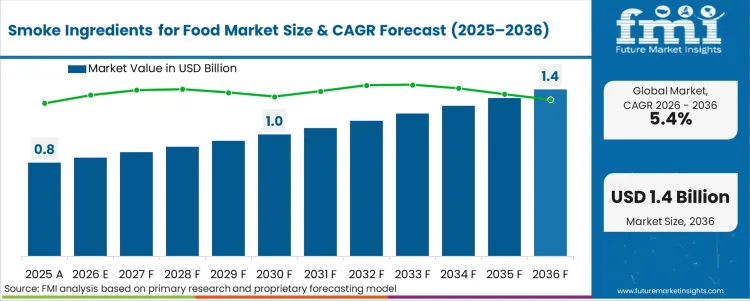
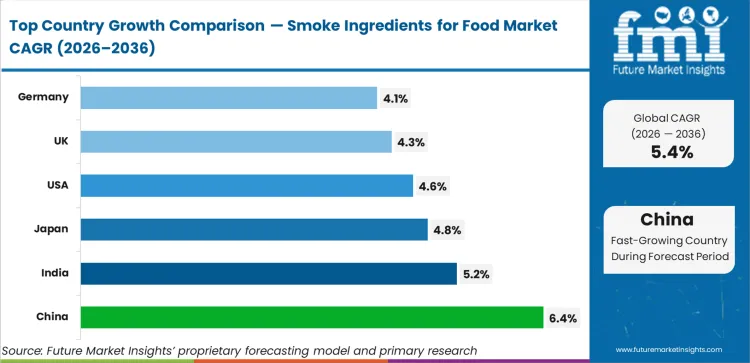
Country-level projections highlight varied regional adoption speeds. China tracks a 6.4% CAGR, trailed by India at 5.2% and Japan at 4.8%. Western economies showcase steady replacement-driven expansion, with the USA registering 4.6%, the UK at 4.3%, and Germany at 4.1%.
Smoke Ingredients for Food Market Key Takeaways
| Metric | Value |
|---|---|
| Industry Size (2026) | USD 849.7 Million |
| Industry Value (2036) | USD 1,428.2 Million |
| CAGR (2026–2036) | 5.4% |
Smoke Ingredients for Food Market Definition
The sector encompasses the commercial production of condensed smoke, liquid extracts, and related aromatic agents used to impart smoked characteristics to foodstuff. Food scientists rely on these pumpable solutions for precise dosage control during high-speed extrusion processes. Advanced processing isolates volatile aromatics, eliminating targeted hazardous compounds while preserving distinct barbecue notes. Formulations replace traditional wood-burning methods to ensure consistent flavor delivery and strict hygiene control.
Smoke Ingredients for Food Market Inclusions
Scope incorporates fluid preparations, soluble powders, and atomized condensates utilized primarily in commercial meat, poultry, and snack processing. The analysis spans global consumption, trade flows, and substitution trends resulting from evolving food safety frameworks. Fluid dispersions offer superior homogenous mixing within large-scale meat vats compared to dry powders.
Smoke Ingredients for Food Market Exclusions
The assessment omits raw wood chips, direct combustion equipment, and downstream finished goods like packaged bacon or retail barbeque sauces. Non-food industrial applications and artisanal small-scale processing remain outside analytical boundaries. The assessment excludes generic savory enhancers lacking specific wood-smoke volatile signatures.
Smoke Ingredients for Food Market Research Methodology
- Primary Research: Direct interviews with flavor scientists and regulatory compliance officers provided baseline substitution timelines and compliance barriers.
- Desk Research: Output data from national agricultural bodies supported volume benchmarking across distinct protein categories.
- Market-Sizing and Forecasting: Bottom-up revenue modeling validated against plant-level capacities confirmed localized production capabilities.
- Data Validation and Update Cycle: Outputs undergo anomaly screening and peer review prior to final release, ensuring precise geographic tracking.
Segmental Analysis
Smoke Ingredients for Food Market Analysis by Application
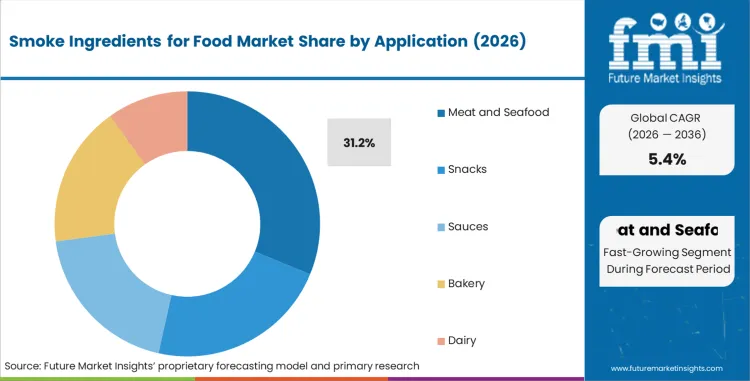
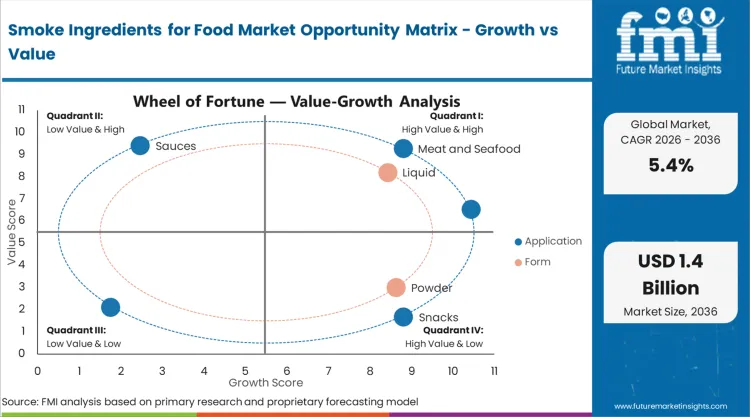
Meat and seafood processing consumes massive volumes of flavoring inputs, securing 31.2% share in 2026. Processors face intense pressure to deliver classic taste profiles while navigating strict new compound restrictions across their global operations. As per FMI's projection, continuous industrial lines require standardized liquid extracts to prevent the batch variations common with direct wood combustion. Rapid urbanization fuels massive demand for convenience proteins requiring extended shelf stability.
- Procurement trigger: Regulatory bodies phasing out major smoke flavorings forces meat processors to source compliant alternatives rapidly to avoid retail delisting.
- Technology shift: Flavor houses introduced primary-smoke-free solutions specifically engineered to meet updated European mandates ahead of stringent enforcement.
- Supply-side move: Leading ingredient developers launched comprehensive replacement collections containing advanced powders and liquids to capture market share. Manufacturers integrate these novel taste systems to protect their lucrative shelf-stable product lines from regulatory seizure.
Smoke Ingredients for Food Market Analysis by Form
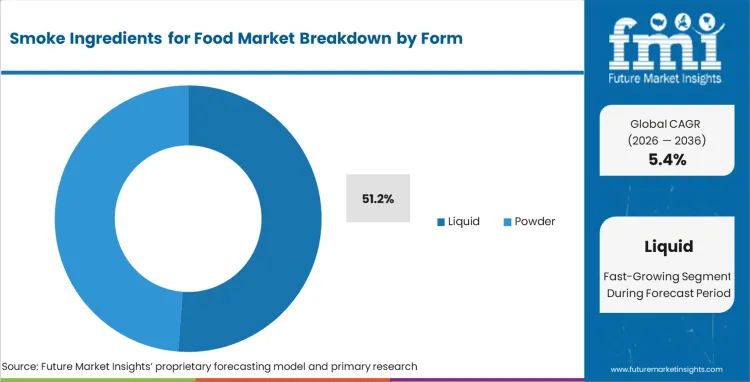
Liquid formats dominate global consumption, capturing 51.2% share in 2026. Fluid dispersions offer superior homogenous mixing within large-scale meat vats compared to dry powders, eliminating clumping issues during processing. Food scientists rely on liquid smoke for precise dosage control during high-speed extrusion processes. FMI analysts opine that the transition toward spray-drenching technologies further cements fluid supremacy across modern processing facilities.
- Buyer priority: Plant managers require easily pumpable inputs to maximize automation efficiency and reduce labor overhead. Fluid formulations prevent clogging within automated injection arrays, keeping continuous meat production lines operating efficiently without costly downtime.
- Regulatory signal: Ingredient companies explicitly position newly formulated smoked condensates as direct answers to recent European bans. Compliance officers approve fluid replacements quickly because integration requires minimal capital expenditure on new mixing hardware.
- Procurement trigger: Mass-market seafood producers buy standardized fluid condensates to achieve identical flavor profiles across millions of canned units. Predictable raw material behavior ensures brands maintain consumer trust despite underlying recipe modifications forced by updated regulations.
Smoke Ingredients for Food Market Drivers, Restraints, and Opportunities
Legislative action represents a massive catalyst reshaping global ingredient procurement. European authorities finalized decisions to phase out several widespread smoke flavorings, triggering global recipe overhauls. Flavor houses respond by launching specialized portfolios, such as the 15 smoke-style flavours introduced by I.T.S to address these very bans, aiming to capture fleeing customers. [8] According to FMI's estimates, suppliers possessing legally sound taste systems capture immense short-term revenue as desperate food manufacturers scramble for viable replacements.
Reformulation physics act as a primary growth restraint across the industry. Swapping legacy flavoring compounds for novel smoke-free solutions often alters product texture, moisture retention, and shelf stability. Food scientists struggle to replicate exact consumer-preferred taste profiles using entirely new chemical foundations. FMI analysts opine that phased rollout strategies allow brands to test modified recipes regionally before committing to total global portfolio conversions. Manufacturers mitigate integration friction by partnering directly with specialized specialty food ingredients developers to co-create custom blends tailored to specific protein matrices.
- Formulation Innovation: Flavour houses develop comprehensive smoke-free replacement collections to directly address urgent compliance needs. Food manufacturers utilize these new toolkits to secure ongoing market access for legacy smoked meat lines.
- Application Diversification: Snack brands integrate compliant powdered alternatives into surface seasonings to capture rising consumer interest in barbeque profiles. Ingredient suppliers unlock entirely new revenue streams outside traditional protein processing categories by leveraging advanced grill type flavors.
- Geographic Expansion: Asian meat producers adopt standardized fluid condensates to elevate export quality and maintain flavor consistency. Predictable performance enables regional processors to access highly regulated Western retail channels without triggering import violations.
Regional Analysis
.webp "Top Country Growth Comparison Smoke Ingredients For Food Market Cagr (2026 2036)")
Based on the regional analysis, the Smoke Ingredients for Food market is segmented into North America, Latin America, Europe, East Asia, South Asia, Oceania and Middle East & Africa across 40+ countries. The full report also offers market attractiveness analysis based on regional trends.
| Country | CAGR (2026 to 2036) |
|---|---|
| China | 6.4% |
| India | 5.2% |
| Japan | 4.8% |
| USA | 4.6% |
| UK | 4.3% |
| Germany | 4.1% |
Source: Future Market Insights (FMI) analysis, based on proprietary forecasting model and primary research
East Asia Smoke Ingredients for Food Market Analysis
East Asia exhibits massive volume expansion driven by rapidly modernizing food processing sectors. Chinese manufacturers increasingly abandon traditional wood-burning methods to adopt consistent, hygienic fluid extracts for vast snack and meat output. Japanese processors leverage delicate smoke notes to add premium cues to extensive seafood product lines without sacrificing efficiency. Regional flavor houses actively expand local production capabilities to serve surging domestic consumption and mitigate supply chain delays.
- China: Growth tracks a CAGR of 6.4% as industrial meat producers standardize flavor profiles across massive regional facilities. This trajectory is supported by the adoption of sophisticated savory ingredients to meet evolving food safety expectations, pushing local brands away from uncontrolled wood combustion.
- Japan: A CAGR of 4.8% reflects continuous innovation within convenience seafood and ready-to-eat categories as processors seek efficiency. This expansion is directly anchored to massive local demand, reflected in Japan's fishery products imports reaching 2.16 million tons in 2024. [4]
FMI’s report includes a detailed analysis of the growth in the East Asia region, along with a country-wise assessment that includes South Korea and Taiwan. These opportunistic countries present highly lucrative expansion targets for specialized flavor developers. Rising disposable incomes across these nations accelerate demand for premium processed meats, rewarding suppliers who offer distinct, clean-label aromatic solutions.
South Asia Smoke Ingredients for Food Market Analysis
South Asian demand accelerates rapidly as organized retail and quick-service restaurant chains penetrate urban centers. Domestic protein production scales up to meet both local consumption and lucrative export contracts. Cost-sensitive manufacturers favor highly concentrated fluid formats to maximize yield and margin. As per FMI's projection, stringent export requirements compel leading local processors to upgrade ingredient sourcing to international standards to avoid costly border rejections.
- India: Expansion at 5.2% CAGR is linked to booming organized meat processing and rising export volumes. This demand shift is reflected in India's total meat production scaling to 10.50 million tonnes in 2024-25, driving massive local requirements for standardized integrated food ingredients. [3]
FMI’s report includes a detailed analysis of the growth in the South Asia region, along with a country-wise assessment that includes Bangladesh and Sri Lanka. Maturing local snack industries in these nations seek cost-effective flavoring systems to differentiate packaged goods. These markets create new avenues for entry-level aromatic condensates that align with tighter regional processing budgets.
North America Smoke Ingredients for Food Market Analysis
North American consumption rests upon deeply entrenched cultural preferences for barbeque and smoked protein profiles. Massive commercial red meat sectors generate continuous baseline volume requirements that support the entire regional flavoring ecosystem. Processors increasingly seek clean-label alternatives to simplify ingredient declarations and appeal to health-conscious retail shoppers. Innovation centers actively collaborate with specialized flavor developers to discover novel sensory experiences.
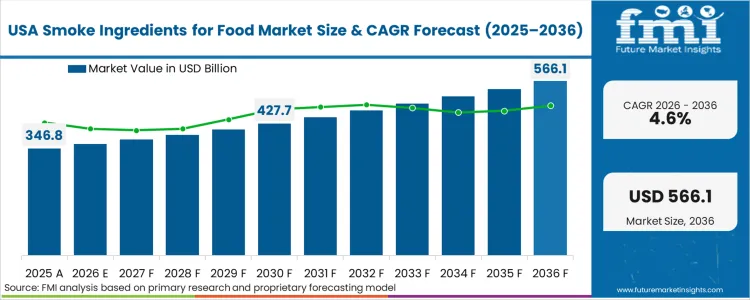
- USA: At 4.6% CAGR, the national outlook is shaped by immense commercial meat output requiring standardized flavor inputs to ensure consistency. This CAGR is underpinned by commercial red meat production reaching an astonishing 55.0 billion pounds in 2024, pulling massive volumes of liquid extracts into the supply chain. [2]
FMI’s report includes a detailed analysis of the growth in the North America region, along with a country-wise assessment that includes Canada and Mexico. Cross-border trade in packaged proteins forces alignment of ingredient specifications across these nations. This dynamic heavily benefits multinational suppliers capable of providing unified, compliant taste systems that integrate smoothly with existing food coating ingredients.
Europe Smoke Ingredients for Food Market Analysis
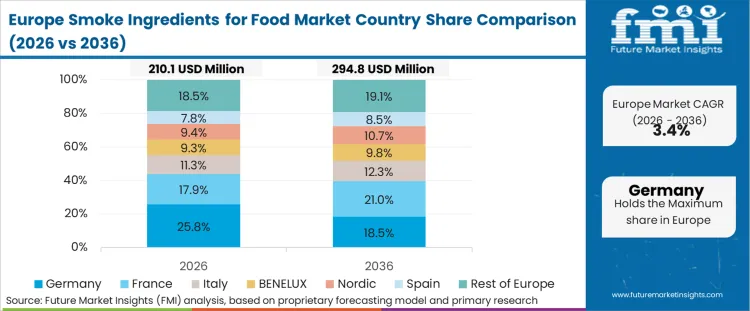
European dynamics center entirely upon unprecedented legislative disruption. Authorities mandated the removal of several widely utilized flavoring compounds, instigating industry-wide panic and rapid reformulation. According to FMI's estimates, regional volume growth remains moderate, but value capture spikes as processors pay premiums for newly engineered, legally compliant alternatives. Flavor houses race to patent and commercialize primary-smoke-free technologies to capture orphaned market share before competitors can react.
- UK: 4.3% CAGR is underpinned by aggressive domestic recipe overhauls mirroring continental regulatory shifts. This trajectory is supported by total UK meat production hitting 4,166 thousand tonnes in 2024, necessitating the rapid rollout of the 15 new smoke-style flavours introduced by I.T.S to address the impending bans. [5]
- Germany: Growth tracks a CAGR of 4.1% as massive local meat processors completely rebuild legacy sausage formulations to remain legally compliant. This expansion is linked to the strict EU phase-out period, which mandates the replacement of traditional smoking replacements within 5 years, forcing processors to secure new contracts immediately. [1]
FMI’s report includes a detailed analysis of the growth in the Europe region, along with a country-wise assessment that includes France and Italy. Traditional charcuterie producers in these nations must balance stringent new chemical restrictions with inflexible consumer taste expectations. This tension drives intense regional demand for highly sophisticated aromatic engineering and advanced functional food ingredients.
Competitive Aligners for Market Players
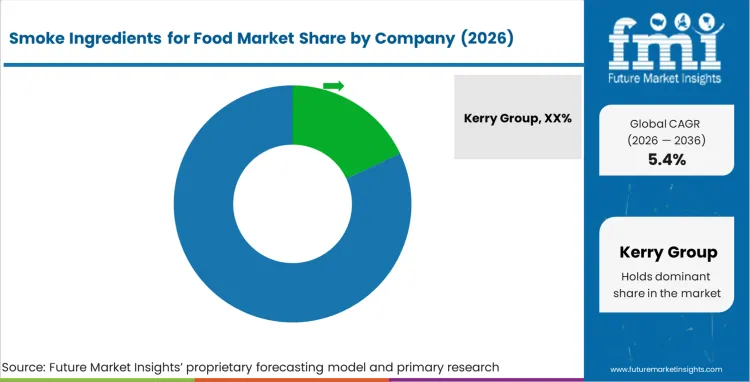
Regulatory compliance completely dictates modern competitive survival. Flavor developers incapable of engineering functional alternatives to banned substances face immediate obsolescence in key markets. In January 2026, Givaudan launched updated customer guidance and positioning around primary-smoke-free solutions tied directly to shifting European regulatory frameworks, ensuring its portfolio remains legally viable. [7]
Vertical integration provides crucial supply chain resilience during periods of intense legislative transition. Companies controlling fundamental wood pyrolysis and condensation processes maintain superior pricing leverage when spot markets experience volatility. Ownership of primary extraction facilities shields suppliers from sudden raw material shortages, ensuring uninterrupted deliveries to massive multinational protein clients.
Partnership ecosystems accelerate the commercialization of complex new taste solutions. Flavor giants actively collaborate with specialized regional blending facilities to localize product application testing for unique cultural preferences. Co-developing recipes directly alongside major food brands guarantees immediate large-scale adoption once new plant-based ingredients achieve final sensory approval.
Recent Developments
The report includes full coverage of key trends from competitive benchmarking. Some of the recent developments covered in the reports:
- In September 2025, Givaudan announced plans to acquire US fragrance house Belle Aire Creations, strengthening regional customer reach under its 2030 growth strategy. [10]
- In May 2024, IFF published a smoke-free replacement collection utilizing both powder and liquid formats designed to meet EU flavouring declarations. [6]
Key Players in Smoke Ingredients for Food
- Kerry Group
- IFF
- dsm-firmenich
- Givaudan
- I.T.S
- Symrise
- Besmoke
- Red Arrow Products
Scope of the Report
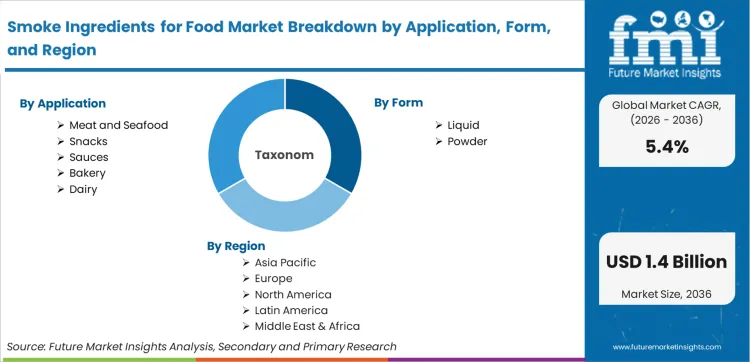
| Metric | Value |
|---|---|
| Quantitative Units | USD 849.7 Million (2026) to USD 1,428.2 Million (2036), at a CAGR of 5.4% |
| Market Definition | Sector encompasses commercial production of condensed smoke, liquid extracts, and related aromatic agents used to impart smoked characteristics to foodstuff. |
| Application Segmentation | Meat and Seafood, Snacks, Sauces, Bakery, Dairy |
| Form Segmentation | Liquid, Powder |
| Regions Covered | North America, Latin America, Europe, East Asia, South Asia, Oceania, Middle East and Africa |
| Countries Covered | China, India, Japan, USA, UK, Germany and 40 plus countries |
| Key Companies Profiled | Kerry Group, IFF, dsm-firmenich, Givaudan, I.T.S, Symrise, Besmoke, Red Arrow Products |
| Forecast Period | 2026 to 2036 |
| Approach | Hybrid top down and bottom up market modeling validated through primary interviews with flavor producers |
Smoke Ingredients for Food Market Analysis by Segments
Application
- Meat and Seafood
- Snacks
- Sauces
- Bakery
- Dairy
Form
- Liquid
- Powder
Region
- Asia Pacific
- India
- China
- Japan
- South Korea
- Indonesia
- Australia & New Zealand
- ASEAN
- Rest of Asia Pacific
- Europe
- Germany
- Italy
- France
- United Kingdom
- Spain
- Benelux
- Nordics
- Central & Eastern Europe
- Rest of Europe
- North America
- United States
- Canada
- Mexico
- Latin America
- Brazil
- Argentina
- Chile
- Rest of Latin America
- Middle East & Africa
- Kingdom of Saudi Arabia
- United Arab Emirates
- South Africa
- Turkey
- Rest of Middle East & Africa
Bibliography
- [1] European Commission. (2024). EU phase-out period when used to replace traditional smoking is 5 years.
- [2] USDA NASS. (2024). US commercial red meat production reached 55.0 billion lb in 2024.
- [3] Government of India, DAHD. (2025). India total meat production recorded at 10.50 million tonnes for 2024-25.
- [4] Japan MAFF. (2025). Japan fishery products imports hit 2.16 million tons in 2024.
- [5] UK DEFRA. (2024). UK total meat production was 4,166 thousand tonnes in 2024.
- [6] IFF. (May 2024). Published smoke-free replacement collection (powder + liquid) designed to meet EU flavouring declarations.
- [7] Givaudan. (Jan 2026). Launched customer guidance and positioning around 'primary-smoke-free' solutions tied to EU regulatory changes.
- [8] I.T.S. (Jun 2024). Introduced 15 smoke-style flavours positioned to address EU smoking/smoke-flavour changes.
- [9] Messe Frankfurt. (2025). Messe Frankfurt / Besmoke official publication
- [10] Givaudan. (2025). Givaudan to acquire Belle Aire Creations
This bibliography is provided for reader reference and is not exhaustive. The full report contains the complete reference list and detailed citations.
This Report Addresses
- Market intelligence to enable structured strategic decision making across global flavor formulation sectors
- Revenue forecasts from 2026 to 2036, supported by validated capacity benchmarks
- Growth opportunity mapping across liquid and powder forms with emphasis on regulatory compliance
- Competition strategy assessment including reformulation capabilities
- Product reformulation tracking alongside upcoming European phase-out timelines
- Regulatory impact analysis covering novel smoke-free aromatic mandates
- Strategic data delivery formats for executive planning
Frequently Asked Questions
How large is the demand for Smoke Ingredients for Food in the global market in 2026?
Demand for global inputs is estimated to reach USD 849.7 Million in 2026.
What will be the market size of Smoke Ingredients for Food in the global market by 2036?
Revenue scale is projected to hit USD 1,428.2 Million by 2036.
What is the expected demand growth for Smoke Ingredients for Food in the global market between 2026 and 2036?
Global consumption is expected to expand at a CAGR of 5.4% between 2026 and 2036.
Which Form is poised to lead global sales by 2026?
Liquid formats capture approximately 51.2% global share in 2026 due to superior pumpability and automation integration.
How significant is the role of Meat and Seafood in driving Smoke Ingredients for Food adoption in 2026?
Meat and seafood application holds 31.2% share in 2026 as protein producers require standardized flavor delivery.
What is driving demand in China?
Tightening food safety controls and massive industrial meat processing expansion drive standardized liquid condensate adoption.
What compliance standards or regulations are referenced for China?
European Union phase-outs act as global reference points for clean-label transition across export-oriented facilities.
What is the China growth outlook in this report?
China is projected to grow at a CAGR of 6.4% during 2026 to 2036.
Why is Europe described as a priority region in this report?
Unprecedented legislative bans force total reformulation across legacy protein supply chains, sparking massive value creation.
What type of demand dominates in Europe?
Replacement-driven purchasing of novel primary-smoke-free aromatic systems dominates regional consumption.
What is the India growth outlook in this report?
India is projected to expand at a CAGR of 5.2% during 2026 to 2036.
Does the report cover Japan in its regional analysis?
Yes, Japan is included within East Asia.
What are the sources referred to for analyzing Japan?
Official statistics published by the Japan Ministry of Agriculture, Forestry and Fisheries are cited.
What is the main demand theme linked to Japan in its region coverage?
Continuous innovation within convenience seafood and ready-to-eat categories drives specialized flavoring requirements.
Does the report cover the USA in its regional analysis?
Yes, the USA is included within North America.
What is the main USA related demand theme in its region coverage?
Massive commercial red meat output requiring standardized clean-label flavor inputs dictates local consumption.
Which product formats or configurations are strategically important for North America supply chains?
Pumpable fluid extracts are prioritized due to seamless integration within automated meat injection arrays.
What is Smoke Ingredients for Food and what is it mainly used for?
The sector covers commercial aromatics designed to replicate traditional wood-smoking profiles in mass-produced foodstuff.
What does Smoke Ingredients for Food mean in this report?
The scope encompasses the commercial production of condensed smoke and liquid extracts for industrial flavoring.
What is included in the scope of this Smoke Ingredients for Food report?
Analysis covers fluid dispersions and soluble powders across commercial meat, poultry, and snack processing.
What is excluded from the scope of this report?
Raw wood chips, direct combustion equipment, and downstream finished goods are omitted.
What does market forecast mean on this page?
Valuation represents a model-based projection built on defined assumptions for strategic planning.
How does FMI build and validate the Smoke Ingredients for Food forecast?
The forecast relies upon hybrid top-down and bottom-up modeling validated through primary interviews with flavor scientists.
What does zero reliance on speculative third party market research mean here?
Direct discussions with compliance officers and verifiable government production datasets secure analytical accuracy.
Preview the report firsthand - request a free sample
Get SampleGet the brochure for pricing and purchase details.
Get PDFTable of Content
- Executive Summary
- Global Market Outlook
- Demand-side Trends
- Supply-side Trends
- Technology Roadmap Analysis
- Analysis and Recommendations
- Market Overview
- Market Coverage / Taxonomy
- Market Definition / Scope / Limitations
- Research Methodology
- Chapter Orientation
- Analytical Lens and Working Hypotheses
- Market Structure, Signals, and Trend Drivers
- Benchmarking and Cross-market Comparability
- Market Sizing, Forecasting, and Opportunity Mapping
- Research Design and Evidence Framework
- Desk Research Programme (Secondary Evidence)
- Company Annual and Sustainability Reports
- Peer-reviewed Journals and Academic Literature
- Corporate Websites, Product Literature, and Technical Notes
- Earnings Decks and Investor Briefings
- Statutory Filings and Regulatory Disclosures
- Technical White Papers and Standards Notes
- Trade Journals, Industry Magazines, and Analyst Briefs
- Conference Proceedings, Webinars, and Seminar Materials
- Government Statistics Portals and Public Data Releases
- Press Releases and Reputable Media Coverage
- Specialist Newsletters and Curated Briefings
- Sector Databases and Reference Repositories
- FMI Internal Proprietary Databases and Historical Market Datasets
- Subscription Datasets and Paid Sources
- Social Channels, Communities, and Digital Listening Inputs
- Additional Desk Sources
- Expert Input and Fieldwork (Primary Evidence)
- Primary Modes
- Qualitative Interviews and Expert Elicitation
- Quantitative Surveys and Structured Data Capture
- Blended Approach
- Why Primary Evidence is Used
- Field Techniques
- Interviews
- Surveys
- Focus Groups
- Observational and In-context Research
- Social and Community Interactions
- Stakeholder Universe Engaged
- C-suite Leaders
- Board Members
- Presidents and Vice Presidents
- R&D and Innovation Heads
- Technical Specialists
- Domain Subject-matter Experts
- Scientists
- Physicians and Other Healthcare Professionals
- Governance, Ethics, and Data Stewardship
- Research Ethics
- Data Integrity and Handling
- Primary Modes
- Tooling, Models, and Reference Databases
- Desk Research Programme (Secondary Evidence)
- Data Engineering and Model Build
- Data Acquisition and Ingestion
- Cleaning, Normalisation, and Verification
- Synthesis, Triangulation, and Analysis
- Quality Assurance and Audit Trail
- Market Background
- Market Dynamics
- Drivers
- Restraints
- Opportunity
- Trends
- Scenario Forecast
- Demand in Optimistic Scenario
- Demand in Likely Scenario
- Demand in Conservative Scenario
- Opportunity Map Analysis
- Product Life Cycle Analysis
- Supply Chain Analysis
- Investment Feasibility Matrix
- Value Chain Analysis
- PESTLE and Porter’s Analysis
- Regulatory Landscape
- Regional Parent Market Outlook
- Production and Consumption Statistics
- Import and Export Statistics
- Market Dynamics
- Global Market Analysis 2021 to 2025 and Forecast, 2026 to 2036
- Historical Market Size Value (USD Million) Analysis, 2021 to 2025
- Current and Future Market Size Value (USD Million) Projections, 2026 to 2036
- Y-o-Y Growth Trend Analysis
- Absolute $ Opportunity Analysis
- Global Market Pricing Analysis 2021 to 2025 and Forecast 2026 to 2036
- Global Market Analysis 2021 to 2025 and Forecast 2026 to 2036, By Application
- Introduction / Key Findings
- Historical Market Size Value (USD Million) Analysis By Application , 2021 to 2025
- Current and Future Market Size Value (USD Million) Analysis and Forecast By Application , 2026 to 2036
- Meat and Seafood
- Snacks
- Sauces
- Bakery
- Dairy
- Meat and Seafood
- Y-o-Y Growth Trend Analysis By Application , 2021 to 2025
- Absolute $ Opportunity Analysis By Application , 2026 to 2036
- Global Market Analysis 2021 to 2025 and Forecast 2026 to 2036, By Form
- Introduction / Key Findings
- Historical Market Size Value (USD Million) Analysis By Form, 2021 to 2025
- Current and Future Market Size Value (USD Million) Analysis and Forecast By Form, 2026 to 2036
- Liquid
- Powder
- Liquid
- Y-o-Y Growth Trend Analysis By Form, 2021 to 2025
- Absolute $ Opportunity Analysis By Form, 2026 to 2036
- Global Market Analysis 2021 to 2025 and Forecast 2026 to 2036, By Region
- Introduction
- Historical Market Size Value (USD Million) Analysis By Region, 2021 to 2025
- Current Market Size Value (USD Million) Analysis and Forecast By Region, 2026 to 2036
- North America
- Latin America
- Western Europe
- Eastern Europe
- East Asia
- South Asia and Pacific
- Middle East & Africa
- Market Attractiveness Analysis By Region
- North America Market Analysis 2021 to 2025 and Forecast 2026 to 2036, By Country
- Historical Market Size Value (USD Million) Trend Analysis By Market Taxonomy, 2021 to 2025
- Market Size Value (USD Million) Forecast By Market Taxonomy, 2026 to 2036
- By Country
- USA
- Canada
- Mexico
- By Application
- By Form
- By Country
- Market Attractiveness Analysis
- By Country
- By Application
- By Form
- Key Takeaways
- Latin America Market Analysis 2021 to 2025 and Forecast 2026 to 2036, By Country
- Historical Market Size Value (USD Million) Trend Analysis By Market Taxonomy, 2021 to 2025
- Market Size Value (USD Million) Forecast By Market Taxonomy, 2026 to 2036
- By Country
- Brazil
- Chile
- Rest of Latin America
- By Application
- By Form
- By Country
- Market Attractiveness Analysis
- By Country
- By Application
- By Form
- Key Takeaways
- Western Europe Market Analysis 2021 to 2025 and Forecast 2026 to 2036, By Country
- Historical Market Size Value (USD Million) Trend Analysis By Market Taxonomy, 2021 to 2025
- Market Size Value (USD Million) Forecast By Market Taxonomy, 2026 to 2036
- By Country
- Germany
- UK
- Italy
- Spain
- France
- Nordic
- BENELUX
- Rest of Western Europe
- By Application
- By Form
- By Country
- Market Attractiveness Analysis
- By Country
- By Application
- By Form
- Key Takeaways
- Eastern Europe Market Analysis 2021 to 2025 and Forecast 2026 to 2036, By Country
- Historical Market Size Value (USD Million) Trend Analysis By Market Taxonomy, 2021 to 2025
- Market Size Value (USD Million) Forecast By Market Taxonomy, 2026 to 2036
- By Country
- Russia
- Poland
- Hungary
- Balkan & Baltic
- Rest of Eastern Europe
- By Application
- By Form
- By Country
- Market Attractiveness Analysis
- By Country
- By Application
- By Form
- Key Takeaways
- East Asia Market Analysis 2021 to 2025 and Forecast 2026 to 2036, By Country
- Historical Market Size Value (USD Million) Trend Analysis By Market Taxonomy, 2021 to 2025
- Market Size Value (USD Million) Forecast By Market Taxonomy, 2026 to 2036
- By Country
- China
- Japan
- South Korea
- By Application
- By Form
- By Country
- Market Attractiveness Analysis
- By Country
- By Application
- By Form
- Key Takeaways
- South Asia and Pacific Market Analysis 2021 to 2025 and Forecast 2026 to 2036, By Country
- Historical Market Size Value (USD Million) Trend Analysis By Market Taxonomy, 2021 to 2025
- Market Size Value (USD Million) Forecast By Market Taxonomy, 2026 to 2036
- By Country
- India
- ASEAN
- Australia & New Zealand
- Rest of South Asia and Pacific
- By Application
- By Form
- By Country
- Market Attractiveness Analysis
- By Country
- By Application
- By Form
- Key Takeaways
- Middle East & Africa Market Analysis 2021 to 2025 and Forecast 2026 to 2036, By Country
- Historical Market Size Value (USD Million) Trend Analysis By Market Taxonomy, 2021 to 2025
- Market Size Value (USD Million) Forecast By Market Taxonomy, 2026 to 2036
- By Country
- Kingdom of Saudi Arabia
- Other GCC Countries
- Turkiye
- South Africa
- Other African Union
- Rest of Middle East & Africa
- By Application
- By Form
- By Country
- Market Attractiveness Analysis
- By Country
- By Application
- By Form
- Key Takeaways
- Key Countries Market Analysis
- USA
- Pricing Analysis
- Market Share Analysis, 2025
- By Application
- By Form
- Canada
- Pricing Analysis
- Market Share Analysis, 2025
- By Application
- By Form
- Mexico
- Pricing Analysis
- Market Share Analysis, 2025
- By Application
- By Form
- Brazil
- Pricing Analysis
- Market Share Analysis, 2025
- By Application
- By Form
- Chile
- Pricing Analysis
- Market Share Analysis, 2025
- By Application
- By Form
- Germany
- Pricing Analysis
- Market Share Analysis, 2025
- By Application
- By Form
- UK
- Pricing Analysis
- Market Share Analysis, 2025
- By Application
- By Form
- Italy
- Pricing Analysis
- Market Share Analysis, 2025
- By Application
- By Form
- Spain
- Pricing Analysis
- Market Share Analysis, 2025
- By Application
- By Form
- France
- Pricing Analysis
- Market Share Analysis, 2025
- By Application
- By Form
- India
- Pricing Analysis
- Market Share Analysis, 2025
- By Application
- By Form
- ASEAN
- Pricing Analysis
- Market Share Analysis, 2025
- By Application
- By Form
- Australia & New Zealand
- Pricing Analysis
- Market Share Analysis, 2025
- By Application
- By Form
- China
- Pricing Analysis
- Market Share Analysis, 2025
- By Application
- By Form
- Japan
- Pricing Analysis
- Market Share Analysis, 2025
- By Application
- By Form
- South Korea
- Pricing Analysis
- Market Share Analysis, 2025
- By Application
- By Form
- Russia
- Pricing Analysis
- Market Share Analysis, 2025
- By Application
- By Form
- Poland
- Pricing Analysis
- Market Share Analysis, 2025
- By Application
- By Form
- Hungary
- Pricing Analysis
- Market Share Analysis, 2025
- By Application
- By Form
- Kingdom of Saudi Arabia
- Pricing Analysis
- Market Share Analysis, 2025
- By Application
- By Form
- Turkiye
- Pricing Analysis
- Market Share Analysis, 2025
- By Application
- By Form
- South Africa
- Pricing Analysis
- Market Share Analysis, 2025
- By Application
- By Form
- USA
- Market Structure Analysis
- Competition Dashboard
- Competition Benchmarking
- Market Share Analysis of Top Players
- By Regional
- By Application
- By Form
- Competition Analysis
- Competition Deep Dive
- Kerry Group
- Overview
- Product Portfolio
- Profitability by Market Segments (Product/Age /Sales Channel/Region)
- Sales Footprint
- Strategy Overview
- Marketing Strategy
- Product Strategy
- Channel Strategy
- IFF
- dsm-firmenich
- Givaudan
- I.T.S
- Symrise
- Besmoke
- Red Arrow Products
- Kerry Group
- Competition Deep Dive
- Assumptions & Acronyms Used


