

- Industry Size (2026)
- USD 425.38 Mn
- Forecast (2036)
- USD 555.25 Mn
- CAGR (2026 to 2036)
- 2.70%
Padded Divider Market Size, Market Forecast and Outlook By FMI
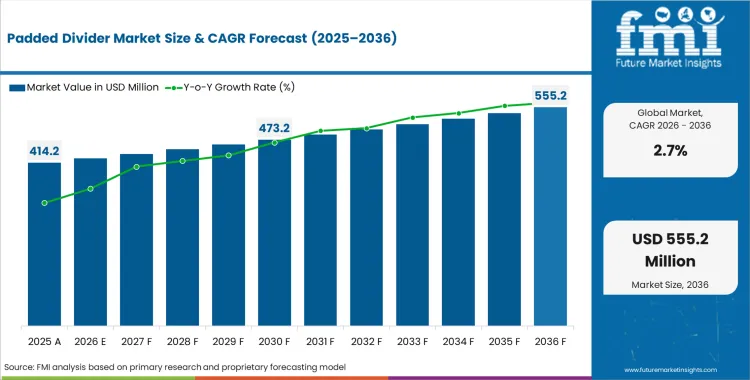
The padded divider market was valued at USD 414.20 million in 2025, projected to reach USD 425.38 million in 2026, and is forecast to expand to USD 555.25 million by 2036 at a 2.70% CAGR. Structural shifts in end-use procurement cycles and tightening performance specifications across downstream sectors are accelerating capital allocation toward padded divider categories. Procurement teams operating across global supply chains now require standardized compliance certifications, compressing qualification timelines and elevating minimum specification thresholds for approved supplier lists.
Summary of Padded Divider Market
- Market Snapshot
- The padded divider market is valued at USD 414.20 million in 2025 and is projected to reach USD 555.25 million by 2036.
- The industry is expected to grow at a 2.70% CAGR from 2026 to 2036, creating an incremental opportunity of USD 129.86 million.
- The market operates as a specification-driven procurement category where compliance certifications, material performance standards, and supply chain integration define competitive positioning.
- Demand and Growth Drivers
- Demand is rising as downstream industries face tightening performance specifications and mandatory compliance requirements across procurement cycles.
- Technology upgrades and process automation are accelerating adoption of higher-specification padded divider products across manufacturing operations.
- Infrastructure expansion programs in emerging economies are creating greenfield demand that bypasses legacy supplier constraints.
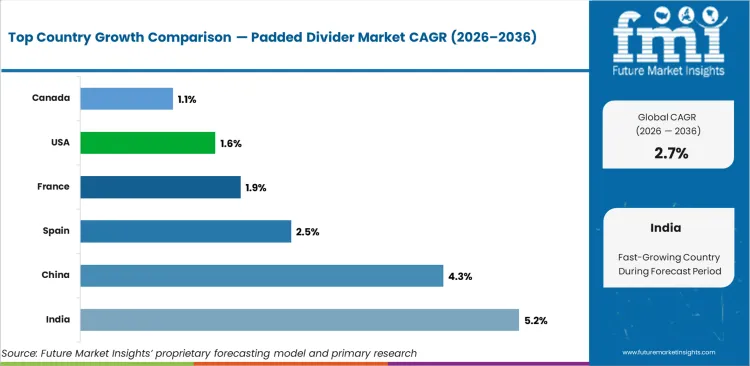
- Among key countries, India at 5.20%, China at 4.30%, Spain at 2.50%, France at 1.90%, USA at 1.60%, Canada at 1.10%.
- Product and Segment View
- The market includes padded divider products segmented across material, product, end-use categories serving diverse industrial and commercial applications.
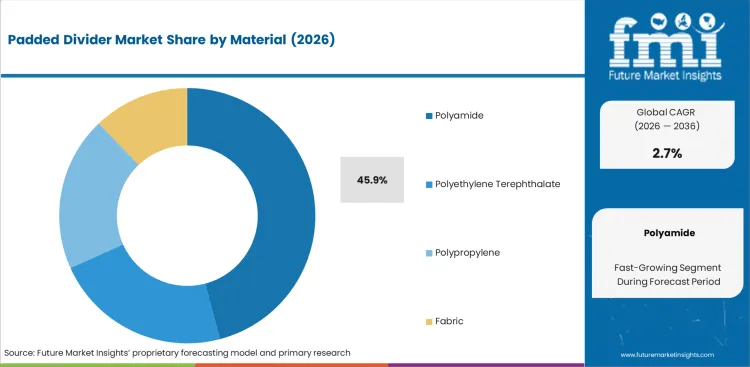
- Polyamide leads by material with 45.9% share in 2026.
- With Compartments leads by product with 57.0% share in 2026.
- The scope covers Polyamide, Polyethylene Terephthalate, Polypropylene, Fabric configurations among other formats, while excluding unrelated commodity categories and non-specialized alternatives.
- Geography and Competitive Outlook
- India and China are the fastest-growing markets due to infrastructure expansion and rising industrial demand, while North America and Europe remain high-value mature demand bases.
- Competition is shaped by vertical integration capabilities, specification compliance certifications, and established procurement channel relationships, with key players including Pelican Products, SKB Cases, B&W International, Nanuk, GWP Group, Topper Cases, Seahorse Protective Cases.
- Market consolidation trends are evident as leading suppliers acquire complementary capabilities to meet broadening customer specification requirements.
- Analyst Opinion at FMI
- Ismail Sutaria, Principal Consultant, opines: 'As per FMI analysis, the padded divider market is transitioning from a volume-driven procurement model to a specification-led qualification framework. Buyers who delay integration of higher-performance padded divider solutions into their supply chains face material cost escalation as compliance timelines compress. FMI analysts observe that suppliers lacking certified production capabilities will find themselves excluded from approved vendor lists as downstream operators enforce tighter material specifications.'
- Strategic Implications / Executive Takeaways
- Procurement directors must transition vendor qualification processes to prioritize lifecycle cost models and specification compliance certifications over lowest unit price evaluations.
- Capital project teams should mandate compatibility with next-generation performance standards in all new equipment procurement specifications entering the 2027 tender cycle.
- Supply chain architects must develop multi-source qualification programs to mitigate concentration risk across critical padded divider supply categories.
Padded Divider Market Key Takeaways
| Metric | Details |
|---|---|
| Industry Size (2026) | USD 425.38 million |
| Industry Value (2036) | USD 555.25 million |
| CAGR (2026-2036) | 2.70% |
Source: Future Market Insights, 2026
Capital expenditure planning cycles across verticals consuming padded divider products have shifted from discretionary upgrades to mandated replacements. Regulatory frameworks governing material performance, safety testing, and environmental compliance are tightening across all major consumption regions. Buyers evaluating supplier contracts increasingly weight lifecycle cost models over upfront unit pricing, favoring suppliers with vertically integrated operations and certified testing capabilities.
Regional deployment parameters reflect differentiated adoption velocities. India sets the pace with a 5.20% CAGR, followed by China at 4.30% as infrastructure expansion programs bypass legacy procurement constraints. Spain operations advance at a 2.50% rate, supported by regulatory compliance mandates. France tracks at 1.90%. USA networks maintain a 1.60% expansion trajectory. Canada registers a 1.10% pace.
Padded Divider Market Definition
Padded Divider constitutes the material, product, or technology category defined by its primary industrial function within downstream manufacturing and end-use sectors. The scope encompasses standardized and specialty configurations compliant with global performance and safety specifications. Core inclusions govern products meeting defined procurement parameters across industrial, commercial, and institutional buyer categories.
Padded Divider Market Inclusions
Market scope includes Polyamide, Polyethylene Terephthalate, Polypropylene, Fabric, With Compartments configurations and related product variants. Global and regional market sizes, forecast period 2026 to 2036, and segment breakdowns by material, product, end-use are fully incorporated within the analytical boundary.
Padded Divider Market Exclusions
Standard commodity alternatives lacking specialized performance certifications are excluded. Downstream finished goods, standalone accessory components, and non-standardized custom fabrications fall outside the analytical parameters. Legacy product formats without current industry specification compliance are explicitly omitted from the valuation.
Padded Divider Market Research Methodology
- Primary Research: Analysts engaged with procurement specification leads, technical managers, and supply chain directors across key consumption sectors to map decision gates triggering product upgrades and supplier requalification.
- Desk Research: Data collection phases aggregated regulatory compliance frameworks, industry standards ratification schedules, and published procurement guidelines from major institutional buyers.
- Market-Sizing and Forecasting: Baseline values derive from a bottom-up aggregation of product volumes and contract values, applying region-specific adoption curves to project future demand velocity.
- Data Validation and Update Cycle: Projections are tested against publicly reported expenditure guidance from leading industrial consumers and trade association production statistics.
Key Industry Highlights
Military Applications of Dividers Secure the Major Sensitive Machinery
The need for cushioned dividers is predicted to grow because of their growing significance in military applications. The dividers, sometimes referred to as cushioned separators, are essential parts of robust military containers. They are especially common in cases with extended drawers because they provide delicate equipment with a safe and well-organized space.
One major aspect propelling the demand for padded bottoms and dividers is the growing need for the secure and dependable transit and storage of explosives and sensitive military equipment.
Padded dividers guard against damage during transportation by efficiently cushioning and dividing items, ensuring the military supplies' functioning and efficacy when they arrive. This lowers the possibility of damaged equipment and the need for replacements, which has a favorable effect on operational efficiency and cost savings. The market is developing because of the rising need for military equipment to be transported and stored securely.
Popularity of Outdoor Staycation Boost Necessity of Padded Sleeves
The emerging engagement in adventurous activities such as rock climbing, hiking, trekking, and camping is foreseen to propel the demand for padded cases, especially among patrons working with sensitive materials such as adventure photographers.
Such activities necessitate robust protective gear for delicate equipment, making padded separators essential for safeguarding against shocks, vibrations, and scratches. Additionally, the packaging of glass products significantly fuels the demand for thick-walled dividers, ensuring the secure transportation of fragile items.
Padded dividers are particularly essential for protecting electronic devices such as smartphones, laptops, cameras, and tablets during shipping or storage. By providing cushioning, these dividers help maintain the integrity of delicate components, thereby enhancing the durability and longevity of high-value items.
The demand for padded cases and dividers is anticipated to see substantial growth in the forthcoming decade, compelled by both the adventurous pursuits of consumers and the need for reliable protective solutions in various industries.
Expensive Manufacturing of Customized Dividers Is Likely to Hamper the Demand
The e-commerce industry and the demand for protective packaging are projected to drive a large expansion in the cushioned divider market. Though they provide better product protection, custom cushioned dividers are sometimes more expensive because of the high expenses of customization, which can be difficult for startups and small enterprises to afford.
Custom-cushioned separators often require special orders and long lead times, which can hinder businesses' ability to quickly obtain them in the fast-paced sector. This may lead to reliance on generic stock packaging solutions, which may not adequately protect products during shipping.
The market has potential, but economic and time constraints may hinder its growth. To maximize its potential, manufacturers should explore cost-effective customization options or develop pre-sized padded dividers for a wider product range.
Padded Divider Demand Analysis 2021 to 2025 and Forecast 2026 to 2036
The global demand for casings with padded sections is projected to register a CAGR of 2% during the forecast period between 2019 and 2023, reaching a total of USD 389.3 million in 2023.
Because cushioned dividers are so good at shielding breakable glassware, the demand for them is predicted to rise significantly. In boxes and other packing, padded dividers form a barrier that keeps items from clinking during shipping, which can lead to chipping and breakage.
Businesses can guarantee product safety, lower returns, and replacement costs, and customers get their goods undamaged, building confidence and brand loyalty. This is advantageous to both parties. It is anticipated that the need for cushioned dividers will increase as the e-commerce sector expands.
The novel trends are propelling the market towards a projected CAGR of 2.7% from 2026 to 2036. The shift translates to a significant incremental opportunity of USD 526.4 million over the subsequent decade. Future developments in design, functionality, and material science are anticipated as the industry develops to secure section carriers' place as essential transportation equipment.
The need for padded partitions is predicted to increase substantially due to the predicted growth in demand for rigid boxes with padded dividers, especially in the automotive parts packaging industry. The cushioned separators play a vital role in securing the safe handling of fragile car parts at every stage of the supply chain, from assembly to storage and shipping.
Padded divisions reduce damage and maintain the integrity of items including engines, bumpers, and headlights by efficiently separating and cushioning these areas. This results in lower replacement and repair costs, which in turn creates a more streamlined and effective automobile sector.
Market Concentration
Tier 1 enterprises represent a large segment of the global packaging sector, possessing a broad reach and considerable impact. Pelican Products is a leading global manufacturer renowned for its high-quality, durable protective cases, which are widely used across various industries including aerospace, military, and consumer electronics.
SKB Case is a prominent player offering a broad range of protective cases with a strong presence in the music, photography, and military sectors, known for their rugged and reliable designs. Both companies set industry standards for protective solutions, combining innovation with durability to meet diverse professional needs.
Tier 2 companies feature well-established businesses that serve a variety of industries with a wide range of product offerings, and they have a strong global presence in the market. B&W International is renowned for its durable protective cases, especially in the photography and industrial sectors.
Nanuk excels with high-performance cases tailored for photography and video equipment. GWP Group specializes in custom protective packaging solutions, catering to sensitive equipment needs. These companies have a strong regional presence and substantial revenue share, though they are not as globally dominant as Tier 1 leaders.
Tier 3 companies are more specialized, smaller businesses that focus on catering to niche or local customers. Topper Cases is a smaller company specializing in niche markets within the protective case industry, offering tailored solutions for specific needs.
Seahorse Protective Cases provides reliable and durable protective cases but has a more limited industry presence compared to larger competitors, focusing on quality and dependability for targeted applications.
Country-wise Insights
The industry analysis for the padded divider market in each of the several countries is provided in the section below. Spain is forecast to hold the top rank in Europe with a CAGR of 2.5% until 2036.
In the Asia Pacific area, India is expected to exhibit a CAGR of 5.2% by 2036, while China's economy is estimated to register a CAGR of 4.3%. Forecasts indicate that there will be an increase in the requirement for cases with dividers in the Asia Pacific region in the future.
.webp "Top Country Growth Comparison Padded Divider Market Cagr (2026 2036)")
| Countries | Value CAGR (2026 to 2036) |
|---|---|
| United States | 1.6% |
| Canada | 1.1% |
| France | 1.9% |
| Spain | 2.5% |
| India | 5.2% |
| China | 4.3% |
Spanish Furniture Sector Paves the Way for Premium Packaging
In Spain, the integration of padded partitions for furniture transportation is projected to grow significantly over the subsequent decade, with an anticipated CAGR of 2.5%.
The growth is driven by the need to protect delicate furniture items, such as glass table tops, mirrors, and wooden surfaces, during transit. Padded dividers are essential in minimizing the risk of scratches, dents, and other surface damage that can occur during movement.
By preserving the appearance and quality of furniture pieces, these protective solutions ensure that items reach their destination in pristine condition. The rising demand for high-quality furniture and the increase in e-commerce and home delivery services further fuel the movement.
As consumers in Spain become more aware of the benefits of using padded dividers, the furniture industry is likely to see a notable gain in their adoption, enhancing the transportation process and customer satisfaction.
E-commerce Packaging Boost Adaption of Protection Dividers in China
Throughout the projection period, the protective dividers industry in China is expected to post a CAGR of 4.3%. The packaging and shipping industries are experiencing a spike in demand for protective partition solutions due to the growing preference of the Chinese population for online shopping. This is a result of e-commerce's ease and diversity, which calls for sturdy packing to ensure safe delivery.
The middle class in China is becoming more affluent, and this has increased consumer spending on non-essentials. Improved protective packaging is now required to avoid damage during shipment. As a result, there is a need for creative packaging solutions to keep up with changing customer demands.
India Skyrockets the Demand for Padded Partition for Fragile Packing
The consumer electronics and appliances sector in India, projected for significant growth by the India Brand Equity Foundation (IBEF) by 2036, is poised to positively impact the demand for cushioned separators. The growth is anticipated to be fueled by a rising demand for electronics and appliances, which necessitates secure and protected transportation.
The demand from India is foreseen to witness a CAGR of 5.2% for padded dividers, reflecting the increased need for secure packaging solutions. The trend is likely to continue in the coming years, contributing to the growth of the Asia Pacific region.
As the demand for electronics and appliances surges, the requirement for cushioned separators to safeguard these delicate items during storage and transportation is estimated to correspondingly rise. Such endeavors present a promising prospect for manufacturers and distributors of padded partitions within India.
Category-wise Insights
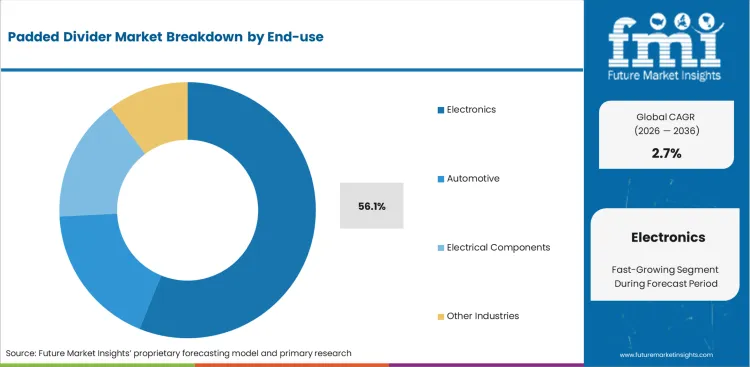
The section that follows contains information on the leading industrial categories. Estimates indicate that in 2026, the polyamide material category is expected to achieve a revenue share of 45.9%. Moreover, it is projected that 56.1% of the demand is anticipated to be accounted for the packaging of electronics in 2026.
Polyamide (PA) Material Garners Prominent Demand in 2026
| Material | Polyamide (PA) |
|---|---|
| Value Share (2026) | 45.9% |
There is a trend in the cushioned divider industry toward more inventive materials. Manufacturers must balance the necessity for some stiffness to preserve structure within packing with the need for soft, flexible cushioning to protect fragile goods.
As a result, people are starting to choose polyamide materials like nylon more and more. In 2026, it is anticipated that their distinct qualities are anticipated to account for 45.9% of the market share.
The pattern indicates a broader need in the protective packaging sector for material science breakthroughs. Since polyamide-based cushioned separators provide better protection for delicate objects within containers, their integration is envisioned to be a key development aspect.
The increasing need for cushioned separators to ensure the secure transportation and storage of fragile items is shown by such a move towards high-performance materials.
For the Sensitive Electronics Packaging, Dividers Acquires Significant Share
| End Use | Electronics |
|---|---|
| Value Share (2026) | 56.1% |
The electronics industry's growing complexity presents a unique challenge for manufacturers to ensure safe transit and storage. It is anticipated to acquire a 56.1% revenue share in 2026.
The market, which creates customized compartments, acts as a necessary line of defense, cradling delicate components and preventing damage during transportation. This minimizes the risk of scratches, fractures, and other unusable items, making the industry thrive.
As circuits get more complicated, more advanced padded divider solutions are required. When it comes to dividers that can be precisely tailored to meet specific requirements and provide the best possible protection for a greater variety of components, manufacturers are increasingly looking to the cushioned divider industry.
This promises the fragile parts' safe arrival as well as their performance once they get there. There's little question that the market is likely to continue to develop quickly in tandem with the electronics sector, providing ever-more-specialized solutions to satisfy the developing need for effective and safe packing.
Competitive Landscape
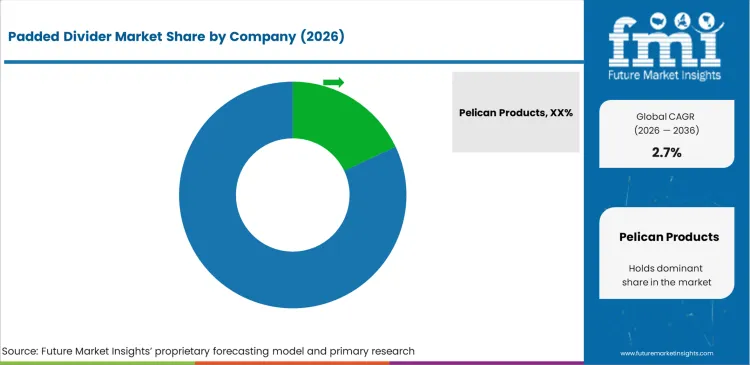
The padded divider industry is undergoing a dynamic transition propelled by strategic development as well as concerns about sustainability. Prominent companies are proactively creating ecologically friendly cushioned separators in response to the increasing need for packaging options that minimize environmental impact. This is in line with customer demands for goods with as little of an impact on the environment as possible.
Meanwhile, other multinational corporations are pursuing inorganic expansion tactics. Their goal in the industry is to expand their product lines through joint ventures, acquisitions, and mergers. They can gain invaluable local knowledge and experience through partnerships with native companies and startups, but acquisitions are a quicker way for them to increase their global reach and take a bigger chunk of the cushioned divider market.
The demand for cushioned dividers appears to be quite competitive and dynamic, with a significant emphasis on innovation and industry supremacy, according to their combined efforts.
Recent Industry Developments in the Padded Divider Market
- In February 2025, NANUK, a Canadian brand, introduced the NANUK-R Collection, an eco-friendly line of protective cases made from over 80% post-consumer recycled resin. The collection aims to reduce plastic waste, with only 9% recycled and offers a lifetime warranty to ensure product longevity, addressing pressing environmental issues.
- In January 2025, Pelican Products and studioFAR collaborated on the U160 backpack, designed for adventure and nature photographers, featuring a waterproof case, padded upper compartment, and weight distribution clip.
Scope of the Report
| Metric | Value |
|---|---|
| Quantitative Units | USD 425.38 million to USD 555.25 million, at a CAGR of 2.70% |
| Market Definition | Padded Divider encompasses the material, product, or technology category serving downstream industrial, commercial, and institutional end-use sectors under defined performance and safety specifications. |
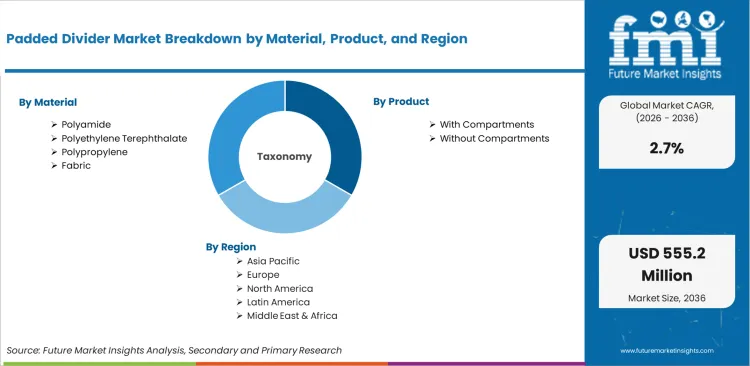
| Material Segmentation | Polyamide, Polyethylene Terephthalate, Polypropylene, Fabric |
| Product Segmentation | With Compartments, Without Compartments |
| End-use Segmentation | Electronics, Automotive, Electrical Components, Other Industries |
| Regions Covered | North America, Latin America, Europe, East Asia, South Asia, Oceania, Middle East & Africa |
| Countries Covered | USA, Canada, France, Spain, India, China, and 40 plus countries |
| Key Companies Profiled | Pelican Products, SKB Cases, B&W International, Nanuk, GWP Group, Topper Cases, Seahorse Protective Cases |
| Forecast Period | 2026 to 2036 |
| Approach | Forecasting models apply a bottom-up methodology starting with global installed base metrics and projecting conversion rates to higher-specification product categories. |
Key Segments of the Padded Divider Industry
By Material:
Based on the material, the industry is divided into Polyamide (PA), Polyethylene Terephthalate (PET), Polypropylene (PP), and fabric.
By Product:
In terms of product, the industry is segregated into compartments and without compartments.
By End-use:
Based on the end-use of the sector, the demand is categorized into electronics, automotive, electrical components, and other industries.
By Region:
Key countries of North America, Latin America, Europe, East Asia, South Asia, Middle East and Africa (MEA), and Oceania have been covered in the report.
Bibliography
- 1. Organisation for Economic Co-operation and Development. (2025, June). Industrial performance and competitiveness indicators. OECD.
- 2. World Bank Group. (2025). Global economic prospects: Industrial supply chains and trade facilitation. World Bank.
- 3. United Nations Industrial Development Organization. (2025). Industrial development report: Manufacturing and global value chains. UNIDO.
- 4. International Organization for Standardization. (2025). ISO standards catalogue: Materials testing and quality management. ISO.
- 5. European Commission, Directorate-General for Internal Market, Industry, Entrepreneurship and SMEs. (2025). Single market for goods: Industrial product compliance. European Commission.
- 6. USA Bureau of Labor Statistics. (2025). Producer price indexes for intermediate demand. USA Department of Labor.
This bibliography is provided for reader reference. The full Future Market Insights report contains the complete reference list with primary research documentation.
Frequently Asked Questions
How large is the demand for Padded Divider in the global market in 2026?
Demand for Padded Divider in the global market is estimated to be valued at USD 425.38 million in 2026.
What will be the market size of Padded Divider in the global market by 2036?
Market size for Padded Divider is projected to reach USD 555.25 million by 2036.
What is the expected demand growth for Padded Divider in the global market between 2026 and 2036?
Demand for Padded Divider is expected to grow at a CAGR of 2.70% between 2026 and 2036.
Which Material is poised to lead global sales by 2026?
Polyamide accounts for 45.9% in 2026, driven by established procurement specifications and downstream integration requirements.
What is driving demand in India?
India leads with a 5.20% CAGR as greenfield industrial facilities deploying modern procurement frameworks create scaled demand for specification-compliant padded divider products.
What is the China growth outlook in this report?
China is projected to grow at a CAGR of 4.30% during 2026 to 2036.
What is Padded Divider and what is it mainly used for?
Padded Divider constitutes the specialized material, product, or technology category designed for defined industrial, commercial, and institutional applications. End-use sectors primarily deploy it to meet performance, safety, and regulatory compliance requirements.
How does FMI build and validate the Padded Divider forecast?
Forecasting models apply a bottom-up methodology starting with global installed base metrics and cross-validate projections against quarterly industry production and trade volumes.
Preview the report firsthand - request a free sample
Get SampleGet the brochure for pricing and purchase details.
Get PDFTable of Content
- Executive Summary
- Global Market Outlook
- Demand-side Trends
- Supply-side Trends
- Technology Roadmap Analysis
- Analysis and Recommendations
- Market Overview
- Market Coverage / Taxonomy
- Market Definition / Scope / Limitations
- Research Methodology
- Chapter Orientation
- Analytical Lens and Working Hypotheses
- Market Structure, Signals, and Trend Drivers
- Benchmarking and Cross-market Comparability
- Market Sizing, Forecasting, and Opportunity Mapping
- Research Design and Evidence Framework
- Desk Research Programme (Secondary Evidence)
- Company Annual and Sustainability Reports
- Peer-reviewed Journals and Academic Literature
- Corporate Websites, Product Literature, and Technical Notes
- Earnings Decks and Investor Briefings
- Statutory Filings and Regulatory Disclosures
- Technical White Papers and Standards Notes
- Trade Journals, Industry Magazines, and Analyst Briefs
- Conference Proceedings, Webinars, and Seminar Materials
- Government Statistics Portals and Public Data Releases
- Press Releases and Reputable Media Coverage
- Specialist Newsletters and Curated Briefings
- Expert Input and Fieldwork (Primary Evidence)
- Primary Modes
- Qualitative Interviews and Expert Elicitation
- Quantitative Surveys and Structured Data Capture
- Blended Approach
- Why Primary Evidence is Used
- Field Techniques
- Interviews
- Surveys
- Focus Groups
- Observational and In-context Research
- Social and Community Interactions
- Stakeholder Universe Engaged
- C-suite Leaders
- Board Members
- Presidents and Vice Presidents
- R&D and Innovation Heads
- Technical Specialists
- Domain Subject-matter Experts
- Scientists
- Physicians and Other Healthcare Professionals
- Governance, Ethics, and Data Stewardship
- Research Ethics
- Data Integrity and Handling
- Primary Modes
- Tooling, Models, and Reference Databases
- Data Engineering and Model Build
- Data Acquisition and Ingestion
- Cleaning, Normalisation, and Verification
- Synthesis, Triangulation, and Analysis
- Quality Assurance and Audit Trail
- Desk Research Programme (Secondary Evidence)
- Market Background
- Market Dynamics
- Drivers
- Restraints
- Opportunity
- Trends
- Scenario Forecast
- Demand in Optimistic Scenario
- Demand in Likely Scenario
- Demand in Conservative Scenario
- Opportunity Map Analysis
- Product Life Cycle Analysis
- Supply Chain Analysis
- Investment Feasibility Matrix
- Value Chain Analysis
- PESTLE and Porter’s Analysis
- Regulatory Landscape
- Regional Parent Market Outlook
- Production and Consumption Statistics
- Import and Export Statistics
- Market Dynamics
- Global Market Analysis 2021 to 2025 and Forecast, 2026 to 2036
- Historical Market Size Value (USD Million) Analysis, 2021 to 2025
- Current and Future Market Size Value (USD Million) Projections, 2026 to 2036
- Y-o-Y Growth Trend Analysis
- Absolute $ Opportunity Analysis
- Global Market Pricing Analysis 2021 to 2025 and Forecast 2026 to 2036
- Global Market Analysis 2021 to 2025 and Forecast 2026 to 2036, By Material
- Introduction / Key Findings
- Historical Market Size Value (USD Million) Analysis By Material , 2021 to 2025
- Current and Future Market Size Value (USD Million) Analysis and Forecast By Material , 2026 to 2036
- Polyamide
- Polyethylene Terephthalate
- Polypropylene
- Fabric
- Polyamide
- Y-o-Y Growth Trend Analysis By Material , 2021 to 2025
- Absolute $ Opportunity Analysis By Material , 2026 to 2036
- Global Market Analysis 2021 to 2025 and Forecast 2026 to 2036, By Product
- Introduction / Key Findings
- Historical Market Size Value (USD Million) Analysis By Product, 2021 to 2025
- Current and Future Market Size Value (USD Million) Analysis and Forecast By Product, 2026 to 2036
- With Compartments
- Without Compartments
- With Compartments
- Y-o-Y Growth Trend Analysis By Product, 2021 to 2025
- Absolute $ Opportunity Analysis By Product, 2026 to 2036
- Global Market Analysis 2021 to 2025 and Forecast 2026 to 2036, By End-use
- Introduction / Key Findings
- Historical Market Size Value (USD Million) Analysis By End-use, 2021 to 2025
- Current and Future Market Size Value (USD Million) Analysis and Forecast By End-use, 2026 to 2036
- Electronics
- Automotive
- Electrical Components
- Other Industries
- Electronics
- Y-o-Y Growth Trend Analysis By End-use, 2021 to 2025
- Absolute $ Opportunity Analysis By End-use, 2026 to 2036
- Global Market Analysis 2021 to 2025 and Forecast 2026 to 2036, By Region
- Introduction
- Historical Market Size Value (USD Million) Analysis By Region, 2021 to 2025
- Current Market Size Value (USD Million) Analysis and Forecast By Region, 2026 to 2036
- North America
- Latin America
- Western Europe
- Eastern Europe
- East Asia
- South Asia and Pacific
- Middle East & Africa
- Market Attractiveness Analysis By Region
- North America Market Analysis 2021 to 2025 and Forecast 2026 to 2036, By Country
- Historical Market Size Value (USD Million) Trend Analysis By Market Taxonomy, 2021 to 2025
- Market Size Value (USD Million) Forecast By Market Taxonomy, 2026 to 2036
- By Country
- USA
- Canada
- Mexico
- By Material
- By Product
- By End-use
- By Country
- Market Attractiveness Analysis
- By Country
- By Material
- By Product
- By End-use
- Key Takeaways
- Latin America Market Analysis 2021 to 2025 and Forecast 2026 to 2036, By Country
- Historical Market Size Value (USD Million) Trend Analysis By Market Taxonomy, 2021 to 2025
- Market Size Value (USD Million) Forecast By Market Taxonomy, 2026 to 2036
- By Country
- Brazil
- Chile
- Rest of Latin America
- By Material
- By Product
- By End-use
- By Country
- Market Attractiveness Analysis
- By Country
- By Material
- By Product
- By End-use
- Key Takeaways
- Western Europe Market Analysis 2021 to 2025 and Forecast 2026 to 2036, By Country
- Historical Market Size Value (USD Million) Trend Analysis By Market Taxonomy, 2021 to 2025
- Market Size Value (USD Million) Forecast By Market Taxonomy, 2026 to 2036
- By Country
- Germany
- UK
- Italy
- Spain
- France
- Nordic
- BENELUX
- Rest of Western Europe
- By Material
- By Product
- By End-use
- By Country
- Market Attractiveness Analysis
- By Country
- By Material
- By Product
- By End-use
- Key Takeaways
- Eastern Europe Market Analysis 2021 to 2025 and Forecast 2026 to 2036, By Country
- Historical Market Size Value (USD Million) Trend Analysis By Market Taxonomy, 2021 to 2025
- Market Size Value (USD Million) Forecast By Market Taxonomy, 2026 to 2036
- By Country
- Russia
- Poland
- Hungary
- Balkan & Baltic
- Rest of Eastern Europe
- By Material
- By Product
- By End-use
- By Country
- Market Attractiveness Analysis
- By Country
- By Material
- By Product
- By End-use
- Key Takeaways
- East Asia Market Analysis 2021 to 2025 and Forecast 2026 to 2036, By Country
- Historical Market Size Value (USD Million) Trend Analysis By Market Taxonomy, 2021 to 2025
- Market Size Value (USD Million) Forecast By Market Taxonomy, 2026 to 2036
- By Country
- China
- Japan
- South Korea
- By Material
- By Product
- By End-use
- By Country
- Market Attractiveness Analysis
- By Country
- By Material
- By Product
- By End-use
- Key Takeaways
- South Asia and Pacific Market Analysis 2021 to 2025 and Forecast 2026 to 2036, By Country
- Historical Market Size Value (USD Million) Trend Analysis By Market Taxonomy, 2021 to 2025
- Market Size Value (USD Million) Forecast By Market Taxonomy, 2026 to 2036
- By Country
- India
- ASEAN
- Australia & New Zealand
- Rest of South Asia and Pacific
- By Material
- By Product
- By End-use
- By Country
- Market Attractiveness Analysis
- By Country
- By Material
- By Product
- By End-use
- Key Takeaways
- Middle East & Africa Market Analysis 2021 to 2025 and Forecast 2026 to 2036, By Country
- Historical Market Size Value (USD Million) Trend Analysis By Market Taxonomy, 2021 to 2025
- Market Size Value (USD Million) Forecast By Market Taxonomy, 2026 to 2036
- By Country
- Kingdom of Saudi Arabia
- Other GCC Countries
- Turkiye
- South Africa
- Other African Union
- Rest of Middle East & Africa
- By Material
- By Product
- By End-use
- By Country
- Market Attractiveness Analysis
- By Country
- By Material
- By Product
- By End-use
- Key Takeaways
- Key Countries Market Analysis
- USA
- Pricing Analysis
- Market Share Analysis, 2025
- By Material
- By Product
- By End-use
- Canada
- Pricing Analysis
- Market Share Analysis, 2025
- By Material
- By Product
- By End-use
- Mexico
- Pricing Analysis
- Market Share Analysis, 2025
- By Material
- By Product
- By End-use
- Brazil
- Pricing Analysis
- Market Share Analysis, 2025
- By Material
- By Product
- By End-use
- Chile
- Pricing Analysis
- Market Share Analysis, 2025
- By Material
- By Product
- By End-use
- Germany
- Pricing Analysis
- Market Share Analysis, 2025
- By Material
- By Product
- By End-use
- UK
- Pricing Analysis
- Market Share Analysis, 2025
- By Material
- By Product
- By End-use
- Italy
- Pricing Analysis
- Market Share Analysis, 2025
- By Material
- By Product
- By End-use
- Spain
- Pricing Analysis
- Market Share Analysis, 2025
- By Material
- By Product
- By End-use
- France
- Pricing Analysis
- Market Share Analysis, 2025
- By Material
- By Product
- By End-use
- India
- Pricing Analysis
- Market Share Analysis, 2025
- By Material
- By Product
- By End-use
- ASEAN
- Pricing Analysis
- Market Share Analysis, 2025
- By Material
- By Product
- By End-use
- Australia & New Zealand
- Pricing Analysis
- Market Share Analysis, 2025
- By Material
- By Product
- By End-use
- China
- Pricing Analysis
- Market Share Analysis, 2025
- By Material
- By Product
- By End-use
- Japan
- Pricing Analysis
- Market Share Analysis, 2025
- By Material
- By Product
- By End-use
- South Korea
- Pricing Analysis
- Market Share Analysis, 2025
- By Material
- By Product
- By End-use
- Russia
- Pricing Analysis
- Market Share Analysis, 2025
- By Material
- By Product
- By End-use
- Poland
- Pricing Analysis
- Market Share Analysis, 2025
- By Material
- By Product
- By End-use
- Hungary
- Pricing Analysis
- Market Share Analysis, 2025
- By Material
- By Product
- By End-use
- Kingdom of Saudi Arabia
- Pricing Analysis
- Market Share Analysis, 2025
- By Material
- By Product
- By End-use
- Turkiye
- Pricing Analysis
- Market Share Analysis, 2025
- By Material
- By Product
- By End-use
- South Africa
- Pricing Analysis
- Market Share Analysis, 2025
- By Material
- By Product
- By End-use
- USA
- Market Structure Analysis
- Competition Dashboard
- Competition Benchmarking
- Market Share Analysis of Top Players
- By Regional
- By Material
- By Product
- By End-use
- Competition Analysis
- Competition Deep Dive
- Pelican Products
- Overview
- Product Portfolio
- Profitability by Market Segments (Product/Age /Sales Channel/Region)
- Sales Footprint
- Strategy Overview
- Marketing Strategy
- Product Strategy
- Channel Strategy
- SKB Cases
- B&W International
- Nanuk
- GWP Group
- Topper Cases
- Seahorse Protective Cases
- Pelican Products
- Competition Deep Dive
- Assumptions & Acronyms Used


