

- Industry Size (2026)
- USD 367.0 Mn
- Forecast (2036)
- USD 669.7 Mn
- CAGR (2026 to 2036)
- 6.2%
Waterless Cleansing Balms Market Forecast and Outlook 2026 to 2036
The global waterless cleansing balms market is projected to reach USD 367.0 million in 2026 and expand to USD 669.7 million by 2036, registering a 6.2% CAGR. According to FMI, the shift toward balm-based facial cleansers is no longer a fringe movement but a scale-up opportunity driven by ingredient transparency, sensorial familiarity, and residue-free rinse-off in travel-friendly formats. These balms, typically formulated without added water, cater to consumers seeking gentle, high-performance solutions for waterproof makeup removal and skin barrier protection, especially in climates or routines that limit access to running water.
“As we transform our company to better capture growth and drive profitability, we remain steadfast in our commitment to advancing environmental stewardship and social impact.”
- Stéphane de La Faverie, President & CEO, The Estée Lauder Companies
Estée Lauder’s progressive commitment to waterless innovation, as evidenced by its 2025 accelerator program supporting concentrated and refillable skincare formats, signals that large-scale beauty incumbents are operationalising environmental goals into pipeline strategy. Balm cleansers are central to this movement because they offer a compelling blend of performance, preservation efficiency, and luxury positioning, without relying on water as a carrier. With both premium and dermocosmetic players scaling balm innovation across North America, Europe, and South Korea, the market is entering a phase where waterless is no longer niche, but necessary.
Quick Stats for Waterless Cleansing Balms Market
- Waterless Cleansing Balms Industry Value (2026): USD 367.0 Million
- Waterless Cleansing Balms Industry Forecast Value (2036): USD 669.7 Million
- Waterless Cleansing Balms Industry Forecast CAGR: 6.2%
- Waterless Cleansing Balms Industry Leading Product: Cleansing Balms (42.6%)
- Waterless Cleansing Balms Industry Key Growth Regions: India, United States, United Kingdom, Germany, Japan
- Waterless Cleansing Balms Industry Key Players: L'Oréal S.A., Unilever Plc, Procter & Gamble, Kao Corporation, Shiseido
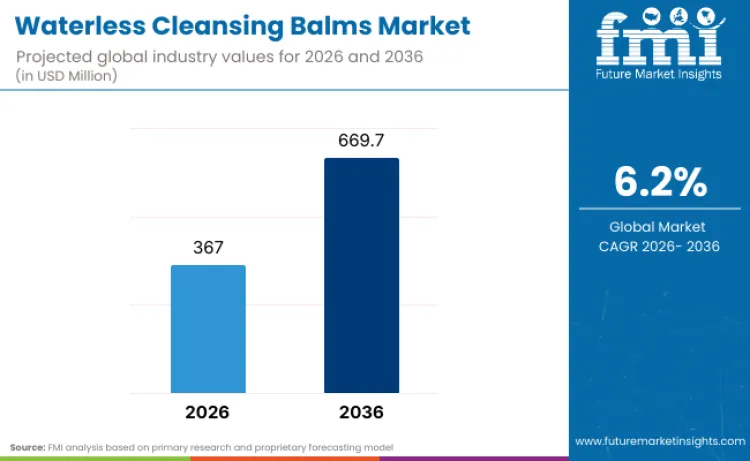
Waterless Cleansing Balms Market Key Takeaways
| Metric | Value |
|---|---|
| Market Value (2026) | USD 367.0 million |
| Market Forecast Value (2036) | USD 669.7 million |
| Forecast CAGR (2026-2036) | 6.2% |
Source: Future Market Insights’ proprietary forecasting model and primary research
Key Shifts in the Waterless Cleansing Balms Market During 2026 to 2036
Prior to 2026, waterless cleansing balms were positioned as niche alternatives to liquid cleansers, often marketed primarily for makeup removal but widely criticised for their greasy texture, difficult rinse-off, and the blurriness they caused around the eyes. Their limited functionality and lack of sensorial appeal created significant friction in daily routines. As a result, consumer adoption was largely confined to zero-waste retail environments or travel-specific formats, with few products demonstrating the reliability needed to become a skincare staple.
By 2026, the segment enters what FMI terms the Waterless Multi-Functionality Phase. This transition is driven by next-generation formulation logic that prioritises high active concentration and skin barrier compatibility, without relying on water, stabilisers, or fillers. Dove’s Serum Bar introduces 50x concentrated actives such as niacinamide and vitamin C, designed for measurable skin and hair performance. In parallel, P&G’s Gemz format employs a porous matrix of spun threads that dissolve instantly to deliver 100 percent active conditioning. These technologies reposition balms from single-use cleansing to multi-functional care within layered skin maintenance routines.
The manufacturing base evolves in lockstep. Lush implements its Jigsaw initiative to localise production and reduce exposure to raw material cost volatility, while Ethique restructures fulfilment operations to minimise air freight and lower Scope 3 emissions. Across the sector, ambient temperature processing becomes a core enabler of energy-efficient, ingredient-stable production. By 2036, waterless cleansing balms are integrated into mainstream regimens, delivering performance outcomes and sustainability benefits in equal measure.
What are the Various Segments of the Waterless Cleansing Balms Market?
The waterless cleansing balms market is segmented by product type into cleansing balms, foaming tablets, solid concentrates, cleansing oils, and powder bars; by formulation type into natural or botanical, organic-certified, and others; by price tier into premium or luxury, mid-range, and mass or economy; by target consumer into women, unisex, and men's grooming; by packaging format into solid bars or balms, tubes or jars, and pods or sachets; by distribution channel into online or e-commerce platforms, specialty stores, hypermarkets or supermarkets, and others; and by region into Asia Pacific (China, Japan, South Korea, India, Australia and New Zealand, ASEAN, rest of Asia Pacific), Europe (Germany, United Kingdom, France, Italy, Spain, Nordic, BENELUX, rest of Europe), North America (United States, Canada, Mexico), Latin America (Brazil, Chile, rest of Latin America), and Middle East and Africa (Kingdom of Saudi Arabia, other GCC countries, Turkey, South Africa, other African Union, rest of Middle East and Africa).
Which Product Type Holds the Largest Share in Waterless Cleansing Balms?
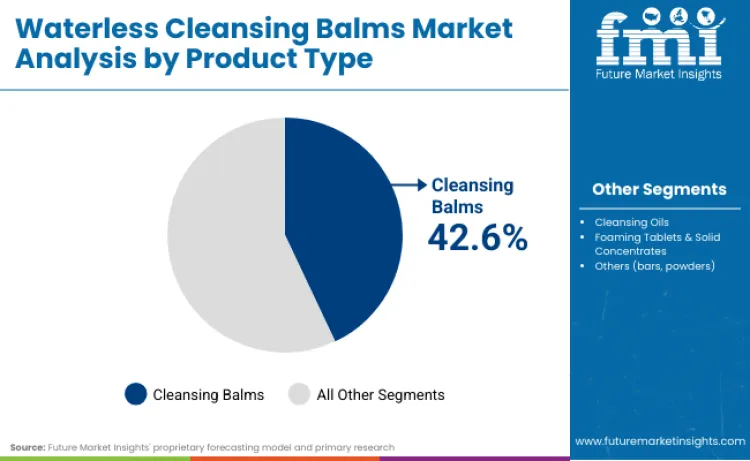
Cleansing balms lead the category with a 42.6% share, driven by their ability to combine efficacy, portability, and waterless formulation logic. L’Oréal S.A., through Garnier, is accelerating category scale by embedding high-potency actives into anhydrous delivery systems. “Garnier SkinActive Erase It All Makeup Cleansing Balm is a cleansing balm formulated with Vitamin C, utilizing anhydrous bases to deliver potent actives to cleanse and remove various types of longwear makeup and sunscreen residue.” Estée Lauder Companies, through Clinique, sets the industry standard in transformation architecture. “Take The Day Off™ Cleansing Balm, transforms from a solid balm into a silky oil upon application, using Safflower Seed Oil to break up natural oil found on skin and dissolve hard-to-remove makeup.” Brands like Earth Rhythm and SBTRCT deepen differentiation by removing water as a filler and focusing on active density. “SBTRCT skincare contains only nominal water content, never exceeding more than 5% of a formulation creating concentrated solid skincare for people who want to reduce environmental impact.”
Which Formulation Base Is Gaining Priority in Brand Portfolios?
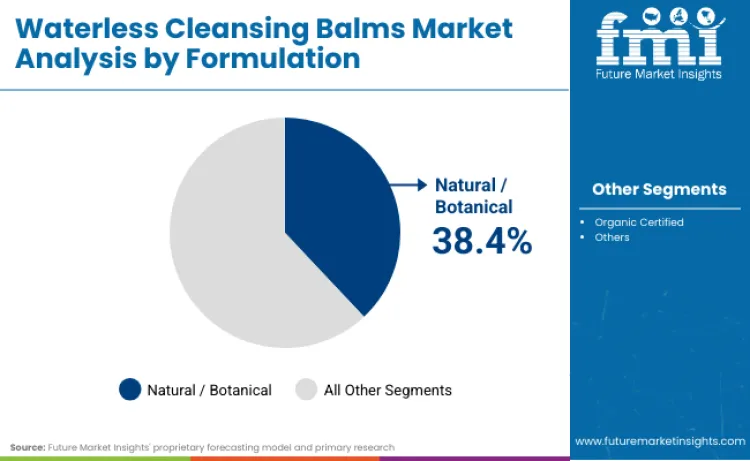
Formulations built around natural and botanical ingredient systems account for 38.4%, as brands shift toward skin-identical, plant-based alternatives that meet both performance and sustainability demands. Beiersdorf is leading this pivot by embedding renewable raw materials across its Nivea and Eucerin portfolios. “Often, natural and naturally derived ingredients that support our skin's natural functions are NIVEA's choice like the rapeseed oil or sunflower wax in our lip balm, sourced from fields that bloom every year keeping an open mind for the most sustainable solution.” These choices aim to ensure high compatibility for sensitive skin while phasing out petroleum-derived emollients. The supplier base reinforces this trend. “Create your unique formulation based on BASF Personal Care versatile ingredient portfolio comprising particularly plant-based surfactants like Coco-Glucoside for high-performing natural cleansers.” Croda also underpins the shift with infrastructure-grade ingredients. “Croda focuses on 100% bio-based surfactants and emulsifiers providing the non-oily dry emollience required for premium natural performance.”
What Structural Drivers Make Waterless Cleansing Balms Win Share?
Waterless cleansing balms gain structural advantage through logistics, regulation, and retail architecture. The primary operational driver is anhydrous concentration. Traditional liquid cleansers are 70 to 90 percent water. Removing water cuts final product weight by up to 60 percent, lowering last-mile delivery costs and fuel surcharges. Balms also increase pallet density due to smaller packaging, a key metric for Amazon FBA and subscription commerce. Regulatory shifts further reinforce this move. Under Extended Producer Responsibility (EPR) laws in the UK and EU, brands pay packaging fees based on recyclability. Balms typically use mono-material jars instead of multi-material plastic pumps, reducing tax exposure. Their low water activity means fewer preservatives, helping bypass synthetic entries in Annex V and simplifying Cosmetic Product Safety Report (CPSR) processes. These advantages shift balm adoption from trend to system logic: better logistics economics, lower compliance burden, and improved packaging efficiency across digital and physical retail channels.
Which Constraints Slow Adoption Even When Interest Exists?
Adoption faces barriers when supply chain risk or pricing logic interrupts the transition. Balms use oil-and-wax blends that are thermally sensitive. If shipping conditions exceed lipid melting points and cool slowly, the formula may crystallize, causing a gritty feel and increased returns. Second, waterless formats carry a higher upfront price because the formula contains 100 percent functional lipids rather than water as filler. While the cost-per-wash may be lower, consumers react to the higher initial purchase price, particularly in price-sensitive mass channels. This slows movement beyond prestige or boutique categories.
What Recent Shifts Explain Why Momentum Has Increased Lately?
Momentum builds as balms become normalized in routines and shelf space. The global double cleansing habit anchors balms as a first-step cleanser, transforming them from luxury to necessity. Retail listings in Ulta, Sephora, and Boots confirm this. At the same time, formulation leadership is regionalising. South Korea drives sensorial innovation with sherbet-style textures, while India blends Ayurvedic oil traditions into globally scaled balm manufacturing. As clean beauty platforms expand into subscription, pharmacy, and e-commerce ecosystems, the bar for balm usability rises, but so does their accessibility. The result: waterless cleansing balms are no longer fringe novelties. They are structurally advantaged formats aligned with policy, retail logic, and performance expectations.
How Is the Waterless Cleansing Balms Market Evolving Globally?
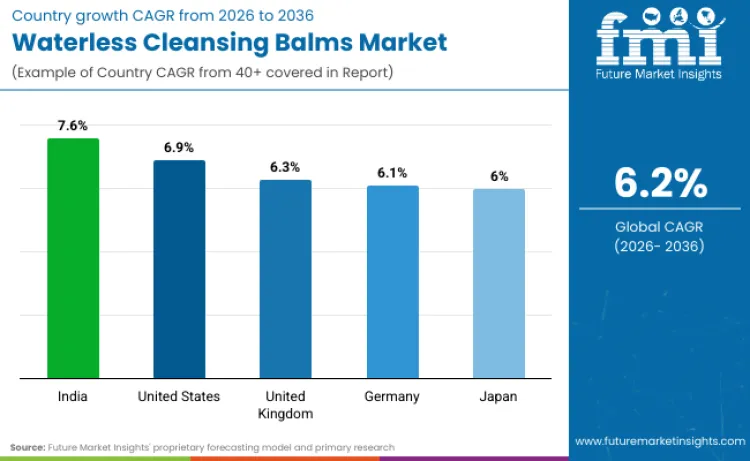
Global demand for waterless cleansing balms is rising as the category shifts from niche trial to routine replenishment, supported by formulation advances that make anhydrous, high concentration balms competitive on makeup removal efficiency, slip, moisture retention, skin compatibility, and balm longevity. Growth is increasingly anchored in performance-led conversion rather than eco positioning, with brands scaling syndet-based systems, smarter emulsifier blending, and stabilization platforms to deliver consistent results across skin types. Expansion is also being reinforced by retail mainstreaming and format normalization, as consumers encounter cleansing balms in mass premium doors and structured planograms, reducing discovery friction and increasing repeat purchase.
| Country | CAGR (2026-2036) |
|---|---|
| India | 7.6% |
| United States | 6.9% |
| United Kingdom | 6.3% |
| Germany | 6.1% |
| Japan | 6.0% |
Source: Future Market Insights analysis, supported by a proprietary forecasting model and primary research
United Kingdom Waterless Cleansing Balms Market Gaining Ground
The United Kingdom waterless cleansing balms market is projected to grow at a 6.3% CAGR from 2026 to 2036, supported by regulatory design that rewards low-packaging, low-water formats. The UK market is shifting toward waterless cleansing balms as a strategic response to the Plastic Packaging Tax and Extended Producer Responsibility (EPR). These policies penalize traditional personal care formats that rely on virgin plastic jars and high water content.
Large players like Unilever are pivoting to anhydrous (water-free) formulations to bypass tax exposure and reduce reporting burdens under the upcoming fee structures. “Extended Producer Responsibility (EPR) schemes – EPR for short – incentivise companies like Unilever, who sell packaged goods, to reduce their use of plastic packaging and make better packaging design choices.” Specialist players like SBTRCT reinforce this by offering “solid-to-balm” architectures that eliminate plastic entirely. “SBTRCT is 100% plastic free skincare... we urgently need to reduce the unnecessary use of water in our production processes and our formulations.”
Germany Waterless Cleansing Balms Market Normalized Through Drugstore Evaluation and Shelf Access
Germany’s waterless cleansing balms market is projected to grow at a 6.1% CAGR from 2026 to 2036, supported by high consumer standards for safety, sustainability, and proven performance. Growth is driven by the normalization of solid and water-free formats, commonly referred to as “Feste Reinigung”, within the country’s mainstream skincare routines. These products are no longer positioned as niche or experimental but are now regularly featured in everyday shopping environments, particularly in high-traffic drugstores.
A defining feature of the German market is its reliance on third-party certification and test-based validation. Consumers in Germany often rely on independent product evaluations to guide purchase decisions, especially in personal care. This preference for certified safety and environmental performance accelerates trust in newer waterless formats, helping them secure long-term shelf presence.
United States Waterless Cleansing Balms Market Anchored in Safety Verification
The United States waterless cleansing balms market is forecast to grow at a 6.9% CAGR between 2026 and 2036, driven by a strong institutional push for safety certification and chemical transparency. The US market is propelled by a demand for safety assurance, with the Environmental Working Group (EWG) serving as the primary authority. The EWG Verified® seal is a critical benchmark for waterless cleansing balms, ensuring they are free from nearly 2,000 banned substances.
“The EWG Verified® mark means a product meets EWG's strictest criteria for transparency and health.” “EWG will license only those products that fully disclose their ingredients. This provision includes, but is not limited to, complete disclosure of fragrance and flavor mixtures.” “When you see the EWG Verified® mark on a product, you can be sure it's free from EWG's chemicals of concern and meets our strictest standards for your health.” Major retailers like Target and Ulta leverage this trust by merchandising waterless balms within “Clean” or “Conscious Beauty” hubs, positioning them as science-backed solutions for makeup removal.
India Waterless Cleansing Balms Market Shaped by Plastic Waste Management Rules
India’s waterless cleansing balms market is expected to grow at a 7.6% CAGR from 2026 to 2036, supported by regulation-first innovation and homegrown execution. The Indian market for waterless cleansing balms is expanding as a direct response to the Plastic Waste Management (Amendment) Rules 2024, which have introduced stricter definitions for biodegradable plastics and increased accountability for Extended Producer Responsibility (EPR). These regulations target microplastics and non-recyclable multi-layered packaging, creating a “compliance premium” for traditional liquid cleansers.
“The Plastic Waste Management (Amendment) Rules, 2024 target microplastics and setting stricter criteria for biodegradable plastics. Biodegradable plastics are now defined as materials capable of degradation without leaving any microplastics.” Homegrown brands like Earth Rhythm have capitalized on this by launching super-concentrated, “solid-to-balm” formulations that utilize compostable, plastic-free packaging, effectively decoupling growth from plastic waste. “We're on a mission to rid the world of plastic waste while offering our customers 100% sustainable, ethically sourced products. We use biodegradable ingredients and compostable packaging so all our solid bars leave no trace.”
Japan Waterless Cleansing Balms Market Aligns with Resource Circulation Law
Japan’s waterless cleansing balms market is projected to grow at a 6.0% CAGR from 2026 to 2036, structured by policy mandates and cultural norms. In Japan, the waterless cleansing balm market is being reshaped by the Act on Promotion of Resource Circulation for Plastics (2022), which mandates that businesses reduce single-use plastics and promotes a circular economy.
“The law requires not only businesses and the local government but also consumers to work together and take concrete actions to reduce plastic waste, especially single-use plastics cosmetic containers are eligible for collecting and recycling.” Major players like Kao Corporation and Shiseido are under increasing pressure to meet 2030 targets for recycled plastic use and waste reduction. “Kao is aiming to achieve net zero waste for plastic packaging and negative waste (recycling more than the amount of plastic packaging used) by 2050. Quantity of fossil-based plastics used in packaging will peak and begin to decline by 2030.” This policy convergence with the national “Mottainai” (waste-not) philosophy anchors balm adoption inside Japan’s mainstream beauty and quasi-drug markets.
Which Leading Companies are Expanding Their Presence in the Waterless Cleansing Balms Market?
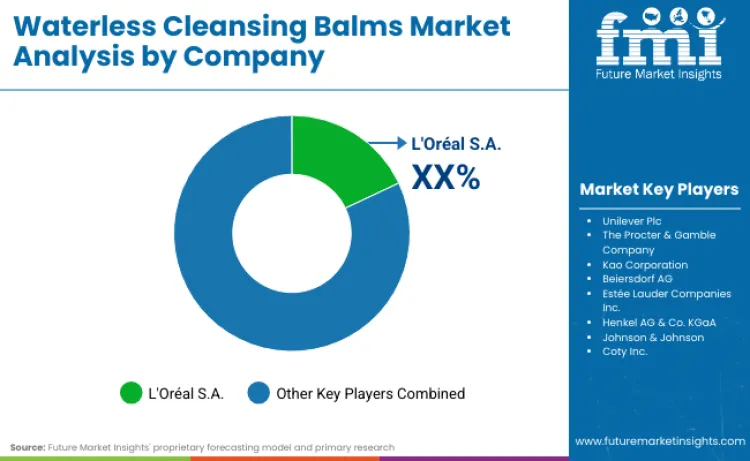
Global expansion in waterless cleansing balms is being driven by companies that already control cleansing routines and can reposition balms as performance essentials rather than sustainability novelties. L’Oréal S.A. leads through its ability to industrialize anhydrous formulation science across dermocosmetic and premium brands, supported by wide retail normalization that places balms alongside liquid cleansers in everyday routines. Its Green Sciences platform aligns waterless formats with low energy manufacturing and circular packaging logic, reinforcing scale adoption. Unilever Plc expands aggressively through Dove and Love Beauty and Planet, focusing on climate resilient textures and mass price accessibility that support high household turnover.
In Asia, formulation leadership comes from Kao Corporation and Shiseido, where sensitive skin compatibility, quasi drug positioning, and emulsification precision strengthen consumer trust.
Prestige and mass dermal science is reinforced by Estée Lauder Companies and Beiersdorf AG, which extend biodegradable and emulsified balm systems through Clinique and NIVEA. The competitive landscape divides between system owners shaping cleansing behavior at scale and volume players that follow once balm usage becomes routine.
Key Players in the Waterless Cleansing Balms Market
- L'Oréal S.A.
- Unilever Plc
- Procter & Gamble
- Kao Corporation
- Shiseido
- Estée Lauder Companies Inc.
- Beiersdorf AG
- Henkel
- Coty
- Revlon
- Johnson & Johnson
- Avon
- Oriflame
- Earth Rhythm
- SBTRCT
Market Definition
The waterless cleansing balms market refers to revenues generated from solid and anhydrous facial cleansing products formulated in balm, bar, or pressed solid formats and sold for routine facial cleansing. These products are engineered to remove makeup, sunscreen, excess sebum, particulate matter, and surface impurities while maintaining skin comfort, without relying on water-based carriers or liquid dilution during formulation. The category includes only rinse-off products intended for facial cleansing as a primary function.
Market size is measured in USD million and evaluated across the 2026 to 2036 forecast period. Waterless cleansing balms are treated as a standalone skincare category due to their distinct formulation logic, usage behavior, and manufacturing processes. The market excludes theoretical or adjacent cleansing concepts and accounts only for products commercially marketed, priced, and used as facial cleansers. Revenues are attributed solely to finished consumer-facing products sold through recognized retail, professional, or institutional channels.
Market Inclusion
The market includes finished, ready-to-use waterless facial cleansing products sold through online platforms, specialty beauty retailers, pharmacies, professional spa channels, hospitality supply chains, and direct-to-consumer distribution. Included formats comprise solid cleansing balms, balm sticks, foaming tablets, solid concentrates, and function-specific cleansing bars designed for repeated consumer or professional use.
Eligible products utilize surfactant-based cleansing systems, emulsifying balm matrices, botanical oil blends, essential oil complexes, and performance-driven formulations that activate during application and rinsing rather than during manufacturing. Revenues from cleansing balms sold individually or within bundled skincare routines, travel kits, or subscription programs are included when the cleansing component is distinctly identified and monetized. The scope covers global demand across North America, Europe, Asia Pacific, Latin America, and the Middle East and Africa, with country-level analysis where retail normalization, regulatory structure, or brand concentration materially influences adoption.
Market Exclusion
The market excludes liquid, gel, foam, lotion, or cream-based facial cleansers regardless of packaging type or concentration level. Moisturizing balms, treatment balms, lip balms, exfoliating balms, leave-on cleansing products, soap bars, and hybrid cleansing-moisturizing formats are not included unless the primary marketed and functional purpose is rinse-off facial cleansing.
The scope also excludes DIY cleansing formulations, bulk professional treatments not sold in individual solid balm form, and experimental or prototype products without established commercial distribution. Single-use dissolvable sheets, wipes, or tablets intended for one-time application are excluded unless marketed for repeated use as waterless cleansing balms. Accessories, refill containers sold without active product, packaging substitutes, and products where cleansing performance is secondary to another skincare function fall outside the defined market boundary.
Scope of the Report
| Items | Values |
|---|---|
| Quantitative Units | USD million |
| Product Type | Cleansing Balms; Foaming Tablets; Solid Concentrates; Cleansing Oils; Powder Bars |
| Formulation Type | Natural/Botanical; Organic-Certified; Others |
| Price Tier | Premium/Luxury; Mid-Range; Mass/Economy |
| Target Consumer | Women; Unisex; Men's Grooming |
| Packaging Format | Solid Bars/Balms; Tubes/Jars; Pods/Sachets |
| Distribution Channel | Online/E-commerce; Specialty Stores; Hypermarkets/Supermarkets |
| Regions Covered | North America, Europe, Asia Pacific, Latin America, Middle East & Africa |
| Countries Covered | India, United States, United Kingdom, Germany, Japan, and 40+ countries |
| Key Companies Profiled | L'Oréal S.A.; Unilever Plc; Procter & Gamble; Kao Corporation; Shiseido; Others |
| Additional Attributes | Dollar sales by product type, formulation, price tier, and distribution channel; performance benchmarking across cleansing efficacy, skin compatibility, format convenience, and balm longevity; consumer adoption drivers linked to performance parity with liquid cleansers and packaging reduction compliance; impact on packaging reduction, replenishment frequency, and repeat purchase behavior; supply chain efficiency under waterless beauty manufacturing models; compatibility with spa standards, retail planograms, and regulatory targets across personal care ecosystems |
Waterless Cleansing Balms Market by Segment
Product Type:
- Cleansing Balms
- Foaming Tablets
- Solid Concentrates
- Cleansing Oils
- Powder Bars
Formulation Type:
- Natural/Botanical
- Organic-Certified
- Others
Price Tier:
- Premium/Luxury
- Mid-Range
- Mass/Economy
Target Consumer:
- Women
- Unisex
- Men's Grooming
Packaging Format:
- Solid Bars/Balms
- Tubes/Jars
- Pods/Sachets
Distribution Channel:
- Online/E-commerce
- Specialty Stores
- Hypermarkets/Supermarkets
Region:
- Asia Pacific
- China
- Japan
- South Korea
- India
- Australia & New Zealand
- ASEAN
- Rest of Asia Pacific
- Europe
- Germany
- United Kingdom
- France
- Italy
- Spain
- Nordic
- BENELUX
- Rest of Europe
- North America
- USA
- Canada
- Mexico
- Latin America
- Brazil
- Chile
- Rest of Latin America
- Middle East & Africa
- Kingdom of Saudi Arabia
- Other GCC Countries
- Turkey
- South Africa
- Other African Union
- Rest of Middle East & Africa
Bibliography
- European Commission. (2023). A European strategy for plastics in a circular economy and packaging waste framework updates. European Commission.
- UK Department for Environment, Food & Rural Affairs. (2024). Extended Producer Responsibility (EPR) for packaging: Policy framework. GOV.UK.
- Government of India, Ministry of Environment, Forest and Climate Change. (2025). Water-efficient manufacturing and sustainability compliance guidelines for consumer goods. Government of India.
Frequently Asked Questions
How big is the global waterless cleansing balms market?
The global waterless cleansing balms market is valued at USD 367.0 million in 2026 and is forecast to reach USD 669.7 million by 2036.
What is the growth outlook for the waterless cleansing balms market over the next 10 years?
The category is projected to expand at a 6.2% CAGR from 2026 to 2036, reflecting accelerating conversion from liquid cleansers to concentrated waterless formats.
Which product segments drive demand in this market?
Cleansing balms lead demand with a 42.6% share, supported by broad suitability across makeup removal, sensitive skin, and deep cleansing routines.
How does consumer behavior differ by region?
Adoption is strongest where performance-led balms are retail-normalized fastest, with India (7.6% CAGR), the United States (6.9%), the United Kingdom (6.3%), Germany (6.1%), and Japan (6.0%) outpacing the global baseline during 2026-2036.
What are the main risks and constraints affecting this market?
Growth is constrained where consumers perceive weaker cleansing efficacy, inconsistent results across skin types, or higher price-per-use versus liquid alternatives, reducing repeat purchase.
Preview the report firsthand - request a free sample
Get SampleGet the brochure for pricing and purchase details.
Get PDFTable of Content
- Executive Summary
- Global Market Outlook
- Demand Side Trends
- Supply Side Trends
- Technology Roadmap Analysis
- Analysis and Recommendations
- Market Overview
- Market Coverage / Taxonomy
- Market Definition / Scope / Limitations
- Research Methodology
- Chapter Orientation
- Analytical Lens and Working Hypotheses
- Market Structure, Signals, and Trend Drivers
- Benchmarking and Cross-market Comparability
- Market Sizing, Forecasting, and Opportunity Mapping
- Research Design and Evidence Framework
- Desk Research Programme (Secondary Evidence)
- Company Annual and Sustainability Reports
- Peer-reviewed Journals and Academic Literature
- Corporate Websites, Product Literature, and Technical Notes
- Earnings Decks and Investor Briefings
- Statutory Filings and Regulatory Disclosures
- Technical White Papers and Standards Notes
- Trade Journals, Industry Magazines, and Analyst Briefs
- Conference Proceedings, Webinars, and Seminar Materials
- Government Statistics Portals and Public Data Releases
- Press Releases and Reputable Media Coverage
- Specialist Newsletters and Curated Briefings
- Sector Databases and Reference Repositories
- Roots Internal Knowledge Base and Historical Datasets
- Subscription Datasets and Paid Sources
- Social Channels, Communities, and Digital Listening Inputs
- Additional Desk Sources
- Expert Input and Fieldwork (Primary Evidence)
- Primary Modes
- Qualitative Interviews and Expert Elicitation
- Quantitative Surveys and Structured Data Capture
- Blended Approach
- Why Primary Evidence is Used
- Field Techniques
- Interviews
- Surveys
- Focus Groups
- Observational and In-context Research
- Social and Community Interactions
- Stakeholder Universe Engaged
- C-suite Leaders
- Board Members
- Presidents and Vice Presidents
- R&D and Innovation Heads
- Technical Specialists
- Domain Subject-matter Experts
- Scientists
- Physicians and Other Healthcare Professionals
- Governance, Ethics, and Data Stewardship
- Research Ethics
- Data Integrity and Handling
- Primary Modes
- Tooling, Models, and Reference Databases
- Desk Research Programme (Secondary Evidence)
- Data Engineering and Model Build
- Data Acquisition and Ingestion
- Cleaning, Normalisation, and Verification
- Synthesis, Triangulation, and Analysis
- Quality Assurance and Audit Trail
- Market Background
- Market Dynamics
- Drivers
- Restraints
- Opportunity
- Trends
- Scenario Forecast
- Demand in Optimistic Scenario
- Demand in Likely Scenario
- Demand in Conservative Scenario
- Opportunity Map Analysis
- Product Life Cycle Analysis
- Supply Chain Analysis
- Investment Feasibility Matrix
- Value Chain Analysis
- PESTLE and Porter's Analysis
- Regulatory Landscape
- Regional Parent Market Outlook
- Production and Consumption Statistics
- Import and Export Statistics
- Market Dynamics
- Global Market Analysis 2021 to 2025 and Forecast, 2026 to 2036
- Historical Market Size Value (USD Million) Analysis, 2021 to 2025
- Current and Future Market Size Value (USD Million) Projections, 2026 to 2036
- Y-o-Y Growth Trend Analysis
- Absolute $ Opportunity Analysis
- Global Market Pricing Analysis 2021 to 2025 and Forecast 2026 to 2036
- Y-o-Y Growth Trend Analysis 2021 to 2025
- Absolute $ Opportunity Analysis 2026 to 2036
- Global Market Analysis 2021 to 2025 and Forecast 2026 to 2036, By Product Type
- Introduction / Key Findings
- Historical Market Size Value (USD Million) Analysis By Product Type, 2021 to 2025
- Current and Future Market Size Value (USD Million) Analysis and Forecast By Product Type, 2026 to 2036
- Cleansing Balms
- Foaming Tablets
- Solid Concentrates
- Cleansing Oils
- Powder Bars
- Y-o-Y Growth Trend Analysis By Product Type, 2021 to 2025
- Absolute $ Opportunity Analysis By Product Type, 2026 to 2036
- Global Market Analysis 2021 to 2025 and Forecast 2026 to 2036, By Formulation Type
- Introduction / Key Findings
- Historical Market Size Value (USD Million) Analysis By Formulation Type, 2021 to 2025
- Current and Future Market Size Value (USD Million) Analysis and Forecast By Formulation Type, 2026 to 2036
- Natural/Botanical
- Organic-Certified
- Others
- Y-o-Y Growth Trend Analysis By Formulation Type, 2021 to 2025
- Absolute $ Opportunity Analysis By Formulation Type, 2026 to 2036
- Global Market Analysis 2021 to 2025 and Forecast 2026 to 2036, By Price Tier
- Introduction / Key Findings
- Historical Market Size Value (USD Million) Analysis By Price Tier, 2021 to 2025
- Current and Future Market Size Value (USD Million) Analysis and Forecast By Price Tier, 2026 to 2036
- Premium/Luxury
- Mid-Range
- Mass/Economy
- Y-o-Y Growth Trend Analysis By Price Tier, 2021 to 2025
- Absolute $ Opportunity Analysis By Price Tier, 2026 to 2036
- Global Market Analysis 2021 to 2025 and Forecast 2026 to 2036, By Target Consumer
- Introduction / Key Findings
- Historical Market Size Value (USD Million) Analysis By Target Consumer, 2021 to 2025
- Current and Future Market Size Value (USD Million) Analysis and Forecast By Target Consumer, 2026 to 2036
- Women
- Unisex
- Men's Grooming
- Y-o-Y Growth Trend Analysis By Target Consumer, 2021 to 2025
- Absolute $ Opportunity Analysis By Target Consumer, 2026 to 2036
- Global Market Analysis 2021 to 2025 and Forecast 2026 to 2036, By Packaging Format
- Introduction / Key Findings
- Historical Market Size Value (USD Million) Analysis By Packaging Format, 2021 to 2025
- Current and Future Market Size Value (USD Million) Analysis and Forecast By Packaging Format, 2026 to 2036
- Solid Bars/Balms
- Tubes/Jars
- Pods/Sachets
- Y-o-Y Growth Trend Analysis By Packaging Format, 2021 to 2025
- Absolute $ Opportunity Analysis By Packaging Format, 2026 to 2036
- Global Market Analysis 2021 to 2025 and Forecast 2026 to 2036, By Distribution Channel
- Introduction / Key Findings
- Historical Market Size Value (USD Million) Analysis By Distribution Channel, 2021 to 2025
- Current and Future Market Size Value (USD Million) Analysis and Forecast By Distribution Channel, 2026 to 2036
- Online/E-commerce
- Specialty Stores
- Hypermarkets/Supermarkets
- Y-o-Y Growth Trend Analysis By Distribution Channel, 2021 to 2025
- Absolute $ Opportunity Analysis By Distribution Channel, 2026 to 2036
- Global Market Analysis 2021 to 2025 and Forecast 2026 to 2036, By Region
- Introduction
- Historical Market Size Value (USD Million) Analysis By Region, 2021 to 2025
- Current Market Size Value (USD Million) Analysis and Forecast By Region, 2026 to 2036
- North America
- Latin America
- Western Europe
- Eastern Europe
- East Asia
- South Asia and Pacific
- Middle East & Africa
- Market Attractiveness Analysis By Region
- North America Market Analysis 2021 to 2025 and Forecast 2026 to 2036, By Country
- Historical Market Size Value (USD Million) Trend Analysis By Market Taxonomy, 2021 to 2025
- Market Size Value (USD Million) Forecast By Market Taxonomy, 2026 to 2036
- By Country
- USA
- Canada
- Mexico
- By Product Type
- By Formulation Type
- By Price Tier
- By Target Consumer
- By Packaging Format
- By Distribution Channel
- By Country
- Market Attractiveness Analysis
- By Country
- By Product Type
- By Formulation Type
- By Price Tier
- By Target Consumer
- By Packaging Format
- By Distribution Channel
- Key Takeaways
- Latin America Market Analysis 2021 to 2025 and Forecast 2026 to 2036, By Country
- Historical Market Size Value (USD Million) Trend Analysis By Market Taxonomy, 2021 to 2025
- Market Size Value (USD Million) Forecast By Market Taxonomy, 2026 to 2036
- By Country
- Brazil
- Chile
- Rest of Latin America
- By Product Type
- By Formulation Type
- By Price Tier
- By Target Consumer
- By Packaging Format
- By Distribution Channel
- By Country
- Market Attractiveness Analysis
- By Country
- By Product Type
- By Formulation Type
- By Price Tier
- By Target Consumer
- By Packaging Format
- By Distribution Channel
- Key Takeaways
- Western Europe Market Analysis 2021 to 2025 and Forecast 2026 to 2036, By Country
- Historical Market Size Value (USD Million) Trend Analysis By Market Taxonomy, 2021 to 2025
- Market Size Value (USD Million) Forecast By Market Taxonomy, 2026 to 2036
- By Country
- Germany
- UK
- Italy
- Spain
- France
- Nordic
- BENELUX
- Rest of Western Europe
- By Product Type
- By Formulation Type
- By Price Tier
- By Target Consumer
- By Packaging Format
- By Distribution Channel
- By Country
- Market Attractiveness Analysis
- By Country
- By Product Type
- By Formulation Type
- By Price Tier
- By Target Consumer
- By Packaging Format
- By Distribution Channel
- Key Takeaways
- Eastern Europe Market Analysis 2021 to 2025 and Forecast 2026 to 2036, By Country
- Historical Market Size Value (USD Million) Trend Analysis By Market Taxonomy, 2021 to 2025
- Market Size Value (USD Million) Forecast By Market Taxonomy, 2026 to 2036
- By Country
- Russia
- Poland
- Hungary
- Balkan & Baltic
- Rest of Eastern Europe
- By Product Type
- By Formulation Type
- By Price Tier
- By Target Consumer
- By Packaging Format
- By Distribution Channel
- By Country
- Market Attractiveness Analysis
- By Country
- By Product Type
- By Formulation Type
- By Price Tier
- By Target Consumer
- By Packaging Format
- By Distribution Channel
- Key Takeaways
- East Asia Market Analysis 2021 to 2025 and Forecast 2026 to 2036, By Country
- Historical Market Size Value (USD Million) Trend Analysis By Market Taxonomy, 2021 to 2025
- Market Size Value (USD Million) Forecast By Market Taxonomy, 2026 to 2036
- By Country
- China
- Japan
- South Korea
- By Product Type
- By Formulation Type
- By Price Tier
- By Target Consumer
- By Packaging Format
- By Distribution Channel
- By Country
- Market Attractiveness Analysis
- By Country
- By Product Type
- By Formulation Type
- By Price Tier
- By Target Consumer
- By Packaging Format
- By Distribution Channel
- Key Takeaways
- South Asia and Pacific Market Analysis 2021 to 2025 and Forecast 2026 to 2036, By Country
- Historical Market Size Value (USD Million) Trend Analysis By Market Taxonomy, 2021 to 2025
- Market Size Value (USD Million) Forecast By Market Taxonomy, 2026 to 2036
- By Country
- India
- ASEAN
- Australia & New Zealand
- Rest of South Asia and Pacific
- By Product Type
- By Formulation Type
- By Price Tier
- By Target Consumer
- By Packaging Format
- By Distribution Channel
- By Country
- Market Attractiveness Analysis
- By Country
- By Product Type
- By Formulation Type
- By Price Tier
- By Target Consumer
- By Packaging Format
- By Distribution Channel
- Key Takeaways
- Middle East & Africa Market Analysis 2021 to 2025 and Forecast 2026 to 2036, By Country
- Historical Market Size Value (USD Million) Trend Analysis By Market Taxonomy, 2021 to 2025
- Market Size Value (USD Million) Forecast By Market Taxonomy, 2026 to 2036
- By Country
- Kingdom of Saudi Arabia
- Other GCC Countries
- Turkiye
- South Africa
- Other African Union
- Rest of Middle East & Africa
- By Product Type
- By Formulation Type
- By Price Tier
- By Target Consumer
- By Packaging Format
- By Distribution Channel
- By Country
- Market Attractiveness Analysis
- By Country
- By Product Type
- By Formulation Type
- By Price Tier
- By Target Consumer
- By Packaging Format
- By Distribution Channel
- Key Takeaways
- Key Countries Market Analysis
- USA
- Pricing Analysis
- Market Share Analysis, 2025
- By Product Type
- By Formulation Type
- By Price Tier
- By Target Consumer
- By Packaging Format
- By Distribution Channel
- Canada
- Pricing Analysis
- Market Share Analysis, 2025
- By Product Type
- By Formulation Type
- By Price Tier
- By Target Consumer
- By Packaging Format
- By Distribution Channel
- Mexico
- Pricing Analysis
- Market Share Analysis, 2025
- By Product Type
- By Formulation Type
- By Price Tier
- By Target Consumer
- By Packaging Format
- By Distribution Channel
- Brazil
- Pricing Analysis
- Market Share Analysis, 2025
- By Product Type
- By Formulation Type
- By Price Tier
- By Target Consumer
- By Packaging Format
- By Distribution Channel
- Chile
- Pricing Analysis
- Market Share Analysis, 2025
- By Product Type
- By Formulation Type
- By Price Tier
- By Target Consumer
- By Packaging Format
- By Distribution Channel
- Germany
- Pricing Analysis
- Market Share Analysis, 2025
- By Product Type
- By Formulation Type
- By Price Tier
- By Target Consumer
- By Packaging Format
- By Distribution Channel
- UK
- Pricing Analysis
- Market Share Analysis, 2025
- By Product Type
- By Formulation Type
- By Price Tier
- By Target Consumer
- By Packaging Format
- By Distribution Channel
- Italy
- Pricing Analysis
- Market Share Analysis, 2025
- By Product Type
- By Formulation Type
- By Price Tier
- By Target Consumer
- By Packaging Format
- By Distribution Channel
- Spain
- Pricing Analysis
- Market Share Analysis, 2025
- By Product Type
- By Formulation Type
- By Price Tier
- By Target Consumer
- By Packaging Format
- By Distribution Channel
- France
- Pricing Analysis
- Market Share Analysis, 2025
- By Product Type
- By Formulation Type
- By Price Tier
- By Target Consumer
- By Packaging Format
- By Distribution Channel
- India
- Pricing Analysis
- Market Share Analysis, 2025
- By Product Type
- By Formulation Type
- By Price Tier
- By Target Consumer
- By Packaging Format
- By Distribution Channel
- ASEAN
- Pricing Analysis
- Market Share Analysis, 2025
- By Product Type
- By Formulation Type
- By Price Tier
- By Target Consumer
- By Packaging Format
- By Distribution Channel
- Australia & New Zealand
- Pricing Analysis
- Market Share Analysis, 2025
- By Product Type
- By Formulation Type
- By Price Tier
- By Target Consumer
- By Packaging Format
- By Distribution Channel
- China
- Pricing Analysis
- Market Share Analysis, 2025
- By Product Type
- By Formulation Type
- By Price Tier
- By Target Consumer
- By Packaging Format
- By Distribution Channel
- Japan
- Pricing Analysis
- Market Share Analysis, 2025
- By Product Type
- By Formulation Type
- By Price Tier
- By Target Consumer
- By Packaging Format
- By Distribution Channel
- South Korea
- Pricing Analysis
- Market Share Analysis, 2025
- By Product Type
- By Formulation Type
- By Price Tier
- By Target Consumer
- By Packaging Format
- By Distribution Channel
- Russia
- Pricing Analysis
- Market Share Analysis, 2025
- By Product Type
- By Formulation Type
- By Price Tier
- By Target Consumer
- By Packaging Format
- By Distribution Channel
- Poland
- Pricing Analysis
- Market Share Analysis, 2025
- By Product Type
- By Formulation Type
- By Price Tier
- By Target Consumer
- By Packaging Format
- By Distribution Channel
- Hungary
- Pricing Analysis
- Market Share Analysis, 2025
- By Product Type
- By Formulation Type
- By Price Tier
- By Target Consumer
- By Packaging Format
- By Distribution Channel
- Kingdom of Saudi Arabia
- Pricing Analysis
- Market Share Analysis, 2025
- By Product Type
- By Formulation Type
- By Price Tier
- By Target Consumer
- By Packaging Format
- By Distribution Channel
- Turkiye
- Pricing Analysis
- Market Share Analysis, 2025
- By Product Type
- By Formulation Type
- By Price Tier
- By Target Consumer
- By Packaging Format
- By Distribution Channel
- South Africa
- Pricing Analysis
- Market Share Analysis, 2025
- By Product Type
- By Formulation Type
- By Price Tier
- By Target Consumer
- By Packaging Format
- By Distribution Channel
- USA
- Market Structure Analysis
- Competition Dashboard
- Competition Benchmarking
- Market Share Analysis of Top Players
- By Regional
- By Product Type
- By Formulation Type
- By Price Tier
- By Target Consumer
- By Packaging Format
- By Distribution Channel
- Competition Analysis
- Competition Deep Dive
- L'Oréal S.A.
- Unilever Plc
- Procter & Gamble
- Kao Corporation
- Shiseido
- Estée Lauder Companies Inc.
- Beiersdorf AG
- Henkel
- Coty
- Revlon
- Competition Deep Dive
- Assumptions & Acronyms Used


