

- Industry Size (2026)
- USD 1.3 Bn
- Forecast (2036)
- USD 3.2 Bn
- CAGR (2026 to 2036)
- 9.2%
Clay-Based Cleansing Bars Market Forecast and Outlook 2026 to 2036
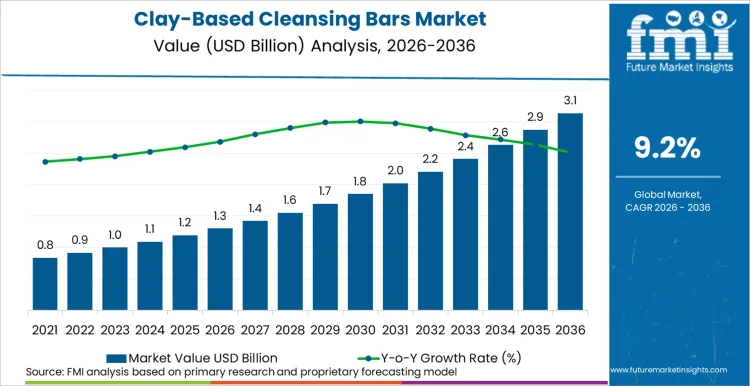
Future Market Insights anticipates robust growth in the clay-based cleansing bars market over the 2026 to 2036 period, with the market expanding from USD 1.3 billion in 2026 to USD 3.2 billion by 2036, registering a 9.20% CAGR. This growth trajectory reflects a decisive shift in consumer purchasing behaviour toward ingredient transparency, where a strong “read the label” culture prioritises clean, recognisable, and plant-derived components such as mineral clays, botanical milks, and naturally sourced exfoliants. FMI notes that clay-based bars are increasingly viewed as intentional, high-performance cleansing solutions rather than minimalist substitutes.
Market acceleration is further supported by the ongoing transition from synthetic detergent systems toward solid beauty formats designed to protect and reinforce skin barrier integrity. According to FMI’s analysis, surfactant systems that exhibit minimal interaction with skin lipids and proteins are widely perceived as gentler, elevating clay-based syndet bars and naturally formulated cleansing bars into premium positioning. This shift is reshaping formulation strategies, with dermatological mildness, barrier compatibility, and low-irritation performance emerging as critical competitive benchmarks.
Future Market Insights highlights that major beauty companies are actively realigning innovation pipelines and portfolio strategies to capture this reformulation-led demand. Environmental stewardship, solid-format adoption, and ingredient simplification are increasingly embedded within long-term growth and profitability agendas, influencing investment priorities and product architecture across global personal care portfolios.
“As we transform our company to better capture growth and drive profitability, we remain steadfast in our commitment to advancing environmental stewardship and social impact” said Stéphane de La Faverie, President and Chief Executive Officer, The Estée Lauder Companies.
Summary of Clay-Based Cleansing Bars Market
What Is Growth Outlook for Clay-Based Cleansing Bars Market as per Future Market Insights Projection? Future Market Insights projects the clay-based cleansing bars market to expand at a 9.2% CAGR from 2026 to 2036, growing from USD 1.3 Billion in 2026 to USD 3.2 Billion by 2036. FMI Research Approach: FMI proprietary forecasting model based on solid beauty adoption rates, premium skincare conversion, and ingredient-led reformulation trends.
How Do FMI Analysts Perceive Clay-Based Cleansing Bars Market to Evolve? FMI analysts perceive the market evolving toward treatment-grade, pH-balanced solid cleansers where mineral efficacy, barrier compatibility, and ingredient transparency replace foaming intensity as performance benchmarks. FMI Research Approach: Evaluation of syndet innovation, regulatory maturation in ingredient disclosure, and dermatology-aligned formulation pipelines.
Which Country Holds Largest Share in Global Clay-Based Cleansing Bars Market? China holds a leading share in the global clay-based cleansing bars market due to strong cultural acceptance of mineral skincare, pollution-driven oil-control demand, and rapid digital retail scale-up. FMI Research Approach: FMI country-level modeling using skincare routine penetration, mineral ingredient acceptance, and e-commerce velocity indicators.
How Large Will Clay-Based Cleansing Bars Market Be by 2036? The global clay-based cleansing bars market is projected to reach USD 3.2 Billion by 2036 as solid, waterless cleansing formats move into mainstream daily skincare routines. FMI Research Approach: Long-term revenue forecasting derived from solid beauty penetration curves and replacement of liquid cleansers.
What Is Definition of Clay-Based Cleansing Bars Market? The clay-based cleansing bars market comprises solid facial and body cleansers formulated with functional mineral or natural clays to deliver oil regulation, impurity removal, and barrier-support cleansing in waterless formats. FMI Research Approach: FMI market taxonomy and inclusion-exclusion framework for solid skincare products using clay as a primary active.
What Are Globally Unique Trends Shaping Clay-Based Cleansing Bars Market? Globally unique trends include waterless beauty adoption, premiumisation of solid skincare, pH-balanced syndet reformulation, and differentiation through rare or region-specific mineral clays. FMI Research Approach: Cross-regional analysis of sustainability mandates, clinical substantiation requirements, and solid-format skincare innovation.
Clay-Based Cleansing Bars Market Key Takeaways
| Metric | Details |
|---|---|
| Industry Size (2026) | USD 1.3 Billion |
| Industry Value (2036) | USD 3.2 Billion |
| CAGR (2026-2036) | 9.2% |
Source: Future Market Insights (FMI) analysis, based on proprietary forecasting model and primary research
Which Factors Drive Clay-Based Cleansing Bars Adoption?
Premiumisation in the cleansing category is being driven by rising consumer expectations around sensorial quality, ingredient provenance, and functional nourishment in solid formats. As liquid soaps face scrutiny for dilution and overuse of synthetic detergents, consumers are gravitating toward concentrated, waterless bars that deliver visible performance with fewer ingredients. This shift is reinforcing clay-based cleansing bars as high-efficacy solutions that combine deep cleansing with skin comfort, elevating bars from basic hygiene products to premium skincare experiences.
Mele Melero, Global VP of Dove Skin Cleansing, captured this premium shift with the industry maxim: “We immediately knew Dove Plant Milk Cleansing Bars could set a new standard for what consumers should expect from a premium bar — an elevated sensorial experience while providing the superior nourishment you know and love.” This drive for efficiency and performance is accelerating a fundamental transition from diluted liquid soaps to potent solid formulations that utilise functional ingredients such as Amazonian White Clay, positioned to penetrate deep into pores and remove impurities and excess oil without compromising barrier health.
Ethique validated this new direction by demonstrating that solid bar formats can eliminate the need for bottles entirely, noting that “the brand's plastic-free solid format represents genuine sustainability innovation backed by transparent impact reporting.” The integration of concentrated solid formulations allows brands to triage environmental impact more rapidly, ensuring that resources are allocated to active ingredients rather than water weight, having “already saved over 37 million plastic bottles and 20 million liters of water.”
How is the Clay-Based Cleansing Bars Market Segmented?
The clay-based cleansing bars market is segmented by product type, ingredient type, packaging type, target consumer profile, price range, and country to reflect how formulation architecture and consumer positioning shape adoption. By product type, the market includes hydrating, exfoliating, detoxifying, soothing, and foaming clay cleansers that serve distinct cleansing and skin-conditioning needs. By ingredient type, demand spans natural clay ingredients, synthetic clay ingredients, and combined formulations, reflecting varying preferences for mineral purity, performance optimisation, and cost efficiency. By packaging type, adoption is distributed across tubes, jars, pumps, sachets, and refill packs, highlighting the balance between convenience, hygiene perception, and sustainability-led formats.
FMI analysis suggests that while premium, natural-ingredient formulations are scaling rapidly, the market structure remains anchored in price-performance balance and routine compatibility. This segmentation highlights a dual-track market where natural clay-led products deliver credibility and sensory appeal, while diversified packaging and pricing tiers provide accessibility and volume scalability across global personal care portfolios.
Why do Hydrating Clay Cleansers hold a Dominant Share?
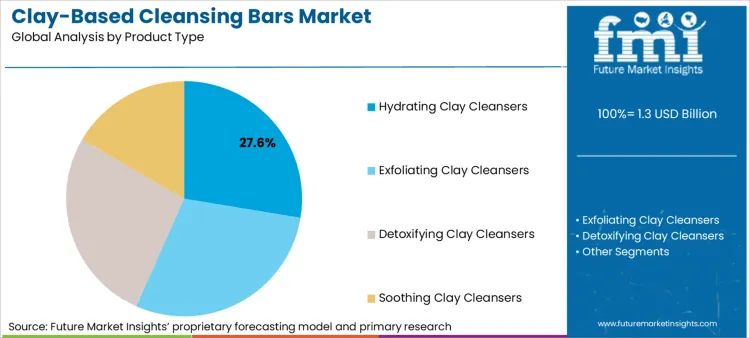
Hydrating clay cleansers lead the clay-based cleansing bars market with a 27.60% share because they solve a core consumer concern: how to get the detoxifying benefits of clay without compromising skin comfort. While traditional clay formats are often associated with dryness, hydrating variants combine clays with milks, oils, and moisture-supporting ingredients, making them suitable for daily use. This balance has helped hydrating clay cleansers become the most approachable and widely adopted product type across mass and premium beauty portfolios.
Artisanal craftsmanship further strengthens this position by offering a sense of authenticity and heritage that many consumers actively seek. Brands such as L’Occitane continue to build trust by positioning their products as “reinterpretations of traditional artisan soap, including the well-known Savon de Marseille,” reinforcing the idea that gentle, hydrating cleansing can coexist with traditional know-how rather than industrial processing.
“Olivier Baussan”, Founder of L'Occitane, explained this personal stake: My search for tradition and know-how led me to listen to the elders. This tradition/know-how is dying because people are so used to petrol-based products. This brought me to meet up with the traditional people, the elders who knew how to use the plants. What’s important about L’Occitane is to be simple and modest, to listen to people who have the know-how, and pass it on.
Why do Natural Clay Ingredients Dominate the Market?
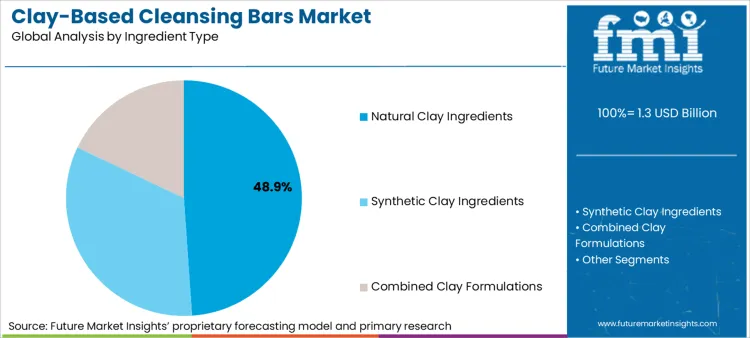
Natural clay ingredients lead the clay-based cleansing bars market with a 48.90% share, reflecting strong consumer preference for mineral-based actives that are perceived as clean, authentic, and skin-compatible. Their dominance is supported by growing skepticism toward synthetic inputs and a renewed appreciation for traditional formulations that balance efficacy with simplicity. Consumers increasingly associate natural clays with gentle detoxification, oil balance, and long-term skin health, reinforcing their role as the foundational ingredient choice in this category.
This deep-seated loyalty protects the segment from rapid displacement by unproven alternatives, as “balancing the simplicity of tradition and the art of modernity has been the cornerstone of L'OCCITANE's philosophy since the beginning.” Traditional approaches are evolving rather than disappearing, with formulations that “celebrate authenticity and quality through traditional techniques and ingredients: each of our artisanal soaps is cauldron cooked and composed of at least 78% vegetable oil.” These dynamics position natural clay ingredients as the structural backbone of sustained growth, anchoring both premiumisation and consumer trust across the market.
What are the Drivers, Restraints, and Opportunities in the Clay-Based Cleansing Bars Market?
Solid-state skincare is reshaping high-performance cleansing by fundamentally changing how efficacy is delivered, measured, and perceived. In clay-based cleansing bars, performance is no longer tied to volume or foaming intensity but to ingredient concentration and functional relevance. By removing water and unnecessary formulation buffers, solid bars deliver higher active density per use, allowing clays, lipids, and emollients to work in closer contact with the skin. This “less is more” logic reframes efficacy as precision rather than abundance, appealing to consumers who now associate shorter ingredient lists with higher formulation intent and better skin outcomes. As a result, solid clay bars are increasingly positioned as treatment-grade cleansers rather than basic hygiene products.
How Is pH-Balanced Innovation Changing Cleansing Practice?
The clay-based cleansing bars market is pivoting decisively from traditional high-alkaline soap chemistry toward syndet-based systems engineered to respect the skin’s acid mantle. This shift directly addresses one of the historical limitations of clay cleansers: barrier disruption caused by elevated pH. By maintaining skin-compatible pH ranges, modern clay bars allow deep pore cleansing and oil regulation without triggering compensatory dryness, irritation, or rebound sebum production. This changes cleansing practice at the routine level, enabling users to manage sensitivity, acne, and dehydration during the first step of care rather than correcting damage later with heavier treatments.
What Role Does Regulatory Maturation Play in Ingredient Innovation?
Clearer regulatory frameworks around ingredient disclosure, sourcing claims, and processing transparency are stabilizing long-term investment in natural clay and botanical formulations. As verification requirements become more explicit, brands can commit capital to specialized raw materials with confidence that their claims can be substantiated across markets. This regulatory maturation reduces ambiguity for consumers and formulators alike, enabling more sophisticated ingredient storytelling grounded in origin, function, and processing integrity rather than marketing abstraction.
Which countries are growing fastest in the Clay-Based Cleansing Bars Market?
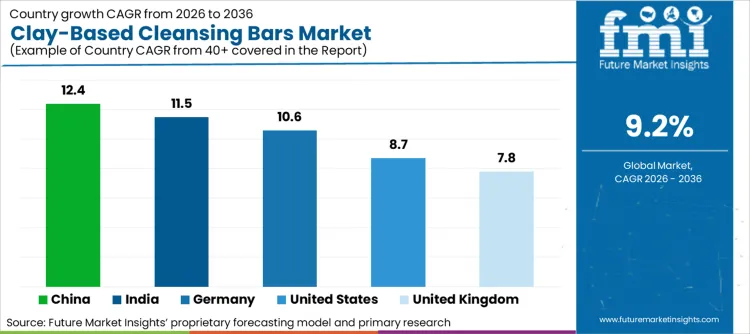
Demand for clay-based cleansing bars is expanding unevenly across regions as consumers shift from basic hygiene toward clinically supported, ingredient-led skincare formats. Growth is strongest in Asia, where acne prevalence, pollution exposure, and familiarity with mineral-based remedies accelerate adoption of clay formats positioned around oil control and barrier health. China and India form the core growth axis as waterless beauty, solid formats, and mineral actives move into daily cleansing routines. In contrast, Europe and North America show more measured expansion, shaped by premiumisation, dermatological validation, and ingredient transparency rather than first-time adoption. Mature markets emphasise formulation credibility, traceable sourcing, and compatibility with sensitive skin, while emerging markets drive volume through efficacy-led claims and affordability. FMI analysis indicates that long-term growth will be governed by the convergence of clinical substantiation, rare clay differentiation, and sustainability-driven solid format adoption rather than simple category novelty.
| Country | CAGR (2026 to 2036) |
|---|---|
| China | 12.4% |
| India | 11.5% |
| Germany | 10.6% |
| United States | 8.7% |
| United Kingdom | 7.8% |
Source: FMI historical analysis and forecast data.
Why Is China Becoming the Fastest-Scaling Market for Clay-Based Cleansing Bars? China is expanding at a 12.4% CAGR, driven by high consumer acceptance of mineral-based skincare and a strong preference for visible efficacy in oil control, acne reduction, and pollution defence. Clay has cultural legitimacy through traditional medicine and modern dermatology, enabling brands to position cleansing bars as treatment-adjacent products rather than simple cleansers.
Urban consumers face elevated sebum imbalance linked to pollution and humidity, increasing demand for clay formats that demonstrate measurable improvements in pore clarity and skin evenness. The waterless beauty trend also aligns with China’s sustainability messaging, supporting solid bar adoption in both mass and premium tiers. Digital retail ecosystems amplify clinical narratives, allowing brands to scale rapidly once efficacy claims are validated. FMI notes that China’s growth is reinforced by fast product education cycles, influencer-led ingredient storytelling, and rising trust in dermatology-supported formulations.
Why Is India Emerging as a High-Momentum Growth Market?
India grows at an 11.5% CAGR, supported by rising awareness of acne management, oil control, and barrier repair among younger consumers. Clay ingredients already hold strong cultural resonance through Ayurvedic and traditional skincare practices, lowering adoption barriers for modern cleansing bars. Increasing urbanisation and pollution exposure heighten demand for detoxifying yet non-stripping cleansers, positioning clay bars as a functional upgrade over conventional soaps.
Price accessibility also plays a role, as solid bars deliver longer usage cycles and reduced water content, appealing to value-conscious households. Domestic brands are actively reformulating with regionally sourced clays, reinforcing trust through local provenance narratives. FMI analysis highlights that India’s growth is not trend-driven alone but anchored in daily routine replacement, where clay-based bars move from occasional treatments into mainstream facial and body cleansing regimens.
Why Does Germany Show Strong Adoption Despite Market Maturity?
Germany expands at a 10.6% CAGR, driven by consumer preference for clinically substantiated, dermatologically compatible skincare. Clay-based cleansing bars resonate with Germany’s emphasis on ingredient safety, barrier integrity, and evidence-backed performance. Consumers scrutinise formulations closely, favouring mineral actives with demonstrated effects on transepidermal water loss, sebum regulation, and irritation reduction.
Solid cleansing formats also align with Germany’s sustainability priorities, particularly reduced packaging and water usage. Apothecary and dermo-cosmetic channels play a key role in legitimising clay bars as skin-health products rather than lifestyle items. FMI notes that growth in Germany is premium-weighted, with demand concentrated around certified sourcing, fragrance-free formulations, and compatibility with sensitive and problem-prone skin rather than mass experimentation.
How Is the United States Market Evolving Around Performance and Transparency?
The United States grows at an 8.7% CAGR, reflecting a shift from novelty adoption toward performance accountability and ingredient transparency. Clay-based cleansing bars gain traction when brands provide clinical data supporting acne reduction, oil balance, and barrier preservation. Consumers increasingly evaluate solid formats against liquid cleansers on efficacy parity rather than sustainability alone. Transparency around natural versus synthetic components is critical, particularly as mass brands clarify formulation choices to maintain trust.
Dermatologist endorsement and clean-beauty positioning intersect, allowing clay bars to sit at the convergence of treatment skincare and daily cleansing. FMI analysis indicates that U.S. growth is constrained by high competition but sustained by repeat purchase behaviour once efficacy is proven and skin tolerance is established.
Why Is the United Kingdom Growing at a More Measured Pace?
The UK expands at a 7.8% CAGR, shaped by cautious adoption and strong reliance on ingredient credibility. Consumers show interest in clay-based cleansing bars primarily within premium and clean-beauty segments, where sustainability, provenance, and skin-friendliness are clearly articulated. Sensitivity concerns and a cooler climate reduce extreme oil-control demand, moderating volume growth relative to Asia. However, waterless beauty narratives resonate strongly, particularly among environmentally conscious consumers. Retailers emphasise education around clay types, mineral content, and dermatological suitability. FMI analysis suggests that UK growth is steady rather than accelerated, anchored in premiumisation and trust-building rather than rapid category expansion.
Competition Outlook
Competition in the clay-based cleansing bars market is intensifying as legacy skincare conglomerates and digitally native brands converge on the same performance and sustainability narrative. Global leaders such as L’Oréal, Olay, Pond’s, Clinique, Neutrogena, and Garnier defend their scale advantage through dermatology-backed claims, global retail penetration, and formulation science that reframes clay bars from basic cleansers into clinically credible treatment-adjacent products. These incumbents leverage trust built in liquid cleansers and extend it into solid formats to retain consumers migrating toward waterless and low-packaging routines.
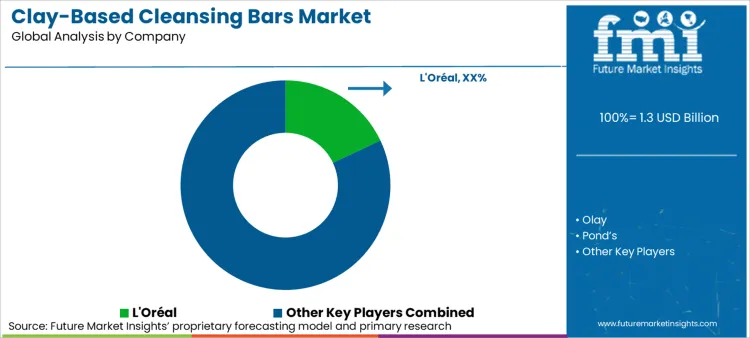
At the same time, Asian beauty specialists including Innisfree and The Face Shop compete through ingredient provenance and mineral storytelling, positioning region-specific clays as functional actives rather than commodity inputs. Indian-origin brands such as WOW Skin Science push transparency-led and clean label positioning to win value-conscious consumers, while niche players like Cardon for Men sharpen gender-specific performance messaging around oil control and skin barrier balance. Overall, competition is shifting from price and fragrance toward efficacy proof, ingredient traceability, and format credibility, with brand trust and formulation narrative acting as the primary differentiators.
Recent Developments:
- In July 2025, L’Oréal reported €22.47 billion in half-year sales with accelerating like-for-like growth, margin expansion to 21.1%, strong emerging-market momentum, and portfolio strengthening through the acquisitions of Medik8 and Color Wow.
- In January 2026, OLAY introduced an updated Regenerist Micro-Sculpting Cream with a new Triple Collagen Peptide, designed to visibly firm, smooth, and brighten skin in just seven days, reflecting OLAY’s long-standing focus on science-backed skin care.
Key Players in Clay-Based Cleansing Bars Market
- L'Oréal
- Olay
- Pond’s
- Innisfree
- Clinique
- Neutrogena
- The Face Shop
- WOW Skin Science
- Garnier
- Cardon for Men
Market Definition
The clay-based cleansing bars market comprises solid facial and body cleansing products formulated with natural or mineral clays as core functional ingredients. These bars are designed to remove impurities, excess sebum, and pollutants while supporting skin barrier health through oil absorption, mineral exchange, and gentle exfoliation.
The market includes bars positioned for daily cleansing, acne management, sensitive skin care, and therapeutic or dermo-cosmetic use. Clay types commonly used include kaolin, bentonite, montmorillonite, and region-specific mineral clays, integrated into soap-free or low-alkaline bar formulations. The category is shaped by waterless beauty adoption, sustainability-driven format shifts, and growing consumer demand for clinically supported, ingredient-transparent solid skincare solutions across mass, premium, and specialty beauty channels.
Market Inclusion
The market includes revenues generated from clay-based cleansing bars sold for facial and body care across mass-market, premium, and dermatology-aligned skincare segments. Included are bars formulated with functional clays for oil control, acne-prone skin, detoxification, sensitive skin cleansing, and barrier-support applications.
Products sold through retail, e-commerce, pharmacy, dermatology clinics, and specialty beauty stores are covered. Included are both soap-based and syndet (soap-free) bars, as well as hybrid cleansing bars combining clay with botanical actives, probiotics, or dermatologically tested ingredients. Private-label offerings, branded formulations, refill-oriented solid formats, and products marketed under clean beauty, waterless beauty, or sustainability claims are part of the market scope when clay serves as a primary cleansing or treatment component.
Market Exclusion
Excluded from the market are liquid, gel, foam, powder, or cream cleansers, even when they contain clay as a secondary ingredient. Clay masks, exfoliating scrubs, bath soaps without a cleansing or facial-care positioning, and industrial or therapeutic clay products not intended for cosmetic cleansing use are also excluded. Products where clay is used only for color, fragrance stabilization, or filler purposes without functional skin-cleansing benefit are not considered part of the market. Additionally excluded are DIY clay powders, spa-grade bulk clays, and professional-use-only formulations not sold as consumer cleansing bars. Shampoo bars, body soaps without skincare positioning, and medical-grade dermatological treatments outside daily cleansing routines fall outside the defined scope.
Scope of Report
| Items | Values |
|---|---|
| Quantitative Units | USD 1.3 Billion |
| Product Type | Hydrating Clay Cleansers; Exfoliating Clay Cleansers; Detoxifying Clay Cleansers; Soothing Clay Cleansers; Foaming Clay Cleansers |
| Ingredient Type | Natural Clay Ingredients; Synthetic Clay Ingredients; Combined Formulations |
| Packaging Type | Tubes; Jars; Pumps; Sachets; Refill Packs |
| Target Consumer Profile | Women; Men; Teenagers; Sensitive Skin Consumers; Organic Product Seekers |
| Price Range | Economical (Below USD 10); Mid-Range (USD 10-30); Premium (USD 30 and above); Luxury (USD 50 and above) |
| Regions Covered | North America; Europe; East Asia; South Asia; Latin America; Middle East & Africa |
| Key Countries | China; India; Germany; United States; United Kingdom |
| Key Companies Profiled | L’Oréal; Olay; Pond’s; Innisfree; Clinique; Neutrogena; The Face Shop; WOW Skin Science; Garnier; Cardon for Men |
| Additional Attributes | Dollar sales measured for solid clay-based facial and body cleansing bars formulated with functional mineral clays, analysed by product type, ingredient composition, packaging format, consumer profile, and price positioning, with emphasis on waterless beauty adoption, ingredient transparency, skin-barrier compatibility, pH-balanced syndet innovation, premiumisation of solid formats, sustainability-led packaging transitions, regional skincare routines, and competitive positioning driven by formulation efficacy, mineral provenance, and dermatological credibility. |
Clay-Based Cleansing Bars Market by Segments
By Product Type:
- Hydrating Clay Cleansers
- Exfoliating Clay Cleansers
- Detoxifying Clay Cleansers
- Soothing Clay Cleansers
- Foaming Clay Cleansers
By Ingredient Type:
- Natural Clay Ingredients
- Synthetic Clay Ingredients
- Combined Clay Formulations
By Packaging Type:
- Tubes
- Jars
- Pumps
- Sachets
- Refill Packs
By Target Consumer Profile:
- Women
- Men
- Teenagers
- Sensitive Skin Consumers
- Organic Product Seekers
By Price Range:
- Economical (Below USD 10)
- Mid-Range (USD 10-30)
- Premium (USD 30 and above)
- Luxury (USD 50 and above)
By Region:
- North America
- Europe
- East Asia
- South Asia
- Latin America
- Middle East & Africa
Bibliography
- The Estée Lauder Companies. (2024, November). Fiscal year 2024 social impact and sustainability report. The Estée Lauder Companies Inc.
- National Medical Products Administration (NMPA). (2023, December). Regulations on the supervision and administration of cosmetic ingredients in China. Government of the People's Republic of China.
- AmorePacific Group. (2024, June). 2023 Sustainability report: A more beautiful world. AmorePacific.
Frequently Asked Questions
How big is the clay-based cleansing bars market in 2026?
The global clay-based cleansing bars market is estimated to be valued at USD 1.3 billion in 2026.
What will be the size of clay-based cleansing bars market in 2036?
The market size for the clay-based cleansing bars market is projected to reach USD 3.1 billion by 2036.
How much will be the clay-based cleansing bars market growth between 2026 and 2036?
The clay-based cleansing bars market is expected to grow at a 9.2% CAGR between 2026 and 2036.
What are the key product types in the clay-based cleansing bars market?
The key product types in clay-based cleansing bars market are hydrating clay cleansers , exfoliating clay cleansers, detoxifying clay cleansers and soothing clay cleansers.
Which ingredient type segment to contribute significant share in the clay-based cleansing bars market in 2026?
In terms of ingredient type, natural clay ingredients segment to command 48.9% share in the clay-based cleansing bars market in 2026.
Preview the report firsthand - request a free sample
Get SampleGet the brochure for pricing and purchase details.
Get PDFTable of Content
- Executive Summary
- Global Market Outlook
- Demand-side Trends
- Supply-side Trends
- Technology Roadmap Analysis
- Analysis and Recommendations
- Market Overview
- Market Coverage / Taxonomy
- Market Definition / Scope / Limitations
- Research Methodology
- Chapter Orientation
- Analytical Lens and Working Hypotheses
- Market Structure, Signals, and Trend Drivers
- Company Annual and Sustainability Reports
- Peer-reviewed Journals and Academic Literature
- Corporate Websites, Product Literature, and Technical Notes
- Earnings Decks and Investor Briefings
- Statutory Filings and Regulatory Disclosures
- Technical White Papers and Standards Notes
- Trade Journals, Industry Magazines, and Analyst Briefs
- Conference Proceedings, Webinars, and Seminar Materials
- Government Statistics Portals and Public Data Releases
- Press Releases and Reputable Media Coverage
- Specialist Newsletters and Curated Briefings
- Sector Databases and Reference Repositories
- FMI Internal Proprietary Databases and Historical Market Datasets
- Subscription Datasets and Paid Sources
- Social Channels, Communities, and Digital Listening Inputs
- Additional Desk Sources
- Expert Input and Fieldwork (Primary Evidence)
- Primary Modes
- Qualitative Interviews and Expert Elicitation
- Quantitative Surveys and Structured Data Capture
- Blended Approach
- Why Primary Evidence is Used
- Field Techniques
- Interviews
- Surveys
- Focus Groups
- Observational and In-context Research
- Social and Community Interactions
- Stakeholder Universe Engaged
- C-suite Leaders
- Board Members
- Presidents and Vice Presidents
- R&D and Innovation Heads
- Technical Specialists
- Domain Subject-matter Experts
- Scientists
- Physicians and Other Healthcare Professionals
- Governance, Ethics, and Data Stewardship
- Research Ethics
- Data Integrity and Handling
- Primary Modes
- Tooling, Models, and Reference Databases
- Data Engineering and Model Build
- Data Acquisition and Ingestion
- Cleaning, Normalisation, and Verification
- Synthesis, Triangulation, and Analysis
- Quality Assurance and Audit Trail
- Market Background
- Market Dynamics
- Drivers
- Restraints
- Opportunity
- Trends
- Scenario Forecast
- Demand in Optimistic Scenario
- Demand in Likely Scenario
- Demand in Conservative Scenario
- Opportunity Map Analysis
- Product Life Cycle Analysis
- Supply Chain Analysis
- Investment Feasibility Matrix
- Value Chain Analysis
- PESTLE and Porter’s Analysis
- Regulatory Landscape
- Regional Parent Market Outlook
- Production and Consumption Statistics
- Import and Export Statistics
- Market Dynamics
- Global Market Analysis 2021 to 2025 and Forecast, 2026 to 2036
- Historical Market Size Value (USD Million) Analysis, 2021 to 2025
- Current and Future Market Size Value (USD Million) Projections, 2026 to 2036
- Y-o-Y Growth Trend Analysis
- Absolute $ Opportunity Analysis
- Global Market Pricing Analysis 2021 to 2025 and Forecast 2026 to 2036
- Global Market Analysis 2021 to 2025 and Forecast 2026 to 2036, By Product Type
- Introduction / Key Findings
- Historical Market Size Value (USD Million) Analysis By Product Type , 2021 to 2025
- Current and Future Market Size Value (USD Million) Analysis and Forecast By Product Type , 2026 to 2036
- Hydrating Clay Cleansers
- Exfoliating Clay Cleansers
- Detoxifying Clay Cleansers
- Soothing Clay Cleansers
- Hydrating Clay Cleansers
- Y-o-Y Growth Trend Analysis By Product Type , 2021 to 2025
- Absolute $ Opportunity Analysis By Product Type , 2026 to 2036
- Global Market Analysis 2021 to 2025 and Forecast 2026 to 2036, By Ingredient Type
- Introduction / Key Findings
- Historical Market Size Value (USD Million) Analysis By Ingredient Type, 2021 to 2025
- Current and Future Market Size Value (USD Million) Analysis and Forecast By Ingredient Type, 2026 to 2036
- Natural Clay Ingredients
- Synthetic Clay Ingredients
- Combined Clay Formulations
- Natural Clay Ingredients
- Y-o-Y Growth Trend Analysis By Ingredient Type, 2021 to 2025
- Absolute $ Opportunity Analysis By Ingredient Type, 2026 to 2036
- Global Market Analysis 2021 to 2025 and Forecast 2026 to 2036, By Region
- Introduction
- Historical Market Size Value (USD Million) Analysis By Region, 2021 to 2025
- Current Market Size Value (USD Million) Analysis and Forecast By Region, 2026 to 2036
- North America
- Latin America
- Western Europe
- Eastern Europe
- East Asia
- South Asia and Pacific
- Middle East & Africa
- Market Attractiveness Analysis By Region
- North America Market Analysis 2021 to 2025 and Forecast 2026 to 2036, By Country
- Historical Market Size Value (USD Million) Trend Analysis By Market Taxonomy, 2021 to 2025
- Market Size Value (USD Million) Forecast By Market Taxonomy, 2026 to 2036
- By Country
- USA
- Canada
- Mexico
- By Product Type
- By Ingredient Type
- By Country
- Market Attractiveness Analysis
- By Country
- By Product Type
- By Ingredient Type
- Key Takeaways
- Latin America Market Analysis 2021 to 2025 and Forecast 2026 to 2036, By Country
- Historical Market Size Value (USD Million) Trend Analysis By Market Taxonomy, 2021 to 2025
- Market Size Value (USD Million) Forecast By Market Taxonomy, 2026 to 2036
- By Country
- Brazil
- Chile
- Rest of Latin America
- By Product Type
- By Ingredient Type
- By Country
- Market Attractiveness Analysis
- By Country
- By Product Type
- By Ingredient Type
- Key Takeaways
- Western Europe Market Analysis 2021 to 2025 and Forecast 2026 to 2036, By Country
- Historical Market Size Value (USD Million) Trend Analysis By Market Taxonomy, 2021 to 2025
- Market Size Value (USD Million) Forecast By Market Taxonomy, 2026 to 2036
- By Country
- Germany
- UK
- Italy
- Spain
- France
- Nordic
- BENELUX
- Rest of Western Europe
- By Product Type
- By Ingredient Type
- By Country
- Market Attractiveness Analysis
- By Country
- By Product Type
- By Ingredient Type
- Key Takeaways
- Eastern Europe Market Analysis 2021 to 2025 and Forecast 2026 to 2036, By Country
- Historical Market Size Value (USD Million) Trend Analysis By Market Taxonomy, 2021 to 2025
- Market Size Value (USD Million) Forecast By Market Taxonomy, 2026 to 2036
- By Country
- Russia
- Poland
- Hungary
- Balkan & Baltic
- Rest of Eastern Europe
- By Product Type
- By Ingredient Type
- By Country
- Market Attractiveness Analysis
- By Country
- By Product Type
- By Ingredient Type
- Key Takeaways
- East Asia Market Analysis 2021 to 2025 and Forecast 2026 to 2036, By Country
- Historical Market Size Value (USD Million) Trend Analysis By Market Taxonomy, 2021 to 2025
- Market Size Value (USD Million) Forecast By Market Taxonomy, 2026 to 2036
- By Country
- China
- Japan
- South Korea
- By Product Type
- By Ingredient Type
- By Country
- Market Attractiveness Analysis
- By Country
- By Product Type
- By Ingredient Type
- Key Takeaways
- South Asia and Pacific Market Analysis 2021 to 2025 and Forecast 2026 to 2036, By Country
- Historical Market Size Value (USD Million) Trend Analysis By Market Taxonomy, 2021 to 2025
- Market Size Value (USD Million) Forecast By Market Taxonomy, 2026 to 2036
- By Country
- India
- ASEAN
- Australia & New Zealand
- Rest of South Asia and Pacific
- By Product Type
- By Ingredient Type
- By Country
- Market Attractiveness Analysis
- By Country
- By Product Type
- By Ingredient Type
- Key Takeaways
- Middle East & Africa Market Analysis 2021 to 2025 and Forecast 2026 to 2036, By Country
- Historical Market Size Value (USD Million) Trend Analysis By Market Taxonomy, 2021 to 2025
- Market Size Value (USD Million) Forecast By Market Taxonomy, 2026 to 2036
- By Country
- Kingdom of Saudi Arabia
- Other GCC Countries
- Turkiye
- South Africa
- Other African Union
- Rest of Middle East & Africa
- By Product Type
- By Ingredient Type
- By Country
- Market Attractiveness Analysis
- By Country
- By Product Type
- By Ingredient Type
- Key Takeaways
- Key Countries Market Analysis
- USA
- Pricing Analysis
- Market Share Analysis, 2025
- By Product Type
- By Ingredient Type
- Canada
- Pricing Analysis
- Market Share Analysis, 2025
- By Product Type
- By Ingredient Type
- Mexico
- Pricing Analysis
- Market Share Analysis, 2025
- By Product Type
- By Ingredient Type
- Brazil
- Pricing Analysis
- Market Share Analysis, 2025
- By Product Type
- By Ingredient Type
- Chile
- Pricing Analysis
- Market Share Analysis, 2025
- By Product Type
- By Ingredient Type
- Germany
- Pricing Analysis
- Market Share Analysis, 2025
- By Product Type
- By Ingredient Type
- UK
- Pricing Analysis
- Market Share Analysis, 2025
- By Product Type
- By Ingredient Type
- Italy
- Pricing Analysis
- Market Share Analysis, 2025
- By Product Type
- By Ingredient Type
- Spain
- Pricing Analysis
- Market Share Analysis, 2025
- By Product Type
- By Ingredient Type
- France
- Pricing Analysis
- Market Share Analysis, 2025
- By Product Type
- By Ingredient Type
- India
- Pricing Analysis
- Market Share Analysis, 2025
- By Product Type
- By Ingredient Type
- ASEAN
- Pricing Analysis
- Market Share Analysis, 2025
- By Product Type
- By Ingredient Type
- Australia & New Zealand
- Pricing Analysis
- Market Share Analysis, 2025
- By Product Type
- By Ingredient Type
- China
- Pricing Analysis
- Market Share Analysis, 2025
- By Product Type
- By Ingredient Type
- Japan
- Pricing Analysis
- Market Share Analysis, 2025
- By Product Type
- By Ingredient Type
- South Korea
- Pricing Analysis
- Market Share Analysis, 2025
- By Product Type
- By Ingredient Type
- Russia
- Pricing Analysis
- Market Share Analysis, 2025
- By Product Type
- By Ingredient Type
- Poland
- Pricing Analysis
- Market Share Analysis, 2025
- By Product Type
- By Ingredient Type
- Hungary
- Pricing Analysis
- Market Share Analysis, 2025
- By Product Type
- By Ingredient Type
- Kingdom of Saudi Arabia
- Pricing Analysis
- Market Share Analysis, 2025
- By Product Type
- By Ingredient Type
- Turkiye
- Pricing Analysis
- Market Share Analysis, 2025
- By Product Type
- By Ingredient Type
- South Africa
- Pricing Analysis
- Market Share Analysis, 2025
- By Product Type
- By Ingredient Type
- USA
- Market Structure Analysis
- Competition Dashboard
- Competition Benchmarking
- Market Share Analysis of Top Players
- By Regional
- By Product Type
- By Ingredient Type
- Competition Analysis
- Competition Deep Dive
- L'Oréal
- Overview
- Product Portfolio
- Profitability by Market Segments (Product/Age /Sales Channel/Region)
- Sales Footprint
- Strategy Overview
- Marketing Strategy
- Product Strategy
- Channel Strategy
- Olay
- Pond’s
- Innisfree
- Clinique
- L'Oréal
- Competition Deep Dive
- Assumptions & Acronyms Used


