

- Industry Size (2026)
- USD 3920.0 Mn
- Forecast (2036)
- USD 7427.8 Mn
- CAGR (2026 to 2036)
- 6.6%
Clean-Label Preservatives Market Forecast and Outlook 2026 to 2036
The clean-label preservatives market is likely to be valued at USD 3,920.0 million in 2026 and is projected to reach USD 7,427.8 million by 2036, at a CAGR of 6.6%. Growth is anchored in replacement of conventional synthetic preservatives across bakery, dairy alternatives, ready meals, beverages, and processed foods. Organic acids, fermentation-derived systems, and cultured ingredients are increasingly specified to deliver microbial control and shelf-life extension while meeting clean-label formulation constraints imposed by retailers and regulators.
Demand acceleration within the clean-label preservatives market is driven by application-specific spoilage control requirements rather than broad ingredient transparency trends. Bakery manufacturers adopt organic acids and fermented solutions to replace propionates while maintaining mold inhibition in bread and cakes. Dairy alternatives and chilled ready meals rely on fermentation-derived preservatives that remain effective under refrigerated storage without sensory interference. Beverage producers use mild acid systems and botanical antimicrobials where clarity and flavor stability permit application. Selection is dictated by moisture content, pH range, and thermal processing exposure, limiting cross-category substitution and reinforcing matrix-specific preservative deployment strategies.
Quick Stats for Clean-Label Preservatives Market
- Clean-Label Preservatives Market Value (2026): USD 3,920.0 million
- Clean-Label Preservatives Market Forecast Value (2036): USD 7,427.8 million
- Clean-Label Preservatives Market Forecast CAGR 2026 to 2036: 6.6%
- Leading Preservative Type by Demand Share: Organic acids and salts
- Fastest-Growing Countries: India, China, Brazil, USA, UK
- Top Players in Global Demand: Kerry Group, Corbion, DSM-Firmenich, Kemin Industries, DuPont (IFF)
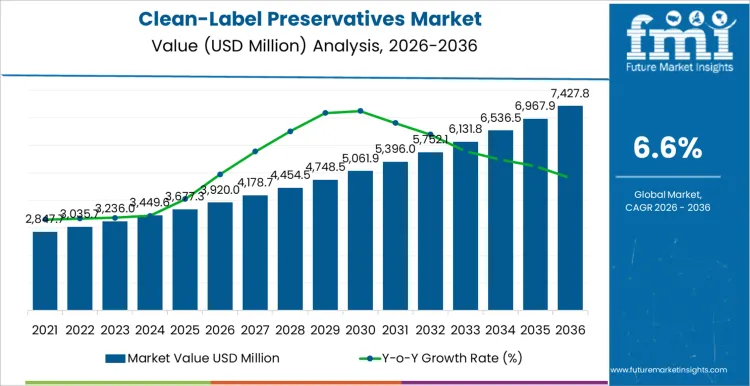
Clean-Label Preservatives Market Key Takeaways
| Metric | Value |
|---|---|
| Market Value (2026) | USD 3,920.0 million |
| Market Forecast Value (2036) | USD 7,427.8 million |
| Forecast CAGR 2026 to 2036 | 6.6% |
Why is the Demand for Clean-Label Preservatives Market Growing?
Food manufacturers reformulating shelf-stable products increasingly turn to clean-label preservatives that meet consumer expectations for simple, recognizable ingredients while maintaining microbial safety. In ready-to-eat meals, deli salads, and packaged snacks, traditional synthetic preservatives face resistance from label-conscious buyers who associate long ingredient lists with lower quality. Clean-label preservation systems based on plant extracts, cultured dextrose, or fermented derivatives help maintain freshness by slowing spoilage and extending product life without artificial naming conventions that trigger avoidance. Beverage producers of cold pressed juices and flavored waters rely on mild acidity regulators and botanical antimicrobials to maintain product integrity between production and point of sale.
Manufacturers in ethnic, artisan, and premium segments adopt these systems to support positioning that links sensory quality with ingredient transparency. Procurement activity in baked goods and dairy alternatives supports adoption because moisture migration and water activity challenges in these formats can accelerate spoilage. Ingredient specialists tailor preservative blends to specific matrices and processing conditions, optimizing efficacy under thermal pasteurization, high pressure processing, and chilled distribution. Sensory scientists assess impact on taste and aroma to ensure preservation strategies do not compromise the distinctive flavor profiles consumers expect. Retailer category teams that manage private label lines specify clean-label preservatives to align with portfolio positioning and regulatory labeling norms in key markets.
How Is the Clean-Label Preservatives Industry Segmented by Preservative Type, Form, and Application?
Demand for clean-label preservatives is shaped by shelf-life requirements, microbial safety expectations, and regulatory pressure to remove synthetic additives. Food manufacturers prioritize preservation systems derived from familiar or traditionally accepted sources while maintaining efficacy across varied processing conditions. Selection depends on antimicrobial spectrum, sensory neutrality, and compatibility with clean-label positioning. Segmentation by preservative type, physical form, and application explains how formulation strategies differ across food categories with distinct stability, moisture, and storage challenges.
Which Preservative Type Holds the Largest Share in Clean-Label Formulations?
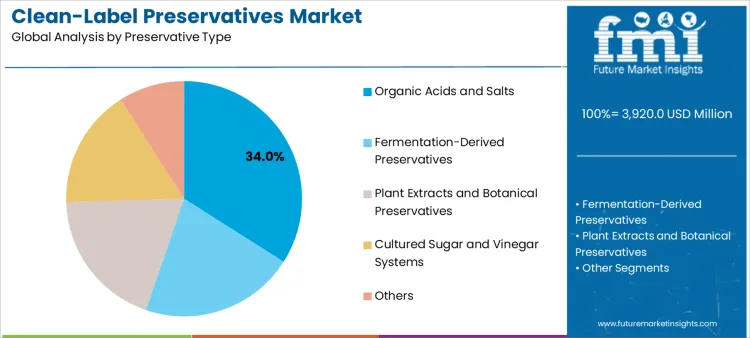
Organic acids and salts account for 34.0%, supported by broad antimicrobial activity and established acceptance across food systems. Fermentation-derived preservatives represent 26.0%, reflecting demand for naturally positioned solutions produced through controlled biological processes. Plant extracts and botanical preservatives hold 21.0%, applied where label perception and multifunctional benefits are prioritized. Cultured sugar and vinegar systems account for 13.0%, used for pH control and microbial inhibition in traditional formulations. Other preservative types represent 6.0%, addressing niche or application-specific requirements.
Key Points
- Organic acids remain widely adopted for antimicrobial control.
- Fermentation-based systems support natural positioning.
- Botanicals address label perception and multifunctionality.
How Does Form Influence the Use of Clean-Label Preservatives?
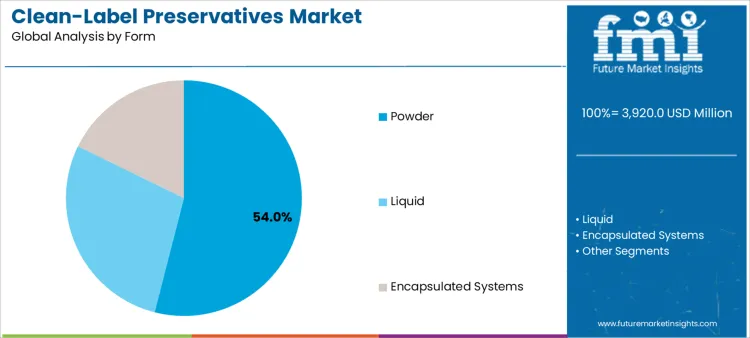
Powder formats represent 54.0%, driven by ease of handling, dosing precision, and stability during storage. Liquid preservatives account for 38.0%, supporting uniform dispersion and rapid integration into wet processing lines. Encapsulated systems hold 8.0%, applied where controlled release or sensory masking is required. Form-based segmentation reflects processing preferences, shelf-life considerations, and compatibility with dry or liquid manufacturing workflows across food categories.
Key Points
- Powders offer storage stability and dosing accuracy.
- Liquid forms support rapid and uniform dispersion.
- Encapsulation enables targeted release control.
Which Applications Drive Demand for Clean-Label Preservatives?
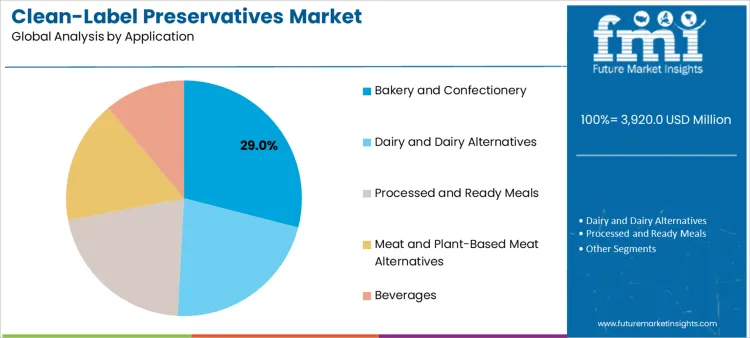
Bakery and confectionery applications account for 29.0%, requiring mold inhibition and extended shelf stability. Dairy and dairy alternatives represent 23.0%, emphasizing microbial control without flavor interference. Processed and ready meals hold 20.0%, driven by storage duration and reheating stability needs. Meat and plant-based meat alternatives account for 16.0%, addressing pathogen control and oxidation challenges. Beverages represent 12.0%, where preservation must align with clarity and flavor integrity.
Key Points
- Bakery products rely on preservatives for mold control.
- Dairy alternatives require sensory-neutral preservation.
- Ready meals prioritize shelf stability and safety.
What are the Key Dynamics in the clean-label preservatives market?
Demand in the clean-label preservatives market is driven by product developers aiming to extend shelf life while meeting consumer preference for recognizable, minimally processed ingredients. Activity is strong in fresh and refrigerated foods, ready-to-eat meals, bakery, juices, and minimally processed produce where traditional synthetic preservatives are viewed unfavorably. Ingredient choice is closely tied to how well a preservative system controls microbial growth or oxidation without altering sensory quality. Procurement decisions hinge on performance in specific matrices rather than broad preservative function alone.
How do spoilage risk profiles in perishable categories shape adoption?
Manufacturers of chilled meals and fresh juices face specific spoilage challenges associated with moisture content and native flora. Clean-label preservatives that target yeast, mold, or bacterial growth are selected based on their efficacy under refrigeration and across pH levels typical of these products. In bakery items, control of rancidity and mold growth without impact on crumb texture or flavor is a key driver for selecting certain botanical extracts or fermentation-derived acids. Dairy alternatives with high water activity require systems that retard oxidation and microbial proliferation without imparting off-notes. Snack bars and dried fruit leverage protective atmospheres combined with clean-label antioxidants to suppress rancidity while preserving texture. Food formulators evaluate performance through accelerated shelf stability tests tailored to the specific spoilage mechanisms of each category.
How do labeling expectations and functional effectiveness limits influence scalability?
Scalability in the clean-label preservatives market is influenced by consumer and regulatory expectations for ingredient declaration and by the functional limits of specific preservative systems in high-risk matrices. Certain plant-derived extracts exhibit limited antimicrobial activity at elevated water activity or under fluctuating temperatures, requiring precise matching to product conditions. Regional differences in allowable labeling terminology affect where products can carry clean-label positioning without extensive compliance work. Cost considerations arise when multi-component systems are necessary to balance oxidation control with microbial inhibition in demanding formats. Sensory evaluation protocols that verify preservative impact on taste and texture extend development timelines, shaping where and how extensively clean-label preservatives are utilized in complex product lines.
How Is Demand for the Clean-Label Preservatives Market Evolving Globally?
Global demand for clean-label preservatives is increasing as food manufacturers replace synthetic preservation systems with label-friendly alternatives. Growth reflects rising regulatory scrutiny, retailer clean-label mandates, and consumer preference for recognizable ingredients. Demand expansion remains closely linked to shelf-life management in bakery, dairy, beverages, and ready meals without compromising safety. Ingredient strategies emphasize fermentation-derived acids, plant extracts, and bio-based preservation systems. India records 7.9% CAGR, China records 7.6% CAGR, Brazil records 7.2% CAGR, USA records 5.8% CAGR, and UK records 5.6% CAGR. Adoption intensity is driven by reformulation pressure and compliance requirements rather than packaged food volume growth.
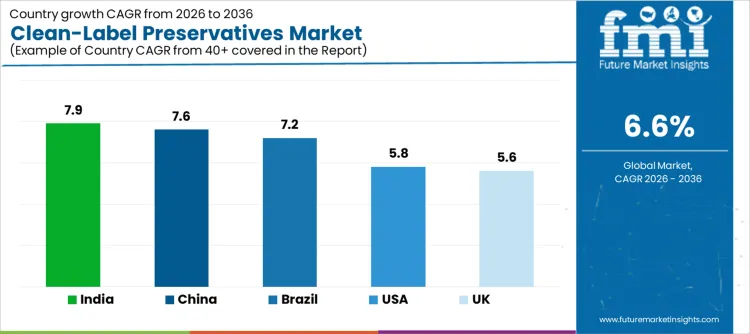
| Country | CAGR (%) |
|---|---|
| India | 7.9% |
| China | 7.6% |
| Brazil | 7.2% |
| USA | 5.8% |
| UK | 5.6% |
What is driving growth of clean-label preservatives demand in India?
Demand for clean-label preservatives in India is expanding as packaged food producers transition away from synthetic additives. Growth at 7.9% CAGR reflects rising reformulation across bakery products, sauces, dairy items, and ready-to-eat foods. High ambient temperatures and fragmented cold-chain infrastructure increase reliance on effective preservation systems. Manufacturers prioritize clean-label acids, cultured dextrose, and plant-based antimicrobials compatible with mass production. Cost sensitivity favors multifunctional preservatives delivering microbial control and shelf stability at low inclusion levels. Expansion of organized retail and private label foods strengthens specification pressure for label transparency across urban consumption centers.
- High ambient temperature preservation needs
- Clean-label bakery and sauce reformulation
- Expansion of organized retail formats
- Cost-efficient microbial control solutions
Why is China seeing expansion in clean-label preservatives adoption?
Clean-label preservatives demand in China is rising as industrial food processors align formulations with ingredient transparency and safety standards. Growth at 7.6% CAGR reflects strong adoption across dairy beverages, bakery, and processed foods supplied through modern retail. Large-scale manufacturing environments require preservatives delivering consistent microbial stability under ultra-high-temperature processing. Ingredient strategies emphasize fermentation-derived and bio-based systems supporting simplified labeling. Domestic suppliers expand capacity for natural preservative solutions tailored for centralized processing. Demand remains concentrated within industrial food production serving national retail and foodservice networks.
- Industrial-scale reformulation programs
- UHT processing stability requirements
- Growth of fermentation-derived preservatives
- Centralized food manufacturing expansion
What factors are shaping clean-label preservatives sales in Brazil?
Sales of clean-label preservatives in Brazil are increasing as manufacturers respond to nutrition labeling rules and consumer preference for natural ingredients. Growth at 7.2% CAGR reflects reformulation across bakery, beverages, sauces, and dairy products. Tropical climate conditions elevate spoilage risk, increasing demand for effective natural preservation systems. Producers focus on maintaining shelf life while preserving flavor and texture. Demand remains strongest in mass-market packaged foods serving price-sensitive consumers. Ingredient selection emphasizes stability under ambient storage and compatibility with existing processing infrastructure.
- Tropical climate driven spoilage control
- Nutrition labeling driven reformulation
- Demand for ambient-stable packaged foods
- Focus on flavor and texture preservation
How is the USA supporting growth of clean-label preservatives demand?
Clean-label preservatives market demand in the USA is advancing as manufacturers simplify ingredient lists across established food categories. Growth at 5.8% CAGR reflects adoption within bakery, dairy alternatives, beverages, and ready meals. Retailer and consumer expectations around transparency influence preservative selection. Fermentation-derived acids and plant-based antimicrobials replace synthetic systems while maintaining food safety. Large brands prioritize preservatives delivering consistent shelf life across national distribution. Demand is driven by compliance with clean-label commitments and brand risk management rather than category expansion.
- Portfolio-wide ingredient simplification
- Retail-driven clean-label standards
- Adoption of fermentation-derived preservatives
- Nationwide distribution shelf-life requirements
What is driving expansion of clean-label preservatives demand in the UK?
Demand for clean-label preservatives in the UK is rising as retailer standards and regulatory frameworks tighten additive usage. Growth at 5.6% CAGR reflects reformulation across bakery, chilled meals, dairy alternatives, and sauces. Ingredient transparency requirements encourage use of natural acids, extracts, and cultured ingredients. Shelf-life preservation remains critical for chilled and short-life products. Retail acceptance benchmarks influence preservative selection and performance expectations. Demand remains linked to compliance-driven reformulation cycles rather than changes in overall food consumption.
- Retail-led clean-label compliance
- Reformulation of chilled and short-life foods
- Preference for natural preservation systems
- Emphasis on ingredient transparency
What is the competitive landscape of demand for the clean-label preservatives market globally?
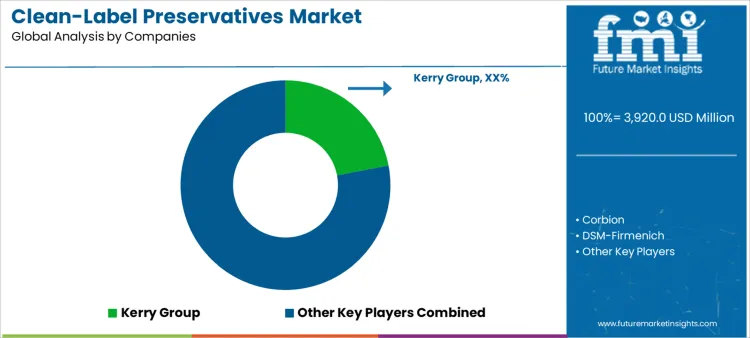
Clean label preservation needs across bakery, meat, dairy, and beverages are driving demand for naturally derived antimicrobial systems. Formulators evaluate inhibition spectrum, pH effectiveness, thermal stability, and sensory impact within minimally processed formulations. Buyer assessment includes label familiarity, regulatory acceptance by region, compatibility with existing hurdles, and shelf life extension performance. Procurement behavior reflects reformulation timelines, pilot validation requirements, and preference for suppliers offering application and microbiology support. Trend in the clean label preservatives market shows replacement of synthetic additives while maintaining safety margins and distribution stability.
Kerry Group leads positioning through fermented and cultured ingredient systems delivering preservation with minimal flavor impact. Corbion competes by supplying organic acid and vinegar based solutions proven across bakery, meat, and dairy applications. DSM Firmenich supports demand with nature derived preservative blends aligned with clean label definitions and global compliance. Kemin Industries maintains relevance through antimicrobial systems backed by applied microbiology expertise and formulation guidance. Competitive differentiation centers on antimicrobial efficacy, sensory neutrality, regulatory clarity, and supplier ability to support reformulation execution.
Key Players in the Clean-Label Preservatives Market
- Kerry Group
- Corbion
- DSM-Firmenich
- Kemin Industries
- DuPont (IFF)
- Others
Scope of the Report
| Items | Values |
|---|---|
| Quantitative Units | USD million |
| Preservative Type | Organic Acids and Salts; Fermentation-Derived Preservatives; Plant Extracts and Botanical Preservatives; Cultured Sugar and Vinegar Systems; Others |
| Form | Powder; Liquid; Encapsulated Systems |
| Application | Bakery and Confectionery; Dairy and Dairy Alternatives; Processed and Ready Meals; Meat and Plant-Based Meat Alternatives; Beverages |
| Regions Covered | Asia Pacific, Europe, North America, Latin America, Middle East & Africa |
| Countries Covered | India, China, Brazil, USA, UK, and 40+ countries |
| Key Companies Profiled | Kerry Group; Corbion; DSM-Firmenich; Kemin Industries; DuPont (IFF); Others |
| Additional Attributes | Dollar sales by preservative type, form, and application; antimicrobial efficacy against spoilage organisms and pathogens under clean-label constraints; performance differences across organic acids, fermentation-derived, and botanical systems; stability and release behavior in powder, liquid, and encapsulated formats; compatibility with bakery, dairy, meat alternative, and beverage matrices; procurement dynamics driven by reformulation programs, regulatory compliance, and long-term supplier partnerships. |
Clean-Label Preservatives Market by Segment
Preservative Type:
- Organic Acids and Salts
- Fermentation-Derived Preservatives
- Plant Extracts and Botanical Preservatives
- Cultured Sugar and Vinegar Systems
- Others
Form:
- Powder
- Liquid
- Encapsulated Systems
Application:
- Bakery and Confectionery
- Dairy and Dairy Alternatives
- Processed and Ready Meals
- Meat and Plant-Based Meat Alternatives
- Beverages
Region:
- Asia Pacific
- China
- Japan
- South Korea
- India
- Australia & New Zealand
- ASEAN
- Rest of Asia Pacific
- Europe
- Germany
- United Kingdom
- France
- Italy
- Spain
- Nordic
- BENELUX
- Rest of Europe
- North America
- United States
- Canada
- Mexico
- Latin America
- Brazil
- Chile
- Rest of Latin America
- Middle East & Africa
- Kingdom of Saudi Arabia
- Other GCC Countries
- Turkey
- South Africa
- Other African Union
- Rest of Middle East & Africa
Bibliography
- European Food Safety Authority. (2023). Safety evaluation and regulatory status of organic acids, fermented ingredients, and botanical preservatives used in food. EFSA Journal, 21(9), e08241.
- Food and Agriculture Organization of the United Nations. (2023). Clean-label food preservation: Natural antimicrobials, fermented systems, and shelf-life management. FAO Food Systems and Food Safety Division.
- McDonnell, L. M., Glass, K. A., & Sindelar, J. J. (2024). Clean-label preservation strategies: Fermentation-derived acids, cultured ingredients, and botanical antimicrobials. Annual Review of Food Science and Technology, 15, 181-203.
- Pérez-Díaz, I. M., Hayes, J. S., & Medina-Meza, I. G. (2023). Antimicrobial efficacy of natural and clean-label preservatives in bakery, dairy, and ready-to-eat foods. Journal of Food Protection, 86(11), 1789-1803.
Frequently Asked Questions
How big is the clean-label preservatives market in 2026?
The global clean-label preservatives market is estimated to be valued at USD 3,920.0 million in 2026.
What will be the size of clean-label preservatives market in 2036?
The market size for the clean-label preservatives market is projected to reach USD 7,427.8 million by 2036.
How much will be the clean-label preservatives market growth between 2026 and 2036?
The clean-label preservatives market is expected to grow at a 6.6% CAGR between 2026 and 2036.
What are the key product types in the clean-label preservatives market?
The key product types in clean-label preservatives market are organic acids and salts, fermentation-derived preservatives, plant extracts and botanical preservatives, cultured sugar and vinegar systems and others.
Which form segment to contribute significant share in the clean-label preservatives market in 2026?
In terms of form, powder segment to command 54.0% share in the clean-label preservatives market in 2026.
Preview the report firsthand - request a free sample
Get SampleGet the brochure for pricing and purchase details.
Get PDFTable of Content
- Executive Summary
- Global Market Outlook
- Demand-side Trends
- Supply-side Trends
- Technology Roadmap Analysis
- Analysis and Recommendations
- Market Overview
- Market Coverage / Taxonomy
- Market Definition / Scope / Limitations
- Market Background
- Market Dynamics
- Drivers
- Restraints
- Opportunity
- Trends
- Scenario Forecast
- Demand in Optimistic Scenario
- Demand in Likely Scenario
- Demand in Conservative Scenario
- Opportunity Map Analysis
- Product Life Cycle Analysis
- Supply Chain Analysis
- Investment Feasibility Matrix
- Value Chain Analysis
- PESTLE and Porter’s Analysis
- Regulatory Landscape
- Regional Parent Market Outlook
- Production and Consumption Statistics
- Import and Export Statistics
- Market Dynamics
- Global Market Analysis 2021 to 2025 and Forecast, 2026 to 2036
- Historical Market Size Value (USD Million) Analysis, 2021 to 2025
- Current and Future Market Size Value (USD Million) Projections, 2026 to 2036
- Y-o-Y Growth Trend Analysis
- Absolute $ Opportunity Analysis
- Global Market Pricing Analysis 2021 to 2025 and Forecast 2026 to 2036
- Global Market Analysis 2021 to 2025 and Forecast 2026 to 2036, By Preservative Type
- Introduction / Key Findings
- Historical Market Size Value (USD Million) Analysis By Preservative Type , 2021 to 2025
- Current and Future Market Size Value (USD Million) Analysis and Forecast By Preservative Type , 2026 to 2036
- Organic Acids and Salts
- Fermentation-Derived Preservatives
- Plant Extracts and Botanical Preservatives
- Cultured Sugar and Vinegar Systems
- Others
- Organic Acids and Salts
- Y-o-Y Growth Trend Analysis By Preservative Type , 2021 to 2025
- Absolute $ Opportunity Analysis By Preservative Type , 2026 to 2036
- Global Market Analysis 2021 to 2025 and Forecast 2026 to 2036, By Form
- Introduction / Key Findings
- Historical Market Size Value (USD Million) Analysis By Form, 2021 to 2025
- Current and Future Market Size Value (USD Million) Analysis and Forecast By Form, 2026 to 2036
- Powder
- Liquid
- Encapsulated Systems
- Powder
- Y-o-Y Growth Trend Analysis By Form, 2021 to 2025
- Absolute $ Opportunity Analysis By Form, 2026 to 2036
- Global Market Analysis 2021 to 2025 and Forecast 2026 to 2036, By Application
- Introduction / Key Findings
- Historical Market Size Value (USD Million) Analysis By Application, 2021 to 2025
- Current and Future Market Size Value (USD Million) Analysis and Forecast By Application, 2026 to 2036
- Bakery and Confectionery
- Dairy and Dairy Alternatives
- Processed and Ready Meals
- Meat and Plant-Based Meat Alternatives
- Beverages
- Bakery and Confectionery
- Y-o-Y Growth Trend Analysis By Application, 2021 to 2025
- Absolute $ Opportunity Analysis By Application, 2026 to 2036
- Global Market Analysis 2021 to 2025 and Forecast 2026 to 2036, By Region
- Introduction
- Historical Market Size Value (USD Million) Analysis By Region, 2021 to 2025
- Current Market Size Value (USD Million) Analysis and Forecast By Region, 2026 to 2036
- North America
- Latin America
- Western Europe
- Eastern Europe
- East Asia
- South Asia and Pacific
- Middle East & Africa
- Market Attractiveness Analysis By Region
- North America Market Analysis 2021 to 2025 and Forecast 2026 to 2036, By Country
- Historical Market Size Value (USD Million) Trend Analysis By Market Taxonomy, 2021 to 2025
- Market Size Value (USD Million) Forecast By Market Taxonomy, 2026 to 2036
- By Country
- USA
- Canada
- Mexico
- By Preservative Type
- By Form
- By Application
- By Country
- Market Attractiveness Analysis
- By Country
- By Preservative Type
- By Form
- By Application
- Key Takeaways
- Latin America Market Analysis 2021 to 2025 and Forecast 2026 to 2036, By Country
- Historical Market Size Value (USD Million) Trend Analysis By Market Taxonomy, 2021 to 2025
- Market Size Value (USD Million) Forecast By Market Taxonomy, 2026 to 2036
- By Country
- Brazil
- Chile
- Rest of Latin America
- By Preservative Type
- By Form
- By Application
- By Country
- Market Attractiveness Analysis
- By Country
- By Preservative Type
- By Form
- By Application
- Key Takeaways
- Western Europe Market Analysis 2021 to 2025 and Forecast 2026 to 2036, By Country
- Historical Market Size Value (USD Million) Trend Analysis By Market Taxonomy, 2021 to 2025
- Market Size Value (USD Million) Forecast By Market Taxonomy, 2026 to 2036
- By Country
- Germany
- UK
- Italy
- Spain
- France
- Nordic
- BENELUX
- Rest of Western Europe
- By Preservative Type
- By Form
- By Application
- By Country
- Market Attractiveness Analysis
- By Country
- By Preservative Type
- By Form
- By Application
- Key Takeaways
- Eastern Europe Market Analysis 2021 to 2025 and Forecast 2026 to 2036, By Country
- Historical Market Size Value (USD Million) Trend Analysis By Market Taxonomy, 2021 to 2025
- Market Size Value (USD Million) Forecast By Market Taxonomy, 2026 to 2036
- By Country
- Russia
- Poland
- Hungary
- Balkan & Baltic
- Rest of Eastern Europe
- By Preservative Type
- By Form
- By Application
- By Country
- Market Attractiveness Analysis
- By Country
- By Preservative Type
- By Form
- By Application
- Key Takeaways
- East Asia Market Analysis 2021 to 2025 and Forecast 2026 to 2036, By Country
- Historical Market Size Value (USD Million) Trend Analysis By Market Taxonomy, 2021 to 2025
- Market Size Value (USD Million) Forecast By Market Taxonomy, 2026 to 2036
- By Country
- China
- Japan
- South Korea
- By Preservative Type
- By Form
- By Application
- By Country
- Market Attractiveness Analysis
- By Country
- By Preservative Type
- By Form
- By Application
- Key Takeaways
- South Asia and Pacific Market Analysis 2021 to 2025 and Forecast 2026 to 2036, By Country
- Historical Market Size Value (USD Million) Trend Analysis By Market Taxonomy, 2021 to 2025
- Market Size Value (USD Million) Forecast By Market Taxonomy, 2026 to 2036
- By Country
- India
- ASEAN
- Australia & New Zealand
- Rest of South Asia and Pacific
- By Preservative Type
- By Form
- By Application
- By Country
- Market Attractiveness Analysis
- By Country
- By Preservative Type
- By Form
- By Application
- Key Takeaways
- Middle East & Africa Market Analysis 2021 to 2025 and Forecast 2026 to 2036, By Country
- Historical Market Size Value (USD Million) Trend Analysis By Market Taxonomy, 2021 to 2025
- Market Size Value (USD Million) Forecast By Market Taxonomy, 2026 to 2036
- By Country
- Kingdom of Saudi Arabia
- Other GCC Countries
- Turkiye
- South Africa
- Other African Union
- Rest of Middle East & Africa
- By Preservative Type
- By Form
- By Application
- By Country
- Market Attractiveness Analysis
- By Country
- By Preservative Type
- By Form
- By Application
- Key Takeaways
- Key Countries Market Analysis
- USA
- Pricing Analysis
- Market Share Analysis, 2025
- By Preservative Type
- By Form
- By Application
- Canada
- Pricing Analysis
- Market Share Analysis, 2025
- By Preservative Type
- By Form
- By Application
- Mexico
- Pricing Analysis
- Market Share Analysis, 2025
- By Preservative Type
- By Form
- By Application
- Brazil
- Pricing Analysis
- Market Share Analysis, 2025
- By Preservative Type
- By Form
- By Application
- Chile
- Pricing Analysis
- Market Share Analysis, 2025
- By Preservative Type
- By Form
- By Application
- Germany
- Pricing Analysis
- Market Share Analysis, 2025
- By Preservative Type
- By Form
- By Application
- UK
- Pricing Analysis
- Market Share Analysis, 2025
- By Preservative Type
- By Form
- By Application
- Italy
- Pricing Analysis
- Market Share Analysis, 2025
- By Preservative Type
- By Form
- By Application
- Spain
- Pricing Analysis
- Market Share Analysis, 2025
- By Preservative Type
- By Form
- By Application
- France
- Pricing Analysis
- Market Share Analysis, 2025
- By Preservative Type
- By Form
- By Application
- India
- Pricing Analysis
- Market Share Analysis, 2025
- By Preservative Type
- By Form
- By Application
- ASEAN
- Pricing Analysis
- Market Share Analysis, 2025
- By Preservative Type
- By Form
- By Application
- Australia & New Zealand
- Pricing Analysis
- Market Share Analysis, 2025
- By Preservative Type
- By Form
- By Application
- China
- Pricing Analysis
- Market Share Analysis, 2025
- By Preservative Type
- By Form
- By Application
- Japan
- Pricing Analysis
- Market Share Analysis, 2025
- By Preservative Type
- By Form
- By Application
- South Korea
- Pricing Analysis
- Market Share Analysis, 2025
- By Preservative Type
- By Form
- By Application
- Russia
- Pricing Analysis
- Market Share Analysis, 2025
- By Preservative Type
- By Form
- By Application
- Poland
- Pricing Analysis
- Market Share Analysis, 2025
- By Preservative Type
- By Form
- By Application
- Hungary
- Pricing Analysis
- Market Share Analysis, 2025
- By Preservative Type
- By Form
- By Application
- Kingdom of Saudi Arabia
- Pricing Analysis
- Market Share Analysis, 2025
- By Preservative Type
- By Form
- By Application
- Turkiye
- Pricing Analysis
- Market Share Analysis, 2025
- By Preservative Type
- By Form
- By Application
- South Africa
- Pricing Analysis
- Market Share Analysis, 2025
- By Preservative Type
- By Form
- By Application
- USA
- Market Structure Analysis
- Competition Dashboard
- Competition Benchmarking
- Market Share Analysis of Top Players
- By Regional
- By Preservative Type
- By Form
- By Application
- Competition Analysis
- Competition Deep Dive
- Kerry Group
- Overview
- Product Portfolio
- Profitability by Market Segments (Product/Age /Sales Channel/Region)
- Sales Footprint
- Strategy Overview
- Marketing Strategy
- Product Strategy
- Channel Strategy
- Corbion
- DSM-Firmenich
- Kemin Industries
- DuPont (IFF)
- Others
- Kerry Group
- Competition Deep Dive
- Assumptions & Acronyms Used
- Research Methodology


