

- Industry Size (2026)
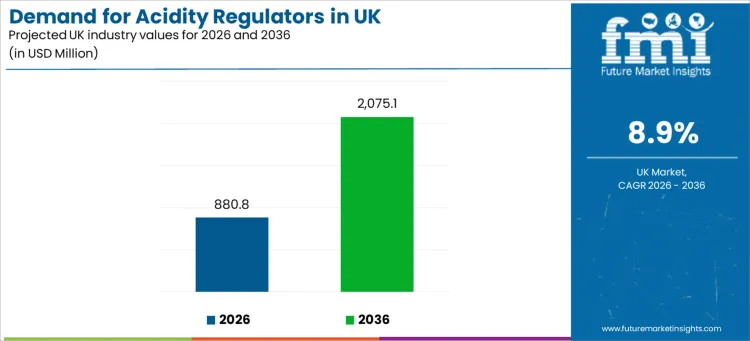
- USD 880.8 Mn
- Forecast (2036)
- USD 2075.1 Mn
- CAGR (2026 to 2036)
- 8.9%
Acidity Regulators Outlook in the UK 2026 to 2036
Demand for acidity regulators in the UK is projected at USD 880.8 million in 2026 and is expected to reach USD 2,075.1 million by 2036, expanding at an 8.9% CAGR. This rise reflects how food and drink manufacturers manage pH control, taste consistency, and shelf-life stability across high-volume production lines. Acidity regulators sit at the intersection of formulation science and operational reliability. They help product teams lock in flavour balance, reduce batch variability, and maintain microbiological stability where heat treatment or cold-chain conditions alone cannot guarantee quality outcomes.
Acidity regulators cover common food acids and salts used for acidification, buffering, and pH adjustment. In practical terms, they support production consistency for beverages, sauces, processed meals, baked goods, and confectionery. They also contribute to texture control, colour stability, and ingredient performance in recipes that include proteins, fats, or emulsified systems. When pH is managed tightly, brands can keep sensory profiles stable across seasonal raw material differences and supplier changes.
For CEOs and senior commercial leaders, demand growth is linked to brand protection and operational predictability. Reformulation cycles, private label competition, and retail specification tightening place greater weight on repeatable product performance. For ingredient suppliers and technology partners, the opportunity sits in reliable supply, consistent purity, strong documentation, and technical support that helps customers shorten development cycles and scale launches with confidence.
Quick Stats for Acidity Regulators Demand in the UK
- Acidity Regulators Valuation in the UK (2026): USD 880.8 million
- Acidity Regulators Forecast Valuation in the UK (2036): USD 2,075.1 million
- Forecast CAGR (2026-2036): 8.9%
- Leading Regional Growth: England (9.8%)
- Leading Type: Acetic Acid (25.6% share)
- Leading Application: Beverages (34.5% share)
- Key Companies Profiled: Archer Daniels Midland Company; Cargill, Incorporated; Tate & Lyle PLC; Jungbunzlauer Suisse AG; Corbion N.V.
Acidity Regulators in the UK Key Takeaways
| Metric | Value |
|---|---|
| Industry Value (2026) | USD 880.8 million |
| Industry Forecast Value (2036) | USD 2,075.1 million |
| Forecast CAGR (2026 to 2036) | 8.9% |
Why is the UK Building Strong Demand for Acidity Regulators?
UK demand is being built on functional dependency rather than optional ingredient use. Food producers rely on acidity regulators to standardise taste, control spoilage risk, and stabilise recipes at scale. This dependency is strongest where manufacturers face high SKU complexity, frequent flavour refresh cycles, and strong retailer control over specification compliance. A beverage producer balancing sweetness, fruit notes, and carbonation performance will treat pH management as a core quality lever, not a finishing step.
Regulatory clarity also supports stable usage. The Food Standards Agency maintains guidance on approved additives and E numbers, including the functional class of acids and acidity regulators. This matters to stakeholders because ingredient teams need confidence that formulation choices remain compliant across product lines and customer geographies inside the UK. Formal definitions within UK legislation also provide clarity on what qualifies as an acidity regulator and how it is interpreted in compliance contexts.
Consumer behaviour drives part of the expansion as well. Shoppers expect consistent taste and shelf life while also showing interest in simpler ingredient narratives. That creates a formulation challenge: maintain stability, reduce waste, protect sensory quality, and keep label language acceptable for mainstream retail. Acidity regulators support this balance by enabling lower preservative load in some use cases and improving performance of natural flavours and plant-based ingredients that can be sensitive to pH drift.
Innovation cycles in packaged beverages add further demand momentum. Better-for-you lines, functional drinks, and low-sugar formulations place more pressure on acid balance, mouthfeel, and aftertaste management. Product owners scanning adjacent formulation categories often align internal planning with broader ingredient themes tied to beverage acidulants and food acidulants, especially when roadmap decisions depend on taste stability and production scalability.
How is Acidity Regulators Demand Segmented by Type and Application?
Segmentation reflects how different acids behave in flavour delivery, buffering performance, solubility, and processing tolerance. It also reflects which product categories depend most on consistent pH control during mixing, heating, storage, and distribution.
Why does Acetic Acid hold the largest type share in UK formulations?
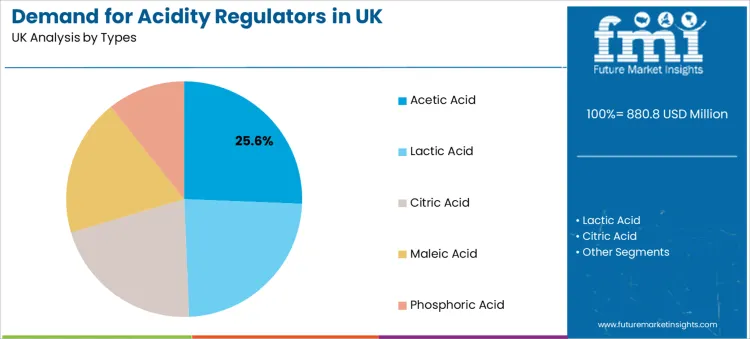
Acetic acid leads with a 25.6% share, making it the most widely used type in this demand landscape. Acetic acid is tightly linked with flavour systems that require sharpness, tang, and freshness perception. It also supports pH reduction where processors need a clear acid profile without heavy masking requirements.
In manufacturing environments, acetic acid is valued for predictable handling characteristics and consistent performance across sauces, pickled profiles, savoury recipes, and selected beverage formulations.
Commercial teams also view acetic acid through availability and supply resilience. It is broadly sourced, widely traded, and supported by mature logistics channels. That matters when procurement leaders need stable pricing visibility and fewer supply disruptions across high-volume production schedules.
Why do Beverages represent the Largest Application Share for acidity regulators in the UK?
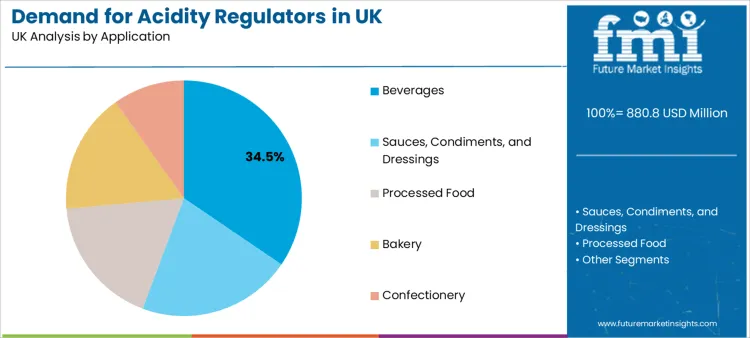
Beverages lead with a 34.5% share, placing them as the largest application area. This position reflects how beverages demand tight flavour repeatability and stable shelf life under variable storage conditions.
pH drift can change sweetness perception, aroma release, and even colour stability in certain drink types. Acid management also influences carbonation performance and helps brands maintain a consistent sensory signature from the first production run to the last batch of the season.
How are sauces, processed food, bakery, and confectionery sustaining steady usage in industrial recipes?
Sauces, condiments, and dressings rely on acidity regulators to stabilise emulsions, control microbial risk, and protect taste balance across oil and water phases. Processed food uses acidity control to support preservation strategies and maintain texture stability during heating and storage. Bakery applications use acids as part of leavening systems and to influence flavour rounding.
Confectionery relies on acids to deliver sharp taste notes, improve flavour clarity, and support texture outcomes in gummies and sour profiles. These categories reinforce demand through repeat orders and long-running SKUs that prioritise stable quality over experimental reformulation.
What are the Dynamics, Restraints, Opportunities, and Threats Shaping this Space?
What dynamics are strengthening UK demand fundamentals?
Packaged food expansion and beverage innovation keep pH adjustment needs elevated. Private label growth and tighter retail quality checks create strong incentives for consistent taste and shelf stability. Regulatory clarity also supports dependable formulation planning, with the Food Standards Agency providing guidance on additive categories and safety context.
Quality systems also play a role. Many manufacturers run HACCP programs where acidity targets act as a control point for spoilage risk reduction. Stronger in-house quality governance increases demand for consistent acid performance and tighter supplier qualification.
What restraints can slow usage growth or shift preferences?
Cost volatility in raw materials can pressure margins and push product teams toward reformulation. Some applications require careful handling due to corrosivity or process interaction, which can raise operational requirements around storage materials and dosing control. Label expectations also shape choice. Some brands aim to simplify ingredient lists, which can reduce tolerance for complex blends even when functionality is strong.
Compliance interpretation can slow changeovers. Product teams must confirm that additive use levels and functional classes align with permitted applications. Formal legal definitions exist within UK regulations, which strengthens compliance clarity but also increases the need for careful documentation.
Where do practical opportunities sit for suppliers and technology partners?
Opportunities rise where customers want multi-functional systems that control acidity while supporting flavour clarity and shelf-life goals. Buffered solutions can help brands maintain stability while reducing sharp taste spikes. International standards work also highlights the role of buffering in food additive applications, including acids and their salts used as preservatives or acidity regulators.
Suppliers can also win share through technical service programs that help customers optimise acid dosing, reduce overuse, and stabilise batch-to-batch quality. Teams often align these formulation decisions with broader ingredient categories such as food additives when mapping long-term sourcing strategy and reformulation pipelines.
What threats can disrupt demand expectations?
Supply disruptions and freight volatility can create short-term shortages for food-grade acids. Reputation risk also matters. A recall linked to formulation drift or compliance mistakes can trigger contract losses and retailer delisting. Companies with strong traceability systems and documentation discipline are better positioned to manage these risks and maintain customer confidence.
How is Acidity Regulators Demand Evolving across Key Regions in the UK?
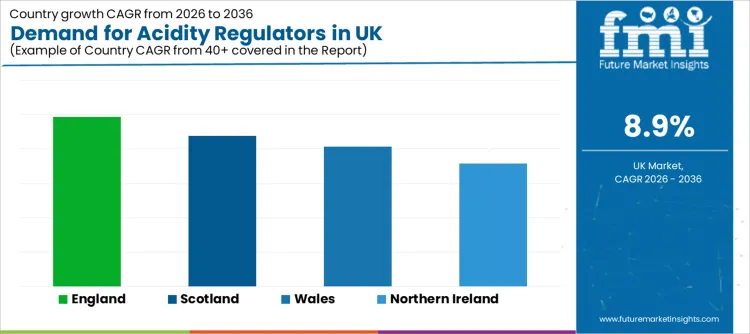
| Region | CAGR (2026-2036) |
|---|---|
| England | 9.8% |
| Scotland | 8.8% |
| Wales | 8.1% |
| Northern Ireland | 7.2% |
Why is England leading growth through high-throughput manufacturing and beverage demand intensity?
England grows at 9.8%, reflecting concentration of large-scale food and drink production sites, dense retail supply chains, and broader SKU diversity across beverage and packaged food categories. High throughput production environments increase reliance on stable pH control and consistent flavour profiles. Suppliers that offer reliable supply, steady quality documentation, and responsive technical support tend to gain stronger traction with large manufacturers operating multi-shift plants.
How is Scotland building consistent growth through targeted production needs and quality-driven procurement?
Scotland advances at 8.8%, supported by steady demand from beverage production, processed foods, and premium product lines where taste consistency is tightly protected. Procurement teams prioritise ingredient traceability and stability, with a practical focus on performance consistency across seasonal variation in raw materials. Technical support that helps maintain flavour integrity without over-acidification can influence supplier selection.
What is pushing Wales forward through expanding packaged food requirements and reformulation activity?
Wales grows at 8.1%, driven by packaged food output and the ongoing need to stabilise recipes that must perform reliably across distribution and storage. Reformulation activity tied to sugar reduction or ingredient changes can increase acidity regulator usage as brands recalibrate taste balance and product stability. Ingredient partners that provide application support for sauces, dressings, and bakery systems can strengthen customer stickiness.
Why is Northern Ireland showing steady gains through structured demand and production continuity needs?
Northern Ireland rises at 7.2%, supported by consistent demand where manufacturers value process stability and cost control. Growth is reinforced by long-running SKUs that depend on predictable acid performance and stable procurement planning. Suppliers that provide consistent delivery reliability and specification clarity can perform well in this region’s operational environment.
What Defines the Competitive Landscape for Acidity Regulators in the UK?
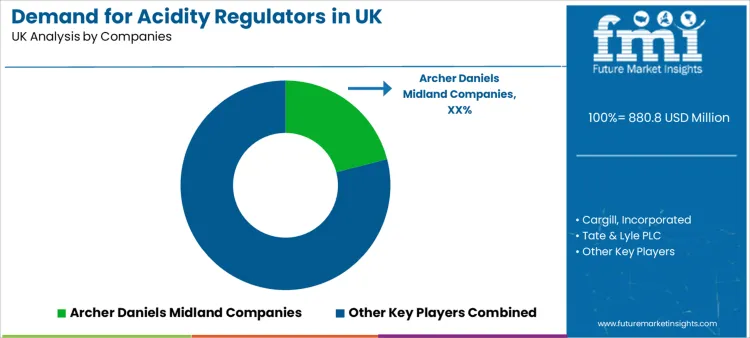
Competition is shaped by purity assurance, consistency of taste outcomes, documentation strength, and supply reliability. Buyers evaluate suppliers based on their ability to deliver stable product quality across batches, support regulatory compliance documentation, and provide technical guidance for application optimisation.
Archer Daniels Midland Company competes through broad ingredient distribution capability and scale-driven supply resilience. Cargill, Incorporated competes through deep formulation support and integrated supply networks serving food and beverage producers. Tate & Lyle PLC competes through strong positioning in specialty ingredients and formulation support across customer segments. Jungbunzlauer Suisse AG competes through fermentation-based acids and strong quality control expectations in food-grade production. Corbion N.V. competes through preservation-linked solutions and technical support tied to food safety and shelf-life objectives.
For stakeholder groups managing cross-category sourcing, acidity regulators often sit alongside adjacent ingredient decisions such as acidity regulators and food acidulants, especially when long-term contracts are designed around consistent quality and predictable supply.
Key Industry Participants
- Archer Daniels Midland Company
- Cargill, Incorporated
- Tate & Lyle PLC
- Jungbunzlauer Suisse AG
- Corbion N.V.
Scope of Report
| Items | Values |
|---|---|
| Quantitative Units | USD Million |
| Types | Acetic Acid; Lactic Acid; Citric Acid; Maleic Acid; Phosphoric Acid |
| Application | Beverages; Sauces, Condiments, and Dressings; Processed Food; Bakery; Confectionery |
| Regions Covered | England; Scotland; Wales; Northern Ireland |
| Key Companies Profiled | Archer Daniels Midland Company; Cargill, Incorporated; Tate & Lyle PLC; Jungbunzlauer Suisse AG; Corbion N.V. |
Acidity Regulators Demand in the UK by Segments
By Type:
- Acetic Acid
- Lactic Acid
- Citric Aci
- Maleic Acid
- Phosphoric Acid
By Application:
- Beverages
- Sauces, Condiments, and Dressings
- Processed Food
- Bakery
- Confectionery
By Region:
- England
- Scotland
- Wales
- Northern Ireland
Bibliography
- Food Standards Agency. (2025). Food additives.
- Food Standards Agency. (2023). Approved additives and E numbers.
- International Electrotechnical Commission. (2024). IEC 62271 series: High-voltage switchgear and controlgear (referenced for functional classification concepts in industrial safety documentation frameworks).
- Legislation.gov.uk. (2009). The Food Additives (England) Regulations 2009.
- Codex Alimentarius Commission. (2024). Joint FAO/WHO Food Standards Programme: CCFA54 working document on buffered vinegar as a preservative and acidity regulator (CX/FA 24/54/9).
- Institute of Food Science & Technology. (2018). Food additives: Functional classes and safety context.
Frequently Asked Questions
What is the outlook for acidity regulators demand in the UK for 2026?
Acidity regulators demand in the UK is expected to total USD 880.8 million in 2026.
What value is expected for acidity regulators demand in UK for 2036?
In 2036, demand for acidity regulators in UK will likely be valued at USD 2,075.1 million.
At what rate will acidity regulators demand in UK progress from 2026 to 2036?
Acidity regulators demand in UK is anticipated to advance at an 8.9% CAGR from 2026 to 2036.
Which type will constitute the bulk of total demand in the UK?
Acetic acid is likely to lead, capturing 25.6% of total demand share.
Which application is expected to lead in the UK?
Beverages are expected to lead, accounting for 34.5% of total demand.
Preview the report firsthand - request a free sample
Get SampleGet the brochure for pricing and purchase details.
Get PDFTable of Content
- Executive Summary
- UK Market Outlook
- Demand-side Trends
- Supply-side Trends
- Technology Roadmap Analysis
- Analysis and Recommendations
- Market Overview
- Market Coverage / Taxonomy
- Market Definition / Scope / Limitations
- Market Background
- Market Dynamics
- Drivers
- Restraints
- Opportunity
- Trends
- Scenario Forecast
- Demand in Optimistic Scenario
- Demand in Likely Scenario
- Demand in Conservative Scenario
- Opportunity Map Analysis
- Product Life Cycle Analysis
- Supply Chain Analysis
- Investment Feasibility Matrix
- Value Chain Analysis
- PESTLE and Porter’s Analysis
- Regulatory Landscape
- Regional Parent Market Outlook
- Production and Consumption Statistics
- Import and Export Statistics
- Market Dynamics
- UK Market Analysis 2021 to 2025 and Forecast, 2026 to 2036
- Historical Market Size Value (USD Million) Analysis, 2021 to 2025
- Current and Future Market Size Value (USD Million) Projections, 2026 to 2036
- Y-o-Y Growth Trend Analysis
- Absolute $ Opportunity Analysis
- UK Market Pricing Analysis 2021 to 2025 and Forecast 2026 to 2036
- UK Market Analysis 2021 to 2025 and Forecast 2026 to 2036, By Types
- Introduction / Key Findings
- Historical Market Size Value (USD Million) Analysis By Types , 2021 to 2025
- Current and Future Market Size Value (USD Million) Analysis and Forecast By Types , 2026 to 2036
- Acetic Acid
- Lactic Acid
- Citric Acid
- Maleic Acid
- Phosphoric Acid
- Acetic Acid
- Y-o-Y Growth Trend Analysis By Types , 2021 to 2025
- Absolute $ Opportunity Analysis By Types , 2026 to 2036
- UK Market Analysis 2021 to 2025 and Forecast 2026 to 2036, By Application
- Introduction / Key Findings
- Historical Market Size Value (USD Million) Analysis By Application, 2021 to 2025
- Current and Future Market Size Value (USD Million) Analysis and Forecast By Application, 2026 to 2036
- Beverages
- Sauces, Condiments, and Dressings
- Processed Food
- Bakery
- Confectionery
- Beverages
- Y-o-Y Growth Trend Analysis By Application, 2021 to 2025
- Absolute $ Opportunity Analysis By Application, 2026 to 2036
- Market Structure Analysis
- Competition Dashboard
- Competition Benchmarking
- Market Share Analysis of Top Players
- By Regional
- By Types
- By Application
- Competition Analysis
- Competition Deep Dive
- Archer Daniels Midland Companies
- Overview
- Product Portfolio
- Profitability by Market Segments (Product/Age /Sales Channel/Region)
- Sales Footprint
- Strategy Overview
- Marketing Strategy
- Product Strategy
- Channel Strategy
- Cargill, Incorporated
- Tate & Lyle PLC
- Jungbunzlauer Suisse AG
- Corbion N.V.
- Archer Daniels Midland Companies
- Competition Deep Dive
- Assumptions & Acronyms Used
- Research Methodology


