

- Industry Size (2026)
- USD 498.0 Mn
- Forecast (2036)
- USD 1385.0 Mn
- CAGR (2026 to 2036)
- 10.5%
Rosemary & Mixed Tocopherol Antioxidant Blend Market Size, Market Forecast and Outlook
In 2025, the rosemary and mixed tocopherol antioxidant blends market surpassed a value of USD 460.0 million and is projected to reach USD 498.0 million in 2026 and USD 1,385.0 million by 2036, reflecting a CAGR of 10.5% as food formulators replace synthetic preservatives with label-friendly botanical stabilizers ahead of strict regulatory deadlines. Clean label transition economics dominate as synthetic additive bans raise reformulation urgency. Brands transition toward synergistic botanical systems, extending shelf stability without compromising clean label claims.
Absolute dollar growth of USD 887.0 million over the decade signals incremental expansion driven by regulatory compliance deadlines rather than transformational opportunity. Buyers transition toward high-performance botanical matrices as health authorities scrutinize traditional synthetic preservatives. In 2025, scientific assessments confirmed rosemary extract at 1500 ppm reduced peroxide values by 40% in perilla seed oil-based margarine [1]. Procurement concentrates on securing bulk organic extracts to ensure uninterrupted supply chains for perishable goods, utilizing food antioxidants frameworks to guide formulations.
Summary of Rosemary & Mixed Tocopherol Antioxidant Blend
- Rosemary & Mixed Tocopherol Antioxidant Blend Market Definition
- Commercial blends combine rosemary extracts and tocopherols to prevent lipid oxidation, ensuring product stability. These blends are used across multiple industries, particularly in food, cosmetics, and pharmaceuticals to extend shelf life.
- Demand Drivers in the Market
- Consumer aversion to synthetic preservatives forces rapid ingredient substitution.
- Synergistic interactions between botanical compounds multiply total shelf-life duration.
- Expanded regulatory approvals unlock massive volume requirements in companion animal sectors.
- Key Segments Analyzed in the FMI Report
- Antioxidant Component: Rosemary extracts (46%) versus mixed tocopherol blends and specialized synergistic blends.
- Application: Food & Beverages (39% of total volume) versus animal feed, cosmetics, nutraceuticals, and pharmaceuticals.
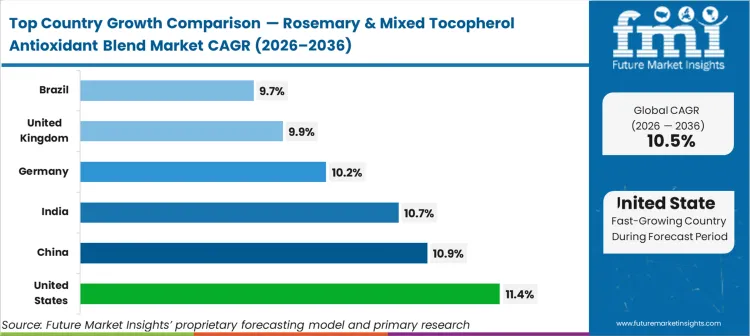
- Geography: High-growth North America and Asia-Pacific (United States 11.4%, China 10.9%, India 10.7%) versus regulation-driven Europe (Germany 10.2%, United Kingdom 9.9%).
- Analyst Opinion at FMI
- Nandini Roy Choudhury, Principal Consultant for Food & Beverage at Future Market Insights, opines, “In our latest Rosemary & Mixed Tocopherol Antioxidant Blend Market analysis, my team and I have identified fat-system customization as the next competitive frontier. Antioxidant performance is no longer evaluated generically; it is tested against specific lipid matrices such as high-oleic oils, nut butters, and plant-based meat fats. Oxidative pathways differ significantly across these systems. Suppliers that develop matrix-specific antioxidant blends with validated thermal stability and minimal flavor carryover will command long-term procurement preference in premium packaged food categories.”
- Strategic Implications/Executive Takeaways
- Secure long-term contracts for organic botanical inputs to hedge against yield fluctuations.
- Develop water-soluble blend formats to capture growing beverage application share.
- Prioritize decolorized extract variants for cosmetically sensitive formulations.
- Methodology
- Validated through first-hand corporate production and capacity data.
- Zero reliance on speculative third-party market research reports.
- Based on verifiable industrial benchmarks and verified sources.
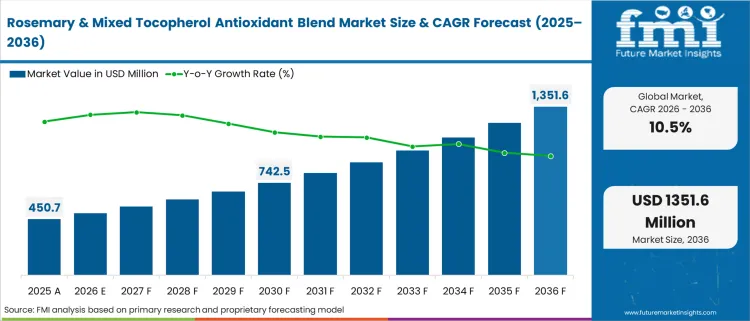
Across China, India, Germany, Brazil, United Kingdom, and United States, growth concentrates where clean label standards align with localized supply capacity. Importers clear procurement faster on specific water-soluble and decolorized botanical capabilities. Sourcing dynamics mirror strict regional export compliance parameters.
Rosemary & Mixed Tocopherol Antioxidant Blend Market Key Takeaways
| Metric | Details |
|---|---|
| Industry Size (2026) | USD 498.0 million |
| Industry Value (2036) | USD 1,385.0 million |
| CAGR (2026-2036) | 10.5% |
Rosemary & Mixed Tocopherol Antioxidant Blend Definition
The sector involves commercial stabilizing agents combining carnosic acid from rosemary with tocopherols from natural sources to prevent lipid oxidation. These blends protect fats and oils from degradation, extending product viability in perishable goods.
Rosemary & Mixed Tocopherol Antioxidant Blend Inclusions
Inclusions cover standardized liquid and powder rosemary extracts containing carnosic acid and carnosol, mixed tocopherol preparations from soybean or sunflower sources, and pre-formulated blends combining both botanical components for commercial stabilization.
Rosemary & Mixed Tocopherol Antioxidant Blend Exclusions
Exclusions include synthetic antioxidants such as BHA, BHT, and TBHQ, single-isolate synthetic vitamin E formats not derived from plant sources, and rosemary essential oils marketed for fragrance without antioxidant standardization.
Rosemary & Mixed Tocopherol Antioxidant Blend Market Research Methodology
- Primary Research: Direct consultations occurred with botanical extraction facility managers to capture yield data and pricing physics.
- Desk Research: Regulatory filings from European food safety authorities regarding lipid oxidation rates provided baseline verification.
- Market-Sizing and Forecasting: Bottom-up modeling reconstructed demand from global high-fat food production volumes and cosmetic emulsion outputs.
- Data Validation and Update Cycle: Analysts checked extraction capacity disclosures against reported global sales figures to ensure supply-demand parity.
Segmental Analysis
Rosemary & Mixed Tocopherol Antioxidant Blend Market Analysis by Antioxidant Component
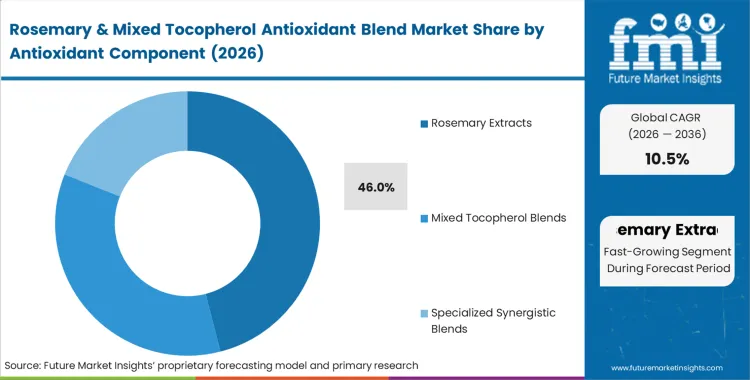
Rosemary extracts command 46% share in 2026. As per FMI's projection, demand relies on high carnosic acid concentrations neutralizing free radicals in extreme heat environments. Decolorized rosemary powder exhibited higher DPPH radical scavenging and lowered IC50 by 15-20% in 2026 trials [3]. Ingredient suppliers prioritize refined powder technologies to serve visually sensitive food applications without altering product aesthetics. Formulators specify exact botanical ratios to optimize lipid protection across diverse food matrices.
- Procurement trigger: Alpha-tocopherol described as potent natural antioxidant provides radical scavenging at 0.1-0.5% concentrations [4]. Formulators adjust inclusion parameters to secure prolonged stability.
- Sourcing shift: Mixed tocopherols in soybean oil deodorizer distillate show gamma-tocopherol dominant for antioxidant activity. Brands shift procurement toward high-gamma variants for superior fat stabilization.
- Operational focus: Rosmarinic acid from rosemary projects a 9.1% CAGR as applications scale [5]. Commercial buyers deploy these functional formats to protect delicate flavor compounds.
Rosemary & Mixed Tocopherol Antioxidant Blend Market Analysis by Application
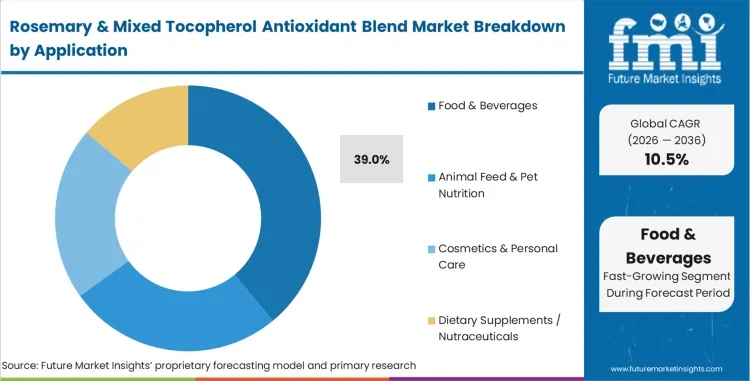
High-fat snacks, processed meats, and omega-3 enriched spreads require effective stabilization to maintain quality across extended distribution networks. Botanical antioxidants such as rosemary extract have demonstrated measurable performance, reducing oxidation markers in fortified margarine by 35-42% at 1000 ppm [6]. Meat processors are increasingly adopting plant-based preservation systems to align with evolving consumer preferences while protecting retail shelf life. As functional food applications expand, food and beverages capture 39% share in 2026.
- Clinical adoption: Alpha-tocopherol and rosemary blend prolongs shelf-life in sardine oil by 150-200% [7]. Seafood processors adopt synergistic systems to drastically reduce spoilage waste.
- Safety validation: Natural vitamin E from plant sources retains 68-75% activity in cosmetic emulsions post-processing [8]. Formulators secure these active compounds to guarantee clean label cosmetic safety.
- Buyer priority: Advanced extraction techniques yield highly purified botanical concentrates. Beverage architects deploy specialized formats to protect vulnerable citrus formulations from rapid degradation.
Rosemary & Mixed Tocopherol Antioxidant Blend Market Drivers, Restraints, and Opportunities
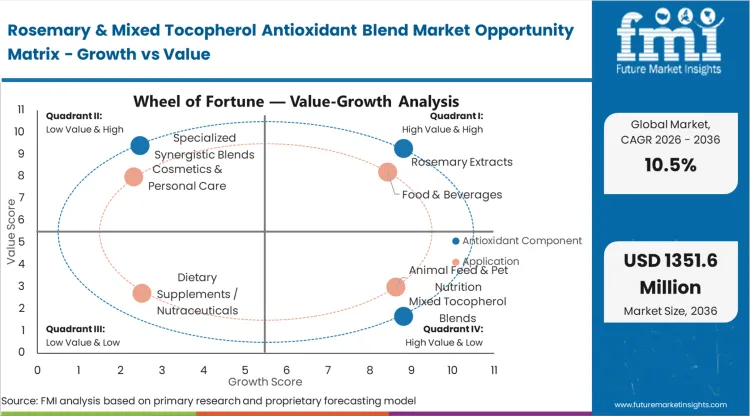
Regulatory bans regarding synthetic food additives trigger massive reformulation cycles across global sectors. FMI analysts opine that food safety authorities actively scrutinize traditional chemicals, forcing multinational brands to source viable botanical alternatives. ADI for rosemary extract limits exposure to 0–0.6 mg/kg bw, proving safe even for high dietary exposure in children [10]. Brands leverage these favorable safety profiles to expand natural stabilization into highly regulated infant categories, shifting procurement budgets toward plant-based preservatives.
High botanical extraction costs create significant margin pressure for end-users accustomed to inexpensive synthetic chemicals. Organic production increases secondary metabolites by 20-40% but carries substantial agricultural premiums [11]. Mid-market food manufacturers struggle to absorb price differentials, requiring blended solutions to maintain unit economics. Formulators negotiate long-term volume contracts to buffer against poor seasonal crop yields and volatile pricing structures.
- Application Expansion: Perilla oil margarine with rosemary improved oxidative stability index by 1.8-2.2x [17]. Brands adopt advanced delivery formats to protect delicate fats from oxidative degradation.
- Margin Protection: Synergistic combinations allow manufacturers to achieve target stability using lower total inclusion rates. Formulators blend specific ratios to optimize protection and lower costs without utilizing synthetic chemicals.
- Beverage Integration: Water-soluble technologies open clear antioxidant drinks categories to botanical stabilization. Beverage brands adopt advanced delivery formats to protect delicate citrus flavors during extended warehousing.
Regional Analysis
Based on the regional analysis, Rosemary & Mixed Tocopherol Antioxidant Blend market is segmented into North America, Latin America, Europe, East Asia, South Asia, Oceania and Middle East & Africa across 40+ countries. The full report also offers market attractiveness analysis based on regional trends.
.webp "Top Country Growth Comparison Rosemary & Mixed Tocopherol Antioxidant Blend Market Cagr (2026 2036)")
| Country | CAGR (2026 to 2036) |
|---|---|
| United States | 11.4% |
| China | 10.9% |
| India | 10.7% |
| Germany | 10.2% |
| United Kingdom | 9.9% |
| Brazil | 9.7% |
Source: Future Market Insights (FMI) analysis, based on proprietary forecasting model and primary research
North America Rosemary & Mixed Tocopherol Antioxidant Blend Market Analysis
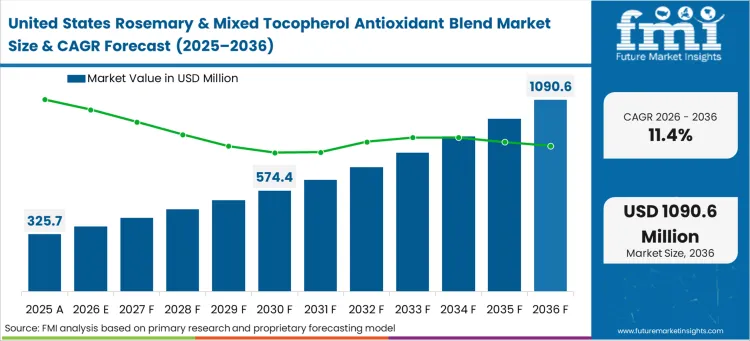
North America drives accelerated botanical integration as consumer advocacy groups push major retailers toward strict clean label mandates. Food conglomerates eliminate synthetic preservatives to secure shelf space at premium grocers. Regional buyers prioritize functional ingredients offering dual preservation and physiological benefits. Supply chains adapt to strict shelf-life requirements for exported goods.
- United States: Demand for rosemary and mixed tocopherol antioxidant blends in United States is set to grow at 11.4% CAGR through 2036, supported by strict retail ingredient guidelines before procurement and budgeting cycles translate into higher deployment volumes. Alpha-tocopherol supplementation increased pulmonary antioxidant enzymes by 30-50% [12]. Processors adopt these systems to maintain visual appeal without synthetic chemicals.
FMI's report includes detailed tracking of regulatory shifts across local states and federal safety thresholds. Canada and Mexico present opportunistic growth vectors driven by cross-border trade standardization in natural antioxidants and food antioxidant compliance. Buyers carefully monitor novel water-soluble technologies to expand claims into functional beverage sectors.
East Asia Rosemary & Mixed Tocopherol Antioxidant Blend Market Analysis
As per FMI's projection, East Asia experiences rapid transition toward natural stabilizers as export-oriented food manufacturers align formulations with stringent Western import standards. Massive domestic snack and noodle markets require substantial lipid protection to survive diverse supply chain environments. Industrial deep-frying operations deploy heat-stable botanical extracts to prevent oil rancidity.
- China: Rosemary and mixed tocopherol antioxidant blend sales in China are projected to rise at 10.9% CAGR from 2026 to 2036 as export compliance mandates, creating a clearer pathway from policy or spending intent to purchase orders. Rosemary polyphenols maintain activity up to 200°C in frying oils [13]. Brands leverage robust local supply networks to secure high-yield botanical extracts.
FMI's report includes comprehensive assessments of regional extraction capabilities and pricing dynamics. Japan and South Korea lead regional research concerning advanced synergistic rosemary extracts and natural rosemarine extract applications. Suppliers monitor agricultural yields closely to mitigate raw material price volatility across Asian supply networks.
South Asia Rosemary & Mixed Tocopherol Antioxidant Blend Market Analysis
South Asia demonstrates surging demand for natural antioxidants fueled by expanding organized retail and packaged food sectors. Rapid urbanization drives consumption of shelf-stable snacks requiring robust lipid protection in challenging tropical climates. Local brands prioritize natural solutions to attract health-conscious urban demographics. Extractors refine extraction yields to lower overall unit costs.
- India: In India, demand for rosemary and mixed tocopherol antioxidant blends is strengthening as premium packaged food consumption continues to rise, encouraging higher utilization of advanced stabilization systems. Research shows rosemary extract reduced MDA formation in woody edible oils by 25-60% [14], reinforcing its effectiveness in oxidative control. Food safety teams are increasingly adopting potent botanical formulations to protect tropical snack exports and maintain product integrity, supporting growth at a 10.7% CAGR from 2026 to 2036.
FMI's report includes granular data covering extraction facility investments and domestic utilization rates. ASEAN countries and Indonesia present massive volume potential as regional processing hubs upgrade antioxidant premix capabilities. Formulators observe local agricultural investments designed to secure domestic organic rosemary supplies.
Europe Rosemary & Mixed Tocopherol Antioxidant Blend Market Analysis
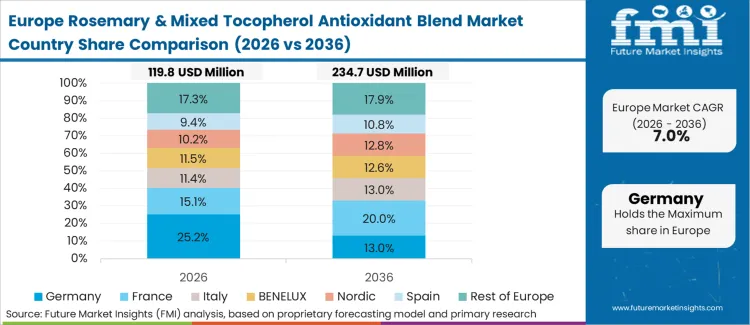
According to FMI's estimates, strict EFSA guidelines compel food and cosmetic manufacturers to utilize rigorously tested botanical extracts. European food safety teams leverage high thresholds to maximize natural preservation efficacy. Companies integrate sophisticated botanical systems to protect delicate formulations from rapid degradation.
- Germany: Germany is expected to grow 10.2% CAGR in rosemary and mixed tocopherol antioxidant blend demand over 2026 to 2036 as clean label pet nutrition scales, tightening the link between operational constraints and adoption-led investment. European Commission authorized Kemin Industries rosemary extract as antioxidant feed additive for cats and dogs [15]. Processors invest heavily in natural stabilization to secure high-margin veterinary accounts.
- United Kingdom: In United Kingdom, rosemary and mixed tocopherol antioxidant blend market is forecast to advance at 9.9% CAGR through 2036, with growth anchored in organic food expansion that converts into measurable budget allocation. Antioxidant capacity of decolorized rosemary powder showed 18-25% higher ORAC values [9]. Supply chains prioritize transparent sourcing for all functional additives.
FMI's report includes an extensive evaluation of local organic certification impacts and import restrictions. France and Italy remain critical markets for cosmetic-grade natural vitamin E product applications. Buyers heavily prioritize sustainable and traceable agricultural sourcing methods.
Latin America Rosemary & Mixed Tocopherol Antioxidant Blend Market Analysis
Latin America integrates natural antioxidant systems as dominant meat processing and export industries adapt to international clean label requirements. Massive beef and poultry sectors require robust stabilization to ensure quality during intercontinental shipping. Major meatpackers utilize refined extracts to prevent discoloration during extended transit. Extractors establish local partnerships to ensure raw material continuity.
- Brazil: In Brazil, demand for rosemary and mixed tocopherol antioxidant blends is rising as stringent meat export standards increase the need for reliable oxidation control. The demonstrated synergy between mixed tocopherols and rosemary extends induction periods by two to three times [16], strengthening processor confidence. Agricultural groups are expanding botanical cultivation to support domestic extraction and processing capacity, driving growth at a 9.7% CAGR over the forecast period.
FMI's report includes an in-depth review of regional supply chains and agricultural output metrics. Argentina and Chile represent key adoption zones for seafood and edible oil stabilization utilizing antioxidant skincare grade botanical inputs where appropriate. Suppliers expand local blending facilities to service massive regional food production conglomerates.
Competitive Aligners for Market Players
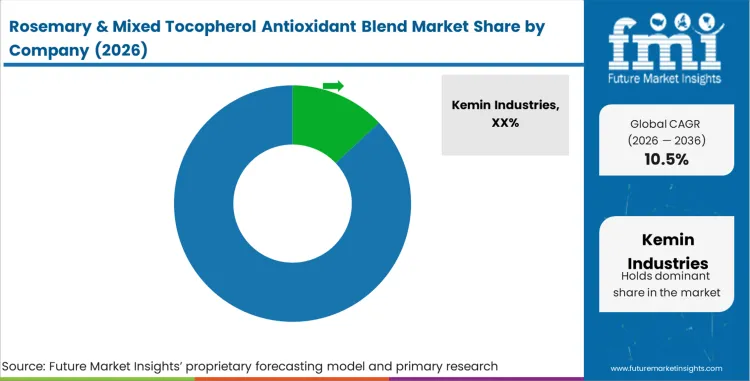
FMI analysts opine that customized synergistic formulations define competitive separation among primary ingredient suppliers. Companies matching specific alpha/gamma ratios capture high-value brand accounts. Ingredient processors focus entirely on isolating specific functional compounds to guarantee exact preservation metrics.
As per FMI's projection, application-specific delivery technologies unlock previously inaccessible product categories for botanical extracts. Competitors failing to develop advanced refinement techniques lose market share in visually sensitive cosmetic applications. Extraction facilities upgrade processing equipment to deliver highly soluble liquid formats required by beverage formulators.
Regulatory foresight and dedicated safety validation secure massive volume contracts in emerging segments. Firms investing heavily in toxicological dossiers capture lucrative first-mover advantages within heavily regulated animal nutrition and infant formula sectors. Strategic sourcing agreements insulate top-tier manufacturers from volatile botanical crop yields.
Recent Developments
The report includes full coverage of key trends from competitive benchmarking. Some of the recent developments covered in the reports:
- In May 2024, Kemin Industries secured European Commission authorization for liquid rosemary extract as an antioxidant feed additive for cats and dogs under EU Regulation 2024/1068. [2]
Key Players in Rosemary & Mixed Tocopherol Antioxidant Blend Market
- Kemin Industries
- Givaudan / Naturex
- Archer Daniels Midland Company
- DSM-Firmenich
- International Flavors & Fragrances Inc.
- Kalsec Inc.
- Camlin Fine Sciences
Scope of the Report
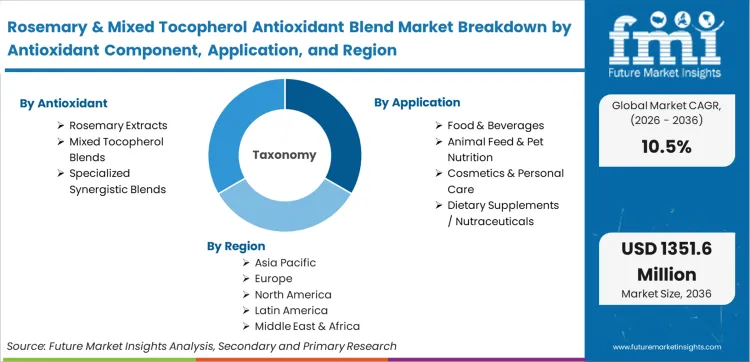
| Metric | Value |
|---|---|
| Quantitative Units | USD 498.0 million (2026) to USD 1,385.0 million (2036), at a CAGR of 10.5% |
| Market Definition | Commercial blends combining carnosic acid from rosemary with naturally sourced alpha, gamma, and delta tocopherols to prevent lipid oxidation in perishable goods. |
| Antioxidant Component Segmentation | Rosemary Extracts, Mixed Tocopherol Blends, Specialized Synergistic Blends |
| Application Segmentation | Food & Beverages, Animal Feed & Pet Nutrition, Cosmetics & Personal Care, Dietary Supplements / Nutraceuticals, Pharmaceuticals / Specialty Formulations |
| Regions Covered | North America, Latin America, Europe, East Asia, South Asia, Oceania, Middle East and Africa |
| Countries Covered | United States, China, India, Germany, United Kingdom, Brazil and 40 plus countries |
| Key Companies Profiled | Kemin Industries, Givaudan / Naturex, Archer Daniels Midland Company, DSM-Firmenich, International Flavors & Fragrances Inc., Kalsec Inc., Camlin Fine Sciences |
| Forecast Period | 2026 to 2036 |
| Approach | Hybrid top-down and bottom-up market modeling, validated through primary interviews with antioxidant blend producers and food manufacturers, supported by trade data benchmarking and production capacity analysis for commercial stabilization applications |
Rosemary & Mixed Tocopherol Antioxidant Blend Market Analysis by Segments
Antioxidant Component
- Rosemary Extracts
- Mixed Tocopherol Blends
- Specialized Synergistic Blends
Application
- Food & Beverages
- Animal Feed & Pet Nutrition
- Cosmetics & Personal Care
- Dietary Supplements / Nutraceuticals
- Pharmaceuticals / Specialty Formulations
Region
- Asia Pacific
- India
- China
- Japan
- South Korea
- Indonesia
- Australia & New Zealand
- ASEAN
- Rest of Asia Pacific
- Europe
- Germany
- Italy
- France
- United Kingdom
- Spain
- Benelux
- Nordics
- Central & Eastern Europe
- Rest of Europe
- North America
- United States
- Canada
- Mexico
- Latin America
- Brazil
- Argentina
- Chile
- Rest of Latin America
- Middle East & Africa
- Kingdom of Saudi Arabia
- United Arab Emirates
- South Africa
- Turkey
- Rest of Middle East & Africa
Bibliography
- [1] Frontiers in Sustainable Food Systems. (2025). Rosemary extract at 1500 ppm reduced peroxide values by ~40% in perilla seed oil-based margarine.
- [2] PR Newswire. (2024, May 2). Kemin Industries request for use of rosemary extract as antioxidant feed additive for cats and dogs authorized by European Commission.
- [3] PubMed. (2026). Decolorized rosemary powder exhibited higher DPPH radical scavenging (IC50 lower by 15-20%).
- [4] MeSH/NIH. (2025). Alpha-tocopherol described as potent natural antioxidant at 0.1-0.5% concentrations.
- [5] PubMed. (2025). Rosmarinic acid 9.1% CAGR projected in related natural preservative applications.
- [6] Frontiers in Sustainable Food Systems. (2025). Rosemary extract in omega-3 rich margarine delayed oxidation markers (TBARS reduced 35-42% at 1000 ppm).
- [7] NIH. (2025). Alpha-tocopherol and rosemary blend prolongs shelf-life in sardine oil by 150-200%.
- [8] MeSH/NIH. (2025). Natural vitamin E from plant sources retains 68-75% activity in cosmetic emulsions.
- [9] PubMed. (2026). Antioxidant capacity of decolorized rosemary powder showed 18-25% higher ORAC values.
- [10] WHO JECFA. (2025). ADI for rosemary extract 0–0.6 mg/kg bw.
- [11] Beyond Pesticides. (2026). Organic production increases secondary metabolites and antioxidant capacity by 20-40%.
- [12] Data.gov. (2025). Alpha-tocopherol supplementation increased pulmonary antioxidant enzymes by 30-50%.
- [13] WHO JECFA. (2025). Rosemary polyphenols maintain activity up to 200°C in frying oils.
- [14] Food Chemistry. (2025). Rosemary extract in woody edible oils reduced MDA formation by 25-60%.
- [15] EUR-Lex. (2025). Authorized rosemary extract as antioxidant feed additive for cats & dogs.
- [16] CGIAR. (2025). Mixed tocopherols and rosemary synergy extends induction period by 2-3x.
- [17] Frontiers in Sustainable Food Systems. (2025). Perilla oil margarine with rosemary improved oxidative stability index by 1.8-2.2x.
This bibliography is provided for reader reference and is not exhaustive. The full report contains the complete reference list and detailed citations.
This Report Addresses
- Market intelligence to enable structured strategic decision making across mature and emerging botanical economies
- Market size estimation and 10 year revenue forecasts from 2026 to 2036, supported by validated capacity and trade benchmarks
- Growth opportunity mapping across liquid, and powder forms with emphasis on clean label grade transitions
- Segment and regional revenue forecasts covering food, beverage, cosmetics, and animal nutrition applications
- Competition strategy assessment including integration models, cost survivability positioning, and compliance capability benchmarking
- Product reformulation and emission compliance tracking including clean label aligned grades
- Regulatory impact analysis covering synthetic additive bans, shelf life thresholds, and export driven specification upgrades
- Market report delivery in PDF, Excel, PPT, and interactive dashboard formats for executive and operational use
Frequently Asked Questions
How large is the demand for Rosemary & Mixed Tocopherol Antioxidant Blend in the global market in 2026?
Demand for Rosemary & Mixed Tocopherol Antioxidant Blend reaches USD 498.0 million in 2026.
What will be the market size of Rosemary & Mixed Tocopherol Antioxidant Blend in the global market by 2036?
Market size reaches USD 1,385.0 million by 2036.
What is the expected demand growth for Rosemary & Mixed Tocopherol Antioxidant Blend in the global market between 2026 and 2036?
Demand grows at a 10.5% CAGR between 2026 and 2036.
Which Antioxidant Component is poised to lead global sales by 2026?
Rosemary Extracts leads with 46% share driven by intense radical scavenging capabilities.
How significant is the role of Food & Beverages in driving Rosemary & Mixed Tocopherol Antioxidant Blend adoption in 2026?
Food & Beverages holds 39% share as brands eliminate synthetic preservatives from high-fat goods.
What is driving demand in United States?
Clean label retail mandates and strict ingredient guidelines dictate rapid commercial adoption.
What compliance standards or regulations are referenced for United States?
Clean label mandates and federal safety thresholds influence buying.
What is the United States growth outlook in this report?
United States grows at 11.4% CAGR through 2036.
Why is Europe described as a priority region in this report?
Strict EFSA safety guidelines force manufacturers toward rigorously tested natural botanical alternatives.
What type of demand dominates in Europe?
Regulatory-driven substitution demand dominates European procurement strategies.
What is China growth outlook in this report?
China expands at 10.9% CAGR through 2036.
Does the report cover India in its regional analysis?
Yes, India falls under South Asia.
What are the sources referred to for analyzing India?
Government agricultural yield reports and regional food production statistics support market projections.
What is the main demand theme linked to India in its region coverage?
Expanding organized retail drives demand for extended shelf-stability in tropical supply chains.
Does the report cover Germany in its regional analysis?
Yes, Germany falls under Europe.
What is the main Germany related demand theme in its region coverage?
Premium pet nutrition and clean label organic food expansion dictate rapid adoption.
Which product formats or configurations are strategically important for North America supply chains?
Decolorized powders and water-soluble liquid formats remain critical for diverse application integration.
What is Rosemary & Mixed Tocopherol Antioxidant Blend and what is it mainly used for?
Commercial botanical blends utilized to prevent rancidity and extend shelf-life in perishable goods.
What does Rosemary & Mixed Tocopherol Antioxidant Blend mean in this report?
Commercial production and integration of standardized botanical antioxidant systems across multiple industries.
What is included in the scope of this Rosemary & Mixed Tocopherol Antioxidant Blend report?
Standardized liquid and powder botanical extracts deployed specifically for lipid stabilization.
What is excluded from the scope of this report?
Synthetic antioxidants like BHA and unverified raw essential oils used strictly for fragrance.
What does market forecast mean on this page?
A model-based projection utilizing verified food production volumes and ingredient inclusion rates.
How does FMI build and validate the Rosemary & Mixed Tocopherol Antioxidant Blend forecast?
Bottom-up modeling validated through direct botanical extraction capacity checks.
What does zero reliance on speculative third party market research mean here?
Primary interviews and verifiable agricultural datasets dictate final market projections.
Preview the report firsthand - request a free sample
Get SampleGet the brochure for pricing and purchase details.
Get PDFTable of Content
- Executive Summary
- Global Market Outlook
- Demand-side Trends
- Supply-side Trends
- Technology Roadmap Analysis
- Analysis and Recommendations
- Market Overview
- Market Coverage / Taxonomy
- Market Definition / Scope / Limitations
- Research Methodology
- Chapter Orientation
- Analytical Lens and Working Hypotheses
- Market Structure, Signals, and Trend Drivers
- Benchmarking and Cross-market Comparability
- Market Sizing, Forecasting, and Opportunity Mapping
- Research Design and Evidence Framework
- Desk Research Programme (Secondary Evidence)
- Company Annual and Sustainability Reports
- Peer-reviewed Journals and Academic Literature
- Corporate Websites, Product Literature, and Technical Notes
- Earnings Decks and Investor Briefings
- Statutory Filings and Regulatory Disclosures
- Technical White Papers and Standards Notes
- Trade Journals, Industry Magazines, and Analyst Briefs
- Conference Proceedings, Webinars, and Seminar Materials
- Government Statistics Portals and Public Data Releases
- Press Releases and Reputable Media Coverage
- Specialist Newsletters and Curated Briefings
- Sector Databases and Reference Repositories
- FMI Internal Proprietary Databases and Historical Market Datasets
- Subscription Datasets and Paid Sources
- Social Channels, Communities, and Digital Listening Inputs
- Additional Desk Sources
- Expert Input and Fieldwork (Primary Evidence)
- Primary Modes
- Qualitative Interviews and Expert Elicitation
- Quantitative Surveys and Structured Data Capture
- Blended Approach
- Why Primary Evidence is Used
- Field Techniques
- Interviews
- Surveys
- Focus Groups
- Observational and In-context Research
- Social and Community Interactions
- Stakeholder Universe Engaged
- C-suite Leaders
- Board Members
- Presidents and Vice Presidents
- R&D and Innovation Heads
- Technical Specialists
- Domain Subject-matter Experts
- Scientists
- Physicians and Other Healthcare Professionals
- Governance, Ethics, and Data Stewardship
- Research Ethics
- Data Integrity and Handling
- Primary Modes
- Tooling, Models, and Reference Databases
- Desk Research Programme (Secondary Evidence)
- Data Engineering and Model Build
- Data Acquisition and Ingestion
- Cleaning, Normalisation, and Verification
- Synthesis, Triangulation, and Analysis
- Quality Assurance and Audit Trail
- Market Background
- Market Dynamics
- Drivers
- Restraints
- Opportunity
- Trends
- Scenario Forecast
- Demand in Optimistic Scenario
- Demand in Likely Scenario
- Demand in Conservative Scenario
- Opportunity Map Analysis
- Product Life Cycle Analysis
- Supply Chain Analysis
- Investment Feasibility Matrix
- Value Chain Analysis
- PESTLE and Porter’s Analysis
- Regulatory Landscape
- Regional Parent Market Outlook
- Production and Consumption Statistics
- Import and Export Statistics
- Market Dynamics
- Global Market Analysis 2021 to 2025 and Forecast, 2026 to 2036
- Historical Market Size Value (USD Million) Analysis, 2021 to 2025
- Current and Future Market Size Value (USD Million) Projections, 2026 to 2036
- Y-o-Y Growth Trend Analysis
- Absolute $ Opportunity Analysis
- Global Market Pricing Analysis 2021 to 2025 and Forecast 2026 to 2036
- Global Market Analysis 2021 to 2025 and Forecast 2026 to 2036, By Antioxidant Component
- Introduction / Key Findings
- Historical Market Size Value (USD Million) Analysis By Antioxidant Component , 2021 to 2025
- Current and Future Market Size Value (USD Million) Analysis and Forecast By Antioxidant Component , 2026 to 2036
- Rosemary Extracts
- Mixed Tocopherol Blends
- Specialized Synergistic Blends
- Rosemary Extracts
- Y-o-Y Growth Trend Analysis By Antioxidant Component , 2021 to 2025
- Absolute $ Opportunity Analysis By Antioxidant Component , 2026 to 2036
- Global Market Analysis 2021 to 2025 and Forecast 2026 to 2036, By Application
- Introduction / Key Findings
- Historical Market Size Value (USD Million) Analysis By Application, 2021 to 2025
- Current and Future Market Size Value (USD Million) Analysis and Forecast By Application, 2026 to 2036
- Food & Beverages
- Animal Feed & Pet Nutrition
- Cosmetics & Personal Care
- Dietary Supplements / Nutraceuticals
- Food & Beverages
- Y-o-Y Growth Trend Analysis By Application, 2021 to 2025
- Absolute $ Opportunity Analysis By Application, 2026 to 2036
- Global Market Analysis 2021 to 2025 and Forecast 2026 to 2036, By Region
- Introduction
- Historical Market Size Value (USD Million) Analysis By Region, 2021 to 2025
- Current Market Size Value (USD Million) Analysis and Forecast By Region, 2026 to 2036
- North America
- Latin America
- Western Europe
- Eastern Europe
- East Asia
- South Asia and Pacific
- Middle East & Africa
- Market Attractiveness Analysis By Region
- North America Market Analysis 2021 to 2025 and Forecast 2026 to 2036, By Country
- Historical Market Size Value (USD Million) Trend Analysis By Market Taxonomy, 2021 to 2025
- Market Size Value (USD Million) Forecast By Market Taxonomy, 2026 to 2036
- By Country
- USA
- Canada
- Mexico
- By Antioxidant Component
- By Application
- By Country
- Market Attractiveness Analysis
- By Country
- By Antioxidant Component
- By Application
- Key Takeaways
- Latin America Market Analysis 2021 to 2025 and Forecast 2026 to 2036, By Country
- Historical Market Size Value (USD Million) Trend Analysis By Market Taxonomy, 2021 to 2025
- Market Size Value (USD Million) Forecast By Market Taxonomy, 2026 to 2036
- By Country
- Brazil
- Chile
- Rest of Latin America
- By Antioxidant Component
- By Application
- By Country
- Market Attractiveness Analysis
- By Country
- By Antioxidant Component
- By Application
- Key Takeaways
- Western Europe Market Analysis 2021 to 2025 and Forecast 2026 to 2036, By Country
- Historical Market Size Value (USD Million) Trend Analysis By Market Taxonomy, 2021 to 2025
- Market Size Value (USD Million) Forecast By Market Taxonomy, 2026 to 2036
- By Country
- Germany
- UK
- Italy
- Spain
- France
- Nordic
- BENELUX
- Rest of Western Europe
- By Antioxidant Component
- By Application
- By Country
- Market Attractiveness Analysis
- By Country
- By Antioxidant Component
- By Application
- Key Takeaways
- Eastern Europe Market Analysis 2021 to 2025 and Forecast 2026 to 2036, By Country
- Historical Market Size Value (USD Million) Trend Analysis By Market Taxonomy, 2021 to 2025
- Market Size Value (USD Million) Forecast By Market Taxonomy, 2026 to 2036
- By Country
- Russia
- Poland
- Hungary
- Balkan & Baltic
- Rest of Eastern Europe
- By Antioxidant Component
- By Application
- By Country
- Market Attractiveness Analysis
- By Country
- By Antioxidant Component
- By Application
- Key Takeaways
- East Asia Market Analysis 2021 to 2025 and Forecast 2026 to 2036, By Country
- Historical Market Size Value (USD Million) Trend Analysis By Market Taxonomy, 2021 to 2025
- Market Size Value (USD Million) Forecast By Market Taxonomy, 2026 to 2036
- By Country
- China
- Japan
- South Korea
- By Antioxidant Component
- By Application
- By Country
- Market Attractiveness Analysis
- By Country
- By Antioxidant Component
- By Application
- Key Takeaways
- South Asia and Pacific Market Analysis 2021 to 2025 and Forecast 2026 to 2036, By Country
- Historical Market Size Value (USD Million) Trend Analysis By Market Taxonomy, 2021 to 2025
- Market Size Value (USD Million) Forecast By Market Taxonomy, 2026 to 2036
- By Country
- India
- ASEAN
- Australia & New Zealand
- Rest of South Asia and Pacific
- By Antioxidant Component
- By Application
- By Country
- Market Attractiveness Analysis
- By Country
- By Antioxidant Component
- By Application
- Key Takeaways
- Middle East & Africa Market Analysis 2021 to 2025 and Forecast 2026 to 2036, By Country
- Historical Market Size Value (USD Million) Trend Analysis By Market Taxonomy, 2021 to 2025
- Market Size Value (USD Million) Forecast By Market Taxonomy, 2026 to 2036
- By Country
- Kingdom of Saudi Arabia
- Other GCC Countries
- Turkiye
- South Africa
- Other African Union
- Rest of Middle East & Africa
- By Antioxidant Component
- By Application
- By Country
- Market Attractiveness Analysis
- By Country
- By Antioxidant Component
- By Application
- Key Takeaways
- Key Countries Market Analysis
- USA
- Pricing Analysis
- Market Share Analysis, 2025
- By Antioxidant Component
- By Application
- Canada
- Pricing Analysis
- Market Share Analysis, 2025
- By Antioxidant Component
- By Application
- Mexico
- Pricing Analysis
- Market Share Analysis, 2025
- By Antioxidant Component
- By Application
- Brazil
- Pricing Analysis
- Market Share Analysis, 2025
- By Antioxidant Component
- By Application
- Chile
- Pricing Analysis
- Market Share Analysis, 2025
- By Antioxidant Component
- By Application
- Germany
- Pricing Analysis
- Market Share Analysis, 2025
- By Antioxidant Component
- By Application
- UK
- Pricing Analysis
- Market Share Analysis, 2025
- By Antioxidant Component
- By Application
- Italy
- Pricing Analysis
- Market Share Analysis, 2025
- By Antioxidant Component
- By Application
- Spain
- Pricing Analysis
- Market Share Analysis, 2025
- By Antioxidant Component
- By Application
- France
- Pricing Analysis
- Market Share Analysis, 2025
- By Antioxidant Component
- By Application
- India
- Pricing Analysis
- Market Share Analysis, 2025
- By Antioxidant Component
- By Application
- ASEAN
- Pricing Analysis
- Market Share Analysis, 2025
- By Antioxidant Component
- By Application
- Australia & New Zealand
- Pricing Analysis
- Market Share Analysis, 2025
- By Antioxidant Component
- By Application
- China
- Pricing Analysis
- Market Share Analysis, 2025
- By Antioxidant Component
- By Application
- Japan
- Pricing Analysis
- Market Share Analysis, 2025
- By Antioxidant Component
- By Application
- South Korea
- Pricing Analysis
- Market Share Analysis, 2025
- By Antioxidant Component
- By Application
- Russia
- Pricing Analysis
- Market Share Analysis, 2025
- By Antioxidant Component
- By Application
- Poland
- Pricing Analysis
- Market Share Analysis, 2025
- By Antioxidant Component
- By Application
- Hungary
- Pricing Analysis
- Market Share Analysis, 2025
- By Antioxidant Component
- By Application
- Kingdom of Saudi Arabia
- Pricing Analysis
- Market Share Analysis, 2025
- By Antioxidant Component
- By Application
- Turkiye
- Pricing Analysis
- Market Share Analysis, 2025
- By Antioxidant Component
- By Application
- South Africa
- Pricing Analysis
- Market Share Analysis, 2025
- By Antioxidant Component
- By Application
- USA
- Market Structure Analysis
- Competition Dashboard
- Competition Benchmarking
- Market Share Analysis of Top Players
- By Regional
- By Antioxidant Component
- By Application
- Competition Analysis
- Competition Deep Dive
- Kemin Industries
- Overview
- Product Portfolio
- Profitability by Market Segments (Product/Age /Sales Channel/Region)
- Sales Footprint
- Strategy Overview
- Marketing Strategy
- Product Strategy
- Channel Strategy
- Givaudan / Naturex
- Archer Daniels Midland Company
- DSM-Firmenich
- International Flavors & Fragrances Inc.
- Kalsec Inc.
- Camlin Fine Sciences
- Kemin Industries
- Competition Deep Dive
- Assumptions & Acronyms Used


