

- Industry Size (2026)
- USD 379.1 Mn
- Forecast (2036)
- USD 626.9 Mn
- CAGR (2026 to 2036)
- 5.2%
Food Grade Dipotassium Phosphate Outlook in the UK 2026 to 2036
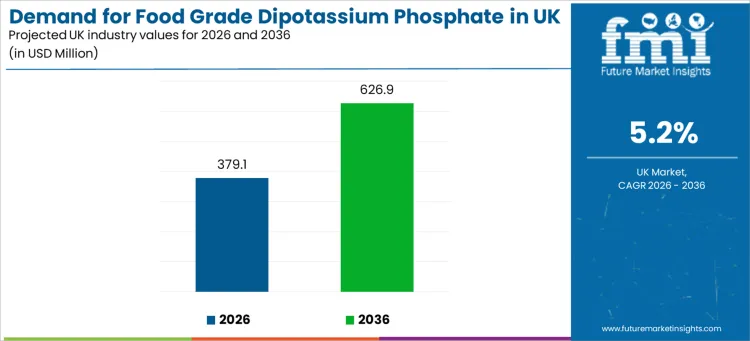
Demand for food grade dipotassium phosphate in the UK is projected at USD 379.1 million in 2026 and is expected to reach USD 626.9 million by 2036, expanding at a 5.2% CAGR. This demand expansion is connected to the ingredient’s role as a functional phosphate used to stabilise formulations, manage acidity, and support processing consistency across packaged food and beverage production. In many recipes, dipotassium phosphate is not selected for taste. It is selected for control. It helps manufacturers achieve repeatable texture, stable pH, improved emulsification behaviour, and consistent product appearance across long distribution cycles.
Food grade dipotassium phosphate is used across dairy, meat, bakery, confectionery, and beverages, with adoption shaped by quality targets such as smoothness, dispersion, colour stability, hydration behaviour, and shelf-life performance. Buyers evaluate it through solubility, dosing accuracy, batch consistency, impurity control, and regulatory fit under authorised additive systems. In practice, it becomes part of the “quiet infrastructure” inside a formulation, supporting predictable processing outcomes at industrial scale.
For CEOs and commercial leaders, the value proposition sits in reduced batch failures, lower scrap risk, and stronger manufacturing uptime. For ingredient solution providers, demand is tied to reliable supply, consistent specifications, and the ability to support customer audits and documentation needs. For retail and foodservice operators, it plays an indirect role by enabling stable finished product quality that holds up across temperature variation, transport exposure, and extended shelf storage.
Quick Stats for Food Grade Dipotassium Phosphate Demand in the UK
- Food Grade Dipotassium Phosphate Valuation in the UK (2026): USD 379.1 million
- Food Grade Dipotassium Phosphate Forecast Valuation in the UK (2036): USD 626.9 million
- Forecast CAGR 2026 to 2036: 5.2%
- Leading Regional Growth: England (5.7%)
- Leading Form: Powder (58.0% share)
- Leading Application: Dairy (36.2% share)
- Leading Product Type: Dipotassium Phosphate Anhydrous (29.2% share)
- Leading End User: Individuals (20.1% share)
- Key Companies Profiled: Foodchem International Corporation; TKI Hrastnik; FBC Industries; Aditya Birla Chemicals; Haifa Chemicals Ltd.
Food Grade Dipotassium Phosphate in the UK Key Takeaways
| Metric | Value |
|---|---|
| Industry Value (2026) | USD 379.1 million |
| Industry Forecast Value (2036) | USD 626.9 million |
| Forecast CAGR (2026 to 2036) | 5.2% |
Why is the UK Building Steady Demand for Food Grade Dipotassium Phosphate?
UK demand is anchored in industrial food processing discipline. As production systems scale, manufacturers need ingredients that deliver consistent outcomes across high-throughput lines and centralised distribution. Dipotassium phosphate supports this requirement because it functions as a buffering agent and stabiliser in several product categories where small pH shifts can change texture, appearance, stability, and consumer experience.
Regulatory clarity supports structured adoption. The Food Standards Agency lists approved additives and E numbers used in food, providing a clear compliance baseline for businesses managing ingredient approvals and labelling practices. In Great Britain’s regulated product register, E 340 is recognised as potassium phosphates, reinforcing how phosphate additives fit within authorised systems.
In production and QA settings, food grade is not only a label. It signals traceability readiness, specification control, and documented purity compliance. Commission Regulation (EU) No 231/2012 provides additive specifications, including for E 340 (ii) dipotassium phosphate, which influences how manufacturers validate ingredient quality and conformance.
Dairy leads application share at 36.2%, reflecting the category’s heavy reliance on stability and texture control. Milk-based products, cream systems, and processed dairy formats can be sensitive to processing conditions such as heat treatment and shear. Manufacturers often use phosphate systems to manage stability and maintain a uniform sensory profile across batches.
Form preference also plays a clear role. Powder holds 58.0% share, supporting bulk manufacturing routines where dosing accuracy, mixing performance, and storage practicality drive procurement decisions. Powder formats often integrate well into standard ingredient handling systems, supporting efficient batching and reduced variability risk.
Teams mapping phosphate functionality across wider food ingredient strategies often align formulation planning with adjacent coverage such as food additives size and phosphate-based ingredient categories such as food grade phosphate when assessing how stabilisers and buffering agents support modern processed food portfolios.
How is Food Grade Dipotassium Phosphate Demand Segmented by Form, Application, Product Type, and End User?
Segmentation reflects how manufacturers dose and handle the ingredient, which product systems benefit most from phosphate functionality, and how supply flows from industrial users to foodservice users and consumer-packaged use.
Why does powder lead form selection for Food Grade Dipotassium Phosphate in the UK?
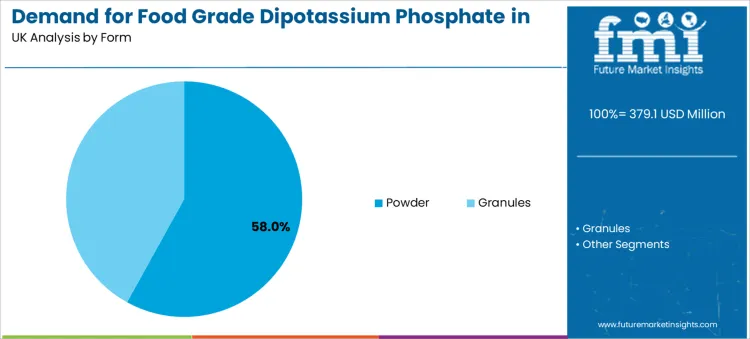
Powder leads with a 58.0% share, making it the most common form used in UK demand. The reason is operational efficiency. Powder aligns with bulk manufacturing workflows that require repeatable dosing, stable storage, and high compatibility with automated batching systems. It supports easier scale-up for producers operating multiple lines and shifts. It also allows tighter control of concentration and dispersion during mixing, which reduces risk of uneven performance in the final product.
From a procurement lens, powder formats reduce complexity in shipping and storage. They typically allow better shelf stability and easier integration into warehouse inventory management practices. These traits matter for manufacturers running lean production schedules, where minor ingredient disruptions can cascade into significant output loss.
How is Dairy anchoring phosphate usage through stability control requirements?
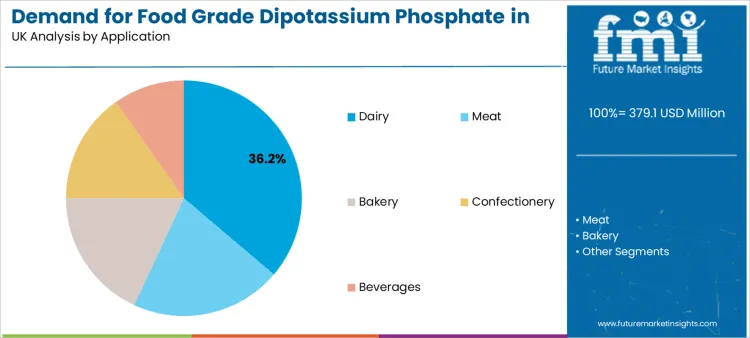
Dairy holds a 36.2% share, confirming it as the largest application group. This dominance reflects how dairy systems are sensitive to pH management, protein stability, and texture uniformity.Dipotassium phosphate supports stable emulsion behaviour and consistent mouthfeel across products that experience thermal stress or extended storage. For production teams, this translates into fewer batch inconsistencies and stronger confidence in finished product appearance and performance.
Other applications such as meat, bakery, confectionery, and beverages also rely on phosphate functionality when processing stability and taste consistency need to be protected. These categories use phosphate systems for buffering and formulation control in ways that fit their unique processing steps and storage conditions.
Why is dipotassium phosphate anhydrous emerging as a leading product type in UK demand patterns?
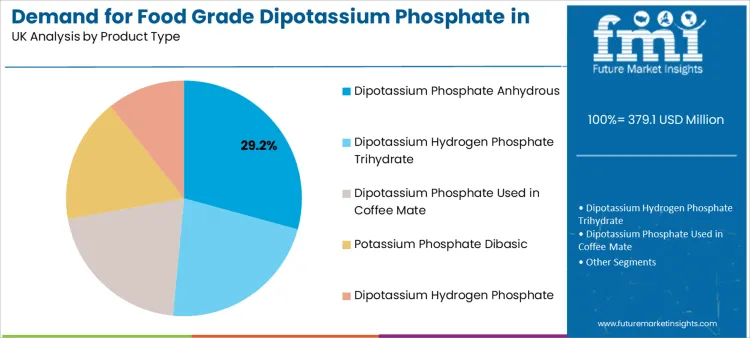
Dipotassium phosphate anhydrous holds a 29.2% share, indicating strong adoption where manufacturers want concentrated functional performance with predictable handling. Product type differentiation matters because it affects solubility behaviour, formulation response, and storage characteristics. Buyers select variants based on their process needs, finished product expectations, and compatibility with existing ingredient systems.
Other product types such as dipotassium hydrogen phosphate, trihydrate forms, coffee-mate use formats, and potassium phosphate dibasic remain relevant across targeted recipes and processing conditions where their functional profile fits specific outcomes.
Why do individuals represent the largest end user group despite industrial dominance in production volumes?
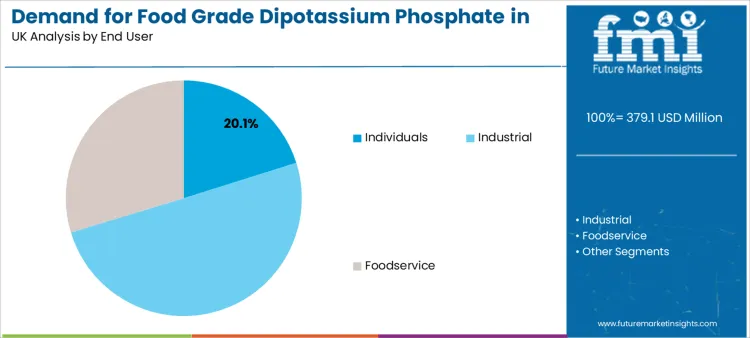
Individuals hold a 20.1% share, showing that consumer access and small-scale usage remain relevant within overall demand structure. Individuals often represent downstream consumption that reflects how phosphate-enabled products are purchased for household use across dairy and processed food baskets.
Industrial end users continue to account for major manufacturing use, while foodservice demand reflects the ingredient’s presence in products served through cafés, catering, institutional kitchens, and prepared food operations.
Decision-makers comparing functional phosphate strategies often track broader salt system direction through categories such as phosphate salts, especially where processing consistency, quality control, and clean labelling sensitivity are being balanced across multiple food product lines.
What are the Dynamics, Restraints, Opportunities, and Threats Shaping this Space?
What dynamics are strengthening UK demand fundamentals?
Functional dependency is a primary driver. Food manufacturers need predictable buffering and stabilisation performance across recipes that must remain consistent through storage and distribution. Regulatory clarity also supports demand by defining approved additive classes and E number references.
Safety assessment context influences how phosphates are evaluated. EFSA’s scientific opinion re-evaluated phosphoric acid and phosphate additives including E 338-341, E 343, and E 450-452, providing an evidence-backed basis that informs regulatory and industry discussions. Codex GSFA also lists dipotassium hydrogen phosphate (INS/E 340(ii)) as part of global additive reference frameworks used across international trade and compliance alignment.
What restraints can slow adoption or increase commercial friction?
Reformulation pressure can act as a restraint where brands aim to simplify labels or reduce additive perception concerns. Consumer-facing pressure can influence retail positioning and ingredient strategy, especially for categories that compete on “minimal ingredients” messaging. Cost volatility in phosphate supply chains also adds pressure, as ingredient buyers seek stable pricing while protecting manufacturing margins.
Documentation burden can increase as suppliers are expected to provide robust quality evidence. Additive specification frameworks such as EU 231/2012 influence the level of compliance detail expected during audits and supplier onboarding.
Where do practical opportunities sit for suppliers and product owners?
Opportunities concentrate in high-trust supply and technical support. Manufacturers want suppliers that can provide consistent purity profiles, low contamination risk, and stable performance across batches. Suppliers that offer application guidance for dairy, bakery, and beverage systems can embed deeper into customer formulation workflows, supporting repeat contracts and longer retention.
There is also opportunity in portfolio integration. Brands that manage phosphate systems alongside emulsifiers, stabilisers, and texture agents can provide “complete formulation packages” rather than single-ingredient supply. Teams developing these strategies often align across adjacent ingredient families such as food grade dipotassium phosphate when mapping how phosphate buffering supports performance in packaged food categories.
What threats can disrupt demand expectations?
Regulatory change, specification tightening, or evolving labelling expectations can create risk for products that depend on additive functionality. Supply disruption risk also matters, especially for manufacturers that rely on just-in-time procurement. If consistent quality supply is interrupted, batch failure risk rises and production schedules can be affected quickly.
How is Food Grade Dipotassium Phosphate Demand Evolving across Key Regions in the UK?
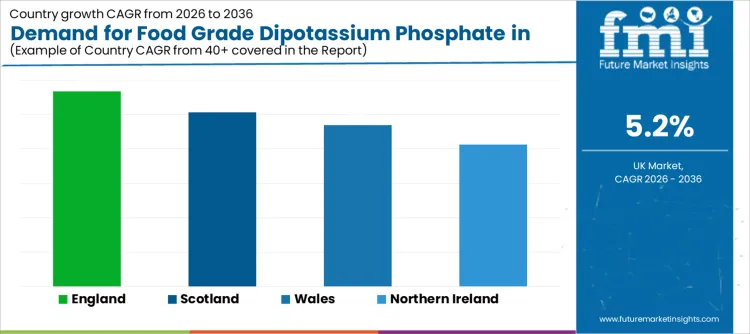
| Region | CAGR 2026 to 2036 |
|---|---|
| England | 5.7% |
| Scotland | 5.1% |
| Wales | 4.7% |
| Northern Ireland | 4.1% |
Why is England leading growth as large-scale food manufacturing and retail supply chains expand?
England grows at 5.7%, supported by a dense manufacturing base and high-volume retail distribution networks that rely on stable formulation outcomes. Producers operating at scale place strong value on buffering and stabilisation ingredients that reduce variability risk and protect sensory consistency across mass-produced dairy, beverages, and processed food formats. Procurement teams in England tend to prioritise suppliers with strong documentation, steady availability, and predictable lead times.
How is Scotland sustaining steady expansion through dairy-linked ingredient usage and production stability needs?
Scotland advances at 5.1%, driven by steady food production requirements where texture and stability control remain essential. Dairy application leadership supports phosphate usage as manufacturers aim to protect uniform product performance. Buyers also value powder format practicality for storage and batching, aligning with efficient production workflows.
What is supporting Wales as phosphate-enabled formulations gain importance in packaged foods?
Wales grows at 4.7%, shaped by consistent demand for formulation support ingredients used in packaged foods and drink systems. Businesses tend to focus on ingredients that improve process control and reduce quality variation risk. Suppliers that provide responsive technical support and consistent specification delivery strengthen position in this region.
Why is Northern Ireland progressing at a measured pace with targeted adoption across food processing categories?
Northern Ireland increases at 4.1%, reflecting targeted usage patterns tied to specific production needs and supply relationships. Demand rises where phosphate functionality supports consistent product outcomes and helps manufacturers manage batch reliability. The pace remains steady, supported by practical procurement discipline and the preference for stable, predictable supply.
What Defines the Competitive Landscape for Food Grade Dipotassium Phosphate in the UK?
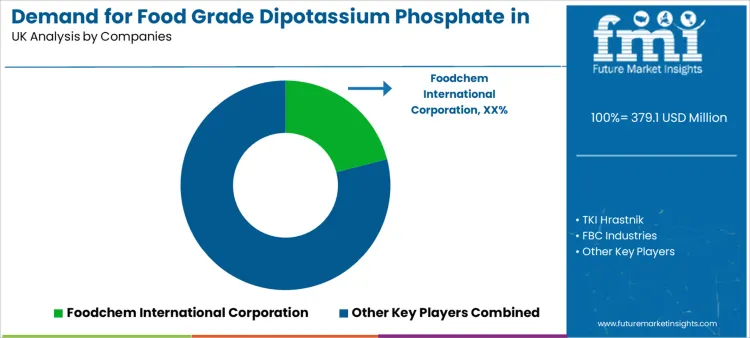
Competition is shaped by specification consistency, documentation readiness, and performance reliability inside customer recipes. Buyers evaluate suppliers based on purity alignment, batch-to-batch stability, packaging integrity, logistics reliability, and the ability to support customer audits with fast documentation response. Suppliers that can deliver both technical guidance and dependable volume availability gain stronger positions with industrial processors that run continuous production cycles.
Foodchem International Corporation competes through ingredient supply capabilities and broad customer coverage. TKI Hrastnik competes through industrial chemical production and phosphate-related materials expertise. FBC Industries competes through supply availability and business-to-business distribution pathways.
Aditya Birla Chemicals competes through chemical manufacturing scale and integrated sourcing strength. Haifa Chemicals Ltd. competes through specialty chemical supply capabilities and process-grade documentation support.
Strategy teams aligning phosphate ingredient direction across broader portfolios often reference adjacent category positioning through phosphate salts and ingredient-wide comparisons such as food additives size when planning scale, compliance readiness, and long-term supply resilience.
Key Industry Participants
- Foodchem International Corporation
- TKI Hrastnik
- FBC Industries
- Aditya Birla Chemicals
- Haifa Chemicals Ltd.
Scope of Report
| Items | Values |
|---|---|
| Quantitative Units | USD Million |
| Form | Powder; Granules |
| Application | Dairy; Meat; Bakery; Confectionery; Beverages |
| Product Type | Dipotassium Phosphate Anhydrous; Dipotassium Hydrogen Phosphate Trihydrate; Dipotassium Phosphate Used in Coffee Mate; Potassium Phosphate Dibasic; Dipotassium Hydrogen Phosphate |
| End User | Individuals; Industrial; Foodservice |
| Regions Covered | England; Scotland; Wales; Northern Ireland |
| Key Companies Profiled | Foodchem International Corporation; TKI Hrastnik; FBC Industries; Aditya Birla Chemicals; Haifa Chemicals Ltd. |
Food Grade Dipotassium Phosphate Demand in the UK by Segments
By Form
- Powder
- Granules
By Application
- Dairy
- Meat
- Bakery
- Confectionery
- Beverages
By Product Type
- Dipotassium Phosphate Anhydrous
- Dipotassium Hydrogen Phosphate Trihydrate
- Dipotassium Phosphate Used in Coffee Mate
- Potassium Phosphate Dibasic
- Dipotassium Hydrogen Phosphate
By End User
- Individuals
- Industrial
- Foodservice
By Region
- England
- Scotland
- Wales
- Northern Ireland
Bibliography
- European Food Safety Authority. (2019). Re-evaluation of phosphoric acid-phosphates - di-, tri- and polyphosphates (E 338-341, E 343, E 450-452) as food additives and the safety of proposed extension of use. EFSA Journal.
- Food Standards Agency. (2025). Approved additives and E numbers.
- Food Standards Agency. (2025). Potassium phosphates (E 340) authorisations register (Great Britain).
- Food and Agriculture Organization of the United Nations. (2025). Dipotassium hydrogen phosphate (340(ii)) additive details (GSFA Online).
- European Union. (2012). Commission Regulation (EU) No 231/2012 laying down specifications for food additives listed in Annexes II and III to Regulation (EC) No 1333/2008: E 340(ii) dipotassium phosphate.
- European Union. (2023). Regulation (EC) No 1333/2008 on food additives (consolidated version).
-
Frequently Asked Questions
- What is the outlook for food grade dipotassium phosphate demand in the UK for 2026?
- Food grade dipotassium phosphate demand in the UK is expected to total USD 379.1 million in 2026.
- What value is expected for food grade dipotassium phosphate demand in UK for 2036?
- In 2036, demand for food grade dipotassium phosphate in UK will likely be valued at USD 626.9 million.
- At what rate will food grade dipotassium phosphate demand in UK progress from 2026 to 2036?
- Food grade dipotassium phosphate demand in UK is anticipated to advance at a 5.2% CAGR from 2026 to 2036.
- Which form will account for the largest share of demand in the UK?
- Powder is likely to lead, capturing 58.0% of total demand share.
- Which application will represent the bulk of usage in the UK?
- Dairy is expected to lead, accounting for 36.2% of total demand.
- Which product type is expected to be most used in the UK?
- Dipotassium phosphate anhydrous is expected to lead, accounting for 29.2% of total demand.
- Which end user group is expected to hold the largest share in the UK?
- Individuals are expected to lead, accounting for 20.1% of total demand.
Frequently Asked Questions
How big is the demand for food grade dipotassium phosphate in uk in 2026?
The demand for food grade dipotassium phosphate in uk is estimated to be valued at USD 379.1 million in 2026.
What will be the size of food grade dipotassium phosphate in uk in 2036?
The market size for the food grade dipotassium phosphate in uk is projected to reach USD 626.9 million by 2036.
How much will be the demand for food grade dipotassium phosphate in uk growth between 2026 and 2036?
The demand for food grade dipotassium phosphate in uk is expected to grow at a 5.2% CAGR between 2026 and 2036.
What are the key product types in the food grade dipotassium phosphate in uk?
The key product types in food grade dipotassium phosphate in uk are powder and granules.
Which application segment is expected to contribute significant share in the food grade dipotassium phosphate in uk in 2026?
In terms of application, dairy segment is expected to command 36.2% share in the food grade dipotassium phosphate in uk in 2026.
Preview the report firsthand - request a free sample
Get SampleGet the brochure for pricing and purchase details.
Get PDFTable of Content
- Executive Summary
- UK Market Outlook
- Demand-side Trends
- Supply-side Trends
- Technology Roadmap Analysis
- Analysis and Recommendations
- Market Overview
- Market Coverage / Taxonomy
- Market Definition / Scope / Limitations
- Market Background
- Market Dynamics
- Drivers
- Restraints
- Opportunity
- Trends
- Scenario Forecast
- Demand in Optimistic Scenario
- Demand in Likely Scenario
- Demand in Conservative Scenario
- Opportunity Map Analysis
- Product Life Cycle Analysis
- Supply Chain Analysis
- Investment Feasibility Matrix
- Value Chain Analysis
- PESTLE and Porter’s Analysis
- Regulatory Landscape
- Regional Parent Market Outlook
- Production and Consumption Statistics
- Import and Export Statistics
- Market Dynamics
- UK Market Analysis 2021 to 2025 and Forecast, 2026 to 2036
- Historical Market Size Value (USD Million) Analysis, 2021 to 2025
- Current and Future Market Size Value (USD Million) Projections, 2026 to 2036
- Y-o-Y Growth Trend Analysis
- Absolute $ Opportunity Analysis
- UK Market Pricing Analysis 2021 to 2025 and Forecast 2026 to 2036
- UK Market Analysis 2021 to 2025 and Forecast 2026 to 2036, By Form
- Introduction / Key Findings
- Historical Market Size Value (USD Million) Analysis By Form , 2021 to 2025
- Current and Future Market Size Value (USD Million) Analysis and Forecast By Form , 2026 to 2036
- Powder
- Granules
- Powder
- Y-o-Y Growth Trend Analysis By Form , 2021 to 2025
- Absolute $ Opportunity Analysis By Form , 2026 to 2036
- UK Market Analysis 2021 to 2025 and Forecast 2026 to 2036, By Application
- Introduction / Key Findings
- Historical Market Size Value (USD Million) Analysis By Application, 2021 to 2025
- Current and Future Market Size Value (USD Million) Analysis and Forecast By Application, 2026 to 2036
- Dairy
- Meat
- Bakery
- Confectionery
- Beverages
- Dairy
- Y-o-Y Growth Trend Analysis By Application, 2021 to 2025
- Absolute $ Opportunity Analysis By Application, 2026 to 2036
- UK Market Analysis 2021 to 2025 and Forecast 2026 to 2036, By Product Type
- Introduction / Key Findings
- Historical Market Size Value (USD Million) Analysis By Product Type, 2021 to 2025
- Current and Future Market Size Value (USD Million) Analysis and Forecast By Product Type, 2026 to 2036
- Dipotassium Phosphate Anhydrous
- Dipotassium Hydrogen Phosphate Trihydrate
- Dipotassium Phosphate Used in Coffee Mate
- Potassium Phosphate Dibasic
- Dipotassium Hydrogen Phosphate
- Dipotassium Phosphate Anhydrous
- Y-o-Y Growth Trend Analysis By Product Type, 2021 to 2025
- Absolute $ Opportunity Analysis By Product Type, 2026 to 2036
- UK Market Analysis 2021 to 2025 and Forecast 2026 to 2036, By End User
- Introduction / Key Findings
- Historical Market Size Value (USD Million) Analysis By End User, 2021 to 2025
- Current and Future Market Size Value (USD Million) Analysis and Forecast By End User, 2026 to 2036
- Individuals
- Industrial
- Foodservice
- Individuals
- Y-o-Y Growth Trend Analysis By End User, 2021 to 2025
- Absolute $ Opportunity Analysis By End User, 2026 to 2036
- Market Structure Analysis
- Competition Dashboard
- Competition Benchmarking
- Market Share Analysis of Top Players
- By Regional
- By Form
- By Application
- By Product Type
- By End User
- Competition Analysis
- Competition Deep Dive
- Foodchem International Corporation
- Overview
- Product Portfolio
- Profitability by Market Segments (Product/Age /Sales Channel/Region)
- Sales Footprint
- Strategy Overview
- Marketing Strategy
- Product Strategy
- Channel Strategy
- TKI Hrastnik
- FBC Industries
- Aditya Birla Chemicals
- Haifa Chemicals Ltd.
- Foodchem International Corporation
- Competition Deep Dive
- Assumptions & Acronyms Used
- Research Methodology


