

- Industry Size (2026)
- USD 105.7 Mn
- Forecast (2036)
- USD 166.6 Mn
- CAGR (2026 to 2036)
- 4.7%
Demand for Food Grade Dipotassium Phosphate in South Korea Forecast and Outlook 2026 to 2036
Revenue from food grade dipotassium phosphate sales in South Korea is anticipated to reach USD 105.7 million in 2026. The industry is predicted to reach USD 166.6 million by 2036, expanding at a compound annual growth rate of 4.7%. South Korea possesses a sophisticated food processing landscape where texture stability and nutritional fortification are paramount. Manufacturers extensively utilize buffering agents to maintain pH levels in processed dairy and beverage products, preventing coagulation and extending shelf life.
Increasing consumption of convenience foods among urban populations drives constant procurement of reliable stabilizing agents. Consumers are also shifting towards protein-rich diets, necessitating efficient emulsification salts for protein drinks and processed cheeses. Consequently, industrial food processors are scaling up production capabilities, securing a steady baseline requirement for high-purity phosphate ingredients to ensure consistent product quality across massive retail distribution networks.
Government agencies actively monitor food safety standards, enforcing strict regulations on additive purity levels. Ministry of Food and Drug Safety policies compel manufacturers to source high-grade ingredients that meet international safety benchmarks. Compliance with these rigorous standards pushes local producers to partner with certified suppliers capable of delivering contaminant-free phosphate salts.
Public focus on health is influencing formulation strategies, with brands reducing sodium content by substituting sodium phosphates with potassium-based alternatives. This health-conscious shift aligns with national initiatives to lower cardiovascular risks associated with high sodium intake. Supporting this transition, regulatory frameworks are evolving to facilitate the approval of potassium-fortified products. Such an environment fosters continuous adoption of dipotassium phosphate as a preferred functional ingredient in the evolving South Korean nutritional landscape.
Quick Stats for Demand for Food Grade Dipotassium Phosphate in South Korea
- Demand for Food Grade Dipotassium Phosphate in South Korea Value (2026): USD 105.7 million
- Demand for Food Grade Dipotassium Phosphate in South Korea Forecast Value (2036): USD 166.6 million
- Demand for Food Grade Dipotassium Phosphate in South Korea Forecast CAGR: 4.7%
- Leading Form Segment for Food Grade Dipotassium Phosphate Industry in South Korea: Powder (61.0%)
- Leading Application Segment for Food Grade Dipotassium Phosphate Industry in South Korea: Dairy (38.1%)
- Leading End User Segment for Food Grade Dipotassium Phosphate Industry in South Korea: Industrial (45.0%)
- Key Growth Regions for Food Grade Dipotassium Phosphate Industry in South Korea: Jeju, South Gyeongsang, South Jeolla, North Jeolla
- Food Grade Dipotassium Phosphate Industry in South Korea Key Players: Foodchem International Corporation, TKI Hrastnik, FBC Industries, Aditya Birla Chemicals, Haifa Chemicals Ltd.
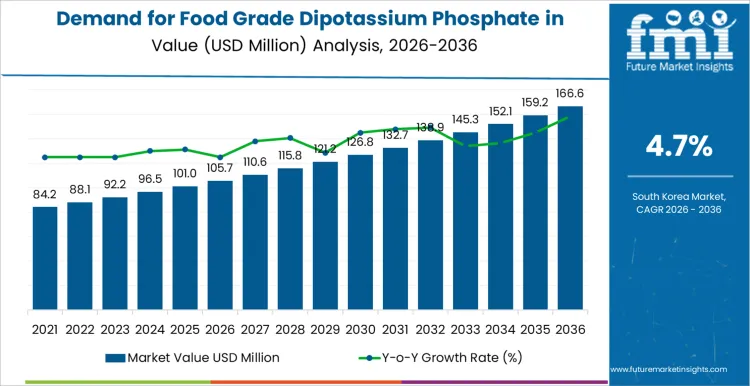
Producers are introducing dipotassium phosphate for food variants with improved flowability, making them easier to handle in automated mixing lines. Innovations in food grade phosphates allow for better interaction with milk proteins, resulting in smoother textures for dairy alternatives. Research into functional food ingredients is expanding the application scope to include electrolyte fortification in sports beverages. Integration of food emulsifiers with phosphate blends offers synergistic effects, improving stability in complex food matrices like non-dairy creamers. These technical strides ensure that manufacturers can meet consumer demands for high-quality, stable, and nutritious food products without compromising on sensory attributes.
Demand for Food Grade Dipotassium Phosphate in South Korea Key Takeaways
South Korea's additive domain is characterized by a strong emphasis on functional performance and health-conscious formulation. Powdered forms currently hold the largest portion of consumption due to ease of storage and precise dosing capabilities. Dairy applications represent the most significant vertical, driven by a robust milk processing and cheese manufacturing sector. Industrial users constitute the primary buyer base, reflecting the dominance of large-scale food conglomerates. Regional growth is notably higher in areas with concentrated food industrial complexes. Competitive dynamics are led by global chemical suppliers who leverage economies of scale to provide cost-effective solutions. Ultimately, this sector acts as a critical enabler for the country's diverse and high-quality processed food supply chain.
| Metric | Value |
|---|---|
| Industry Size (2026) | USD 105.7 million |
| Industry Value (2036) | USD 166.6 million |
| CAGR (2026 to 2036) | 4.7% |
What Specific Industrial Factors Are Fueling Phosphate Adoption?
Rising demand for shelf-stable dairy products acts as a primary catalyst for ingredient procurement. Manufacturers utilize diphosphates and other salts to prevent protein destabilization during heat treatment processes like UHT. Expansion of the coffee culture in South Korea drives consumption of non-dairy creamers, which rely heavily on food stabilizers to prevent feathering in hot beverages. Growing popularity of processed meats and convenience meals necessitates effective water-binding agents to improve yield and texture. Furthermore, the trend towards food fortifying agents sees potassium phosphates being used to boost mineral content in health drinks. These industrial requirements ensure a consistent and growing need for high-performance buffering agents across multiple food categories.
How is the Sector Structured Across Key Segments?
Structure of this domain is categorized by physical form, application vertical, specific product chemical type, and end-user classification. Form segmentation distinguishes between versatile powders and specialized liquid or granule formats. Application classification highlights the critical role of dairy, followed by meat and bakery sectors. Product type segmentation differentiates between anhydrous and hydrated forms based on moisture content requirements. End-user data underscores the dominance of industrial-scale processors compared to smaller foodservice operators or direct consumer usage. Understanding this segmentation helps suppliers optimize inventory management, ensuring availability of specific grades required for diverse manufacturing processes, from cheese melting to beverage buffering.
Why Does the Powder Form Maintain Dominance?
Powder forms command a 61.0% share of the industry. Industrial processors favor powder due to its superior stability and longer shelf life compared to liquid solutions. Ease of handling and precise weighing capabilities make powder ideal for automated batching systems used in large food factories. Logistics costs are significantly lower for transporting concentrated powder than diluted liquids. baking ingredients suppliers also prefer powder formats for dry mixes used in commercial bakeries. Versatility of powder allows it to be dissolved at specific concentrations as needed, providing manufacturers with flexibility in formulation. Consequently, high efficiency and cost-effectiveness secure powder's position as the standard format for bulk procurement.
How is the Dairy Application Contributing to Sector Growth?
Dairy applications account for 38.1% of the usage share. South Korea has a thriving dairy industry producing milk, yogurt, and processed cheese products that require pH stabilization. Dipotassium phosphate prevents casein micelles from coagulating during pasteurization, ensuring smooth texture. processed food trends show increasing consumption of cheese-flavored snacks and sauces, where phosphates act as emulsifying salts. Use of these salts in recovery drinks and protein shakes to maintain mineral balance is also rising. Critical nature of these functions in preventing spoilage and maintaining sensory quality makes the dairy sector the most reliable and extensive consumer of food-grade phosphates.
Why Do Industrial Users Lead Consumption?
Industrial users capture a 45.0% share of the sector. Large food conglomerates in South Korea dominate the production of instant noodles, beverages, and packaged snacks. These massive operations require bulk quantities of additives to maintain continuous production lines. Consistency in product quality across millions of units demands the use of standardized phosphate salts. Industrial buyers benefit from economies of scale, purchasing directly from manufacturers or major distributors. Strict quality control protocols in industrial settings necessitate reliable supply partners. Therefore, the volume driven by these giant entities dwarfs consumption by smaller bakeries or individual consumers, making them the central pillar of demand.
Will the Shift to Low-Sodium Products Redefine Future Sales?
Usage of potassium-based additives is gaining traction as a strategy to reduce dietary sodium. Health authorities are campaigning against high salt intake, prompting manufacturers to reformulate products. Replacing sodium phosphates with dipotassium guanylate and dipotassium phosphate allows brands to maintain functionality while improving nutritional profiles. This substitution offers a significant opportunity for growth in the "better-for-you" segment. However, potassium ingredients often carry a higher price tag than sodium counterparts. Balancing cost implications with health marketing claims is a key challenge. Nevertheless, the long-term trend towards heart-healthy formulations positions potassium phosphates as a vital ingredient for future product development.
How Do Raw Material Fluctuations Impact Pricing?
Volatility in the global price of phosphate rock and potassium chloride directly affects production costs. phosphates supply chains are susceptible to geopolitical tensions and mining output variations. Manufacturers must navigate these fluctuations to offer stable pricing to food clients. Energy costs for the energy-intensive purification process also play a role. Increases in raw material costs are often passed down the supply chain, potentially squeezing margins for food processors. To mitigate these risks, suppliers are diversifying sourcing strategies and investing in efficient production technologies. Stable supply agreements are becoming crucial for industrial buyers seeking to insulate themselves from global commodity price spikes.
Is the Trend Towards Clean Label Affecting Demand?
Consumer demand for recognizable ingredients poses a challenge to chemical-sounding additives. "Clean label" trends encourage the removal of E-numbers, pushing some brands to seek natural alternatives. However, finding natural ingredients that match the buffering capacity and stability of injectable potassium phosphate grade salts is difficult. Manufacturers are responding by educating consumers on the safety and necessity of these minerals. Some are reformulating to use minimal effective doses. Despite the pressure, the functional indispensability of phosphates in preventing spoilage and maintaining texture ensures their continued use, particularly in mass-market products where safety and shelf-life are non-negotiable.
How is the Food Processing Landscape Evolving Across South Korea's Regions?
Regional consumption patterns reflect the distribution of specialized food industrial zones and agricultural processing centers. Industrial hubs drive demand for bulk additives, while agricultural provinces utilize regulators for dairy and meat processing. Government support for regional food clusters is decentralizing demand, encouraging value-added processing near farms.
| Region | CAGR (2026 to 2036) |
|---|---|
| Jeju | 5.6% |
| South Gyeongsang | 4.9% |
| South Jeolla | 4.4% |
| North Jeolla | 3.7% |
Why is the Dairy Industry in Jeju Driving Rapid Growth?
Adoption of food additives in Jeju is projected to expand at a CAGR of 5.6%. Jeju Island is a premier location for dairy farming, hosting numerous milk processing facilities. Local production of milk, yogurt, and cheese drives the need for high-quality buffering agents. Tourism on the island boosts demand for locally produced dairy snacks and beverages. Manufacturers focus on premium quality, utilizing top-grade dipotassium phosphate to ensure product stability during transport to the mainland. Investments in expanding dairy processing capacity to meet national demand directly correlate with increased procurement of these essential functional ingredients.
How is Industrial Processing in South Gyeongsang Influencing Sales?
Sales of food ingredients in South Gyeongsang are likely to reach a CAGR of 4.9%. This region hosts major industrial complexes and ports, facilitating the import of raw materials and export of processed foods. Large-scale noodle and snack factories located here utilize phosphates for texture and pH control. Proximity to logistics hubs allows for efficient distribution of bulk powder ingredients. Corporate investment in upgrading food manufacturing lines to automated systems ensures consistent, high-volume consumption. Economic activity in this industrial belt supports a steady baseline of demand for versatile food additives.
What Specific Factors Drive Demand in South Jeolla?
Expansion in South Jeolla is anticipated to rise at a CAGR of 4.4%. Known for its rich agricultural output, South Jeolla is seeing growth in value-added food processing. Meat processing facilities in the region use phosphates to improve water retention in ham and sausages. Local government initiatives to promote regional food products are encouraging standardization and quality improvement, leading to wider adoption of industrial-grade additives. Small and medium enterprises are transitioning from traditional methods to modern processing, increasing their utilization of functional ingredients to extend shelf life and reach broader distribution channels.
Why is North Jeolla Modernizing its Food Clusters?
Deployment of food technologies in North Jeolla is expected to increase at a CAGR of 3.7%. The National Food Cluster in Iksan is a hub for food innovation, attracting companies specializing in functional foods and beverages. Research institutes here are developing new applications for phosphates in health-oriented products. Focus on creating high-value export items necessitates the use of globally accepted additives. While growing from a smaller base, the concentration of R&D expertise ensures that North Jeolla remains at the forefront of formulation innovation, driving long-term value creation in the sector.
What Strategic Initiatives Define Market Leadership?
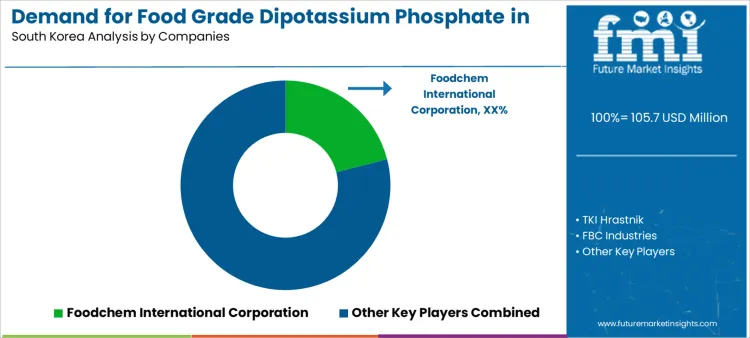
Foodchem International Corporation commands a dominant position with a 21.0% share, leveraging its massive global distribution network. Strategy revolves around offering a "one-stop-shop" experience for food additives, bundling phosphates with other ingredients. Foodchem invests in quality certifications like Halal and Kosher to meet diverse export requirements of Korean manufacturers. Competitors like TKI Hrastnik and FBC Industries focus on high-purity niche grades for specialized applications. Strategic partnerships with local Korean distributors allow these global giants to penetrate the fragmented SME food processor network effectively, ensuring product availability across the peninsula.
How Are Niche Competitors Challenging Global Giants?
Specialized players such as Aditya Birla Chemicals and Haifa Chemicals differentiate themselves through technical expertise and customer support. They target specific verticals like high-end dairy or pharmaceutical-grade nutrition where quality specifications are rigorous. By offering superior technical documentation and formulation assistance, these companies appeal to R&D teams in major food corporations. Smaller competitors also compete on agility, offering flexible minimum order quantities to mid-sized processors. This focus on service and technical value allows them to carve out profitable segments despite the volume dominance of larger entities.
Key Companies
- Foodchem International Corporation
- TKI Hrastnik
- FBC Industries
- Aditya Birla Chemicals
- Haifa Chemicals Ltd.
Scope of Report
| Items | Values |
|---|---|
| Quantitative Units | USD Million |
| Form | Powder, Granules |
| Product Type | Dipotassium Phosphate Anhydrous, Dipotassium Hydrogen Phosphate Trihydrate, Dipotassium Phosphate Used in Coffee Mate, Potassium Phosphate Dibasic, Dipotassium Hydrogen Phosphate |
| Application | Dairy, Meat, Bakery, Confectionery, Beverages |
| End User | Individuals, Industrial, Foodservice |
| Regions Covered | Jeju, South Gyeongsang, South Jeolla, North Jeolla |
| Key Companies Profiled | Foodchem, TKI Hrastnik, FBC Industries, Aditya Birla Chemicals, Haifa Chemicals |
Demand for Food Grade Dipotassium Phosphate in South Korea by Segments
By Form:
- Powder
- Granules
By Application:
- Dairy
- Meat
- Bakery
- Confectionery
- Beverages
By Product Type:
- Dipotassium Phosphate Anhydrous
- Dipotassium Hydrogen Phosphate Trihydrate
- Dipotassium Phosphate Used in Coffee Mate
- Potassium Phosphate Dibasic
- Dipotassium Hydrogen Phosphate
By End User:
- Individuals
- Industrial
- Foodservice
Bibliography
- Ministry of Food and Drug Safety. (2024, October 2). Standards and specifications for food additives (MFDS Notice No. 2024-56, full text). Ministry of Food and Drug Safety, Republic of Korea.
- Ministry of Food and Drug Safety. (2024, October 2). Partial revision notice for “Standards and specifications for food additives” (MFDS Notice No. 2024-56). Ministry of Food and Drug Safety, Republic of Korea.
- Statistics Korea. (2024, December 16). Preliminary results of the 2023 mining and manufacturing survey. Statistics Korea, Republic of Korea.
- Korea Agro-Fisheries and Food Trade Corporation. (2024, September 22). Processed food segmented market newsletter (including raw material status and trade distribution snapshots). Korea Agro-Fisheries and Food Trade Corporation, Republic of Korea.
- Statistics Korea. (2024, November 28). Monthly industrial statistics, October 2024 (manufacturing production indicators relevant to mining and manufacturing activity). Statistics Korea, Republic of Korea.
Frequently Asked Questions
How big is the demand for Food Grade Dipotassium Phosphate in South Korea in 2026?
The demand for Food Grade Dipotassium Phosphate in South Korea is estimated to be valued at USD 105.7 million in 2026.
What will be the size of Food Grade Dipotassium Phosphate in South Korea in 2036?
The industry size for the Food Grade Dipotassium Phosphate in South Korea is projected to reach USD 166.6 million by 2036.
How much will be the demand for Food Grade Dipotassium Phosphate in South Korea growth between 2026 and 2036?
The demand for Food Grade Dipotassium Phosphate in South Korea is expected to grow at a 4.7% CAGR between 2026 and 2036.
What are the key product types in the Food Grade Dipotassium Phosphate in South Korea?
The key product types in Food Grade Dipotassium Phosphate in South Korea are Dipotassium Phosphate Anhydrous and Dipotassium Hydrogen Phosphate Trihydrate.
Which end user segment is expected to contribute significant share in the Food Grade Dipotassium Phosphate in South Korea in 2026?
By end user, Industrial segment is expected to command 45.0% share in the Food Grade Dipotassium Phosphate in South Korea in 2026.
Preview the report firsthand - request a free sample
Get SampleGet the brochure for pricing and purchase details.
Get PDFTable of Content
- Executive Summary
- South Korea Market Outlook
- Demand-side Trends
- Supply-side Trends
- Technology Roadmap Analysis
- Analysis and Recommendations
- Market Overview
- Market Coverage / Taxonomy
- Market Definition / Scope / Limitations
- Market Background
- Market Dynamics
- Drivers
- Restraints
- Opportunity
- Trends
- Scenario Forecast
- Demand in Optimistic Scenario
- Demand in Likely Scenario
- Demand in Conservative Scenario
- Opportunity Map Analysis
- Product Life Cycle Analysis
- Supply Chain Analysis
- Investment Feasibility Matrix
- Value Chain Analysis
- PESTLE and Porter’s Analysis
- Regulatory Landscape
- Regional Parent Market Outlook
- Production and Consumption Statistics
- Import and Export Statistics
- Market Dynamics
- South Korea Market Analysis 2021 to 2025 and Forecast, 2026 to 2036
- Historical Market Size Value (USD Million) Analysis, 2021 to 2025
- Current and Future Market Size Value (USD Million) Projections, 2026 to 2036
- Y-o-Y Growth Trend Analysis
- Absolute $ Opportunity Analysis
- South Korea Market Pricing Analysis 2021 to 2025 and Forecast 2026 to 2036
- South Korea Market Analysis 2021 to 2025 and Forecast 2026 to 2036, By Form
- Introduction / Key Findings
- Historical Market Size Value (USD Million) Analysis By Form , 2021 to 2025
- Current and Future Market Size Value (USD Million) Analysis and Forecast By Form , 2026 to 2036
- Powder
- Granules
- Powder
- Y-o-Y Growth Trend Analysis By Form , 2021 to 2025
- Absolute $ Opportunity Analysis By Form , 2026 to 2036
- South Korea Market Analysis 2021 to 2025 and Forecast 2026 to 2036, By Application
- Introduction / Key Findings
- Historical Market Size Value (USD Million) Analysis By Application, 2021 to 2025
- Current and Future Market Size Value (USD Million) Analysis and Forecast By Application, 2026 to 2036
- Dairy
- Meat
- Bakery
- Confectionery
- Beverages
- Dairy
- Y-o-Y Growth Trend Analysis By Application, 2021 to 2025
- Absolute $ Opportunity Analysis By Application, 2026 to 2036
- South Korea Market Analysis 2021 to 2025 and Forecast 2026 to 2036, By Product Type
- Introduction / Key Findings
- Historical Market Size Value (USD Million) Analysis By Product Type, 2021 to 2025
- Current and Future Market Size Value (USD Million) Analysis and Forecast By Product Type, 2026 to 2036
- Dipotassium Phosphate Anhydrous
- Dipotassium Hydrogen Phosphate Trihydrate
- Dipotassium Phosphate Used in Coffee Mate
- Potassium Phosphate Dibasic
- Dipotassium Hydrogen Phosphate
- Dipotassium Phosphate Anhydrous
- Y-o-Y Growth Trend Analysis By Product Type, 2021 to 2025
- Absolute $ Opportunity Analysis By Product Type, 2026 to 2036
- South Korea Market Analysis 2021 to 2025 and Forecast 2026 to 2036, By End User
- Introduction / Key Findings
- Historical Market Size Value (USD Million) Analysis By End User, 2021 to 2025
- Current and Future Market Size Value (USD Million) Analysis and Forecast By End User, 2026 to 2036
- Individuals
- Industrial
- Foodservice
- Individuals
- Y-o-Y Growth Trend Analysis By End User, 2021 to 2025
- Absolute $ Opportunity Analysis By End User, 2026 to 2036
- Market Structure Analysis
- Competition Dashboard
- Competition Benchmarking
- Market Share Analysis of Top Players
- By Regional
- By Form
- By Application
- By Product Type
- By End User
- Competition Analysis
- Competition Deep Dive
- Foodchem International Corporation
- Overview
- Product Portfolio
- Profitability by Market Segments (Product/Age /Sales Channel/Region)
- Sales Footprint
- Strategy Overview
- Marketing Strategy
- Product Strategy
- Channel Strategy
- TKI Hrastnik
- FBC Industries
- Aditya Birla Chemicals
- Haifa Chemicals Ltd.
- Foodchem International Corporation
- Competition Deep Dive
- Assumptions & Acronyms Used
- Research Methodology


