

- Industry Size (2026)
- USD 6160.5 Mn
- Forecast (2036)
- USD 11564.2 Mn
- CAGR (2026 to 2036)
- 6.5%
Food Grade Sodium Hypochlorite Market Forecast and Outlook 2026 to 2036
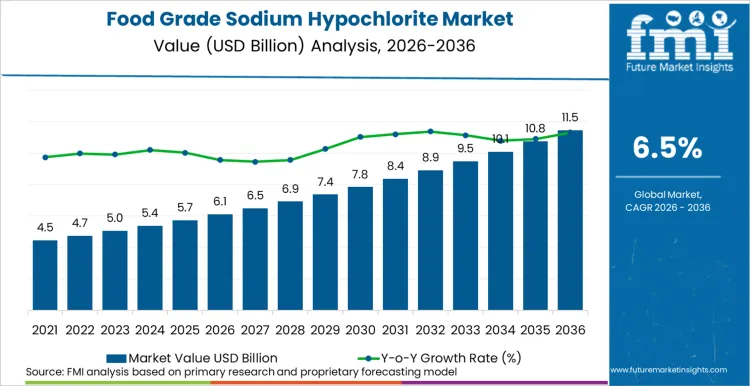
The global food grade sodium hypochlorite sector is on track to achieve a valuation of USD 11,564.2 million by 2036, expanding from USD 6,160.5 million in 2026 at a CAGR of 6.5%. As per Future Market Insights, expansion is structurally underpinned by the non-discretionary nature of food safety disinfection which makes sodium hypochlorite demand directly proportional to food processing throughput rather than discretionary capital spending.
The updated NSF/ANSI/CAN 60-2025 standard, which took effect in January 2025, established new health effects requirements for drinking water treatment chemicals including sodium hypochlorite, raising the purity and documentation bar for all suppliers serving food and municipal water applications. This regulatory upgrade compels smaller regional producers to either invest in quality management systems or cede market share to certified high-purity manufacturers. Simultaneously, the consolidation of chlor-alkali production capacity through major transactions is reshaping supply dynamics across North America.
Vicki Hollub, President and CEO of Occidental Petroleum, stated regarding the OxyChem divestiture: 'This transaction allows us to unlock significant value from our chemical business while sharpening our strategic focus.' The completed sale of OxyChem to Berkshire Hathaway for USD 9.7 billion in January 2026 confirms that chlor-alkali assets remain highly valued by long-term industrial investors. FMI is of the opinion that the transfer of OxyChem to Berkshire Hathaway's industrial portfolio will bring operational stability and sustained capital investment to one of North America's largest sodium hypochlorite production bases.
The operational landscape in 2025 and 2026 has been shaped by both consolidation and supply disruptions. Olin Corporation, the world's largest chlor-alkali producer, reported operational disruptions at its Freeport, Texas facility in January 2026 due to an extended maintenance turnaround and unplanned downtime, temporarily tightening sodium hypochlorite supply in the Gulf Coast region. HASA, Inc. completed the acquisition of Chem Eleven Products, Inc. in February 2024, expanding its liquid sodium hypochlorite distribution footprint in Texas and the Southern United States. Olin reinforced its strategic partnership with K2 Pure Solutions in late 2024 to distribute high-purity bleach products with lower salt footprints for food-grade applications across North America. As per FMI, the combination of asset consolidation at the production level and distribution expansion at the regional level confirms that the food grade sodium hypochlorite supply chain is professionalizing rapidly, with quality certification and logistics reliability replacing price as the primary competitive differentiators.
Key Takeaways
The food grade sodium hypochlorite market is controlled by a concentrated group of chlor-alkali producers where Olin Corporation, OxyChem (now Berkshire Hathaway), Westlake Corporation, and Shin-Etsu Chemical collectively dominate global production capacity. FMI analysts observe that the electrochemical nature of chlor-alkali production creates high fixed-cost barriers to entry, ensuring that market power remains with incumbent producers who control electrolysis infrastructure.
Pricing asymmetry in the food grade sodium hypochlorite market is driven by the premium commanded by certified high-purity product over commodity-grade bleach. Food and beverage processors and municipal water systems are willing to pay 20 to 40% premiums for sodium hypochlorite that meets NSF/ANSI 60 certification and comes with full traceability documentation. As per FMI, this quality premium insulates certified producers from commodity price competition and creates a two-tier market structure.
Sourcing fragility is concentrated in the energy intensity of chlor-alkali electrolysis and the logistical constraints of transporting a corrosive liquid chemical. Sodium hypochlorite degrades during storage and transport, requiring regional production and distribution networks. Olin's unplanned downtime at Freeport, Texas in January 2026 demonstrates how a single facility disruption can tighten regional supply. FMI opines that companies with geographically diversified production networks and dedicated distribution fleets hold a structural logistics advantage.
Brand and compliance risks center on the consequences of contamination or off-specification delivery to food processing facilities. A single batch of out-of-spec sodium hypochlorite delivered to a food manufacturer can trigger product recalls, regulatory action, and brand damage across the food supply chain. The NSF/ANSI/CAN 60-2025 standard update addresses this risk by raising documentation and testing requirements.
Geographic leverage is concentrated in North America, which accounts for the largest food grade sodium hypochlorite consumption driven by the scale of its food processing industry and stringent FDA and EPA water treatment mandates. Europe follows with REACH and Biocidal Products Regulation (BPR) driving quality requirements. Asia Pacific is the fastest-growing consumption region, driven by food processing capacity expansion in China and India. Latin America and the Middle East are developing markets with growth tied to food safety regulation formalization.
The executive reframing for the food grade sodium hypochlorite market is that this is a utility chemical whose value is defined entirely by purity certification, supply reliability, and logistics proximity rather than by product innovation. FMI analysts emphasize that procurement executives must evaluate sodium hypochlorite suppliers on supply chain resilience and quality system maturity, not on unit price alone.
Summary of Food Grade Sodium Hypochlorite Market
What Is Growth Outlook for Food Grade Sodium Hypochlorite Market as per Future Market Insights Projection?
Future Market Insights projects the food grade sodium hypochlorite market to expand at a CAGR of 6.5% from 2026 to 2036, increasing from USD 6,160.5 Million in 2026 to USD 11,564.2 Million by 2036.
FMI Research Approach: FMI proprietary forecasting model based on food processing throughput growth and water treatment chemical consumption rates.
How Do FMI Analysts Perceive Food Grade Sodium Hypochlorite Market to Evolve?
FMI analysts perceive the market evolving toward quality-certified, regionally distributed supply networks where NSF/ANSI 60 compliance and logistics reliability replace price as the primary competitive differentiators.
FMI Research Approach: NSF/ANSI/CAN 60-2025 standard update analysis and chlor-alkali capacity tracking.
Which Country Holds Largest Share in Global Food Grade Sodium Hypochlorite Market?
The United States holds a significant share of the global food grade sodium hypochlorite market by value which is supported by the scale of its food processing industry and mandatory FDA/EPA water treatment chemical standards.
FMI Research Approach: FMI country-level revenue modeling by food processing output and water treatment chemical consumption.
How Large Will Food Grade Sodium Hypochlorite Market Be by 2036?
The global food grade sodium hypochlorite market is projected to reach USD 11,564.2 Million by 2036.
FMI Research Approach: FMI long-term revenue forecast derived from food production volume projections and per-unit disinfection chemical consumption rates.
What Is Definition of Food Grade Sodium Hypochlorite Market?
The food grade sodium hypochlorite market includes revenue from sodium hypochlorite solutions manufactured, certified, and sold specifically for food contact surface disinfection, produce washing, water treatment in food processing, and municipal drinking water purification at food-safe concentrations.
FMI Research Approach: FMI market taxonomy and inclusion-exclusion framework.
What Are Globally Unique Trends Shaping Food Grade Sodium Hypochlorite Market?
Globally unique trends include the NSF/ANSI/CAN 60-2025 standard update raising health effects requirements, the consolidation of chlor-alkali assets through the USD 9.7 billion OxyChem-Berkshire Hathaway transaction, and AI-driven automated dosing systems for precision sodium hypochlorite application.
FMI Research Approach: Occidental Petroleum OxyChem divestiture filing and NSF International standard publication.
Food Grade Sodium Hypochlorite Market Key Takeaways
| Metric | Details |
|---|---|
| Industry Size (2026) | USD 6,160.5 Million |
| Industry Value (2036) | USD 11,564.2 Million |
| CAGR (2026 to 2036) | 6.5% |
Source: Future Market Insights (FMI) analysis, based on proprietary forecasting model and primary research
Regional Market Trends
North America
As food processing, beverage, and dairy sectors play a significant role in North America, food-grade sodium hypochlorite is a high-value market. The United States and Canada also employ clear food safety and sanitation rules, in which sodium hypochlorite is considered a disinfectant and antimicrobial. As food producers strive to comply with stringent hygiene standards to prevent contamination and ensure food safety, the demand for high-purity sodium hypochlorite is on the rise.
In addition, the advancements in food processing facilities using automated sanitation systems has a positive impact in demand for high-quality disinfectants. What is more, as concerns about chemical residues in foods mount, North American producers are also striving to formulate effective, yet environmentally-friendly products.
Europe
Germany, France, and the United Kingdom are some of the key consumers of food-grade sodium hypochlorite in Europe, which still holds a considerable market share. Sodium hypochlorite is heavily used for surface cleaning, water treatment, and dairy equipment sanitation, making the food processing sector in the region a highly regulated industry.
European Union regulations related to food safety and water quality are stringent, creating demand for high-purity, low-residue disinfectants. But growing concern about the environmental consequences of chlorinated compounds has prompted more interest in environmentally benign alternatives. European makers are actively investing in green disinfection technologies with lower chemical exposure and ensures effective food processing usage.
Asia-Pacific
The food-grade sodium hypochlorite market is observed to grow the fastest in the Asia-Pacific region owing to widespread industrialization at a fast pace along with the increasing food and beverage production units coupled with rising awareness about hygiene and food safety.
The major players of market sodium hypochlorite include both consumers and producers and come from China, India, Japan and South Korea, led by China. Increased consumer awareness about foodborne diseases and government initiatives toward strict sanitation practices in food processing plants is primarily driving the demand for the market. In addition, the growing dairy and seafood industries in the area need potent disinfectant techniques to ensure the safety of products and preserve their freshness.
But at the same time, the market is also facing the challenge of inconsistent enforcement of regulatory body and fear of over-usage of chlorine while processing food due to toxic effects; thus the demand for alternative methods of disinfection, such as ozone and UV treatment is increasing.
Challenges and Opportunities
Challenge
Regulatory and Environmental Concerns
Increasing regulatory pressure on chlorine-based disinfectants, which may pose environmental and health risks, is one of the key challenges facing the food-grade sodium hypochlorite market. Sodium hypochlorite can produce chlorinated byproducts, which have been linked to safety and wastewater disposal issues. Increasingly, governments and environmental authorities are implementing stricter regulations on chlorine-based disinfectants that require manufacturers to invest in sophisticated production processes that minimize harmful residues and conform to evolving safety standards.
Opportunity
Development of Safer and Sustainable Disinfection Solutions
Food-grade sodium hypochlorite market will have a significant opportunity as demand for sustainable and green disinfection practices is soaring. It has caused many companies to invest in further purification processes, to obtain sodium hypochlorite with much fewer impurities and less chemical residues. Research on new disinfection protocols such as stabilized hypochlorous acid solutions, electrolyzed water and biodegradable antimicrobial compounds is also surging. Deployment of such advanced solutions can permit food manufacturers to attain regulatory conformity in addition to increased functional efficacy as well as durability.
Shifts in the Food Grade Sodium Hypochlorite Market 2021 to 2025 and Future Trends 2026 to 2036
Between 2021 and 2025, the food grade sodium hypochlorite market experienced steady growth, driven by increasing demand for effective disinfection and sanitation solutions in the food and beverage industry. The COVID-19 pandemic heightened awareness of food safety, leading to a surge in the use of sodium hypochlorite as a sanitizing agent for food processing equipment, water treatment, and surface disinfection. Additionally, the expansion of the packaged food industry and stringent hygiene regulations fueled market adoption.
Between 2026 and 2036, the food grade sodium hypochlorite market will undergo significant transformation, driven by sustainability initiatives, precision-controlled disinfection technologies, and AI-powered monitoring systems. The adoption of eco-friendly hypochlorite formulations with reduced environmental impact will gain traction, as industries prioritize green sanitation solutions.
Market Shifts: A Comparative Analysis 2021 to 2025 vs. 2026 to 2036
| Market Shift | 2021 to 2025 |
|---|---|
| Regulatory Landscape | Stricter food safety and hygiene regulations, permissible concentration limits. |
| Technological Advancements | Stabilized sodium hypochlorite formulations, automated dosing systems. |
| Industry Applications | Food processing, water treatment, surface sanitation. |
| Adoption of Smart Equipment | Automated dosing systems, on-site generation (OSG) technology. |
| Sustainability & Cost Efficiency | Controlled-release formulations, reduced chemical wastage. |
| Data Analytics & Predictive Modeling | Cloud-integrated disinfection monitoring, AI-based compliance tracking. |
| Production & Supply Chain Dynamics | COVID-19-induced supply chain disruptions, increased demand for food-safe disinfectants. |
| Market Growth Drivers | Growth driven by food safety concerns, regulatory enforcement, and pandemic-driven hygiene awareness. |
| Market Shift | 2026 to 2036 |
|---|---|
| Regulatory Landscape | AI-powered compliance monitoring, block chain-based traceability, sustainability-driven chemical regulations. |
| Technological Advancements | AI-driven precision dosing, nanotechnology-based stabilizers, hybrid chlorine formulations. |
| Industry Applications | Expansion into AI-integrated smart food factories, bio-based disinfectant alternatives. |
| Adoption of Smart Equipment | IoT-enabled real-time sanitation monitoring, self-regulating disinfection systems. |
| Sustainability & Cost Efficiency | Green sanitation solutions, recyclable packaging, energy-efficient OSG systems. |
| Data Analytics & Predictive Modeling | Quantum-enhanced predictive sanitation modeling, decentralized AI-driven hygiene control. |
| Production & Supply Chain Dynamics | AI-optimized supply chains, renewable energy-powered sodium hypochlorite production. |
| Market Growth Drivers | AI-powered sanitation automation, sustainable disinfection technologies, and expansion into next-gen food processing applications. |
Country wise Outlook
United States
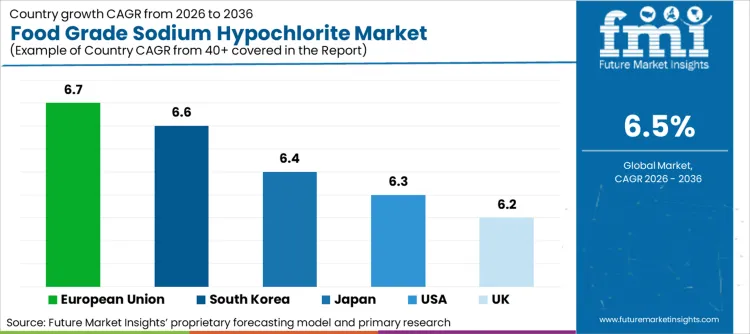
With further market growth fueled by the broad application of sodium hypochlorite: food processing, water treatment, and disinfection for foodservice businesses, the USA food grade sodium hypochlorite industry is on an upswing. Growing focus on food safety and tighter rules from the FDA are creating demand for low-purity disinfectants.
Furthermore, the growing demand for effective sanitizing solutions in dairy, beverage, and poultry processing is paving the way for market growth. The increasing concern for microbial contamination control in food processing also fuels the market for sodium hypochlorite.
| Country | CAGR (2026 to 2036) |
|---|---|
| USA | 6.3% |
United Kingdom
The reason for this are stringent hygiene practices in the food & beverage industry in UK and an increase in the use of chlorine-based disinfectants as food processing chemical agents. The growth of dairy and meat processing plants has increased the need for effective sanitation solutions. Moreover, rising consumer awareness regarding foodborne disease is driving food manufacturers to invest in better disinfection systems which is driving the growth of the market.
| Country | CAGR (2026 to 2036) |
|---|---|
| UK | 6.2% |
European Union
The EU market is growing in the premise of EFSA's stringent food safety regulations and an acute need for effective water treatment products for food processing industries. Leading the market in countries such as Germany, France and Italy and growth of dairy, beverage and bakery segments is driving the market. Changing preferences for sustainable products, however, are spurring the research and development of low-residue sodium hypochlorite products.
| Country | CAGR (2026 to 2036) |
|---|---|
| European Union | 6.7% |
Japan
Japan's market is spurred by superior hygiene levels of food production, robust regulatory conditions, and enhanced demand for secure and effective disinfectants against food. Expanded seafood processing markets have resulted in greater use of sodium hypochlorite as a water treatment and pathogen eliminator agent. Moreover, advances in chlorination-based sanitization technologies are helping to introduce more effective food-safe hypochlorite offerings.
| Country | CAGR (2026 to 2036) |
|---|---|
| Japan | 6.4% |
South Korea
With the growing usage of food-grade disinfectants in the production of alcoholic/non-alcoholic beverages, dairy processing and poultry has boosted the South Korea market. Food export quality standard compliance is driving manufacturers towards more efficient and safer sanitizing processes Also, government drives for food safety compliance and investment in state-of-the-art water treatment solutions are further fueling market growth.
| Country | CAGR (2026 to 2036) |
|---|---|
| South Korea | 6.6% |
Segmentation Outlook
Liquid Food Grade Sodium Hypochlorite Leads Market Expansion as Water Disinfection and Sanitation Gain Global Importance
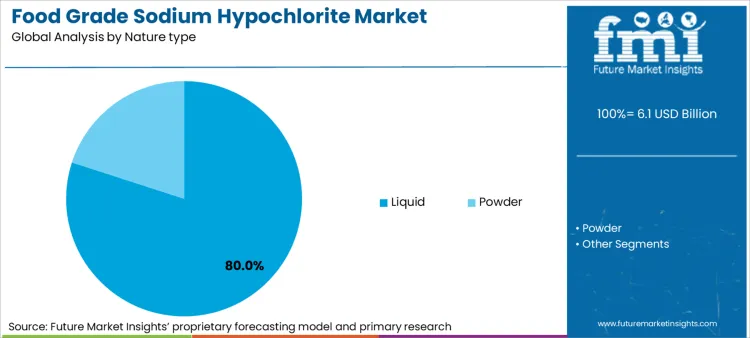
Liquid food grade sodium hypochlorite is the fastest growing segment in the food grade sodium hypochlorite market as a result of its application in water treatment, food processing sanitation and microbial control. Unlike powdered forms, liquid sodium hypochlorite can be easily dissolved and swiftly dispersed over a large area and thus, is the most enduring form for industrial applications.
The growing demand for water disinfection in food processing and beverage production has fueled its adoption, with manufacturers keen to ensure pathogen control and regulatory compliance. The feed and poultry industry represents a healthy growth opportunity for the market global automated dosing system for food and beverage market, which is attributed to the high-quality chemical application provided by these systems resulting in lower human exposure and waste (fewer low-quality chemical applications). Liquid sodium hypochlorite formulations capable of combining chlorinated stabilizer compounds yielding fewer volatile byproduct formations offered the market with sustainable adoption in food sanitation applications thereby maximizing its growth.
The growth of liquid sodium hypochlorite-based microbial control solutions, with sophisticated chlorine monitoring technologies and AI-based sanitation analytics, has increased industry uptake, providing enhanced hygiene management and efficiency in food processing. The growing emphasis on cost-effective food safety solutions has promoted extensive use of liquid sodium hypochlorite in dairy, poultry, and seafood sectors, further solidifying its position as a critical disinfectant in microbial prevention measures. Though it leads in sanitation, microbial control, and water disinfection, the liquid sodium hypochlorite market has challenges such as chemical stability issues, regulations in transport, and safety precautions in handling. Nevertheless, new developments in stabilized sodium hypochlorite products, automated chlorine dosing units, and block chain-supported food safety tracing are enhancing efficiency, sustainability, and compliance, allowing for further market growth globally.
Water Disinfection Function Drives Market Growth as Global Emphasis on Hygiene and Public Health Strengthens
Food grade sodium hypochlorite's water disinfection property has developed a lot of momentum, especially among food processing facilities, beverage companies, and municipal water authorities, who focus more and more on water cleanliness, pathogen destruction, and contamination avoidance. In contrast to other disinfectants, sodium hypochlorite delivers extensive antimicrobial action, sustained performance, and economic disinfection, making it the most desired one for maintaining safe water consumption in food manufacturing and processing.
Increasing use of chlorine water disinfection prompted by strict laws on drinking water quality and industry sanitation has led to faster-than-expected take-up, with food processors needing effective solutions against microbial contamination. The growth of intelligent water monitoring systems, combining in-real-time chlorine concentration monitoring, auto-dosing adjustment, and AI-driven contamination detection, has driven market demand, guaranteeing optimal disinfection performance. Innovations in low-residue sodium hypochlorite solutions, with improved stabilizers and pH-controlled options, have increased uptake in delicate food processing applications, protecting food quality with minimal chemical interference.
The increasing pattern of environmentally friendly disinfection practices, including recyclable packaging, environmentally friendly production processes, and energy-efficient disinfection equipment, has further supported market growth in line with environmental stewardship measures. The widespread use of food safety certification schemes, including sodium hypochlorite compliance testing and traceability policies, has increased demand, guaranteeing openness and following worldwide sanitation measures.
Even though it has strengths in microbial management, regulatory adherence, and water safety, the water disinfection market is threatened by issues of chlorine residual issues, disinfection byproduct regulation, and changing safety standards. Nevertheless, innovative developments in precision chlorine dosing technology, hybrid disinfection, and biodegradable chlorine stabilizers are driving efficiency, sustainability, and customer trust, supporting sustained growth for sodium hypochlorite-based water disinfection products globally.
Oxidizing Function Gains Market Adoption as Chemical Stability and Food Safety Standards Improve
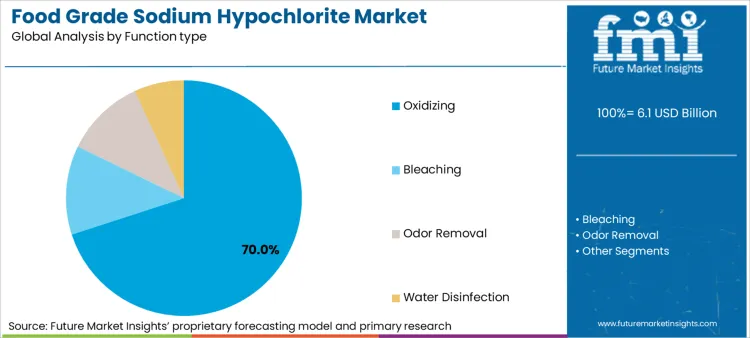
The oxidizing action of sodium hypochlorite has achieved universal acceptance in food safety uses, especially in microbial control, sanitizing surfaces, and breaking down organic residues. In contrast to traditional oxidizers, sodium hypochlorite enjoys broad-spectrum activity, immediate action, and economic costs, positions it as a dependable option for food industry disinfection protocols. The rising need for oxidative sanitation, including computerized oxidation dosing, chlorine-based pathogen destruction, and AI-powered microbial risk assessments, has spurred uptake, providing for improved hygiene control and compliance.
Although it has its strengths in microbial control and sanitation effectiveness, the oxidizing component has its weaknesses in the form of chemical degradation hazards, occupational safety issues, and environmental concerns. Nonetheless, new developments in stabilized oxidation chemistry, artificial intelligence -based dosage control, and biodegradable oxidizer formulations are improving efficiency, safety, and sustainability, guaranteeing future market expansion.
Bleaching Function Expands as Food Aesthetics and Quality Standards Gain Importance
The bleaching action of sodium hypochlorite has captured robust market popularity, especially for food processing where color stabilization, decontamination, and prevention of spoilage are needed. In contrast to artificial bleaching chemicals, sodium hypochlorite offers stable whitening properties, microbial guarding, and extended shelf life effects, guaranteeing industry compliance. The growth of chlorine-based food bleaching solutions, with AI-optimized color enhancement technologies, real-time monitoring of bleaching effects, and residue-free bleaching agents, has reinforced industry adoption, guaranteeing higher product quality and consistency.
Although bleaching outperforms in food aesthetics and spoilage resistance, the bleaching market has challenges in the form of residue management; regulatory scrutiny; and shifting consumer preferences toward natural alternatives. As sodium hypochlorite-based bleaching solutions continue to expand globally, innovations around low-residue bleaching formulas, hybrid bleaching technology, and block chain-based bleaching process authentication are increasing transparency, effectiveness, and consumer confidence.
The use of food grade sodium hypochlorite/toxic-free sodium hypochlorite is on the rise as industry places increasing emphasis on food safety, hygiene control, and regulatory compliance. The use of stabilized formulations, AI-enabled sanitation analytics, and eco-friendly disinfection processes are driving change within the industry and ensuring this growth and usage continues long after pandemic-related restrictions have lifted for global food processing and water sanitation uses.
Competitive Outlook
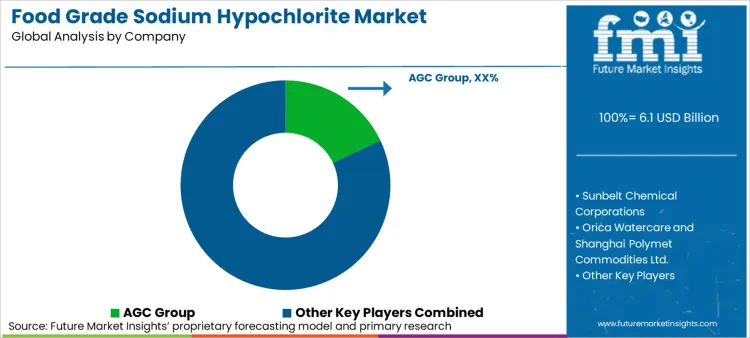
The Food Grade Sodium Hypochlorite Market is experiencing significant growth, driven by increasing demand for food safety and sanitation solutions. As a widely used disinfectant and antimicrobial agent, food-grade sodium hypochlorite plays a critical role in food processing, beverage production, dairy sanitation, and water treatment applications.
Stringent food safety regulations, rising consumer awareness regarding hygiene, and advancements in chemical formulation technologies are fueling the market expansion. Leading companies are focusing on enhanced production capacities, sustainable manufacturing practices, and strategic partnerships to gain a competitive edge.
Recent Developments
- In January 2026, Occidental Petroleum completed the sale of its chemical business OxyChem to Berkshire Hathaway for USD 9.7 billion, transferring one of North America's largest sodium hypochlorite production bases to a long-term industrial owner.
- In February 2024, HASA, Inc. completed the acquisition of Chem Eleven Products, Inc., expanding its liquid sodium hypochlorite distribution footprint across Texas and the Southern United States for food-grade and municipal water applications.
- In January 2025, the updated NSF/ANSI/CAN 60-2025 standard took effect, establishing new health effects requirements for drinking water treatment chemicals including sodium hypochlorite used in food processing environments.
Market Share Analysis by Company
| Company Name | Estimated Market Share (%) |
|---|---|
| AGC Group | 18-22% |
| Sunbelt Chemical Corporations | 15-19% |
| Orica Watercare and Shanghai Polymet Commodities Ltd. | 12-16% |
| Odyssey Manufacturing Co. | 10-14% |
| Solvay Chemicals, Inc. | 7-11% |
| Other Companies (combined) | 25-35% |
Key Company Offerings and Activities
| Company Name | Key Offerings/Activities |
|---|---|
| AGC Group | Manufactures high-purity sodium hypochlorite for food and beverage sanitation. |
| Sunbelt Chemical Corporations | Specializes in food-safe chlorine-based disinfectants for food processing industries. |
| Orica Watercare and Shanghai Polymet Commodities Ltd. | Provides customized sodium hypochlorite solutions for food, beverage, and water treatment sectors. |
| Odyssey Manufacturing Co. | Focuses on bulk and high-purity sodium hypochlorite production, catering to food sanitation needs. |
| Solvay Chemicals, Inc. | Develops sustainable and high-quality chlorine derivatives, including food-grade sodium hypochlorite. |
Key Company Insights
AGC Group (18-22%)
A sodium hypochlorite market leader, AGC Group specializes in high-purity formulation for the food sector. AGC Group has diversified its manufacturing capacity to meet growing global demand for food safety and disinfection solutions.
Sunbelt Chemical Corporations (15-19%)
Sunbelt has a broad portfolio of chlorine-based food disinfectants to meet international food safety standards. The firm invests significantly in R&D to create more chemically stable and effective products.
Orica Watercare and Shanghai Polymet Commodities Ltd. (12-16%)
This international player deals with specially tailored sodium hypochlorite products with usage in food processing facilities, beverage companies, and water sanitation facilities. The company is dedicated to supply chain effectiveness and cost-efficient manufacturing.
Odyssey Manufacturing Co. (10-14%)
A prominent sodium hypochlorite bulk manufacturer, Odyssey Manufacturing serves food-grade uses through careful regulatory compliance and high standards of quality. Odyssey is developing a wider distribution chain in primary markets.
Solvay Chemicals, Inc. (7-11%)
Solvay enjoys a reputation for sustainable, high-purity derivatives of chlorine products such as food sanitation and water treatment sodium hypochlorite. Solvay emphasizes using environmentally friendly processes to minimize waste chemicals.
Other Key Players (25-35% Combined)
The Food Grade Sodium Hypochlorite Market is also supported by regional and emerging manufacturers, including:
- BASF SE - Develops high-performance chlorine-based solutions for food and beverage applications.
- OxyChem (Occidental Chemical Corporation) - Specializes in bulk and packaged sodium hypochlorite solutions for industrial food sanitation.
- Westlake Chemical Corporation - Produces high-purity sodium hypochlorite with advanced formulation techniques.
- Lonza Group - Offers food-safe disinfectant solutions, focusing on microbial control and food preservation.
- Kuehne Chemical Company, Inc. - Supplies customized sodium hypochlorite blends for food and beverage industries.
Market Definition
The food grade sodium hypochlorite market represents revenue generated from the manufacture and sale of sodium hypochlorite solutions that meet food-grade purity and safety standards for use in food processing, produce disinfection, and potable water treatment. The market measures the value of certified sodium hypochlorite products sold to food and beverage processors, municipal water treatment facilities, and institutional food service operations.
Inclusions cover NSF/ANSI 60 certified sodium hypochlorite solutions, food contact surface sanitizers using sodium hypochlorite as the active ingredient, produce wash and fresh-cut processing disinfectants, CIP (clean-in-place) solutions for dairy, beverage, and meat processing, and municipal drinking water treatment chemicals at food-safe concentrations. Automated dosing and monitoring equipment sold as part of integrated sodium hypochlorite application systems are also included.
Exclusions include industrial-grade sodium hypochlorite for non-food applications (textile bleaching, pulp processing), household bleach products not certified for food contact, solid calcium hypochlorite products, and chlorine gas or chlorine dioxide systems. Sodium hypochlorite production equipment and electrolysis cell hardware are outside the scope.
Scope of Report
| Items | Values |
|---|---|
| Quantitative Units (2026) | USD 6,160.5 Million |
| Product Type | Certified Liquid Sodium Hypochlorite, CIP Disinfection Solutions, Produce Wash Formulations, Potable Water Treatment Solutions |
| Material Type | High-Purity (less than 50 ppm salt), Standard Food-Grade, Electrochlorination On-Site Generated |
| End-Use / Channel | Food and Beverage Processors, Municipal Water Utilities, Institutional Food Service, Dairy and Meat Processing Plants |
| Regions Covered | North America, Europe, Asia Pacific, Latin America, Middle East and Africa |
| Countries Covered | USA, Germany, China, India, Japan, Brazil, and 40+ countries |
| Key Companies Profiled | Olin Corporation, OxyChem (Berkshire Hathaway), Westlake Corporation, HASA Inc., K2 Pure Solutions, Shin-Etsu Chemical, Xylem (Evoqua) |
| Additional Attributes | Revenue analysis by application and purity grade, NSF/ANSI 60 certification tracking, chlor-alkali capacity and utilization monitoring, supply chain disruption impact assessment, and AI dosing system adoption rates |
Food Grade Sodium Hypochlorite Market by Segments
By Product Type:
- Certified Liquid Sodium Hypochlorite
- CIP Disinfection Solutions
- Produce Wash Formulations
- Potable Water Treatment Solutions
- On-Site Electrochlorination Systems
By Material Type:
- High-Purity (Low-Salt) Solutions
- Standard Food-Grade Solutions
- On-Site Generated Hypochlorite
By Region:
- North America
- Europe
- East Asia
- South Asia
- Latin America
- Middle East and Africa
Bibliography
- Occidental Petroleum Corporation. (2026, January). OxyChem sale completion announcement. Oxy.com News.
- NSF International. (2025, January). NSF/ANSI/CAN 60-2025 standard update publication. NSF International.
- Olin Corporation. (2026, January). Fourth quarter 2025 operational update. Olin Investor Relations.
- HASA, Inc. (2024, February). Chem Eleven Products acquisition announcement. HASA Inc.
Frequently Asked Questions
What is the current global market size for Food Grade Sodium Hypochlorite?
The global market is valued at USD 6,160.5 Million in 2026, driven by mandatory food safety disinfection requirements and the NSF/ANSI/CAN 60-2025 standard update.
What is the projected Compound Annual Growth Rate (CAGR) for the market over the next 10 years?
The market is projected to grow at a CAGR of 6.5% from 2026 to 2036.
Which regions are experiencing the fastest expansion?
Asia Pacific leads growth driven by food processing capacity expansion in China and India, followed by North America where quality certification requirements are tightening.
What are the primary market drivers?
Non-discretionary food safety disinfection demand proportional to food processing throughput and the NSF/ANSI/CAN 60-2025 standard raising purity requirements are the primary drivers.
Who are the leading suppliers in the industry?
Olin Corporation, OxyChem (Berkshire Hathaway), Westlake Corporation, and HASA are key players, differentiating through certified high-purity production and regional distribution networks.
Preview the report firsthand - request a free sample
Get SampleGet the brochure for pricing and purchase details.
Get PDFTable of Content
- Executive Summary
- Global Market Outlook
- Demand-side Trends
- Supply-side Trends
- Technology Roadmap Analysis
- Analysis and Recommendations
- Market Overview
- Market Coverage / Taxonomy
- Market Definition / Scope / Limitations
- Research Methodology
- Chapter Orientation
- Analytical Lens and Working Hypotheses
- Market Structure, Signals, and Trend Drivers
- Benchmarking and Cross-market Comparability
- Market Sizing, Forecasting, and Opportunity Mapping
- Research Design and Evidence Framework
- Desk Research Programme (Secondary Evidence)
- Company Annual and Sustainability Reports
- Peer-reviewed Journals and Academic Literature
- Corporate Websites, Product Literature, and Technical Notes
- Earnings Decks and Investor Briefings
- Statutory Filings and Regulatory Disclosures
- Technical White Papers and Standards Notes
- Trade Journals, Industry Magazines, and Analyst Briefs
- Conference Proceedings, Webinars, and Seminar Materials
- Government Statistics Portals and Public Data Releases
- Press Releases and Reputable Media Coverage
- Specialist Newsletters and Curated Briefings
- Sector Databases and Reference Repositories
- FMI Internal Proprietary Databases and Historical Market Datasets
- Subscription Datasets and Paid Sources
- Social Channels, Communities, and Digital Listening Inputs
- Additional Desk Sources
- Expert Input and Fieldwork (Primary Evidence)
- Primary Modes
- Qualitative Interviews and Expert Elicitation
- Quantitative Surveys and Structured Data Capture
- Blended Approach
- Why Primary Evidence is Used
- Field Techniques
- Interviews
- Surveys
- Focus Groups
- Observational and In-context Research
- Social and Community Interactions
- Stakeholder Universe Engaged
- C-suite Leaders
- Board Members
- Presidents and Vice Presidents
- R&D and Innovation Heads
- Technical Specialists
- Domain Subject-matter Experts
- Scientists
- Physicians and Other Healthcare Professionals
- Governance, Ethics, and Data Stewardship
- Research Ethics
- Data Integrity and Handling
- Primary Modes
- Tooling, Models, and Reference Databases
- Desk Research Programme (Secondary Evidence)
- Data Engineering and Model Build
- Data Acquisition and Ingestion
- Cleaning, Normalisation, and Verification
- Synthesis, Triangulation, and Analysis
- Quality Assurance and Audit Trail
- Market Background
- Market Dynamics
- Drivers
- Restraints
- Opportunity
- Trends
- Scenario Forecast
- Demand in Optimistic Scenario
- Demand in Likely Scenario
- Demand in Conservative Scenario
- Opportunity Map Analysis
- Product Life Cycle Analysis
- Supply Chain Analysis
- Investment Feasibility Matrix
- Value Chain Analysis
- PESTLE and Porter’s Analysis
- Regulatory Landscape
- Regional Parent Market Outlook
- Production and Consumption Statistics
- Import and Export Statistics
- Market Dynamics
- Global Market Analysis 2021 to 2025 and Forecast, 2026 to 2036
- Historical Market Size Value (USD Million) Analysis, 2021 to 2025
- Current and Future Market Size Value (USD Million) Projections, 2026 to 2036
- Y-o-Y Growth Trend Analysis
- Absolute $ Opportunity Analysis
- Global Market Pricing Analysis 2021 to 2025 and Forecast 2026 to 2036
- Global Market Analysis 2021 to 2025 and Forecast 2026 to 2036, By Nature type
- Introduction / Key Findings
- Historical Market Size Value (USD Million) Analysis By Nature type , 2021 to 2025
- Current and Future Market Size Value (USD Million) Analysis and Forecast By Nature type , 2026 to 2036
- Liquid
- Powder
- Liquid
- Y-o-Y Growth Trend Analysis By Nature type , 2021 to 2025
- Absolute $ Opportunity Analysis By Nature type , 2026 to 2036
- Global Market Analysis 2021 to 2025 and Forecast 2026 to 2036, By Function type
- Introduction / Key Findings
- Historical Market Size Value (USD Million) Analysis By Function type, 2021 to 2025
- Current and Future Market Size Value (USD Million) Analysis and Forecast By Function type, 2026 to 2036
- Oxidizing
- Bleaching
- Odor Removal
- Water Disinfection
- Oxidizing
- Y-o-Y Growth Trend Analysis By Function type, 2021 to 2025
- Absolute $ Opportunity Analysis By Function type, 2026 to 2036
- Global Market Analysis 2021 to 2025 and Forecast 2026 to 2036, By Region
- Introduction
- Historical Market Size Value (USD Million) Analysis By Region, 2021 to 2025
- Current Market Size Value (USD Million) Analysis and Forecast By Region, 2026 to 2036
- North America
- Latin America
- Western Europe
- Eastern Europe
- East Asia
- South Asia and Pacific
- Middle East & Africa
- Market Attractiveness Analysis By Region
- North America Market Analysis 2021 to 2025 and Forecast 2026 to 2036, By Country
- Historical Market Size Value (USD Million) Trend Analysis By Market Taxonomy, 2021 to 2025
- Market Size Value (USD Million) Forecast By Market Taxonomy, 2026 to 2036
- By Country
- USA
- Canada
- Mexico
- By Nature type
- By Function type
- By Country
- Market Attractiveness Analysis
- By Country
- By Nature type
- By Function type
- Key Takeaways
- Latin America Market Analysis 2021 to 2025 and Forecast 2026 to 2036, By Country
- Historical Market Size Value (USD Million) Trend Analysis By Market Taxonomy, 2021 to 2025
- Market Size Value (USD Million) Forecast By Market Taxonomy, 2026 to 2036
- By Country
- Brazil
- Chile
- Rest of Latin America
- By Nature type
- By Function type
- By Country
- Market Attractiveness Analysis
- By Country
- By Nature type
- By Function type
- Key Takeaways
- Western Europe Market Analysis 2021 to 2025 and Forecast 2026 to 2036, By Country
- Historical Market Size Value (USD Million) Trend Analysis By Market Taxonomy, 2021 to 2025
- Market Size Value (USD Million) Forecast By Market Taxonomy, 2026 to 2036
- By Country
- Germany
- UK
- Italy
- Spain
- France
- Nordic
- BENELUX
- Rest of Western Europe
- By Nature type
- By Function type
- By Country
- Market Attractiveness Analysis
- By Country
- By Nature type
- By Function type
- Key Takeaways
- Eastern Europe Market Analysis 2021 to 2025 and Forecast 2026 to 2036, By Country
- Historical Market Size Value (USD Million) Trend Analysis By Market Taxonomy, 2021 to 2025
- Market Size Value (USD Million) Forecast By Market Taxonomy, 2026 to 2036
- By Country
- Russia
- Poland
- Hungary
- Balkan & Baltic
- Rest of Eastern Europe
- By Nature type
- By Function type
- By Country
- Market Attractiveness Analysis
- By Country
- By Nature type
- By Function type
- Key Takeaways
- East Asia Market Analysis 2021 to 2025 and Forecast 2026 to 2036, By Country
- Historical Market Size Value (USD Million) Trend Analysis By Market Taxonomy, 2021 to 2025
- Market Size Value (USD Million) Forecast By Market Taxonomy, 2026 to 2036
- By Country
- China
- Japan
- South Korea
- By Nature type
- By Function type
- By Country
- Market Attractiveness Analysis
- By Country
- By Nature type
- By Function type
- Key Takeaways
- South Asia and Pacific Market Analysis 2021 to 2025 and Forecast 2026 to 2036, By Country
- Historical Market Size Value (USD Million) Trend Analysis By Market Taxonomy, 2021 to 2025
- Market Size Value (USD Million) Forecast By Market Taxonomy, 2026 to 2036
- By Country
- India
- ASEAN
- Australia & New Zealand
- Rest of South Asia and Pacific
- By Nature type
- By Function type
- By Country
- Market Attractiveness Analysis
- By Country
- By Nature type
- By Function type
- Key Takeaways
- Middle East & Africa Market Analysis 2021 to 2025 and Forecast 2026 to 2036, By Country
- Historical Market Size Value (USD Million) Trend Analysis By Market Taxonomy, 2021 to 2025
- Market Size Value (USD Million) Forecast By Market Taxonomy, 2026 to 2036
- By Country
- Kingdom of Saudi Arabia
- Other GCC Countries
- Turkiye
- South Africa
- Other African Union
- Rest of Middle East & Africa
- By Nature type
- By Function type
- By Country
- Market Attractiveness Analysis
- By Country
- By Nature type
- By Function type
- Key Takeaways
- Key Countries Market Analysis
- USA
- Pricing Analysis
- Market Share Analysis, 2025
- By Nature type
- By Function type
- Canada
- Pricing Analysis
- Market Share Analysis, 2025
- By Nature type
- By Function type
- Mexico
- Pricing Analysis
- Market Share Analysis, 2025
- By Nature type
- By Function type
- Brazil
- Pricing Analysis
- Market Share Analysis, 2025
- By Nature type
- By Function type
- Chile
- Pricing Analysis
- Market Share Analysis, 2025
- By Nature type
- By Function type
- Germany
- Pricing Analysis
- Market Share Analysis, 2025
- By Nature type
- By Function type
- UK
- Pricing Analysis
- Market Share Analysis, 2025
- By Nature type
- By Function type
- Italy
- Pricing Analysis
- Market Share Analysis, 2025
- By Nature type
- By Function type
- Spain
- Pricing Analysis
- Market Share Analysis, 2025
- By Nature type
- By Function type
- France
- Pricing Analysis
- Market Share Analysis, 2025
- By Nature type
- By Function type
- India
- Pricing Analysis
- Market Share Analysis, 2025
- By Nature type
- By Function type
- ASEAN
- Pricing Analysis
- Market Share Analysis, 2025
- By Nature type
- By Function type
- Australia & New Zealand
- Pricing Analysis
- Market Share Analysis, 2025
- By Nature type
- By Function type
- China
- Pricing Analysis
- Market Share Analysis, 2025
- By Nature type
- By Function type
- Japan
- Pricing Analysis
- Market Share Analysis, 2025
- By Nature type
- By Function type
- South Korea
- Pricing Analysis
- Market Share Analysis, 2025
- By Nature type
- By Function type
- Russia
- Pricing Analysis
- Market Share Analysis, 2025
- By Nature type
- By Function type
- Poland
- Pricing Analysis
- Market Share Analysis, 2025
- By Nature type
- By Function type
- Hungary
- Pricing Analysis
- Market Share Analysis, 2025
- By Nature type
- By Function type
- Kingdom of Saudi Arabia
- Pricing Analysis
- Market Share Analysis, 2025
- By Nature type
- By Function type
- Turkiye
- Pricing Analysis
- Market Share Analysis, 2025
- By Nature type
- By Function type
- South Africa
- Pricing Analysis
- Market Share Analysis, 2025
- By Nature type
- By Function type
- USA
- Market Structure Analysis
- Competition Dashboard
- Competition Benchmarking
- Market Share Analysis of Top Players
- By Regional
- By Nature type
- By Function type
- Competition Analysis
- Competition Deep Dive
- AGC Group
- Overview
- Product Portfolio
- Profitability by Market Segments (Product/Age /Sales Channel/Region)
- Sales Footprint
- Strategy Overview
- Marketing Strategy
- Product Strategy
- Channel Strategy
- Sunbelt Chemical Corporations
- Orica Watercare and Shanghai Polymet Commodities Ltd.
- Odyssey Manufacturing Co.
- Solvay Chemicals, Inc.
- Akzo Nobel N.V.
- BASF SE
- Olin Corporation
- AGC Group
- Competition Deep Dive
- Assumptions & Acronyms Used


