

- Industry Size (2026)
- USD 381.9 Mn
- Forecast (2036)
- USD 1114.1 Mn
- CAGR (2026 to 2036)
- 11.3%
Food Grade Ammonium Carbonate Market Size, Market Forecast and Outlook By FMI
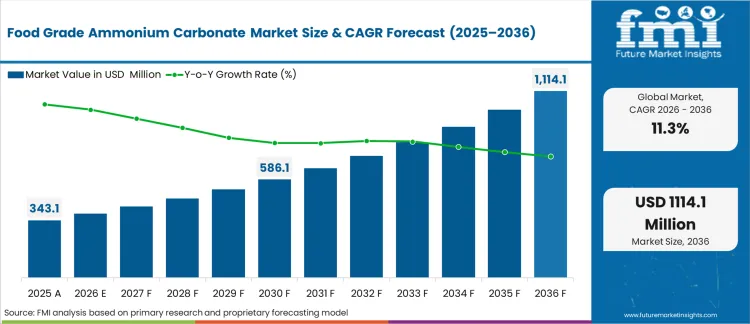
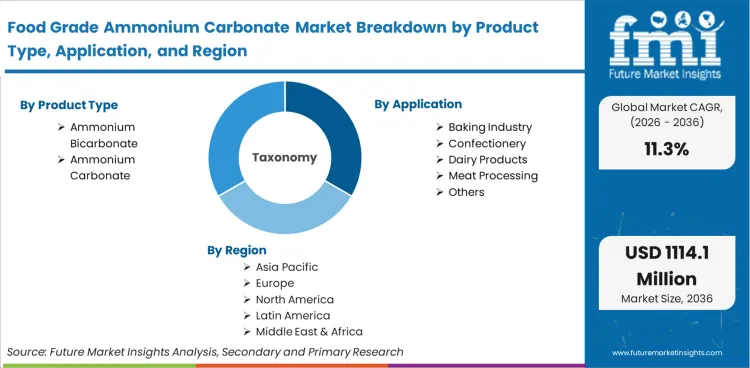
In 2025, the food grade ammonium carbonate market was valued at USD 343.1 million. Based on Future Market Insights' analysis, demand for food grade ammonium carbonate is estimated to grow to USD 381.9 million in 2026 and USD 1,114.1 million by 2036. FMI projects a CAGR of 11.3% during the forecast period.
Absolute dollar growth of USD 732.2 million over the decade signals accelerating structural demand conversion from sodium-bearing chemical leavening agents toward sodium-free alternatives, driven by the FDA's August 2025 guidance actively promoting sodium reduction in processed foods as a direct policy intervention that makes ammonium carbonate's sodium-free leavening profile commercially compelling for bakery and confectionery manufacturers under regulatory cost pressure. [2] BASF's February 2026 announcement of the successful startup of major production facilities at its new Verbund site in Zhanjiang, China, with emphasis on Nutrition and Care segment food-grade additive production including E503i ammonium carbonate, directly expands Asia Pacific supply capacity for a market where China leads growth at 9.2% CAGR. [1]
Summary of Food Grade Ammonium Carbonate Market
- Food Grade Ammonium Carbonate Market Definition
- The market covers food-grade ammonium carbonate (E503ii) and ammonium bicarbonate (E503i) in powder and lump/flake forms, serving chemical leavening functions in bakery, confectionery, dairy, and meat processing applications for food manufacturers, industrial bakeries, confectionery manufacturers, and household use.
- Demand Drivers in the Market
- BASF's February 2026 announcement of successful plant startup at its Zhanjiang Verbund site in China, with the Nutrition and Care segment specifically focused on food-grade additive production including ammonium carbonate (E503i), expanding Asia Pacific supply capacity for the region growing at 9.2% CAGR. [1]
- USDA Agricultural Marketing Service January 2025 final Technical Evaluation Report reaffirming ammonium carbonate's permitted status as a leavening agent in organic food processing under 7 CFR 205.605(b)(5), securing long-term supply confidence for organic bakery manufacturers operating through the next five-year NOSB renewal cycle. [2]
- FDA's August 2025 active promotion of sodium reduction in processed foods making ammonium carbonate's sodium-free leavening profile a regulatory compliance advantage over sodium bicarbonate in categories where FDA sodium reduction targets apply, including bread, cookies, crackers, and processed snack categories. [3]
- Key Segments Analyzed in the FMI Report
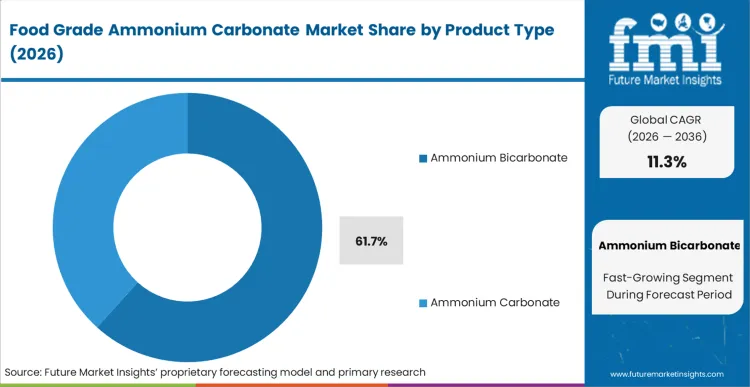
- Product Type: Ammonium Bicarbonate holds 61.7% of product type share in 2026, reflecting its dominant use in cookie, cracker, and biscuit production where the complete volatilization of ammonia gas during baking leaves no residual chemical taste in low-moisture finished products.
- Application: Baking Industry accounts for 54.3% of application value in 2026, encompassing industrial bread, cookie, cracker, biscuit, and savory snack production where ammonium carbonate provides volume and texture development without the residual sodium contribution of conventional sodium bicarbonate.
- Form: Powder holds 73.5% of form share in 2026, preferred for precise metering, even dispersion in dough systems, and compatibility with industrial batching and dispensing equipment in food manufacturing facilities.
- Analyst Opinion at FMI
- Nandini Roy Choudhury, Principal Consultant for Food & Beverage and Materials Industry at Future Market Insights, opines, "In the updated version of the Food Grade Ammonium Carbonate Market Report for 2026 to 2036, CXOs will find that the convergence of FDA sodium reduction guidance, USDA organic reaffirmation, and BASF's expanded Asia Pacific food-grade production capacity creates a once-in-a-decade alignment of regulatory, supply chain, and market access factors that positions food-grade ammonium carbonate for above-industry growth through 2036. My findings indicate that food manufacturers with sodium reduction commitments in bakery and cracker categories who have not yet evaluated ammonium carbonate as a leavening substitution option face an avoidable competitive cost disadvantage, as early reformulators will lock in supply agreements with premium food-grade producers during the current capacity expansion phase before demand concentration tightens supply availability and raises spot pricing."
- Strategic Implications / Executive Takeaways
- Establish long-term supply agreements with BASF and Tata Chemicals food-grade ammonium carbonate production lines during the current BASF Zhanjiang capacity expansion phase, before FDA sodium reduction compliance demand concentrates purchasing among first-mover food manufacturers and spot market availability tightens.
- Develop ammonium carbonate leavening system application expertise for the organic bakery segment, where the USDA January 2025 five-year status reaffirmation provides long-term procurement confidence and the organic bakery market's price premium supports higher food-grade ammonium carbonate cost per unit than conventional bakery.
- Build technical service capability to support confectionery and meat processing manufacturers evaluating ammonium carbonate for sodium reduction reformulation, where the application know-how for dosage optimization in non-standard bakery matrices is the primary barrier preventing faster category adoption.
- Methodology
- Validated through primary interviews with food-grade ammonium carbonate producers and industrial bakery manufacturers, supported by USDA AMS Technical Evaluation Report data and FDA sodium reduction guidance documentation.
- Grounded in BASF Zhanjiang site commissioning announcements, EU food additive E503 regulation status data, and bakery production volume benchmarks by region.
- Zero reliance on speculative third-party market research; all forecasts reflect verifiable regulatory status decisions, confirmed capacity announcements, and FDA policy guidance timelines.
As a BASF spokesperson noted regarding the company's Zhanjiang site commissioning and its 2025 strategic priorities, BASF is focusing on 'core businesses, including the Nutrition & Care and Chemicals segments, which oversee the production of food-grade additives' to serve growing regional demand for high-purity food ingredients. [1]
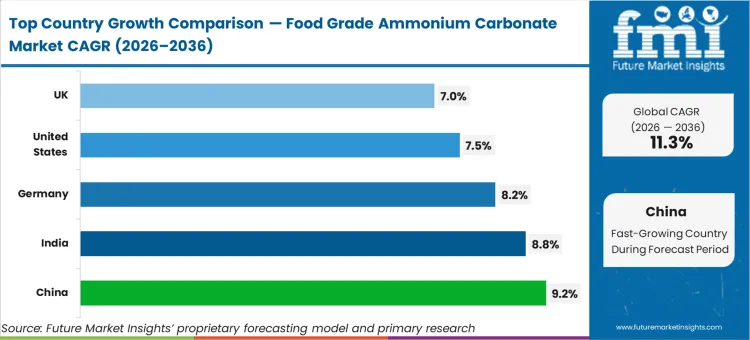
China leads growth at 9.2% CAGR through 2036, driven by organized food manufacturing sector expansion and the Zhanjiang Verbund site's food-grade additive production capacity serving domestic bakery and confectionery manufacturers. India follows at 8.8%, supported by expanding organized bakery sector growth and growing food manufacturer demand for certified food-grade leavening agents. Germany grows at 8.2% as EU organic bakery sector expansion drives demand for USDA/EU-equivalent certified ammonium carbonate. The UK grows at 7.0% and the United States at 7.5%, where FDA sodium reduction guidance accelerates procurement decisions favoring sodium-free leavening agents. Ammonium Bicarbonate holds 61.7% of product type share; Baking Industry application accounts for 54.3%; Food Manufacturers end-user category holds 46.8%; Powder form represents 73.5% of form share.
Food Grade Ammonium Carbonate Market Definition
The food grade ammonium carbonate market encompasses the global production, trade, and food industry application of ammonium carbonate (E503ii) and ammonium bicarbonate (E503i) meeting food-grade purity specifications for use as chemical leavening agents in baked goods, confectionery, and other food processing applications. These compounds function as bakers' ammonia, releasing ammonia, carbon dioxide, and water vapor on heating to produce volume expansion in dough and batter systems without residual flavor impact in low-moisture finished products. Food-grade purity requirements distinguish this market from industrial-grade ammonium carbonate used in chemical processing.
Food Grade Ammonium Carbonate Market Inclusions
The report includes comprehensive global and regional market sizing by volume and value with a 10-year forecast from 2026 to 2036. Segmental analysis covers product type, application, end-user, and form dimensions. Country-level CAGR analysis includes the United States, UK, Germany, India, and China. FDA sodium reduction policy impact on chemical leavening agent procurement, USDA National Organic Program reaffirmation for organic bakery applications, BASF Zhanjiang capacity expansion impact on Asia Pacific supply, and competitive positioning among BASF, Honeywell, Tata Chemicals, Solvay, and regional producers are incorporated.
Food Grade Ammonium Carbonate Market Exclusions
The scope excludes industrial-grade ammonium carbonate used in chemical, pharmaceutical, and agricultural fertilizer manufacturing where food-grade purity specifications are not required. Baking powder formulations where ammonium carbonate is a minor component of a blended leavening system are excluded unless the ammonium carbonate ingredient component is separately valued. Sodium bicarbonate and other non-ammonium leavening agents are outside the market scope.
Food Grade Ammonium Carbonate Market Research Methodology
- Primary Research: Interviews were conducted with food-grade ammonium carbonate and bicarbonate producers, industrial bakery and confectionery manufacturers specifying chemical leavening agents, organic food certification specialists, food ingredient distributors serving the bakery and confectionery sectors, and regulatory affairs specialists tracking FDA sodium reduction guidance and USDA National Organic Program ammonium carbonate status.
- Desk Research: FDA Guidance for Industry on Voluntary Sodium Reduction Goals for commercially processed foods, USDA Agricultural Marketing Service Technical Evaluation Report for ammonium bicarbonate and carbonate sunset review published January 2025, BASF corporate press releases for Zhanjiang Verbund site commissioning, EU food additive regulation E503 status data, and producer capacity announcements supported the quantitative framework.
- Market-Sizing and Forecasting: A hybrid bottom-up and top-down model reconstructed demand from bakery production volumes by region with chemical leavening agent consumption benchmarks, confectionery and biscuit production data, organic bakery market growth trajectories with ammonium carbonate permitted status integration, and Asia Pacific food manufacturing sector expansion rates, validated against producer shipment data and known application dosage protocols.
- Data Validation and Update Cycle: Outputs underwent cross-validation against FDA sodium reduction voluntary target adoption rates by food manufacturer category, USDA organic program renewal cycle impact on organic bakery procurement, anomaly screening for outlier country trajectories, and expert review by food chemists and bakery technology specialists prior to release.
Key Industry Highlights
Consumers are seeking detailed nutritional information
Nowadays, consumers are more concerned about what goes into their food products and they like to be informed of what they are consuming, which has boosted the demand for more transparency from manufacturers.
Due to growing health, ethical, and environmental issues consumers want to know the origin of ingredients, their nutritional value and whether they are allergen-free or free from harmful chemicals or not. As a result, companies are forced to disclose detailed information on labels. By doing this, further companies can slowly win the trust of consumers as well. For instance,
Kerry group has developed a clean label enzyme solution- Biobake, especially designed for use in bread and rolls, frozen and retarded doughs, wafers and crackers.
Expansion of Dairy and Meat Processing
The expansion of the dairy and meat processing industry is driving the demand for food-grade ammonium carbonate as companies seek out for innovative formulations and preservation methods. Ammonium carbonate is used to improve flavors and improve the texture of dairy products, such as cheeses and yogurts.
In meat processing, it acts as a preservative, helps in extending shelf life while also maintaining product quality. As these industries focus on developing new products and meeting consumer preferences for taste and freshness, the usage of ammonium carbonate is increasingly beneficial.
Innovation in Confectionery
The confectionery industry is experiencing momentous innovation, with manufacturers experimenting with new flavors, textures, and product formats to attract consumers. Food-grade ammonium carbonate is playing a crucial role in this process, as it helps in creating unique candy products by improving texture and providing a light, airy quality.
Its ability to produce distinctive mouthfeel and flavor composition allows confectionery companies to differentiate their offerings in the competitive market. As consumer preferences expand, the demand for ammonium carbonate in innovative candy formulations continues to rise.
Peeps is a popular marshmallow candy produced by Just Born, Inc. Peeps is known for their unique texture and light, fluffy consistency, which is achieved in part through the use of ammonium carbonate.
In recent years, Just Born has expanded its Peeps product line to include various flavors and seasonal shapes, such as chocolate-dipped and fruit-flavored varieties. The inclusion of ammonium carbonate helps in maintaining the desired texture while also allowing for creative flavor combinations.
Ready-to-use leavening agent mixes are becoming popular
Ready-to-use leavening agent mixes, such as pre-measured baking powder and yeast blends, are gaining popularity due to their convenience and consistency. As these products simplify the baking process by eliminating the need for precise measurements and reducing preparation time.
This is particularly appealing to amateur bakers who may find traditional baking intimidating, as well as to professionals seeking efficiency. The rise of home baking during the pandemic has further boosted the demand, with consumers searching for easy and reliable solutions to prepare homemade baked products. For instance,
Maxx Performance microencapsulation systems protect ingredients, prevents degradation and premature reaction and improving performance at minimal cost without altering production processes. They also deliver a bread dough with enhanced physical attributes and allow for the slow release of leavening acid or base at the ideal time during baking.
2021 to 2025 Global Food Grade Ammonium Carbonate Sales Analysis Compared to Demand Forecasts for 2026 to 2036
Global Food Grade Ammonium Carbonate sales increased at a CAGR of 10.4% from 2021 to 2025. For the next ten years (2026 to 2036), projections are that expenditure on food grade ammonium carbonate will rise at 11.3% CAGR
Food-grade ammonium carbonate is a highly versatile ingredient which is utilized across multiple applications in the food industry. In baking, it functions as an effective leavening agent, which helps to create light and airy textures in products like cookies, crackers, and breads. In dairy products, ammonium carbonate improves flavor and texture, further contributing to the quality of items such as cheeses and yogurts.
Additionally, in meat processing, it acts as a preservative and flavor enhancer, and improving the overall quality of processed meats. This adaptability across various sectors allows food-grade ammonium carbonate to meet diverse industry needs, and further driving its demand and usage.
The growing preference for home baking, fueled by social media and a desire for homemade treats, has drastically increased the demand for traditional leavening agents like food-grade ammonium carbonate. As consumers pursues to replicate artisanal baked goods, they are choosing ammonium carbonate for its ability to enhance texture and flavor.
This ingredient is particularly valued in recipes for cookies, crackers, and other baked items, where it contributes to a light, crisp texture. The emphasis on quality and authenticity in baking has led both home bakers and professional artisans to embrace ammonium carbonate, further driving its popularity in the market.
Artisan cookie brand such as Tate's Bake Shop, which is known for its thin, crispy cookies, Tate's uses traditional baking techniques and high-quality ingredients, including ammonium carbonate, to achieve the desired texture and flavor.
Market Concentration
Tier 1 companies comprise market leaders with market revenue of above USD 20 million capturing significant sales domain share of 40% to 50% in the global sphere. These business leaders are characterized by high production capacity and a wide product portfolio.
These trade leaders are distinguished by their extensive expertise in manufacturing and reconditioning across multiple packaging formats and a broad geographical reach, underpinned by a robust consumer base.
They provide a wide range of series including reconditioning, recycling, and manufacturing utilizing the latest technology and meeting the regulatory standards providing the highest quality. Prominent companies within tier 1 include BASF, Solvay S.A., Tata Chemicals Ltd., Univar Solutions, The Chemical Company, Thermo Fisher Scientific, and American Elements.
Tier 2 companies include mid-size players with revenue of USD 4 to 20 million having presence in specific regions and highly influencing the local retail space. These are characterized by a strong presence overseas and strong consumer base knowledge.
These industry players have good technology and ensure regulatory compliance but may not have advanced technology and wide global reach. Prominent companies in tier 2 include Honeywell, ECSA Chemicals, Avantor, Destiny Chemicals, Nabhi Chemicals, and A. B. ENTERPRISES.
Tier 3 includes the majority of small-scale companies operating at the local presence and serving niche demand space having revenue below USD 4 million. These companies are notably oriented towards fulfilling local marketplace demands and are consequently classified within the tier 3 share segment.
They are small-scale players and have limited geographical reach. Tier 3, within this context, is recognized as an unorganized field, denoting a sector characterized by a lack of extensive structure and formalization when compared to organized competitors.
Country-wise Insights
The following table shows the estimated growth rates of the top sales domains. India and China are set to exhibit high Food Grade Ammonium Carbonate consumption, recording CAGRs of 8.8% and 9.2%, respectively, through 2034.
.webp "Top Country Growth Comparison Food Grade Ammonium Carbonate Market Cagr (2026 2036)")
| Countries | CAGR 2024 to 2034 |
|---|---|
| United States | 7.5% |
| UK | 7.0% |
| Germany | 8.2% |
| India | 8.8% |
| China | 9.2% |
United States to Retain Dominance in Food Grade Ammonium Carbonate Sales
The ecosystem for Food Grade Ammonium Carbonate in the United States is projected to exhibit a CAGR of 7.5% during the assessment period. By 2034, revenue from the sales of food-grade ammonium carbonate in the country is expected to reach USD 155.2 million.
With the growing number of suppliers and distributors, both commercial and home bakers can easily access this ingredient through various channels, including online platforms and local specialty stores. This accessibility encourages experimentation and innovation in baking, as more consumers and small businesses look to create high-quality, artisanal products.
As food-grade ammonium carbonate becomes more widely recognized for its benefits in enhancing texture and flavor, its presence in the market continues to expand, further driving its demand among diverse baking enthusiasts.
Demand Outlook for Food Grade Ammonium Carbonate in Germany
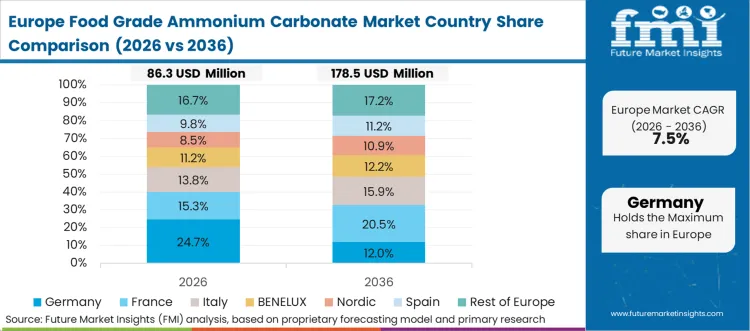
Food Grade Ammonium Carbonate demand in Germany is calculated to rise at a value CAGR of 8.2% during the forecast period (2024 to 2034). By 2034, Germany is expected to account for 18.9% of Food Grade Ammonium Carbonate sales in Europe.
The European Food Safety Authority (EFSA) plays a crucial role in regulating Food Grade Ammonium Carbonate used in food products. By conducting thorough scientific assessments, EFSA ensures that these agents meet stringent safety standards before they are approved for use. This stringent evaluation process helps to prevent any potential health risks associated with food grade ammonium carbonate (leavening agents).
As a result, consumers can trust that the food products they purchase are safe to eat. This regulatory oversight not only protects public health but also enhances consumer confidence in the food industry, knowing that EFSA’s stringent guidelines are in place to safeguard their well-being.
Increasing Foreign Investment in China’s Food Industry
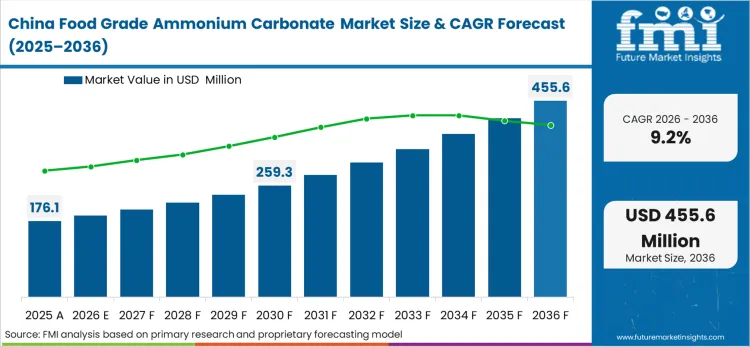
Consumption of Food Grade Ammonium Carbonate in China is projected to increase at a value CAGR of 9.2% over the next ten years. By 2034, the business size is forecasted to reach USD 37.7 million, with China expected to account for a domain share of 53.8% in East Asia.
Increased foreign investment in China’s food sector has considerably enhanced the production and availability of baked products. This influx of capital has enabled local companies to upgrade their technology, improve supply chains, and expand their product offerings. Foreign investors bring not only financial resources but also expertise and innovation, leading to higher quality and more diverse baked products.
Additionally, partnerships with international brands have introduced new flavors and baking techniques to the Chinese market, catering to evolving consumer preferences.
Category-Wise Insights
Enhancement of Dairy Products with Food-Grade Ammonium Carbonate
| Segment | Dairy Products (Application) |
|---|---|
| Value Share (2026) | 38.3% |
Food-grade ammonium carbonate drastically improves dairy products through several methods. It improves texture by creating a smoother, creamier mouthfeel in items like cheese and yogurt, and uplifts the overall sensory experience for consumers.
Additionally, it contributes to flavor development by helping to create distinct taste profiles, which makes dairy products more appealing to those searching for unique and flavorful choices. Furthermore, ammonium carbonate acts as a stabilizer, maintaining the consistency and quality of dairy products over time.
This stabilization is particularly important for products with varying moisture content, as it ensures stability and extends shelf life, which further allows companies to deliver high-quality products that meet consumer expectations for freshness and taste.
The Dominance of Powdered Ammonium Carbonate in Food Applications
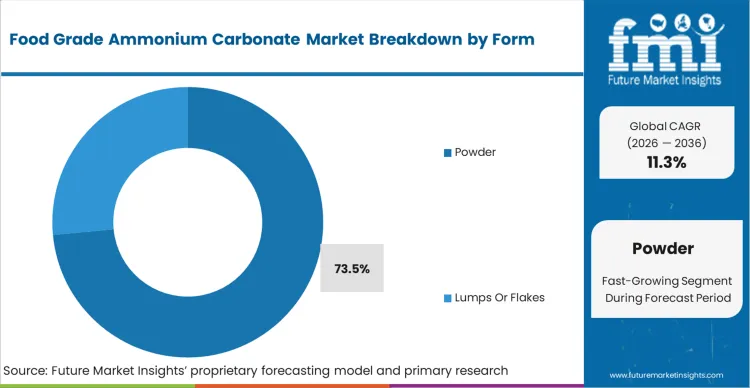
| Segment | Powder (Form) |
|---|---|
| Value Share (2026) | 73.5% |
The powdered form of food-grade ammonium carbonate is increasingly preferred due to its multiple advantages. Its ease of use allows for simple measurement and inclusion into recipes, which makes it convenient for both home bakers and food manufacturers, as it dissolves quickly for uniform distribution in baked goods. Further, its versatility enables applications across baking, confectionery, and dairy products, catering to diverse food formulations.
Additionally, powdered ammonium carbonate generally boasts a longer shelf life and is easier to store in airtight containers, which protects it from moisture. It provides consistent performance, further ensuring reliable texture and flavor in products, which is essential for quality control. Furthermore, its cost-effectiveness and compatibility with other dry ingredients make it an ideal choice for baking mixes and pre-packaged foods.
Competitive Aligners for Market Players
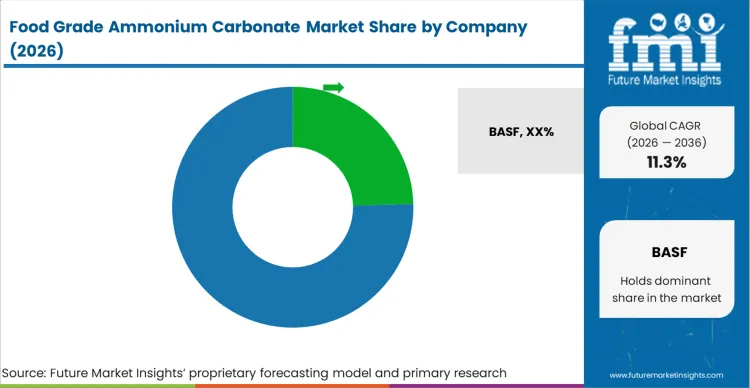
The food grade ammonium carbonate market is moderately fragmented with a combination of large diversified chemical producers and regional specialty chemical suppliers. BASF holds an estimated 24.6% share in 2026, with Honeywell, Thermo Fisher Scientific, ECSA Chemicals, The Chemical Company, Avantor, Solvay S.A., Tata Chemicals, Univar Solutions, American Elements, and regional producers including Destiny Chemicals, Nabhi Chemicals, and A. B. Enterprises serving domestic markets. BASF's February 2026 Zhanjiang Verbund site commissioning, specifically citing the Nutrition and Care segment's food-grade additive production, creates a new Asia Pacific production footprint that directly addresses the supply gap driving China's 9.2% CAGR growth trajectory. [1]
The USDA's January 2025 Technical Evaluation Report reaffirming ammonium carbonate's permitted status in organic food processing for the next five-year sunset cycle removes the single largest regulatory uncertainty that has historically constrained organic bakery procurement commitments. [2] Organic bakery manufacturers who had maintained buffer sourcing strategies anticipating potential delisting can now convert to longer-term supply contracts that support food-grade ammonium carbonate producers in forward capacity planning. The FDA's August 2025 sodium reduction guidance for commercially processed foods directly elevates ammonium carbonate's value proposition in the competitive leavening agent market, as its sodium-free profile converts from a product attribute into a regulatory compliance advantage. [3]
Buyer concentration is moderate, with industrial bakeries and food manufacturers representing the primary procurement base. Household end-user demand at 29.4% of the end-user segment is fragmented across specialty food retailers and online channels.
Recent Developments
- February 2026: BASF announced the successful startup of major production facilities at its new Verbund site in Zhanjiang, China, a cornerstone of the company's Winning Ways strategy. In its 2025 fiscal summary, BASF emphasized that despite a volatile chemical market it is focusing on core businesses including the Nutrition and Care and Chemicals segments, which oversee production of food-grade additives including ammonium carbonate (E503i). The new facility enhances BASF's ability to serve growing Asia Pacific regional demand for high-purity food ingredients. [1]
- January 2025: The USDA's Agricultural Marketing Service published a final Technical Evaluation Report for the National Organic Standards Board regarding the sunset review of ammonium carbonate. The review reaffirmed ammonium carbonate's status as a permitted leavening agent in organic food processing under 7 CFR 205.605(b)(5), securing its use in clean-label and organic bakery markets through the next five-year NOSB renewal cycle and providing long-term procurement confidence for organic food manufacturers. [2]
Key Players in Food Grade Ammonium Carbonate Market
- BASF
- Honeywell
- Thermo Fisher Scientific
- ECSA Chemicals
- The Chemical Company
- Avantor
- Solvay S.A.
- Tata Chemicals Ltd.
- Univar Solutions
- American Elements
- Destiny Chemicals
- Nabhi Chemicals
- A. B. Enterprises
Scope of the Report
| Metric | Value |
|---|---|
| Quantitative Units | USD 381.9 million (2026) to USD 1,114.1 million (2036), at a CAGR of 11.3% |
| Market Definition | The food grade ammonium carbonate market covers food-grade ammonium carbonate (E503ii) and ammonium bicarbonate (E503i) in powder and lump/flake forms meeting food-grade purity specifications for chemical leavening in bakery, confectionery, dairy, and meat processing applications for food manufacturers, industrial bakeries, and household use. |
| Product Type Segmentation | Ammonium Bicarbonate, Ammonium Carbonate |
| Application Segmentation | Baking Industry, Confectionery, Dairy Products, Meat Processing, Others |
| End-User Segmentation | Food Manufacturers, Bakeries, Confectionery Manufacturers, Household |
| Form Segmentation | Powder, Lumps or Flakes |
| Regions Covered | North America, Latin America, Europe, East Asia, South Asia, Oceania, Middle East and Africa |
| Countries Covered | United States, United Kingdom, Germany, India, China, France, Japan, Brazil, South Korea, Australia and 40 plus countries |
| Key Companies Profiled | BASF, Honeywell, Thermo Fisher Scientific, ECSA Chemicals, Avantor, Solvay S.A., Tata Chemicals Ltd., Univar Solutions, American Elements, Destiny Chemicals |
| Forecast Period | 2026 to 2036 |
| Approach | Hybrid bottom-up and top-down market modeling validated through primary interviews with food-grade ammonium carbonate producers and industrial bakery manufacturers, supported by USDA AMS Technical Evaluation Report data and FDA sodium reduction guidance documentation |
Food Grade Ammonium Carbonate Market Analysis by Segments
Product Type
- Ammonium Bicarbonate (61.7% share, 2026)
- Ammonium Carbonate
Application
- Baking Industry (54.3% share, 2026)
- Confectionery
- Dairy Products
- Meat Processing
- Others
End-User
- Food Manufacturers (46.8% share, 2026)
- Bakeries
- Confectionery Manufacturers
- Household
Form
- Powder (73.5% share, 2026)
- Lumps or Flakes
Region
- North America: United States (7.5% CAGR), Canada, Mexico
- Latin America: Brazil, Argentina, Chile, Rest of Latin America
- Europe: Germany (8.2% CAGR), United Kingdom (7.0% CAGR), France, Italy, Spain, Benelux, Nordics, Rest of Europe
- East Asia: China (9.2% CAGR), Japan, South Korea
- South Asia: India (8.8% CAGR), Indonesia, Malaysia, Thailand, Rest of South Asia
- Oceania: Australia, New Zealand
- Middle East & Africa: Saudi Arabia, UAE, South Africa, Rest of Middle East & Africa
Bibliography
- [1] BASF SE. (2026). BASF Announces Successful Startup of Major Plants at New Verbund Site in Zhanjiang, China. Corporate Press Release, February 2026.
- [2] USDA Agricultural Marketing Service. (2025). Technical Evaluation Report: Ammonium Bicarbonate and Ammonium Carbonate in Organic Crop and Handling Production. National Organic Standards Board Sunset Review, January 2025.
- [3] USA Food and Drug Administration. (2025). Voluntary Sodium Reduction Goals: Target Mean and Upper Bound Concentrations for Sodium in Commercially Processed, Packaged, and Prepared Foods. FDA Guidance for Industry, August 2025.
- [4] BASF SE. (2025). BASF 2025 Annual Report: Nutrition & Care Segment Performance. Annual Report, 2025.
- [5] European Food Safety Authority. (2024). Re-evaluation of Ammonium Carbonates (E503) as Food Additives. EFSA Journal, 2024.
This Report Addresses
- Market intelligence to enable food-grade ammonium carbonate sourcing strategy, sodium reduction reformulation planning, and organic bakery supply agreement decisions across baking, confectionery, and food manufacturing segments
- Market size estimation and 10-year revenue forecasts from 2026 to 2036, incorporating FDA sodium reduction guidance adoption curve modeling and USDA organic reaffirmation demand impact
- Growth opportunity mapping across Ammonium Bicarbonate and Ammonium Carbonate product types with emphasis on Asia Pacific demand growth driven by BASF Zhanjiang capacity expansion
- Segment and regional revenue forecasts covering product type, application, end-user, and form dimensions with country-level CAGR analysis for the USA, UK, Germany, India, and China
- Competition strategy assessment including BASF Asia Pacific capacity expansion, Tata Chemicals India positioning, and Solvay and Honeywell food-grade additive competitive dynamics
- Regulatory impact analysis covering FDA sodium reduction guidance for processed food manufacturers, USDA National Organic Program ammonium carbonate sunset review cycle, and EU E503 food additive re-evaluation status
- Supply chain analysis covering ammonia feedstock price linkage, food-grade purity specification requirements, packaging and storage conditions for moisture-sensitive ammonium carbonate, and distribution channel structure for industrial versus household grades
- Market report delivery in PDF, Excel, PPT, and interactive dashboard formats for executive and operational use
Frequently Asked Questions
How large is the demand for Food Grade Ammonium Carbonate in the global market in 2026?
Demand for Food Grade Ammonium Carbonate in the global market is estimated to be valued at USD 381.9 million in 2026.
What will be the market size of Food Grade Ammonium Carbonate by 2036?
Market size for Food Grade Ammonium Carbonate is projected to reach USD 1,114.1 million by 2036.
What is the expected CAGR for the Food Grade Ammonium Carbonate market between 2026 and 2036?
Demand for Food Grade Ammonium Carbonate is expected to grow at a CAGR of 11.3% between 2026 and 2036.
Which product type leads the Food Grade Ammonium Carbonate market in 2026?
Ammonium Bicarbonate holds 61.7% of product type share in 2026, reflecting its dominant use in cookie, cracker, and biscuit manufacturing where complete volatilization during baking leaves no residual ammonia flavor in low-moisture finished products.
Which application leads the Food Grade Ammonium Carbonate market?
Baking Industry accounts for 54.3% of application value in 2026, encompassing industrial bread, cookie, cracker, and savory snack production where ammonium carbonate provides leavening volume and texture development without sodium contribution.
What is the significance of the USDA January 2025 reaffirmation for the organic bakery segment?
The USDA AMS January 2025 Technical Evaluation Report reaffirming ammonium carbonate's permitted status in organic food processing under 7 CFR 205.605(b)(5) secures its use through the next five-year NOSB renewal cycle, removing regulatory uncertainty and enabling organic bakery manufacturers to convert from buffer sourcing to long-term supply agreements.
Which country leads Food Grade Ammonium Carbonate growth?
China leads at 9.2% CAGR through 2036, driven by organized food manufacturing sector expansion and BASF's February 2026 Zhanjiang Verbund site commissioning, which expands food-grade additive production capacity specifically to serve growing Asia Pacific demand for high-purity food ingredients.
How does FDA sodium reduction guidance affect the Food Grade Ammonium Carbonate market?
FDA's August 2025 active promotion of sodium reduction in commercially processed foods elevates ammonium carbonate's sodium-free leavening profile from a product attribute to a regulatory compliance advantage over sodium bicarbonate, accelerating procurement decisions in bakery and cracker categories where FDA voluntary sodium reduction targets apply.
What form of Food Grade Ammonium Carbonate dominates the market?
Powder holds 73.5% of form share in 2026, preferred for precise metering in industrial baking systems, even dispersion in dough and batter matrices, and compatibility with the automated batching and dispensing equipment used in commercial food manufacturing facilities.
How does FMI validate its Food Grade Ammonium Carbonate forecast?
Forecast is developed using hybrid bottom-up and top-down modeling validated through primary interviews with food-grade ammonium carbonate producers and industrial bakery manufacturers, USDA AMS Technical Evaluation Report data, FDA sodium reduction guidance, and BASF Zhanjiang site commissioning announcements.
Preview the report firsthand - request a free sample
Get SampleGet the brochure for pricing and purchase details.
Get PDFTable of Content
- Executive Summary
- Global Market Outlook
- Demand-side Trends
- Supply-side Trends
- Technology Roadmap Analysis
- Analysis and Recommendations
- Market Overview
- Market Coverage / Taxonomy
- Market Definition / Scope / Limitations
- Research Methodology
- Chapter Orientation
- Analytical Lens and Working Hypotheses
- Market Structure, Signals, and Trend Drivers
- Benchmarking and Cross-market Comparability
- Market Sizing, Forecasting, and Opportunity Mapping
- Research Design and Evidence Framework
- Desk Research Programme (Secondary Evidence)
- Company Annual and Sustainability Reports
- Peer-reviewed Journals and Academic Literature
- Corporate Websites, Product Literature, and Technical Notes
- Earnings Decks and Investor Briefings
- Statutory Filings and Regulatory Disclosures
- Technical White Papers and Standards Notes
- Trade Journals, Industry Magazines, and Analyst Briefs
- Conference Proceedings, Webinars, and Seminar Materials
- Government Statistics Portals and Public Data Releases
- Press Releases and Reputable Media Coverage
- Specialist Newsletters and Curated Briefings
- Sector Databases and Reference Repositories
- FMI Internal Proprietary Databases and Historical Market Datasets
- Subscription Datasets and Paid Sources
- Social Channels, Communities, and Digital Listening Inputs
- Additional Desk Sources
- Expert Input and Fieldwork (Primary Evidence)
- Primary Modes
- Qualitative Interviews and Expert Elicitation
- Quantitative Surveys and Structured Data Capture
- Blended Approach
- Why Primary Evidence is Used
- Field Techniques
- Interviews
- Surveys
- Focus Groups
- Observational and In-context Research
- Social and Community Interactions
- Stakeholder Universe Engaged
- C-suite Leaders
- Board Members
- Presidents and Vice Presidents
- R&D and Innovation Heads
- Technical Specialists
- Domain Subject-matter Experts
- Scientists
- Physicians and Other Healthcare Professionals
- Governance, Ethics, and Data Stewardship
- Research Ethics
- Data Integrity and Handling
- Primary Modes
- Tooling, Models, and Reference Databases
- Desk Research Programme (Secondary Evidence)
- Data Engineering and Model Build
- Data Acquisition and Ingestion
- Cleaning, Normalisation, and Verification
- Synthesis, Triangulation, and Analysis
- Quality Assurance and Audit Trail
- Market Background
- Market Dynamics
- Drivers
- Restraints
- Opportunity
- Trends
- Scenario Forecast
- Demand in Optimistic Scenario
- Demand in Likely Scenario
- Demand in Conservative Scenario
- Opportunity Map Analysis
- Product Life Cycle Analysis
- Supply Chain Analysis
- Investment Feasibility Matrix
- Value Chain Analysis
- PESTLE and Porter’s Analysis
- Regulatory Landscape
- Regional Parent Market Outlook
- Production and Consumption Statistics
- Import and Export Statistics
- Market Dynamics
- Global Market Analysis 2021 to 2025 and Forecast, 2026 to 2036
- Historical Market Size Value (USD Million) Analysis, 2021 to 2025
- Current and Future Market Size Value (USD Million) Projections, 2026 to 2036
- Y-o-Y Growth Trend Analysis
- Absolute $ Opportunity Analysis
- Global Market Pricing Analysis 2021 to 2025 and Forecast 2026 to 2036
- Global Market Analysis 2021 to 2025 and Forecast 2026 to 2036, By Product Type
- Introduction / Key Findings
- Historical Market Size Value (USD Million) Analysis By Product Type , 2021 to 2025
- Current and Future Market Size Value (USD Million) Analysis and Forecast By Product Type , 2026 to 2036
- Ammonium Bicarbonate
- Ammonium Carbonate
- Ammonium Bicarbonate
- Y-o-Y Growth Trend Analysis By Product Type , 2021 to 2025
- Absolute $ Opportunity Analysis By Product Type , 2026 to 2036
- Global Market Analysis 2021 to 2025 and Forecast 2026 to 2036, By Application
- Introduction / Key Findings
- Historical Market Size Value (USD Million) Analysis By Application, 2021 to 2025
- Current and Future Market Size Value (USD Million) Analysis and Forecast By Application, 2026 to 2036
- Baking Industry
- Confectionery
- Dairy Products
- Meat Processing
- Others
- Baking Industry
- Y-o-Y Growth Trend Analysis By Application, 2021 to 2025
- Absolute $ Opportunity Analysis By Application, 2026 to 2036
- Global Market Analysis 2021 to 2025 and Forecast 2026 to 2036, By End-User
- Introduction / Key Findings
- Historical Market Size Value (USD Million) Analysis By End-User, 2021 to 2025
- Current and Future Market Size Value (USD Million) Analysis and Forecast By End-User, 2026 to 2036
- Food Manufacturers
- Bakeries
- Confectionery Manufacturers
- Household
- Food Manufacturers
- Y-o-Y Growth Trend Analysis By End-User, 2021 to 2025
- Absolute $ Opportunity Analysis By End-User, 2026 to 2036
- Global Market Analysis 2021 to 2025 and Forecast 2026 to 2036, By Form
- Introduction / Key Findings
- Historical Market Size Value (USD Million) Analysis By Form, 2021 to 2025
- Current and Future Market Size Value (USD Million) Analysis and Forecast By Form, 2026 to 2036
- Powder
- Lumps Or Flakes
- Powder
- Y-o-Y Growth Trend Analysis By Form, 2021 to 2025
- Absolute $ Opportunity Analysis By Form, 2026 to 2036
- Global Market Analysis 2021 to 2025 and Forecast 2026 to 2036, By Region
- Introduction
- Historical Market Size Value (USD Million) Analysis By Region, 2021 to 2025
- Current Market Size Value (USD Million) Analysis and Forecast By Region, 2026 to 2036
- North America
- Latin America
- Western Europe
- Eastern Europe
- East Asia
- South Asia and Pacific
- Middle East & Africa
- Market Attractiveness Analysis By Region
- North America Market Analysis 2021 to 2025 and Forecast 2026 to 2036, By Country
- Historical Market Size Value (USD Million) Trend Analysis By Market Taxonomy, 2021 to 2025
- Market Size Value (USD Million) Forecast By Market Taxonomy, 2026 to 2036
- By Country
- USA
- Canada
- Mexico
- By Product Type
- By Application
- By End-User
- By Form
- By Country
- Market Attractiveness Analysis
- By Country
- By Product Type
- By Application
- By End-User
- By Form
- Key Takeaways
- Latin America Market Analysis 2021 to 2025 and Forecast 2026 to 2036, By Country
- Historical Market Size Value (USD Million) Trend Analysis By Market Taxonomy, 2021 to 2025
- Market Size Value (USD Million) Forecast By Market Taxonomy, 2026 to 2036
- By Country
- Brazil
- Chile
- Rest of Latin America
- By Product Type
- By Application
- By End-User
- By Form
- By Country
- Market Attractiveness Analysis
- By Country
- By Product Type
- By Application
- By End-User
- By Form
- Key Takeaways
- Western Europe Market Analysis 2021 to 2025 and Forecast 2026 to 2036, By Country
- Historical Market Size Value (USD Million) Trend Analysis By Market Taxonomy, 2021 to 2025
- Market Size Value (USD Million) Forecast By Market Taxonomy, 2026 to 2036
- By Country
- Germany
- UK
- Italy
- Spain
- France
- Nordic
- BENELUX
- Rest of Western Europe
- By Product Type
- By Application
- By End-User
- By Form
- By Country
- Market Attractiveness Analysis
- By Country
- By Product Type
- By Application
- By End-User
- By Form
- Key Takeaways
- Eastern Europe Market Analysis 2021 to 2025 and Forecast 2026 to 2036, By Country
- Historical Market Size Value (USD Million) Trend Analysis By Market Taxonomy, 2021 to 2025
- Market Size Value (USD Million) Forecast By Market Taxonomy, 2026 to 2036
- By Country
- Russia
- Poland
- Hungary
- Balkan & Baltic
- Rest of Eastern Europe
- By Product Type
- By Application
- By End-User
- By Form
- By Country
- Market Attractiveness Analysis
- By Country
- By Product Type
- By Application
- By End-User
- By Form
- Key Takeaways
- East Asia Market Analysis 2021 to 2025 and Forecast 2026 to 2036, By Country
- Historical Market Size Value (USD Million) Trend Analysis By Market Taxonomy, 2021 to 2025
- Market Size Value (USD Million) Forecast By Market Taxonomy, 2026 to 2036
- By Country
- China
- Japan
- South Korea
- By Product Type
- By Application
- By End-User
- By Form
- By Country
- Market Attractiveness Analysis
- By Country
- By Product Type
- By Application
- By End-User
- By Form
- Key Takeaways
- South Asia and Pacific Market Analysis 2021 to 2025 and Forecast 2026 to 2036, By Country
- Historical Market Size Value (USD Million) Trend Analysis By Market Taxonomy, 2021 to 2025
- Market Size Value (USD Million) Forecast By Market Taxonomy, 2026 to 2036
- By Country
- India
- ASEAN
- Australia & New Zealand
- Rest of South Asia and Pacific
- By Product Type
- By Application
- By End-User
- By Form
- By Country
- Market Attractiveness Analysis
- By Country
- By Product Type
- By Application
- By End-User
- By Form
- Key Takeaways
- Middle East & Africa Market Analysis 2021 to 2025 and Forecast 2026 to 2036, By Country
- Historical Market Size Value (USD Million) Trend Analysis By Market Taxonomy, 2021 to 2025
- Market Size Value (USD Million) Forecast By Market Taxonomy, 2026 to 2036
- By Country
- Kingdom of Saudi Arabia
- Other GCC Countries
- Turkiye
- South Africa
- Other African Union
- Rest of Middle East & Africa
- By Product Type
- By Application
- By End-User
- By Form
- By Country
- Market Attractiveness Analysis
- By Country
- By Product Type
- By Application
- By End-User
- By Form
- Key Takeaways
- Key Countries Market Analysis
- USA
- Pricing Analysis
- Market Share Analysis, 2025
- By Product Type
- By Application
- By End-User
- By Form
- Canada
- Pricing Analysis
- Market Share Analysis, 2025
- By Product Type
- By Application
- By End-User
- By Form
- Mexico
- Pricing Analysis
- Market Share Analysis, 2025
- By Product Type
- By Application
- By End-User
- By Form
- Brazil
- Pricing Analysis
- Market Share Analysis, 2025
- By Product Type
- By Application
- By End-User
- By Form
- Chile
- Pricing Analysis
- Market Share Analysis, 2025
- By Product Type
- By Application
- By End-User
- By Form
- Germany
- Pricing Analysis
- Market Share Analysis, 2025
- By Product Type
- By Application
- By End-User
- By Form
- UK
- Pricing Analysis
- Market Share Analysis, 2025
- By Product Type
- By Application
- By End-User
- By Form
- Italy
- Pricing Analysis
- Market Share Analysis, 2025
- By Product Type
- By Application
- By End-User
- By Form
- Spain
- Pricing Analysis
- Market Share Analysis, 2025
- By Product Type
- By Application
- By End-User
- By Form
- France
- Pricing Analysis
- Market Share Analysis, 2025
- By Product Type
- By Application
- By End-User
- By Form
- India
- Pricing Analysis
- Market Share Analysis, 2025
- By Product Type
- By Application
- By End-User
- By Form
- ASEAN
- Pricing Analysis
- Market Share Analysis, 2025
- By Product Type
- By Application
- By End-User
- By Form
- Australia & New Zealand
- Pricing Analysis
- Market Share Analysis, 2025
- By Product Type
- By Application
- By End-User
- By Form
- China
- Pricing Analysis
- Market Share Analysis, 2025
- By Product Type
- By Application
- By End-User
- By Form
- Japan
- Pricing Analysis
- Market Share Analysis, 2025
- By Product Type
- By Application
- By End-User
- By Form
- South Korea
- Pricing Analysis
- Market Share Analysis, 2025
- By Product Type
- By Application
- By End-User
- By Form
- Russia
- Pricing Analysis
- Market Share Analysis, 2025
- By Product Type
- By Application
- By End-User
- By Form
- Poland
- Pricing Analysis
- Market Share Analysis, 2025
- By Product Type
- By Application
- By End-User
- By Form
- Hungary
- Pricing Analysis
- Market Share Analysis, 2025
- By Product Type
- By Application
- By End-User
- By Form
- Kingdom of Saudi Arabia
- Pricing Analysis
- Market Share Analysis, 2025
- By Product Type
- By Application
- By End-User
- By Form
- Turkiye
- Pricing Analysis
- Market Share Analysis, 2025
- By Product Type
- By Application
- By End-User
- By Form
- South Africa
- Pricing Analysis
- Market Share Analysis, 2025
- By Product Type
- By Application
- By End-User
- By Form
- USA
- Market Structure Analysis
- Competition Dashboard
- Competition Benchmarking
- Market Share Analysis of Top Players
- By Regional
- By Product Type
- By Application
- By End-User
- By Form
- Competition Analysis
- Competition Deep Dive
- BASF
- Overview
- Product Portfolio
- Profitability by Market Segments (Product/Age /Sales Channel/Region)
- Sales Footprint
- Strategy Overview
- Marketing Strategy
- Product Strategy
- Channel Strategy
- Honeywell
- Thermo Fisher Scientific
- ECSA Chemicals
- The Chemical Company
- Avantor
- Solvay S.A.
- Tata Chemicals Ltd.
- Univar Solutions
- American Elements
- Destiny Chemicals
- Nabhi Chemicals
- A. B. ENTERPRISES
- BASF
- Competition Deep Dive
- Assumptions & Acronyms Used


