

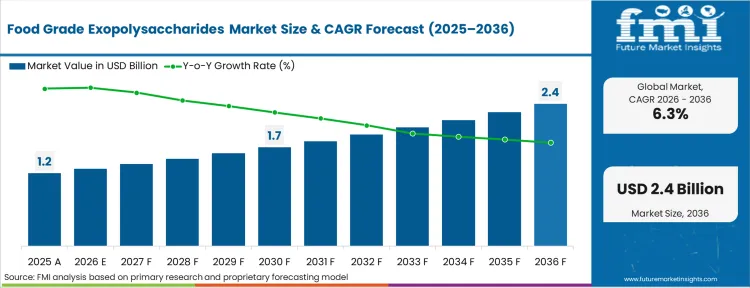
- Industry Size (2026)
- USD 1.3 Bn
- Forecast (2036)
- USD 2.4 Bn
- CAGR (2026 to 2036)
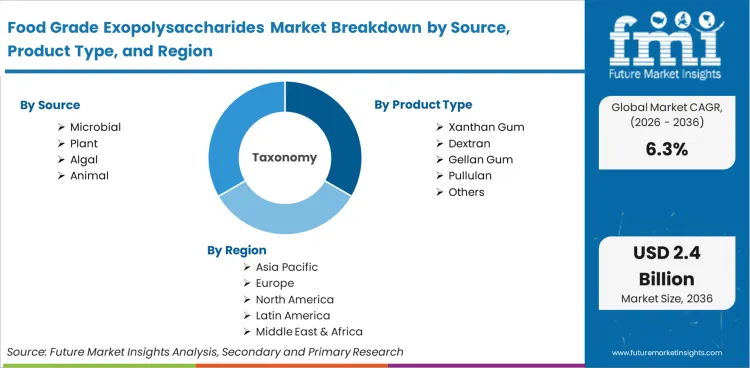
- 6.3%
Food Grade Exopolysaccharides Market Size, Market Forecast and Outlook By FMI
The food grade exopolysaccharides market was valued at USD 1.2 billion in 2025. Sales are poised to cross USD 1.3 billion in 2026 at a CAGR of 6.3% during the forecast period. Increasing investment propels the total opportunity to USD 2.4 billion through 2036 as formulation engineers systematically replace synthetic hydrocolloids with biologically fermented alternatives to satisfy stringent clean-label procurement mandates.
Food and beverage formulators are currently navigating a fundamental shift away from simply achieving viscosity toward establishing comprehensive rheological stability without triggering consumer additive skepticism. This transition forces research and development teams to qualify naturally derived thickening agents that perform consistently under high-shear processing conditions. Delaying this transition leaves brands exposed to reformulations mandated by evolving regulatory frameworks, directly threatening retail shelf placements.
Exopolysaccharides derived from controlled bacterial fermentation provide this precise functionality, solving stability challenges that heavily modified agricultural starches struggle to address. The structural shift toward clean label ingredients establishes a baseline requirement rather than a premium feature. Before this expansion accelerates fully, formulators must cross a specific operational threshold: achieving cost parity with legacy starches in continuous production environments. This gate is triggered by primary ingredient suppliers scaling precision fermentation vessels, which significantly drives down the unit economics of exopolysaccharide harvesting. Once this threshold is crossed, the cost-in-use barrier dissolves, allowing mass-market food manufacturers to integrate these texturants without compromising margin targets.
Summary of Food Grade Exopolysaccharides Market
- Food Grade Exopolysaccharides Market Definition
- High-molecular-weight biological polymers utilized as primary structural, stabilizing, and texturizing agents in human food applications. The sector is defined by its transition away from chemically modified texturants toward biologically synthesized alternatives that fulfill clean-label formulation requirements.
- Demand Drivers in the Market
- Stringent clean-label mandates from retail distribution networks force formulation engineers to replace synthetic thickeners with biologically synthesized alternatives.
- The rising penetration of plant-based dairy alternatives compels product developers to utilize highly efficient suspension agents to prevent phase separation.
- Continuous-process manufacturing optimization pushes procurement directors to source texturants that maintain stable viscosity across extreme thermal and shear conditions.
- Key Segments Analyzed in the FMI Report
- Microbial: Microbial is expected to hold 55.4% share in 2026, as bacterial fermentation guarantees consistent molecular weight independent of agricultural climate variations.
- Xanthan Gum: Xanthan Gum is poised to record 42.1% share in 2026, due to its unmatched synergistic interaction with other galactomannans in lowering overall formulation costs.
- Dairy Products: Dairy Products is anticipated to garner 34.8% share in 2026, driven by the structural requirement to mimic butterfat mouthfeel in low-fat and non-dairy formats.
- India: 9.1% compound growth, reflecting rapid formalization of the domestic dairy processing sector and aggressive expansion of ambient-stable beverage distribution.
- Analyst Opinion at FMI
- Nandini Roy Choudhury, Principal Analyst for Food and Beverage, opines, "The standard market metrics capture volume output and unit pricing accurately, but they completely miss the hidden formulation tax. Procurement teams are not just calculating the per-kilo cost of xanthan gum; they are measuring the immense operational savings realized when a single microbial exopolysaccharide eliminates the need for three separate synthetic emulsifiers on the ingredient declaration."
- Strategic Implications / Executive Takeaways
- Formulation engineers must pre-qualify multi-functional microbial blends to accelerate product development cycles ahead of impending additive regulatory shifts.
- Ingredient procurement teams should secure long-term capacity agreements with primary fermentation suppliers to avoid spot-market volatility driven by specialized strain shortages.
- Tier-1 fermentation operators face significant margin compression that requires immediate investment in continuous-feed bioreactor technologies to defend unit economics.
- Methodology
- Primary Research: Procurement directors at tier-1 dairy processors, formulation engineers, and technical sales heads.
- Desk Research: Global food safety regulatory approvals and clean-label certification registries.
- Market-Sizing and Forecasting: Baseline volume anchors directly to commercial fermentation capacity metrics.
- Data Validation and Update Cycle: Forecast trajectories cross-validated against industrial bioprocessing equipment capital expenditure trends.
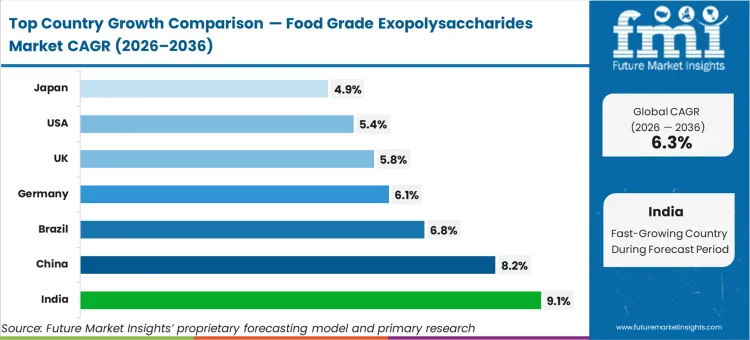
India is expected to track at a CAGR of 9.1%, followed by China expanding at 8.2% and Brazil registering 6.8%. Germany advances at 6.1%, while the United Kingdom is likely to grow at 5.8%. The United States follows with an estimated 5.4%, and Japan is poised to garner 4.9%. This hierarchy reflects a fundamental divergence in capital deployment: emerging processing hubs are leapfrogging legacy texturant infrastructure directly into modern fermentation applications, whereas established markets face the friction of recalibrating existing high-throughput extrusion lines.
Food Grade Exopolysaccharides Market Key Takeaways
| Metric | Details |
|---|---|
| Industry Size (2026) | USD 1.3 billion |
| Industry Value (2036) | USD 2.4 billion |
| CAGR (2026-2036) | 6.3% |
Source: Future Market Insights (FMI) analysis, based on proprietary forecasting model and primary research
Food Grade Exopolysaccharides Market Definition
The food grade exopolysaccharides sector comprises high-molecular-weight polymers secreted by microorganisms, plants, or algae, utilized strictly within human consumption frameworks. It fundamentally differs from general hydrocolloids by its biological synthesis pathway, offering distinct rheological properties, superior water-binding capacities, and clean-label compatibility that traditional chemically modified starches cannot replicate operationally.
Food Grade Exopolysaccharides Market Inclusions
Scope incorporates bacterially fermented texturants such as xanthan and gellan gum, alongside plant-derived mucilages and algal extracts utilized for thickening, stabilizing, or gelling in food matrices. The analysis tracks pure and blended hydrocolloid stabilizers that function as primary structural agents within dairy, bakery, beverage, and meat applications.
Food Grade Exopolysaccharides Market Exclusions
The analysis explicitly excludes exopolysaccharides utilized in pharmaceutical encapsulation, cosmetic formulations, and industrial drilling fluids. These categories operate under fundamentally different regulatory qualification standards, distinct pricing economics, and entirely separate procurement cycles that do not overlap with the nutritional safety matrices governing food and beverage manufacturing.
Food Grade Exopolysaccharides Market Research Methodology
- Primary Research: Procurement directors at tier-1 dairy processors, formulation engineers at multinational beverage conglomerates, and technical sales heads at fermentation ingredient suppliers.
- Desk Research: Global food safety regulatory approvals, clean-label certification registries, and patent filings for novel bacterial fermentation strains.
- Market-Sizing and Forecasting: Baseline volume anchors directly to commercial fermentation capacity metrics and aggregated import/export data for specialized food gums.
- Data Validation and Update Cycle: Forecast trajectories cross-validated against industrial bioprocessing equipment capital expenditure trends and tier-1 consumer brand reformulation announcements.
Segmental Analysis
Food Grade Exopolysaccharides Market Analysis by Source
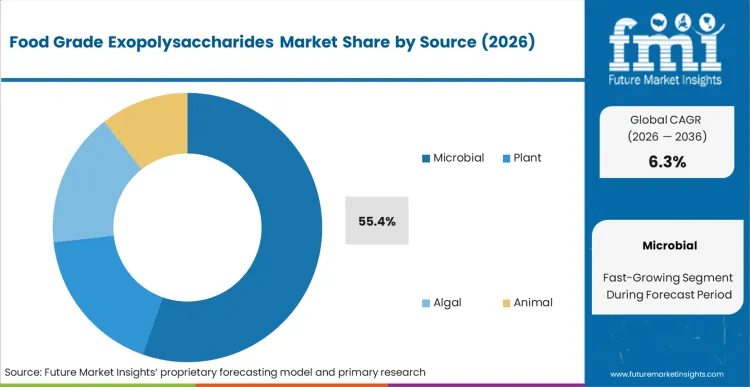
Legacy chemically modified starches and basic plant extracts routinely fail to maintain structural integrity under ultra-high-temperature (UHT) pasteurization, forcing manufacturers to search for hardier alternatives. As per FMI's projection, the microbial segment holds 55.4% share in 2026 because bacterial fermentation yields polymers with highly predictable molecular structures, eliminating the batch-to-batch rheological variance that plagues agricultural extracts. This consistency provides formulation engineers the operational confidence to design complex food matrices without engineering excessive safety margins. The shift fundamentally changes ingredient sourcing from agricultural commodities to precision biotechnology frameworks. Formulators clinging to legacy plant extracts face unpredictable production yields and severe texture degradation during extended ambient shelf life.
- Initiation: The immediate requirement to stabilize suspended particles in complex fluid dynamics triggers the switch to bacterially fermented polymers. Formulation teams specify microbial sources to eliminate separation defects.
- Validation: Rigorous pilot-plant stress testing confirms the microbial texturant's ability to survive intense thermal shocks and mechanical shear without losing viscosity.
- Expansion: Reliable batch consistency prompts procurement directors to standardize these microbial agents across multiple product portfolios, permanently replacing inferior texturants.
Food Grade Exopolysaccharides Market Analysis by Product Type
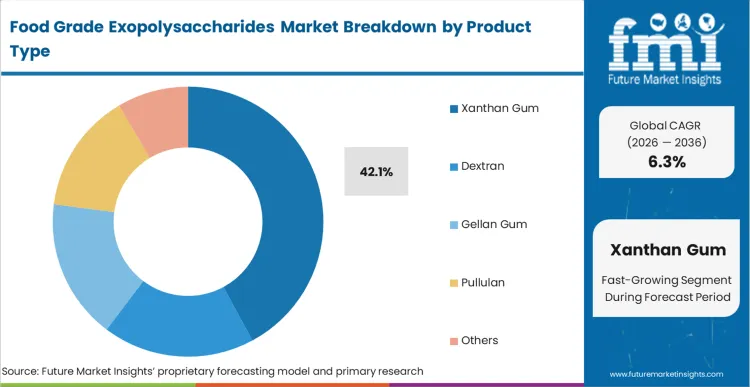
The reason xanthan gum dominates the market architecture is simple: it interacts synergistically with secondary gums to create exponential viscosity at extremely low inclusion rates. According to FMI's estimates, this operational leverage secures xanthan gum a 42.1% share in 2026, as buyers use it to artificially lower the overall cost-in-use of their texturizing systems. The dynamic allows procurement officers to hit aggressive margin targets while maintaining premium mouthfeel attributes in the final product. Buyers who ignore this synergistic capability end up over-indexing on singular expensive gums, steadily eroding their formulation profitability.
- Sourcing: Procurement officers capture immediate savings by utilizing xanthan's synergistic properties, drastically reducing the total volume of hydrocolloids required per batch. This minimizes upfront ingredient expenditure.
- Hidden: Uncalibrated hydration protocols during high-speed mixing introduce severe lumping, requiring unexpected investments in specialized shear-dispersion equipment.
- Lifecycle: A comprehensive lifecycle assessment reveals that despite a higher per-kilo price, the ultra-low inclusion rate of xanthan gum delivers superior gross margins compared to bulk commodity starches.
Food Grade Exopolysaccharides Market Analysis by Application
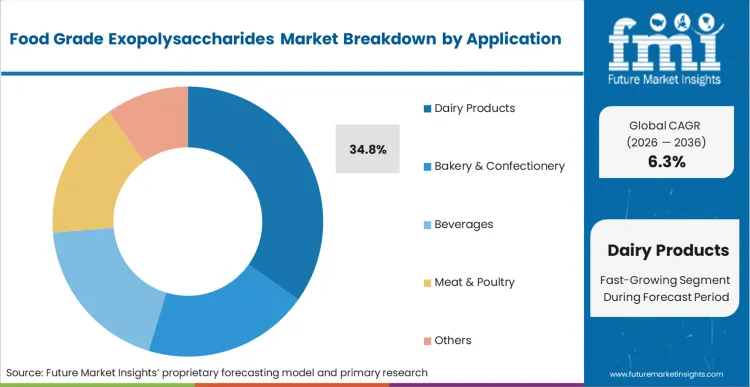
Dairy and dairy-alternative processors are currently being forced to replicate the complex lubricity and mouthfeel of natural milk fat without using actual fat. This structural requirement drives the dairy application segment to represent 34.8% of the total landscape in 2026, as operators lean on exopolysaccharides to build convincing textures. In FMI's view, incorporating these advanced polymers transforms the processor's capability, allowing them to formulate highly stable yogurts and ambient-stable beverages that do not undergo syneresis during transit. Processors who fail to qualify these advanced biopolymers watch their products separate on retail shelves, resulting in immediate distributor delistings.
- Defect: Unstabilized proteins in low-pH dairy environments inevitably precipitate, destroying the visual appeal and texture of the beverage. Exopolysaccharides halt this specific failure mode.
- Residual: Even with advanced texturants, minor fluctuations in processing temperatures can trigger delayed gelation, creating an ongoing quality control risk for floor operators.
- Realization: Plant managers must strictly calibrate their homogenization pressures in tandem with polymer inclusion to capture the complete suspension benefit.
Food Grade Exopolysaccharides Market Drivers, Restraints, and Opportunities
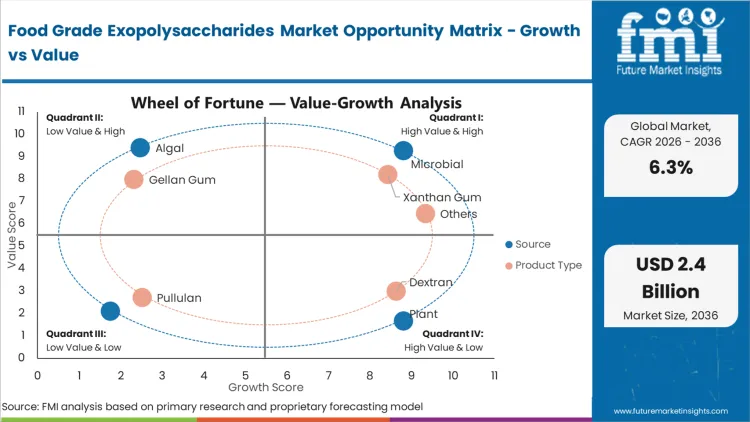
The absolute requirement to strip unrecognizable chemical emulsifiers from ingredient declarations compels product developers to specify naturally fermented exopolysaccharides. This shift transfers the burden from marketing teams to formulation engineers, who must replicate legacy textures using only biologically recognized polymers. If brands hesitate to implement these clean-label architectures, they risk rapid market share erosion as major retail buyers systematically purge artificially stabilized products from their primary planograms.
The most significant friction slowing widespread integration is the radical change in hydration behavior that these advanced polymers introduce to legacy mixing infrastructure. Unlike traditional starches that disperse easily, highly functional exopolysaccharides require precise shear conditions to activate fully. This constraint forces plant operators to fundamentally recalibrate their batching sequences and often requires capital expenditure for specialized induction hoppers. Pre-hydrated liquid polymer dispersions offer a partial workaround, but they introduce severe inbound freight inefficiencies that negate raw material cost savings.
Opportunities in the Food Grade Exopolysaccharides Market
- Synergistic: Formulators utilizing precision-fermented gellan gum in combination with traditional galactomannans unlock ultra-low inclusion rate stabilization systems. Beverage developers leverage this to create hyper-clear, particle-suspended fortified waters.
- Fermentation: Next-generation bioreactor continuous-feed technology dramatically lowers the energetic penalty of microbial harvesting. Primary ingredient processors implement these systems to collapse their unit economics and outprice agricultural extract competitors.
- Textural: The explosion of the meat-alternative category requires extreme moisture-binding capabilities during high-heat extrusion. Savory application scientists deploy tailored exopolysaccharides to lock in juiciness that mimics animal-derived fat matrices.
Regional Analysis
Based on the regional analysis, the food grade exopolysaccharides market is segmented into North America, Latin America, Europe, East Asia, South Asia, Oceania, and Middle East and Africa across 40 plus countries.
.webp "Top Country Growth Comparison Food Grade Exopolysaccharides Market Cagr (2026 2036)")
| Country | CAGR (2026 to 2036) |
|---|---|
| India | 9.1% |
| China | 8.2% |
| Brazil | 6.8% |
| Germany | 6.1% |
| United Kingdom | 5.8% |
| United States | 5.4% |
| Japan | 4.9% |
Source: Future Market Insights (FMI) analysis, based on proprietary forecasting model and primary research
Asia Pacific Food Grade Exopolysaccharides Market Analysis
The modernization of the domestic dairy and beverage processing infrastructure defines Asia's adoption curve. Unlike established markets upgrading existing lines, South Asian processors are building high-throughput facilities from scratch, allowing them to specify advanced shear-mixing equipment capable of handling complex microbial exopolysaccharides from day one. FMI analysts opine that this greenfield advantage eliminates the retrofit friction that slows adoption elsewhere.
- India: The rapid formalization of India's fragmented dairy cooperative network forces processors to implement advanced stabilization for long-haul ambient distribution. This requirement alters the procurement timeline, shifting buyers away from cheap local starches toward high-performance fermented gums. FMI estimates the food grade exopolysaccharides market in India to expand at an annual growth rate of 9.1%. The reality on the processing floor is that these polymers are not adopted for clean-label optics, but purely as functional survival tools to prevent product spoilage during severe summer transit.
- China: Massive state-backed investments in synthetic biology and precision fermentation infrastructure provide domestic food manufacturers with near-limitless, low-cost access to xanthan and gellan variants. This capacity surplus enables aggressive formulation experimentation previously restricted by high ingredient costs. The food grade exopolysaccharides segment in China is projected to grow at an average annual rate of 8.2%. The trajectory points toward total displacement of imported agricultural hydrocolloids by domestically fermented polymers within the decade.
- Japan: An aging demographic profile with highly specific dysphagia (swallowing difficulty) dietary requirements drives demand for ultra-precise, predictable thickening agents. Clinical nutrition formulators operate under zero-tolerance variance metrics. Japan's food grade exopolysaccharides industry is expected to demonstrate a CAGR of 4.9%. This creates a massive competitive gap between standard bulk texturant suppliers and those capable of guaranteeing medical-grade rheological consistency.
Europe Food Grade Exopolysaccharides Market Analysis
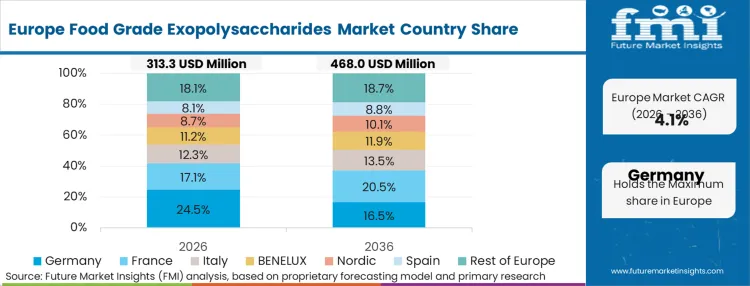
Europe's market dynamic is entirely policy-led, dictated by the European Food Safety Authority's continuous re-evaluation of acceptable daily intakes for traditional chemical emulsifiers. This regulatory environment creates a hostile landscape for synthetic texturants, forcing an artificial acceleration toward biologically derived exopolysaccharides. In FMI's view, procurement teams are no longer negotiating purely on price; they are buying regulatory insurance.
- Germany: German retail consortiums wield immense power, enforcing strict private-label ingredient standards that preempt actual federal legislation. Brand manufacturers must preemptively strip synthetic thickeners to maintain their shelf positioning. Demand for food grade exopolysaccharides in Germany is estimated to expand at a CAGR of 6.1%. Operations managers who successfully integrate these biopolymers fundamentally simplify their regulatory reporting burden, freeing up vast internal compliance resources.
- United Kingdom: The post-Brexit supply chain environment heavily penalizes the import of bulky, low-value agricultural starches, pushing UK processors toward highly concentrated, low-inclusion-rate microbial gums. This geographical friction mandates a shift in formulation strategy to optimize freight density. A CAGR of 5.8% is expected for food grade exopolysaccharides in the United Kingdom over the forecast period. Companies that move first capture highly lucrative, long-term supply contracts with major domestic bakery chains seeking localized resilience.
FMI's report includes extensive coverage of adjacent markets in Southeast Asia and the Middle East. Processors across these emerging territories are uniformly leveraging advanced biopolymers to extend the ambient shelf life of consumer packaged goods across severe climate zones.
Competitive Aligners for Market Players
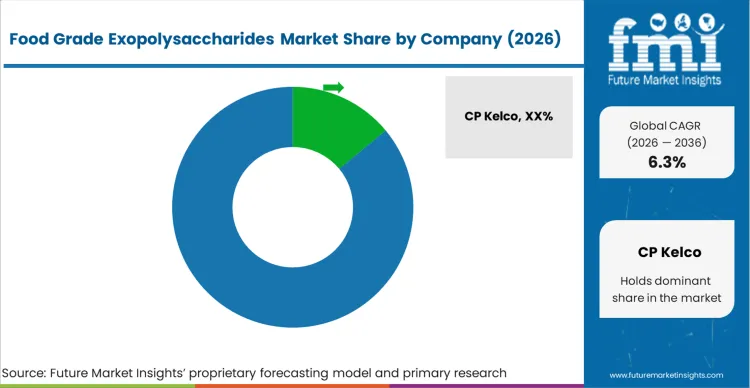
The competitive structure of the exopolysaccharides market is highly concentrated because the capital expenditure required to build, validate, and scale precision fermentation bioreactors represents a massive barrier to entry. Companies like CP Kelco, IFF (DuPont), and Jungbunzlauer dominate not because of aggressive marketing, but because they possess legacy bioprocessing infrastructure that has already been fully amortized. Buyers ultimately distinguish qualified from unqualified vendors based entirely on batch-to-batch rheological consistency a metric that only mature fermentation operators can guarantee at scale.
Incumbents maintain their structural advantage through deeply entrenched proprietary bacterial strains that yield specific polymer chain lengths unmatched by off-the-shelf biological cultures. This advantage persists because replicating a specific texture profile requires exactly matching the molecular weight distribution of the incumbent's polymer. Challengers attempting to disrupt this space must build entirely new downstream recovery and purification capabilities that can achieve equivalent purity without violating existing process patents.
Large multinational food conglomerates actively resist vendor lock-in by designing their base formulations to accept blended texturizing systems rather than relying on a single proprietary gum. This creates structural tension between buyers demanding commoditized pricing and dominant vendors incentivized to push highly specialized, patent-protected polymer variants. Through 2036, the market will become increasingly bifurcated, with basic xanthan operating as a fragmented commodity while highly specialized gellan and pullulan fractions remain tightly consolidated among a few tier-1 biotechnology firms.
Key Players in Food Grade Exopolysaccharides Market
- CP Kelco
- IFF (DuPont)
- Cargill
- Ingredion
- ADM
- Kerry Group
- Jungbunzlauer
- Tate & Lyle
Scope of the Report
| Metric | Value |
|---|---|
| Quantitative Units | USD 1.3 billion to USD 2.4 billion, at a CAGR of 6.3% |
| Market Definition | High-molecular-weight biological polymers utilized as primary structural, stabilizing, and texturizing agents in human food applications. |
| Source Segmentation | Microbial, Plant, Algal, Animal |
| Product Type Segmentation | Xanthan Gum, Dextran, Gellan Gum, Pullulan, Others |
| Application Segmentation | Dairy Products, Bakery & Confectionery, Beverages, Meat & Poultry, Others |
| Regions Covered | North America, Latin America, Europe, East Asia, South Asia, Oceania, Middle East and Africa |
| Countries Covered | India, China, Brazil, Germany, United Kingdom, United States, Japan, and 40 plus countries |
| Key Companies Profiled | CP Kelco, IFF (DuPont), Cargill, Ingredion, ADM, Kerry Group, Jungbunzlauer, Tate & Lyle |
| Forecast Period | 2026 to 2036 |
| Approach | Primary interviews targeted procurement directors and technical formulation engineers. Baseline data anchors to commercial fermentation capacity metrics. Forecasts cross-validated against industrial bioprocessing equipment capital expenditure trends. |
Source: Future Market Insights (FMI) analysis, based on proprietary forecasting model and primary research
Food Grade Exopolysaccharides Market Analysis by Segments
-
Source:
- Microbial
- Plant
- Algal
- Animal
-
Product Type:
- Xanthan Gum
- Dextran
- Gellan Gum
- Pullulan
- Others
-
Application:
- Dairy Products
- Bakery & Confectionery
- Beverages
- Meat & Poultry
- Others
-
Region:
- North America
- United States
- Canada
- Latin America
- Brazil
- Mexico
- Europe
- Germany
- United Kingdom
- France
- Italy
- Asia Pacific
- China
- Japan
- South Korea
- India
- Thailand
- Oceania
- Australia
- New Zealand
- Middle East and Africa
- South Africa
- GCC
- North America
Bibliography
- Nguyen, H. T., Nguyen, T. H., & Nguyen, H. H. (2024, September). Advances in microbial exopolysaccharides: Structure, biosynthesis, and applications. Frontiers in Microbiology.
- Mouro, C., Fernandes, P., & Rocha, C. (2024, July). Microbial exopolysaccharides: Structure, diversity, and industrial applications. Biopolymers. MDPI.
- Sadeghi, M., Zununi-Vahed, S., & Maleki-Dizaji, N. (2024, May). Bifidobacterium-derived exopolysaccharides and their functional potential in food and health. Frontiers in Microbiology.
- Sharma, R., Nath, P. C., Bhunia, B., & Bandyopadhyay, T. K. (2024, January). Microbial exopolysaccharides: Production, properties, and food applications. In Food Process Engineering and Technology. Springer.
- Broeker, J., & Seibold, G. (2025, October). Engineering microbial exopolysaccharides for food and biotechnology applications. Current Opinion in Biotechnology.
- Kumari, J., Singh, R., & Verma, A. (2025, March). Microbial exopolysaccharides: Classification, biosynthesis pathways, and industrial applications. Carbohydrate Polymers.
- American Chemical Society. (2025, October). Microbial-mediated biopolymers (exopolysaccharides) in food technology and packaging. ACS Food Science & Technology.
- Institute of Food Technologists. (2025, June). Recent advances in exopolysaccharide-protein interactions in fermented foods. Comprehensive Reviews in Food Science and Food Safety.
This bibliography is provided for reader reference. The full FMI report contains the complete reference list with primary source documentation.
This Report Addresses
- Market intelligence to support strategic decision making across microbial, plant, and algal texturant categories
- Market size estimation and 10-year revenue forecasts from 2026 to 2036, supported by commercial fermentation capacity baseline metrics
- Growth opportunity mapping across specific xanthan and gellan product types with emphasis on achieving cost parity with legacy starches
- Segment and regional revenue forecasts covering bakery and dairy applications across EFSA-governed regulatory environments
- Competition strategy assessment including proprietary strain development, downstream purification capabilities, and bioprocessing amortization
- Technology development tracking including continuous-feed bioreactors and ultra-low inclusion rate blending protocols
- Market access analysis covering EFSA re-evaluations and GRAS notification pathways for novel biopolymers
- Market report delivery in PDF, Excel, PPT, and interactive dashboard formats for executive strategy, ingredient procurement planning, and operational benchmarking use
Frequently Asked Questions
How large is the food grade exopolysaccharides market in 2026?
The industry reaches USD 1.3 billion in 2026. This scale illustrates that fermented biopolymers have firmly transitioned from niche, premium formulation tools into foundational, mass-market texturizing agents.
What will it be valued at by 2036?
Total valuation reaches USD 2.4 billion by the end of the forecast. The near-doubling in value reflects the aggressive phase-out of chemically modified starches across tier-1 consumer packaged goods portfolios globally.
What CAGR is projected?
The 6.3% CAGR reflects the pace at which major processing facilities are upgrading their high-shear induction equipment not simply the speed of shifting consumer preferences. Adoption is structurally throttled by the capital expenditure required to recalibrate mixing lines.
Which Source segment leads?
Microbial sources lead the landscape. Formulation teams prioritize bacterial fermentation because it guarantees highly predictable molecular weights and batch consistency, eliminating the seasonal yield variance associated with agricultural extracts.
Which Product Type segment leads?
Xanthan gum captures the dominant position. Procurement directors leverage xanthan's unique ability to synergize with secondary galactomannans, driving down the overall inclusion rate and artificially lowering the total cost-in-use of the stabilizer system.
Which Application segment leads?
Dairy products remain the primary application base. Processors are forced to rely on high-performance exopolysaccharides to replicate the complex lubricity and suspension properties of milk fat in plant-based and low-fat dairy alternatives without triggering syneresis.
What drives rapid growth?
Clean-label retail procurement mandates push the industry forward. Major distribution networks systematically reject products stabilized with unrecognizable chemical emulsifiers, forcing formulation engineers to switch to biologically derived, label-friendly alternatives.
What is the primary restraint?
The profound difference in hydration kinetics poses a significant operational barrier. Advanced microbial polymers require perfectly calibrated shear conditions to activate, forcing legacy plant operators to fundamentally alter their batching sequences and invest in specialized dispersion machinery.
Which country grows fastest?
India expands rapidly against established European markets. While Germany focuses on swapping texturants in existing formulations, India's greenfield dairy processing infrastructure allows operators to install advanced shear-mixing capabilities optimized for exopolysaccharides from the outset.
How do EFSA regulatory updates impact European procurement?
Continuous re-evaluations of synthetic emulsifiers transform how European buyers operate. Procurement teams actively specify fermented exopolysaccharides not just for performance, but as preemptive regulatory insurance against impending chemical additive bans.
Why is continuous-feed bioreactor technology critical for ingredient suppliers?
Batch fermentation severely limits margin expansion due to high energetic penalties. Transitioning to continuous-feed systems fundamentally collapses unit economics, allowing tier-1 ingredient suppliers to price microbial polymers competitively against deeply entrenched agricultural starches.
How do buyers resist vendor lock-in with proprietary biopolymers?
Large food conglomerates intentionally design resilient formulation architectures. Instead of relying on a single, patented microbial gum from one supplier, they engineer blended texturizing systems that accept commoditized inputs, neutralizing the pricing power of specialized fermentation operators.
What role does precise molecular weight play in qualification?
Different polymer chain lengths yield drastically different viscosities under identical shear stress. Technical engineers will disqualify any supplier unable to guarantee tight molecular weight distributions, as variance directly causes catastrophic product failure on high-speed filling lines.
Why do meat alternative manufacturers utilize fermented gums?
Plant-based meat extrusion requires extreme moisture retention to survive harsh thermal processing. Exopolysaccharides lock a precise water matrix within the protein structure, artificially replicating the juiciness and bite resistance of animal-derived fat complexes.
How does freight density shape regional adoption in the UK?
Post-Brexit supply chain friction penalizes the importation of low-value, bulky agricultural starches. UK processors shift toward highly potent microbial exopolysaccharides specifically because their ultra-low inclusion rates drastically reduce inbound freight volumes and warehousing requirements.
How does formulation complexity differ for low-pH beverages?
Acidic environments rapidly degrade standard suspension agents. Beverage scientists deploy specific exopolysaccharides that remain structurally rigid in low-pH conditions to prevent protein precipitation and phase separation during ambient distribution.
What changes operationally when a facility adopts liquid polymer dispersions?
While pre-hydrated formats bypass the need for expensive high-shear powder induction equipment, they radically alter inbound logistics. Plant managers trade powder mixing complexity for significantly increased inbound freight costs due to the high water weight of the dispersions.
How do clinical nutrition applications dictate texturant sourcing in Japan?
Medical-grade dysphagia products require absolute rheological precision to prevent patient aspiration. This zero-tolerance variance metric creates an impenetrable barrier, restricting procurement exclusively to tier-1 fermentation suppliers capable of surgical consistency.
Why does xanthan gum create supply chain resilience?
Its unmatched synergistic interaction with other gums provides formulation elasticity. If global supply shocks hit one specific secondary gum, formulators can pivot to an alternative blend component while using the xanthan base to maintain the required viscosity profile.
What data anchors the baseline sizing for this market?
FMI's baseline calculations map directly to commercial biomanufacturing vessel capacities and documented capital expenditures by the primary ingredient tier, ensuring forecasts remain grounded in physical production realities rather than theoretical demand.
Preview the report firsthand - request a free sample
Get SampleGet the brochure for pricing and purchase details.
Get PDFTable of Content
- Executive Summary
- Global Market Outlook
- Demand-side Trends
- Supply-side Trends
- Technology Roadmap Analysis
- Analysis and Recommendations
- Market Overview
- Market Coverage / Taxonomy
- Market Definition / Scope / Limitations
- Research Methodology
- Chapter Orientation
- Analytical Lens and Working Hypotheses
- Market Structure, Signals, and Trend Drivers
- Benchmarking and Cross-market Comparability
- Market Sizing, Forecasting, and Opportunity Mapping
- Research Design and Evidence Framework
- Desk Research Programme (Secondary Evidence)
- Company Annual and Sustainability Reports
- Peer-reviewed Journals and Academic Literature
- Corporate Websites, Product Literature, and Technical Notes
- Earnings Decks and Investor Briefings
- Statutory Filings and Regulatory Disclosures
- Technical White Papers and Standards Notes
- Trade Journals, Industry Magazines, and Analyst Briefs
- Conference Proceedings, Webinars, and Seminar Materials
- Government Statistics Portals and Public Data Releases
- Press Releases and Reputable Media Coverage
- Specialist Newsletters and Curated Briefings
- Expert Input and Fieldwork (Primary Evidence)
- Primary Modes
- Qualitative Interviews and Expert Elicitation
- Quantitative Surveys and Structured Data Capture
- Blended Approach
- Why Primary Evidence is Used
- Field Techniques
- Interviews
- Surveys
- Focus Groups
- Observational and In-context Research
- Social and Community Interactions
- Stakeholder Universe Engaged
- C-suite Leaders
- Board Members
- Presidents and Vice Presidents
- R&D and Innovation Heads
- Technical Specialists
- Domain Subject-matter Experts
- Scientists
- Physicians and Other Healthcare Professionals
- Governance, Ethics, and Data Stewardship
- Research Ethics
- Data Integrity and Handling
- Primary Modes
- Tooling, Models, and Reference Databases
- Data Engineering and Model Build
- Data Acquisition and Ingestion
- Cleaning, Normalisation, and Verification
- Synthesis, Triangulation, and Analysis
- Quality Assurance and Audit Trail
- Desk Research Programme (Secondary Evidence)
- Market Background
- Market Dynamics
- Drivers
- Restraints
- Opportunity
- Trends
- Scenario Forecast
- Demand in Optimistic Scenario
- Demand in Likely Scenario
- Demand in Conservative Scenario
- Opportunity Map Analysis
- Product Life Cycle Analysis
- Supply Chain Analysis
- Investment Feasibility Matrix
- Value Chain Analysis
- PESTLE and Porter’s Analysis
- Regulatory Landscape
- Regional Parent Market Outlook
- Production and Consumption Statistics
- Import and Export Statistics
- Market Dynamics
- Global Market Analysis 2021 to 2025 and Forecast, 2026 to 2036
- Historical Market Size Value (USD Million) Analysis, 2021 to 2025
- Current and Future Market Size Value (USD Million) Projections, 2026 to 2036
- Y-o-Y Growth Trend Analysis
- Absolute $ Opportunity Analysis
- Global Market Pricing Analysis 2021 to 2025 and Forecast 2026 to 2036
- Global Market Analysis 2021 to 2025 and Forecast 2026 to 2036, By Source
- Introduction / Key Findings
- Historical Market Size Value (USD Million) Analysis By Source , 2021 to 2025
- Current and Future Market Size Value (USD Million) Analysis and Forecast By Source , 2026 to 2036
- Microbial
- Plant
- Algal
- Animal
- Microbial
- Y-o-Y Growth Trend Analysis By Source , 2021 to 2025
- Absolute $ Opportunity Analysis By Source , 2026 to 2036
- Global Market Analysis 2021 to 2025 and Forecast 2026 to 2036, By Product Type
- Introduction / Key Findings
- Historical Market Size Value (USD Million) Analysis By Product Type, 2021 to 2025
- Current and Future Market Size Value (USD Million) Analysis and Forecast By Product Type, 2026 to 2036
- Xanthan Gum
- Dextran
- Gellan Gum
- Pullulan
- Others
- Xanthan Gum
- Y-o-Y Growth Trend Analysis By Product Type, 2021 to 2025
- Absolute $ Opportunity Analysis By Product Type, 2026 to 2036
- Global Market Analysis 2021 to 2025 and Forecast 2026 to 2036, By Application
- Introduction / Key Findings
- Historical Market Size Value (USD Million) Analysis By Application, 2021 to 2025
- Current and Future Market Size Value (USD Million) Analysis and Forecast By Application, 2026 to 2036
- Dairy Products
- Bakery & Confectionery
- Beverages
- Meat & Poultry
- Others
- Dairy Products
- Y-o-Y Growth Trend Analysis By Application, 2021 to 2025
- Absolute $ Opportunity Analysis By Application, 2026 to 2036
- Global Market Analysis 2021 to 2025 and Forecast 2026 to 2036, By Region
- Introduction
- Historical Market Size Value (USD Million) Analysis By Region, 2021 to 2025
- Current Market Size Value (USD Million) Analysis and Forecast By Region, 2026 to 2036
- North America
- Latin America
- Western Europe
- Eastern Europe
- East Asia
- South Asia and Pacific
- Middle East & Africa
- Market Attractiveness Analysis By Region
- North America Market Analysis 2021 to 2025 and Forecast 2026 to 2036, By Country
- Historical Market Size Value (USD Million) Trend Analysis By Market Taxonomy, 2021 to 2025
- Market Size Value (USD Million) Forecast By Market Taxonomy, 2026 to 2036
- By Country
- USA
- Canada
- Mexico
- By Source
- By Product Type
- By Application
- By Country
- Market Attractiveness Analysis
- By Country
- By Source
- By Product Type
- By Application
- Key Takeaways
- Latin America Market Analysis 2021 to 2025 and Forecast 2026 to 2036, By Country
- Historical Market Size Value (USD Million) Trend Analysis By Market Taxonomy, 2021 to 2025
- Market Size Value (USD Million) Forecast By Market Taxonomy, 2026 to 2036
- By Country
- Brazil
- Chile
- Rest of Latin America
- By Source
- By Product Type
- By Application
- By Country
- Market Attractiveness Analysis
- By Country
- By Source
- By Product Type
- By Application
- Key Takeaways
- Western Europe Market Analysis 2021 to 2025 and Forecast 2026 to 2036, By Country
- Historical Market Size Value (USD Million) Trend Analysis By Market Taxonomy, 2021 to 2025
- Market Size Value (USD Million) Forecast By Market Taxonomy, 2026 to 2036
- By Country
- Germany
- UK
- Italy
- Spain
- France
- Nordic
- BENELUX
- Rest of Western Europe
- By Source
- By Product Type
- By Application
- By Country
- Market Attractiveness Analysis
- By Country
- By Source
- By Product Type
- By Application
- Key Takeaways
- Eastern Europe Market Analysis 2021 to 2025 and Forecast 2026 to 2036, By Country
- Historical Market Size Value (USD Million) Trend Analysis By Market Taxonomy, 2021 to 2025
- Market Size Value (USD Million) Forecast By Market Taxonomy, 2026 to 2036
- By Country
- Russia
- Poland
- Hungary
- Balkan & Baltic
- Rest of Eastern Europe
- By Source
- By Product Type
- By Application
- By Country
- Market Attractiveness Analysis
- By Country
- By Source
- By Product Type
- By Application
- Key Takeaways
- East Asia Market Analysis 2021 to 2025 and Forecast 2026 to 2036, By Country
- Historical Market Size Value (USD Million) Trend Analysis By Market Taxonomy, 2021 to 2025
- Market Size Value (USD Million) Forecast By Market Taxonomy, 2026 to 2036
- By Country
- China
- Japan
- South Korea
- By Source
- By Product Type
- By Application
- By Country
- Market Attractiveness Analysis
- By Country
- By Source
- By Product Type
- By Application
- Key Takeaways
- South Asia and Pacific Market Analysis 2021 to 2025 and Forecast 2026 to 2036, By Country
- Historical Market Size Value (USD Million) Trend Analysis By Market Taxonomy, 2021 to 2025
- Market Size Value (USD Million) Forecast By Market Taxonomy, 2026 to 2036
- By Country
- India
- ASEAN
- Australia & New Zealand
- Rest of South Asia and Pacific
- By Source
- By Product Type
- By Application
- By Country
- Market Attractiveness Analysis
- By Country
- By Source
- By Product Type
- By Application
- Key Takeaways
- Middle East & Africa Market Analysis 2021 to 2025 and Forecast 2026 to 2036, By Country
- Historical Market Size Value (USD Million) Trend Analysis By Market Taxonomy, 2021 to 2025
- Market Size Value (USD Million) Forecast By Market Taxonomy, 2026 to 2036
- By Country
- Kingdom of Saudi Arabia
- Other GCC Countries
- Turkiye
- South Africa
- Other African Union
- Rest of Middle East & Africa
- By Source
- By Product Type
- By Application
- By Country
- Market Attractiveness Analysis
- By Country
- By Source
- By Product Type
- By Application
- Key Takeaways
- Key Countries Market Analysis
- USA
- Pricing Analysis
- Market Share Analysis, 2025
- By Source
- By Product Type
- By Application
- Canada
- Pricing Analysis
- Market Share Analysis, 2025
- By Source
- By Product Type
- By Application
- Mexico
- Pricing Analysis
- Market Share Analysis, 2025
- By Source
- By Product Type
- By Application
- Brazil
- Pricing Analysis
- Market Share Analysis, 2025
- By Source
- By Product Type
- By Application
- Chile
- Pricing Analysis
- Market Share Analysis, 2025
- By Source
- By Product Type
- By Application
- Germany
- Pricing Analysis
- Market Share Analysis, 2025
- By Source
- By Product Type
- By Application
- UK
- Pricing Analysis
- Market Share Analysis, 2025
- By Source
- By Product Type
- By Application
- Italy
- Pricing Analysis
- Market Share Analysis, 2025
- By Source
- By Product Type
- By Application
- Spain
- Pricing Analysis
- Market Share Analysis, 2025
- By Source
- By Product Type
- By Application
- France
- Pricing Analysis
- Market Share Analysis, 2025
- By Source
- By Product Type
- By Application
- India
- Pricing Analysis
- Market Share Analysis, 2025
- By Source
- By Product Type
- By Application
- ASEAN
- Pricing Analysis
- Market Share Analysis, 2025
- By Source
- By Product Type
- By Application
- Australia & New Zealand
- Pricing Analysis
- Market Share Analysis, 2025
- By Source
- By Product Type
- By Application
- China
- Pricing Analysis
- Market Share Analysis, 2025
- By Source
- By Product Type
- By Application
- Japan
- Pricing Analysis
- Market Share Analysis, 2025
- By Source
- By Product Type
- By Application
- South Korea
- Pricing Analysis
- Market Share Analysis, 2025
- By Source
- By Product Type
- By Application
- Russia
- Pricing Analysis
- Market Share Analysis, 2025
- By Source
- By Product Type
- By Application
- Poland
- Pricing Analysis
- Market Share Analysis, 2025
- By Source
- By Product Type
- By Application
- Hungary
- Pricing Analysis
- Market Share Analysis, 2025
- By Source
- By Product Type
- By Application
- Kingdom of Saudi Arabia
- Pricing Analysis
- Market Share Analysis, 2025
- By Source
- By Product Type
- By Application
- Turkiye
- Pricing Analysis
- Market Share Analysis, 2025
- By Source
- By Product Type
- By Application
- South Africa
- Pricing Analysis
- Market Share Analysis, 2025
- By Source
- By Product Type
- By Application
- USA
- Market Structure Analysis
- Competition Dashboard
- Competition Benchmarking
- Market Share Analysis of Top Players
- By Regional
- By Source
- By Product Type
- By Application
- Competition Analysis
- Competition Deep Dive
- CP Kelco
- Overview
- Product Portfolio
- Profitability by Market Segments (Product/Age /Sales Channel/Region)
- Sales Footprint
- Strategy Overview
- Marketing Strategy
- Product Strategy
- Channel Strategy
- IFF (DuPont)
- Cargill
- Ingredion
- ADM
- Kerry Group
- Jungbunzlauer
- Tate & Lyle
- CP Kelco
- Competition Deep Dive
- Assumptions & Acronyms Used


