

- Industry Size (2026)
- USD 440.2 Mn
- Forecast (2036)
- USD 941.6 Mn
- CAGR (2026 to 2036)
- 7.9%
Low-Cadmium, Premium Food-Grade Phosphate Fertilizer Market Forecast and Outlook 2026 to 2036
The low-cadmium, premium food-grade phosphate fertilizer market is valued at USD 440.2 million in 2026 and is projected to reach USD 941.6 million by 2036, reflecting a CAGR of 7.9%. Market behavior across this period is governed less by overall fertilizer consumption and more by tightening control over impurity risk within regulated food supply chains. Value concentrates around producers that can secure low-cadmium phosphate rock or deploy effective purification processes at scale. Cost structures remain structurally higher than conventional phosphates due to beneficiation intensity, segregation requirements, and continuous analytical testing. Pricing power rests with suppliers able to guarantee cadmium thresholds across batches, since downstream food processors treat non-compliance as an unacceptable operational risk rather than a negotiable parameter.
Quick Stats for Low-Cadmium, Premium Food-Grade Phosphate Fertilizer Market
- Low-Cadmium, Premium Food-Grade Phosphate Fertilizer Market Value (2026): USD 440.2 million
- Low-Cadmium, Premium Food-Grade Phosphate Fertilizer Market Forecast Value (2036): USD 941.6 million
- Forecast CAGR (2026-2036): 7.9%
- Leading Application Segment in Global Demand: Dairy
- Fastest-Growing Countries: India, China, USA, Poland
- Key Players in Global Demand: Yara International, The Mosaic Company, OCP Group, PhosAgro, ICL Group Ltd.
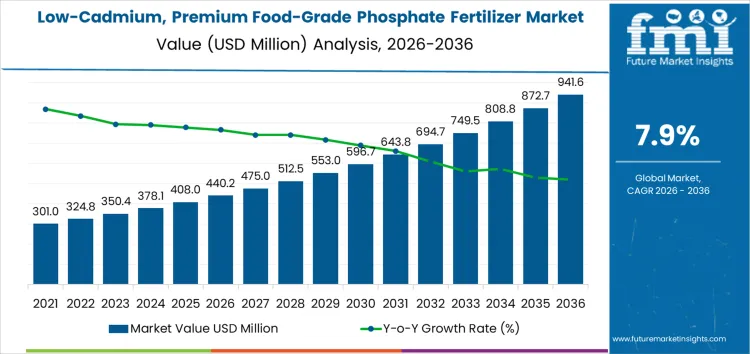
Commercial momentum is reinforced by procurement discipline rather than volume expansion. Buyers prioritize traceability, documentation depth, and long-term reliability of supply, especially where fertilizers influence crops entering infant nutrition, dairy, or export-oriented food processing. Switching costs remain elevated because alternative phosphate sources often require soil retesting, reformulated nutrient plans, and renewed certification audits. Regulatory divergence across regions further narrows supplier pools, increasing dependence on established producers with proven compliance histories. Growth quality therefore reflects consolidation around technically capable suppliers, gradual normalization of premium pricing, and alignment between fertilizer purity and downstream food safety assurance rather than broad-based agricultural input substitution.
Low-Cadmium, Premium Food-Grade Phosphate Fertilizer Market Key Takeaways
| Metric | Value |
|---|---|
| Market Value (2026) | USD 440.2 million |
| Market Forecast Value (2036) | USD 941.6 million |
| Forecast CAGR (2026-2036) | 7.9% |
Why is the Demand for Low-Cadmium, Premium Food-Grade Phosphate Fertilizer Market Growing Globally?
Demand for low-cadmium, premium food-grade phosphate fertilizer is growing globally due to heightened food safety standards, soil health concerns, and stricter regulatory limits on heavy metal content in agricultural inputs. Cadmium, a toxic element often present in phosphate rock, can accumulate in soil and enter the food chain, triggering public health concerns and limits in export and domestic food safety frameworks. Growers and fertilizer manufacturers adopt low-cadmium phosphate fertilizers to reduce potential crop uptake of cadmium and support compliance with food safety regulations established in multiple regions.
Premium food-grade phosphate inputs with controlled trace element profiles support quality assurance in high value crops destined for sensitive markets that monitor heavy metal residues. Sustainable agriculture initiatives emphasize nutrient stewardship and minimized contaminant load, which strengthens adoption of fertilizers with enhanced purity characteristics. Retail distribution of specialty fertilizers expands through agronomy service providers, cooperatives, and precision agriculture platforms that tailor nutrient programs for crop and soil conditions. Research and product development improve beneficiation and purification processes that deliver consistent phosphorus availability with reduced impurity burden. Farm advisors and certification programs encourage use of premium, low-cadmium products as part of integrated nutrient management strategies in global crop production systems.
How Is the Low-Cadmium, Premium Food-Grade Phosphate Fertilizer Market Structured?
Demand for low-cadmium, premium food-grade phosphate fertilizer is shaped by tightening food safety standards, impurity control requirements, and traceability expectations across regulated food processing environments. Buyers prioritize phosphate inputs with verified cadmium reduction, consistent chemical performance, and suitability for direct food-contact applications. Global demand reflects increased regulatory oversight, supplier qualification audits, and preference for high-purity phosphate materials integrated into dairy, beverage, bakery, and meat processing operations.
Which Application Segment Accounts for the Largest Share of Global Demand?
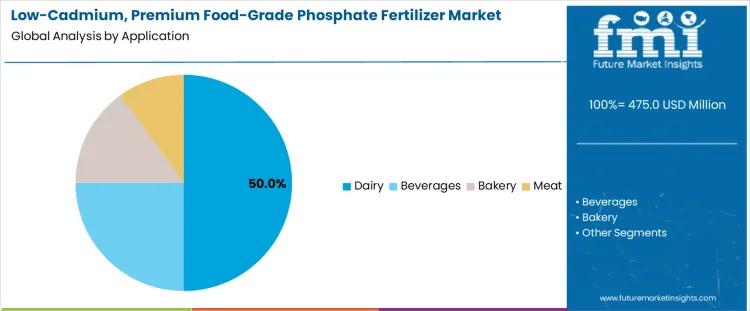
Dairy applications account for 50.0%, representing the largest share of global demand. Food-grade phosphates are widely used in dairy processing for buffering capacity, protein stabilization, emulsification support, and texture optimization across milk, cheese, and processed dairy products. Beverage applications follow at 25.0%, where phosphates contribute to acidity control, mineral fortification, and formulation stability in carbonated and functional drinks. Bakery applications hold 15.0%, supporting leavening systems, dough conditioning, and crumb structure control. Meat applications represent 10.0%, focusing on moisture retention, yield improvement, and processing consistency under regulated impurity limits.
Key Points
- Dairy leads due to broad functional phosphate usage
- Beverages rely on purity for formulation stability
- Meat usage remains selective with strict specifications
Which Form Type Holds the Largest Share of Global Demand?
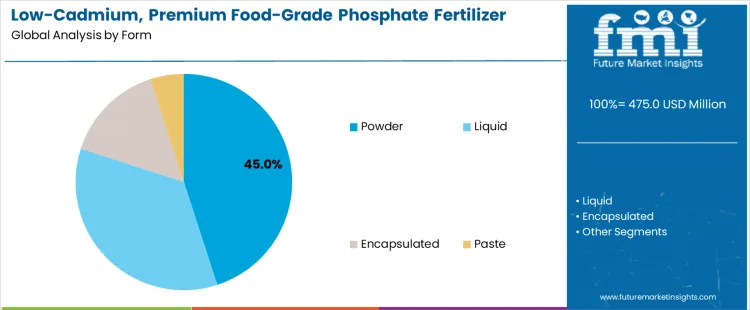
Powder form accounts for 45.0%, making it the leading form globally. Powdered phosphates offer extended shelf life, stable transport characteristics, and compatibility with large-scale dry blending and batching systems used by food manufacturers. Liquid forms follow at 35.0%, preferred where rapid solubility, precise dosing, and automated metering systems are required in continuous processing lines. Encapsulated formats represent 15.0%, supporting controlled release, reduced handling exposure, and application-specific performance consistency. Paste form holds 5.0%, used in specialized formulations requiring semi-solid incorporation or controlled viscosity during processing.
Key Points
- Powders dominate due to storage and blending efficiency
- Liquids support precision dosing in continuous systems
- Encapsulation improves handling and application control
Which Distribution Channel Represents the Largest Share of Global Demand?
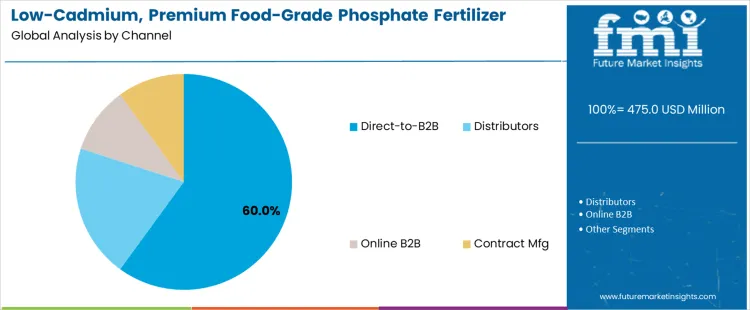
Direct-to-B2B channels account for 60.0%, representing the largest share of global demand. Food processors favor direct procurement models to maintain specification control, batch traceability, and compliance documentation aligned with food safety regulations. Distributors follow at 20.0%, supporting regional supply coverage and smaller-volume buyers lacking direct sourcing capabilities. Online B2B channels represent 10.0%, reflecting gradual adoption of digital procurement for standardized grades. Contract manufacturing accounts for 10.0%, enabling customized phosphate formulations tailored to specific food processing requirements.
Key Points
- Direct sourcing ensures compliance and quality assurance
- Distributors provide regional accessibility
- Contract manufacturing supports customized formulations
What are the Key Dynamics in the Low-Cadmium, Premium Food-Grade Phosphate Fertilizer Market?
Global demand rises as agricultural producers, food processors, and fertilizer manufacturers prioritize reduction of cadmium transfer from soil into food crops. Low-cadmium, premium food-grade phosphate fertilizers support safer nutrient inputs for fruits, vegetables, cereals, and specialty crops used in human consumption. Adoption aligns with food safety programs, export quality requirements, and heightened awareness of heavy metal accumulation risks in agricultural soils. Usage spans intensive horticulture, regulated food supply chains, and regions where long-term soil health and consumer safety influence fertilizer selection and procurement strategies.
How do food safety requirements and agricultural quality standards shape adoption?
Food producers and downstream buyers increasingly require nutrient inputs that limit heavy metal uptake in crops destined for direct consumption. Low-cadmium phosphate fertilizers support compliance with food safety thresholds set by processors, retailers, and national authorities. Growers supplying premium produce, infant food ingredients, and export markets adopt these fertilizers to meet strict quality specifications. Agronomists integrate low-cadmium inputs into nutrient management programs focused on long-term soil stewardship. Fertilizer suppliers respond by offering documented cadmium specifications and batch-level testing. Demand strengthens where traceability, certification, and compliance documentation influence crop acceptance in regulated food supply chains.
How do supply constraints, cost structure, and processing complexity influence market scalability?
Availability of phosphate rock with naturally low cadmium content remains limited, constraining production scale and increasing reliance on selective sourcing. Additional beneficiation, purification, and testing requirements raise production and logistics costs compared with standard phosphate fertilizers. Premium pricing restricts adoption among commodity crop growers operating under tight margin conditions. Segregation of raw materials and finished products increases operational complexity for manufacturers and distributors. Variability in cadmium regulations across regions complicates product standardization and global distribution planning. Long-term market growth depends on improved purification technologies, stable access to compliant raw materials, harmonized cadmium thresholds, and alignment between fertilizer pricing and value realization within food-grade agricultural systems.
How Is Demand for Low-Cadmium, Premium Food-Grade Phosphate Fertilizer Evolving Globally?
Demand for low-cadmium, premium food-grade phosphate fertilizer is increasing globally due to tighter heavy metal regulations, food safety enforcement, and rising scrutiny of agricultural input quality. India leads with a 13.6% CAGR, supported by soil health initiatives and export-oriented crop production. China follows at 12.9%, driven by regulatory tightening and phosphate processing upgrades. USA records a 12.1% CAGR, shaped by residue compliance and specialty agriculture requirements. Poland posts 11.4%, reflecting EU cadmium thresholds and transition toward higher-purity fertilizer inputs. Growth reflects a structural shift toward phosphate fertilizers engineered to minimize cadmium accumulation in soils and food chains.
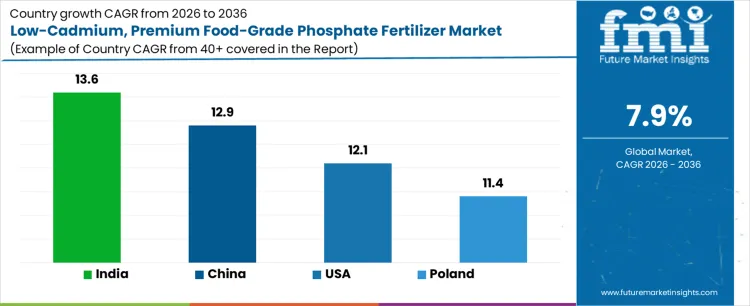
| Country | CAGR (%) |
|---|---|
| India | 13.6% |
| China | 12.9% |
| USA | 12.1% |
| Poland | 11.4% |
What is driving accelerated adoption of low-cadmium phosphate fertilizers in India?
India demand is driven by growing concern over soil contamination, food export compliance, and long-term agricultural sustainability. CAGR of 13.6% reflects increased uptake of phosphate fertilizers with reduced cadmium content across horticulture, cereals, and oilseed cultivation. Government-led soil health care programs raise awareness of heavy metal accumulation risks. Export-oriented crops require fertilizers that meet international food-grade standards. Domestic producers invest in beneficiation, acidulation control, and impurity removal technologies to supply premium grades. Farmer education programs influence fertilizer selection toward quality-focused inputs. Growth remains policy-supported and agriculture-led, aligned with food safety objectives, export competitiveness, and sustainable soil management priorities.
- Expansion of national soil health monitoring programs
- Export compliance requirements for food-grade crops
- Awareness of cadmium bioaccumulation risks
- Investment in phosphate purification and processing
How is China sustaining strong growth in low-cadmium phosphate fertilizer demand?
China demand reflects regulatory pressure on fertilizer contaminants and modernization of phosphate production infrastructure. CAGR of 12.9% is supported by phased restrictions on high-cadmium phosphate rock sources and enforcement of cleaner input standards. Large producers upgrade beneficiation and chemical processing steps to reduce heavy metal content. Food safety monitoring across domestic supply chains increases demand for premium fertilizer grades. Adoption expands across staple grains and high-value crops. Centralized policy enforcement accelerates transition toward compliant products. Growth remains scale-driven and regulation-aligned, supported by agricultural intensification and environmental risk management priorities.
- Regulatory limits on cadmium in fertilizers
- Upgrading of phosphate beneficiation facilities
- Food safety monitoring across supply chains
- Large-scale adoption in staple and specialty crops
What factors are shaping demand growth in the USA for low-cadmium phosphate fertilizers?
USA demand is shaped by food safety compliance, specialty crop production, and environmental stewardship expectations. CAGR of 12.1% reflects increased use of low-cadmium phosphate fertilizers in fruits, vegetables, nuts, and processed food supply chains. Retailers and exporters impose residue standards that influence input selection. Soil testing and nutrient management programs encourage adoption of cleaner phosphate sources. Domestic producers prioritize sourcing lower-cadmium rock and applying purification processes. Traceability and documentation requirements further support premium fertilizer uptake. Growth remains compliance-driven and quality-focused, aligned with sustainable agriculture and risk mitigation objectives.
- Specialty crop and processed food requirements
- Retailer and exporter residue compliance standards
- Emphasis on soil testing and nutrient stewardship
- Preference for traceable, premium fertilizer inputs
Why is Poland showing steady expansion in low-cadmium phosphate fertilizer usage?
Poland demand reflects alignment with EU fertilizer regulations and transition toward higher-quality agricultural inputs. CAGR of 11.4% is supported by compliance with strict cadmium thresholds under European Union standards. Farmers adopt premium phosphate fertilizers to preserve soil quality and maintain access to regulated export markets. Integration with EU food safety and environmental frameworks influences procurement decisions. Domestic and regional suppliers adjust sourcing strategies to meet purity requirements. Agricultural modernization programs reinforce adoption of compliant inputs. Growth remains regulation-driven and agriculture-focused, supported by long-term soil protection and export-oriented farming practices.
- Compliance with EU cadmium threshold regulations
- Focus on soil preservation and productivity
- Alignment with European food safety frameworks
- Adoption of premium phosphate fertilizer grades
What is the competitive landscape of demand for low-cadmium, premium food-grade phosphate fertilizer?
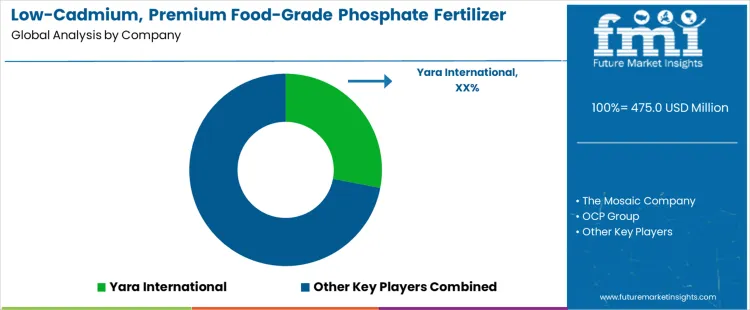
Demand for low-cadmium, premium food-grade phosphate fertilizer is driven by tighter heavy metal regulations, food safety standards, and sustainability requirements in agricultural supply chains. These fertilizers are used in high-value crops, horticulture, and regions with strict cadmium limits, requiring controlled raw material sourcing and refined processing. Buyers evaluate cadmium thresholds, phosphorus availability, solubility, granulation quality, and consistency across batches. Procurement teams prioritize suppliers with access to low-cadmium phosphate rock, advanced purification processes, and documented compliance with regional regulatory frameworks. Trend in the global market reflects increasing regulatory divergence, premium pricing for compliant products, and stronger linkage between fertilizer quality and downstream food safety assurance.
Yara International maintains leading positioning through controlled sourcing, purification technologies, and premium phosphate fertilizer portfolios aligned with low-cadmium requirements. The Mosaic Company supports global demand with food-grade and specialty phosphate fertilizers produced under stringent quality controls. OCP Group leverages scale and process optimization to supply low-cadmium phosphate products to regulated markets. PhosAgro benefits from naturally low-cadmium phosphate rock, enabling consistent compliance and competitive positioning in premium segments. ICL Group Ltd. contributes specialty phosphate fertilizers targeted at high-value crops and regulated agricultural applications. Competitive differentiation depends on raw material quality, cadmium control capability, regulatory documentation, and ability to serve premium agricultural markets reliably.
Key Players in the Low-Cadmium, Premium Food-Grade Phosphate Fertilizer Market
- Yara International
- The Mosaic Company
- OCP Group
- PhosAgro
- ICL Group Ltd.
Scope of the Report
| Items | Values |
|---|---|
| Quantitative Units | USD million |
| Application | Dairy; Beverages; Bakery; Meat |
| Form | Powder; Liquid; Encapsulated; Paste |
| Channel | Direct-to-B2B; Distributors; Online B2B; Contract Mfg |
| Regions Covered | Asia Pacific, Europe, North America, Latin America, Middle East & Africa |
| Countries Covered | India, China, USA, Poland, and 40+ countries |
| Key Companies Profiled | Yara International; The Mosaic Company; OCP Group; PhosAgro; ICL Group Ltd. |
| Additional Attributes | Dollar sales by application and form; adoption trends for low-cadmium phosphate inputs in food-grade fertilizer supply chains; cadmium threshold compliance and trace metal purity benchmarks; compatibility with food-processing and agricultural quality standards; granulation, solubility, and handling performance metrics; regulatory limits on cadmium content and food-contact safety influencing premium phosphate fertilizer selection. |
Low-Cadmium, Premium Food-Grade Phosphate Fertilizer Market by Segment
Application:
- Dairy
- Beverages
- Bakery
- Meat
Form:
- Powder
- Liquid
- Encapsulated
- Paste
Channel:
- Direct-to-B2B
- Distributors
- Online B2B
- Contract Mfg
Region:
- Asia Pacific
- China
- Japan
- South Korea
- India
- Australia & New Zealand
- ASEAN
- Rest of Asia Pacific
- Europe
- Germany
- United Kingdom
- France
- Italy
- Spain
- Nordic
- BENELUX
- Rest of Europe
- North America
- United States
- Canada
- Mexico
- Latin America
- Brazil
- Chile
- Rest of Latin America
- Middle East & Africa
- Kingdom of Saudi Arabia
- Other GCC Countries
- Turkey
- South Africa
- Other African Union
- Rest of Middle East & Africa
Frequently Asked Questions
How big is the low-cadmium, premium food-grade phosphate fertilizer market in 2026?
The global low-cadmium, premium food-grade phosphate fertilizer market is estimated to be valued at USD 440.2 million in 2026.
What will be the size of low-cadmium, premium food-grade phosphate fertilizer market in 2036?
The market size for the low-cadmium, premium food-grade phosphate fertilizer market is projected to reach USD 941.6 million by 2036.
How much will be the low-cadmium, premium food-grade phosphate fertilizer market growth between 2026 and 2036?
The low-cadmium, premium food-grade phosphate fertilizer market is expected to grow at a 7.9% CAGR between 2026 and 2036.
What are the key application types in the low-cadmium, premium food-grade phosphate fertilizer market?
The key application types in the low-cadmium, premium food-grade phosphate fertilizer market are dairy, beverages, bakery, and meat.
Which form segment will contribute significant share in the low-cadmium, premium food-grade phosphate fertilizer market in 2026?
In terms of form, powder segment to command 45.0% share in the low-cadmium, premium food-grade phosphate fertilizer market in 2026.
Preview the report firsthand - request a free sample
Get SampleGet the brochure for pricing and purchase details.
Get PDFTable of Content
- Executive Summary
- Global Market Outlook
- Demand-side Trends
- Supply-side Trends
- Technology Roadmap Analysis
- Analysis and Recommendations
- Market Overview
- Market Coverage / Taxonomy
- Market Definition / Scope / Limitations
- Market Background
- Market Dynamics
- Drivers
- Restraints
- Opportunity
- Trends
- Scenario Forecast
- Demand in Optimistic Scenario
- Demand in Likely Scenario
- Demand in Conservative Scenario
- Opportunity Map Analysis
- Product Life Cycle Analysis
- Supply Chain Analysis
- Investment Feasibility Matrix
- Value Chain Analysis
- PESTLE and Porter’s Analysis
- Regulatory Landscape
- Regional Parent Market Outlook
- Production and Consumption Statistics
- Import and Export Statistics
- Market Dynamics
- Global Market Analysis 2021 to 2025 and Forecast, 2026 to 2036
- Historical Market Size Value (USD Million) Analysis, 2021 to 2025
- Current and Future Market Size Value (USD Million) Projections, 2026 to 2036
- Y-o-Y Growth Trend Analysis
- Absolute $ Opportunity Analysis
- Global Market Pricing Analysis 2021 to 2025 and Forecast 2026 to 2036
- Global Market Analysis 2021 to 2025 and Forecast 2026 to 2036, By Application
- Introduction / Key Findings
- Historical Market Size Value (USD Million) Analysis By Application , 2021 to 2025
- Current and Future Market Size Value (USD Million) Analysis and Forecast By Application , 2026 to 2036
- Dairy
- Beverages
- Bakery
- Meat
- Dairy
- Y-o-Y Growth Trend Analysis By Application , 2021 to 2025
- Absolute $ Opportunity Analysis By Application , 2026 to 2036
- Global Market Analysis 2021 to 2025 and Forecast 2026 to 2036, By Form
- Introduction / Key Findings
- Historical Market Size Value (USD Million) Analysis By Form, 2021 to 2025
- Current and Future Market Size Value (USD Million) Analysis and Forecast By Form, 2026 to 2036
- Powder
- Liquid
- Encapsulated
- Paste
- Powder
- Y-o-Y Growth Trend Analysis By Form, 2021 to 2025
- Absolute $ Opportunity Analysis By Form, 2026 to 2036
- Global Market Analysis 2021 to 2025 and Forecast 2026 to 2036, By Channel
- Introduction / Key Findings
- Historical Market Size Value (USD Million) Analysis By Channel, 2021 to 2025
- Current and Future Market Size Value (USD Million) Analysis and Forecast By Channel, 2026 to 2036
- Direct-to-B2B
- Distributors
- Online B2B
- Contract Mfg
- Direct-to-B2B
- Y-o-Y Growth Trend Analysis By Channel, 2021 to 2025
- Absolute $ Opportunity Analysis By Channel, 2026 to 2036
- Global Market Analysis 2021 to 2025 and Forecast 2026 to 2036, By Region
- Introduction
- Historical Market Size Value (USD Million) Analysis By Region, 2021 to 2025
- Current Market Size Value (USD Million) Analysis and Forecast By Region, 2026 to 2036
- North America
- Latin America
- Western Europe
- Eastern Europe
- East Asia
- South Asia and Pacific
- Middle East & Africa
- Market Attractiveness Analysis By Region
- North America Market Analysis 2021 to 2025 and Forecast 2026 to 2036, By Country
- Historical Market Size Value (USD Million) Trend Analysis By Market Taxonomy, 2021 to 2025
- Market Size Value (USD Million) Forecast By Market Taxonomy, 2026 to 2036
- By Country
- USA
- Canada
- Mexico
- By Application
- By Form
- By Channel
- By Country
- Market Attractiveness Analysis
- By Country
- By Application
- By Form
- By Channel
- Key Takeaways
- Latin America Market Analysis 2021 to 2025 and Forecast 2026 to 2036, By Country
- Historical Market Size Value (USD Million) Trend Analysis By Market Taxonomy, 2021 to 2025
- Market Size Value (USD Million) Forecast By Market Taxonomy, 2026 to 2036
- By Country
- Brazil
- Chile
- Rest of Latin America
- By Application
- By Form
- By Channel
- By Country
- Market Attractiveness Analysis
- By Country
- By Application
- By Form
- By Channel
- Key Takeaways
- Western Europe Market Analysis 2021 to 2025 and Forecast 2026 to 2036, By Country
- Historical Market Size Value (USD Million) Trend Analysis By Market Taxonomy, 2021 to 2025
- Market Size Value (USD Million) Forecast By Market Taxonomy, 2026 to 2036
- By Country
- Germany
- UK
- Italy
- Spain
- France
- Nordic
- BENELUX
- Rest of Western Europe
- By Application
- By Form
- By Channel
- By Country
- Market Attractiveness Analysis
- By Country
- By Application
- By Form
- By Channel
- Key Takeaways
- Eastern Europe Market Analysis 2021 to 2025 and Forecast 2026 to 2036, By Country
- Historical Market Size Value (USD Million) Trend Analysis By Market Taxonomy, 2021 to 2025
- Market Size Value (USD Million) Forecast By Market Taxonomy, 2026 to 2036
- By Country
- Russia
- Poland
- Hungary
- Balkan & Baltic
- Rest of Eastern Europe
- By Application
- By Form
- By Channel
- By Country
- Market Attractiveness Analysis
- By Country
- By Application
- By Form
- By Channel
- Key Takeaways
- East Asia Market Analysis 2021 to 2025 and Forecast 2026 to 2036, By Country
- Historical Market Size Value (USD Million) Trend Analysis By Market Taxonomy, 2021 to 2025
- Market Size Value (USD Million) Forecast By Market Taxonomy, 2026 to 2036
- By Country
- China
- Japan
- South Korea
- By Application
- By Form
- By Channel
- By Country
- Market Attractiveness Analysis
- By Country
- By Application
- By Form
- By Channel
- Key Takeaways
- South Asia and Pacific Market Analysis 2021 to 2025 and Forecast 2026 to 2036, By Country
- Historical Market Size Value (USD Million) Trend Analysis By Market Taxonomy, 2021 to 2025
- Market Size Value (USD Million) Forecast By Market Taxonomy, 2026 to 2036
- By Country
- India
- ASEAN
- Australia & New Zealand
- Rest of South Asia and Pacific
- By Application
- By Form
- By Channel
- By Country
- Market Attractiveness Analysis
- By Country
- By Application
- By Form
- By Channel
- Key Takeaways
- Middle East & Africa Market Analysis 2021 to 2025 and Forecast 2026 to 2036, By Country
- Historical Market Size Value (USD Million) Trend Analysis By Market Taxonomy, 2021 to 2025
- Market Size Value (USD Million) Forecast By Market Taxonomy, 2026 to 2036
- By Country
- Kingdom of Saudi Arabia
- Other GCC Countries
- Turkiye
- South Africa
- Other African Union
- Rest of Middle East & Africa
- By Application
- By Form
- By Channel
- By Country
- Market Attractiveness Analysis
- By Country
- By Application
- By Form
- By Channel
- Key Takeaways
- Key Countries Market Analysis
- USA
- Pricing Analysis
- Market Share Analysis, 2025
- By Application
- By Form
- By Channel
- Canada
- Pricing Analysis
- Market Share Analysis, 2025
- By Application
- By Form
- By Channel
- Mexico
- Pricing Analysis
- Market Share Analysis, 2025
- By Application
- By Form
- By Channel
- Brazil
- Pricing Analysis
- Market Share Analysis, 2025
- By Application
- By Form
- By Channel
- Chile
- Pricing Analysis
- Market Share Analysis, 2025
- By Application
- By Form
- By Channel
- Germany
- Pricing Analysis
- Market Share Analysis, 2025
- By Application
- By Form
- By Channel
- UK
- Pricing Analysis
- Market Share Analysis, 2025
- By Application
- By Form
- By Channel
- Italy
- Pricing Analysis
- Market Share Analysis, 2025
- By Application
- By Form
- By Channel
- Spain
- Pricing Analysis
- Market Share Analysis, 2025
- By Application
- By Form
- By Channel
- France
- Pricing Analysis
- Market Share Analysis, 2025
- By Application
- By Form
- By Channel
- India
- Pricing Analysis
- Market Share Analysis, 2025
- By Application
- By Form
- By Channel
- ASEAN
- Pricing Analysis
- Market Share Analysis, 2025
- By Application
- By Form
- By Channel
- Australia & New Zealand
- Pricing Analysis
- Market Share Analysis, 2025
- By Application
- By Form
- By Channel
- China
- Pricing Analysis
- Market Share Analysis, 2025
- By Application
- By Form
- By Channel
- Japan
- Pricing Analysis
- Market Share Analysis, 2025
- By Application
- By Form
- By Channel
- South Korea
- Pricing Analysis
- Market Share Analysis, 2025
- By Application
- By Form
- By Channel
- Russia
- Pricing Analysis
- Market Share Analysis, 2025
- By Application
- By Form
- By Channel
- Poland
- Pricing Analysis
- Market Share Analysis, 2025
- By Application
- By Form
- By Channel
- Hungary
- Pricing Analysis
- Market Share Analysis, 2025
- By Application
- By Form
- By Channel
- Kingdom of Saudi Arabia
- Pricing Analysis
- Market Share Analysis, 2025
- By Application
- By Form
- By Channel
- Turkiye
- Pricing Analysis
- Market Share Analysis, 2025
- By Application
- By Form
- By Channel
- South Africa
- Pricing Analysis
- Market Share Analysis, 2025
- By Application
- By Form
- By Channel
- USA
- Market Structure Analysis
- Competition Dashboard
- Competition Benchmarking
- Market Share Analysis of Top Players
- By Regional
- By Application
- By Form
- By Channel
- Competition Analysis
- Competition Deep Dive
- Yara International
- Overview
- Product Portfolio
- Profitability by Market Segments (Product/Age /Sales Channel/Region)
- Sales Footprint
- Strategy Overview
- Marketing Strategy
- Product Strategy
- Channel Strategy
- The Mosaic Company
- OCP Group
- PhosAgro
- ICL Group Ltd.
- Yara International
- Competition Deep Dive
- Assumptions & Acronyms Used
- Research Methodology


