

- Industry Size (2026)
- USD 341.6 Mn
- Forecast (2036)
- USD 794 Mn
- CAGR (2026 to 2036)
- 8.8%
Manure-Derived Pelletized Premium Fertilizer Market Forecast and Outlook 2026 to 2036
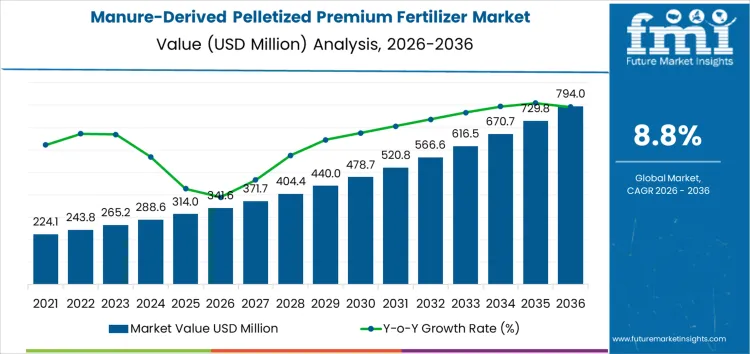
The manure-derived pelletized premium fertilizer market is projected to grow from USD 341.6 million in 2026 to USD 794 million by 2036, reflecting a compound annual growth rate (CAGR) of 8.8%. Capital intensity will be a significant factor driving market expansion, as investments in specialized production facilities and equipment will be necessary to scale operations. The high initial capital required for pelletizing and ensuring product quality may limit entry for smaller players but also positions the market for consolidation.
Return timelines will also influence decision-making, with many investors seeking longer-term gains due to the nature of agricultural product cycles. Investment selectivity will intensify, with investors prioritizing companies with strong sustainability credentials, efficient production methods, and established market access. As demand for premium fertilizers increases, those that demonstrate cost-effective scaling and differentiation in terms of quality will capture the most value. Successful companies will balance innovation, regulatory compliance, and operational efficiency to remain competitive.
Quick Stats of the Manure-Derived Pelletized Premium Fertilizer Market
- Manure-Derived Pelletized Premium Fertilizer Market Value (2026): USD 341.6 million
- Manure-Derived Pelletized Premium Fertilizer Market Forecast Value (2036): USD 794 million
- Manure-Derived Pelletized Premium Fertilizer Market Global Forecast CAGR (2026-2036): 8.8%
- Manure-Derived Pelletized Premium Fertilizer Market Leading Segment: Sales Channel (Ag-Retailers) 60%
- Key Growth Regions in Manure-Derived Pelletized Premium Fertilizer Market: India
- Top Players in Manure-Derived Pelletized Premium Fertilizer Market: Nutrien, Yara International, EuroChem, ICL Group, UPL, BASF
What is the Growth Forecast for the Manure-Derived Pelletized Premium Fertilizer Market through 2036?
The market growth curve shape analysis for the manure-derived pelletized premium fertilizer market indicates an initial acceleration followed by steady, mature growth as the market expands. From 2026 to 2031, the market will experience significant acceleration, growing from USD 341.6 million to USD 520.8 million. This early phase reflects a strong surge in adoption, driven by the increasing demand for organic farming solutions and the rising awareness of environmental concerns related to synthetic fertilizers. The curve during this period will steepen as more agricultural producers and consumers shift towards sustainable farming practices and organic alternatives. Innovations in pelletizing technologies, which enhance the ease of application and effectiveness of manure-derived fertilizers, will also contribute to this acceleration.
As the market matures from 2031 to 2036, the growth rate will stabilize. From USD 520.8 million in 2031, the market will grow to USD 794 million by 2036, reflecting a more gradual increase in value. During this period, the growth curve will flatten, indicating that the market has reached a stage of wider adoption and is moving towards saturation. While the demand for sustainable and organic fertilizers will continue to rise, growth will be driven by incremental innovation and the continued shift toward eco-friendly farming practices, rather than by rapid adoption. The steady rise in market value during this phase reflects the maturing of the market, where manure-derived fertilizers become a standard choice in agricultural practices.
Manure-Derived Pelletized Premium Fertilizer Market Key Takeaways
| Metric | Value |
|---|---|
| Industry Sales Value (2026) | USD 341.6 million |
| Industry Forecast Value (2036) | USD 794 million |
| Industry Forecast CAGR (2026-2036) | 8.8% |
What Is Driving the Demand for Manure Derived Pelletized Premium Fertilizer?
Historical demand for manure derived pelletized premium fertilizer has been shaped by growing interest in organic and sustainable agricultural inputs that replace or reduce reliance on synthetic fertilizers. Organic fertilizers convert livestock manure and other organic waste into nutrient rich inputs that supply nitrogen, phosphorus, and potassium to soils and crops while contributing to soil structure and biology. The broader organic fertilizer market has expanded substantially, with values rising from around USD 9.8 billion in 2023 and expected to reach nearly USD 19.6 billion by 2032 at an approximate CAGR of 8 %, reflecting increasing adoption of sustainable nutrient sources globally.
Pelletizing manure improves nutrient handling and uniformity compared with raw slurries, addressing traditional drawbacks such as variable nutrient content, odor issues, and challenges in transport and storage. Pelletized forms also support more precise application rates across horticulture, field crops, and organic systems. Techniques for converting raw manure into dense, uniform pellets assist farmers and producers in aligning nutrient delivery with soil needs, enhancing consistency over unprocessed manure. Pelletized manure fertilizer historically benefited organic growers and soil health advocates seeking alternatives with improved user convenience and application control.
Future demand for manure derived pelletized premium fertilizer is expected to be shaped by continued expansion of organic farming and sustainable agriculture practices, which prioritize efficient use of organic resources and improved soil nutrient management. Growth factors include increasing farmland under organic certification, rising consumer demand for produce grown with natural inputs, and supportive government incentives that encourage reduced chemical fertilizer use.
Enhanced production processes that produce pathogen free, balanced nutrient pellets help expand adoption across commercial agriculture and specialty markets where precision nutrient management is required. Emphasis on precision agriculture and traceability in nutrient sourcing supports use of pelletized formats that provide uniform nutrient distribution and easier application with modern equipment. Technical drivers include improvements in pellet durability, consistency of nutrient content, and integration with soil biology enhancers, while challenges remain in balancing production costs with crop value and scaling processing infrastructure. Continued refinement of pellet chemistry and formulation standards may influence longer term uptake in both conventional and organic farming systems.
What are the Leading Segments in the Global Manure-Derived Pelletized Premium Fertilizer Market?
The global manure-derived pelletized premium fertilizer market is segmented by technology and sales channel. Among technologies, anaerobic digestion leads the market, capturing 45% of the share, followed by pyrolysis, chemical precipitation, and composting. Anaerobic digestion is preferred due to its efficiency in breaking down organic waste and converting it into valuable, nutrient-rich fertilizers. On the sales channel side, ag-retailers dominate the market, holding 60% of the share, followed by direct-to-farmer, online marketplaces, and cooperatives. Ag-retailers lead the market due to their established distribution networks and ability to reach a wide range of agricultural customers.
What Drives the Growth of Anaerobic Digestion in the Manure-Derived Pelletized Premium Fertilizer Market?
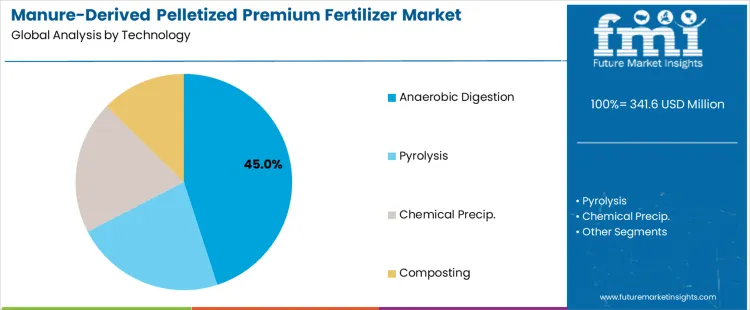
Anaerobic digestion is the leading technology in the manure-derived pelletized premium fertilizer market, holding 45% of the share. This growth is driven by the efficiency of anaerobic digestion in converting organic matter, such as manure, into high-quality, nutrient-dense fertilizers. This process not only produces a valuable fertilizer but also helps reduce greenhouse gas emissions and odors associated with manure management. As sustainability becomes a priority in agriculture, anaerobic digestion is increasingly adopted as an environmentally friendly technology. Furthermore, the ability of anaerobic digestion to generate energy in the form of biogas while simultaneously producing premium fertilizer makes it a cost-effective and resource-efficient solution, fueling its dominance in the market.
What is Driving the Demand for Ag-Retailers in the Manure-Derived Pelletized Premium Fertilizer Market?
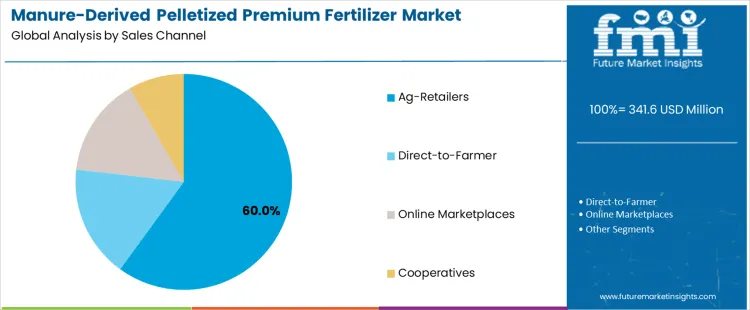
Ag-retailers are the leading sales channel in the manure-derived pelletized premium fertilizer market, capturing 60% of the share. This demand is driven by ag-retailers' established relationships with farmers and their ability to offer a wide range of products, including manure-derived fertilizers. Ag-retailers provide farmers with convenient access to premium fertilizers, often with the added benefit of expert advice, customized solutions, and large-scale distribution capabilities. The extensive network of ag-retailers ensures that manure-derived pelletized fertilizers can reach a broad customer base, from small farms to large agricultural operations. As the demand for sustainable and efficient fertilizers grows, ag-retailers will continue to play a crucial role in delivering these products to the agricultural market.
What are the Defining Dynamics in the Manure Derived Pelletized Premium Fertilizer Market?
The manure derived pelletized premium fertilizer market is shaped by demand for nutrient rich soil amendments that support crop productivity and soil structure. These products convert livestock and organic waste into uniform pellets with balanced nitrogen, phosphorus, and potassium content. Growers consider pellet quality, nutrient release patterns, and handling convenience. Regulations on waste management and fertilizer labeling influence product formulation and marketing. Supply chain factors, such as feedstock availability and pellet production capacity, affect market participation. End users evaluate cost, performance, and compatibility with their crop management systems when choosing premium manure based fertilizers.
What are the Key Drivers Supporting Growth in This Market?
Agricultural users are seeking efficient nutrient sources that reduce dependence on synthetic fertilizers, which is a driver of growth for manure derived pelletized premium fertilizers. Scientific research indicating benefits of organic matter and soil microbial activity encourages adoption of products that supply macro and micronutrients while improving soil health. Policies that govern organic waste recycling and nutrient management are increasing interest in value added manure products. Advances in pelletization technology enhance nutrient retention and product uniformity. Expansion of commercial livestock operations contributes to steady feedstock supply, supporting production of pelletized fertilizers for crop systems with diverse nutrient demands.
What Restraints Are Limiting Market Expansion?
Cost considerations can limit adoption of manure derived pelletized premium fertilizers in budget sensitive farming sectors. Pellet production and processing infrastructure requires investment in drying, grinding, and pelletizing equipment, which may not be accessible to all producers. Variability in manure composition influences nutrient consistency, posing challenges for standardization and quality control. Perceptions among some users about odor or slower nutrient release compared with synthetic alternatives can affect acceptance. Regulatory requirements for organic certification and waste handling differ by region, adding complexity for suppliers targeting multiple markets.
What Emerging Trends Are Influencing the Market’s Future Development?
Improved pelletization and granulation technologies are enhancing product uniformity and nutrient stability, making manure derived fertilizers more competitive with conventional options. There is increased focus on formulations that match specific crop nutrient uptake patterns, supporting precision nutrient management. Integration of soil testing and data driven application planning is encouraging targeted use of premium organic fertilizers. Collaboration between fertilizer producers, agronomists, and extension services is expanding to support best practices. Growing interest in regenerative agriculture and soil carbon enhancement is reinforcing the role of organic pelletized fertilizers in long term soil health strategies.
What is the Country-Wise Analysis of the Manure-Derived Pelletized Premium Fertilizer Market?
The manure-derived pelletized premium fertilizer market is witnessing significant growth, driven by increasing consumer demand for sustainable and organic fertilizers that promote soil health and enhance crop yields. These fertilizers, made from manure and processed into pelletized forms, offer a natural and environmentally friendly alternative to synthetic chemical fertilizers. Developed markets such as the USA are seeing steady growth, driven by the growing emphasis on sustainable farming practices and organic agriculture.
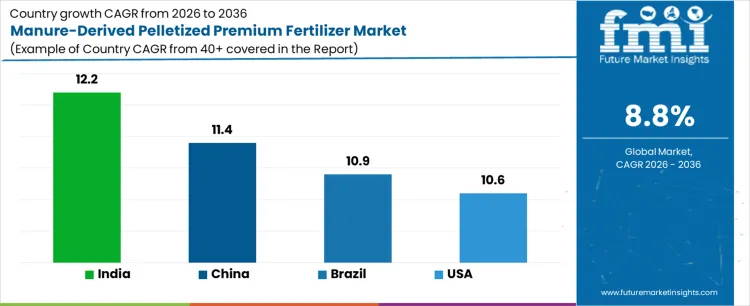
Emerging markets like China, Brazil, and India are experiencing even faster growth due to the rising adoption of environmentally friendly farming practices and the need for effective, cost-efficient fertilizers to support growing agricultural demands. As the global focus on sustainable agriculture and organic farming continues to rise, the market for manure-derived pelletized premium fertilizers is expected to expand significantly in both developed and developing regions.
| Country | CAGR (2026-2036) |
|---|---|
| USA | 10.6% |
| China | 11.4% |
| Brazil | 10.9% |
| India | 12.2% |
What is the Growth Outlook for the Manure-Derived Pelletized Premium Fertilizer Market in the USA?
The manure-derived pelletized premium fertilizer market in the USA is expected to grow steadily, with a projected CAGR of 10.6% from 2026 to 2036. As the USA agricultural industry continues to focus on sustainable farming practices, the demand for natural fertilizers is on the rise. Consumers are increasingly turning to organic and manure-derived fertilizers, which provide essential nutrients to crops without the negative environmental impact of chemical fertilizers. USA farmers are seeking efficient, cost-effective, and eco-friendly solutions to improve soil health and increase crop yields, and manure-derived pelletized fertilizers are gaining popularity for their organic benefits. The growing adoption of sustainable farming practices, supported by government incentives and the organic farming movement, is expected to drive the continued growth of the manure-derived pelletized premium fertilizer market in the USA.
What is the Market Outlook for the Manure-Derived Pelletized Premium Fertilizer Market in China?
China is projected to experience strong growth in the manure-derived pelletized premium fertilizer market, with a projected CAGR of 11.4% from 2026 to 2036. As the world’s largest producer and consumer of fertilizers, China is increasingly shifting toward sustainable farming practices to address environmental concerns associated with synthetic fertilizers. Manure-derived pelletized fertilizers, which provide organic nutrients to crops, are gaining traction in China as part of the country’s broader efforts to improve soil quality and promote more sustainable agriculture. With growing demand for eco-friendly and cost-effective solutions, the manure-derived fertilizer market is expected to expand significantly. The Chinese government’s focus on sustainable farming, along with the rising interest in organic farming practices, will drive demand for manure-derived pelletized fertilizers in the coming years.
What is the Growth Forecast for the Manure-Derived Pelletized Premium Fertilizer Market in Brazil?
Brazil is expected to see steady growth in the manure-derived pelletized premium fertilizer market, with a projected CAGR of 10.9% from 2026 to 2036. Brazil, one of the largest agricultural producers in the world, is increasingly adopting sustainable farming practices to meet the growing demand for food while protecting the environment. Manure-derived pelletized fertilizers are gaining popularity as Brazilian farmers seek natural alternatives to synthetic fertilizers that are both effective and environmentally friendly. With Brazil’s large-scale agricultural operations, the demand for fertilizers that improve soil health and enhance crop yields is expected to rise. The shift towards organic and eco-friendly farming practices in Brazil will further drive the growth of the manure-derived pelletized premium fertilizer market.
What is the Market Outlook for the Manure-Derived Pelletized Premium Fertilizer Market in India?
India is projected to experience the highest growth in the manure-derived pelletized premium fertilizer market, with a projected CAGR of 12.2% from 2026 to 2036. India’s agricultural sector is undergoing a transformation, with a growing focus on sustainable practices and organic farming to increase crop yields and protect the environment. Manure-derived pelletized fertilizers are gaining popularity in India as farmers seek alternatives to chemical fertilizers that can improve soil quality and support long-term agricultural productivity. With the need to feed a rapidly growing population and the increasing awareness of the environmental impact of synthetic fertilizers, the demand for manure-derived fertilizers is expected to rise significantly. The Indian government’s push for organic farming, along with rising consumer demand for organic food, will further drive market growth, positioning India as a key growth market for manure-derived pelletized fertilizers.
What are the Growth Prospects for the Manure-Derived Pelletized Premium Fertilizer Market Globally?
Globally, the manure-derived pelletized premium fertilizer market is poised for strong expansion due to increasing consumer demand for organic and sustainable farming solutions. As more farmers seek natural alternatives to synthetic fertilizers, manure-derived products offer a viable solution that enhances soil health and reduces environmental impact. With growing emphasis on sustainable agriculture, improved farming productivity, and the need for eco-friendly alternatives, the market for manure-derived fertilizers will continue to expand across both developed and emerging markets. The global trend toward organic farming, supported by government incentives and consumer demand for healthier, environmentally conscious farming practices, will be a key driver of growth in this sector.
What is the Competitive Landscape for the Manure-Derived Pelletized Premium Fertilizer Market?
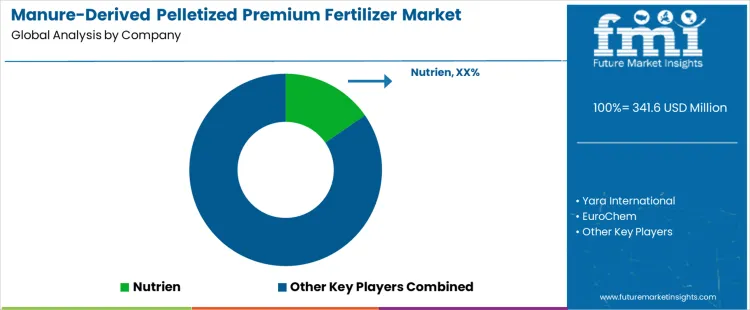
The manure-derived pelletized premium fertilizer market is expanding as the agricultural industry increasingly seeks sustainable, efficient, and eco-friendly alternatives to traditional chemical fertilizers. Nutrien leads the market with its high-quality manure-derived pelletized fertilizers, offering solutions that provide essential nutrients while promoting soil health and reducing environmental impact. Their commitment to product innovation, sustainability, and regulatory compliance has positioned them as a dominant player in the market. Yara International, EuroChem, and ICL Group are key competitors, each offering specialized manure-based fertilizers designed to meet the growing demand for organic, high-performance agricultural solutions. Yara International focuses on providing high-quality, nutrient-rich products that enhance crop growth and soil fertility, while EuroChem and ICL Group offer sustainable alternatives that integrate organic material with advanced nutrient delivery systems.
UPL and BASF further contribute to the competitive landscape by offering their own manure-derived pelletized fertilizers, focusing on improving nutrient utilization efficiency and promoting sustainable farming practices. UPL specializes in innovative agricultural solutions, while BASF emphasizes sustainable crop nutrition products that help reduce environmental impact. These companies compete by focusing on product performance, sustainability, and the growing consumer demand for organic and eco-friendly fertilizers. As the push for sustainable agriculture continues to grow, the market for manure-derived pelletized premium fertilizers is expected to expand, driving further innovation and competition in the sector.
Key Players of the Manure-Derived Pelletized Premium Fertilizer Market
- Nutrien
- Yara International
- EuroChem
- ICL Group
- UPL
- BASF
Scope of the Report
| Items | Values |
|---|---|
| Quantitative Units (2026) | USD Million |
| Source | Animal Manure, Food Waste, Wastewater Sludge, Crop Residue |
| Technology | Anaerobic Digestion, Pyrolysis, Chemical Precipitation, Composting |
| Sales Channel | Ag Retailers, Direct to Farmer, Online Marketplaces, Cooperatives |
| Companies | Nutrien, Yara International, EuroChem, ICL Group, UPL, BASF |
| Regions Covered | North America, Latin America, Western Europe, Eastern Europe, South Asia & Pacific, East Asia, Middle East & Africa |
| Countries Covered | United States, Canada, Mexico, Brazil, Argentina, Germany, France, United Kingdom, Italy, Spain, Netherlands, China, India, Japan, South Korea, ANZ, GCC Countries, South Africa |
| Additional Attributes | Dollar by sales by source, technology, sales channel, and region. Includes analysis of market trends in manure derived pelletized premium fertilizer adoption, performance of pelletized fertilizers across agronomic applications, cost and production technology drivers, regulatory and environmental factors affecting use of manure based fertilizers, adoption patterns among farming systems, market share and competitive positioning of key companies, innovations in pelletization and nutrient stabilization technologies, and evaluation of impact on nutrient use efficiency, crop performance, soil health, and farmer acceptance. |
Manure-Derived Pelletized Premium Fertilizer Market Segmentation
Source
- Animal Manure
- Food Waste
- Wastewater Sludge
- Crop Residue
Technology
- Anaerobic Digestion
- Pyrolysis
- Chemical Precipitation
- Composting
Sales Channel
- Ag-Retailers
- Direct-to-Farmer
- Online Marketplaces
- Cooperatives
Region
- Asia Pacific
- China
- Japan
- South Korea
- India
- Australia & New Zealand
- ASEAN
- Rest of Asia Pacific
- Europe
- Germany
- United Kingdom
- France
- Italy
- Spain
- Nordic
- BENELUX
- Rest of Europe
- North America
- United States
- Canada
- Mexico
- Latin America
- Brazil
- Chile
- Rest of Latin America
- Middle East & Africa
- Kingdom of Saudi Arabia
- Other GCC Countries
- Turkey
- South Africa
- Other African Union
- Rest of Middle East & Africa
Frequently Asked Questions
How big is the manure-derived pelletized premium fertilizer market in 2026?
The global manure-derived pelletized premium fertilizer market is estimated to be valued at USD 341.6 million in 2026.
What will be the size of manure-derived pelletized premium fertilizer market in 2036?
The market size for the manure-derived pelletized premium fertilizer market is projected to reach USD 794.0 million by 2036.
How much will be the manure-derived pelletized premium fertilizer market growth between 2026 and 2036?
The manure-derived pelletized premium fertilizer market is expected to grow at a 8.8% CAGR between 2026 and 2036.
What are the key source types in the manure-derived pelletized premium fertilizer market?
The key source types in the manure-derived pelletized premium fertilizer market are animal manure, food waste, wastewater sludge, and crop residue.
Which technology segment will contribute significant share in the manure-derived pelletized premium fertilizer market in 2026?
In terms of technology, anaerobic digestion segment to command 45.0% share in the manure-derived pelletized premium fertilizer market in 2026.
Preview the report firsthand - request a free sample
Get SampleGet the brochure for pricing and purchase details.
Get PDFTable of Content
- Executive Summary
- Global Market Outlook
- Demand-side Trends
- Supply-side Trends
- Technology Roadmap Analysis
- Analysis and Recommendations
- Market Overview
- Market Coverage / Taxonomy
- Market Definition / Scope / Limitations
- Market Background
- Market Dynamics
- Drivers
- Restraints
- Opportunity
- Trends
- Scenario Forecast
- Demand in Optimistic Scenario
- Demand in Likely Scenario
- Demand in Conservative Scenario
- Opportunity Map Analysis
- Product Life Cycle Analysis
- Supply Chain Analysis
- Investment Feasibility Matrix
- Value Chain Analysis
- PESTLE and Porter’s Analysis
- Regulatory Landscape
- Regional Parent Market Outlook
- Production and Consumption Statistics
- Import and Export Statistics
- Market Dynamics
- Global Market Analysis 2021 to 2025 and Forecast, 2026 to 2036
- Historical Market Size Value (USD Million) Analysis, 2021 to 2025
- Current and Future Market Size Value (USD Million) Projections, 2026 to 2036
- Y-o-Y Growth Trend Analysis
- Absolute $ Opportunity Analysis
- Global Market Pricing Analysis 2021 to 2025 and Forecast 2026 to 2036
- Global Market Analysis 2021 to 2025 and Forecast 2026 to 2036, By Source
- Introduction / Key Findings
- Historical Market Size Value (USD Million) Analysis By Source , 2021 to 2025
- Current and Future Market Size Value (USD Million) Analysis and Forecast By Source , 2026 to 2036
- Animal Manure
- Food Waste
- Wastewater Sludge
- Crop Residue
- Animal Manure
- Y-o-Y Growth Trend Analysis By Source , 2021 to 2025
- Absolute $ Opportunity Analysis By Source , 2026 to 2036
- Global Market Analysis 2021 to 2025 and Forecast 2026 to 2036, By Technology
- Introduction / Key Findings
- Historical Market Size Value (USD Million) Analysis By Technology, 2021 to 2025
- Current and Future Market Size Value (USD Million) Analysis and Forecast By Technology, 2026 to 2036
- Anaerobic Digestion
- Pyrolysis
- Chemical Precip.
- Composting
- Anaerobic Digestion
- Y-o-Y Growth Trend Analysis By Technology, 2021 to 2025
- Absolute $ Opportunity Analysis By Technology, 2026 to 2036
- Global Market Analysis 2021 to 2025 and Forecast 2026 to 2036, By Sales Channel
- Introduction / Key Findings
- Historical Market Size Value (USD Million) Analysis By Sales Channel, 2021 to 2025
- Current and Future Market Size Value (USD Million) Analysis and Forecast By Sales Channel, 2026 to 2036
- Ag-Retailers
- Direct-to-Farmer
- Online Marketplaces
- Cooperatives
- Ag-Retailers
- Y-o-Y Growth Trend Analysis By Sales Channel, 2021 to 2025
- Absolute $ Opportunity Analysis By Sales Channel, 2026 to 2036
- Global Market Analysis 2021 to 2025 and Forecast 2026 to 2036, By Region
- Introduction
- Historical Market Size Value (USD Million) Analysis By Region, 2021 to 2025
- Current Market Size Value (USD Million) Analysis and Forecast By Region, 2026 to 2036
- North America
- Latin America
- Western Europe
- Eastern Europe
- East Asia
- South Asia and Pacific
- Middle East & Africa
- Market Attractiveness Analysis By Region
- North America Market Analysis 2021 to 2025 and Forecast 2026 to 2036, By Country
- Historical Market Size Value (USD Million) Trend Analysis By Market Taxonomy, 2021 to 2025
- Market Size Value (USD Million) Forecast By Market Taxonomy, 2026 to 2036
- By Country
- USA
- Canada
- Mexico
- By Source
- By Technology
- By Sales Channel
- By Country
- Market Attractiveness Analysis
- By Country
- By Source
- By Technology
- By Sales Channel
- Key Takeaways
- Latin America Market Analysis 2021 to 2025 and Forecast 2026 to 2036, By Country
- Historical Market Size Value (USD Million) Trend Analysis By Market Taxonomy, 2021 to 2025
- Market Size Value (USD Million) Forecast By Market Taxonomy, 2026 to 2036
- By Country
- Brazil
- Chile
- Rest of Latin America
- By Source
- By Technology
- By Sales Channel
- By Country
- Market Attractiveness Analysis
- By Country
- By Source
- By Technology
- By Sales Channel
- Key Takeaways
- Western Europe Market Analysis 2021 to 2025 and Forecast 2026 to 2036, By Country
- Historical Market Size Value (USD Million) Trend Analysis By Market Taxonomy, 2021 to 2025
- Market Size Value (USD Million) Forecast By Market Taxonomy, 2026 to 2036
- By Country
- Germany
- UK
- Italy
- Spain
- France
- Nordic
- BENELUX
- Rest of Western Europe
- By Source
- By Technology
- By Sales Channel
- By Country
- Market Attractiveness Analysis
- By Country
- By Source
- By Technology
- By Sales Channel
- Key Takeaways
- Eastern Europe Market Analysis 2021 to 2025 and Forecast 2026 to 2036, By Country
- Historical Market Size Value (USD Million) Trend Analysis By Market Taxonomy, 2021 to 2025
- Market Size Value (USD Million) Forecast By Market Taxonomy, 2026 to 2036
- By Country
- Russia
- Poland
- Hungary
- Balkan & Baltic
- Rest of Eastern Europe
- By Source
- By Technology
- By Sales Channel
- By Country
- Market Attractiveness Analysis
- By Country
- By Source
- By Technology
- By Sales Channel
- Key Takeaways
- East Asia Market Analysis 2021 to 2025 and Forecast 2026 to 2036, By Country
- Historical Market Size Value (USD Million) Trend Analysis By Market Taxonomy, 2021 to 2025
- Market Size Value (USD Million) Forecast By Market Taxonomy, 2026 to 2036
- By Country
- China
- Japan
- South Korea
- By Source
- By Technology
- By Sales Channel
- By Country
- Market Attractiveness Analysis
- By Country
- By Source
- By Technology
- By Sales Channel
- Key Takeaways
- South Asia and Pacific Market Analysis 2021 to 2025 and Forecast 2026 to 2036, By Country
- Historical Market Size Value (USD Million) Trend Analysis By Market Taxonomy, 2021 to 2025
- Market Size Value (USD Million) Forecast By Market Taxonomy, 2026 to 2036
- By Country
- India
- ASEAN
- Australia & New Zealand
- Rest of South Asia and Pacific
- By Source
- By Technology
- By Sales Channel
- By Country
- Market Attractiveness Analysis
- By Country
- By Source
- By Technology
- By Sales Channel
- Key Takeaways
- Middle East & Africa Market Analysis 2021 to 2025 and Forecast 2026 to 2036, By Country
- Historical Market Size Value (USD Million) Trend Analysis By Market Taxonomy, 2021 to 2025
- Market Size Value (USD Million) Forecast By Market Taxonomy, 2026 to 2036
- By Country
- Kingdom of Saudi Arabia
- Other GCC Countries
- Turkiye
- South Africa
- Other African Union
- Rest of Middle East & Africa
- By Source
- By Technology
- By Sales Channel
- By Country
- Market Attractiveness Analysis
- By Country
- By Source
- By Technology
- By Sales Channel
- Key Takeaways
- Key Countries Market Analysis
- USA
- Pricing Analysis
- Market Share Analysis, 2025
- By Source
- By Technology
- By Sales Channel
- Canada
- Pricing Analysis
- Market Share Analysis, 2025
- By Source
- By Technology
- By Sales Channel
- Mexico
- Pricing Analysis
- Market Share Analysis, 2025
- By Source
- By Technology
- By Sales Channel
- Brazil
- Pricing Analysis
- Market Share Analysis, 2025
- By Source
- By Technology
- By Sales Channel
- Chile
- Pricing Analysis
- Market Share Analysis, 2025
- By Source
- By Technology
- By Sales Channel
- Germany
- Pricing Analysis
- Market Share Analysis, 2025
- By Source
- By Technology
- By Sales Channel
- UK
- Pricing Analysis
- Market Share Analysis, 2025
- By Source
- By Technology
- By Sales Channel
- Italy
- Pricing Analysis
- Market Share Analysis, 2025
- By Source
- By Technology
- By Sales Channel
- Spain
- Pricing Analysis
- Market Share Analysis, 2025
- By Source
- By Technology
- By Sales Channel
- France
- Pricing Analysis
- Market Share Analysis, 2025
- By Source
- By Technology
- By Sales Channel
- India
- Pricing Analysis
- Market Share Analysis, 2025
- By Source
- By Technology
- By Sales Channel
- ASEAN
- Pricing Analysis
- Market Share Analysis, 2025
- By Source
- By Technology
- By Sales Channel
- Australia & New Zealand
- Pricing Analysis
- Market Share Analysis, 2025
- By Source
- By Technology
- By Sales Channel
- China
- Pricing Analysis
- Market Share Analysis, 2025
- By Source
- By Technology
- By Sales Channel
- Japan
- Pricing Analysis
- Market Share Analysis, 2025
- By Source
- By Technology
- By Sales Channel
- South Korea
- Pricing Analysis
- Market Share Analysis, 2025
- By Source
- By Technology
- By Sales Channel
- Russia
- Pricing Analysis
- Market Share Analysis, 2025
- By Source
- By Technology
- By Sales Channel
- Poland
- Pricing Analysis
- Market Share Analysis, 2025
- By Source
- By Technology
- By Sales Channel
- Hungary
- Pricing Analysis
- Market Share Analysis, 2025
- By Source
- By Technology
- By Sales Channel
- Kingdom of Saudi Arabia
- Pricing Analysis
- Market Share Analysis, 2025
- By Source
- By Technology
- By Sales Channel
- Turkiye
- Pricing Analysis
- Market Share Analysis, 2025
- By Source
- By Technology
- By Sales Channel
- South Africa
- Pricing Analysis
- Market Share Analysis, 2025
- By Source
- By Technology
- By Sales Channel
- USA
- Market Structure Analysis
- Competition Dashboard
- Competition Benchmarking
- Market Share Analysis of Top Players
- By Regional
- By Source
- By Technology
- By Sales Channel
- Competition Analysis
- Competition Deep Dive
- Nutrien
- Overview
- Product Portfolio
- Profitability by Market Segments (Product/Age /Sales Channel/Region)
- Sales Footprint
- Strategy Overview
- Marketing Strategy
- Product Strategy
- Channel Strategy
- Yara International
- EuroChem
- ICL Group
- UPL
- BASF
- Nutrien
- Competition Deep Dive
- Assumptions & Acronyms Used
- Research Methodology


