

- Industry Size (2026)
- USD 637.5 Mn
- Forecast (2036)
- USD 968.9 Mn
- CAGR (2026 to 2036)
- 4.3%
Demand for Compostable Foodservice Packaging in South Korea Forecast and Outlook 2026 to 2036
Sales of compostable foodservice packaging in South Korea are projected to be valued at USD 637.5 million in 2026. This rapidly evolving sector is likely to reach USD 968.9 million by 2036, advancing at a compound annual growth rate of 4.3%. South Korea possesses one of the most sophisticated food delivery networks in the world, locally known as "Baedal," which necessitates immense volumes of single-use containers. Increasing environmental awareness among the populace, combined with government-led initiatives to curb plastic waste, is forcing a structural pivot toward materials that can break down organically. Major metropolitan areas like Seoul are implementing stricter regulations on disposable cups and trays in cafes, compelling franchise operators to adopt certified compostable alternatives to avoid punitive disposal fees.
The industry trajectory is heavily influenced by the "Green New Deal" policies which aim to transform the nation's resource circulation infrastructure. Conventional petroleum-based plastics are systematically being phased out in favor of bio-based polymers and fiber-based solutions. Domestic chemical companies are collaborating with paper manufacturers to develop novel aqueous coatings that provide necessary oil and moisture resistance without compromising compostability. This technical evolution ensures that eco-friendly containers can withstand the high temperatures of Korean soups and stews, a critical functional requirement that previously hindered the adoption of early biodegradable options.
Quick Stats for Demand for Compostable Foodservice Packaging in South Korea
- Industry Value (2026): USD 637.5 million
- Industry Forecast Value (2036): USD 968.9 million
- Industry Forecast CAGR: 4.3%
- Leading Material Type: Paper & Paperboard (38.0%)
- Leading Packaging Type: Plates (38.3%)
- Leading End Use: Chain Restaurants (Dominant)
- Key Growth Regions: Jeju, South Gyeongsang, South Jeolla, North Jeolla
- Key Players: Huhtamaki Oyj, Stora Enso Oyj, Georgia-Pacific LLC, WestRock Company, Mondi Group
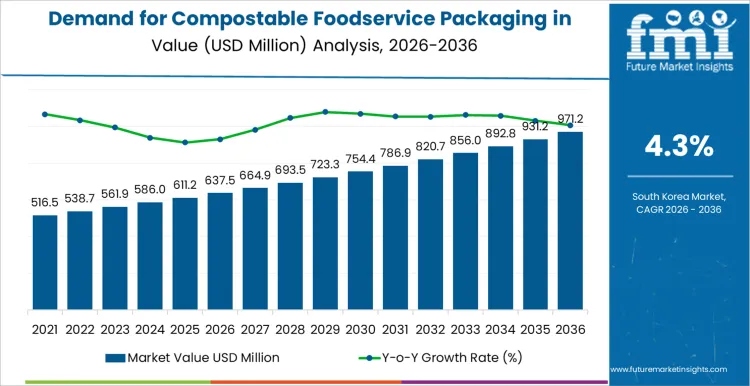
Technological adoption is pivoting toward the utilization of locally abundant marine resources, specifically algae and seaweed, to create bioplastic alternatives. Research institutes are optimizing the extraction of cellulose from agricultural byproducts to reinforce paperboard containers, reducing reliance on imported wood pulp. The integration of compostable foodservice packaging solutions into the rapidly expanding "quick commerce" sector is becoming a standard operational practice. Retailers are leveraging these sustainable materials to enhance brand equity among eco-conscious consumers who prioritize environmental responsibility alongside convenience.
Demand for Compostable Foodservice Packaging in South Korea Key Takeaways
| Metric | Value |
|---|---|
| Industry Size (2026) | USD 637.5 million |
| Industry Value (2036) | USD 968.9 million |
| CAGR (2026 to 2036) | 4.3% |
What Regulatory Forces Accelerate Eco-Packaging Adoption?
A primary catalyst for growth is the rigorous enforcement of the "Resource Recycling Act," which restricts the use of PVC and colored PET bottles, spilling over into foodservice regulations. The implementation of the disposable cup deposit system in major franchises creates a financial incentive for consumers and businesses to switch to biodegradable tableware or reusable systems. South Korean conglomerates (Chaebols) are actively integrating ESG targets into their procurement strategies, mandating that cafeteria operations and subsidiary food brands transition to sustainable materials. This corporate responsibility drive creates a guaranteed volume for suppliers of certified compostable goods, stabilizing the investment landscape for new manufacturing facilities.
How is the Sector Structured Across Key Segments?
The sector is segmented to address the functional diversity required by different dining formats, from high-traffic festivals to premium home delivery. It is primarily categorized by material type, reflecting the feedstock source. The packaging type segment highlights the specific form factors used in service. The end use segment underscores the business models driving consumption. Each segment plays a vital role, where paperboard drives volume in dry foods and bagasse enables leak-proof solutions for wet meals.
Why Does Paper & Paperboard Maintain Material Leadership?
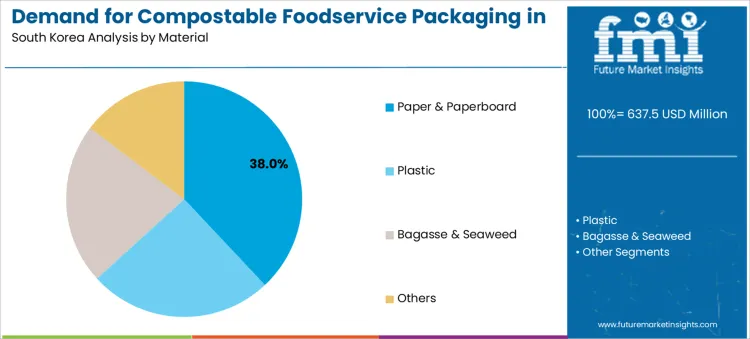
Paper & Paperboard command a 38.0% share of the industry. This prevalence is attributed to the established recycling and composting infrastructure for fiber-based materials in South Korea. Consumers are highly accustomed to separating paper waste, making the transition to biodegradable food packaging seamless. Innovations by local mills to create grease-resistant paper without fluorinated chemicals (PFAS-free) have reinforced the safety profile of this material. Fast-food chains rely heavily on paper for burger wraps, fry cartons, and bakery bags, sustaining steady demand volume.
How Do Plates Anchor the Packaging Type Segment?
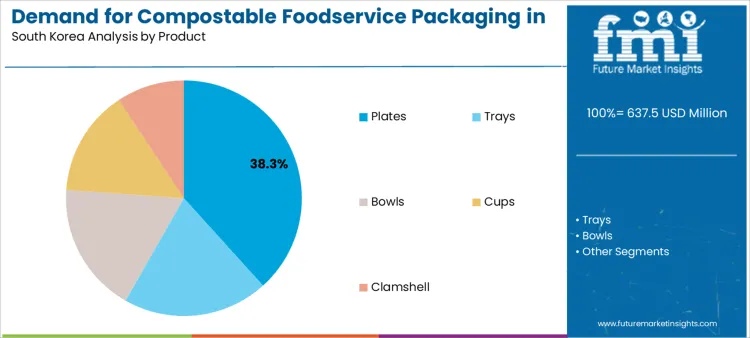
Plates account for 38.3% of the packaging type volume. The widespread culture of outdoor dining, particularly along the Han River and during regional festivals, necessitates vast quantities of disposable plates. Event organizers are increasingly mandating compostable options to manage waste in public spaces effectively. Rigid, molded-fiber plates offer the necessary structural integrity to hold heavy Korean dishes without collapsing, replacing traditional polystyrene foam options. This segment is supported by the availability of aesthetic designs that mimic ceramic textures, appealing to premium catering services.
Why Are Chain Restaurants the Primary End Users?
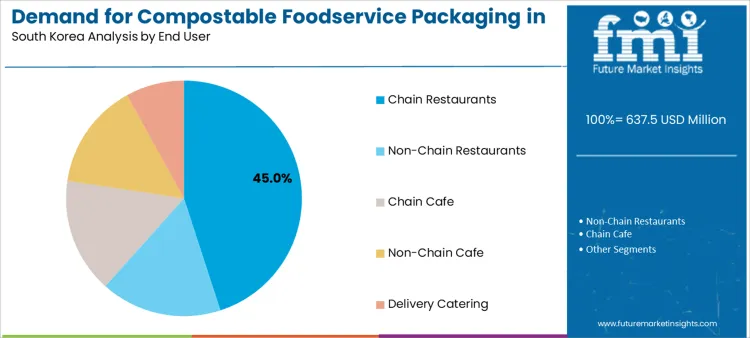
Chain Restaurants represent the dominant end use segment. Major franchises like Lotteria, Mom's Touch, and global brands operate thousands of outlets across the peninsula, creating massive, centralized procurement needs. These entities face the highest level of public scrutiny and regulatory pressure to adopt compostable plastic packaging alternatives. Implementing sustainable practices across a nationwide network allows for economies of scale, reducing the unit cost of compostable items and making the switch financially viable compared to independent operators.
Is the Cafe Culture Driving Bagasse Adoption?
The Bagasse & Seaweed segment holds a significant 24.0% share. South Korea's intense coffee consumption culture drives the need for sustainable takeaway solutions. Bagasse (sugarcane pulp) provides excellent insulation and rigidity for hot beverage cups and compostable food trays. Cafe chains are adopting these agricultural byproducts to differentiate their brand stories. The integration of seaweed extracts to create edible or rapidly degrading coatings for cups is a niche but growing trend, aligning with the country's marine biotechnology strengths.
Will Marine Biomass Revolutionize Material Sourcing?
A significant trend is the exploration of algae and seaweed as primary feedstocks. South Korea's extensive coastline and expertise in aquaculture provide a unique advantage in developing zero waste food tray microalgae pha solutions. Startups are extracting alginate to produce transparent, flexible films that can replace conventional plastic windows in sandwich boxes. This innovation addresses the dual challenge of land scarcity for crop-based bioplastics and the need for materials that degrade safely in marine environments if leaked.
Does Infrastructure Lag Hinder Full Circularity?
The most significant restraint is the limited capacity of industrial composting facilities to handle non-fiber compostables. While PLA and other bioplastics are theoretically compostable, they often require specific temperature and humidity conditions not available in standard municipal organic waste treatment plants. This gap leads to compostable pouches often being incinerated or landfilled, negating their environmental benefits. Overcoming this requires coordinated investment from the government and private waste management firms to upgrade processing infrastructure to accept diverse bio-materials.
How Can Quick Commerce Unlock New Value?
The emerging field of eco-friendly logistics presents a frontier of opportunity. Platforms like Coupang and Market Kurly are under pressure to reduce the packaging waste associated with fresh food delivery. Suppliers who facilitate e grocery compostable delivery bags and insulated containers stand to capture significant revenue. Developing durable yet compostable thermal liners and structural components for delivery boxes allows these tech giants to meet their "zero-waste" delivery pledges, creating a high-volume B2B channel.
How is the Packaging Landscape Evolving Across South Korea's Regions?
The regional analysis shows a distinct pattern where tourist hubs enforce strict bans to protect natural assets, while industrial zones focus on sustainable canteen solutions. High-growth areas are characterizing their development by establishing "Zero-Waste" districts. As distinct provinces implement local environmental ordinances, the utilization of compostable wares is becoming tailored to regional economic activities.
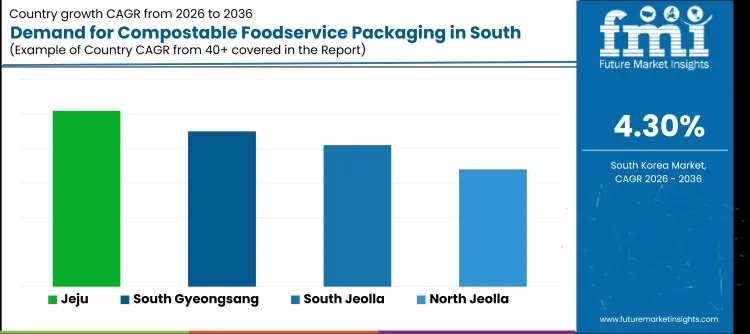
| Region | CAGR (2026 to 2036) |
|---|---|
| Jeju | 5.1% |
| South Gyeongsang | 4.5% |
| South Jeolla | 4.1% |
| North Jeolla | 3.4% |
Why is the "Plastic-Free Island" Policy Driving Demand in Jeju?
Adoption of compostable packaging in Jeju is projected to expand at a CAGR of 5.1%. As a premier tourist destination, Jeju enforces the "Carbon-Free Island 2030" vision, which includes aggressive mandates against single-use non-degradable plastics. Hotels, cafes, and tourist sites are legally required to use eco-friendly consumables, driving massive demand for disposable cutlery made from PLA or wood. The island serves as a testbed for closed-loop systems where foodservice waste is locally composted to support regional agriculture, ensuring high adoption rates.
How is Industrial Catering Influencing South Gyeongsang?
Sales of eco-friendly tableware in South Gyeongsang are likely to reach a CAGR of 4.5%. This region, home to major shipyards and automotive plants, hosts large-scale industrial cafeterias serving thousands of workers daily. The demand is fueled by corporate ESG mandates to reduce cafeteria waste. Companies are replacing melamine and plastic trays with biodegradable packaging solutions to lower their environmental impact. This B2B volume provides a stable revenue baseline for suppliers capable of delivering bulk quantities of durable compostable wares.
What Role Does Agricultural Processing Play in South Jeolla?
The compostable sector in South Jeolla is anticipated to rise at a CAGR of 4.1%. As a key agricultural hub, the region focuses on sustainable packaging for its local produce and value-added food products. Local governments subsidize the use of disposable food containers made from agricultural byproducts for festivals and local sectors. The synergy between local biomass availability (rice husks, straw) and packaging production creates a circular economic model that supports regional small businesses.
How is the Food Cluster Shaping North Jeolla?
Deployment of sustainable packaging in North Jeolla is expected to increase at a CAGR of 3.4%. The National Food Cluster in Iksan attracts food processing companies aiming for global export industries. These companies are adopting compostable packaging to meet the stringent environmental standards of export destinations in Europe and North America. Research institutes in the region are collaborating with private firms to develop novel, food-safe barrier coatings that allow compostable materials to be used for wet and acidic Korean foods like Kimchi.
What Strategies Define Leadership in Compostables?
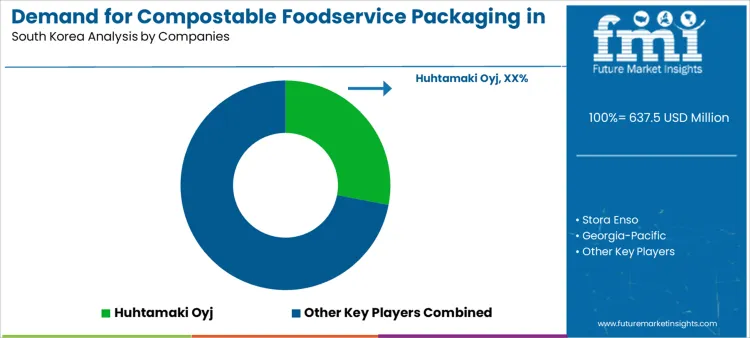
The competitive sphere is characterized by the strategic maneuvering of global packaging giants who are establishing local production hubs to serve the distinct needs of the Korean food service industry. Huhtamaki Oyj commands a significant lead with a 28.0% share, capitalizing on its extensive portfolio of fiber-molded products. Competition is intensifying as domestic paper companies diversify into the compostable tableware sector, offering customized shapes and sizes that cater specifically to Korean banchan (side dish) culture. Competitors like Stora Enso and WestRock are countering by emphasizing the strength and printability of their virgin fiber boards, targeting premium cosmetic and confectionery brands that require high-end sustainable packaging.
How Are Material Innovators Challenging the Status Quo?
A key trend is the rise of material science companies focusing on non-wood fibers. Mondi Group and Georgia-Pacific are investing in R&D to improve the performance of bagasse and bamboo blends, offering stronger and more water-resistant alternatives to paper. Domestic players are responding by forming alliances with chemical firms to produce PHA and PLA blends that mimic the functionality of traditional plastics. This intense rivalry is driving down the cost of biopolymers, accelerating their penetration into the mass-market delivery segment previously dominated by cheap polypropylene.
Key Companies
- Huhtamaki Oyj
- Stora Enso Oyj
- Georgia-Pacific LLC
- WestRock Company
- Mondi Group
- Reynolds Consumer Products
- Genpak, LLC
- Vegware
- Pactiv LLC
- Dart Container Corporation
Scope of Report
| Items | Values |
|---|---|
| Quantitative Units | USD Million |
| Material Type | Paper & Paperboard, Plastic, Bagasse & Seaweed, Others |
| Packaging Type | Plates, Trays, Bowls, Cups, Clamshell, Cutlery, Pouches |
| End Use | Chain Restaurants, Non-Chain Restaurants, Chain Cafe, Non-Chain Cafe, Delivery Catering, Independent Food Vendors |
| Regions Covered | Jeju, South Gyeongsang, South Jeolla, North Jeolla |
| Key Companies Profiled | Huhtamaki, Stora Enso, Georgia-Pacific, WestRock, Mondi, and others. |
Demand for Compostable Foodservice Packaging in South Korea by Segments
By Material Type:
- Paper & Paperboard
- Plastic
- Bagasse & Seaweed
- Others
By Packaging Type:
- Plates
- Trays
- Bowls
- Cups
- Clamshell
- Cutlery
- Pouches
By End Use:
- Chain Restaurants
- Non-Chain Restaurants
- Chain Cafe
- Non-Chain Cafe
- Delivery Catering
- Independent Food Vendors
Bibliography
- Ministry of Environment. (2025, December 22). Comprehensive plastic reduction plan to cut household and business plastic waste by 30 percent by 2030. Ministry of Environment, Republic of Korea.
- Ministry of Environment. (2024, November 23). Korea’s resource circulation policy introduced. Ministry of Environment, Republic of Korea.
- Statistics Korea. (2024, October 1). Online shopping in August 2024. Statistics Korea, Republic of Korea.
- Statistics Korea. (2023, December 28). Results of the experimental dining delivery fee index compilation. Statistics Korea, Republic of Korea.
- Rural Development Administration. (2025, March 5). Accelerating commercialization of green bio materials through public-private collaboration. Rural Development Administration, Republic of Korea.
Frequently Asked Questions
How big is the demand for compostable foodservice packaging in south korea in 2026?
The demand for compostable foodservice packaging in south korea is estimated to be valued at USD 637.5 million in 2026.
What will be the size of compostable foodservice packaging in south korea in 2036?
The market size for the compostable foodservice packaging in south korea is projected to reach USD 971.2 million by 2036.
How much will be the demand for compostable foodservice packaging in south korea growth between 2026 and 2036?
The demand for compostable foodservice packaging in south korea is expected to grow at a 4.3% CAGR between 2026 and 2036.
What are the key product types in the compostable foodservice packaging in south korea?
The key product types in compostable foodservice packaging in south korea are 0.33, 0.24, 0.05 and 0.05.
Which 0.383 segment is expected to contribute significant share in the compostable foodservice packaging in south korea in 2026?
In terms of 0.383, 0.22 segment is expected to command 0.0% share in the compostable foodservice packaging in south korea in 2026.
Preview the report firsthand - request a free sample
Get SampleGet the brochure for pricing and purchase details.
Get PDFTable of Content
- Executive Summary
- South Korea Market Outlook
- Demand-side Trends
- Supply-side Trends
- Technology Roadmap Analysis
- Analysis and Recommendations
- Market Overview
- Market Coverage / Taxonomy
- Market Definition / Scope / Limitations
- Market Background
- Market Dynamics
- Drivers
- Restraints
- Opportunity
- Trends
- Scenario Forecast
- Demand in Optimistic Scenario
- Demand in Likely Scenario
- Demand in Conservative Scenario
- Opportunity Map Analysis
- Product Life Cycle Analysis
- Supply Chain Analysis
- Investment Feasibility Matrix
- Value Chain Analysis
- PESTLE and Porter’s Analysis
- Regulatory Landscape
- Regional Parent Market Outlook
- Production and Consumption Statistics
- Import and Export Statistics
- Market Dynamics
- South Korea Market Analysis 2021 to 2025 and Forecast, 2026 to 2036
- Historical Market Size Value (USD Million) Analysis, 2021 to 2025
- Current and Future Market Size Value (USD Million) Projections, 2026 to 2036
- Y-o-Y Growth Trend Analysis
- Absolute $ Opportunity Analysis
- South Korea Market Pricing Analysis 2021 to 2025 and Forecast 2026 to 2036
- South Korea Market Analysis 2021 to 2025 and Forecast 2026 to 2036, By 0.38
- Introduction / Key Findings
- Historical Market Size Value (USD Million) Analysis By 0.38 , 2021 to 2025
- Current and Future Market Size Value (USD Million) Analysis and Forecast By 0.38 , 2026 to 2036
- 0.33
- 0.24
- 0.05
- 0.33
- Y-o-Y Growth Trend Analysis By 0.38 , 2021 to 2025
- Absolute $ Opportunity Analysis By 0.38 , 2026 to 2036
- South Korea Market Analysis 2021 to 2025 and Forecast 2026 to 2036, By 0.383
- Introduction / Key Findings
- Historical Market Size Value (USD Million) Analysis By 0.383, 2021 to 2025
- Current and Future Market Size Value (USD Million) Analysis and Forecast By 0.383, 2026 to 2036
- 0.22
- 0.184
- 0.149
- 0.064
- 0.149
- 0.064
- 0.22
- Y-o-Y Growth Trend Analysis By 0.383, 2021 to 2025
- Absolute $ Opportunity Analysis By 0.383, 2026 to 2036
- South Korea Market Analysis 2021 to 2025 and Forecast 2026 to 2036, By 0.45
- Introduction / Key Findings
- Historical Market Size Value (USD Million) Analysis By 0.45, 2021 to 2025
- Current and Future Market Size Value (USD Million) Analysis and Forecast By 0.45, 2026 to 2036
- 0.2
- 0.15
- 0.12
- 0.08
- 0.2
- Y-o-Y Growth Trend Analysis By 0.45, 2021 to 2025
- Absolute $ Opportunity Analysis By 0.45, 2026 to 2036
- Market Structure Analysis
- Competition Dashboard
- Competition Benchmarking
- Market Share Analysis of Top Players
- By Regional
- By 0.38
- By 0.383
- By 0.45
- Competition Analysis
- Competition Deep Dive
- Competition Deep Dive
- Assumptions & Acronyms Used
- Research Methodology


