

- Industry Size (2026)
- USD 940 Mn
- Forecast (2036)
- USD 3484.8 Mn
- CAGR (2026 to 2036)
- 14.0%
Compostable PHA Film Packaging Materials Market Forecast and Outlook 2026 to 2036
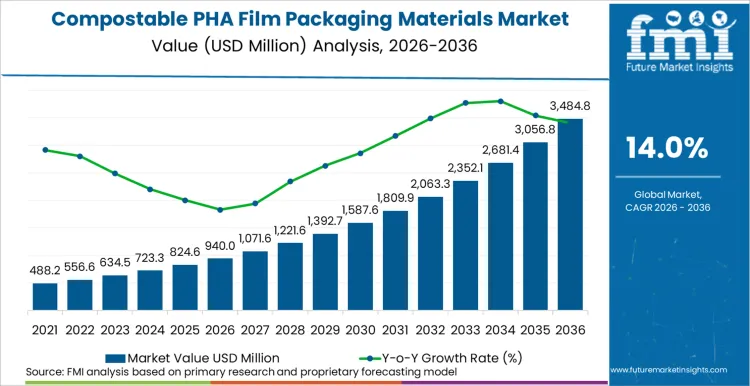
The compostable PHA film packaging materials market is set to reach USD 940 million in 2026 and is projected to reach USD 3,484.8 million by 2036 at a 14% CAGR. Demand is anchored in pack formats that require certified compostability alongside defined barrier and seal performance. Brand owners set film thickness, heat seal windows, and print receptivity during packaging system design. Once a structure enters an approved claims scope, material substitution triggers renewed conformity testing and label authorization. Volume expansion follows adoption in food service, fresh produce, and consumer goods where disposal pathways are prescribed by retailers and municipalities. Program growth reflects portfolio conversions rather than isolated line trials.
Control over packaging architectures shapes participation in the compostable PHA film packaging materials market through approved structures, audit calendars, and claim governance maintained by brand and retail organizations. Entry depends on evidence covering compostability outcomes, residue limits, and compatibility with declared collection routes. Product families remain fixed across extended cycles because on-pack statements and compliance files attach to complete constructions. Supplier rotation occurs during platform redesign windows rather than routine sourcing rounds. Revenue development tracks the number of packaging programs converted to PHA-based films. Competitive standing depends on early inclusion in packaging development roadmaps and continued acceptance within governed material frameworks across multi-category portfolios.
Compostable PHA Film Packaging Materials Market Quick Stats
- Compostable PHA Film Packaging Materials Market Value (2026): USD 940 million
- Compostable PHA Film Packaging Materials Market Forecast Value (2036): USD 3,484.8 million
- Compostable PHA Film Packaging Materials Market Forecast CAGR 2026 to 2036: 14.0%
- Leading End Use in Compostable PHA Film Packaging Materials Market: Fresh food and produce
- Key Growth Regions in Compostable PHA Film Packaging Materials Market: India, China, USA, Germany, Japan
- Top Players in Compostable PHA Film Packaging Materials Market: Danimer Scientific, CJ Biomaterials, TIPA, Bluepha, Kingfa Sci. & Tech., Kaneka
What is the Growth Forecast for the Compostable PHA Film Packaging Materials Market through 2036?
Material choice in this segment starts with compostability certification, seal performance, and barrier targets rather than with resin price alone. The compostable PHA film packaging materials market in 2026 stands at USD 940.0 million, rising from USD 488.2 million in 2021 as food, personal care, and single use packaging formats replace conventional films. Converters judge these films by seal window width, puncture resistance, print anchorage, and consistency on form fill seal lines. Adoption depends on how reliably the film runs at speed and how well it protects shelf life. The value path passes USD 1,587.6 million in 2030 and moves toward USD 3,484.8 million by 2036, which represents a 14.00% growth rate.
Packaging platform governance shapes spending in the compostable PHA film packaging materials market. Volumes move under multi year programs tied to tooling, artwork libraries, and certified structure lists. Inventory exposure stays moderate since roll stock turns quickly. Cost structure reflects PHA resin availability, extrusion yield, coating steps, and quality screening. Plants track seal integrity, scrap rate, and line uptime as operating controls. Annual values pass USD 2,063.3 million in 2033 and USD 2,681.4 million in 2035 as more categories convert base packs. The move to USD 3,484.8 million in 2036 comes from broader coverage across everyday formats, thicker functional builds in some applications, and longer contracts that lock these films into standard packaging specifications.
Compostable PHA Film Packaging Materials Market Key Takeaways
| Metric | Value |
|---|---|
| Market Value (2026) | USD 940 million |
| Forecast Value (2036) | USD 3,484.8 million |
| Forecast CAGR 2026 to 2036 | 14.0% |
Source: Future Market Insights (FMI) analysis, based on proprietary forecasting model and primary research
How Is the Compostable PHA Film Packaging Materials Market Being Used to Control Barrier Performance and Disposal Pathway Compliance in Flexible Packaging?
Packaging producers treat the compostable PHA film packaging materials market as part of certification governance and waste routing discipline rather than as a simple material swap. Programs specify certified compostable PHA packaging films and marine degradable flexible packaging materials to meet defined end of life claims while maintaining shelf protection. Qualification teams rely on compostability testing and certification services and disintegration and biodegradation validation protocols to confirm that inks, coatings, and seal layers do not block breakdown. Engineering groups evaluate bio based barrier film technologies and compostable heat seal layer systems to keep oxygen and moisture control within target ranges. The focus remains on seal integrity, puncture resistance, and curl control because packaging that performs in distribution but fails disposal audits creates compliance exposure and claim withdrawal risk.
Release governance places compostable packaging compliance documentation frameworks inside shipment approval rather than inside marketing review. Selection criteria for PHA film packaging suppliers include feedstock traceability and molecular weight consistency across campaigns. Life cycle assessment for compostable flexible packaging systems is used to verify that sourcing and conversion steps do not undermine declared benefits. Waste stream compatibility for compostable PHA films shapes material choice because misrouted structures defeat recovery objectives. Shelf life stability testing for PHA packaging films defines acceptance gates for migration, brittleness, and seal aging. Audit readiness for compostable packaging claims sets ongoing surveillance requirements. This makes PHA film specification a certification and risk management decision rather than a short term cost or design optimization exercise.
How Do Shelf-Life Risk Management and Converting Line Constraints Shape Demand in the Compostable PHA Film Packaging Materials Market by End Use and Film Format in 2026?
In the Compostable PHA Film Packaging Materials Market, specification work is driven by spoilage exposure, sealing reliability, and documentation burden tied to compostability claims rather than by resin substitution alone. Packaging owners running fresh food distribution programs, retail private label packaging, and certified compostable product lines require films that keep mechanical properties stable across cold storage, humid environments, and variable filling speeds. By end use, demand spans fresh food and produce, FMCG and compostable packs, mass compostable films, premium bio-films, organic food packaging, and other uses. By film format, usage covers flexible films and wraps, stand-up pouches, rollstock films, thin compostable films, and other formats. Portfolio choices reflect shrink risk, audit exposure, and line uptime.
Why Does Fresh Food and Produce Set Most Qualification Rules?
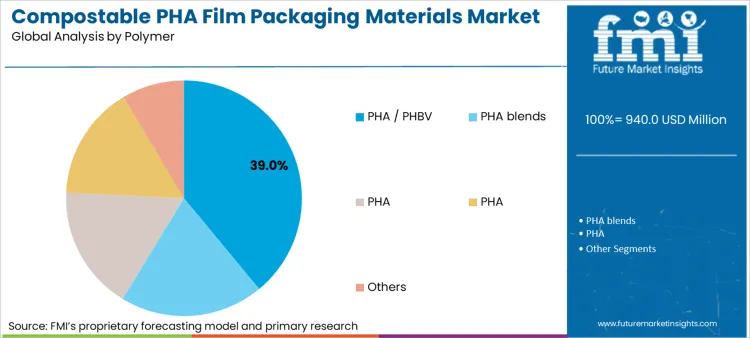
Fresh food and produce account for about 39% share, placing this segment at the center of most qualification programs. High respiration rates, condensation cycles, and variable handling conditions force tight control over seal strength and tear resistance. FMCG and compostable packs follow, driven by retailer scorecards and packaging harmonization efforts. Mass compostable films serve standardized products where cost and throughput dominate. Premium bio-films focus on appearance and material storytelling. Organic food packaging adds stricter claim scrutiny. Packaging engineers approve end uses through leak testing and compression trials. Operations teams approve through line efficiency and waste rates. Quality teams approve through shelf-life loss metrics and complaint patterns.
Target application selection fixes equipment settings, inspection gates, and storage conditions. Introducing a new end-use category requires fresh shelf-life studies and machinability trials. Procurement locks supply to maintain continuity of the approved grade. Certification files and label language follow the same application mapping. Commercial planning expands assortments within the same end-use class rather than rotating categories. The demand profile therefore remains concentrated in fresh food and produce programs where failure cost, public visibility, and regulatory oversight converge.
Why Do Flexible Web Formats Dominate Production Planning?
Flexible films and wraps represent about 40% share, reflecting their compatibility with a wide range of existing form-fill-seal and flow-wrap lines. This format tolerates variation in product geometry and supports high changeover frequency. Stand-up pouches appear where shelf presentation and portion control matter. Rollstock films serve long runs that require stable web handling and predictable registration. Thin compostable films address lightweight items with short distribution cycles. Other formats remain marginal. Converting teams evaluate formats through seal window width and web stability. Operations teams evaluate through uptime and scrap generation. Compliance teams evaluate through structure traceability and disintegration performance.
Format decisions lock in adhesive systems, printing processes, and sealing profiles. A shift in format requires new tooling trials and updated certification documentation. Production scheduling aligns inventory widths and storage conditions to the chosen family. Supplier qualification and incoming inspection follow. Field performance tracking assumes the same mechanical behavior. Growth occurs by scaling approved formats across more SKUs and regions rather than introducing new constructions. Demand therefore concentrates in flexible web formats that protect throughput, reduce conversion risk, and keep certification maintenance predictable across large packaging portfolios.
Why Are Film Converting and Pack Performance Requirements Driving Compostable PHA Film Adoption?
Film converting lines and form fill seal machines demand materials that hold tensile strength, seal reliably, and run without excessive breaks or curl. At the same time, food packaging operations and personal care pack formats are tightening material acceptance rules for disposal pathways. These pressures meet inside PHA film structures, where compostable chemistry must still behave like conventional films during slitting, printing, and sealing. Packaging certification programs and material compliance frameworks evaluate finished film performance rather than resin alone. Demand grows because converters want drop in film solutions that protect throughput, preserve shelf performance, and avoid equipment changes.
What Is Slowing Standardization of PHA Film Structures Across Packaging Uses?
Raw material supply from biopolymer resin producers and formulation work in additive compounding operations produce wide variation in stiffness, heat response, and tear behavior. Barrier needs for snack packaging differ from those for home and personal care packs, which prevents reuse of a single film design. Qualification also passes through package testing laboratories and customer line trials, which lengthens approval cycles. These dependencies keep PHA film designs application specific. Converters face multiple grades, longer development timelines, and limited ability to consolidate platforms even when pack shapes and machines are similar.
How Are Platform Film Strategies Changing PHA Film Development?
Material suppliers and converters are building families of compatible films designed to run across pouch, wrap, and sachet equipment. Packaging machinery teams and process engineering groups now join projects earlier to define seal windows, stiffness limits, and winding behavior. Testing and validation partners are engaged upstream to lock film constructions before scale production. Development is moving toward repeatable film systems supported by shared performance data and defined operating ranges. Competitive advantage comes from offering proven PHA film platforms that reduce line risk, shorten customer trials, and stabilize production planning.
What is the Demand for Compostable PHA Film Packaging Materials by Country?
| Country | CAGR (%) |
|---|---|
| Germany | 13.0% |
| USA | 13.4% |
| China | 15.6% |
| Japan | 11.0% |
| India | 16.2% |
Source: Future Market Insights (FMI) analysis, based on proprietary forecasting model and primary research
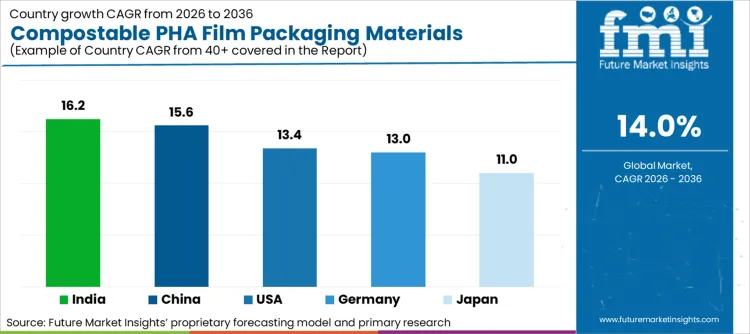
The demand for compostable PHA film packaging materials is increasing across food, beverage, and consumer goods packaging where biodegradability, regulatory compliance, and material performance are critical. India leads at 16.2% CAGR, supported by growing packaged goods production, eco-conscious consumer trends, and regulatory incentives for biodegradable materials. China follows at 15.6%, driven by large scale adoption in retail and export packaging. The USA grows at 13.4%, shaped by corporate sustainability initiatives and increasing consumer demand for eco-friendly packaging solutions. Germany records 13.0%, reflecting stringent environmental regulations and adoption in food and specialty packaging. Japan posts 11.0%, within a mature market emphasizing certified compostable materials and consistent quality.
How Production Line Performance Shapes the Compostable PHA Film Packaging Materials Market in Germany
High-speed packaging operations in Germany demand films that combine mechanical strength, barrier protection, and certified compostability, supporting a 13% CAGR for the compostable PHA film packaging materials market. Engineers evaluate dimensional stability, heat-seal reliability, and puncture resistance under automated filling and laminating conditions. Once validated, materials are deployed across multiple production lines for retail, foodservice, and e-commerce packaging applications. Volume growth aligns with adoption by large-scale packaging programs and institutional sustainability initiatives. Supplier participation depends on audit compliance, certification verification, and technical support capabilities. Commercial outcomes rely on reproducible material performance, consistent barrier properties, and reliable operational integration across production facilities.
How Packaging Safety and Handling Requirements Influence the Compostable PHA Film Packaging Materials Market in the USA
During intensive food and e-commerce packaging cycles, manufacturers in the United States require films that maintain tensile strength, seal integrity, and certified compostability, driving a 13.4% CAGR. Testing focuses on puncture resistance, barrier efficiency, thermal tolerance, and compatibility with high-speed automated equipment. Once a material meets performance criteria, it is adopted across multiple production lines and product categories. Supplier access relies on thorough certification, audit compliance, and technical support for process integration. Volume growth follows large-scale retail programs, e-commerce packaging expansion, and institutional sustainability initiatives. Commercial success depends on consistent material performance, operational reliability, and reproducible quality across facilities.
How Urban Logistics Programs Drive the Compostable PHA Film Packaging Materials Market in China
Rapid expansion of e-commerce and urban delivery networks is accelerating the compostable PHA film packaging materials market in China at a 15.6% CAGR. Films are evaluated for puncture resistance, tensile strength, barrier performance, and certified compostability under high-throughput production conditions. Technical teams assess seal integrity, dimensional stability, and compatibility with automated laminating and filling systems. Once validated, materials are implemented across multiple packaging lines to meet urban distribution demands. Supplier participation depends on documentation accuracy, audit compliance, and capacity to support high-volume operations. Volume growth corresponds with e-commerce platform expansion, retail packaging programs, and institutional adoption. Commercial advantage relies on reproducible performance, operational reliability, and process consistency across manufacturing facilities.
How Material Certification and Application Standards Guide the Compostable PHA Film Packaging Materials Market in Japan
In Japan, strict packaging standards and food-contact regulations are shaping the compostable PHA film packaging materials market, which is growing at an 11% CAGR. Selected films must meet tensile strength, puncture resistance, barrier efficiency, and certified compostability requirements. Technical evaluations include heat-seal performance, dimensional stability, and compatibility with automated packaging equipment. Once approved, materials are deployed across multiple lines for retail, e-commerce, and foodservice applications. Supplier participation requires complete certification, audit compliance, and technical support. Volume growth is linked to adoption by major retail chains, packaged goods companies, and institutional programs. Commercial success relies on consistent film performance, operational reliability, and reproducible quality.
How E-Commerce Volume and Platform Scaling Shape the Compostable PHA Film Packaging Materials Market in India
E-commerce expansion and increasing high-volume production lines in India are driving the compostable PHA film packaging materials market at a 16.2% CAGR. Materials are evaluated for barrier performance, tensile strength, puncture resistance, and certified compostability under automated filling and laminating operations. Engineers assess dimensional stability, heat-seal reliability, and compatibility with high-speed packaging equipment. Once validated, films are deployed across multiple production lines and distribution networks. Supplier access depends on certification documentation, audit compliance, and technical support. Volume growth follows platform expansion, large-scale retail programs, and packaging line scaling. Commercial advantage relies on reproducible performance, operational reliability, and consistent support across multiple manufacturing facilities.
What Methods Are Leading Suppliers Using in the Compostable PHA Film Packaging Materials Market?
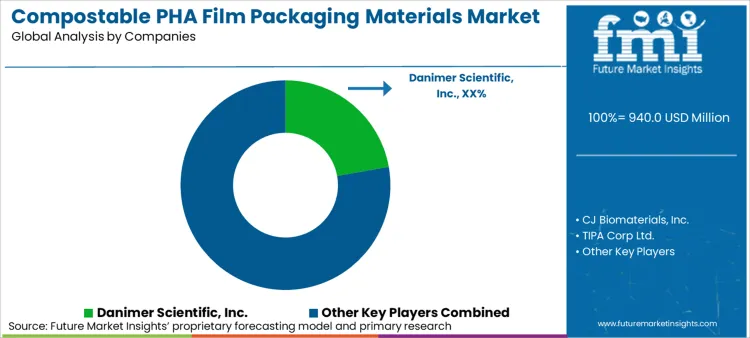
Film biodegradability, barrier performance, and processing compatibility define adoption in the Compostable PHA Film Packaging Materials Market. Danimer Scientific, CJ Biomaterials, TIPA, Bluepha, Kingfa Sci. & Tech., and Kaneka compete during pilot extrusion, barrier testing, and industrial packaging validation. Once incorporated into food, consumer, or industrial packaging, tensile strength, moisture resistance, and certified compostability anchor supplier selection. Danimer Scientific emphasizes PHA films engineered for industrial-scale composting and consistent barrier performance. CJ Biomaterials delivers bio-based films optimized for flexible packaging. TIPA focuses on consumer-oriented compostable films with verified end-of-life processing. Bluepha provides PHA films with chemical and thermal stability. Kingfa Sci. & Tech. targets high-performance biofilms for diverse packaging formats. Kaneka supplies functional PHA films with scalable production and industrial compliance.
Mechanical integrity, process reproducibility, and certification support shape competitive positioning in the Compostable PHA Film Packaging Materials Market. Engineers assess tensile strength, barrier efficiency, film uniformity, compostability certification, and thermal tolerance during validation. Production teams prioritize suppliers capable of reproducible lots, scalable output, and technical guidance for packaging line integration. Danimer Scientific secures adoption through performance validation and process support. CJ Biomaterials maintains positions in industrial and consumer flexible packaging. TIPA captures adoption in certified end-of-life consumer products. Bluepha competes in applications requiring chemical and thermal resistance. Kingfa Sci. & Tech. supports specialty packaging programs. Kaneka provides large-scale PHA film supply with verified compostable compliance. Market positions vary by film composition, application type, production scale, and regional environmental standards.
Key Players in Compostable PHA Film Packaging Materials Market
- Danimer Scientific, Inc.
- CJ Biomaterials, Inc.
- TIPA Corp Ltd.
- Bluepha Co., Ltd.
- Kingfa Sci. & Tech. Co., Ltd.
- Kaneka Corporation
Scope of the Report
| Items | Values |
|---|---|
| Quantitative Units (2026) | USD million |
| End-use | Fresh food and produce, FMCG and compostable packs, mass compostable films, premium bio-films, organic food packaging, others |
| Film Format | Flexible films and wraps, stand-up pouches, rollstock films, thin compostable films, others |
| Material | PHA-based films, PHA blends and formulations, compostable PHA compounds, others |
| Barrier or Seal Technology | Bio-based barrier film technologies, compostable heat-seal layer systems, coating and surface treatment systems, controlled seal window technologies, others |
| Regions Covered | Asia Pacific, Europe, North America, Latin America, Middle East & Africa |
| Countries Covered | United States, Canada, Mexico, Germany, United Kingdom, France, Italy, Spain, Nordics, BENELUX, China, Japan, South Korea, India, Australia & New Zealand, ASEAN, Brazil, Chile, Saudi Arabia, Turkey, South Africa, and other regional markets |
| Key Companies Profiled | Danimer Scientific, CJ Biomaterials, TIPA, Bluepha, Kingfa Sci. & Tech., Kaneka |
| Additional Attributes | Dollar sales by end-use, film format, material, and barrier or seal technology, compostability certification and audit governance, disposal pathway and waste stream compatibility, shelf-life stability and seal aging performance, puncture resistance and curl control, machinability on form-fill-seal and flow-wrap lines, multi-year packaging platform programs, qualification and revalidation cycles, and regional demand patterns across food, personal care, and consumer goods packaging |
Compostable PHA Film Packaging Materials Market Segmentation
End-use:
- Fresh food & produce
- FMCG & compostable packs
- Mass compostable films
- Premium bio-films
- Organic food packaging
- Others
Film Format:
- Flexible films & wraps
- Stand-up pouches
- Rollstock films
- Thin compostable films
- Others
Polymer:
- PHA or PHBV
- PHA blends
- PHA
- Others
Film Technology:
- Blown film extrusion & bio-coating
- Sealability optimisation
- High-output extrusion
- Precision film control
- Others
Region
- Asia Pacific
- China
- Japan
- South Korea
- India
- Australia & New Zealand
- ASEAN
- Rest of Asia Pacific
- Europe
- Germany
- United Kingdom
- France
- Italy
- Spain
- Nordic
- BENELUX
- Rest of Europe
- North America
- United States
- Canada
- Mexico
- Latin America
- Brazil
- Chile
- Rest of Latin America
- Middle East & Africa
- Kingdom of Saudi Arabia
- Other GCC Countries
- Turkey
- South Africa
- Other African Union
- Rest of Middle East & Africa
Bibliography
- European Commission. (2024). Packaging and packaging waste. European Commission.
- European Commission. (2023). Policy framework on biobased, biodegradable and compostable plastics. European Commission.
- European Committee for Standardization. (2024). EN 13432: Packaging - Requirements for packaging recoverable through composting and biodegradation. CEN.
- International Organization for Standardization. (2023). ISO 17088: Specifications for compostable plastics. ISO.
- International Organization for Standardization. (2024). ISO 14855: Determination of the ultimate aerobic biodegradability of plastic materials under controlled composting conditions. ISO.
Frequently Asked Questions
How big is the compostable pha film packaging materials market in 2026?
The global compostable pha film packaging materials market is estimated to be valued at USD 940.0 million in 2026.
What will be the size of compostable pha film packaging materials market in 2036?
The market size for the compostable pha film packaging materials market is projected to reach USD 3,484.8 million by 2036.
How much will be the compostable pha film packaging materials market growth between 2026 and 2036?
The compostable pha film packaging materials market is expected to grow at a 14.0% CAGR between 2026 and 2036.
What are the key product types in the compostable pha film packaging materials market?
The key product types in compostable pha film packaging materials market are fresh food & produce, fmcg & compostable packs, mass compostable films, premium bio-films, organic food packaging and others.
Which film format segment to contribute significant share in the compostable pha film packaging materials market in 2026?
In terms of film format, flexible films & wraps segment to command 40.0% share in the compostable pha film packaging materials market in 2026.
Preview the report firsthand - request a free sample
Get SampleGet the brochure for pricing and purchase details.
Get PDFTable of Content
- Executive Summary
- Global Market Outlook
- Demand-side Trends
- Supply-side Trends
- Technology Roadmap Analysis
- Analysis and Recommendations
- Market Overview
- Market Coverage / Taxonomy
- Market Definition / Scope / Limitations
- Market Background
- Market Dynamics
- Drivers
- Restraints
- Opportunity
- Trends
- Scenario Forecast
- Demand in Optimistic Scenario
- Demand in Likely Scenario
- Demand in Conservative Scenario
- Opportunity Map Analysis
- Product Life Cycle Analysis
- Supply Chain Analysis
- Investment Feasibility Matrix
- Value Chain Analysis
- PESTLE and Porter’s Analysis
- Regulatory Landscape
- Regional Parent Market Outlook
- Production and Consumption Statistics
- Import and Export Statistics
- Market Dynamics
- Global Market Analysis 2021 to 2025 and Forecast, 2026 to 2036
- Historical Market Size Value (USD Million) Analysis, 2021 to 2025
- Current and Future Market Size Value (USD Million) Projections, 2026 to 2036
- Y-o-Y Growth Trend Analysis
- Absolute $ Opportunity Analysis
- Global Market Pricing Analysis 2021 to 2025 and Forecast 2026 to 2036
- Global Market Analysis 2021 to 2025 and Forecast 2026 to 2036, By End-use
- Introduction / Key Findings
- Historical Market Size Value (USD Million) Analysis By End-use , 2021 to 2025
- Current and Future Market Size Value (USD Million) Analysis and Forecast By End-use , 2026 to 2036
- Fresh food & produce
- FMCG & compostable packs
- Mass compostable films
- Premium bio-films
- Organic food packaging
- Others
- Fresh food & produce
- Y-o-Y Growth Trend Analysis By End-use , 2021 to 2025
- Absolute $ Opportunity Analysis By End-use , 2026 to 2036
- Global Market Analysis 2021 to 2025 and Forecast 2026 to 2036, By Film Format
- Introduction / Key Findings
- Historical Market Size Value (USD Million) Analysis By Film Format, 2021 to 2025
- Current and Future Market Size Value (USD Million) Analysis and Forecast By Film Format, 2026 to 2036
- Flexible films & wraps
- Stand-up pouches
- Rollstock films
- Thin compostable films
- Others
- Flexible films & wraps
- Y-o-Y Growth Trend Analysis By Film Format, 2021 to 2025
- Absolute $ Opportunity Analysis By Film Format, 2026 to 2036
- Global Market Analysis 2021 to 2025 and Forecast 2026 to 2036, By Polymer
- Introduction / Key Findings
- Historical Market Size Value (USD Million) Analysis By Polymer, 2021 to 2025
- Current and Future Market Size Value (USD Million) Analysis and Forecast By Polymer, 2026 to 2036
- PHA / PHBV
- PHA blends
- PHA
- PHA
- Others
- PHA / PHBV
- Y-o-Y Growth Trend Analysis By Polymer, 2021 to 2025
- Absolute $ Opportunity Analysis By Polymer, 2026 to 2036
- Global Market Analysis 2021 to 2025 and Forecast 2026 to 2036, By Film Technology
- Introduction / Key Findings
- Historical Market Size Value (USD Million) Analysis By Film Technology, 2021 to 2025
- Current and Future Market Size Value (USD Million) Analysis and Forecast By Film Technology, 2026 to 2036
- Blown film extrusion & bio-coating
- Sealability optimisation
- High-output extrusion
- Precision film control
- Others
- Blown film extrusion & bio-coating
- Y-o-Y Growth Trend Analysis By Film Technology, 2021 to 2025
- Absolute $ Opportunity Analysis By Film Technology, 2026 to 2036
- Global Market Analysis 2021 to 2025 and Forecast 2026 to 2036, By Region
- Introduction
- Historical Market Size Value (USD Million) Analysis By Region, 2021 to 2025
- Current Market Size Value (USD Million) Analysis and Forecast By Region, 2026 to 2036
- North America
- Latin America
- Western Europe
- Eastern Europe
- East Asia
- South Asia and Pacific
- Middle East & Africa
- Market Attractiveness Analysis By Region
- North America Market Analysis 2021 to 2025 and Forecast 2026 to 2036, By Country
- Historical Market Size Value (USD Million) Trend Analysis By Market Taxonomy, 2021 to 2025
- Market Size Value (USD Million) Forecast By Market Taxonomy, 2026 to 2036
- By Country
- USA
- Canada
- Mexico
- By End-use
- By Film Format
- By Polymer
- By Film Technology
- By Country
- Market Attractiveness Analysis
- By Country
- By End-use
- By Film Format
- By Polymer
- By Film Technology
- Key Takeaways
- Latin America Market Analysis 2021 to 2025 and Forecast 2026 to 2036, By Country
- Historical Market Size Value (USD Million) Trend Analysis By Market Taxonomy, 2021 to 2025
- Market Size Value (USD Million) Forecast By Market Taxonomy, 2026 to 2036
- By Country
- Brazil
- Chile
- Rest of Latin America
- By End-use
- By Film Format
- By Polymer
- By Film Technology
- By Country
- Market Attractiveness Analysis
- By Country
- By End-use
- By Film Format
- By Polymer
- By Film Technology
- Key Takeaways
- Western Europe Market Analysis 2021 to 2025 and Forecast 2026 to 2036, By Country
- Historical Market Size Value (USD Million) Trend Analysis By Market Taxonomy, 2021 to 2025
- Market Size Value (USD Million) Forecast By Market Taxonomy, 2026 to 2036
- By Country
- Germany
- UK
- Italy
- Spain
- France
- Nordic
- BENELUX
- Rest of Western Europe
- By End-use
- By Film Format
- By Polymer
- By Film Technology
- By Country
- Market Attractiveness Analysis
- By Country
- By End-use
- By Film Format
- By Polymer
- By Film Technology
- Key Takeaways
- Eastern Europe Market Analysis 2021 to 2025 and Forecast 2026 to 2036, By Country
- Historical Market Size Value (USD Million) Trend Analysis By Market Taxonomy, 2021 to 2025
- Market Size Value (USD Million) Forecast By Market Taxonomy, 2026 to 2036
- By Country
- Russia
- Poland
- Hungary
- Balkan & Baltic
- Rest of Eastern Europe
- By End-use
- By Film Format
- By Polymer
- By Film Technology
- By Country
- Market Attractiveness Analysis
- By Country
- By End-use
- By Film Format
- By Polymer
- By Film Technology
- Key Takeaways
- East Asia Market Analysis 2021 to 2025 and Forecast 2026 to 2036, By Country
- Historical Market Size Value (USD Million) Trend Analysis By Market Taxonomy, 2021 to 2025
- Market Size Value (USD Million) Forecast By Market Taxonomy, 2026 to 2036
- By Country
- China
- Japan
- South Korea
- By End-use
- By Film Format
- By Polymer
- By Film Technology
- By Country
- Market Attractiveness Analysis
- By Country
- By End-use
- By Film Format
- By Polymer
- By Film Technology
- Key Takeaways
- South Asia and Pacific Market Analysis 2021 to 2025 and Forecast 2026 to 2036, By Country
- Historical Market Size Value (USD Million) Trend Analysis By Market Taxonomy, 2021 to 2025
- Market Size Value (USD Million) Forecast By Market Taxonomy, 2026 to 2036
- By Country
- India
- ASEAN
- Australia & New Zealand
- Rest of South Asia and Pacific
- By End-use
- By Film Format
- By Polymer
- By Film Technology
- By Country
- Market Attractiveness Analysis
- By Country
- By End-use
- By Film Format
- By Polymer
- By Film Technology
- Key Takeaways
- Middle East & Africa Market Analysis 2021 to 2025 and Forecast 2026 to 2036, By Country
- Historical Market Size Value (USD Million) Trend Analysis By Market Taxonomy, 2021 to 2025
- Market Size Value (USD Million) Forecast By Market Taxonomy, 2026 to 2036
- By Country
- Kingdom of Saudi Arabia
- Other GCC Countries
- Turkiye
- South Africa
- Other African Union
- Rest of Middle East & Africa
- By End-use
- By Film Format
- By Polymer
- By Film Technology
- By Country
- Market Attractiveness Analysis
- By Country
- By End-use
- By Film Format
- By Polymer
- By Film Technology
- Key Takeaways
- Key Countries Market Analysis
- USA
- Pricing Analysis
- Market Share Analysis, 2025
- By End-use
- By Film Format
- By Polymer
- By Film Technology
- Canada
- Pricing Analysis
- Market Share Analysis, 2025
- By End-use
- By Film Format
- By Polymer
- By Film Technology
- Mexico
- Pricing Analysis
- Market Share Analysis, 2025
- By End-use
- By Film Format
- By Polymer
- By Film Technology
- Brazil
- Pricing Analysis
- Market Share Analysis, 2025
- By End-use
- By Film Format
- By Polymer
- By Film Technology
- Chile
- Pricing Analysis
- Market Share Analysis, 2025
- By End-use
- By Film Format
- By Polymer
- By Film Technology
- Germany
- Pricing Analysis
- Market Share Analysis, 2025
- By End-use
- By Film Format
- By Polymer
- By Film Technology
- UK
- Pricing Analysis
- Market Share Analysis, 2025
- By End-use
- By Film Format
- By Polymer
- By Film Technology
- Italy
- Pricing Analysis
- Market Share Analysis, 2025
- By End-use
- By Film Format
- By Polymer
- By Film Technology
- Spain
- Pricing Analysis
- Market Share Analysis, 2025
- By End-use
- By Film Format
- By Polymer
- By Film Technology
- France
- Pricing Analysis
- Market Share Analysis, 2025
- By End-use
- By Film Format
- By Polymer
- By Film Technology
- India
- Pricing Analysis
- Market Share Analysis, 2025
- By End-use
- By Film Format
- By Polymer
- By Film Technology
- ASEAN
- Pricing Analysis
- Market Share Analysis, 2025
- By End-use
- By Film Format
- By Polymer
- By Film Technology
- Australia & New Zealand
- Pricing Analysis
- Market Share Analysis, 2025
- By End-use
- By Film Format
- By Polymer
- By Film Technology
- China
- Pricing Analysis
- Market Share Analysis, 2025
- By End-use
- By Film Format
- By Polymer
- By Film Technology
- Japan
- Pricing Analysis
- Market Share Analysis, 2025
- By End-use
- By Film Format
- By Polymer
- By Film Technology
- South Korea
- Pricing Analysis
- Market Share Analysis, 2025
- By End-use
- By Film Format
- By Polymer
- By Film Technology
- Russia
- Pricing Analysis
- Market Share Analysis, 2025
- By End-use
- By Film Format
- By Polymer
- By Film Technology
- Poland
- Pricing Analysis
- Market Share Analysis, 2025
- By End-use
- By Film Format
- By Polymer
- By Film Technology
- Hungary
- Pricing Analysis
- Market Share Analysis, 2025
- By End-use
- By Film Format
- By Polymer
- By Film Technology
- Kingdom of Saudi Arabia
- Pricing Analysis
- Market Share Analysis, 2025
- By End-use
- By Film Format
- By Polymer
- By Film Technology
- Turkiye
- Pricing Analysis
- Market Share Analysis, 2025
- By End-use
- By Film Format
- By Polymer
- By Film Technology
- South Africa
- Pricing Analysis
- Market Share Analysis, 2025
- By End-use
- By Film Format
- By Polymer
- By Film Technology
- USA
- Market Structure Analysis
- Competition Dashboard
- Competition Benchmarking
- Market Share Analysis of Top Players
- By Regional
- By End-use
- By Film Format
- By Polymer
- By Film Technology
- Competition Analysis
- Competition Deep Dive
- Danimer Scientific, Inc.
- Overview
- Product Portfolio
- Profitability by Market Segments (Product/Age /Sales Channel/Region)
- Sales Footprint
- Strategy Overview
- Marketing Strategy
- Product Strategy
- Channel Strategy
- CJ Biomaterials, Inc.
- TIPA Corp Ltd.
- Bluepha Co., Ltd.
- Kingfa Sci. & Tech. Co., Ltd.
- Kaneka Corporation
- Danimer Scientific, Inc.
- Competition Deep Dive
- Assumptions & Acronyms Used
- Research Methodology


