

- Industry Size (2026)
- USD 620 Mn
- Forecast (2036)
- USD 2422.4 Mn
- CAGR (2026 to 2036)
- 14.6%
Compostable Bubble Film Packaging Materials Market Forecast and Outlook 2026 to 2036
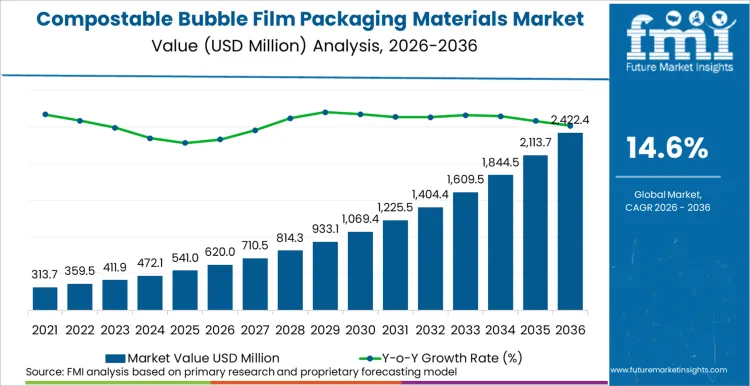
The compostable bubble film packaging materials market is valued at USD 620 million in 2026 and is projected to reach USD 2,422.4 million by 2036 at a 14.60% CAGR. Demand is set by e-commerce fulfillment standards, product protection requirements, and disposal pathway rules applied to transit packaging. Packaging owners specify cushioning performance, puncture resistance, and seal integrity during pack design. Once a shipping format enters certification scope, later material changes require renewed conformity testing and claim approval. Volume growth follows expansion of parcel shipping, direct-to-consumer distribution, and regulatory pressure to replace conventional plastic cushioning in protective mailers and wrap formats.
Access to the compostable bubble film packaging materials market is governed by inclusion in approved packaging formats held by retailers, logistics operators, and brand owners. Entry depends on documented compostability outcomes, protection performance under drop and vibration profiles, and compatibility with existing packing equipment. Approved formats remain stable across extended program cycles because labeling permissions and compliance files attach to complete constructions. Supplier changes occur during packaging platform updates rather than routine purchasing. Revenue development reflects the number of shipping programs converted to certified compostable cushioning. Competitive position depends on early involvement in packaging design programs and continued acceptance within controlled material frameworks used by distribution networks.
Compostable Bubble Film Packaging Materials Market Quick Stats
- Compostable Bubble Film Packaging Materials Market Value (2026): USD 620 million
- Compostable Bubble Film Packaging Materials Market Forecast Value (2036): USD 2,422.4 million
- Compostable Bubble Film Packaging Materials Market Forecast CAGR 2026 to 2036: 14.6%
- Leading End Use in Compostable Bubble Film Packaging Materials Market: E-commerce and fragile goods
- Key Growth Regions in Compostable Bubble Film Packaging Materials Market: India, China, USA, Germany, Japan
- Top Players in Compostable Bubble Film Packaging Materials Market: Storopack, Sealed Air, Pregis, Ranpak, Huilong Packaging, FP Corporation
What is the Growth Forecast for the Compostable Bubble Film Packaging Materials Market through 2036?
Protective packaging in this segment balances cushioning performance, pack density, and disposal route compatibility. The compostable bubble film packaging materials market in 2026 stands at USD 620.0 million, up from USD 313.7 million in 2021 as e commerce, electronics, and fulfillment operations look to replace conventional air bubble films. Buyers evaluate these materials through burst strength, recovery after compression, seal behavior, and consistency on automated wrapping lines. Adoption depends on how well the film runs inside existing packing equipment and how reliably it protects goods in transit. The path to USD 2,422.4 million by 2036 represents a 14.60% growth rate driven by broader platform mandates and higher usage per shipment.
Fulfillment network design shapes commercial demand in the compostable bubble film packaging materials market. Volumes follow long term contracts tied to packing line standardization and sustainability targets. Inventory exposure stays moderate since roll stock turns quickly. Cost structure reflects resin systems, extrusion yield, bubble forming precision, and conversion scrap. Operations teams track damage rates, pack speed, and storage efficiency as primary metrics. Annual values pass USD 933.1 million in 2029 and USD 1,404.4 million in 2033 as more networks switch base materials. The move to USD 2,422.4 million in 2036 comes from wider coverage across shipping categories, thicker cushioning builds for fragile goods, and longer agreements that fix these films into standard packaging playbooks.
Compostable Bubble Film Packaging Materials Market Key Takeaways
| Metric | Value |
|---|---|
| Market Value (2026) | USD 620 million |
| Forecast Value (2036) | USD 2,422.4 million |
| Forecast CAGR 2026 to 2036 | 14.6% |
Source: FMI’s proprietary forecasting model and primary research
How Is the Compostable Bubble Film Packaging Materials Market Being Used to Control Protection Performance and End of Life Compliance in Transit Packaging?
Packaging suppliers treat the compostable bubble film packaging materials market as part of claims governance and disposal routing rather than as a simple replacement for conventional cushioning. Programs specify certified compostable protective packaging films and industrial compostable cushioning bubble materials to meet handling protection targets while preserving defined end of life pathways. Qualification teams rely on compostability testing and certification services and disintegration performance validation protocols to confirm that bubble structures, seal layers, and additives do not block breakdown. Engineering groups evaluate bio based cushioning film structures and compostable sealing and bonding systems to keep air retention and impact absorption stable during storage and transport. The focus stays on burst resistance, compression recovery, and leak rate control because packaging that protects well but fails composting audits creates compliance exposure and claim withdrawal risk.
Release governance places compostable packaging compliance documentation frameworks inside shipment approval rather than inside design review. Selection criteria for compostable protective packaging suppliers include feedstock traceability and consistency of bubble geometry across runs. Life cycle assessment for compostable transit packaging systems is used to confirm that performance gains do not undermine disposal claims. Waste stream compatibility for compostable cushioning materials shapes material choice because misrouting defeats recovery targets. Transit durability testing for compostable bubble films defines acceptance gates for drop, vibration, and stacking loads. Audit readiness for compostable packaging claims sets ongoing surveillance requirements. This makes bubble film specification a certification and risk control decision rather than a short term cost or logistics convenience choice.
How Do Shipping Damage Risk and Waste Stream Compatibility Shape Demand in the Compostable Bubble Film Packaging Materials Market by End Use and Cushioning Format in 2026?
In the Compostable Bubble Film Packaging Materials Market, material selection begins with drop damage exposure, return rates, and disposal pathway compatibility rather than with packaging material cost alone. Operators running e-commerce logistics networks, marketplace fulfillment systems, and premium shipping programs require cushioning materials that absorb impact while meeting compostability and labeling requirements. By end use, demand spans e-commerce and fragile goods, e-commerce fulfillment, mass logistics, premium logistics, marketplace shipping, and other uses. By cushioning format, usage covers bubble wrap and air pillows, protective mailers, cushion films, thin cushioning films, and other formats. Portfolio structure reflects breakage risk, packing speed, and waste compliance exposure.
Why Does E-Commerce and Fragile Goods Shipping Anchor Volume Demand?
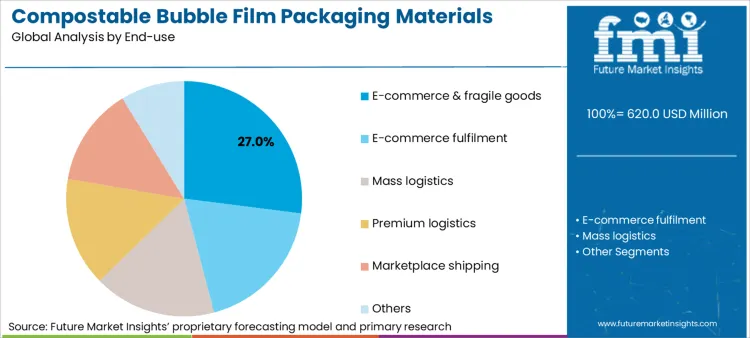
E-commerce and fragile goods account for about 27% share, reflecting high exposure to parcel drops, conveyor handling, and last-mile variability. In e-commerce logistics networks, packaging failure directly translates into returns, refunds, and reverse logistics cost. E-commerce fulfillment operations follow, driven by standardized pack stations and throughput targets. Mass logistics focuses on cost-per-shipment and packing speed, while premium logistics prioritizes presentation and damage avoidance. Marketplace shipping remains fragmented across seller types. Packaging engineers evaluate end uses through drop test performance and pack density. Operations teams evaluate through packing time and material consumption. Quality teams evaluate through breakage rates and customer complaints.
End-use focus sets cartonization rules, packing station layouts, and material cut lengths. A change in target application requires new drop tests and revised packing instructions. Procurement aligns sourcing to secure continuity of the approved cushioning grade. Audit and sustainability reporting also follow the same application logic. Growth comes from adding more shipments within the same use case rather than switching between shipping models. Demand therefore concentrates in fragile goods and high-return-risk categories where damage prevention and waste compliance intersect.
Why Do Bubble Wrap and Cushion Film Formats Lead Adoption?
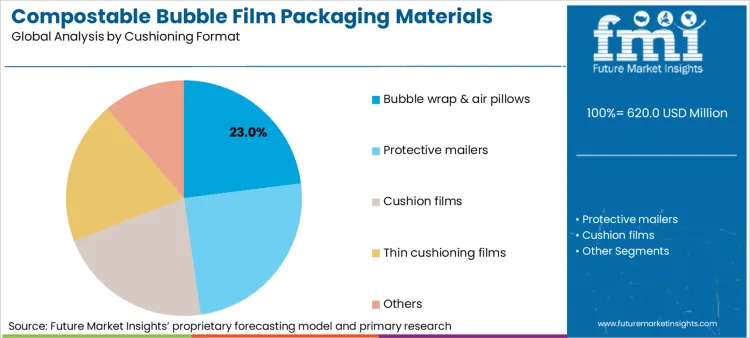
Bubble wrap and air pillows represent about 23% share, reflecting their versatility, predictable energy absorption, and compatibility with manual and automated packing lines. This format fits most box geometries and allows on-demand inflation in fulfillment centers. Protective mailers serve small, flat items where packaging simplicity matters. Cushion films support wrap-style protection for irregular shapes, while thin cushioning films address lightweight shipments. Other formats remain niche. Materials teams evaluate formats through compression set and rebound. Operations teams evaluate through packing speed and storage volume. Sustainability teams evaluate through compostability performance and labeling compliance.
Format selection then fixes dispenser equipment, storage footprint, and packing workflows. Any change requires new operator training and revised work instructions. Production planning aligns inventory and replenishment to the chosen format mix. Supplier contracts and quality plans also follow. Field performance tracking and damage claim analysis assume the same cushioning behavior. Expansion occurs by deploying the same formats across more fulfillment sites rather than introducing new cushioning concepts. Demand therefore concentrates in bubble-based and cushion film solutions that balance protection reliability, packing efficiency, and waste stream compatibility across high-volume shipping operations.
Why Are Shipping Protection Requirements Pulling Demand for Compostable Bubble Film Packaging Materials?
E-commerce fulfillment centers and distribution warehouses depend on cushioning films that absorb impact while staying easy to wrap, seal, and cut. At the same time, protective packaging operations and parcel shipping workflows are tightening material acceptance rules for disposal and recovery pathways. These two pressures converge in bubble film, where compostable structures must still deliver puncture resistance, consistent bubble integrity, and stable winding behavior. Packaging certification programs and material compliance frameworks evaluate performance at the finished film level rather than at resin level. Demand grows because packers want cushioning materials that behave like conventional bubble film without forcing changes to packing stations or operator routines.
What Is Preventing Fast Standardization of Compostable Bubble Film Structures?
Feedstock variability across biopolymer film supply chains and additive compounding systems creates wide differences in bubble stability, seal strength, and tear behavior. Requirements for electronics packaging differ from those for glassware and consumer goods shipping, which blocks reuse of one bubble structure across categories. Qualification must also pass through drop test laboratories and customer transit simulations, which slows rollout. These dependencies keep bubble film recipes application specific. Converters face multiple SKUs, extended trial cycles, and limited ability to collapse platforms even when outer pack formats look similar.
How Are Packaging Line Strategies Changing Bubble Film Material Development?
Material suppliers and converters are moving toward families of compatible bubble films designed to run on the same inflation, lamination, and slitting equipment. Packaging equipment teams and line engineering groups are now involved earlier to define acceptable stiffness, seal windows, and unwind behavior. Testing and validation partners are also engaged upstream to lock constructions before high volume packing trials. Development is shifting toward repeatable material stacks supported by shared performance data and defined processing ranges. Competitive position comes from offering proven bubble film systems that reduce line risk, cut requalification time, and keep packing throughput stable.
What is the Demand for Compostable Bubble Film Packaging Materials by Country?
| Country | CAGR (%) |
|---|---|
| Germany | 13.6% |
| USA | 14.0% |
| China | 16.4% |
| Japan | 11.8% |
| India | 17.0% |
Source: FMI’s proprietary forecasting model and primary research
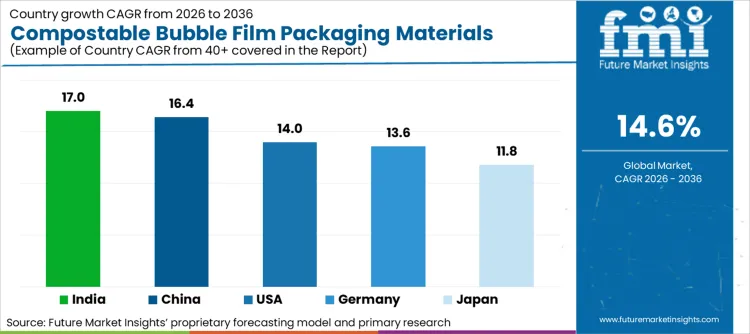
The demand for compostable bubble film packaging materials is increasing across e-commerce, electronics, and consumer goods packaging where protection, sustainability, and end-of-life compliance are essential. India leads at 17.0% CAGR, supported by expanding e-commerce operations, rising awareness of eco-friendly packaging, and government initiatives promoting biodegradable materials. China follows at 16.4%, driven by large scale manufacturing and adoption of compostable films for both domestic and export packaging. The USA grows at 14.0%, shaped by corporate sustainability programs and consumer preference for environmentally responsible packaging. Germany records 13.6%, reflecting strict environmental regulations and demand for certified compostable protective films. Japan posts 11.8%, within a mature market emphasizing compliance, quality, and material certification.
How E-Commerce Growth Drives the Compostable Bubble Film Packaging Materials Market in Germany
Rapid expansion of online retail and parcel shipping is supporting a 13.6% CAGR for the compostable bubble film packaging materials market in Germany. Material selection emphasizes cushioning performance, puncture resistance, and certified compostability under industrial and home composting standards. Technical evaluation includes bubble integrity, tensile strength, dimensional stability, and compatibility with automated packaging lines. Once a material passes validation, it is deployed across multiple production lines and packaging applications. Volume growth is aligned with e-commerce logistics, retail packaging programs, and sustainable packaging mandates. Supplier participation depends on certification documentation, quality verification, and technical support for high-throughput production. Commercial success relies on reproducible material performance, operational reliability, and consistent compliance across manufacturing sites.
How Logistics and Safety Requirements Influence the Compostable Bubble Film Packaging Materials Market in the USA
In the United States, the compostable bubble film packaging materials market is growing at a 14% CAGR due to increasing adoption of eco-friendly packaging in e-commerce and retail distribution. Materials are assessed for impact absorption, bubble stability, barrier protection, and compatibility with automated filling and sealing equipment. Technical teams examine puncture resistance, stretchability, and print adhesion. Once approved, products are deployed across multiple production lines and shipping applications. Supplier access depends on certification verification, audit compliance, and technical support capabilities. Volume growth is linked to e-commerce expansion, packaging programs for consumer goods, and institutional sustainability initiatives. Commercial success relies on consistent cushioning performance, durability, and operational reliability across production environments.
How Urban Distribution Networks Shape the Compostable Bubble Film Packaging Materials Market in China
High-volume parcel delivery and urban distribution programs are driving the compostable bubble film packaging materials market in China at a 16.4% CAGR. Selection emphasizes bubble uniformity, tensile strength, and certified compostability. Engineers evaluate material performance under repeated compression, thermal stability, and compatibility with automated packaging machines. Once validated, the same material is deployed across multiple production lines and packaging formats. Supplier participation depends on audit compliance, technical documentation, and integration support. Volume growth follows the expansion of e-commerce, logistics, and retail packaging networks. Commercial advantage relies on reproducible cushioning performance, operational reliability, and consistent quality across high-throughput production facilities.
How Food Safety and Packaging Standards Influence the Compostable Bubble Film Packaging Materials Market in Japan
In Japan, the compostable bubble film packaging materials market is advancing at an 11.8% CAGR due to strict food safety and packaging regulations. Materials are selected for cushioning efficacy, puncture resistance, barrier integrity, and certified compostability. Evaluation focuses on dimensional stability, bubble integrity, thermal tolerance, and compatibility with automated packaging and filling equipment. Once validated, products are deployed across multiple production lines for retail, e-commerce, and foodservice applications. Supplier access depends on certification completeness, audit compliance, and technical support. Volume growth follows adoption by major retailers, parcel services, and packaged goods programs. Commercial success relies on consistent performance, reproducibility, and operational reliability across manufacturing sites.
How Platform Expansion and High-Volume E-Commerce Drive the Compostable Bubble Film Packaging Materials Market in India
Compostable bubble film packaging materials market in India is growing at a 17% CAGR due to increasing e-commerce adoption and expansion of large-scale distribution platforms. Materials are selected for tensile strength, bubble stability, puncture resistance, and certified compostability. Engineers evaluate dimensional consistency, performance under compression, and compatibility with high-speed automated packaging machines. Once validated, products are deployed across multiple production lines and logistics packaging programs. Supplier participation depends on documentation, certification verification, and technical support. Volume growth follows fleet expansion, e-commerce platform adoption, and packaging program scale-up. Commercial advantage relies on reproducible cushioning performance, operational reliability, and consistent process support across production facilities.
What Strategies Are Suppliers Using in the Compostable Bubble Film Packaging Materials Market?
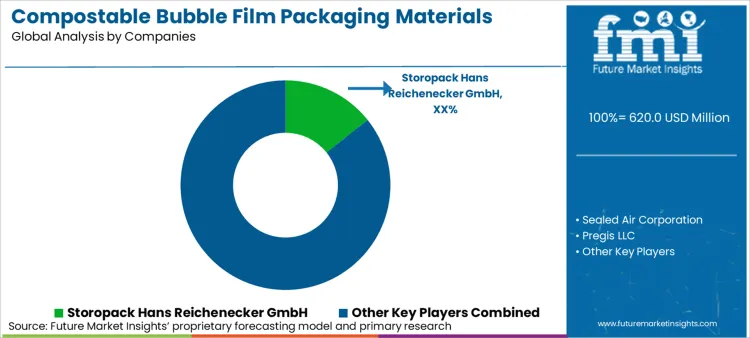
Film compostability, cushioning performance, and production adaptability drive adoption in the Compostable Bubble Film Packaging Materials Market. Storopack, Sealed Air, Pregis, Ranpak, Huilong Packaging, and FP Corporation compete during pilot production, bubble integrity testing, and industrial line validation. Once integrated into protective packaging for electronics, consumer goods, or fragile items, resilience, air retention, and certified compostability anchor supplier selection. Storopack emphasizes engineered bubble films with verified industrial composting performance. Sealed Air delivers flexible solutions compatible with automated packaging lines. Pregis provides compostable cushioning films optimized for e-commerce shipments. Ranpak targets pulp-based and hybrid packaging solutions. Huilong Packaging focuses on high-performance, bio-based bubble films. FP Corporation supplies scalable, certified compostable cushioning materials.
Mechanical reliability, film uniformity, and certification compliance shape competitive positioning in the Compostable Bubble Film Packaging Materials Market. Engineers assess puncture resistance, air retention, compostability verification, and dimensional stability during trials. Production teams prioritize suppliers able to deliver reproducible lots, scalable output, and technical guidance for automated packaging integration. Storopack secures adoption through process support and verified compostable testing. Sealed Air maintains share in industrial and e-commerce applications. Pregis captures adoption in flexible packaging workflows. Ranpak competes in hybrid or pulp-integrated cushioning solutions. Huilong Packaging holds positions where high-performance biofilms are critical. FP Corporation provides industrial-scale support and certification verification. Market positions vary by film composition, application type, production scale, and regional environmental standards.
Key Players in Compostable Bubble Film Packaging Materials Market
- Storopack Hans Reichenecker GmbH
- Sealed Air Corporation
- Pregis LLC
- Ranpak Holdings Corp.
- Huilong Packaging
- FP Corporation
Scope of the Report
| Items | Values |
|---|---|
| Quantitative Units (2026) | USD million |
| End-use | E-commerce and fragile goods, e-commerce fulfilment, mass logistics, premium logistics, marketplace shipping, others |
| Cushioning Format | Bubble wrap and air pillows, protective mailers, cushion films, thin cushioning films, others |
| Material | PLA or PBAT blends, compostable blends, PLA or PBAT, others |
| Foam or Film Technology | Air-cell extrusion and heat sealing, on-demand air systems, high-speed bubble forming, precision sealing, others |
| Regions Covered | Asia Pacific, Europe, North America, Latin America, Middle East & Africa |
| Countries Covered | United States, Canada, Mexico, Germany, United Kingdom, France, Italy, Spain, Nordics, BENELUX, China, Japan, South Korea, India, Australia & New Zealand, ASEAN, Brazil, Chile, Saudi Arabia, Turkey, South Africa, and other regional markets |
| Key Companies Profiled | Storopack Hans Reichenecker, Sealed Air, Pregis, Ranpak, Huilong Packaging, FP Corporation |
| Additional Attributes | Dollar sales by end-use, cushioning format, material, and foam or film technology, cushioning performance and damage reduction metrics, compostability certification and audit governance, drop, vibration, and stacking test protocols, compatibility with automated packing lines and on-demand air systems, bubble integrity and air retention performance, fulfillment network standardization cycles, multi-year packaging program contracts, and regional demand patterns across e-commerce, logistics, and consumer goods shipping |
Compostable Bubble Film Packaging Materials Market Segmentation
End-use:
- E-commerce & fragile goods
- E-commerce fulfilment
- Mass logistics
- Premium logistics
- Marketplace shipping
- Others
Cushioning Format:
- Bubble wrap & air pillows
- Protective mailers
- Cushion films
- Thin cushioning films
- Others
Material:
- PLA or PBAT blends
- Compostable blends
- PLA or PBAT
- Others
Foam or Film Technology:
- Air-cell extrusion & heat sealing
- On-demand air systems
- High-speed bubble forming
- Precision sealing
- Others
Region
- Asia Pacific
- China
- Japan
- South Korea
- India
- Australia & New Zealand
- ASEAN
- Rest of Asia Pacific
- Europe
- Germany
- United Kingdom
- France
- Italy
- Spain
- Nordic
- BENELUX
- Rest of Europe
- North America
- United States
- Canada
- Mexico
- Latin America
- Brazil
- Chile
- Rest of Latin America
- Middle East & Africa
- Kingdom of Saudi Arabia
- Other GCC Countries
- Turkey
- South Africa
- Other African Union
- Rest of Middle East & Africa
Bibliography
- European Commission. (2024). Packaging and Packaging Waste Regulation (PPWR) - Policy and legislative status. European Commission.
- European Committee for Standardization. (2024). EN 13432: Packaging - Requirements for packaging recoverable through composting and biodegradation. CEN.
- International Organization for Standardization. (2023). ISO 17088: Specifications for compostable plastics. ISO.
- International Organization for Standardization. (2024). ISO 14855: Determination of the ultimate aerobic biodegradability of plastic materials under controlled composting conditions. ISO.
-
Frequently Asked Questions
- How big is the compostable bubble film packaging materials market in 2026? The compostable bubble film packaging materials market is projected to be valued at USD 620 million in 2026.
- What will be the size of the compostable bubble film packaging materials market in 2036? The market size for compostable bubble film packaging materials is projected to reach USD 2,422.4 million by 2036.
- How fast will the compostable bubble film packaging materials market grow between 2026 and 2036? Demand for compostable bubble film packaging materials is projected to grow at a 14.6% CAGR between 2026 and 2036.
- Which end-use segment holds a significant share in the compostable bubble film packaging materials market in 2026? In terms of end use, e-commerce and fragile goods are expected to account for a 27% share in 2026.
- Which cushioning format category contributes a major share in the compostable bubble film packaging materials market in 2026? Bubble wrap and air pillows are expected to represent a 23% share in the compostable bubble film packaging materials market in 2026.
Frequently Asked Questions
How big is the compostable bubble film packaging materials market in 2026?
The global compostable bubble film packaging materials market is estimated to be valued at USD 620.0 million in 2026.
What will be the size of compostable bubble film packaging materials market in 2036?
The market size for the compostable bubble film packaging materials market is projected to reach USD 2,422.4 million by 2036.
How much will be the compostable bubble film packaging materials market growth between 2026 and 2036?
The compostable bubble film packaging materials market is expected to grow at a 14.6% CAGR between 2026 and 2036.
What are the key product types in the compostable bubble film packaging materials market?
The key product types in compostable bubble film packaging materials market are e-commerce & fragile goods, e-commerce fulfilment, mass logistics, premium logistics, marketplace shipping and others.
Which cushioning format segment to contribute significant share in the compostable bubble film packaging materials market in 2026?
In terms of cushioning format, bubble wrap & air pillows segment to command 23.0% share in the compostable bubble film packaging materials market in 2026.
Preview the report firsthand - request a free sample
Get SampleGet the brochure for pricing and purchase details.
Get PDFTable of Content
- Executive Summary
- Global Market Outlook
- Demand-side Trends
- Supply-side Trends
- Technology Roadmap Analysis
- Analysis and Recommendations
- Market Overview
- Market Coverage / Taxonomy
- Market Definition / Scope / Limitations
- Market Background
- Market Dynamics
- Drivers
- Restraints
- Opportunity
- Trends
- Scenario Forecast
- Demand in Optimistic Scenario
- Demand in Likely Scenario
- Demand in Conservative Scenario
- Opportunity Map Analysis
- Product Life Cycle Analysis
- Supply Chain Analysis
- Investment Feasibility Matrix
- Value Chain Analysis
- PESTLE and Porter’s Analysis
- Regulatory Landscape
- Regional Parent Market Outlook
- Production and Consumption Statistics
- Import and Export Statistics
- Market Dynamics
- Global Market Analysis 2021 to 2025 and Forecast, 2026 to 2036
- Historical Market Size Value (USD Million) Analysis, 2021 to 2025
- Current and Future Market Size Value (USD Million) Projections, 2026 to 2036
- Y-o-Y Growth Trend Analysis
- Absolute $ Opportunity Analysis
- Global Market Pricing Analysis 2021 to 2025 and Forecast 2026 to 2036
- Global Market Analysis 2021 to 2025 and Forecast 2026 to 2036, By End-use
- Introduction / Key Findings
- Historical Market Size Value (USD Million) Analysis By End-use , 2021 to 2025
- Current and Future Market Size Value (USD Million) Analysis and Forecast By End-use , 2026 to 2036
- E-commerce & fragile goods
- E-commerce fulfilment
- Mass logistics
- Premium logistics
- Marketplace shipping
- Others
- E-commerce & fragile goods
- Y-o-Y Growth Trend Analysis By End-use , 2021 to 2025
- Absolute $ Opportunity Analysis By End-use , 2026 to 2036
- Global Market Analysis 2021 to 2025 and Forecast 2026 to 2036, By Cushioning Format
- Introduction / Key Findings
- Historical Market Size Value (USD Million) Analysis By Cushioning Format, 2021 to 2025
- Current and Future Market Size Value (USD Million) Analysis and Forecast By Cushioning Format, 2026 to 2036
- Bubble wrap & air pillows
- Protective mailers
- Cushion films
- Thin cushioning films
- Others
- Bubble wrap & air pillows
- Y-o-Y Growth Trend Analysis By Cushioning Format, 2021 to 2025
- Absolute $ Opportunity Analysis By Cushioning Format, 2026 to 2036
- Global Market Analysis 2021 to 2025 and Forecast 2026 to 2036, By Material
- Introduction / Key Findings
- Historical Market Size Value (USD Million) Analysis By Material, 2021 to 2025
- Current and Future Market Size Value (USD Million) Analysis and Forecast By Material, 2026 to 2036
- PLA or PBAT blends
- Compostable blends
- PLA or PBAT
- PLA or PBAT blends
- Y-o-Y Growth Trend Analysis By Material, 2021 to 2025
- Absolute $ Opportunity Analysis By Material, 2026 to 2036
- Global Market Analysis 2021 to 2025 and Forecast 2026 to 2036, By Foam or Film Technology
- Introduction / Key Findings
- Historical Market Size Value (USD Million) Analysis By Foam or Film Technology, 2021 to 2025
- Current and Future Market Size Value (USD Million) Analysis and Forecast By Foam or Film Technology, 2026 to 2036
- Air-cell extrusion & heat sealing
- On-demand air systems
- High-speed bubble forming
- Precision sealing
- Others
- Air-cell extrusion & heat sealing
- Y-o-Y Growth Trend Analysis By Foam or Film Technology, 2021 to 2025
- Absolute $ Opportunity Analysis By Foam or Film Technology, 2026 to 2036
- Global Market Analysis 2021 to 2025 and Forecast 2026 to 2036, By Region
- Introduction
- Historical Market Size Value (USD Million) Analysis By Region, 2021 to 2025
- Current Market Size Value (USD Million) Analysis and Forecast By Region, 2026 to 2036
- North America
- Latin America
- Western Europe
- Eastern Europe
- East Asia
- South Asia and Pacific
- Middle East & Africa
- Market Attractiveness Analysis By Region
- North America Market Analysis 2021 to 2025 and Forecast 2026 to 2036, By Country
- Historical Market Size Value (USD Million) Trend Analysis By Market Taxonomy, 2021 to 2025
- Market Size Value (USD Million) Forecast By Market Taxonomy, 2026 to 2036
- By Country
- USA
- Canada
- Mexico
- By End-use
- By Cushioning Format
- By Material
- By Foam or Film Technology
- By Country
- Market Attractiveness Analysis
- By Country
- By End-use
- By Cushioning Format
- By Material
- By Foam or Film Technology
- Key Takeaways
- Latin America Market Analysis 2021 to 2025 and Forecast 2026 to 2036, By Country
- Historical Market Size Value (USD Million) Trend Analysis By Market Taxonomy, 2021 to 2025
- Market Size Value (USD Million) Forecast By Market Taxonomy, 2026 to 2036
- By Country
- Brazil
- Chile
- Rest of Latin America
- By End-use
- By Cushioning Format
- By Material
- By Foam or Film Technology
- By Country
- Market Attractiveness Analysis
- By Country
- By End-use
- By Cushioning Format
- By Material
- By Foam or Film Technology
- Key Takeaways
- Western Europe Market Analysis 2021 to 2025 and Forecast 2026 to 2036, By Country
- Historical Market Size Value (USD Million) Trend Analysis By Market Taxonomy, 2021 to 2025
- Market Size Value (USD Million) Forecast By Market Taxonomy, 2026 to 2036
- By Country
- Germany
- UK
- Italy
- Spain
- France
- Nordic
- BENELUX
- Rest of Western Europe
- By End-use
- By Cushioning Format
- By Material
- By Foam or Film Technology
- By Country
- Market Attractiveness Analysis
- By Country
- By End-use
- By Cushioning Format
- By Material
- By Foam or Film Technology
- Key Takeaways
- Eastern Europe Market Analysis 2021 to 2025 and Forecast 2026 to 2036, By Country
- Historical Market Size Value (USD Million) Trend Analysis By Market Taxonomy, 2021 to 2025
- Market Size Value (USD Million) Forecast By Market Taxonomy, 2026 to 2036
- By Country
- Russia
- Poland
- Hungary
- Balkan & Baltic
- Rest of Eastern Europe
- By End-use
- By Cushioning Format
- By Material
- By Foam or Film Technology
- By Country
- Market Attractiveness Analysis
- By Country
- By End-use
- By Cushioning Format
- By Material
- By Foam or Film Technology
- Key Takeaways
- East Asia Market Analysis 2021 to 2025 and Forecast 2026 to 2036, By Country
- Historical Market Size Value (USD Million) Trend Analysis By Market Taxonomy, 2021 to 2025
- Market Size Value (USD Million) Forecast By Market Taxonomy, 2026 to 2036
- By Country
- China
- Japan
- South Korea
- By End-use
- By Cushioning Format
- By Material
- By Foam or Film Technology
- By Country
- Market Attractiveness Analysis
- By Country
- By End-use
- By Cushioning Format
- By Material
- By Foam or Film Technology
- Key Takeaways
- South Asia and Pacific Market Analysis 2021 to 2025 and Forecast 2026 to 2036, By Country
- Historical Market Size Value (USD Million) Trend Analysis By Market Taxonomy, 2021 to 2025
- Market Size Value (USD Million) Forecast By Market Taxonomy, 2026 to 2036
- By Country
- India
- ASEAN
- Australia & New Zealand
- Rest of South Asia and Pacific
- By End-use
- By Cushioning Format
- By Material
- By Foam or Film Technology
- By Country
- Market Attractiveness Analysis
- By Country
- By End-use
- By Cushioning Format
- By Material
- By Foam or Film Technology
- Key Takeaways
- Middle East & Africa Market Analysis 2021 to 2025 and Forecast 2026 to 2036, By Country
- Historical Market Size Value (USD Million) Trend Analysis By Market Taxonomy, 2021 to 2025
- Market Size Value (USD Million) Forecast By Market Taxonomy, 2026 to 2036
- By Country
- Kingdom of Saudi Arabia
- Other GCC Countries
- Turkiye
- South Africa
- Other African Union
- Rest of Middle East & Africa
- By End-use
- By Cushioning Format
- By Material
- By Foam or Film Technology
- By Country
- Market Attractiveness Analysis
- By Country
- By End-use
- By Cushioning Format
- By Material
- By Foam or Film Technology
- Key Takeaways
- Key Countries Market Analysis
- USA
- Pricing Analysis
- Market Share Analysis, 2025
- By End-use
- By Cushioning Format
- By Material
- By Foam or Film Technology
- Canada
- Pricing Analysis
- Market Share Analysis, 2025
- By End-use
- By Cushioning Format
- By Material
- By Foam or Film Technology
- Mexico
- Pricing Analysis
- Market Share Analysis, 2025
- By End-use
- By Cushioning Format
- By Material
- By Foam or Film Technology
- Brazil
- Pricing Analysis
- Market Share Analysis, 2025
- By End-use
- By Cushioning Format
- By Material
- By Foam or Film Technology
- Chile
- Pricing Analysis
- Market Share Analysis, 2025
- By End-use
- By Cushioning Format
- By Material
- By Foam or Film Technology
- Germany
- Pricing Analysis
- Market Share Analysis, 2025
- By End-use
- By Cushioning Format
- By Material
- By Foam or Film Technology
- UK
- Pricing Analysis
- Market Share Analysis, 2025
- By End-use
- By Cushioning Format
- By Material
- By Foam or Film Technology
- Italy
- Pricing Analysis
- Market Share Analysis, 2025
- By End-use
- By Cushioning Format
- By Material
- By Foam or Film Technology
- Spain
- Pricing Analysis
- Market Share Analysis, 2025
- By End-use
- By Cushioning Format
- By Material
- By Foam or Film Technology
- France
- Pricing Analysis
- Market Share Analysis, 2025
- By End-use
- By Cushioning Format
- By Material
- By Foam or Film Technology
- India
- Pricing Analysis
- Market Share Analysis, 2025
- By End-use
- By Cushioning Format
- By Material
- By Foam or Film Technology
- ASEAN
- Pricing Analysis
- Market Share Analysis, 2025
- By End-use
- By Cushioning Format
- By Material
- By Foam or Film Technology
- Australia & New Zealand
- Pricing Analysis
- Market Share Analysis, 2025
- By End-use
- By Cushioning Format
- By Material
- By Foam or Film Technology
- China
- Pricing Analysis
- Market Share Analysis, 2025
- By End-use
- By Cushioning Format
- By Material
- By Foam or Film Technology
- Japan
- Pricing Analysis
- Market Share Analysis, 2025
- By End-use
- By Cushioning Format
- By Material
- By Foam or Film Technology
- South Korea
- Pricing Analysis
- Market Share Analysis, 2025
- By End-use
- By Cushioning Format
- By Material
- By Foam or Film Technology
- Russia
- Pricing Analysis
- Market Share Analysis, 2025
- By End-use
- By Cushioning Format
- By Material
- By Foam or Film Technology
- Poland
- Pricing Analysis
- Market Share Analysis, 2025
- By End-use
- By Cushioning Format
- By Material
- By Foam or Film Technology
- Hungary
- Pricing Analysis
- Market Share Analysis, 2025
- By End-use
- By Cushioning Format
- By Material
- By Foam or Film Technology
- Kingdom of Saudi Arabia
- Pricing Analysis
- Market Share Analysis, 2025
- By End-use
- By Cushioning Format
- By Material
- By Foam or Film Technology
- Turkiye
- Pricing Analysis
- Market Share Analysis, 2025
- By End-use
- By Cushioning Format
- By Material
- By Foam or Film Technology
- South Africa
- Pricing Analysis
- Market Share Analysis, 2025
- By End-use
- By Cushioning Format
- By Material
- By Foam or Film Technology
- USA
- Market Structure Analysis
- Competition Dashboard
- Competition Benchmarking
- Market Share Analysis of Top Players
- By Regional
- By End-use
- By Cushioning Format
- By Material
- By Foam or Film Technology
- Competition Analysis
- Competition Deep Dive
- Storopack Hans Reichenecker GmbH
- Overview
- Product Portfolio
- Profitability by Market Segments (Product/Age /Sales Channel/Region)
- Sales Footprint
- Strategy Overview
- Marketing Strategy
- Product Strategy
- Channel Strategy
- Sealed Air Corporation
- Pregis LLC
- Ranpak Holdings Corp.
- Huilong Packaging
- FP Corporation
- Storopack Hans Reichenecker GmbH
- Competition Deep Dive
- Assumptions & Acronyms Used
- Research Methodology


