

- Industry Size (2026)
- USD 702.9 Mn
- Forecast (2036)
- USD 2746.2 Mn
- CAGR (2026 to 2036)
- 14.6%
E-Grocery Compostable Delivery Bags Market Forecast and Outlook 2026 to 2036
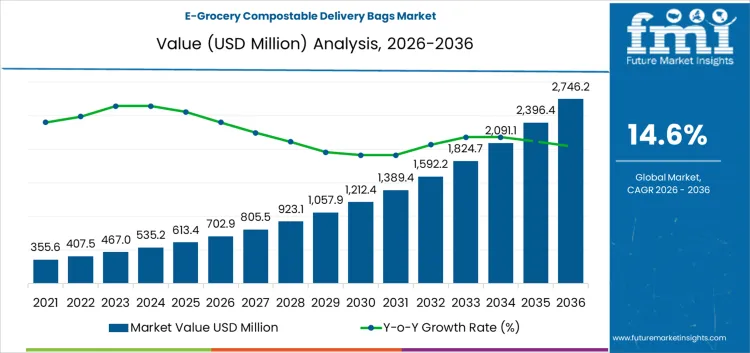
The e-grocery compostable delivery bags market is projected to reach USD 2,746.2 million by 2036, growing at a CAGR of 14.6% from its 2026 value of USD 702.9 million. As the market matures, application concentration will play a crucial role in determining market stability, with key sectors, such as grocery and e-commerce, driving the majority of demand. End-use dependency will shape growth quality, as fluctuations in consumer behavior and the rapid expansion of e-grocery services may affect bag volumes.
Stability in volume growth will be essential, with industry players needing to manage shifting demands in alignment with supply chain dynamics. Seasonal demand and fluctuating regulatory pressures on packaging materials will also affect performance, especially as companies adapt to sustainability targets. The concentration of key players in specific regions, along with their ability to scale, will influence how effectively market players capture value, while also navigating competitive pressures.
Quick Stats for the E-Grocery Compostable Delivery Bags Market:
- E-Grocery Compostable Delivery Bags Market Value (2026): USD 702.9 million
- E-Grocery Compostable Delivery Bags Market Forecast Value (2036): USD 2,746.2 million
- E-Grocery Compostable Delivery Bags Market Global Forecast CAGR (2026-2036): 14.6%
- E-Grocery Compostable Delivery Bags Market Leading Segment: Online Retailers (58%)
- Key Growth Regions in E-Grocery Compostable Delivery Bags Market: India
- Top Players in E-Grocery Compostable Delivery Bags Market: NatureWorks LLC, BASF SE (Compostable Polymers), Novamont S.p.A., TotalEnergies Corbion, FKuR Kunststoff GmbH
What is the Growth Forecast for the E-Grocery Compostable Delivery Bags Market through 2036?
The e-grocery compostable delivery bags market is set to grow at a robust rate through 2036, driven by increasing demand for sustainable packaging solutions. As e-commerce and online grocery shopping continue to expand, compostable delivery bags are expected to play an essential role in minimizing the environmental impact of packaging waste. With a CAGR of 14.6%, the market value is forecast to rise from USD 702.9 million in 2026 to USD 2,746.2 million by 2036. This growth is supported by growing consumer preference for eco-friendly packaging and stricter regulations on single-use plastics.
The shift towards compostable packaging reflects broader trends in sustainability and waste reduction in the e-commerce sector. As companies respond to consumer demand for environmentally friendly practices, the use of compostable bags in grocery deliveries is expected to become more widespread. By 2036, the e-grocery compostable delivery bags market will be an integral part of the industry’s efforts to reduce its environmental footprint and contribute to a more sustainable future in online retail.
E-Grocery Compostable Delivery Bags Market Key Takeaways
| Metric | Value |
|---|---|
| Industry Sales Value (2026) | USD 702.9 million |
| Industry Forecast Value (2036) | USD 2,746.2 million |
| Industry Forecast CAGR 2026 to 2036 | 14.6% |
What Is Driving the E-Grocery Compostable Delivery Bags Market?
Historically, the e grocery compostable delivery bags market evolved in response to rising e commerce penetration and environmental concerns over single use plastics. Traditional delivery methods predominantly used petroleum based plastic bags for parcel protection and insulation, driven by low cost, moisture resistance, and widespread processing familiarity. As online grocery ordering expanded, the volume of single use packaging grew, attracting regulatory scrutiny and consumer criticism. Early adoption of compostable alternatives was gradual, largely concentrated in sustainability minded brands and pilot programs rather than mainstream logistics.
Compostable bags made from plant based polymers such as PLA and starch blends were tested for dry goods and light produce deliveries, where performance met basic requirements. Retailers that trialed compostable bags focused on marketing differentiation and alignment with corporate environmental reports, feeding initial demand without significantly displacing plastic usage in core operations. Infrastructure limitations for industrial composting and questions around performance under diverse delivery conditions restrained rapid adoption.
Future demand for e grocery compostable delivery bags is expected to be driven by tightening regulations on single use plastics, increasing retailer commitments to lower environmental impact, and rising consumer preference for sustainable packaging solutions. As governments enact bans or levies on conventional plastic bags and introduce mandates for compostable alternatives, e grocery providers will be incentivized to transition to certified compostable materials. Retailers and third party delivery platforms are projected to integrate compostable delivery bags into standard logistics, particularly for last mile distribution of fresh and ambient groceries, as part of broader sustainable procurement policies.
Technological advances in biopolymer formulations will improve performance in moisture, grease, and thermal resistance, narrowing the gap with plastic counterparts. Growth factors will include expansion of industrial composting facilities, clearer labeling standards to reduce contamination in waste streams, and cost reductions through scale economies in bioplastic production. Barriers to market expansion will persist, including higher material costs relative to plastics, varying composting infrastructure by region, and the need for stakeholder education on proper disposal. Long term demand trajectories will depend on alignment between regulatory frameworks, logistics performance requirements, and demonstrable environmental benefits in full life cycle assessments.
What are the Key Segments in the E-Grocery Compostable Delivery Bags Market?
The E-Grocery Compostable Delivery Bags market is segmented into product formats and distribution channels. The product formats include standard carry-out bags, drawstring bags, handle pouch bags, and custom printed bags, with standard carry-out bags representing the largest segment. The distribution channels for these bags include online retailers, grocery chains, third-party logistics, and direct-to-consumer sales, with online retailers taking the largest share of 58%. The increasing demand for sustainable and eco-friendly packaging solutions in the e-grocery sector is driving the growth of this market. As more consumers shift to online grocery shopping, the need for compostable delivery bags that are both functional and environmentally responsible is rising. Key regions driving this market include North America, Europe, and Asia Pacific, where consumers and retailers are prioritizing sustainable packaging alternatives.
What is Driving Growth in the Standard Carry-Out Bags Segment?
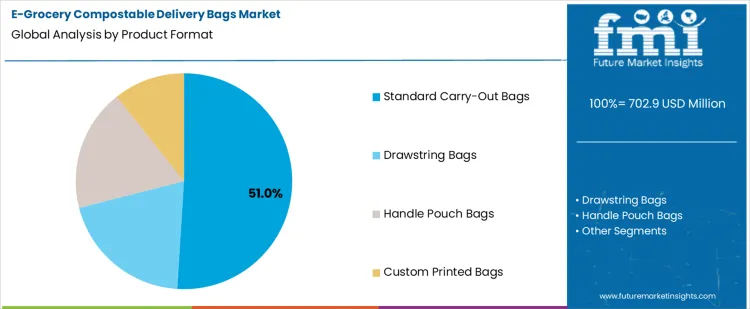
Standard carry-out bags dominate the product format segment, accounting for 51% of the market share. These bags are favored for their simplicity, functionality, and cost-effectiveness in the e-grocery sector. As e-grocery businesses look to reduce their environmental impact, compostable delivery bags made from materials such as PLA and PHA have emerged as a sustainable alternative to conventional plastic bags. Standard carry-out bags are particularly popular because of their wide usage across various e-grocery operations, from fresh food delivery to packaged products. Their versatility and large capacity make them ideal for handling a variety of grocery items, which is a key factor in their widespread adoption.
The growing consumer preference for eco-friendly packaging is another major driver, with many consumers seeking to reduce their environmental footprint. In regions like North America and Europe, where sustainability regulations are more stringent, the demand for compostable standard carry-out bags is expected to grow significantly. Furthermore, the rise of eco-conscious consumer behavior and increasing pressure on retailers to adopt sustainable practices are also contributing to the growth of this segment. As more companies commit to reducing plastic waste, standard carry-out bags made from compostable materials are poised to become the preferred choice for e-grocery deliveries.
What is Driving the Growth of Online Retailers in the E-Grocery Compostable Delivery Bags Market?
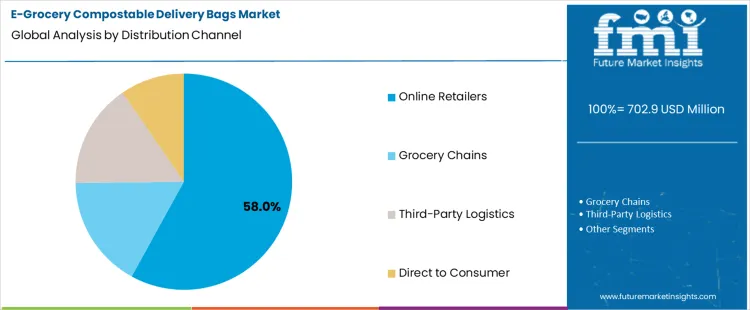
Online retailers account for the largest share of the distribution channel segment in the E-Grocery Compostable Delivery Bags market, with 58% of the market share. The growth of online grocery shopping, particularly accelerated by the COVID-19 pandemic, has significantly increased the demand for delivery bags that are both sustainable and efficient. Online retailers are increasingly turning to compostable delivery bags as part of their efforts to meet consumer demand for eco-friendly packaging and to comply with stringent environmental regulations in various regions. As the e-grocery sector continues to expand, the adoption of compostable bags is being driven by both consumer preference for sustainable products and the need for retailers to differentiate themselves in a competitive market.
Compostable bags, particularly standard carry-out bags, provide an environmentally friendly alternative to traditional plastic bags and offer a functional solution for packaging and delivering groceries. Additionally, the growing emphasis on reducing single-use plastic waste and the rise of sustainability-focused policies by governments in North America and Europe are accelerating the shift to compostable packaging. The ability of online retailers to integrate these solutions into their supply chains, coupled with the growing awareness of environmental issues, is expected to continue driving the demand for compostable delivery bags in the e-grocery market.
What are the Key Dynamics in the E-Grocery Compostable Delivery Bags Market?
The e-grocery compostable delivery bags market is expanding as consumer demand for environmentally friendly packaging solutions rises. As e-commerce grocery shopping continues to grow, the need for sustainable, compostable delivery options has gained traction among retailers and consumers alike. Compostable delivery bags made from materials such as plant-based biopolymers, starches, or polyhydroxyalkanoates (PHA) offer an eco-friendly alternative to traditional plastic bags. These bags break down naturally under composting conditions, reducing the environmental impact of single-use plastics. Increased awareness of plastic pollution and the environmental consequences of waste, particularly in the food and beverage sector, has prompted both consumers and companies to seek biodegradable alternatives. Additionally, governments around the world are enacting stricter regulations on plastic usage, driving the demand for sustainable packaging options in e-grocery deliveries.
What are the Key Drivers of Growth in the E-Grocery Compostable Delivery Bags Market?
Several factors are driving growth in the e-grocery compostable delivery bags market. First, the increasing consumer preference for sustainable and eco-friendly products is pushing grocery delivery companies to adopt compostable bags as part of their environmental strategies. Consumers are more conscious about reducing their carbon footprint, especially when it comes to packaging waste. Moreover, regulatory pressures are encouraging retailers to shift from traditional plastic bags to compostable alternatives, particularly in regions with stringent plastic waste policies. The growing popularity of online grocery shopping, fueled by convenience and evolving consumer habits, further boosts the demand for efficient, environmentally responsible delivery solutions. Innovations in biopolymer technology and the development of cost-effective compostable materials also play a crucial role in making these solutions more viable for widespread adoption.
What are the Key Restraints in the E-Grocery Compostable Delivery Bags Market?
Despite the growth potential, the e-grocery compostable delivery bags market faces several challenges. High production costs of compostable materials, compared to conventional plastic, remain a significant barrier. These costs are primarily due to the expensive raw materials required to create compostable bags, as well as the research and development needed to improve the properties of these materials. Additionally, the infrastructure for industrial composting is not uniformly available across all regions, which means that consumers may not have access to proper disposal systems to ensure these bags break down as intended. This lack of composting infrastructure can limit the practical benefits of using compostable bags. Another challenge is the performance of compostable bags, as they may not always offer the same strength, durability, or moisture resistance as plastic bags, potentially limiting their application in certain types of deliveries.
What are the Key Trends in the E-Grocery Compostable Delivery Bags Market?
Key trends in the e-grocery compostable delivery bags market include advancements in biopolymer research, which are leading to the development of more durable, cost-effective, and high-performance compostable materials. Innovations in materials, such as the use of plant-based plastics and biodegradable polymers, are expanding the functionality of compostable bags, making them more suitable for the diverse needs of e-grocery deliveries. Another trend is the growing focus on the circular economy, with more companies looking to implement systems that integrate compostable packaging into broader waste management and recycling strategies. There is also an increasing push for transparent labeling, allowing consumers to easily identify compostable products and make more informed purchasing decisions. The rise of eco-conscious consumerism and the need for sustainable practices in e-commerce will continue to drive the growth of the compostable delivery bags market, as companies aim to meet both environmental standards and consumer expectations.
What is the Country-Wise Analysis of the E-Grocery Compostable Delivery Bags Market?
The e-grocery compostable delivery bags market is experiencing significant growth across key regions, driven by rising demand for sustainable packaging solutions in the online grocery sector. The shift toward eco-friendly alternatives to plastic bags is being accelerated by increasing environmental concerns, government regulations, and consumer preference for green packaging. Countries such as the USA, China, Germany, the UK, and India are seeing a rapid adoption of compostable delivery bags in the e-grocery industry, with local market dynamics influenced by regulatory frameworks, consumer behavior, and innovations in biodegradable materials. The growth in these regions highlights a global trend towards reducing plastic waste and adopting sustainable practices in the e-commerce and grocery delivery sectors.
| Country | CAGR 2026 to 2036 |
|---|---|
| USA | 13.9% |
| China | 15.7% |
| Germany | 12.8% |
| UK | 11.5% |
| India | 16.4% |
What is Driving the Growth of the E-Grocery Compostable Delivery Bags Market in the USA?
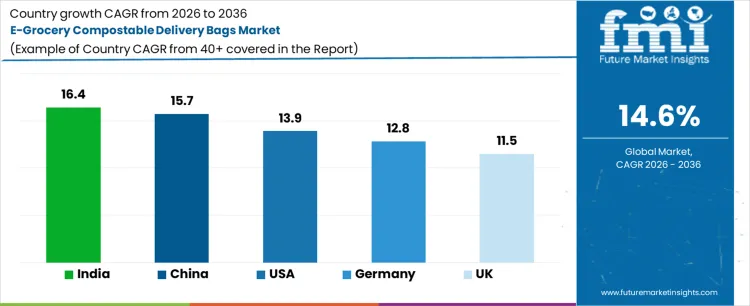
The e-grocery compostable delivery bags market in the USA is growing at a CAGR of 13.9%. This growth is driven by the increasing consumer demand for sustainable packaging options as more people embrace eco-friendly lifestyles. The USA has been at the forefront of adopting biodegradable alternatives in various industries, and the e-grocery sector is no exception. Stringent regulations aimed at reducing plastic waste, especially in major states like California, are pushing e-grocery businesses to adopt compostable delivery bags. Additionally, consumer preference for environmentally conscious brands and the increasing pressure on businesses to meet sustainability targets are contributing to the market’s growth. Innovations in compostable bag materials and improved supply chain logistics are also enhancing the affordability and practicality of using compostable delivery bags in the e-grocery sector.
How is the E-Grocery Compostable Delivery Bags Market Evolving in China?
China’s e-grocery compostable delivery bags market is growing rapidly with a CAGR of 15.7%. As one of the largest e-commerce markets globally, China is increasingly focusing on sustainable packaging due to rising environmental concerns and government policies targeting plastic reduction. China’s government has introduced regulations to reduce plastic waste, which is pushing e-grocery companies to seek alternatives such as compostable delivery bags. In addition, consumer demand for eco-friendly products is rising as more people become aware of environmental issues. As the country’s e-grocery sector continues to expand, the demand for compostable delivery bags is expected to increase significantly. China's focus on innovation and large-scale production of biodegradable materials will likely make compostable delivery bags more accessible and cost-effective, further driving market growth.
What Factors are Influencing the E-Grocery Compostable Delivery Bags Market in Germany?
Germany’s e-grocery compostable delivery bags market is experiencing steady growth, with a CAGR of 12.8%. Germany has long been a leader in sustainability, with strict waste management regulations and a strong commitment to reducing plastic consumption. The German government has introduced laws that require businesses to reduce plastic use and offer biodegradable alternatives. As a result, e-grocery companies are increasingly turning to compostable delivery bags to align with these regulations and meet consumer demand for sustainable packaging. With a highly environmentally conscious consumer base, Germany is seeing increasing adoption of compostable bags in the e-grocery sector. Innovations in biodegradable materials and improvements in bag functionality are making compostable bags a more attractive option for businesses in the country.
How is the E-Grocery Compostable Delivery Bags Market Performing in the UK?
The e-grocery compostable delivery bags market in the UK is growing at a CAGR of 11.5%. The UK’s commitment to reducing plastic waste and promoting sustainability is driving the adoption of compostable delivery bags in the e-grocery sector. The government has introduced various measures to reduce plastic use, including bans on single-use plastic bags and encouraging the use of biodegradable alternatives. As consumer awareness of environmental issues continues to rise, e-grocery businesses in the UK are increasingly adopting compostable delivery bags to meet regulatory requirements and cater to eco-conscious consumers. The growth of the e-commerce sector, combined with an increasing focus on sustainability, is expected to drive further market expansion in the UK.
What is Contributing to the Growth of the E-Grocery Compostable Delivery Bags Market in India?
India’s e-grocery compostable delivery bags market is growing at a CAGR of 16.4%, the highest among the countries analyzed. The rapid growth of the e-commerce and grocery delivery sectors in India is contributing significantly to the demand for compostable delivery bags. India is also facing increasing plastic waste issues, particularly in urban areas, which has led the government to implement stricter regulations and encourage businesses to adopt eco-friendly packaging solutions. The rising awareness among Indian consumers about environmental sustainability is further boosting demand for compostable delivery bags. As the country continues to urbanize and online grocery shopping becomes more widespread, the demand for sustainable packaging solutions like compostable delivery bags is expected to grow substantially.
What is the Competitive Landscape for the E-Grocery Compostable Delivery Bags Market?
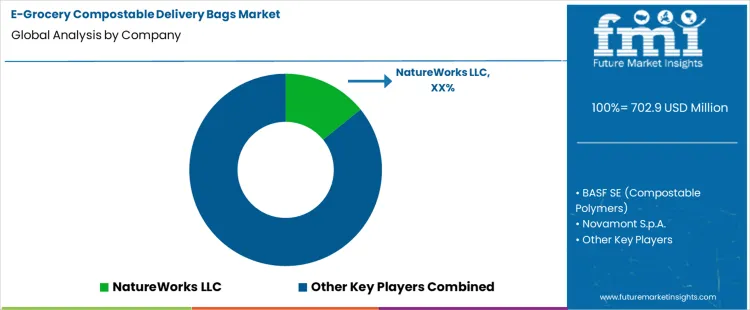
The e-grocery compostable delivery bags market is rapidly expanding, with leading companies driving innovation in sustainable packaging solutions. NatureWorks LLC stands at the forefront, leveraging its expertise in biopolymer production to develop compostable bags that meet the growing demand for environmentally friendly packaging in the e-grocery sector. The company’s strong commitment to sustainability and its advanced production processes have established it as a market leader. BASF SE, a major player in compostable polymers, also contributes significantly to the market, providing high-performance biodegradable materials for packaging applications.
Novamont S.p.A. focuses on developing eco-friendly solutions using its proprietary biopolymer technologies, strengthening its presence in the e-grocery sector. Other companies, including TotalEnergies Corbion and FKuR Kunststoff GmbH, are also actively involved in producing compostable materials tailored for use in delivery bags, aligning with the industry’s shift toward reducing plastic waste and promoting circular economy practices.
In this competitive landscape, companies employ various strategies to secure their position in the growing market for compostable delivery bags. Product innovation is a key focus, with firms continually refining their materials to enhance performance while maintaining environmental benefits. NatureWorks LLC, for example, is investing heavily in improving the durability and functionality of its compostable bags, ensuring they meet the practical needs of e-grocery deliveries.
BASF SE’s strategy includes expanding its portfolio of compostable polymers, targeting a broader range of industries beyond e-grocery. Novamont S.p.A. focuses on strategic collaborations to further the adoption of its products in the packaging market. TotalEnergies Corbion and FKuR Kunststoff GmbH are also forming partnerships to ensure widespread use of their compostable materials, emphasizing scalability and cost-efficiency. These strategies, combined with the growing consumer demand for sustainable solutions, are expected to drive continued market growth and reinforce the competitive positions of these companies in the e-grocery compostable delivery bags market.
Key Players of the E-Grocery Compostable Delivery Bags Market
- NatureWorks LLC
- BASF SE (Compostable Polymers)
- Novamont S.p.A.
- TotalEnergies Corbion
- FKuR Kunststoff GmbH
- Others
Scope of the Report
| Items | Values |
|---|---|
| Quantitative Units (2026) | USD Million |
| Material Type | PLA (Polylactic Acid), PBAT or PBS Blends, PHA (Polyhydroxyalkanoates), Others |
| Product Format | Standard Carry-Out Bags, Drawstring Bags, Handle Pouch Bags, Custom Printed Bags |
| Distribution Channel | Online Retailers, Grocery Chains, Third-Party Logistics, Direct to Consumer |
| Companies | NatureWorks LLC, BASF SE (Compostable Polymers), Novamont S.p.A., TotalEnergies Corbion, FKuR Kunststoff GmbH, Others |
| Regions Covered | North America, Latin America, Western Europe, Eastern Europe, South Asia and Pacific, East Asia, Middle East & Africa |
| Countries Covered | United States, Canada, Mexico, Brazil, Argentina, Germany, France, United Kingdom, Italy, Spain, Netherlands, China, India, Japan, South Korea, ANZ, GCC Countries, South Africa |
| Additional Attributes | Dollar sales by material type, product format, distribution channel, and region. Includes market trends towards compostable and eco-friendly packaging, regulatory compliance, cost-effectiveness, market share and competitive positioning of key companies, and innovations in sustainable delivery bag production. |
E-Grocery Compostable Delivery Bags Market Segmentation
Material Type
- PLA (Polylactic Acid)
- PBAT or PBS Blends
- PHA (Polyhydroxyalkanoates)
- Others
Product Format
- Standard Carry-Out Bags
- Drawstring Bags
- Handle Pouch Bags
- Custom Printed Bags
- Others
Distribution Channel
- Online Retailers
- Grocery Chains
- Third-Party Logistics
- Direct to Consumer
Region
- Asia Pacific
- China
- Japan
- India
- Australia & New Zealand
- ASEAN
- Rest of Asia Pacific
- Europe
- Germany
- United Kingdom
- France
- Italy
- Spain
- Nordic
- BENELUX
- Rest of Europe
- North America
- United States
- Canada
- Mexico
- Latin America
- Brazil
- Argentina
- Rest of Latin America
- Middle East & Africa
- Kingdom of Saudi Arabia
- Other GCC Countries
- South Africa
- Rest of Middle East & Africa
Bibliography
- United Nations Environment Programme. (2023). Turning off the Tap: How the world can end plastic pollution and create a circular economy. United Nations Environment Programme.
- European Parliament and Council of the European Union. (2025). Regulation (EU) 2025/40 on packaging and packaging waste. Official Journal of the European Union.
- Ministry of Environment, Forest and Climate Change, Government of India. (2024). Plastic Waste Management (Amendment) Rules, 2024. Gazette of India.
- ASTM International. (2023). ASTM D6400-23: Standard Specification for Labeling of Plastics Designed to be Aerobically Composted in Municipal or Industrial Facilities. ASTM Standards.
- International Organization for Standardization. (2023). ISO 20200:2023 Plastics: Determination of the degree of disintegration of plastic materials under composting conditions in a laboratory-scale test. ISO Standards.
Frequently Asked Questions
How big is the e-grocery compostable delivery bags market in 2026?
The global e-grocery compostable delivery bags market is estimated to be valued at USD 702.9 million in 2026.
What will be the size of e-grocery compostable delivery bags market in 2036?
The market size for the e-grocery compostable delivery bags market is projected to reach USD 2,746.2 million by 2036.
How much will be the e-grocery compostable delivery bags market growth between 2026 and 2036?
The e-grocery compostable delivery bags market is expected to grow at a 14.6% CAGR between 2026 and 2036.
What are the key product types in the e-grocery compostable delivery bags market?
The key product types in e-grocery compostable delivery bags market are pla (polylactic acid), pbat or pbs blends, pha (polyhydroxyalkanoates) and others.
Which product format segment to contribute significant share in the e-grocery compostable delivery bags market in 2026?
In terms of product format, standard carry-out bags segment to command 51.0% share in the e-grocery compostable delivery bags market in 2026.
Preview the report firsthand - request a free sample
Get SampleGet the brochure for pricing and purchase details.
Get PDFTable of Content
- Executive Summary
- Global Market Outlook
- Demand-side Trends
- Supply-side Trends
- Technology Roadmap Analysis
- Analysis and Recommendations
- Market Overview
- Market Coverage / Taxonomy
- Market Definition / Scope / Limitations
- Market Background
- Market Dynamics
- Drivers
- Restraints
- Opportunity
- Trends
- Scenario Forecast
- Demand in Optimistic Scenario
- Demand in Likely Scenario
- Demand in Conservative Scenario
- Opportunity Map Analysis
- Product Life Cycle Analysis
- Supply Chain Analysis
- Investment Feasibility Matrix
- Value Chain Analysis
- PESTLE and Porter’s Analysis
- Regulatory Landscape
- Regional Parent Market Outlook
- Production and Consumption Statistics
- Import and Export Statistics
- Market Dynamics
- Global Market Analysis 2021 to 2025 and Forecast, 2026 to 2036
- Historical Market Size Value (USD Million) Analysis, 2021 to 2025
- Current and Future Market Size Value (USD Million) Projections, 2026 to 2036
- Y-o-Y Growth Trend Analysis
- Absolute $ Opportunity Analysis
- Global Market Pricing Analysis 2021 to 2025 and Forecast 2026 to 2036
- Global Market Analysis 2021 to 2025 and Forecast 2026 to 2036, By Material Type
- Introduction / Key Findings
- Historical Market Size Value (USD Million) Analysis By Material Type , 2021 to 2025
- Current and Future Market Size Value (USD Million) Analysis and Forecast By Material Type , 2026 to 2036
- PLA (Polylactic Acid)
- PBAT or PBS Blends
- PHA (Polyhydroxyalkanoates)
- Others
- PLA (Polylactic Acid)
- Y-o-Y Growth Trend Analysis By Material Type , 2021 to 2025
- Absolute $ Opportunity Analysis By Material Type , 2026 to 2036
- Global Market Analysis 2021 to 2025 and Forecast 2026 to 2036, By Product Format
- Introduction / Key Findings
- Historical Market Size Value (USD Million) Analysis By Product Format, 2021 to 2025
- Current and Future Market Size Value (USD Million) Analysis and Forecast By Product Format, 2026 to 2036
- Standard Carry-Out Bags
- Drawstring Bags
- Handle Pouch Bags
- Custom Printed Bags
- Standard Carry-Out Bags
- Y-o-Y Growth Trend Analysis By Product Format, 2021 to 2025
- Absolute $ Opportunity Analysis By Product Format, 2026 to 2036
- Global Market Analysis 2021 to 2025 and Forecast 2026 to 2036, By Distribution Channel
- Introduction / Key Findings
- Historical Market Size Value (USD Million) Analysis By Distribution Channel, 2021 to 2025
- Current and Future Market Size Value (USD Million) Analysis and Forecast By Distribution Channel, 2026 to 2036
- Online Retailers
- Grocery Chains
- Third-Party Logistics
- Direct to Consumer
- Online Retailers
- Y-o-Y Growth Trend Analysis By Distribution Channel, 2021 to 2025
- Absolute $ Opportunity Analysis By Distribution Channel, 2026 to 2036
- Global Market Analysis 2021 to 2025 and Forecast 2026 to 2036, By Region
- Introduction
- Historical Market Size Value (USD Million) Analysis By Region, 2021 to 2025
- Current Market Size Value (USD Million) Analysis and Forecast By Region, 2026 to 2036
- North America
- Latin America
- Western Europe
- Eastern Europe
- East Asia
- South Asia and Pacific
- Middle East & Africa
- Market Attractiveness Analysis By Region
- North America Market Analysis 2021 to 2025 and Forecast 2026 to 2036, By Country
- Historical Market Size Value (USD Million) Trend Analysis By Market Taxonomy, 2021 to 2025
- Market Size Value (USD Million) Forecast By Market Taxonomy, 2026 to 2036
- By Country
- USA
- Canada
- Mexico
- By Material Type
- By Product Format
- By Distribution Channel
- By Country
- Market Attractiveness Analysis
- By Country
- By Material Type
- By Product Format
- By Distribution Channel
- Key Takeaways
- Latin America Market Analysis 2021 to 2025 and Forecast 2026 to 2036, By Country
- Historical Market Size Value (USD Million) Trend Analysis By Market Taxonomy, 2021 to 2025
- Market Size Value (USD Million) Forecast By Market Taxonomy, 2026 to 2036
- By Country
- Brazil
- Chile
- Rest of Latin America
- By Material Type
- By Product Format
- By Distribution Channel
- By Country
- Market Attractiveness Analysis
- By Country
- By Material Type
- By Product Format
- By Distribution Channel
- Key Takeaways
- Western Europe Market Analysis 2021 to 2025 and Forecast 2026 to 2036, By Country
- Historical Market Size Value (USD Million) Trend Analysis By Market Taxonomy, 2021 to 2025
- Market Size Value (USD Million) Forecast By Market Taxonomy, 2026 to 2036
- By Country
- Germany
- UK
- Italy
- Spain
- France
- Nordic
- BENELUX
- Rest of Western Europe
- By Material Type
- By Product Format
- By Distribution Channel
- By Country
- Market Attractiveness Analysis
- By Country
- By Material Type
- By Product Format
- By Distribution Channel
- Key Takeaways
- Eastern Europe Market Analysis 2021 to 2025 and Forecast 2026 to 2036, By Country
- Historical Market Size Value (USD Million) Trend Analysis By Market Taxonomy, 2021 to 2025
- Market Size Value (USD Million) Forecast By Market Taxonomy, 2026 to 2036
- By Country
- Russia
- Poland
- Hungary
- Balkan & Baltic
- Rest of Eastern Europe
- By Material Type
- By Product Format
- By Distribution Channel
- By Country
- Market Attractiveness Analysis
- By Country
- By Material Type
- By Product Format
- By Distribution Channel
- Key Takeaways
- East Asia Market Analysis 2021 to 2025 and Forecast 2026 to 2036, By Country
- Historical Market Size Value (USD Million) Trend Analysis By Market Taxonomy, 2021 to 2025
- Market Size Value (USD Million) Forecast By Market Taxonomy, 2026 to 2036
- By Country
- China
- Japan
- South Korea
- By Material Type
- By Product Format
- By Distribution Channel
- By Country
- Market Attractiveness Analysis
- By Country
- By Material Type
- By Product Format
- By Distribution Channel
- Key Takeaways
- South Asia and Pacific Market Analysis 2021 to 2025 and Forecast 2026 to 2036, By Country
- Historical Market Size Value (USD Million) Trend Analysis By Market Taxonomy, 2021 to 2025
- Market Size Value (USD Million) Forecast By Market Taxonomy, 2026 to 2036
- By Country
- India
- ASEAN
- Australia & New Zealand
- Rest of South Asia and Pacific
- By Material Type
- By Product Format
- By Distribution Channel
- By Country
- Market Attractiveness Analysis
- By Country
- By Material Type
- By Product Format
- By Distribution Channel
- Key Takeaways
- Middle East & Africa Market Analysis 2021 to 2025 and Forecast 2026 to 2036, By Country
- Historical Market Size Value (USD Million) Trend Analysis By Market Taxonomy, 2021 to 2025
- Market Size Value (USD Million) Forecast By Market Taxonomy, 2026 to 2036
- By Country
- Kingdom of Saudi Arabia
- Other GCC Countries
- Turkiye
- South Africa
- Other African Union
- Rest of Middle East & Africa
- By Material Type
- By Product Format
- By Distribution Channel
- By Country
- Market Attractiveness Analysis
- By Country
- By Material Type
- By Product Format
- By Distribution Channel
- Key Takeaways
- Key Countries Market Analysis
- USA
- Pricing Analysis
- Market Share Analysis, 2025
- By Material Type
- By Product Format
- By Distribution Channel
- Canada
- Pricing Analysis
- Market Share Analysis, 2025
- By Material Type
- By Product Format
- By Distribution Channel
- Mexico
- Pricing Analysis
- Market Share Analysis, 2025
- By Material Type
- By Product Format
- By Distribution Channel
- Brazil
- Pricing Analysis
- Market Share Analysis, 2025
- By Material Type
- By Product Format
- By Distribution Channel
- Chile
- Pricing Analysis
- Market Share Analysis, 2025
- By Material Type
- By Product Format
- By Distribution Channel
- Germany
- Pricing Analysis
- Market Share Analysis, 2025
- By Material Type
- By Product Format
- By Distribution Channel
- UK
- Pricing Analysis
- Market Share Analysis, 2025
- By Material Type
- By Product Format
- By Distribution Channel
- Italy
- Pricing Analysis
- Market Share Analysis, 2025
- By Material Type
- By Product Format
- By Distribution Channel
- Spain
- Pricing Analysis
- Market Share Analysis, 2025
- By Material Type
- By Product Format
- By Distribution Channel
- France
- Pricing Analysis
- Market Share Analysis, 2025
- By Material Type
- By Product Format
- By Distribution Channel
- India
- Pricing Analysis
- Market Share Analysis, 2025
- By Material Type
- By Product Format
- By Distribution Channel
- ASEAN
- Pricing Analysis
- Market Share Analysis, 2025
- By Material Type
- By Product Format
- By Distribution Channel
- Australia & New Zealand
- Pricing Analysis
- Market Share Analysis, 2025
- By Material Type
- By Product Format
- By Distribution Channel
- China
- Pricing Analysis
- Market Share Analysis, 2025
- By Material Type
- By Product Format
- By Distribution Channel
- Japan
- Pricing Analysis
- Market Share Analysis, 2025
- By Material Type
- By Product Format
- By Distribution Channel
- South Korea
- Pricing Analysis
- Market Share Analysis, 2025
- By Material Type
- By Product Format
- By Distribution Channel
- Russia
- Pricing Analysis
- Market Share Analysis, 2025
- By Material Type
- By Product Format
- By Distribution Channel
- Poland
- Pricing Analysis
- Market Share Analysis, 2025
- By Material Type
- By Product Format
- By Distribution Channel
- Hungary
- Pricing Analysis
- Market Share Analysis, 2025
- By Material Type
- By Product Format
- By Distribution Channel
- Kingdom of Saudi Arabia
- Pricing Analysis
- Market Share Analysis, 2025
- By Material Type
- By Product Format
- By Distribution Channel
- Turkiye
- Pricing Analysis
- Market Share Analysis, 2025
- By Material Type
- By Product Format
- By Distribution Channel
- South Africa
- Pricing Analysis
- Market Share Analysis, 2025
- By Material Type
- By Product Format
- By Distribution Channel
- USA
- Market Structure Analysis
- Competition Dashboard
- Competition Benchmarking
- Market Share Analysis of Top Players
- By Regional
- By Material Type
- By Product Format
- By Distribution Channel
- Competition Analysis
- Competition Deep Dive
- NatureWorks LLC
- Overview
- Product Portfolio
- Profitability by Market Segments (Product/Age /Sales Channel/Region)
- Sales Footprint
- Strategy Overview
- Marketing Strategy
- Product Strategy
- Channel Strategy
- BASF SE (Compostable Polymers)
- Novamont S.p.A.
- TotalEnergies Corbion
- FKuR Kunststoff GmbH
- Others
- NatureWorks LLC
- Competition Deep Dive
- Assumptions & Acronyms Used
- Research Methodology


