

- Industry Size (2025)
- USD 16.5 Mn
- Forecast (2035)
- USD 28.6 Mn
- CAGR (2025 to 2035)
- 5.6%
Demand for Compostable & Biodegradable Refuse Bags in Japan Forecast and Outlook 2025 to 2035
The demand for compostable and biodegradable refuse bags in Japan is expected to grow steadily from USD 16.5 million in 2025 to USD 28.6 million by 2035, driven by a 5.6% CAGR. In the first five years (2025-2030), the industry will grow by USD 5.2 million, reaching USD 21.7 million by 2030. This growth is fueled by increasing environmental awareness and the shift towards sustainable alternatives to conventional plastic bags. The demand in this period will see annual increases of around USD 1.0 million, with more businesses and households adopting eco-friendly packaging solutions as a result of heightened regulatory pressure and growing consumer demand for greener products.
Quick Stats of the Demand for Compostable & Biodegradable Refuse Bags in Japan
- Demand for Compostable & Biodegradable Refuse Bags in Japan Value (2025): USD 16.5 million
- Demand for Compostable & Biodegradable Refuse Bags in Japan Forecast Value (2035): USD 28.6 million
- Demand for Compostable & Biodegradable Refuse Bags in Japan Forecast CAGR (2025-2035): 5.6%
- Demand for Compostable & Biodegradable Refuse Bags in Japan Leading Product Type: Compostable
- Demand for Compostable & Biodegradable Refuse Bags in Japan Key Growth Regions: Kyushu & Okinawa, Kanto, Kansai, Chubu, Tohoku, Rest of Japan
- Demand for Compostable & Biodegradable Refuse Bags in Japan Top Players: Vegware Global, Cedp Ltd., BioBag International AS, Clondalkin Group Holdings B.V., Cardia Compostable

In the next five years (2030-2035), the growth accelerates slightly, with demand rising by USD 6.9 million, reaching USD 28.6 million by 2035. This represents an annual increase of about USD 1.4 million, reflecting Japan's ongoing commitment to sustainability and circular economy practices. The shift toward compostable and biodegradable refuse bags is expected to gain momentum as both consumers and companies align with government-driven environmental goals, which are anticipated to further influence industry dynamics. As biodegradable materials and eco-conscious packaging gain traction, the demand for such products will continue to rise steadily, particularly in residential and commercial sectors.
Demand for Compostable & Biodegradable Refuse Bags in Japan Key Takeaways
| Metric | Value |
|---|---|
| Demand for Compostable & Biodegradable Refuse Bags in Japan Value (2025) | USD 16.5 million |
| Demand for Compostable & Biodegradable Refuse Bags in Japan Forecast Value (2035) | USD 28.6 million |
| Demand for Compostable & Biodegradable Refuse Bags in Japan Forecast CAGR (2025-2035) | 5.6% |
Why is the Demand for Compostable & Biodegradable Refuse Bags in Japan Growing?
The demand for compostable and biodegradable refuse bags in Japan is increasing as the country intensifies efforts to address environmental concerns, particularly plastic waste. These eco-friendly alternatives to traditional plastic bags are designed to break down naturally, reducing their long-term impact on the environment. With Japan's growing commitment to sustainability and waste reduction, these bags are gaining popularity in both residential and commercial sectors. In addition to reducing plastic pollution, compostable bags support more efficient waste management, contributing to Japan's broader goals of reducing landfill waste and improving recycling efforts.
The growing consumer preference for environmentally responsible products plays a significant role in this shift. Japan has long been known for its commitment to environmental conservation, and there is increasing awareness of the harmful effects of plastic on ecosystems, especially marine life. As a result, both consumers and businesses are seeking greener alternatives to traditional plastic bags. Government regulations further support this trend, with policies aimed at reducing plastic waste and encouraging the use of compostable and biodegradable products.
Advances in material technology are improving the durability and cost-effectiveness of compostable bags, making them more accessible for everyday use. This has helped expand the industry, as consumers no longer have to compromise on quality or practicality when choosing environmentally friendly options. As innovations in biodegradable materials continue, the adoption of compostable refuse bags in Japan is expected to grow, driven by ongoing environmental initiatives, increasing consumer awareness, and advancements in waste management infrastructure.
What is the Segment-Wise Analysis of Demand for Compostable & Biodegradable Refuse Bags in Japan?
Demand for compostable and biodegradable refuse bags in Japan is segmented by product type, end use, capacity, material type, thickness, and region. By product type, compostable bags lead at 54.6%, followed by biodegradable options. In terms of end use, retail and consumer demand accounts for 45%, with industrial and institutional sectors contributing to the industry. The most common capacities are 7 to 20 gallons, 20 to 30 gallons, and 30 to 40 gallons. Materials include PLA, PBS, PBAT, PHA, and starch blends. Thickness ranges from 0 to 0.7 mil up to above 1.5 mil. Regionally, demand spans Kyushu & Okinawa, Kanto, Kansai, Chubu, Tohoku, and the rest of Japan.
How Do Compostable Bags Lead the Demand for Compostable & Biodegradable Refuse Bags in Japan?

Compostable bags account for 54.6% of the demand for compostable and biodegradable refuse bags in Japan, driven by increasing environmental concerns and the desire for sustainable waste management. These bags are made from renewable resources like PLA (Polylactic Acid) and are designed to break down in composting systems, making them ideal for reducing landfill waste. As Japan moves toward more eco-conscious living, compostable bags are gaining popularity, particularly among consumers and businesses looking to align their waste management practices with sustainability goals. The demand is also fueled by regulatory pressures and initiatives promoting biodegradable alternatives to plastic. Compostable bags are seen as safer and more environmentally responsible compared to conventional plastic bags, making them a preferred choice for retail, household, and commercial use.
Why Does Retail & Consumer Lead the Demand for Compostable & Biodegradable Refuse Bags in Japan?

Retail and consumer sectors account for 45% of the demand for compostable and biodegradable refuse bags in Japan, reflecting the growing consumer interest in environmentally-friendly products. With an increased focus on sustainability, many Japanese consumers are opting for eco-friendly waste disposal solutions, making compostable bags a preferred choice in households and retail settings. Retailers, especially supermarkets and convenience stores, are responding by offering biodegradable alternatives, catering to the rising demand for sustainable products. The retail sector also plays a significant role in educating consumers about the environmental benefits of using compostable refuse bags, which further drives adoption. With the growing awareness of plastic pollution and the push for zero-waste lifestyles, the retail and consumer sector remains the leading driver of demand for these products.
What are the Key Trends, Drivers, and Restraints in Demand for Compostable & Biodegradable Refuse Bags in Japan?
Demand for compostable and biodegradable refuse bags in Japan is increasing due to rising environmental awareness and a growing emphasis on sustainable waste management. With concerns over plastic waste and pollution, consumers, businesses, and municipalities are shifting from traditional plastic trash bags to eco-friendly alternatives that break down naturally. The global push towards biodegradable packaging and waste reduction has influenced the Japanese industry, creating momentum for compostable refuse bags. Challenges include higher production costs compared to conventional plastic bags and limitations in waste-processing infrastructure, as not all regions are equipped to compost or properly manage biodegradable waste.
Why is Demand for Compostable & Biodegradable Refuse Bags Growing in Japan?
Several factors are contributing to the growing demand for compostable refuse bags in Japan. The country's heightened environmental consciousness, driven by the desire to reduce plastic consumption, has led consumers to seek more sustainable alternatives. Japanese waste management policies and an established culture of recycling and waste separation also make compostable bags an attractive option. With an increase in organic waste (food scraps), compostable bags offer an efficient way to separate biodegradable waste for proper disposal. The growing availability of compostable bags through superindustrys and online platforms has improved consumer access and convenience, driving widespread adoption across residential and commercial sectors.
How are Technological & Industry Innovations Driving Demand for Compostable & Biodegradable Refuse Bags in Japan?
Advancements in bioplastics and biodegradable polymers have significantly improved the performance of compostable refuse bags, making them stronger, more durable, and suitable for everyday use. Materials derived from starch, plant-based resins, or bio-based polymers have overcome past limitations, such as tear resistance and leakage prevention, making these bags comparable to conventional plastic options. These technological innovations have also led to a wider range of products, from small kitchen liners to larger commercial trash bags, addressing diverse consumer needs. As material science continues to progress, the availability and functionality of compostable refuse bags will further improve, increasing their adoption across various sectors, including households, offices, and businesses.
What are the Key Challenges and Risks That Could Limit Compostable & Biodegradable Refuse Bag Demand in Japan?
Despite increasing interest, there are several challenges to the widespread adoption of compostable refuse bags in Japan. First, their higher cost compared to traditional plastic bags may deter price-sensitive consumers or bulk purchasers. Second, the effectiveness of compostable bags depends on the availability of proper waste disposal infrastructure. In areas without adequate industrial composting or organic waste processing facilities, these bags may not decompose effectively and could end up in landfills. Consumer education about proper disposal practices is crucial; if compostable bags are mixed with regular waste, it complicates recycling efforts. Lastly, concerns about the strength, durability, and performance of compostable bags for heavy or wet waste could slow consumer adoption unless product quality continues to improve.
What is the Regional Demand Outlook for Compostable & Biodegradable Refuse Bags in Japan?
Demand for compostable and biodegradable refuse bags in Japan is growing steadily across all regions, with Kyushu & Okinawa leading at a 7.0% CAGR, driven by the region’s focus on sustainability and eco-friendly practices. Kanto follows with a 6.5% CAGR, supported by the region’s large urban population and increasing awareness of environmental issues. Kansai shows a 5.7% CAGR, fueled by the region’s strong commitment to waste management and sustainability initiatives. Chubu experiences a 5.0% CAGR, with growing demand driven by both industrial and residential sectors prioritizing eco-friendly alternatives. Tohoku and the Rest of Japan see moderate growth at 4.4% and 4.2%, respectively.

| Region | CAGR (%) |
|---|---|
| Kyushu & Okinawa | 7.0% |
| Kanto | 6.5% |
| Kansai | 5.7% |
| Chubu | 5.0% |
| Tohoku | 4.4% |
| Rest of Japan | 4.2% |
How is Demand for Compostable & Biodegradable Refuse Bags Growing in Kyushu & Okinawa?
Kyushu & Okinawa leads the demand for compostable and biodegradable refuse bags, growing at a 7.0% CAGR. The region’s focus on sustainability and eco-friendly practices is driving this trend, as local governments and consumers are increasingly adopting green alternatives to reduce plastic waste. Okinawa, with its tourism industry, faces increased waste management pressures, leading to greater adoption of biodegradable refuse bags in hotels, resorts, and other businesses. The region’s agricultural and residential sectors are turning to compostable bags for waste disposal, as part of broader environmental conservation efforts. As environmental consciousness grows and the government encourages sustainable waste management practices, the demand for these refuse bags is expected to continue rising. With a growing focus on sustainability in both urban and rural areas, Kyushu & Okinawa’s industry for compostable and biodegradable refuse bags is expected to expand further.
Why is Demand for Compostable & Biodegradable Refuse Bags Rising in Kanto?

In Kanto, demand for compostable and biodegradable refuse bags is rising at a 6.5% CAGR. Kanto, with its large urban population, is increasingly focused on environmental issues, especially plastic waste reduction. Tokyo and its surrounding areas, which generate significant waste, are adopting sustainable waste management solutions. Local governments and businesses are promoting the use of eco-friendly refuse bags to reduce the environmental impact of traditional plastic bags. The rising consumer preference for green products and an increasing focus on reducing plastic pollution are driving the adoption of biodegradable and compostable refuse bags in both residential and commercial sectors. As government regulations and environmental campaigns push for more sustainable waste management solutions, demand for these bags in Kanto is expected to continue to grow. With the region's focus on eco-conscious practices, the trend toward biodegradable refuse bags will likely strengthen in the coming years.
How is Demand for Compostable & Biodegradable Refuse Bags Expanding in Kansai?

Kansai shows steady demand for compostable and biodegradable refuse bags, growing at a 5.7% CAGR. The region’s strong commitment to sustainability and waste management initiatives is a key driver of this growth. Kansai’s cities, including Osaka and Kyoto, are increasingly adopting eco-friendly alternatives to reduce plastic waste and improve waste recycling systems. Biodegradable refuse bags are gaining popularity in both urban and residential sectors as part of broader sustainability efforts. With a rising awareness of environmental issues and an increasing demand for sustainable products, Kansai’s industry for compostable refuse bags is expanding. The region’s focus on reducing carbon footprints, coupled with government support for sustainable waste management practices, is further contributing to this trend. As Kansai continues to prioritize eco-friendly practices and waste reduction, demand for compostable and biodegradable refuse bags is expected to grow steadily, with both commercial and residential sectors embracing green alternatives.
Why is Demand for Compostable & Biodegradable Refuse Bags Growing in Chubu?

Chubu is experiencing steady demand for compostable and biodegradable refuse bags, growing at a 5.0% CAGR. The region’s increasing focus on sustainable waste management practices and reducing plastic pollution is driving the adoption of eco-friendly alternatives. Chubu, which has a diverse industrial base, is seeing growing demand for biodegradable refuse bags in both residential and commercial sectors, especially in cities like Nagoya. The region’s commitment to environmental conservation and reducing the carbon footprint is pushing businesses and households to switch to more sustainable products. The growing awareness of the harmful effects of plastic waste and the push for recycling and composting are contributing to this shift. As more companies in Chubu adopt eco-friendly waste management solutions, the demand for compostable refuse bags is expected to continue growing steadily.
How is Demand for Compostable & Biodegradable Refuse Bags Expanding in Tohoku?
Tohoku is seeing moderate growth in compostable and biodegradable refuse bag demand, with a 4.4% CAGR. While the region’s adoption of eco-friendly waste management solutions is slower than in urban centers, there is growing awareness and interest in adopting sustainable practices. As environmental concerns continue to rise, more households and businesses in Tohoku are turning to biodegradable refuse bags as a solution to reduce plastic waste. The region’s agricultural sector is also adopting compostable bags for waste disposal, contributing to the steady rise in demand. Government initiatives aimed at promoting sustainability and reducing plastic waste are further supporting the shift toward biodegradable and compostable alternatives. As Tohoku’s population grows more eco-conscious and sustainability becomes a bigger priority, demand for these refuse bags will continue to expand gradually.
Why is Demand for Compostable & Biodegradable Refuse Bags Steady in the Rest of Japan?
The Rest of Japan is experiencing steady demand for compostable and biodegradable refuse bags, with a 4.2% CAGR. Although adoption is slower compared to major urban regions, there is growing interest in these sustainable products as environmental awareness increases. In rural and smaller urban areas, the awareness of plastic waste and its environmental impact is pushing consumers and businesses to adopt biodegradable refuse bags for everyday waste disposal. As more government policies and initiatives promote sustainability and waste reduction, the adoption of compostable bags is gradually spreading across these areas. The shift toward greener waste management practices, particularly in agricultural and residential sectors, is driving this change. With growing awareness of climate change and the benefits of reducing plastic waste, demand for compostable and biodegradable refuse bags is expected to continue to grow steadily in the Rest of Japan, although at a slower pace compared to urbanized regions.
What is Driving the Demand for Compostable & Biodegradable Refuse Bags in Japan and Who Are the Key Suppliers?
The demand for compostable and biodegradable refuse bags in Japan is increasing as environmental awareness rises among consumers and regulatory pressure pushes for reduced plastic waste. Japan has strengthened legislation aimed at plastic resource circulation and waste reduction, encouraging both companies and consumers to switch from conventional plastic bags to eco-friendly alternatives. As biodegradable and bio-based plastics become more refined and affordable, refuse bags made from these materials are gaining acceptance across households and municipalities looking to minimize environmental impact.
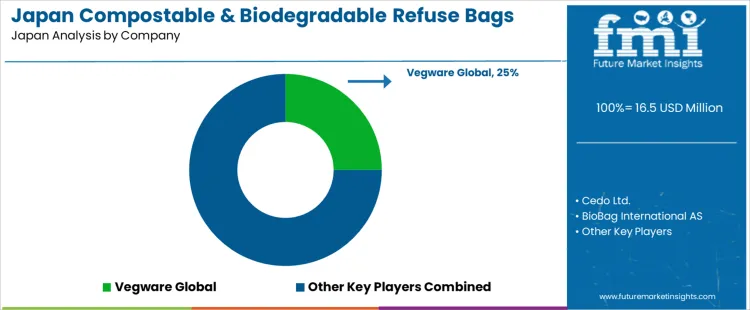
Leading suppliers offering compostable and biodegradable refuse bags in Japan or supplying globally relevant products for the Japanese industry include Vegware Global, Cedo Ltd., BioBag International AS, Clondalkin Group Holdings B.V., and Cardia Compostable. Vegware Global leads among them with a share of 25.0%. These companies supply refuse-bag solutions that comply with compostability or biodegradability standards, enabling households and businesses to meet regulatory and environmental expectations while disposing of waste more sustainably.
As recycling regulations tighten and consumer values shift toward eco-friendly living, the adoption of compostable refuse bags is expected to continue rising. Improvements in biodegradable polymer technologies including better strength and degradation performance make these bags more practical for everyday use. With Japanese municipalities emphasizing waste sorting and material-cycle economy, compostable waste bags offer a credible alternative to single-use plastic, further boosting their adoption across residential and commercial segments.
Key Players in Japan Compostable & Biodegradable Refuse Bags Demand
- Vegware Global
- Cedo Ltd.
- BioBag International AS
- Clondalkin Group Holdings B.V.
- Cardia Compostable
Scope of Report
| Items | Values |
|---|---|
| Quantitative Units (2025) | USD million |
| Capacity | 7 to 20 Gallons, 20 to 30 Gallons, 30 to 40 Gallons, 40 to 55 Gallons, Above 55 Gallons |
| Product Type | Compostable, Biodegradable |
| Material Type | PLA, PBS, PBAT, PHA, Starch Blends |
| Thickness | 0 to 0.7 mil, 0.7 to 0.9 mil, 0.9 to 1.5 mil, Above 1.5 mil |
| End Use | Retail & Consumer, Industrial, Institutional |
| Region | Kyushu & Okinawa, Kanto, Kansai, Chubu, Tohoku, Rest of Japan |
| Countries Covered | Japan |
| Key Companies Profiled | Vegware Global, Cedco Ltd., BioBag International AS, Clondalkin Group Holdings B.V., Cardia Compostable |
| Additional Attributes | Dollar sales by product type and material; regional CAGR and growth trends; rising adoption of compostable and biodegradable bags in retail and industrial applications; increasing regulations for eco-friendly packaging. |
Japan Compostable & Biodegradable Refuse Bags Demand by Key Segments
Capacity
- 7 to 20 Gallons
- 20 to 30 Gallons
- 30 to 40 Gallons
- 40 to 55 Gallons
- Above 55 Gallons
Product Type
- Compostable
- Biodegradable
Material Type
- PLA
- PBS
- PBAT
- PHA
- Starch Blends
Thickness
- 0 to 0.7 mil
- 0.7 to 0.9 mil
- 0.9 to 1.5 mil
- Above 1.5 mil
End Use
- Retail & Consumer
- Industrial
- Institutional
Region
- Kyushu & Okinawa
- Kanto
- Kansai
- Chubu
- Tohoku
- Rest of Japan
Frequently Asked Questions
How big is the demand for compostable & biodegradable refuse bags in Japan in 2025?
The demand for compostable & biodegradable refuse bags in Japan is estimated to be valued at USD 16.5 million in 2025.
What will be the size of compostable & biodegradable refuse bags in Japan in 2035?
The market size for the compostable & biodegradable refuse bags in Japan is projected to reach USD 28.6 million by 2035.
How much will be the demand for compostable & biodegradable refuse bags in Japan growth between 2025 and 2035?
The demand for compostable & biodegradable refuse bags in Japan is expected to grow at a 5.6% CAGR between 2025 and 2035.
What are the key product types in the compostable & biodegradable refuse bags in Japan?
The key product types in compostable & biodegradable refuse bags in Japan are 7 to 20 gallons, 20 to 30 gallons, 30 to 40 gallons, 40 to 55 gallons and above 55 gallons.
Which product type segment is expected to contribute significant share in the compostable & biodegradable refuse bags in Japan in 2025?
In terms of product type, compostable segment is expected to command 54.5% share in the compostable & biodegradable refuse bags in Japan in 2025.
Preview the report firsthand - request a free sample
Get SampleGet the brochure for pricing and purchase details.
Get PDFTable of Content
- Executive Summary
- Japan Market Outlook
- Demand-side Trends
- Supply-side Trends
- Technology Roadmap Analysis
- Analysis and Recommendations
- Market Overview
- Market Coverage / Taxonomy
- Market Definition / Scope / Limitations
- Market Background
- Market Dynamics
- Drivers
- Restraints
- Opportunity
- Trends
- Scenario Forecast
- Demand in Optimistic Scenario
- Demand in Likely Scenario
- Demand in Conservative Scenario
- Opportunity Map Analysis
- Product Life Cycle Analysis
- Supply Chain Analysis
- Investment Feasibility Matrix
- Value Chain Analysis
- PESTLE and Porter’s Analysis
- Regulatory Landscape
- Regional Parent Market Outlook
- Production and Consumption Statistics
- Import and Export Statistics
- Market Dynamics
- Japan Market Analysis 2020 to 2024 and Forecast, 2025 to 2035
- Historical Market Size Value (USD Million) Analysis, 2020 to 2024
- Current and Future Market Size Value (USD Million) Projections, 2025 to 2035
- Y-o-Y Growth Trend Analysis
- Absolute $ Opportunity Analysis
- Japan Market Pricing Analysis 2020 to 2024 and Forecast 2025 to 2035
- Japan Market Analysis 2020 to 2024 and Forecast 2025 to 2035, By Capacity
- Introduction / Key Findings
- Historical Market Size Value (USD Million) Analysis By Capacity , 2020 to 2024
- Current and Future Market Size Value (USD Million) Analysis and Forecast By Capacity , 2025 to 2035
- 7 to 20 Gallons
- 20 to 30 Gallons
- 30 to 40 Gallons
- 40 to 55 Gallons
- Above 55 Gallons
- Y-o-Y Growth Trend Analysis By Capacity , 2020 to 2024
- Absolute $ Opportunity Analysis By Capacity , 2025 to 2035
- Japan Market Analysis 2020 to 2024 and Forecast 2025 to 2035, By Product Type
- Introduction / Key Findings
- Historical Market Size Value (USD Million) Analysis By Product Type, 2020 to 2024
- Current and Future Market Size Value (USD Million) Analysis and Forecast By Product Type, 2025 to 2035
- Compostable
- Biodegradable
- Y-o-Y Growth Trend Analysis By Product Type, 2020 to 2024
- Absolute $ Opportunity Analysis By Product Type, 2025 to 2035
- Japan Market Analysis 2020 to 2024 and Forecast 2025 to 2035, By Material Type
- Introduction / Key Findings
- Historical Market Size Value (USD Million) Analysis By Material Type, 2020 to 2024
- Current and Future Market Size Value (USD Million) Analysis and Forecast By Material Type, 2025 to 2035
- PLA
- PBS
- PBAT
- PHA
- Starch Blends
- Y-o-Y Growth Trend Analysis By Material Type, 2020 to 2024
- Absolute $ Opportunity Analysis By Material Type, 2025 to 2035
- Japan Market Analysis 2020 to 2024 and Forecast 2025 to 2035, By Thickness
- Introduction / Key Findings
- Historical Market Size Value (USD Million) Analysis By Thickness, 2020 to 2024
- Current and Future Market Size Value (USD Million) Analysis and Forecast By Thickness, 2025 to 2035
- 0 to 0.7 mil
- 0.7 to 0.9 mil
- 0.9 to 1.5 mil
- Above 1.5 mil
- Y-o-Y Growth Trend Analysis By Thickness, 2020 to 2024
- Absolute $ Opportunity Analysis By Thickness, 2025 to 2035
- Japan Market Analysis 2020 to 2024 and Forecast 2025 to 2035, By End Use
- Introduction / Key Findings
- Historical Market Size Value (USD Million) Analysis By End Use, 2020 to 2024
- Current and Future Market Size Value (USD Million) Analysis and Forecast By End Use, 2025 to 2035
- Retail & Consumer
- Industrial
- Institutional
- Y-o-Y Growth Trend Analysis By End Use, 2020 to 2024
- Absolute $ Opportunity Analysis By End Use, 2025 to 2035
- Market Structure Analysis
- Competition Dashboard
- Competition Benchmarking
- Market Share Analysis of Top Players
- By Regional
- By Capacity
- By Product Type
- By Material Type
- By Thickness
- By End Use
- Competition Analysis
- Competition Deep Dive
- Vegware Global
- Overview
- Product Portfolio
- Profitability by Market Segments (Product/Age /Sales Channel/Region)
- Sales Footprint
- Strategy Overview
- Marketing Strategy
- Product Strategy
- Channel Strategy
- Cedo Ltd.
- BioBag International AS
- Clondalkin Group Holdings B.V.
- Cardia Compostable
- Vegware Global
- Competition Deep Dive
- Assumptions & Acronyms Used
- Research Methodology


