

- Industry Size (2025)
- USD 133.9 Mn
- Forecast (2035)
- USD 266.5 Mn
- CAGR (2025 to 2035)
- 7.1%
Demand for Compostable & Biodegradable Refuse Bags in USA 2025 to 2035
The demand for compostable and biodegradable refuse bags in the USA is valued at USD 133.9 million in 2025 and is forecasted to reach USD 266.5 million by 2035, reflecting a CAGR of 7.1%. Growth is influenced by regulatory policies promoting sustainable waste handling, rising household composting practices, and the expansion of municipal organic waste collection programs. Businesses in foodservice, hospitality, and retail increasingly shift to environmentally compliant packaging to reduce landfill contribution and improve sustainability credentials.
Compostable bags represent the leading product type due to their compatibility with community composting streams and certified biodegradation performance. Consumers prefer plant-based feedstocks and certified compostability labels that ensure alignment with local waste treatment systems. Performance improvements in tear resistance and moisture tolerance support broader USAge across residential and commercial settings.
The West, South, and Northeast regions show strong adoption. These areas enforce stricter landfill diversion requirements, offer incentives for food waste segregation, and operate a larger number of industrial composting facilities. High awareness of plastic waste impacts further advances the shift from traditional petroleum-based refuse bags toward compostable alternatives. Key suppliers include Vegware Global, Cedo Ltd., BioBag International AS, Clondalkin Group Holdings B.V., and Cardia Compostable. Their strategies focus on scaling bio-resin sourcing, improving compatibility with automated waste handling equipment, and expanding distribution networks through retail chains and bulk procurement channels.
Quick Stats for USA Compostable & Biodegradable Refuse Bags Demand
- USA Compostable & Biodegradable Refuse Bags Sales Value (2025): USD 133.9 million
- USA Compostable & Biodegradable Refuse Bags Forecast Value (2035): USD 266.5 million
- USA Compostable & Biodegradable Refuse Bags Forecast CAGR (2025–2035): 7.1%
- Leading Product Type in USA Compostable & Biodegradable Refuse Bags Demand: Compostable Bags
- Key Growth Regions in USA Compostable & Biodegradable Refuse Bags Demand: West USA, South USA, Northeast USA
- Top Players in USA Compostable & Biodegradable Refuse Bags Demand: Vegware Global, Cedo Ltd., BioBag International AS, Clondalkin Group Holdings B.V., Cardia Compostable
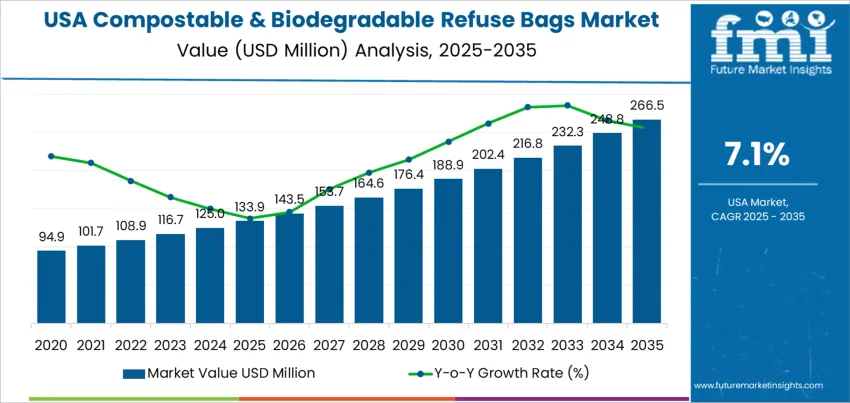
What is the Growth Forecast for Compostable & Biodegradable Refuse Bags Industry in USA through 2035?
Demand for compostable and biodegradable refuse bags in the United States reflects a distribution of growth contribution led by municipalities and institutional waste programs implementing organic-waste collection. City-level landfill diversion targets and food-waste mandates drive procurement from waste-management operators, giving public-sector contracts a strong share of overall demand contribution. Large retail and grocery chains contribute the next tier as they transition to environmentally aligned packaging policies. Store-brand product lines and corporate sustainability reporting strengthen recurring orders. Foodservice operators increase contribution through compliance with composting requirements in regulated states, adding consistent commercial volume.
Residential users provide expanding but smaller contribution. Consumer adoption depends on price parity with traditional polyethylene bags and availability in mainstream retail channels. Awareness improves through curbside composting expansion, which broadens participation in suburban and urban households. Industrial composting facilities influence contribution indirectly by validating product certification standards, which supports purchasing confidence. This blend of public-sector leadership, commercial compliance, and gradual household adoption produces a balanced contribution structure. Growth remains strongest in regions with active waste-reduction policies, while national adoption progresses as cost and performance improve within the United States.
USA Compostable & Biodegradable Refuse Bags Key Takeaways
| Metric | Value |
|---|---|
| USA Compostable & Biodegradable Refuse Bags Sales Value (2025) | USD 133.9 million |
| USA Compostable & Biodegradable Refuse Bags Forecast Value (2035) | USD 266.5 million |
| USA Compostable & Biodegradable Refuse Bags Forecast CAGR (2025-2035) | 7.1% |
Why is the Demand for Compostable and Biodegradable Refuse Bags in the USA Growing?
Demand for compostable and biodegradable refuse bags in the USA is increasing because consumers, municipalities and commercial businesses place greater emphasis on environmental sustainability. Many households favour biodegradable bags to reduce plastic waste and support recycling or composting initiatives. Cities with organic waste collection programmes often require or strongly encourage compostable refuse bags to comply with local waste policy. Restaurants, grocery stores and foodservice providers adopt compostable bags for kitchen scraps and food waste to meet sustainability standards and reduce landfill burden. Waste haulers and composting facilities support higher volumes of organic waste when biodegradable bags facilitate safe containment without compromising compost quality.
Retailers and e-commerce platforms respond by increasing shelf space for compostable refuse bags in different sizes, including small kitchen liners and large yard-waste bags, to meet both residential and commercial demand. Constraints include higher cost compared with conventional plastic refuse bags and variability in composting infrastructure across regions. Areas lacking industrial composting facilities may limit actual biodegradation, which reduces perceived benefit. Some consumers question the durability or shelf life of compostable bags when used for heavy or wet waste.
Which Capacities, Product Types, and Materials Lead Demand for Compostable & Biodegradable Refuse Bags in the USA?
Demand for compostable and biodegradable refuse bags in the United States is driven by plastic reduction mandates, enhanced municipal composting adoption, and rising household participation in waste segregation. Consumer preference leans toward products compliant with USA certifications such as ASTM D6400 and BPI labeling for composting safety. Commercial and institutional buyers increasingly shift from petroleum-based liners to bio-alternatives to meet sustainability reporting and purchasing standards. Growth is linked to curbside organic waste collection programs expanding across multiple states, including California and New York.
By Capacity, 7–20 Gallon Bags Hold the Largest Share
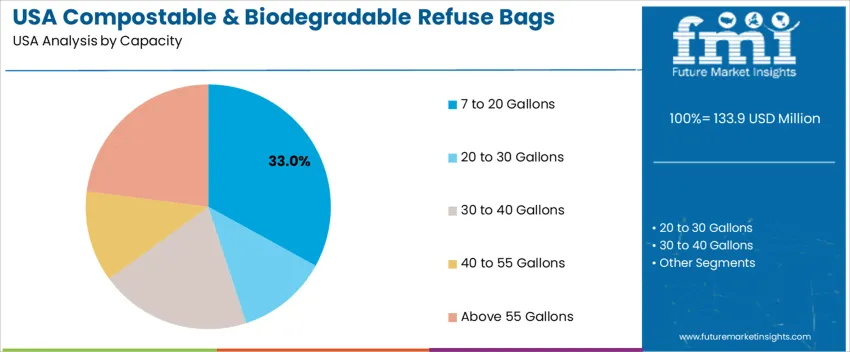
Refuse bags with 7-20 gallon capacity represent 33.0%, driven by widespread household use in kitchen bins and municipal organic waste programs. Their compatibility with standard residential containers supports recurring purchases and subscription-based replenishment. Above 55 gallon bags hold 23.0%, used in commercial kitchens, foodservice, and institutional composting sites handling higher organic volumes. 30–40 gallon formats contribute 20.0%, balancing indoor and outdoor USAge in medium-size trash containers. 20–30 gallon and 40–55 gallon sizes, each at 12.0%, serve workplaces, hospitality spaces, and community facilities. Capacity selection aligns with waste-segment requirements, bin infrastructure, and odor-control handling across household and commercial channels.
Key Points:
- Household organics drive highest USAge in 7–20 gallon range
- Larger capacities target commercial food waste collection
- Mid-range sizes support mixed residential and institutional demand
By Product Type, Compostable Bags Hold the Largest Share
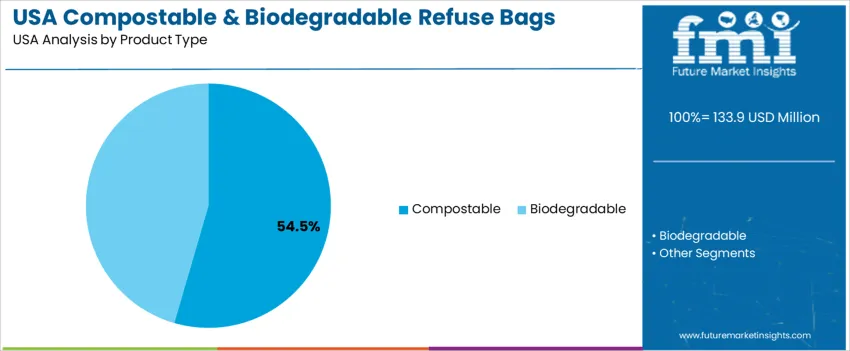
Compostable refuse bags account for 54.5%, driven by local authority acceptance in organics programs requiring full compostability without microplastic residue. Retailers increasingly position compostable liners as the standard for green disposal, backed by consumer willingness to pay for certified eco-benefits. Biodegradable bags hold 45.5%, but their adoption is moderated by varying state-level labeling restrictions and slower breakdown in landfill environments. USA demand shifts toward bags compatible with commercial composting infrastructure, especially where contamination control is closely monitored.
Key Points:
- Compostable bags preferred due to regulatory acceptance and certification
- Biodegradable options persist where composting facilities are limited
- Policy-driven procurement accelerates compostable category expansion
By Material, PLA Leads Usage
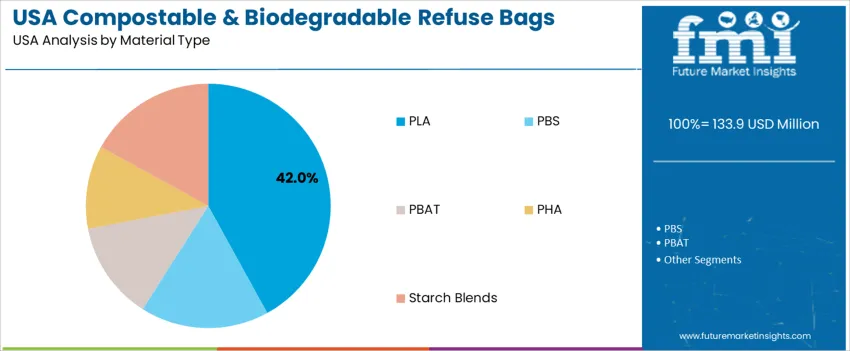
Polylactic Acid (PLA) holds 42.0%, supported by high strength-to-weight performance and scaling biopolymer availability from North American suppliers. Starch blends and Polybutylene Succinate (PBS) both hold meaningful shares at 17.0%, used for improved flexibility and breakdown rates in wet food waste. Polybutylene Adipate Terephthalate (PBAT) accounts for 13.0%, balancing mechanical durability for heavier loads. Polyhydroxyalkanoates (PHA) represent 11.0%, valued for marine-safe decomposition but currently constrained by cost. Material choice reflects performance needs for moisture resistance, tensile strength, and compliance with industrial composting conditions.
Key Points:
- PLA supports volume production and household bin suitability
- PBS and starch blends improve composting efficiency in food-waste streams
- PHA remains premium but aligns with future sustainability goals
What are the Drivers, Restraints, and Key Trends of the Demand for Compostable and Biodegradable Refuse Bags in the USA?
Growth of municipal composting programs, rising household participation in organic waste separation and increased retailer emphasis on sustainable packaging drive demand.
In the United States, curbside composting programs continue to expand in cities across California, Washington, Oregon, Colorado and parts of the Northeast, which increases demand for certified compostable refuse bags that simplify organics collection. Homeowners and apartment residents use biodegradable liners to manage food scraps with reduced odor and easier bin hygiene. Major retailers introduce sustainable bag assortments in household cleaning aisles as part of corporate plastic-reduction commitments. Foodservice operations and grocery stores promoting zero-waste initiatives encourage customers to adopt compost-friendly disposal products. These factors support sustained procurement of compostable and biodegradable bags through both consumer and commercial channels.
Higher price compared with traditional plastic, varied composting infrastructure and uncertainty about performance in real-world disposal conditions restrain demand.
Compostable refuse bags typically cost more per unit than conventional polyethylene trash bags, limiting regular purchase among cost-conscious households. Access to industrial composting facilities remains uneven, with many regions still dependent on landfills where biodegradable products do not break down effectively. Some consumers’ express concerns about bag strength and leakage when handling wet organic waste, which can discourage repeat buying. Confusion between biodegradable and certified compostable labeling also creates consumer hesitation. These practical and economic challenges limit rapid expansion in suburban and rural industries.
Shift toward mandated organics collection, increased certification and labeling clarity and rising adoption in commercial foodservice define key trends.
State regulations requiring organic waste diversion stimulate demand for compost-approved refuse bags that fit standard collection bins. Manufacturers focus on clearer labeling and compliance with commercial compost standards to build confidence among municipalities and households. Restaurants, cafeterias and institutional kitchens integrate certified compostable bags as part of waste-sorting procedures that support sustainability reporting goals. E-commerce platforms expand product access and allow subscription ordering aligned with weekly kitchen waste volumes. These developments indicate growing, policy-driven demand for compostable and biodegradable refuse bags across the United States as waste-reduction expectations increase in both residential and commercial settings.
Analysis of the Demand for Compostable & Biodegradable Refuse Bags in the USA by Region
Demand for compostable and biodegradable refuse bags in the United States is expanding as consumers, municipalities, and waste-management operators adopt sustainable alternatives to conventional plastic trash liners. Growth is driven by landfill diversion mandates, curbside organics collection, and corporate sustainability commitments. In many states, restrictions on single-use plastics accelerate procurement of certified compostable solutions that comply with ASTM D6400 and municipal composting standards. Retailers are increasing shelf space for biodegradable bags aligned with household waste-sorting habits. West USA leads with 8.2% CAGR, followed by South USA at 7.3%, Northeast USA at 6.6%, and Midwest USA at 5.7%, reflecting regional differences in environmental policy enforcement, recycling infrastructure availability, and green consumer purchasing behavior.
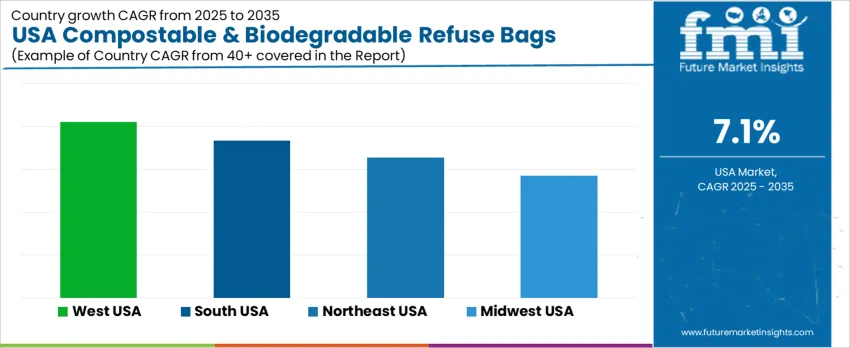
| Region | CAGR (2025-2035) |
|---|---|
| West USA | 8.2% |
| South USA | 7.3% |
| Northeast USA | 6.6% |
| Midwest USA | 5.7% |
How is the West USA driving demand for compostable & biodegradable refuse bags?
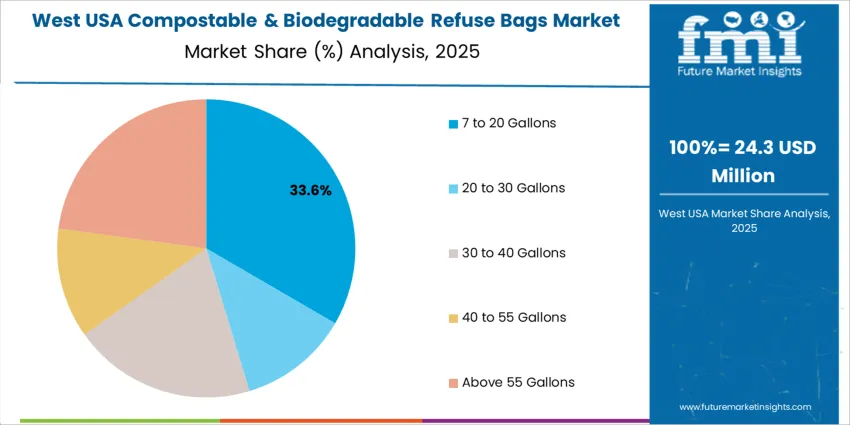
The West USA grows at 8.2% CAGR, supported by statewide legislation that limits traditional plastic waste generation in California, Washington, and Oregon. Widespread commercial composting programs encourage residents and restaurants to segregate food scraps using certified compostable liners that comply with industrial composting timelines. Retailers partner with eco-certified packaging suppliers to expand product availability through online and store channels. Municipalities specify compostability labeling standards to improve disposal accuracy, reducing contamination in green bins. Buyers prioritize tensile strength, leak protection, and performance compatibility with moist organic waste. Procurement emphasizes proven biodegradation outcomes verified by laboratory validation and facility acceptance.
- Strict plastic regulations promoting certified compostable alternatives
- Residential and foodservice organics programs driving liner USAge
- Retail expansion supporting accessibility of eco-options
- Performance consistency influencing supply decisions
How is the South USA shaping USAge trends?
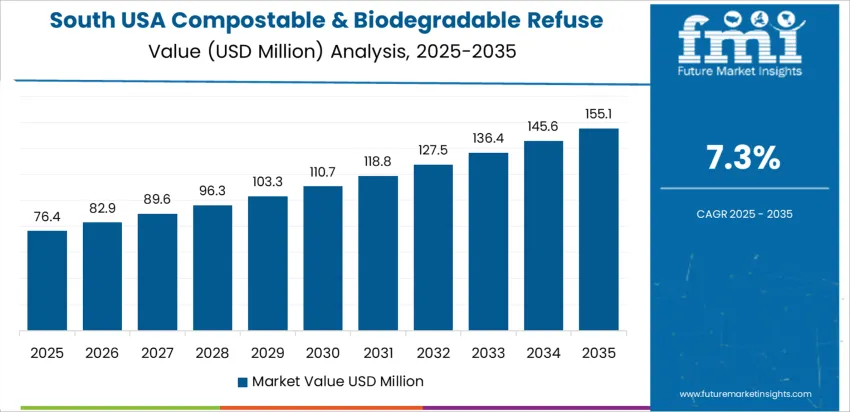
The South USA advances at 7.3% CAGR, driven by population growth in states such as Texas, Florida, and Georgia resulting in rising household waste volumes. Sustainability initiatives in suburban communities encourage selective adoption of biodegradable trash liners within voluntary recycling programs. Waste-management companies introduce pilot organics diversion routes in metropolitan areas, creating new supply opportunities for compostable bag vendors. Retailers industry biodegradable bags as odor-resistant solutions tailored to warm-climate waste challenges. Buyers evaluate affordability and durability as primary decision factors, balancing sustainability goals with household budgets.
- Population expansion increasing household waste segmentation
- Pilot composting initiatives opening procurement channels
- Retail marketing focused on odor-control benefits
- Cost-performance balance guiding adoption pace
How is the Northeast USA supporting the transition?
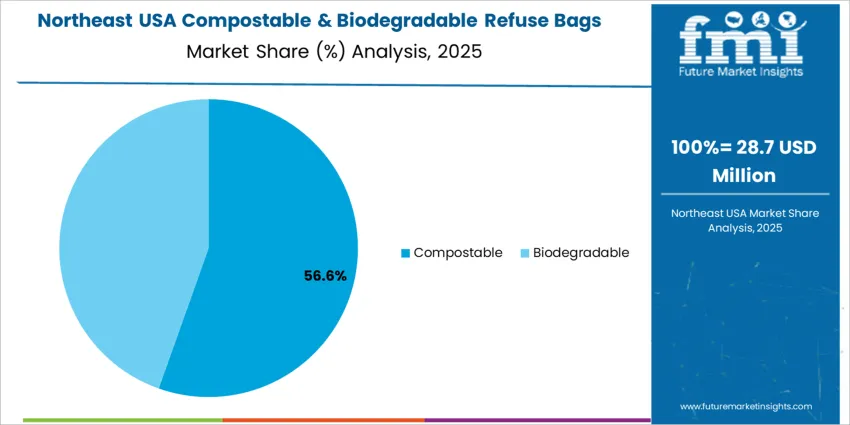
The Northeast USA records 6.6% CAGR, linked to strong waste-reduction policies in New York, Massachusetts, and New Jersey. Mandatory organics recycling in select cities accelerates commercial and residential demand for certified compostable liners. Dense urban environments amplify the need for contained disposal of food waste and wet trash to manage sanitation conditions. Municipal authorities promote approved-liner lists and labeling enforcement to ensure compatibility with regional processing facilities. Procurement teams demand traceability documentation verifying compliance with industrial composting requirements.
- Regulatory mandates accelerating adoption
- Waste sanitation needs in high-density areas
- Municipal enforcement improving material stream quality
- Verified compostability critical in procurement reviews
How is the Midwest USA contributing to adoption?
The Midwest USA grows at 5.7% CAGR, reflecting gradual expansion of municipal composting infrastructure across Illinois, Minnesota, and Ohio. Early adopters within community recycling programs lead purchasing of biodegradable bags, particularly for food-waste drop-off services that require contamination control. Corporate sustainability commitments in food processing and retail sectors support procurement consistency. Consumers evaluate bag reliability and tear resistance, especially in colder climates where frozen food waste handling influences product performance expectations. Supply chain focus remains on value, longevity of stock, and predictable demand cycles.
- Community composting programs enabling initial adoption
- Retail and food industry sustainability plans shaping demand
- Climate-specific performance influencing product selection
- Value-focused purchasing supporting steady but modest growth
How is competitive positioning structured among suppliers of compostable and biodegradable refuse bags in the United States?
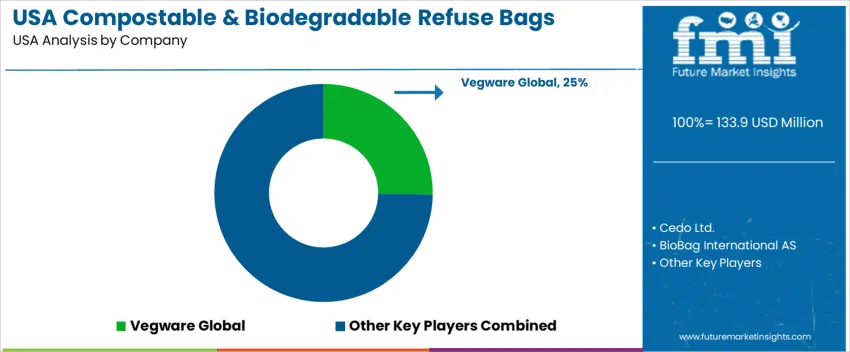
Competitive dynamics in the United States compostable and biodegradable refuse-bag segment are guided by certified compostability, retail shelf access, and municipal acceptance of biobags within organics programs. Vegware Global holds an estimated 25.2%, supported by strong alignment with food-service composting requirements and distribution partnerships targeting institutional and commercial waste streams. Its strength reflects compliance with USA compostability standards and broad SKU availability. Cedo Ltd. competes through cost-positioned solutions aimed at grocery and private-label channels. Its participation centers on supplying lighter-gauge liners for household food-waste separation where price sensitivity is significant. BioBag International AS maintains a prominent presence, reinforced by certification with organics-recovery facilities and long-standing relationships in states with active composting mandates.
Clondalkin Group Holdings B.V. advances participation where refuse-bag durability and printed branding are priorities for retail partners. Volume reliability and material-strength control support share stability. Cardia Compostable targets municipal and B2B segments requiring scalable procurement of starch-based liners, contributing to competitive pressure in cost-controlled tenders. Advantage depends on ASTM-compliant labeling, proven breakdown performance within industrial composting cycles, and reliable supply to regions adopting food-waste diversion initiatives. Suppliers combining verified environmental performance with strong North American distribution retain the most durable positioning in USA compostable refuse-bag demand.
Key Players in USA Compostable & Biodegradable Refuse Bags Demand
- Vegware Global
- Cedo Ltd.
- BioBag International AS
- Clondalkin Group Holdings B.V.
- Cardia Compostable
Scope of the Report
| Items | Values |
|---|---|
| Quantitative Units | USD million |
| Capacity | 7 to 20 Gallons, 20 to 30 Gallons, 30 to 40 Gallons, 40 to 55 Gallons, Above 55 Gallons |
| Product Type | Compostable, Biodegradable |
| Material Type | PLA, PBS, PBAT, PHA, Starch Blends |
| Thickness | 0 to 0.7 mil, 0.7 to 0.9 mil, 0.9 to 1.5 mil, Above 1.5 mil |
| End Use | Retail & Consumer, Industrial, Institutional |
| Regions Covered | West USA, South USA, Northeast USA, Midwest USA |
| Key Companies Profiled | Vegware Global, Cedo Ltd., BioBag International AS, Clondalkin Group Holdings B.V., Cardia Compostable |
| Additional Attributes | Dollar sales by capacity, product type, material composition, thickness, and end-use segments; regional adoption supported by municipal composting mandates; competitive positioning of certified compostable vs. biodegradable solutions; trends in retail consumer demand and institutional waste diversion goals; R&D in PHA, PBAT, and starch-blend performance enhancements and ASTM compostability compliance. |
USA Compostable & Biodegradable Refuse Bags Demand by Segments
Capacity:
- 7 to 20 Gallons
- 20 to 30 Gallons
- 30 to 40 Gallons
- 40 to 55 Gallons
- Above 55 Gallons
Product Type:
- Compostable
- Biodegradable
Material Type:
- PLA
- PBS
- PBAT
- PHA
- Starch Blends
Thickness:
- 0 to 0.7 mil
- 0.7 to 0.9 mil
- 0.9 to 1.5 mil
- Above 1.5 mil
End Use:
- Retail & Consumer
- Industrial
- Institutional
Region:
- West USA
- South USA
- Northeast USA
- Midwest USA
Frequently Asked Questions
How big is the demand for compostable & biodegradable refuse bags in USA in 2025?
The demand for compostable & biodegradable refuse bags in USA is estimated to be valued at USD 133.9 million in 2025.
What will be the size of compostable & biodegradable refuse bags in USA in 2035?
The market size for the compostable & biodegradable refuse bags in USA is projected to reach USD 266.5 million by 2035.
How much will be the demand for compostable & biodegradable refuse bags in USA growth between 2025 and 2035?
The demand for compostable & biodegradable refuse bags in USA is expected to grow at a 7.1% CAGR between 2025 and 2035.
What are the key product types in the compostable & biodegradable refuse bags in USA?
The key product types in compostable & biodegradable refuse bags in USA are 7 to 20 gallons, 20 to 30 gallons, 30 to 40 gallons, 40 to 55 gallons and above 55 gallons.
Which product type segment is expected to contribute significant share in the compostable & biodegradable refuse bags in USA in 2025?
In terms of product type, compostable segment is expected to command 54.5% share in the compostable & biodegradable refuse bags in USA in 2025.
Preview the report firsthand - request a free sample
Get SampleGet the brochure for pricing and purchase details.
Get PDFTable of Content
- Executive Summary
- USA Market Outlook
- Demand-side Trends
- Supply-side Trends
- Technology Roadmap Analysis
- Analysis and Recommendations
- Market Overview
- Market Coverage / Taxonomy
- Market Definition / Scope / Limitations
- Market Background
- Market Dynamics
- Drivers
- Restraints
- Opportunity
- Trends
- Scenario Forecast
- Demand in Optimistic Scenario
- Demand in Likely Scenario
- Demand in Conservative Scenario
- Opportunity Map Analysis
- Product Life Cycle Analysis
- Supply Chain Analysis
- Investment Feasibility Matrix
- Value Chain Analysis
- PESTLE and Porter’s Analysis
- Regulatory Landscape
- Regional Parent Market Outlook
- Production and Consumption Statistics
- Import and Export Statistics
- Market Dynamics
- USA Market Analysis 2020 to 2024 and Forecast, 2025 to 2035
- Historical Market Size Value (USD Million) Analysis, 2020 to 2024
- Current and Future Market Size Value (USD Million) Projections, 2025 to 2035
- Y-o-Y Growth Trend Analysis
- Absolute $ Opportunity Analysis
- USA Market Pricing Analysis 2020 to 2024 and Forecast 2025 to 2035
- USA Market Analysis 2020 to 2024 and Forecast 2025 to 2035, By Capacity
- Introduction / Key Findings
- Historical Market Size Value (USD Million) Analysis By Capacity , 2020 to 2024
- Current and Future Market Size Value (USD Million) Analysis and Forecast By Capacity , 2025 to 2035
- 7 to 20 Gallons
- 20 to 30 Gallons
- 30 to 40 Gallons
- 40 to 55 Gallons
- Above 55 Gallons
- Y-o-Y Growth Trend Analysis By Capacity , 2020 to 2024
- Absolute $ Opportunity Analysis By Capacity , 2025 to 2035
- USA Market Analysis 2020 to 2024 and Forecast 2025 to 2035, By Product Type
- Introduction / Key Findings
- Historical Market Size Value (USD Million) Analysis By Product Type, 2020 to 2024
- Current and Future Market Size Value (USD Million) Analysis and Forecast By Product Type, 2025 to 2035
- Compostable
- Biodegradable
- Y-o-Y Growth Trend Analysis By Product Type, 2020 to 2024
- Absolute $ Opportunity Analysis By Product Type, 2025 to 2035
- USA Market Analysis 2020 to 2024 and Forecast 2025 to 2035, By Material Type
- Introduction / Key Findings
- Historical Market Size Value (USD Million) Analysis By Material Type, 2020 to 2024
- Current and Future Market Size Value (USD Million) Analysis and Forecast By Material Type, 2025 to 2035
- PLA
- PBS
- PBAT
- PHA
- Starch Blends
- Y-o-Y Growth Trend Analysis By Material Type, 2020 to 2024
- Absolute $ Opportunity Analysis By Material Type, 2025 to 2035
- USA Market Analysis 2020 to 2024 and Forecast 2025 to 2035, By Thickness
- Introduction / Key Findings
- Historical Market Size Value (USD Million) Analysis By Thickness, 2020 to 2024
- Current and Future Market Size Value (USD Million) Analysis and Forecast By Thickness, 2025 to 2035
- 0 to 0.7 mil
- 0.7 to 0.9 mil
- 0.9 to 1.5 mil
- Above 1.5 mil
- Y-o-Y Growth Trend Analysis By Thickness, 2020 to 2024
- Absolute $ Opportunity Analysis By Thickness, 2025 to 2035
- USA Market Analysis 2020 to 2024 and Forecast 2025 to 2035, By End Use
- Introduction / Key Findings
- Historical Market Size Value (USD Million) Analysis By End Use, 2020 to 2024
- Current and Future Market Size Value (USD Million) Analysis and Forecast By End Use, 2025 to 2035
- Retail & Consumer
- Industrial
- Institutional
- Y-o-Y Growth Trend Analysis By End Use, 2020 to 2024
- Absolute $ Opportunity Analysis By End Use, 2025 to 2035
- Market Structure Analysis
- Competition Dashboard
- Competition Benchmarking
- Market Share Analysis of Top Players
- By Regional
- By Capacity
- By Product Type
- By Material Type
- By Thickness
- By End Use
- Competition Analysis
- Competition Deep Dive
- Vegware Global
- Overview
- Product Portfolio
- Profitability by Market Segments (Product/Age /Sales Channel/Region)
- Sales Footprint
- Strategy Overview
- Marketing Strategy
- Product Strategy
- Channel Strategy
- Cedo Ltd.
- BioBag International AS
- Clondalkin Group Holdings B.V.
- Cardia Compostable
- Vegware Global
- Competition Deep Dive
- Assumptions & Acronyms Used
- Research Methodology


