

- Industry Size (2026)
- USD 1.89 Bn
- Forecast (2036)
- USD 5.31 Bn
- CAGR (2026 to 2036)
- 10.9%
Biodegradable Insulated Panel Market Size, Market Forecast and Outlook By FMI
The biodegradable insulated panel market was valued at USD 1.70 billion in 2025, projected to reach USD 1.89 billion in 2026, and is forecast to expand to USD 5.31 billion by 2036 at a 10.9% CAGR. Tightening building energy performance standards and expanding sustainable construction material mandates are accelerating procurement of biodegradable insulated panels across commercial cold chain, pharmaceutical logistics, and green building applications. Facility managers and cold chain logistics operators now face binding thermal performance requirements alongside end-of-life material disposal regulations that penalize non-recyclable and non-compostable insulation waste streams.
Summary of Biodegradable Insulated Panel Market
- By 2036, the market is projected to be worth USD 5.31 billion.
- A 10.9% compound annual growth rate is anticipated between 2026 and 2036.
- Market size in 2025 was estimated at USD 1.70 billion.
- An absolute dollar opportunity of USD 3.42 billion is anticipated between 2026 and 2036.
- 3 To 5 Cm leads by Thickness with 35.0% share in 2026.
- Bioplastics leads by Material with 40.0% share in 2026.
- Demand is rising as building energy performance standards mandate higher thermal resistance values while end-of-life disposal regulations penalize non-compostable insulation materials.
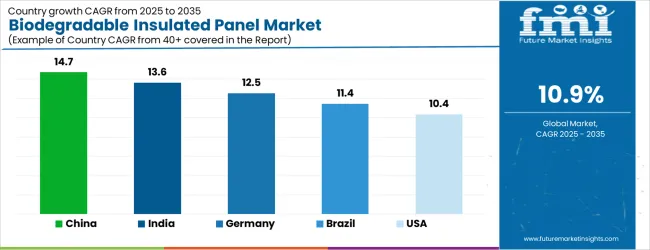
- Among key countries, China leads at 14.7% CAGR, followed by India at 13.6%, Germany at 12.5%, Brazil at 11.4%, the USA at 10.4%, the UK at 9.3%, and Japan at 8.2%.
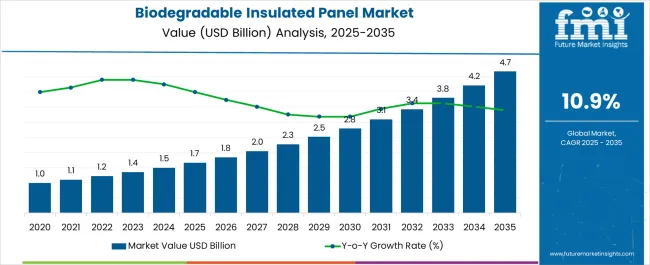
The insulated panel sector is experiencing a material composition shift as building energy codes and packaging waste directives converge to create procurement specifications that conventional expanded polystyrene and polyurethane foam panels cannot satisfy without end-of-life disposal liabilities. FMI analysts observe that bioplastic-based insulation cores, mycelium-grown panels from agricultural waste substrates, and natural cotton insulation systems now deliver thermal resistance values competitive with petroleum-derived foams for specific thickness ranges and application conditions. Agricultural waste composite panels, utilizing rice husk, hemp shiv, and straw fiber matrices, are gaining qualification in cold chain packaging and temporary construction insulation where single-use lifecycle economics favor compostable materials over recyclable alternatives.
China sets a 14.7% CAGR trajectory, supported by green building certification expansion and cold chain logistics infrastructure construction programs. India tracks at 13.6%, driven by national sustainable building codes and pharmaceutical cold chain modernization investments. Germany maintains 12.5%, anchored by Passivhaus standard adoption and packaging waste reduction mandates. Brazil registers 11.4%, propelled by commercial construction growth and agricultural waste valorization programs. The USA sustains 10.4%, reflecting growing LEED certification requirements and cold chain pharmaceutical distribution expansion. The UK records 9.3%, maintained by Building Regulations Part L thermal performance updates. Japan tracks at 8.2%, grounded in ZEH (Zero Energy House) building program specifications.
Biodegradable Insulated Panel Market Key Takeaways
| Metric | Details |
|---|---|
| Industry Size (2026) | USD 1.89 billion |
| Industry Value (2036) | USD 5.31 billion |
| CAGR (2026-2036) | 10.9% |
Source: Future Market Insights, 2026
Biodegradable Insulated Panel Market Definition
Biodegradable insulated panels are thermal barrier systems constructed from biologically derived core materials designed to degrade through composting or natural decomposition after their functional service period. The category includes bioplastic-core panels, natural cotton insulation, and agricultural waste composite panels utilizing rice husk, hemp shiv, straw fiber, and mycelium-grown substrates. These panels serve cold chain packaging, building insulation, pharmaceutical logistics, and temporary construction applications where end-of-life compostability or biodegradation is a procurement specification.
Biodegradable Insulated Panel Market Inclusions
Market scope includes all certified biodegradable and compostable insulated panel systems for cold chain, construction, and logistics applications. Coverage extends to global and regional market sizes, forecast period 2026 to 2036, segmentation by thickness and material, thermal performance benchmarking, and end-of-life certification mapping.
Biodegradable Insulated Panel Market Exclusions
The scope excludes conventional expanded polystyrene (EPS), extruded polystyrene (XPS), and polyurethane foam insulation panels. Permanent structural insulation products without biodegradability or compostability certification are also excluded, as are standalone vapor barrier membranes and reflective insulation foils.
Biodegradable Insulated Panel Market Research Methodology
- Primary Research: Analysts engaged with cold chain packaging procurement managers, green building material specifiers, and bioplastic insulation production engineers to map thermal performance requirements and qualification criteria.
- Desk Research: Data collection phases aggregated building energy performance regulation databases, packaging waste directive documentation, cold chain thermal qualification standards, and company sustainability reports from biodegradable panel manufacturers.
- Market-Sizing and Forecasting: Baseline values derive from a bottom-up aggregation of biodegradable insulated panel shipment volumes, applying application-specific adoption rates and regulatory compliance penetration curves to project demand growth.
- Data Validation and Update Cycle: Projections are tested against publicly reported expenditure guidance from leading industry participants, cross-referenced with regulatory filing data and trade association statistics to maintain forecast accuracy.
Why is the Biodegradable Insulated Panel Market Growing?
The Biodegradable Insulated Panel market is witnessing steady growth due to increasing emphasis on sustainable packaging and eco-friendly building solutions. The current market scenario is shaped by rising regulatory mandates for reducing carbon footprint and plastic waste across both developed and emerging economies. Companies are adopting biodegradable materials to meet consumer demand for environmentally responsible products, while ensuring thermal efficiency and durability.
Technological advancements in bioplastics and foam alternatives are enabling high-performance insulation with minimal environmental impact. The integration of biodegradable panels in food storage, cold chain logistics, and industrial applications is contributing to broader adoption. Rising awareness among manufacturers and consumers regarding environmental sustainability, coupled with government incentives for green packaging, is driving growth.
Additionally, the need for energy-efficient storage solutions is supporting investment in innovative panel designs Looking forward, the market is expected to expand further with improvements in material performance, cost optimization, and adoption in new applications beyond traditional food and pharmaceutical sectors.
Segmental Analysis
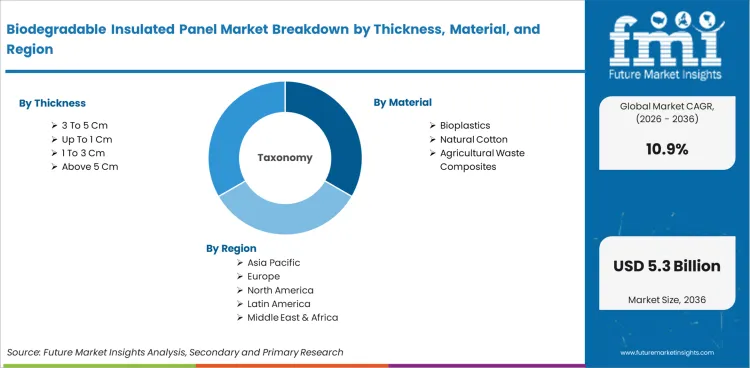
The biodegradable insulated panel market is segmented by thickness, material, application, and geographic regions. By thickness, biodegradable insulated panel market is divided into 3 To 5 Cm, Up To 1 Cm, 1 To 3 Cm, and Above 5 Cm. In terms of material, biodegradable insulated panel market is classified into Bioplastics, Natural Cotton, and Agricultural Waste Composites. Based on application, biodegradable insulated panel market is segmented into Food, Beverages, Pharmaceutical, Medical, and Chemicals. Regionally, the biodegradable insulated panel industry is classified into North America, Latin America, Western Europe, Eastern Europe, Balkan & Baltic Countries, Russia & Belarus, Central Asia, East Asia, South Asia & Pacific, and the Middle East & Africa.
Insights into the 3 To 5 Cm Thickness Segment
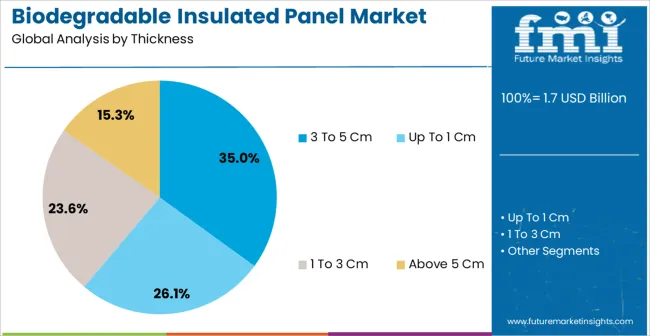
The 3 to 5 cm thickness segment is projected to hold 35.0% of the Biodegradable Insulated Panel market revenue share in 2026, making it the leading thickness category. This dominance is being driven by its optimal balance between insulation performance and material cost, allowing panels to meet thermal protection standards while remaining economically feasible. Adoption has been favored in applications requiring medium thermal resistance without excessive bulk, such as commercial cold storage and refrigerated transport.
The segment’s growth has been accelerated by the flexibility to integrate various biodegradable materials, which enhances durability, moisture resistance, and structural integrity. Manufacturers prefer this thickness range as it supports modular designs and ease of installation.
Furthermore, the ability to maintain performance consistency across variable environmental conditions has strengthened its market position As industry stakeholders focus on combining sustainability with functionality, the 3 to 5 cm thickness range is expected to continue driving revenue growth in the market, serving as a standard for both commercial and industrial insulation applications.
Insights into the Bioplastics Material Segment
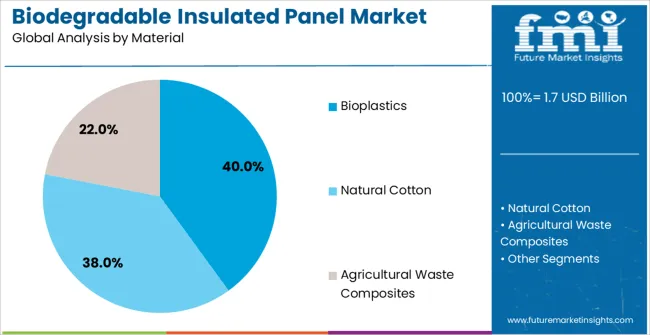
The Bioplastics material segment is anticipated to account for 40.0% of the Biodegradable Insulated Panel market revenue share in 2026, making it the dominant material type. This position is being influenced by the growing shift toward renewable, non-toxic, and compostable materials that meet stringent environmental regulations. Bioplastics offer advantages such as high thermal insulation, resistance to moisture, and compatibility with a variety of panel thicknesses, which support scalable production and long-term durability.
The adoption of bioplastics has been promoted by consumer and regulatory demand for sustainable packaging and construction materials, reducing dependence on petroleum-based foams. Additionally, bioplastics allow manufacturers to optimize panels for both thermal performance and structural integrity while maintaining environmental compliance.
The versatility of bioplastics in applications such as food storage, cold chain logistics, and refrigerated transport has reinforced its leading position As sustainability continues to gain prominence in industrial and commercial sectors, bioplastics are expected to remain a key driver of market growth, ensuring eco-friendly yet high-performing insulated panels.
Insights into the Food Application Segment
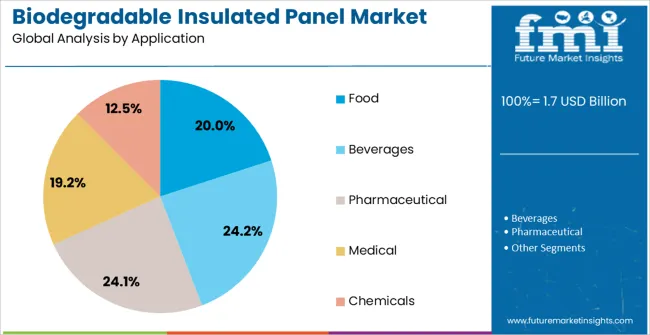
The food application segment is expected to hold 20.0% of the Biodegradable Insulated Panel market revenue share in 2026, making it the leading application area. Growth in this segment has been driven by the rising demand for sustainable cold chain solutions in food storage, transportation, and packaging. Food safety regulations and consumer expectations for environmentally responsible packaging have accelerated the adoption of biodegradable insulated panels.
The ability to maintain precise temperature control while using eco-friendly materials has reinforced their use in perishable food segments. Manufacturers benefit from panels that offer thermal efficiency, durability, and compliance with sustainability standards, enabling cost-effective and reliable storage solutions.
Additionally, the expansion of online food delivery, cold storage facilities, and frozen food distribution has fueled the requirement for high-performance biodegradable panels As companies continue to prioritize sustainability in operational processes and supply chains, the food segment is expected to sustain its leadership in market revenue, supporting broader adoption of eco-conscious insulation technologies.
Market Overview
Fresh produce and pharmaceutical industries growth across the globe to propel the biodegradable insulated panel demand
Expanded polystyrene (EPS), polyurethane (PUR), expanded polypropylene (EPP) and other conventional plastic materials are presently dominating the insulated panels demand in the present market scenario globally.
Continuously increasing non-biodegradable plastic waste has resulted into high intolerance towards the conventional plastics with the imposition of strict regulations restraining the usage of conventional plastics. The cold chain participants are gradually switching to the Biodegradable insulated panel from conventional expanded plastic insulated panel to prevent their business from getting impacted by the plastic usage regulations.
Thus, the global biodegradable insulated panel market is expected to witness steep inclination in during the forecast period and create large incremental opportunity for the biodegradable insulated panel market players across the globe.
Analysis of Biodegradable Insulated Panel Market By Key Countries
.webp "Top Country Growth Comparison Biodegradable Insulated Panel Market Cagr (2026 2036)")
| Country | CAGR |
|---|---|
| China | 14.7% |
| India | 13.6% |
| Germany | 12.5% |
| Brazil | 11.4% |
| USA | 10.4% |
| UK | 9.3% |
| Japan | 8.2% |
Country-wise Analysis
The Biodegradable Insulated Panel Market is expected to register a CAGR of 10.9% during the forecast period, exhibiting varied country level momentum. China leads with the highest CAGR of 14.7%, followed by India at 13.6%. Developed markets such as Germany, France, and the UK continue to expand steadily, while the USA is likely to grow at consistent rates. Japan posts the lowest CAGR at 8.2%, yet still underscores a broadly positive trajectory for the global Biodegradable Insulated Panel Market. In 2024, Germany held a dominant revenue in the Western Europe market and is expected to grow with a CAGR of 12.5%. The USA Biodegradable Insulated Panel Market is estimated to be valued at USD 582.9 million in 2026 and is anticipated to reach a valuation of USD 582.9 million by 2036. Sales are projected to rise at a CAGR of 0.0% over the forecast period between 2026 and 2036. While Japan and South Korea markets are estimated to be valued at USD 88.0 million and USD 45.9 million respectively in 2026.
Key Players in the Biodegradable Insulated Panel Market
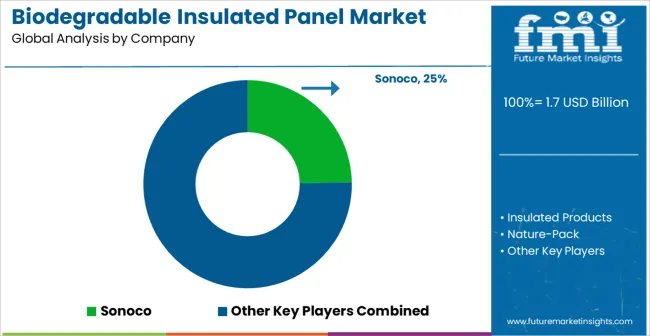
- Sonoco
- Insulated Products
- Nature-Pack
- Ecovative Design
- KTM Industries
- Vericool
- AeroSafe Global
- ThermoPod
Scope of the Report
| Metric | Value |
|---|---|
| Quantitative Units | USD 1.89 billion to USD 5.31 billion, at a CAGR of 10.9% |
| Market Definition | Biodegradable insulated panels are thermal barrier systems constructed from biologically derived core materials designed to degrade through composting or natural decomposition after their functional service period. The category includes bioplastic-core panels, natural cotton insulation, and agricultural waste composite panels utilizing rice husk, hemp shiv, straw fiber, and mycelium-grown substrates. |
| Thickness Segmentation | Up To 1 Cm, 1 To 3 Cm, 3 To 5 Cm, Above 5 Cm |
| Material Segmentation | Bioplastics, Natural Cotton, Agricultural Waste Composites |
| Regions Covered | North America, Latin America, Europe, East Asia, South Asia, Oceania, Middle East & Africa |
| Countries Covered | China, India, Germany, Brazil, USA, UK, Japan, and 40 plus countries |
| Key Companies Profiled | Sonoco, Insulated Products, Nature-Pack, Ecovative Design, KTM Industries, Vericool, AeroSafe Global, ThermoPod |
| Forecast Period | 2026 to 2036 |
| Approach | Forecasting models apply a hybrid bottom-up and top-down methodology starting with installed base metrics and production volumes, cross-validated against industry expenditure data and regulatory compliance adoption rates. |
Biodegradable Insulated Panel Market by Segments
Thickness:
- 3 To 5 Cm
- Up To 1 Cm
- 1 To 3 Cm
- Above 5 Cm
Material:
- Bioplastics
- Natural Cotton
- Agricultural Waste Composites
Application:
- Food
- Beverages
- Pharmaceutical
- Medical
- Chemicals
Region:
- North America
- USA
- Canada
- Mexico
- Latin America
- Brazil
- Chile
- Rest of Latin America
- Western Europe
- Germany
- UK
- Italy
- Spain
- France
- Nordic
- BENELUX
- Rest of Western Europe
- Eastern Europe
- Russia
- Poland
- Hungary
- Balkan & Baltic
- Rest of Eastern Europe
- East Asia
- China
- Japan
- South Korea
- South Asia and Pacific
- India
- ASEAN
- Australia & New Zealand
- Rest of South Asia and Pacific
- Middle East & Africa
- Kingdom of Saudi Arabia
- Other GCC Countries
- Turkiye
- South Africa
- Other African Union
- Rest of Middle East & Africa
Bibliography
- 1. European Commission. (2024). Energy Performance of Buildings Directive (EPBD) recast: insulation material requirements. European Commission.
- 2. International Organization for Standardization. (2022). ISO 14855-1:2012 Determination of the ultimate aerobic biodegradability under controlled composting conditions. ISO.
- 3. U.S. Green Building Council. (2024). LEED v5: material and resource credit requirements for insulation. USGBC.
- 4. Organisation for Economic Co-operation and Development. (2024). Sustainable building materials: lifecycle assessment frameworks. OECD.
- 5. United Nations Environment Programme. (2024). Global status report for buildings and construction. UNEP.
- 6. Ecovative Design LLC. (2024). Mycelium-based insulation technology: performance data sheets. Ecovative.
This bibliography is provided for reader reference. The full Future Market Insights report contains the complete reference list with primary research documentation.
Frequently Asked Questions
How large is the demand for Biodegradable Insulated Panel in the global market in 2026?
Demand for Biodegradable Insulated Panel in the global market is estimated to be valued at USD 1.89 billion in 2026.
What will be the market size of Biodegradable Insulated Panel in the global market by 2036?
Market size for Biodegradable Insulated Panel is projected to reach USD 5.31 billion by 2036.
What is the expected demand growth for Biodegradable Insulated Panel in the global market between 2026 and 2036?
Demand for Biodegradable Insulated Panel is expected to grow at a CAGR of 10.9% between 2026 and 2036.
Which Thickness is poised to lead global sales by 2026?
3 To 5 Cm accounts for 35% share in 2026 as the leading thickness category in the biodegradable insulated panel market.
How is the role of Bioplastics in driving Biodegradable Insulated Panel adoption in 2026?
Bioplastics represents 40% of material share in the biodegradable insulated panel market in 2026.
What is driving demand in China?
China is projected to grow at a CAGR of 14.7% during 2026 to 2036, representing the fastest-growing national market.
What does the market forecast represent?
The market forecast represents a model-based projection built on defined industry, regulatory, and supply chain assumptions for strategic planning purposes.
How does FMI build and validate the Biodegradable Insulated Panel forecast?
Forecasting models apply a hybrid bottom-up methodology starting with global production and procurement metrics, cross-validated against industry expenditure volumes and regulatory compliance adoption data.
Preview the report firsthand - request a free sample
Get SampleGet the brochure for pricing and purchase details.
Get PDFTable of Content
- Executive Summary
- Global Market Outlook
- Demand-side Trends
- Supply-side Trends
- Technology Roadmap Analysis
- Analysis and Recommendations
- Market Overview
- Market Coverage / Taxonomy
- Market Definition / Scope / Limitations
- Research Methodology
- Chapter Orientation
- Analytical Lens and Working Hypotheses
- Market Structure, Signals, and Trend Drivers
- Benchmarking and Cross-market Comparability
- Market Sizing, Forecasting, and Opportunity Mapping
- Research Design and Evidence Framework
- Desk Research Programme (Secondary Evidence)
- Company Annual and Sustainability Reports
- Peer-reviewed Journals and Academic Literature
- Corporate Websites, Product Literature, and Technical Notes
- Earnings Decks and Investor Briefings
- Statutory Filings and Regulatory Disclosures
- Technical White Papers and Standards Notes
- Trade Journals, Industry Magazines, and Analyst Briefs
- Conference Proceedings, Webinars, and Seminar Materials
- Government Statistics Portals and Public Data Releases
- Press Releases and Reputable Media Coverage
- Specialist Newsletters and Curated Briefings
- Sector Databases and Reference Repositories
- FMI Internal Proprietary Databases and Historical Market Datasets
- Subscription Datasets and Paid Sources
- Social Channels, Communities, and Digital Listening Inputs
- Additional Desk Sources
- Expert Input and Fieldwork (Primary Evidence)
- Primary Modes
- Qualitative Interviews and Expert Elicitation
- Quantitative Surveys and Structured Data Capture
- Blended Approach
- R&D and Innovation Heads
- Technical Specialists
- Domain Subject-matter Experts
- Scientists
- Physicians and Other Healthcare Professionals
- Primary Modes
- Governance, Ethics, and Data Stewardship
- Research Ethics
- Data Integrity and Handling
- Desk Research Programme (Secondary Evidence)
- Tooling, Models, and Reference Databases
- Data Engineering and Model Build
- Data Acquisition and Ingestion
- Cleaning, Normalisation, and Verification
- Synthesis, Triangulation, and Analysis
- Quality Assurance and Audit Trail
- Market Background
- Market Dynamics
- Drivers
- Restraints
- Opportunity
- Trends
- Scenario Forecast
- Demand in Optimistic Scenario
- Demand in Likely Scenario
- Demand in Conservative Scenario
- Opportunity Map Analysis
- Product Life Cycle Analysis
- Supply Chain Analysis
- Investment Feasibility Matrix
- Value Chain Analysis
- PESTLE and Porter’s Analysis
- Regulatory Landscape
- Regional Parent Market Outlook
- Production and Consumption Statistics
- Import and Export Statistics
- Market Dynamics
- Global Market Analysis 2021 to 2025 and Forecast, 2026 to 2036
- Historical Market Size Value (USD Million) Analysis, 2021 to 2025
- Current and Future Market Size Value (USD Million) Projections, 2026 to 2036
- Y-o-Y Growth Trend Analysis
- Absolute $ Opportunity Analysis
- Global Market Pricing Analysis 2021 to 2025 and Forecast 2026 to 2036
- Global Market Analysis 2021 to 2025 and Forecast 2026 to 2036, By Thickness
- Introduction / Key Findings
- Historical Market Size Value (USD Million) Analysis By Thickness , 2021 to 2025
- Current and Future Market Size Value (USD Million) Analysis and Forecast By Thickness , 2026 to 2036
- 3 To 5 Cm
- Up To 1 Cm
- 1 To 3 Cm
- Above 5 Cm
- 3 To 5 Cm
- Y-o-Y Growth Trend Analysis By Thickness , 2021 to 2025
- Absolute $ Opportunity Analysis By Thickness , 2026 to 2036
- Global Market Analysis 2021 to 2025 and Forecast 2026 to 2036, By Material
- Introduction / Key Findings
- Historical Market Size Value (USD Million) Analysis By Material, 2021 to 2025
- Current and Future Market Size Value (USD Million) Analysis and Forecast By Material, 2026 to 2036
- Bioplastics
- Natural Cotton
- Agricultural Waste Composites
- Bioplastics
- Y-o-Y Growth Trend Analysis By Material, 2021 to 2025
- Absolute $ Opportunity Analysis By Material, 2026 to 2036
- Global Market Analysis 2021 to 2025 and Forecast 2026 to 2036, By Application
- Introduction / Key Findings
- Historical Market Size Value (USD Million) Analysis By Application, 2021 to 2025
- Current and Future Market Size Value (USD Million) Analysis and Forecast By Application, 2026 to 2036
- Food
- Beverages
- Pharmaceutical
- Medical
- Chemicals
- Food
- Y-o-Y Growth Trend Analysis By Application, 2021 to 2025
- Absolute $ Opportunity Analysis By Application, 2026 to 2036
- Global Market Analysis 2021 to 2025 and Forecast 2026 to 2036, By Region
- Introduction
- Historical Market Size Value (USD Million) Analysis By Region, 2021 to 2025
- Current Market Size Value (USD Million) Analysis and Forecast By Region, 2026 to 2036
- North America
- Latin America
- Western Europe
- Eastern Europe
- East Asia
- South Asia and Pacific
- Middle East & Africa
- Market Attractiveness Analysis By Region
- North America Market Analysis 2021 to 2025 and Forecast 2026 to 2036, By Country
- Historical Market Size Value (USD Million) Trend Analysis By Market Taxonomy, 2021 to 2025
- Market Size Value (USD Million) Forecast By Market Taxonomy, 2026 to 2036
- By Country
- USA
- Canada
- Mexico
- By Thickness
- By Material
- By Application
- By Country
- Market Attractiveness Analysis
- By Country
- By Thickness
- By Material
- By Application
- Key Takeaways
- Latin America Market Analysis 2021 to 2025 and Forecast 2026 to 2036, By Country
- Historical Market Size Value (USD Million) Trend Analysis By Market Taxonomy, 2021 to 2025
- Market Size Value (USD Million) Forecast By Market Taxonomy, 2026 to 2036
- By Country
- Brazil
- Chile
- Rest of Latin America
- By Thickness
- By Material
- By Application
- By Country
- Market Attractiveness Analysis
- By Country
- By Thickness
- By Material
- By Application
- Key Takeaways
- Western Europe Market Analysis 2021 to 2025 and Forecast 2026 to 2036, By Country
- Historical Market Size Value (USD Million) Trend Analysis By Market Taxonomy, 2021 to 2025
- Market Size Value (USD Million) Forecast By Market Taxonomy, 2026 to 2036
- By Country
- Germany
- UK
- Italy
- Spain
- France
- Nordic
- BENELUX
- Rest of Western Europe
- By Thickness
- By Material
- By Application
- By Country
- Market Attractiveness Analysis
- By Country
- By Thickness
- By Material
- By Application
- Key Takeaways
- Eastern Europe Market Analysis 2021 to 2025 and Forecast 2026 to 2036, By Country
- Historical Market Size Value (USD Million) Trend Analysis By Market Taxonomy, 2021 to 2025
- Market Size Value (USD Million) Forecast By Market Taxonomy, 2026 to 2036
- By Country
- Russia
- Poland
- Hungary
- Balkan & Baltic
- Rest of Eastern Europe
- By Thickness
- By Material
- By Application
- By Country
- Market Attractiveness Analysis
- By Country
- By Thickness
- By Material
- By Application
- Key Takeaways
- East Asia Market Analysis 2021 to 2025 and Forecast 2026 to 2036, By Country
- Historical Market Size Value (USD Million) Trend Analysis By Market Taxonomy, 2021 to 2025
- Market Size Value (USD Million) Forecast By Market Taxonomy, 2026 to 2036
- By Country
- China
- Japan
- South Korea
- By Thickness
- By Material
- By Application
- By Country
- Market Attractiveness Analysis
- By Country
- By Thickness
- By Material
- By Application
- Key Takeaways
- South Asia and Pacific Market Analysis 2021 to 2025 and Forecast 2026 to 2036, By Country
- Historical Market Size Value (USD Million) Trend Analysis By Market Taxonomy, 2021 to 2025
- Market Size Value (USD Million) Forecast By Market Taxonomy, 2026 to 2036
- By Country
- India
- ASEAN
- Australia & New Zealand
- Rest of South Asia and Pacific
- By Thickness
- By Material
- By Application
- By Country
- Market Attractiveness Analysis
- By Country
- By Thickness
- By Material
- By Application
- Key Takeaways
- Middle East & Africa Market Analysis 2021 to 2025 and Forecast 2026 to 2036, By Country
- Historical Market Size Value (USD Million) Trend Analysis By Market Taxonomy, 2021 to 2025
- Market Size Value (USD Million) Forecast By Market Taxonomy, 2026 to 2036
- By Country
- Kingdom of Saudi Arabia
- Other GCC Countries
- Turkiye
- South Africa
- Other African Union
- Rest of Middle East & Africa
- By Thickness
- By Material
- By Application
- By Country
- Market Attractiveness Analysis
- By Country
- By Thickness
- By Material
- By Application
- Key Takeaways
- Key Countries Market Analysis
- USA
- Pricing Analysis
- Market Share Analysis, 2025
- By Thickness
- By Material
- By Application
- Canada
- Pricing Analysis
- Market Share Analysis, 2025
- By Thickness
- By Material
- By Application
- Mexico
- Pricing Analysis
- Market Share Analysis, 2025
- By Thickness
- By Material
- By Application
- Brazil
- Pricing Analysis
- Market Share Analysis, 2025
- By Thickness
- By Material
- By Application
- Chile
- Pricing Analysis
- Market Share Analysis, 2025
- By Thickness
- By Material
- By Application
- Germany
- Pricing Analysis
- Market Share Analysis, 2025
- By Thickness
- By Material
- By Application
- UK
- Pricing Analysis
- Market Share Analysis, 2025
- By Thickness
- By Material
- By Application
- Italy
- Pricing Analysis
- Market Share Analysis, 2025
- By Thickness
- By Material
- By Application
- Spain
- Pricing Analysis
- Market Share Analysis, 2025
- By Thickness
- By Material
- By Application
- France
- Pricing Analysis
- Market Share Analysis, 2025
- By Thickness
- By Material
- By Application
- India
- Pricing Analysis
- Market Share Analysis, 2025
- By Thickness
- By Material
- By Application
- ASEAN
- Pricing Analysis
- Market Share Analysis, 2025
- By Thickness
- By Material
- By Application
- Australia & New Zealand
- Pricing Analysis
- Market Share Analysis, 2025
- By Thickness
- By Material
- By Application
- China
- Pricing Analysis
- Market Share Analysis, 2025
- By Thickness
- By Material
- By Application
- Japan
- Pricing Analysis
- Market Share Analysis, 2025
- By Thickness
- By Material
- By Application
- South Korea
- Pricing Analysis
- Market Share Analysis, 2025
- By Thickness
- By Material
- By Application
- Russia
- Pricing Analysis
- Market Share Analysis, 2025
- By Thickness
- By Material
- By Application
- Poland
- Pricing Analysis
- Market Share Analysis, 2025
- By Thickness
- By Material
- By Application
- Hungary
- Pricing Analysis
- Market Share Analysis, 2025
- By Thickness
- By Material
- By Application
- Kingdom of Saudi Arabia
- Pricing Analysis
- Market Share Analysis, 2025
- By Thickness
- By Material
- By Application
- Turkiye
- Pricing Analysis
- Market Share Analysis, 2025
- By Thickness
- By Material
- By Application
- South Africa
- Pricing Analysis
- Market Share Analysis, 2025
- By Thickness
- By Material
- By Application
- USA
- Market Structure Analysis
- Competition Dashboard
- Competition Benchmarking
- Market Share Analysis of Top Players
- By Regional
- By Thickness
- By Material
- By Application
- Competition Analysis
- Competition Deep Dive
- Sonoco
- Overview
- Product Portfolio
- Profitability by Market Segments (Product/Age /Sales Channel/Region)
- Sales Footprint
- Strategy Overview
- Marketing Strategy
- Product Strategy
- Channel Strategy
- Insulated Products
- Nature-Pack
- Ecovative Design
- KTM Industries
- Vericool
- AeroSafe Global
- ThermoPod
- Sonoco
- Competition Deep Dive
- Assumptions & Acronyms Used


