

- Industry Size (2026)
- USD 0.7 Bn
- Forecast (2036)
- USD 1.8 Bn
- CAGR (2026 to 2036)
- 9.1%
Biodegradable Wrap Systems Market Forecast and Outlook 2026 to 2036
Biodegradable wrap systems market value is projected to reach USD 0.7 billion in 2026, supported by stronger environmental awareness and rising demand for sustainable packaging options in food storage and preparation. As per FMI projections, revenue is expected to expand at a 9.1% CAGR from 2026 to 2036, taking the market to USD 1.8 billion by the end of the forecast period. Regulatory pressure to reduce single use plastics and growing preference for low waste consumption patterns are reinforcing adoption across household and commercial use cases.
On the supply side, manufacturers are investing in next generation biopolymers to improve barrier performance, heat tolerance, and sealing characteristics while preserving composability and biodegradability targets. Material development is shifting from petroleum-based films toward plant derived formulations, including cellulose and starch based structures, to support food contact compliance and extend freshness performance in real use conditions. This transition is expanding product portfolios across rolls, sheets, and reusable compostable wrap formats, with vendors competing on durability, transparency, and moisture control.
Quick Stats for Biodegradable Wrap Systems Market
- Biodegradable Wrap Systems Industry Value (2026): USD 0.7 Billion
- Biodegradable Wrap Systems Industry Forecast Value (2036): USD 1.8 Billion
- Biodegradable Wrap Systems Industry Forecast CAGR: 9.1%
- Biodegradable Wrap Systems Industry Leading Material Type: Plant-Based Wraps (34.7%)
- Biodegradable Wrap Systems Industry Key Growth Regions: Germany, United States, Japan
- Biodegradable Wrap Systems Industry Key Players: Glad, Saran, AEP Industries, Polyvinyl Films, Lakeland
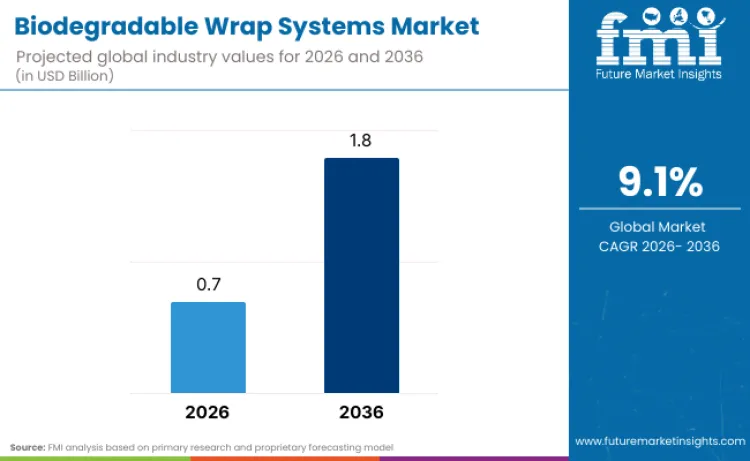
Concerns around plastic pollution and microplastic exposure are influencing purchasing decisions and accelerating replacement of conventional wraps, particularly in markets where consumers and retailers prioritize plastic free packaging. FMI estimates that ongoing research into preservation outcomes for natural wrap materials is increasing the importance of standardized biodegradation and composability testing, which supports regulatory acceptance and buyer confidence. Circular economy targets are also supporting demand as brands and foodservice operators adopt compostable solutions to strengthen sustainability claims and reduce waste handling complexity. Public initiatives focused on plastic reduction, together with higher willingness to pay for sustainable packaging in developed economies, are expected to sustain market expansion and encourage wider retail availability.
Biodegradable Wrap Systems Market Key Takeaways
| Metric | Value |
|---|---|
| Industry Size (2026) | USD 0.7 Billion |
| Industry Value (2036) | USD 1.8 Billion |
| CAGR (2026-2036) | 9.1% |
Source: Future Market Insights (FMI) analysis, based on proprietary forecasting model and primary research
What Factors Are Driving Faster Adoption of Plant Based Wraps?
Plant based wrap adoption is increasing as zero waste lifestyles and plastic reduction goals push consumers and retailers toward bio derived packaging alternatives. Improvements in cellulose wrap production are strengthening performance in food storage by supporting better moisture control and helping maintain freshness, which increases acceptance for everyday use. This positioning is appealing for buyers looking for certified compostable options that align with sustainability expectations and disposal preferences. Commercial trials and wider use of seaweed based wraps are also expanding the addressable market, showing that plant derived materials can work in higher volume foodservice environments where handling efficiency and consistency matter.
Education and awareness initiatives that communicate the environmental benefits of plant derived materials are reinforcing retailer support and improving shelf visibility for biodegradable wrap options. In response, packaging suppliers are expanding certified product lines for industrial and foodservice wrapping needs, focusing on compliance, barrier performance, and reliable sourcing. Adoption is also supported by functional enhancements such as beeswax coatings, which can improve sealing and preservation characteristics while keeping the product aligned with compostable and environmentally responsible positioning.
How Is the Biodegradable Wrap Systems Market Segmented Across Key Categories?
Global landscape is intricately segmented to address diverse requirements of the sustainable packaging industry, categorizing sector by material type, form factor, application area, and distribution channel. Structural division allows stakeholders to identify specific environmental targets, such as rising demand for heavy-duty formats in commercial applications or preference for lightweight options in residential food storage. By analyzing these segments, manufacturers can tailor production lines to meet distinct needs of food service establishments versus household consumers. Segmentation also highlights shift from traditional plastic approaches to certified compostable alternatives. As industry matures, granular segmentation becomes essential for understanding biodegradation pathways and regulatory compliance, ensuring product development aligns with evolving environmental standards.
What Is Keeping Plant Based Wraps as the Leading Material Choice?
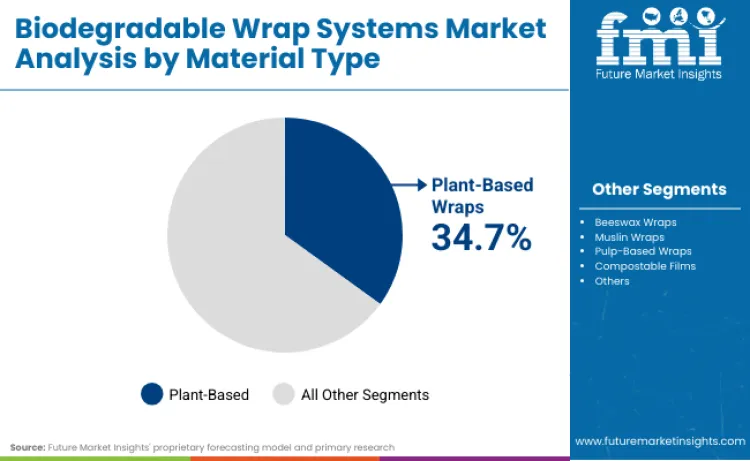
Plant based wraps are expected to hold a 34.7% share in 2026 because they are strongly aligned with compostability requirements and have broad acceptance as biodegradable materials in consumer and food contact use cases. Their lead is supported by certifications that validate compostable claims and strengthen buyer confidence across retail and foodservice channels. Manufacturing progress, including improved cellulose extraction and cleaner processing controls, is also improving consistency and reducing unwanted residues, which supports compliance and product performance. FMI expects demand to remain firm as packaging guidelines increasingly favor plant derived materials that can break down under home composting conditions within typical composting cycles.
- Certified compostable positioning supports adoption
- Strong alignment with biodegradability expectations
- Cleaner processing improves consistency and compliance
- Suitable for home composting use cases
Why Are Standard Thickness Wraps the Preferred Quality Option?
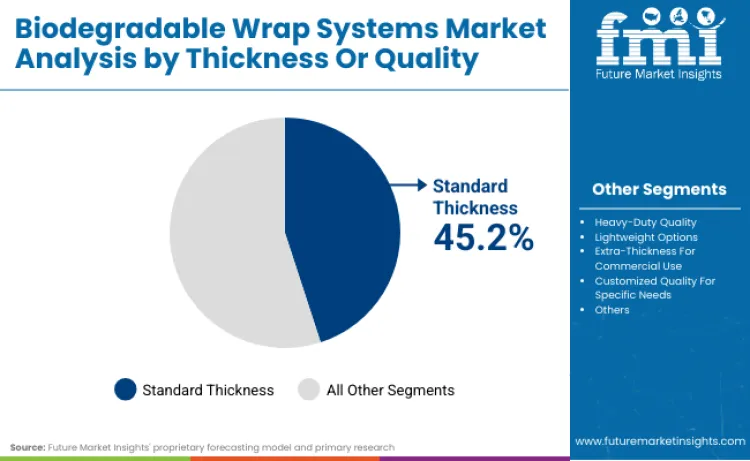
Standard thickness wraps are projected to account for 45.2% share in 2026 because they balance durability with biodegradation performance for routine food use. Compared with ultra thin formats, standard thickness typically provides more reliable barrier properties and handling strength, which supports broader use in household and commercial storage. Manufacturers are using tighter thickness calibration controls to deliver consistent moisture protection and predictable performance across batches. FMI estimates that continued focus on thickness optimization will sustain demand, as brands and consumers prioritize wraps that deliver dependable food preservation while meeting sustainability expectations.
- Balanced durability and biodegradation performance
- More reliable barrier properties for daily use
- Consistent moisture protection supports freshness
- Tight manufacturing control improves repeatability
What Is Driving Food Storage to Lead Application Demand?
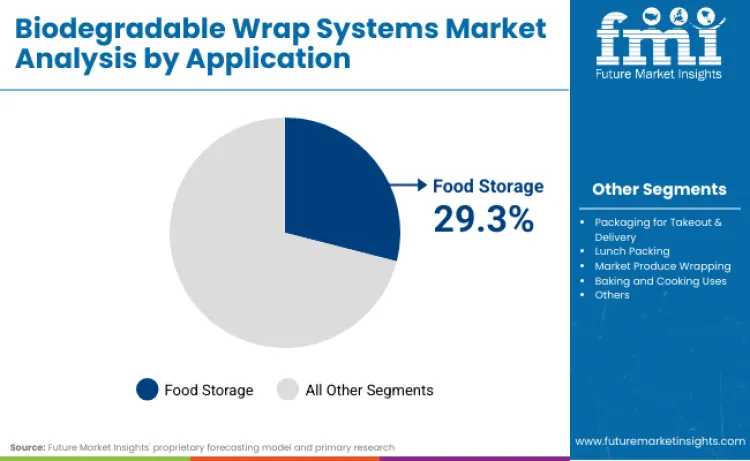
Food storage is expected to represent 29.3% of demand in 2026 because it is the most frequent and repeat use case for wraps in households and small food operations. Consumers are adopting biodegradable options to reduce plastic use while still meeting freshness and hygiene needs for perishable items. Compatibility with multiple storage practices, including refrigeration and container based storage, is supporting wider use across different food categories. FMI expects brands that focus on cellulose and starch based formulations for high usage storage needs to strengthen customer retention among eco focused buyers.
- High frequency household use sustains volume
- Plastic reduction goals support switching behavior
- Works across varied storage and preservation methods
Cellulose and starch formats build repeat demand
How Will Plastic Reduction Regulations Influence Biodegradable Wrap Sales?
Stronger plastic reduction policies are expected to lift demand for biodegradable wraps by increasing the need for certified compostable alternatives in both retail and commercial packaging. As compliance expectations tighten, buyers are likely to prefer wraps with verified biodegradation performance and clearer disposal guidance that aligns with local waste handling rules. Circular economy targets are also reinforcing demand for fully compostable formulations that can reduce landfill dependency and improve organic waste management outcomes. Suppliers that do not align products with certification and labeling expectations risk losing shelf presence with sustainability focused retailers and distributors. FMI projects that wider waste reduction legislation will continue to stimulate product differentiation, with third party certification becoming a key requirement for market access and procurement decisions.
How Will Food Service Adoption Reshape Distribution Channels?
Food service adoption is shifting distribution toward higher volume purchasing, as restaurants and commercial kitchens increasingly buy biodegradable wraps through wholesale and contract supply routes. Integration with sustainable operations is supporting faster implementation, where procurement teams select packaging based on compliance and sustainability targets. Commercial users are also driving demand for more specific wrap performance requirements, encouraging suppliers to offer customized formats and specifications through B2B channels. Growth in restaurant supply networks is improving price competitiveness and availability compared to retail led models. FMI estimates that sustainability tracking in mobile and on the go food service formats will reinforce ongoing engagement with compliant packaging programs and support repeat bulk ordering.
How Will Biomaterial Innovation Shape Market Growth for Biodegradable Wraps?
Material innovation is expected to support market growth by improving performance and strengthening credibility of environmental claims, while also raising development and validation costs. Advances in biomaterials are improving decomposition outcomes and barrier properties, which can increase adoption where performance has been a constraint. Research backed property improvements also allow suppliers to communicate more specific biodegradation timelines, supporting clearer positioning in competitive segments. Harmonization of compostability standards across regions can simplify market entry and help certified brands expand internationally. FMI expects evidence requirements to become more demanding, pushing manufacturers to invest in controlled composting studies and documentation that substantiates biodegradation claims for regulators and commercial buyers.
How Will the Biodegradable Wrap Systems Industry Evolve in Major Nations?
Global landscape for sustainable packaging wraps is characterized by diverse regulatory frameworks, influenced by environmental policies and waste management standards. Established markets prioritize certified compostable formulations and industrial-scale biodegradation testing, whereas emerging economies focus on accessible pricing and basic environmental protection. Europe is emerging as rapid growth hub due to increasing plastic reduction legislation and expanding environmental awareness. Conversely, North American sectors pivot towards home composting compatibility and residential application protocols. Government initiatives in developed nations supporting waste reduction policies ensure sustained demand for biodegradable alternatives across all demographics.
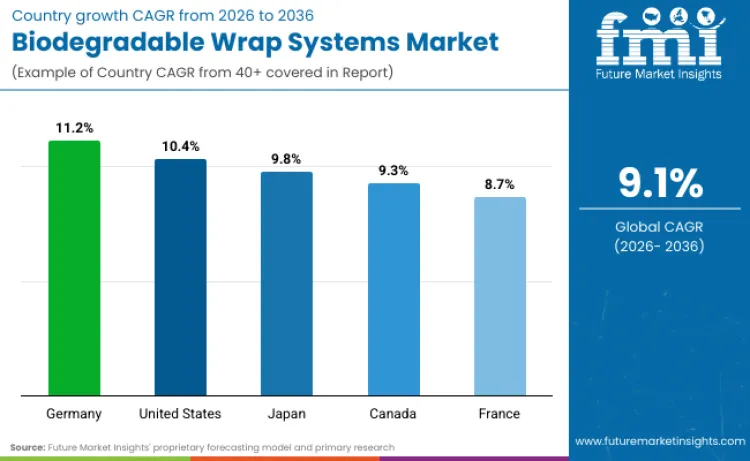
| Country | CAGR (2026 to 2036) |
|---|---|
| Germany | 11.2% |
| United States | 10.4% |
| Japan | 9.8% |
| Canada | 9.3% |
| France | 8.7% |
Source: FMI analysis based on primary research and proprietary forecasting model
What Is Driving Biodegradable Wrap Systems Market Growth in Germany?
Sales of sustainable packaging wraps in Germany are set to grow at 11.2% CAGR through 2036. Expansion is underpinned by strict environmental regulations and increasing plastic waste reduction mandates among commercial establishments. Growth is fueled by government environmental policies emphasizing circular economy principles and waste stream management. Rising environmental consciousness drives premium biodegradable adoption per capita among eco-conscious consumers. As per FMI's projection, presence of major sustainable packaging companies establishing local production capabilities streamlines supply chains and reduces import dependencies. Emphasis on industrial composting infrastructure integration with certified biodegradable materials continues to be primary driver, maintaining Germany's position as critical growth engine for sustainable packaging products.
What Factors Are Accelerating Biodegradable Wrap Systems Expansion in the United States?
Demand for environmentally responsible packaging solutions in United States is projected to rise at 10.4% CAGR during assessment period. Initiatives emphasizing plastic pollution reduction foster favorable environment for compostable packaging adoption. Increasing investment in waste management infrastructure creates extensive distribution channels for certified biodegradable products. Rising consumer environmental awareness requiring accessible eco-friendly options prompts domestic brands to develop cost-effective formulations. FMI is of the opinion that shift is supported by state-level policies encouraging sustainable packaging manufacturing, accelerating uptake of domestically produced biodegradable brands across urban centers and fueling sector expansion through improved market accessibility.
What Is Supporting Biodegradable Wrap Systems Growth Potential in Japan?
Biodegradable wrap systems industry in Japan is poised to expand at 9.8% CAGR. Growth is largely attributed to increasing awareness of marine plastic pollution among island populations. Government focus on environmental initiatives addressing waste management challenges encourages consumers to adopt preventive packaging measures. As per FMI's estimates, increasing partnerships between local manufacturers and international biomaterial suppliers ensure availability of high-quality compostable raw materials. Economic stability combined with growing environmental education attracts significant investment in sustainable packaging products. Strong regulatory framework ensuring biodegradation verification and safety further drives consumer confidence in eco-friendly packaging protocols.
What Is Fueling Biodegradable Wrap Systems Industry Growth in Canada?
Sales of sustainable packaging wraps in Canada are set to grow at 9.3% CAGR. Expansion is underpinned by comprehensive environmental policies recognizing biodegradable packaging benefits. Growth is fueled by increasing awareness of plastic pollution driving consumers toward preventive measures. Widespread adoption of municipal composting programs creates steady demand for home-compostable packaging management. High standards of environmental research and regulatory oversight prompt brands to invest in verified compostable formulations. FMI is of the opinion that emphasis on natural resource protection and waste reduction continues to be primary driver, maintaining Canada position as innovation leader in sustainable packaging solutions.
What Is Enabling Biodegradable Wrap Systems Sector Expansion in France?
Revenue from sustainable packaging wraps in France is set to grow at 8.7% CAGR. Expansion is underpinned by European Union environmental directive compliance requirements. Growth is fueled by increasing awareness of single-use plastic impacts. As per FMI's projection, moderate adoption of zero-waste lifestyles and sustainable consumption drives revenue generation in eco-friendly packaging segments. Presence of established chemical companies ensures high-quality material standards and biodegradation validation. Emphasis on environmental science research and regulatory compliance continues to be primary driver, maintaining France position as quality-focused market for sustainable packaging solutions.
How Competitive Is the Biodegradable Wrap Systems Market and What Strategies Are Shaping Brand Advantage?
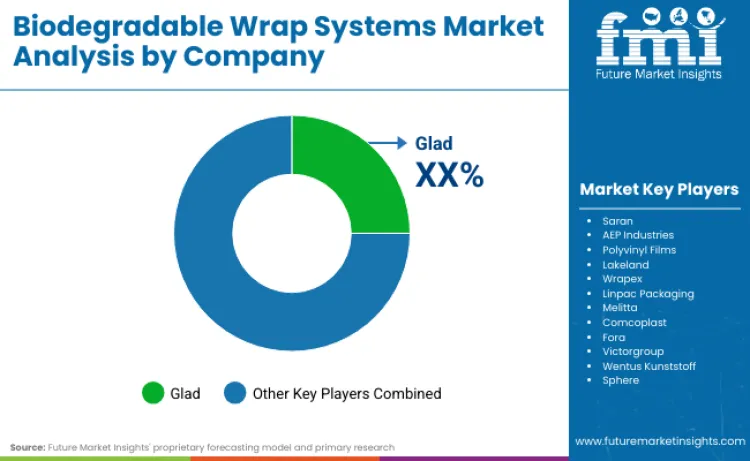
Competition in biodegradable wrap systems is increasingly influenced by certification strength, material performance, and the ability to meet application specific requirements across food storage and commercial use. Many suppliers are prioritizing biodegradation and compostability certification as a primary differentiator, since verified claims improve shelf acceptance and support procurement by retailers and foodservice buyers. Brands such as Glad and Saran are investing in research collaborations with environmental and materials focused institutions to validate compostability performance and strengthen credibility in regulated markets. A major strategic direction is the development of tailored product platforms that allow manufacturers to match wrap properties to use cases such as moisture control, sealing needs, and handling durability.
Partnerships with waste management organizations are also becoming more important as companies align products with municipal composting rules and disposal pathways, which can improve adoption where infrastructure exists. Innovation remains a key competitive lever, with suppliers advancing biomaterial chemistry to improve decomposition outcomes while maintaining functional performance in real world packaging conditions. Deal activity is generally measured, with acquisitions often focused on securing raw material supply and managing cost volatility while competing against conventional plastic film producers. FMI estimates that brands with broad retail reach and stronger certification investment maintain an advantage, including Glad, which benefits from distribution scale and sustained focus on environmental validation.
Key Players in Biodegradable Wrap Systems Market
- Glad
- Saran
- AEP Industries
- Polyvinyl Films
- Lakeland
- Wrapex
- Linpac Packaging
- Melitta
- Comcoplast
- Fora
- Victorgroup
- Wentus Kunststoff
- Sphere
Scope of Report
| Items | Values |
|---|---|
| Quantitative Units | USD Billion |
| Material Type Segments | Plant-Based Wraps; Beeswax Wraps; Muslin Wraps; Pulp-Based Wraps; Compostable Films; Others |
| Application Categories | Food Storage; Packaging for Takeout & Delivery; Lunch Packing; Market Produce Wrapping; Baking and Cooking Uses; Others |
| End User Categories | Residential Consumers; Food Service Industry; Retail Stores; Food Manufacturers; Catering Services; Others |
| Distribution Channel Types | Online Retail; Hypermarkets/Supermarkets; Specialty Stores; Convenience Stores; Direct Sales; Others |
| Thickness Or Quality Categories | Standard Thickness; Heavy-Duty Quality; Lightweight Options; Extra-Thickness For Commercial Use; Customized Quality For Specific Needs; Others |
| Regions Covered | North America, Europe, East Asia, South Asia, Latin America, Middle East & Africa |
| Key Countries | Germany, United States, Japan, Canada, France |
| Key Companies Profiled | Glad; Saran; AEP Industries; Polyvinyl Films; Lakeland; Wrapex; Linpac Packaging; Melitta; Comcoplast; Fora; Victorgroup; Wentus Kunststoff; Sphere |
| Additional Attributes | Dollar sales measured for biodegradable wrap systems used in sustainable food packaging and eco-friendly storage applications, specified by base material type (plant cellulose, beeswax, natural fibers, compostable polymers), product thickness, preservation performance preference, application focus (residential storage, commercial wrapping, food service packaging), retail model (direct vs. retail distribution), and compliance alignment with evolving biodegradation standards and environmental certification requirements. |
Biodegradable Wrap Systems Market by Segments
Material Type
- Plant-Based Wraps
- Beeswax Wraps
- Muslin Wraps
- Pulp-Based Wraps
- Compostable Films
- Others
Application
- Food Storage
- Packaging for Takeout & Delivery
- Lunch Packing
- Market Produce Wrapping
- Baking and Cooking Uses
- Others
End User
- Residential Consumers
- Food Service Industry
- Retail Stores
- Food Manufacturers
- Catering Services
- Others
Distribution Channel
- Online Retail
- Hypermarkets/Supermarkets
- Specialty Stores
- Convenience Stores
- Direct Sales
- Others
Thickness Or Quality
- Standard Thickness
- Heavy-Duty Quality
- Lightweight Options
- Extra-Thickness For Commercial Use
- Customized Quality For Specific Needs
- Others
Bibliography
- Food and Agriculture Organization of the United Nations. (2024). Livestock waste management and sustainable packaging strategies. FAO.
- International Organization for Standardization. (2023). ISO 14021: Environmental labels and declarations-Self‑declared environmental claims (Type II environmental labeling). ISO.
- World Wide Fund for Nature (WWF). (2024). Sustainable packaging and plastic reduction: Best practice guidance for food supply chains. WWF.
Frequently Asked Questions
How big is the global biodegradable wrap systems market?
The global biodegradable wrap systems market is valued at USD 0.7 billion in 2026.
What is the growth outlook for the biodegradable wrap systems market over the next 10 years?
The market is projected to grow at a CAGR of 9.1% from 2026 to 2036, reaching USD 1.8 billion by 2036.
Which applications or end uses drive demand for biodegradable wrap systems?
Demand is primarily driven by food storage applications, supported by rising household use and increasing adoption in foodservice and retail packaging.
What are the main risks and constraints affecting this market?
Key constraints include higher material costs, performance limitations versus conventional plastics, certification requirements, and variability in composting infrastructure across regions.
How do regulations and standards impact the biodegradable wrap systems market?
Environmental regulations and compostability standards strongly influence product design, certification needs, and market access, making compliance a critical factor for supplier competitiveness.
Preview the report firsthand - request a free sample
Get SampleGet the brochure for pricing and purchase details.
Get PDFTable of Content
- Executive Summary
- Global Market Outlook
- Demand Side Trends
- Supply Side Trends
- Technology Roadmap Analysis
- Analysis and Recommendations
- Market Overview
- Market Coverage / Taxonomy
- Market Definition / Scope / Limitations
- Research Methodology
- Chapter Orientation
- Analytical Lens and Working Hypotheses
- Market Structure, Signals, and Trend Drivers
- Benchmarking and Cross-market Comparability
- Market Sizing, Forecasting, and Opportunity Mapping
- Research Design and Evidence Framework
- Desk Research Programme (Secondary Evidence)
- Company Annual and Sustainability Reports
- Peer-reviewed Journals and Academic Literature
- Corporate Websites, Product Literature, and Technical Notes
- Earnings Decks and Investor Briefings
- Statutory Filings and Regulatory Disclosures
- Technical White Papers and Standards Notes
- Trade Journals, Industry Magazines, and Analyst Briefs
- Conference Proceedings, Webinars, and Seminar Materials
- Government Statistics Portals and Public Data Releases
- Press Releases and Reputable Media Coverage
- Specialist Newsletters and Curated Briefings
- Sector Databases and Reference Repositories
- FMI Internal Knowledge Base and Historical Datasets
- Subscription Datasets and Paid Sources
- Social Channels, Communities, and Digital Listening Inputs
- Additional Desk Sources
- Expert Input and Fieldwork (Primary Evidence)
- Primary Modes
- Qualitative Interviews and Expert Elicitation
- Quantitative Surveys and Structured Data Capture
- Blended Approach
- Why Primary Evidence is Used
- Field Techniques
- Interviews
- Surveys
- Focus Groups
- Observational and In-context Research
- Social and Community Interactions
- Stakeholder Universe Engaged
- C-suite Leaders
- Board Members
- Presidents and Vice Presidents
- R&D and Innovation Heads
- Technical Specialists
- Domain Subject-matter Experts
- Scientists
- Physicians and Other Healthcare Professionals
- Governance, Ethics, and Data Stewardship
- Research Ethics
- Data Integrity and Handling
- Primary Modes
- Tooling, Models, and Reference Databases
- Desk Research Programme (Secondary Evidence)
- Data Engineering and Model Build
- Data Acquisition and Ingestion
- Cleaning, Normalisation, and Verification
- Synthesis, Triangulation, and Analysis
- Quality Assurance and Audit Trail
- Market Background
- Market Dynamics
- Drivers
- Restraints
- Opportunity
- Trends
- Scenario Forecast
- Demand in Optimistic Scenario
- Demand in Likely Scenario
- Demand in Conservative Scenario
- Opportunity Map Analysis
- Product Life Cycle Analysis
- Supply Chain Analysis
- Investment Feasibility Matrix
- Value Chain Analysis
- PESTLE and Porter's Analysis
- Regulatory Landscape
- Regional Parent Market Outlook
- Production and Consumption Statistics
- Import and Export Statistics
- Market Dynamics
- Global Market Analysis 2021 to 2025 and Forecast, 2026 to 2036
- Historical Market Size Value (USD Billion) Analysis, 2021 to 2025
- Current and Future Market Size Value (USD Billion) Projections, 2026 to 2036
- Y-o-Y Growth Trend Analysis
- Absolute $ Opportunity Analysis
- Global Market Pricing Analysis 2021 to 2025 and Forecast 2026 to 2036
- Y-o-Y Growth Trend Analysis 2021 to 2025
- Absolute $ Opportunity Analysis 2026 to 2036
- Global Market Analysis 2021 to 2025 and Forecast 2026 to 2036, By Material Type
- Introduction / Key Findings
- Historical Market Size Value (USD Billion) Analysis By Material Type, 2021 to 2025
- Current and Future Market Size Value (USD Billion) Analysis and Forecast By Material Type, 2026 to 2036
- Plant-Based Wraps
- Beeswax Wraps
- Muslin Wraps
- Pulp-Based Wraps
- Compostable Films
- Others
- Y-o-Y Growth Trend Analysis By Material Type, 2021 to 2025
- Absolute $ Opportunity Analysis By Material Type, 2026 to 2036
- Global Market Analysis 2021 to 2025 and Forecast 2026 to 2036, By Application
- Introduction / Key Findings
- Historical Market Size Value (USD Billion) Analysis By Application, 2021 to 2025
- Current and Future Market Size Value (USD Billion) Analysis and Forecast By Application, 2026 to 2036
- Food Storage
- Packaging for Takeout & Delivery
- Lunch Packing
- Market Produce Wrapping
- Baking and Cooking Uses
- Others
- Y-o-Y Growth Trend Analysis By Application, 2021 to 2025
- Absolute $ Opportunity Analysis By Application, 2026 to 2036
- Global Market Analysis 2021 to 2025 and Forecast 2026 to 2036, By End User
- Introduction / Key Findings
- Historical Market Size Value (USD Billion) Analysis By End User, 2021 to 2025
- Current and Future Market Size Value (USD Billion) Analysis and Forecast By End User, 2026 to 2036
- Residential Consumers
- Food Service Industry
- Retail Stores
- Food Manufacturers
- Catering Services
- Others
- Y-o-Y Growth Trend Analysis By End User, 2021 to 2025
- Absolute $ Opportunity Analysis By End User, 2026 to 2036
- Global Market Analysis 2021 to 2025 and Forecast 2026 to 2036, By Distribution Channel
- Introduction / Key Findings
- Historical Market Size Value (USD Billion) Analysis By Distribution Channel, 2021 to 2025
- Current and Future Market Size Value (USD Billion) Analysis and Forecast By Distribution Channel, 2026 to 2036
- Online Retail
- Hypermarkets/Supermarkets
- Specialty Stores
- Convenience Stores
- Direct Sales
- Others
- Y-o-Y Growth Trend Analysis By Distribution Channel, 2021 to 2025
- Absolute $ Opportunity Analysis By Distribution Channel, 2026 to 2036
- Global Market Analysis 2021 to 2025 and Forecast 2026 to 2036, By Thickness or Quality
- Introduction / Key Findings
- Historical Market Size Value (USD Billion) Analysis By Thickness or Quality, 2021 to 2025
- Current and Future Market Size Value (USD Billion) Analysis and Forecast By Thickness or Quality, 2026 to 2036
- Standard Thickness
- Heavy-Duty Quality
- Lightweight Options
- Extra-Thickness For Commercial Use
- Customized Quality For Specific Needs
- Others
- Y-o-Y Growth Trend Analysis By Thickness or Quality, 2021 to 2025
- Absolute $ Opportunity Analysis By Thickness or Quality, 2026 to 2036
- Global Market Analysis 2021 to 2025 and Forecast 2026 to 2036, By Region
- Introduction
- Historical Market Size Value (USD Billion) Analysis By Region, 2021 to 2025
- Current Market Size Value (USD Billion) Analysis and Forecast By Region, 2026 to 2036
- North America
- Latin America
- Western Europe
- Eastern Europe
- East Asia
- South Asia and Pacific
- Middle East & Africa
- Market Attractiveness Analysis By Region
- North America Market Analysis 2021 to 2025 and Forecast 2026 to 2036, By Country
- Historical Market Size Value (USD Billion) Trend Analysis By Market Taxonomy, 2021 to 2025
- Market Size Value (USD Billion) Forecast By Market Taxonomy, 2026 to 2036
- By Country
- USA
- Canada
- Mexico
- By Material Type
- By Application
- By End User
- By Distribution Channel
- By Thickness or Quality
- By Country
- Market Attractiveness Analysis
- By Country
- By Material Type
- By Application
- By End User
- By Distribution Channel
- By Thickness or Quality
- Key Takeaways
- Latin America Market Analysis 2021 to 2025 and Forecast 2026 to 2036, By Country
- Historical Market Size Value (USD Billion) Trend Analysis By Market Taxonomy, 2021 to 2025
- Market Size Value (USD Billion) Forecast By Market Taxonomy, 2026 to 2036
- By Country
- Brazil
- Chile
- Rest of Latin America
- By Material Type
- By Application
- By End User
- By Distribution Channel
- By Thickness or Quality
- By Country
- Market Attractiveness Analysis
- By Country
- By Material Type
- By Application
- By End User
- By Distribution Channel
- By Thickness or Quality
- Key Takeaways
- Western Europe Market Analysis 2021 to 2025 and Forecast 2026 to 2036, By Country
- Historical Market Size Value (USD Billion) Trend Analysis By Market Taxonomy, 2021 to 2025
- Market Size Value (USD Billion) Forecast By Market Taxonomy, 2026 to 2036
- By Country
- Germany
- UK
- Italy
- Spain
- France
- Nordic
- BENELUX
- Rest of Western Europe
- By Material Type
- By Application
- By End User
- By Distribution Channel
- By Thickness or Quality
- By Country
- Market Attractiveness Analysis
- By Country
- By Material Type
- By Application
- By End User
- By Distribution Channel
- By Thickness or Quality
- Key Takeaways
- Eastern Europe Market Analysis 2021 to 2025 and Forecast 2026 to 2036, By Country
- Historical Market Size Value (USD Billion) Trend Analysis By Market Taxonomy, 2021 to 2025
- Market Size Value (USD Billion) Forecast By Market Taxonomy, 2026 to 2036
- By Country
- Russia
- Poland
- Hungary
- Balkan & Baltic
- Rest of Eastern Europe
- By Material Type
- By Application
- By End User
- By Distribution Channel
- By Thickness or Quality
- By Country
- Market Attractiveness Analysis
- By Country
- By Material Type
- By Application
- By End User
- By Distribution Channel
- By Thickness or Quality
- Key Takeaways
- East Asia Market Analysis 2021 to 2025 and Forecast 2026 to 2036, By Country
- Historical Market Size Value (USD Billion) Trend Analysis By Market Taxonomy, 2021 to 2025
- Market Size Value (USD Billion) Forecast By Market Taxonomy, 2026 to 2036
- By Country
- China
- Japan
- South Korea
- By Material Type
- By Application
- By End User
- By Distribution Channel
- By Thickness or Quality
- By Country
- Market Attractiveness Analysis
- By Country
- By Material Type
- By Application
- By End User
- By Distribution Channel
- By Thickness or Quality
- Key Takeaways
- South Asia and Pacific Market Analysis 2021 to 2025 and Forecast 2026 to 2036, By Country
- Historical Market Size Value (USD Billion) Trend Analysis By Market Taxonomy, 2021 to 2025
- Market Size Value (USD Billion) Forecast By Market Taxonomy, 2026 to 2036
- By Country
- India
- ASEAN
- Australia & New Zealand
- Rest of South Asia and Pacific
- By Material Type
- By Application
- By End User
- By Distribution Channel
- By Thickness or Quality
- By Country
- Market Attractiveness Analysis
- By Country
- By Material Type
- By Application
- By End User
- By Distribution Channel
- By Thickness or Quality
- Key Takeaways
- Middle East & Africa Market Analysis 2021 to 2025 and Forecast 2026 to 2036, By Country
- Historical Market Size Value (USD Billion) Trend Analysis By Market Taxonomy, 2021 to 2025
- Market Size Value (USD Billion) Forecast By Market Taxonomy, 2026 to 2036
- By Country
- Kingdom of Saudi Arabia
- Other GCC Countries
- Turkiye
- South Africa
- Other African Union
- Rest of Middle East & Africa
- By Material Type
- By Application
- By End User
- By Distribution Channel
- By Thickness or Quality
- By Country
- Market Attractiveness Analysis
- By Country
- By Material Type
- By Application
- By End User
- By Distribution Channel
- By Thickness or Quality
- Key Takeaways
- Key Countries Market Analysis
- USA
- Pricing Analysis
- Market Share Analysis, 2025
- By Material Type
- By Application
- By End User
- By Distribution Channel
- By Thickness or Quality
- Canada
- Pricing Analysis
- Market Share Analysis, 2025
- By Material Type
- By Application
- By End User
- By Distribution Channel
- By Thickness or Quality
- Mexico
- Pricing Analysis
- Market Share Analysis, 2025
- By Material Type
- By Application
- By End User
- By Distribution Channel
- By Thickness or Quality
- Brazil
- Pricing Analysis
- Market Share Analysis, 2025
- By Material Type
- By Application
- By End User
- By Distribution Channel
- By Thickness or Quality
- Chile
- Pricing Analysis
- Market Share Analysis, 2025
- By Material Type
- By Application
- By End User
- By Distribution Channel
- By Thickness or Quality
- Germany
- Pricing Analysis
- Market Share Analysis, 2025
- By Material Type
- By Application
- By End User
- By Distribution Channel
- By Thickness or Quality
- UK
- Pricing Analysis
- Market Share Analysis, 2025
- By Material Type
- By Application
- By End User
- By Distribution Channel
- By Thickness or Quality
- Italy
- Pricing Analysis
- Market Share Analysis, 2025
- By Material Type
- By Application
- By End User
- By Distribution Channel
- By Thickness or Quality
- Spain
- Pricing Analysis
- Market Share Analysis, 2025
- By Material Type
- By Application
- By End User
- By Distribution Channel
- By Thickness or Quality
- France
- Pricing Analysis
- Market Share Analysis, 2025
- By Material Type
- By Application
- By End User
- By Distribution Channel
- By Thickness or Quality
- India
- Pricing Analysis
- Market Share Analysis, 2025
- By Material Type
- By Application
- By End User
- By Distribution Channel
- By Thickness or Quality
- ASEAN
- Pricing Analysis
- Market Share Analysis, 2025
- By Material Type
- By Application
- By End User
- By Distribution Channel
- By Thickness or Quality
- Australia & New Zealand
- Pricing Analysis
- Market Share Analysis, 2025
- By Material Type
- By Application
- By End User
- By Distribution Channel
- By Thickness or Quality
- China
- Pricing Analysis
- Market Share Analysis, 2025
- By Material Type
- By Application
- By End User
- By Distribution Channel
- By Thickness or Quality
- Japan
- Pricing Analysis
- Market Share Analysis, 2025
- By Material Type
- By Application
- By End User
- By Distribution Channel
- By Thickness or Quality
- South Korea
- Pricing Analysis
- Market Share Analysis, 2025
- By Material Type
- By Application
- By End User
- By Distribution Channel
- By Thickness or Quality
- Russia
- Pricing Analysis
- Market Share Analysis, 2025
- By Material Type
- By Application
- By End User
- By Distribution Channel
- By Thickness or Quality
- Poland
- Pricing Analysis
- Market Share Analysis, 2025
- By Material Type
- By Application
- By End User
- By Distribution Channel
- By Thickness or Quality
- Hungary
- Pricing Analysis
- Market Share Analysis, 2025
- By Material Type
- By Application
- By End User
- By Distribution Channel
- By Thickness or Quality
- Kingdom of Saudi Arabia
- Pricing Analysis
- Market Share Analysis, 2025
- By Material Type
- By Application
- By End User
- By Distribution Channel
- By Thickness or Quality
- Turkiye
- Pricing Analysis
- Market Share Analysis, 2025
- By Material Type
- By Application
- By End User
- By Distribution Channel
- By Thickness or Quality
- South Africa
- Pricing Analysis
- Market Share Analysis, 2025
- By Material Type
- By Application
- By End User
- By Distribution Channel
- By Thickness or Quality
- USA
- Market Structure Analysis
- Competition Dashboard
- Competition Benchmarking
- Market Share Analysis of Top Players
- By Regional
- By Material Type
- By Application
- By End User
- By Distribution Channel
- By Thickness or Quality
- Competition Analysis
- Competition Deep Dive
- Glad
- Saran
- AEP Industries
- Polyvinyl Films
- Lakeland
- Wrapex
- Linpac Packaging
- Melitta
- Comcoplast
- Fora
- Victorgroup
- Wentus Kunststoff
- Sphere
- Competition Deep Dive
- Assumptions & Acronyms Used


