

- Industry Size (2026)
- USD 8.67 Bn
- Forecast (2036)
- USD 15.09 Bn
- CAGR (2026 to 2036)
- 5.7%
Panel Mounted Disconnect Switch Market Size, Market Forecast and Outlook By FMI
The panel mounted disconnect switch market was valued at USD 8.20 billion in 2025, projected to reach USD 8.67 billion in 2026, and is forecast to expand to USD 15.09 billion by 2036 at a 5.7% CAGR. Expansion of industrial electrification infrastructure, grid modernization programs, and growing installed base of renewable energy systems are driving procurement of panel mounted disconnect switches across industrial, commercial, and utility applications. FMI is of the opinion that the convergence of electrical safety code revisions and distributed energy resource integration requirements is creating a structural procurement cycle that extends well beyond standard equipment replacement timelines.
Summary of Panel Mounted Disconnect Switch Market
- The market is forecast to touch USD 15.09 billion by 2036.
- Annual growth of 5.7% is projected across the 2026–2036 forecast horizon.
- In 2025, market value was pegged at USD 8.20 billion.
- The forecast period unlocks an incremental opportunity worth USD 6.42 billion.
- Non-Fused switches lead by product type with 61.3% share in 2026, reflecting the dominant installed base across industrial motor control centers and HVAC distribution panels.
- Low Voltage holds 47.9% share by voltage class, driven by concentrated demand from building services and light industrial distribution.
- Industrial applications command 52.6% share, anchored by motor isolation, maintenance disconnection, and equipment protection requirements across manufacturing facilities.
- The market is an infrastructure-driven electrical components category where voltage rating compliance, safety code alignment, and grid interconnection standards define procurement specifications.
- China leads at 7.7% CAGR, followed by India at 7.1%, Germany at 6.6%, France at 6.0%, UK at 5.4%, USA at 4.8%, and Brazil at 4.3%.
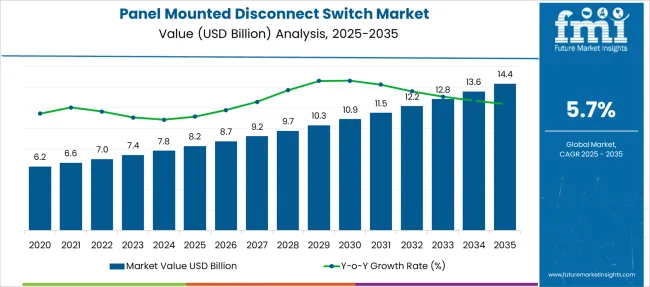
Panel Mounted Disconnect Switch Market Key Takeaways
| Metric | Details |
|---|---|
| Industry Size (2026) | USD 8.67 billion |
| Industry Value (2036) | USD 15.09 billion |
| CAGR (2026 to 2036) | 5.7% |
Source: Future Market Insights, 2026
Non-fused disconnect switches dominate the product mix, accounting for the largest installed base across industrial motor control centers and HVAC distribution panels. Low voltage applications hold the largest share, reflecting the concentrated demand from building services, light industrial, and commercial distribution systems. FMI analysts note that medium and high voltage disconnect switch procurement is accelerating as utility-scale solar and wind installations require dedicated isolation equipment compliant with updated grid interconnection standards. The shift toward modular switchgear assemblies is compressing installation timelines, allowing electrical contractors to meet tighter project commissioning schedules.
China leads with a 7.7% CAGR, driven by its massive industrial construction pipeline and grid expansion investments. India follows at 7.1%, supported by rural electrification programs and manufacturing corridor development under national infrastructure schemes. Germany registers 6.6%, where Energiewende-related grid upgrades sustain steady procurement. France tracks at 6.0%, the UK at 5.4%, the USA at 4.8%, and Brazil at 4.3%, where growing distributed solar installations and industrial park construction support demand.
Panel Mounted Disconnect Switch Market Definition
Panel mounted disconnect switches are manually or mechanically operated switching devices installed within electrical enclosures to provide visible isolation of circuits for maintenance, safety, and equipment protection purposes. These switches are rated for low, medium, and high voltage applications and are available in fused and non-fused configurations for industrial, commercial, and utility distribution systems.
Panel Mounted Disconnect Switch Market Inclusions
Market scope covers non-fused and fused panel mounted disconnect switches across low, medium, and high voltage ratings. The report includes global and regional market sizes, forecast period 2026 to 2036, and segment breakdowns by product type, voltage class, and application.
Panel Mounted Disconnect Switch Market Exclusions
The scope excludes molded case circuit breakers, automatic transfer switches, and programmable logic controller-operated contactors. Standalone fuse holders without integrated disconnect functionality and miniature circuit breakers for residential branch circuits are also excluded.
Panel Mounted Disconnect Switch Market Research Methodology
- Primary Research: Analysts conducted interviews with electrical panel OEM engineers, switchgear procurement managers, and utility grid planning directors to map specification cycles and project pipeline timelines.
- Desk Research: Data collection phases aggregated electrical equipment trade statistics from national customs databases, grid modernization program budgets from energy ministries, and electrical code revision schedules from standards bodies.
- Market-Sizing and Forecasting: Baseline values derive from a bottom-up aggregation of disconnect switch shipment volumes by voltage class and product type, applying regional electrification penetration curves and grid upgrade schedules to project demand trajectories.
- Data Validation and Update Cycle: Projections are tested against publicly reported capital expenditure plans from leading electrical utilities and industrial conglomerate annual procurement disclosures.
Why is the Panel Mounted Disconnect Switch Market Growing?
The panel mounted disconnect switch market is experiencing steady growth, driven by the increasing demand for reliable electrical safety devices in industrial settings. Industry requirements for secure isolation of electrical circuits to perform maintenance and ensure operator safety have highlighted the importance of disconnect switches.
The shift toward automation and upgraded power distribution systems has contributed to higher adoption rates. Improvements in switch design, focusing on durability and ease of installation, have enhanced their appeal to electrical engineers and facility managers.
Additionally, strict safety regulations and standards in electrical installations continue to drive the replacement of outdated equipment. The market outlook remains positive with growing industrial infrastructure development and the need for efficient power control solutions. Segment growth is expected to be dominated by non-fused switches, low voltage ratings of 11 kV or below, and applications focused on the industrial sector.
Segmental Analysis
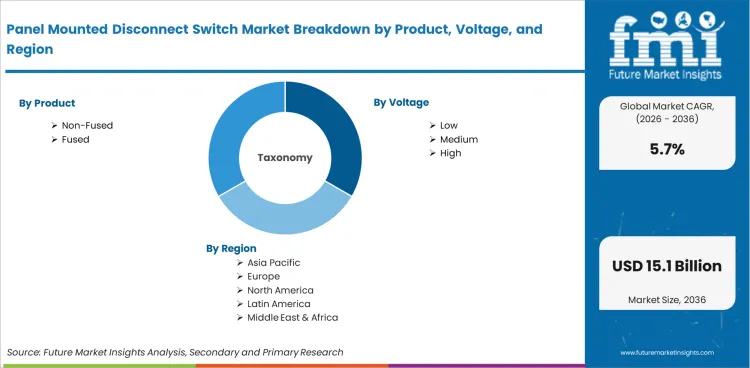
The panel-mounted disconnect switch market is segmented by product, voltage, and application and geographic regions. The product of the panel-mounted disconnect switch market is divided into Non-Fused and Fused. In terms of voltage, the panel-mounted disconnect switch market is classified into Low (≤ 11 kV), Medium (> 11 kV - 33 kV), and High (> 33 kV). Based on the application of the panel-mounted disconnect switch, the market is segmented into Industrial, Commercial, and Utility. Regionally, the panel-mounted disconnect switch industry is classified into North America, Latin America, Western Europe, Eastern Europe, Balkan & Baltic Countries, Russia & Belarus, Central Asia, East Asia, South Asia & Pacific, and the Middle East & Africa.
Insights into the Product Segment: Non-Fused
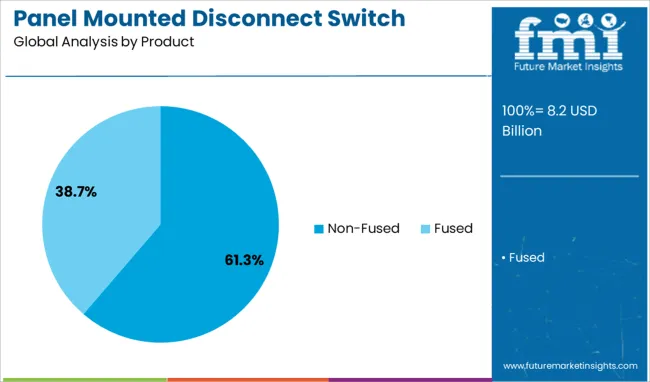
The non-fused product segment is expected to hold 61.3% of the panel mounted disconnect switch market revenue in 2026, maintaining its leadership position. This segment has grown due to its suitability for use in circuits where upstream protection devices handle fault interruption. Non-fused switches are preferred for their simpler design, ease of maintenance, and cost-effectiveness.
Industrial users have increasingly favored non-fused switches for applications requiring circuit isolation without the need for built-in overcurrent protection. The segment benefits from widespread acceptance in electrical panels for motor control centers and distribution boards.
As operational safety and efficiency remain critical, non-fused disconnect switches are anticipated to continue leading product demand.
Insights into the Voltage Segment: Low (≤ 11 kV)
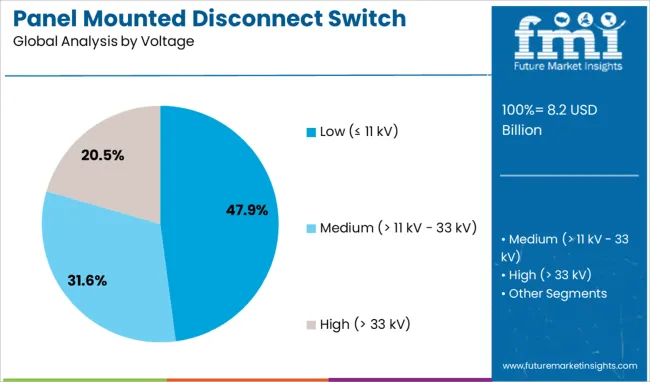
The low voltage segment, defined as 11 kV or below, is projected to contribute 47.9% of the market revenue in 2026, establishing itself as the dominant voltage rating category. This is primarily due to the extensive use of low voltage electrical systems in industrial facilities for power distribution and equipment control.
Low voltage disconnect switches provide reliable isolation and safe maintenance access while meeting industry safety standards. The segment has expanded alongside industrial growth, where low voltage applications are common in motors, transformers, and control circuits.
Its broad applicability and compliance with electrical safety regulations ensure sustained demand. As industrial power systems modernize and expand, low voltage disconnect switches are expected to retain their market prominence.
Insights into the Application Segment: Industrial
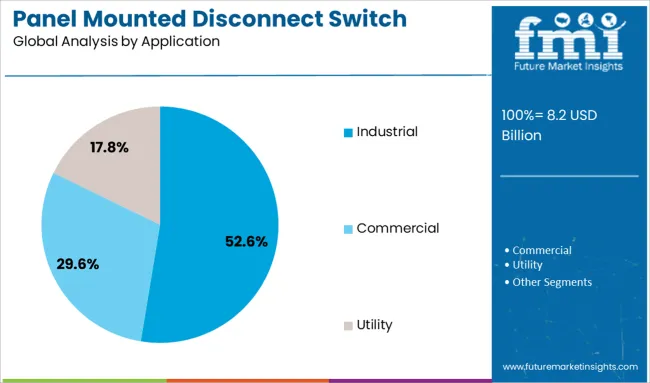
The industrial segment is projected to represent 52.6% of the panel mounted disconnect switch market revenue in 2026, making it the largest application segment. Industrial facilities demand robust and reliable electrical components to ensure uninterrupted operations and worker safety. Disconnect switches are critical for isolating equipment during maintenance and emergencies.
The rise in industrial automation, increased factory expansions, and modernization of electrical infrastructure have all contributed to the growing need for panel mounted disconnect switches.
Stringent occupational health and safety regulations also mandate the use of proper disconnecting devices to reduce electrical hazards. With continued industrial development worldwide, the industrial application segment is expected to maintain its leadership in market revenue.
What are the Drivers, Restraints, and Key Trends of the Panel Mounted Disconnect Switch Market?
The panel mounted disconnect switch market is expanding owing to stringent electrical safety regulations, growing automation adoption, and expansion of power infrastructure worldwide. Investors are focused on smart and IoT-enabled switch designs integrated into control panels for predictive maintenance in utilities and industrial sectors. Compact and modular designs are becoming mainstream for space-limited installations. High installation and retrofit complexity, competition from dry-type alternatives, and reliance on oil-filled construction restrict market expansion. Manufacturers prioritizing safety standards compliance and ease of installation are viewed as best positioned for growth through 2025 and beyond.
Rising Safety Regulations and Automation Demand
Market growth is being driven by enforcement of electrical isolation standards and increased automation across manufacturing and energy sectors. In 2024, utilities in Asia-Pacific and North America accelerated upgrading of distribution panels, driving procurement of panel mounted disconnect switches for high-voltage safety applications. Growing investment in grid modernization and EV charging infrastructure prompted greater deployment of safe disconnect solutions rated above 11 kV. It is widely believed that emphasis on compliance with IEC and UL standards is ensuring steady adoption among industrial buyers globally.
Smart Diagnostics and Modular Switch Platforms
Opportunities are emerging in disconnect devices featuring built‑in condition monitoring and remote status reporting for predictive maintenance. By 2025, switch-makers rolled out units with digital sensors tracking temperature and switching cycles, facilitating integration into smart substation schemes. Modular designs and plug-and-play cartridges are gaining traction in commercial installations to simplify servicing. It is considered that suppliers offering connected and scalable switch platforms will attract utilities and large industrial clients looking to reduce downtime and TOTAL cost of ownership.
Compact Form Factors and Enhanced Reliability Features
A key trend in 2024–2025 has been transition toward compact switch models designed for space-constrained panels, especially in data centres and offshore applications. IoT-enabled diagnostic feedback and ruggedized insulation systems are being adopted to enable real-time fault detection. Non-fused switch variants continue to dominate due to lower maintenance and simpler operation. Hybrid versions combining fused and non-fused modules are also gaining interest. It is strongly believed that product designs delivering reliability and form-factor flexibility will dictate procurement preferences across new installations.
High Capital Costs and Adoption Complexity
The market is constrained by high equipment and installation costs, limited retrofit compatibility, and long certification cycles. In 2024 developers encountered delays in commissioning due to stringent compliance checks and oil-related safety procedures. Furthermore, dry-type alternatives and fuse-free switch tech are increasingly preferred for lower-voltage indoor panels, limiting use of panel-mounted types in certain segments. It is strongly believed that smaller players unable to offer simplified installation and cost-effective designs will be challenged in competing with emerging alternatives.
Analysis of Panel Mounted Disconnect Switch Market By Key Countries
.webp "Top Country Growth Comparison Panel Mounted Disconnect Switch Market Cagr (2026 2036)")
| Country | CAGR |
|---|---|
| China | 7.7% |
| India | 7.1% |
| Germany | 6.6% |
| France | 6.0% |
| UK | 5.4% |
| USA | 4.8% |
| Brazil | 4.3% |
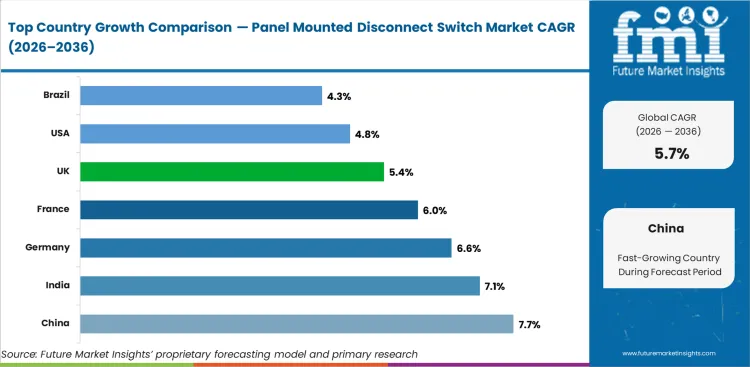
The global panel mounted disconnect switch market is projected to grow at a CAGR of 5.7% from 2026 to 2036. China leads with 7.7%, followed by India at 7.1% and Germany at 6.6%. France records 6.0%, while the United Kingdom posts 5.4%. Growth is driven by rising adoption in industrial control systems, enhanced electrical safety standards, and expansion of renewable energy projects. China and India dominate demand through rapid industrialization, while Germany focuses on compact high-performance designs. France and the UK prioritize compliance-driven retrofits and integration with smart monitoring features for advanced electrical systems.
Demand Forecast for Panel Mounted Disconnect Switch Market in China
The panel mounted disconnect switch market in China is projected to grow at 7.7%, supported by large-scale automation projects and increased focus on safety in power distribution systems. Rotary disconnect switches dominate usage in industrial control panels. Manufacturers integrate arc-flash mitigation technologies for improved protection. Growth in renewable power installations accelerates adoption across substations and distributed generation units.
- Rotary disconnect switches dominate industrial panel applications.
- Arc-flash mitigation features enhance workplace electrical safety.
- Renewable projects increase adoption of high-durability disconnect switches.
Panel Mounted Disconnect Switch Market Growth Outlook in India
The panel mounted disconnect switch market in India is expected to grow at 7.1%, driven by expanding manufacturing infrastructure and energy sector modernization. Compact switch designs dominate installation in HVAC and motor control systems. Manufacturers develop cost-effective solutions with quick-install features for SMEs. Rising demand for reliable circuit isolation in commercial buildings boosts deployment.
- Compact disconnect switches dominate HVAC and motor control setups.
- Quick-install models cater to cost-sensitive small-scale enterprises.
- Commercial real estate growth drives switch demand in new projects.
Future Outlook for Panel Mounted Disconnect Switch Market in Germany
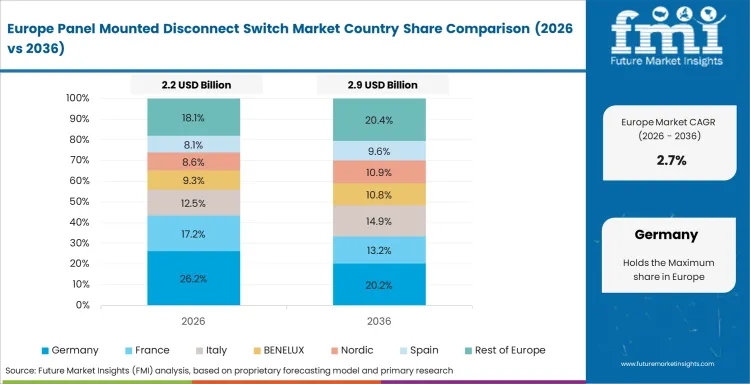
The panel mounted disconnect switch market in Germany is forecast to grow at 6.6%, driven by Industry 4.0 adoption and strong emphasis on operational safety. Fused disconnect switches dominate heavy-duty industrial environments. Manufacturers innovate with IP65-rated enclosures for harsh conditions. Increasing deployment in automated assembly lines accelerates demand for advanced switchgear solutions.
- Fused disconnect switches dominate heavy industrial panel usage.
- IP65-rated enclosures ensure performance in harsh operating conditions.
- Automated manufacturing drives adoption of advanced panel switches.
Analysis of Panel Mounted Disconnect Switch Market in France
The panel mounted disconnect switch market in France is expected to grow at 6.0%, supported by modernization of aging electrical networks and renewable energy integration. Non-fused disconnect switches dominate retrofitting projects for commercial setups. Manufacturers introduce modular configurations to improve installation flexibility. Increased focus on compliance with EU electrical safety norms boosts demand for premium switchgear.
- Non-fused disconnect switches dominate retrofits in commercial panels.
- Modular panel designs enhance scalability for building upgrades.
- Regulatory compliance requirements drive premium switch adoption.
Growth Analysis of Panel Mounted Disconnect Switch Market in the United Kingdom
The panel mounted disconnect switch market in the UK is projected to grow at 5.4%, driven by expansion of smart grid projects and rising energy efficiency mandates. Multi-pole disconnect switches dominate installations in renewable energy systems. Manufacturers invest in integrating remote monitoring capabilities with IoT platforms. Increasing adoption in data centers reinforces market demand for high-reliability disconnect switches.
- Multi-pole disconnect switches dominate renewable and smart grid systems.
- IoT-enabled designs support predictive maintenance and remote control.
- Data center growth fuels demand for reliable electrical isolation.
Competitive Landscape of Panel Mounted Disconnect Switch Market
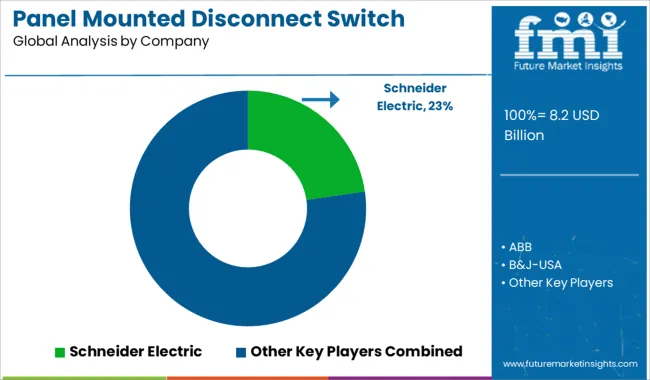
The panel mounted disconnect switch market is moderately consolidated, with Schneider Electric recognized as a leading player due to its comprehensive range of high-performance disconnect switches designed for industrial, commercial, and residential applications. The company’s focus on safety, reliability, and integration with smart energy management systems strengthens its leadership in the global market.
Key players include ABB, B&J-USA, c3controls, Changan Group, Eaton, Emerson Electric, EMSPEC, General Electric, Havells India, Honeywell International, Littelfuse, LOVATO ELECTRIC, MERSEN EP, Richards Manufacturing, Rockwell Automation, Salzer, Siemens, SOCOMEC, and WEG. These companies provide disconnect switches engineered to ensure safe power isolation during maintenance and emergency shutdowns, with designs suitable for harsh environments and compliance with international safety standards such as IEC and UL.
Market growth is driven by increasing demand for electrical safety solutions, modernization of power distribution infrastructure, and growing adoption of renewable energy systems requiring secure isolation mechanisms.
Leading manufacturers are focusing on innovations such as compact modular designs, enhanced arc-flash protection, and integration of digital monitoring for predictive maintenance. North America and Europe dominate the market due to stringent electrical safety regulations, while Asia-Pacific is experiencing rapid growth fueled by industrial expansion and smart grid deployments.
Key Developments in Panel Mounted Disconnect Switch Market
In March 2025, ABB committed USD 120 million to expand its electrification manufacturing capacity in the USA-doubling its Mississippi facility and adding production in Selmer, Tennessee. This investment also created approximately 250 new jobs, reinforcing ABB’s leadership in panel-mounted disconnect switch production across North America.
Scope of the Report
| Metric | Value |
|---|---|
| Quantitative Units | USD 8.67 billion to USD 15.09 billion, at a CAGR of 5.7% |
| Market Definition | Panel Mounted Disconnect Switches encompass manually or mechanically operated switching devices installed within electrical enclosures to provide visible circuit isolation for maintenance, safety, and equipment protection across low, medium, and high voltage industrial, commercial, and utility distribution systems. |
| Segmentation | Product: Non-Fused, Fused; Voltage: Low, Medium, High; Application: Industrial, Commercial, Utility |
| Regions Covered | North America, Latin America, Europe, East Asia, South Asia, Oceania, Middle East & Africa |
| Countries Covered | China, India, Germany, France, UK, USA, Brazil, and 40 plus countries |
| Key Companies Profiled | Schneider Electric, ABB, B&J-USA, c3controls, Changan Group, Eaton, Emerson Electric, EMSPEC, General Electric, Havells India, Honeywell International, Littelfuse, LOVATO ELECTRIC, MERSEN EP, Richards Manufacturing, Rockwell Automation, Salzer, Siemens, SOCOMEC, WEG |
| Forecast Period | 2026 to 2036 |
| Approach | Forecasting models apply a bottom-up methodology starting with disconnect switch shipment volumes by voltage class and product type, projecting regional demand based on electrification penetration curves, grid upgrade schedules, and industrial construction pipeline analysis. |
Panel Mounted Disconnect Switch Market by Segments
Product:
- Non-Fused
- Fused
Voltage:
- Low (≤ 11 kV)
- Medium (> 11 kV - 33 kV)
- High (> 33 kV)
Application:
- Industrial
- Commercial
- Utility
Region:
- North America
- USA
- Canada
- Mexico
- Latin America
- Brazil
- Chile
- Rest of Latin America
- Western Europe
- Germany
- UK
- Italy
- Spain
- France
- Nordic
- BENELUX
- Rest of Western Europe
- Eastern Europe
- Russia
- Poland
- Hungary
- Balkan & Baltic
- Rest of Eastern Europe
- East Asia
- China
- Japan
- South Korea
- South Asia and Pacific
- India
- ASEAN
- Australia & New Zealand
- Rest of South Asia and Pacific
- Middle East & Africa
- Kingdom of Saudi Arabia
- Other GCC Countries
- Turkiye
- South Africa
- Other African Union
- Rest of Middle East & Africa
Bibliography
- 1. International Electrotechnical Commission. (2024). IEC 60947-3: Low-Voltage Switchgear and Controlgear, Part 3: Switches, Disconnectors, Switch-Disconnectors and Fuse-Combination Units. IEC.
- 2. International Energy Agency. (2024). World Energy Investment 2024. IEA.
- 3. European Commission, Directorate-General for Energy. (2024). EU Electricity Grid Action Plan. European Commission.
- 4. United States Department of Energy. (2024). Grid Modernization Initiative Peer Review Report. U.S. DOE.
- 5. Ministry of Power, Government of India. (2024). Annual Report 2023-24: Rural Electrification and Distribution Reforms. Ministry of Power.
- 6. National Electrical Manufacturers Association. (2024). NEMA Standards for Enclosed Switches. NEMA.
This bibliography is provided for reader reference. The full Future Market Insights report contains the complete reference list with primary research documentation.
Frequently Asked Questions
How large is the demand for Panel Mounted Disconnect Switches in the global market in 2026?
Demand for Panel Mounted Disconnect Switches in the global market is estimated to be valued at USD 8.67 billion in 2026.
What will be the market size of Panel Mounted Disconnect Switches by 2036?
Market size for Panel Mounted Disconnect Switches is projected to reach USD 15.09 billion by 2036.
What is the expected demand growth between 2026 and 2036?
Demand for Panel Mounted Disconnect Switches is expected to grow at a CAGR of 5.7% between 2026 and 2036.
Which Product type is poised to lead by share in 2026?
Non-Fused disconnect switches account for 61.3% share in 2026, reflecting the dominant installed base across industrial motor control centers and commercial distribution panels.
How significant is the Industrial application segment?
Industrial applications hold 52.6% share in 2026, anchored by motor isolation, maintenance disconnection, and equipment protection requirements across manufacturing facilities.
What is the growth outlook for China in this report?
China is projected to grow at a CAGR of 7.7% during 2026 to 2036, driven by its industrial construction pipeline and grid expansion investments.
What is a Panel Mounted Disconnect Switch and what is it mainly used for?
A panel mounted disconnect switch is a manually operated switching device installed within electrical enclosures to provide visible circuit isolation. It is primarily used for maintenance safety, equipment protection, and regulatory compliance in industrial, commercial, and utility distribution systems.
Preview the report firsthand - request a free sample
Get SampleGet the brochure for pricing and purchase details.
Get PDFTable of Content
- Executive Summary
- Global Market Outlook
- Demand-side Trends
- Supply-side Trends
- Technology Roadmap Analysis
- Analysis and Recommendations
- Market Overview
- Market Coverage / Taxonomy
- Market Definition / Scope / Limitations
- Research Methodology
- Chapter Orientation
- Analytical Lens and Working Hypotheses
- Market Structure, Signals, and Trend Drivers
- Benchmarking and Cross-market Comparability
- Market Sizing, Forecasting, and Opportunity Mapping
- Research Design and Evidence Framework
- Desk Research Programme (Secondary Evidence)
- Company Annual and Sustainability Reports
- Peer-reviewed Journals and Academic Literature
- Corporate Websites, Product Literature, and Technical Notes
- Earnings Decks and Investor Briefings
- Statutory Filings and Regulatory Disclosures
- Technical White Papers and Standards Notes
- Trade Journals, Industry Magazines, and Analyst Briefs
- Conference Proceedings, Webinars, and Seminar Materials
- Government Statistics Portals and Public Data Releases
- Press Releases and Reputable Media Coverage
- Specialist Newsletters and Curated Briefings
- Sector Databases and Reference Repositories
- FMI Internal Proprietary Databases and Historical Market Datasets
- Subscription Datasets and Paid Sources
- Social Channels, Communities, and Digital Listening Inputs
- Additional Desk Sources
- Expert Input and Fieldwork (Primary Evidence)
- Primary Modes
- Qualitative Interviews and Expert Elicitation
- Quantitative Surveys and Structured Data Capture
- Blended Approach
- Why Primary Evidence is Used
- Field Techniques
- Interviews
- Surveys
- Focus Groups
- Observational and In-context Research
- Social and Community Interactions
- Stakeholder Universe Engaged
- C-suite Leaders
- Board Members
- Presidents and Vice Presidents
- R&D and Innovation Heads
- Technical Specialists
- Domain Subject-matter Experts
- Scientists
- Physicians and Other Healthcare Professionals
- Governance, Ethics, and Data Stewardship
- Research Ethics
- Data Integrity and Handling
- Primary Modes
- Tooling, Models, and Reference Databases
- Desk Research Programme (Secondary Evidence)
- Data Engineering and Model Build
- Data Acquisition and Ingestion
- Cleaning, Normalisation, and Verification
- Synthesis, Triangulation, and Analysis
- Quality Assurance and Audit Trail
- Market Background
- Market Dynamics
- Drivers
- Restraints
- Opportunity
- Trends
- Scenario Forecast
- Demand in Optimistic Scenario
- Demand in Likely Scenario
- Demand in Conservative Scenario
- Opportunity Map Analysis
- Product Life Cycle Analysis
- Supply Chain Analysis
- Investment Feasibility Matrix
- Value Chain Analysis
- PESTLE and Porter’s Analysis
- Regulatory Landscape
- Regional Parent Market Outlook
- Production and Consumption Statistics
- Import and Export Statistics
- Market Dynamics
- Global Market Analysis 2021 to 2025 and Forecast, 2026 to 2036
- Historical Market Size Value (USD Million) Analysis, 2021 to 2025
- Current and Future Market Size Value (USD Million) Projections, 2026 to 2036
- Y-o-Y Growth Trend Analysis
- Absolute $ Opportunity Analysis
- Global Market Pricing Analysis 2021 to 2025 and Forecast 2026 to 2036
- Global Market Analysis 2021 to 2025 and Forecast 2026 to 2036, By Product
- Introduction / Key Findings
- Historical Market Size Value (USD Million) Analysis By Product , 2021 to 2025
- Current and Future Market Size Value (USD Million) Analysis and Forecast By Product , 2026 to 2036
- Non-Fused
- Fused
- Non-Fused
- Y-o-Y Growth Trend Analysis By Product , 2021 to 2025
- Absolute $ Opportunity Analysis By Product , 2026 to 2036
- Global Market Analysis 2021 to 2025 and Forecast 2026 to 2036, By Voltage
- Introduction / Key Findings
- Historical Market Size Value (USD Million) Analysis By Voltage, 2021 to 2025
- Current and Future Market Size Value (USD Million) Analysis and Forecast By Voltage, 2026 to 2036
- Low
- Medium
- High
- Low
- Y-o-Y Growth Trend Analysis By Voltage, 2021 to 2025
- Absolute $ Opportunity Analysis By Voltage, 2026 to 2036
- Global Market Analysis 2021 to 2025 and Forecast 2026 to 2036, By Application
- Introduction / Key Findings
- Historical Market Size Value (USD Million) Analysis By Application, 2021 to 2025
- Current and Future Market Size Value (USD Million) Analysis and Forecast By Application, 2026 to 2036
- Industrial
- Commercial
- Utility
- Industrial
- Y-o-Y Growth Trend Analysis By Application, 2021 to 2025
- Absolute $ Opportunity Analysis By Application, 2026 to 2036
- Global Market Analysis 2021 to 2025 and Forecast 2026 to 2036, By Region
- Introduction
- Historical Market Size Value (USD Million) Analysis By Region, 2021 to 2025
- Current Market Size Value (USD Million) Analysis and Forecast By Region, 2026 to 2036
- North America
- Latin America
- Western Europe
- Eastern Europe
- East Asia
- South Asia and Pacific
- Middle East & Africa
- Market Attractiveness Analysis By Region
- North America Market Analysis 2021 to 2025 and Forecast 2026 to 2036, By Country
- Historical Market Size Value (USD Million) Trend Analysis By Market Taxonomy, 2021 to 2025
- Market Size Value (USD Million) Forecast By Market Taxonomy, 2026 to 2036
- By Country
- USA
- Canada
- Mexico
- By Product
- By Voltage
- By Application
- By Country
- Market Attractiveness Analysis
- By Country
- By Product
- By Voltage
- By Application
- Key Takeaways
- Latin America Market Analysis 2021 to 2025 and Forecast 2026 to 2036, By Country
- Historical Market Size Value (USD Million) Trend Analysis By Market Taxonomy, 2021 to 2025
- Market Size Value (USD Million) Forecast By Market Taxonomy, 2026 to 2036
- By Country
- Brazil
- Chile
- Rest of Latin America
- By Product
- By Voltage
- By Application
- By Country
- Market Attractiveness Analysis
- By Country
- By Product
- By Voltage
- By Application
- Key Takeaways
- Western Europe Market Analysis 2021 to 2025 and Forecast 2026 to 2036, By Country
- Historical Market Size Value (USD Million) Trend Analysis By Market Taxonomy, 2021 to 2025
- Market Size Value (USD Million) Forecast By Market Taxonomy, 2026 to 2036
- By Country
- Germany
- UK
- Italy
- Spain
- France
- Nordic
- BENELUX
- Rest of Western Europe
- By Product
- By Voltage
- By Application
- By Country
- Market Attractiveness Analysis
- By Country
- By Product
- By Voltage
- By Application
- Key Takeaways
- Eastern Europe Market Analysis 2021 to 2025 and Forecast 2026 to 2036, By Country
- Historical Market Size Value (USD Million) Trend Analysis By Market Taxonomy, 2021 to 2025
- Market Size Value (USD Million) Forecast By Market Taxonomy, 2026 to 2036
- By Country
- Russia
- Poland
- Hungary
- Balkan & Baltic
- Rest of Eastern Europe
- By Product
- By Voltage
- By Application
- By Country
- Market Attractiveness Analysis
- By Country
- By Product
- By Voltage
- By Application
- Key Takeaways
- East Asia Market Analysis 2021 to 2025 and Forecast 2026 to 2036, By Country
- Historical Market Size Value (USD Million) Trend Analysis By Market Taxonomy, 2021 to 2025
- Market Size Value (USD Million) Forecast By Market Taxonomy, 2026 to 2036
- By Country
- China
- Japan
- South Korea
- By Product
- By Voltage
- By Application
- By Country
- Market Attractiveness Analysis
- By Country
- By Product
- By Voltage
- By Application
- Key Takeaways
- South Asia and Pacific Market Analysis 2021 to 2025 and Forecast 2026 to 2036, By Country
- Historical Market Size Value (USD Million) Trend Analysis By Market Taxonomy, 2021 to 2025
- Market Size Value (USD Million) Forecast By Market Taxonomy, 2026 to 2036
- By Country
- India
- ASEAN
- Australia & New Zealand
- Rest of South Asia and Pacific
- By Product
- By Voltage
- By Application
- By Country
- Market Attractiveness Analysis
- By Country
- By Product
- By Voltage
- By Application
- Key Takeaways
- Middle East & Africa Market Analysis 2021 to 2025 and Forecast 2026 to 2036, By Country
- Historical Market Size Value (USD Million) Trend Analysis By Market Taxonomy, 2021 to 2025
- Market Size Value (USD Million) Forecast By Market Taxonomy, 2026 to 2036
- By Country
- Kingdom of Saudi Arabia
- Other GCC Countries
- Turkiye
- South Africa
- Other African Union
- Rest of Middle East & Africa
- By Product
- By Voltage
- By Application
- By Country
- Market Attractiveness Analysis
- By Country
- By Product
- By Voltage
- By Application
- Key Takeaways
- Key Countries Market Analysis
- USA
- Pricing Analysis
- Market Share Analysis, 2025
- By Product
- By Voltage
- By Application
- Canada
- Pricing Analysis
- Market Share Analysis, 2025
- By Product
- By Voltage
- By Application
- Mexico
- Pricing Analysis
- Market Share Analysis, 2025
- By Product
- By Voltage
- By Application
- Brazil
- Pricing Analysis
- Market Share Analysis, 2025
- By Product
- By Voltage
- By Application
- Chile
- Pricing Analysis
- Market Share Analysis, 2025
- By Product
- By Voltage
- By Application
- Germany
- Pricing Analysis
- Market Share Analysis, 2025
- By Product
- By Voltage
- By Application
- UK
- Pricing Analysis
- Market Share Analysis, 2025
- By Product
- By Voltage
- By Application
- Italy
- Pricing Analysis
- Market Share Analysis, 2025
- By Product
- By Voltage
- By Application
- Spain
- Pricing Analysis
- Market Share Analysis, 2025
- By Product
- By Voltage
- By Application
- France
- Pricing Analysis
- Market Share Analysis, 2025
- By Product
- By Voltage
- By Application
- India
- Pricing Analysis
- Market Share Analysis, 2025
- By Product
- By Voltage
- By Application
- ASEAN
- Pricing Analysis
- Market Share Analysis, 2025
- By Product
- By Voltage
- By Application
- Australia & New Zealand
- Pricing Analysis
- Market Share Analysis, 2025
- By Product
- By Voltage
- By Application
- China
- Pricing Analysis
- Market Share Analysis, 2025
- By Product
- By Voltage
- By Application
- Japan
- Pricing Analysis
- Market Share Analysis, 2025
- By Product
- By Voltage
- By Application
- South Korea
- Pricing Analysis
- Market Share Analysis, 2025
- By Product
- By Voltage
- By Application
- Russia
- Pricing Analysis
- Market Share Analysis, 2025
- By Product
- By Voltage
- By Application
- Poland
- Pricing Analysis
- Market Share Analysis, 2025
- By Product
- By Voltage
- By Application
- Hungary
- Pricing Analysis
- Market Share Analysis, 2025
- By Product
- By Voltage
- By Application
- Kingdom of Saudi Arabia
- Pricing Analysis
- Market Share Analysis, 2025
- By Product
- By Voltage
- By Application
- Turkiye
- Pricing Analysis
- Market Share Analysis, 2025
- By Product
- By Voltage
- By Application
- South Africa
- Pricing Analysis
- Market Share Analysis, 2025
- By Product
- By Voltage
- By Application
- USA
- Market Structure Analysis
- Competition Dashboard
- Competition Benchmarking
- Market Share Analysis of Top Players
- By Regional
- By Product
- By Voltage
- By Application
- Competition Analysis
- Competition Deep Dive
- Schneider Electric
- Overview
- Product Portfolio
- Profitability by Market Segments (Product/Age /Sales Channel/Region)
- Sales Footprint
- Strategy Overview
- Marketing Strategy
- Product Strategy
- Channel Strategy
- ABB
- B&J-USA
- c3controls
- Changan Group
- Eaton
- Emerson Electric
- EMSPEC
- General Electric
- Havells India
- Honeywell International
- Littelfuse
- LOVATO ELECTRIC
- MERSEN EP
- Richards Manufacturing
- Rockwell Automation
- Salzer
- Siemens
- SOCOMEC
- WEG
- Schneider Electric
- Competition Deep Dive
- Assumptions & Acronyms Used


