

- Industry Size (2026)
- USD 1.1 Bn
- Forecast (2036)
- USD 2.7 Bn
- CAGR (2026 to 2036)
- 9.0%
Biodegradable Polyester-Cellulosic Blend Fiber Market Forecast and Outlook 2026 to 2036
The biodegradable polyester-cellulosic blend fiber market is projected to be valued at USD 1.1 billion in 2026. FMI expects this value to reach USD 2.7 billion by 2036, expanding at a 9.0% CAGR. Growth is led by specification-led adoption in hygiene, institutional nonwovens, and selected textile programs where buyers want a controlled shift away from standard polyester while protecting manufacturing efficiency.
In most purchasing programs, blend recipes are locked during product qualification and stay unchanged for extended periods because downstream converting parameters, customer claims, and internal quality files reference fixed material settings. This creates a market where repeatability and production discipline matter more than one-time performance claims.
Quick Stats for Biodegradable Polyester-Cellulosic Blend Fiber Market
- Biodegradable Polyester-Cellulosic Blend Fiber Market Value (2026): USD 1.1 billion
- Biodegradable Polyester-Cellulosic Blend Fiber Market Forecast Value (2036): USD 2.7 billion
- Biodegradable Polyester-Cellulosic Blend Fiber Market Forecast CAGR: 9.0%
- Leading Polymer: PLA & co-polyesters (66.0%)
- Leading Blend: Polyester biodegradable blends (33.3%)
- Leading Application: Hygiene & disposable textiles (34.5%)
- Key Growth Countries: USA, UK, Germany, South Korea, Japan
- Key Players: Toray Industries, Lenzing, Eastman Chemical Company, Birla Cellulose, Teijin, Far
- Eastern New Century, Kelheim Fibres, NatureWorks, Sateri, Mitsubishi Chemical Group
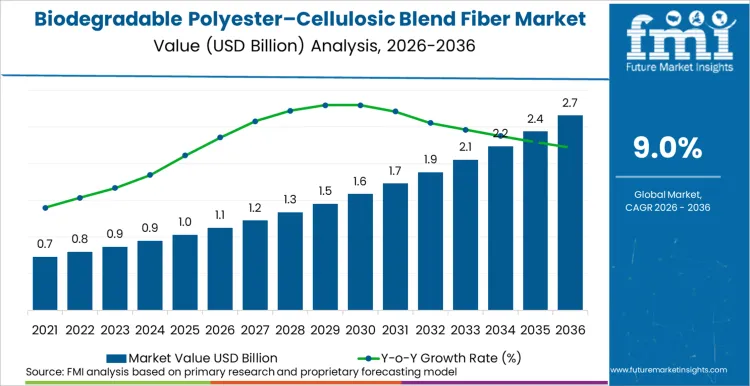
As per FMI's projection, buyers are converging on three practical filters: line compatibility, repeatable lot performance, and claim defensibility. Cellulosic fractions support softness and moisture interaction cues, while biodegradable polyester fractions maintain handling stability and tensile retention.
Scale is expected to concentrate among suppliers that can deliver consistent blend ratios, predictable processing windows, and short response times for technical documentation needed in ongoing audits.
Macro Trends: What Chemicals and Materials Forces Will Shape This Fiber Category?
How is Carbon Accounting influencing Fiber Procurement?
As per FMI's estimates, procurement is moving toward scorecards that link allocations to measurable reductions in supply-chain intensity. Buyers want auditable datasets, stable sourcing, and fast documentation refresh cycles, which increases the value of traceability-ready blends and disciplined specification control.
Why are Mills demanding drop-in upgrades instead of disruptive switches?
FMI is of the opinion that scaling happens faster when blends preserve throughput and reduce troubleshooting. Adoption rises when fibers behave predictably across spinning, web formation, and bonding, keeping yield loss and downtime low.
What is pushing Materials Teams to simplify chemistry while Improving Performance?
As per FMI's projection, fewer formulation variables are becoming a competitive advantage because they lower compliance and quality risk. Suppliers that deliver stable bonding response with cleaner chemistry profiles are easier to qualify across multi-site manufacturing.
How will scrutiny of Biodegradation Claims influence Commercialization?
As per FMI's estimates, customers will require clearer alignment to recognized test methods and intended disposal conditions. Suppliers that standardize proof packages reduce buyer risk and keep programs running without revalidation delays.
Biodegradable Polyester-Cellulosic Blend Fiber Market Key Takeaways
| Metric | Value |
|---|---|
| Market Value (2026) | USD 1.1 billion |
| Market Forecast Value (2036) | USD 2.7 billion |
| Forecast CAGR 2026 to 2036 | 9.0% |
Source: FMI analysis based on primary research and proprietary forecasting model
Why Are Hygiene and Textile Buyers Increasingly Specifying Biodegradable Blend Fibers?
Demand is rising because fiber choice is now managed alongside compliance, retailer rules, and portfolio refresh timelines. as per FMI's projection, converters want fibers that qualify quickly and then run for long cycles without repeated re-tuning. This is most visible in high-volume lines that already compete on web uniformity and defect control, similar to programs tracked in the nonwoven fabrics market.
A second driver is hybrid value: cellulosic content improves comfort cues, while biodegradable polyester maintains runability and mechanical retention. as per FMI's estimates, adoption accelerates when the blend improves product feel without forcing changes to bonding settings, line speed, or finishing sequences. This purchasing logic also benefits from the broader expansion of bio-based inputs across polymer portfolios such as the bioplastics market.
A third demand catalyst is supplier governance and multi-plant repeatability. Many converters want the same blend specification to run across several sites with minimal performance drift, which increases the value of disciplined change control and consistent raw-material sourcing.
Procurement teams increasingly request batch history visibility, tight incoming inspection rules, and technical support that can resolve performance deviations within days, not weeks. This approach strengthens preference for suppliers that maintain stable processing windows and predictable product feel across repeat campaigns.
How Is the Market Structured by Polymer, Blend Architecture, and Application?
Segmentation maps to how buyers qualify fiber systems for long production campaigns. Polymer choice sets the processing envelope and claim pathway. Blend architecture defines handfeel, moisture interaction, and quality stability. Application segmentation shows where buyers pay for comfort and repeatability.
Which polymer pathway is most scalable for converter qualification?
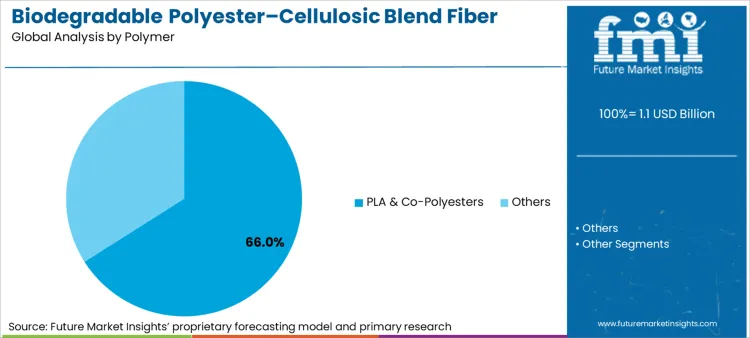
PLA & co-polyesters hold 66.0% because they deliver repeatable processing behavior and stable web formation for continuous production. Their leadership is supported by technical learning carried across adjacent biodegradable fiber portfolios such as the PLA-PHA co-polyester fibers market.
Which blend family leads when stability must be protected?
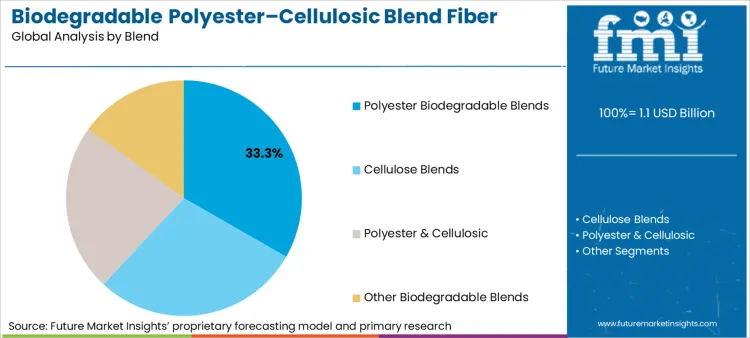
Polyester biodegradable blends hold 33.3% because they keep polyester-like handling while improving softness and moisture cues. Share leadership is reinforced by the ability to scale these blends with lower process disruption than more radical chemistry changes.
Why are polyester and cellulosic hybrid blends gaining attention in textiles?
Polyester & cellulosic systems are used as a risk-managed upgrade route for apparel-adjacent and home formats. Established supply depth in the cellulose fiber market supports consistency for buyers that need reliable repeat sourcing.
Which application anchors the largest demand pool?
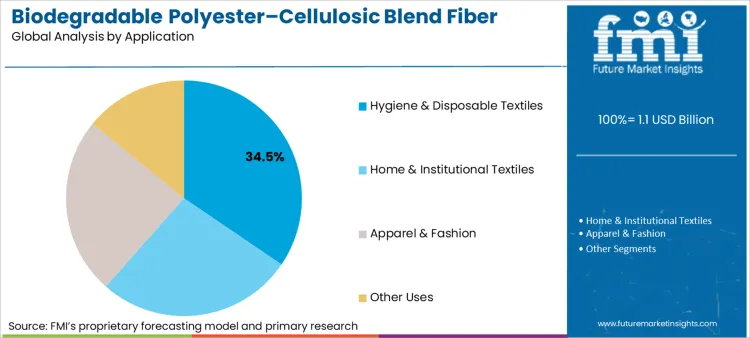
Hygiene & disposable textiles hold 34.5% because volumes are large and product lines refresh frequently. Suppliers that deliver stable web formation and consistent softness tend to be favored for multi-quarter purchasing cycles.
How is Nonwoven Platform Conversion Creating a Durable Growth Driver?
Converters are approving blends at platform level, then rolling them into adjacent SKUs to simplify sourcing and documentation. Once a recipe is qualified, switching costs rise because change control affects multiple sites, packaging claims, and internal quality files.
Do Feedstock Volatility and Specification Complexity Restrain Growth?
FMI is of the opinion that delivered-cost volatility, inconsistent lots, and slow documentation updates can delay reorders and extend qualification cycles. Suppliers that cannot hold performance windows may lose share even if their price is competitive, because downtime risk outweighs short-term savings.
Where will opportunities emerge as circularity requirements tighten?
Demand will grow for traceability-ready fibers designed for simplified chemistry and predictable end-of-life pathways. This aligns with the momentum in circular design certified textile fiber systems. Early adopters will prioritize blends that allow rapid SKU conversion without major capital changes today.
How Is the Biodegradable Polyester-Cellulosic Blend Fiber Market Expected to Evolve Across Major Nations?
Growth varies by hygiene manufacturing scale, export exposure, and claim governance maturity. Developed markets move faster due to retailer requirements and procurement scorecards. Manufacturing hubs scale when compliant materials improve market access. The following table highlights growth expectations.
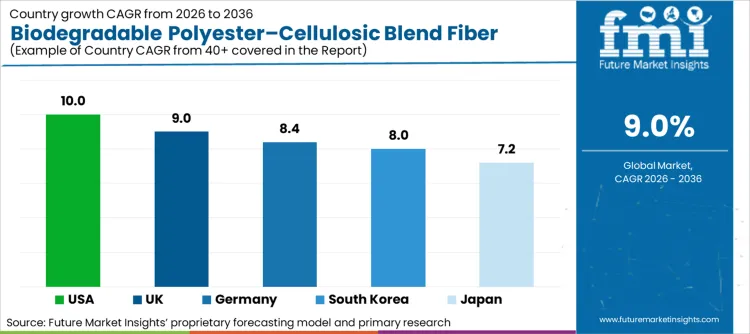
| Country | CAGR (2026-2036) |
|---|---|
| USA | 10.0% |
| UK | 9.0% |
| Germany | 8.4% |
| South Korea | 8.0% |
| Japan | 7.2% |
Source: FMI analysis based on primary research and proprietary forecasting model
Why is the USA accelerating platform qualification of blend fibers?
The USA benefits from large converter capacity and structured procurement processes that reward documentation speed and consistent supply. Growth concentrates in hygiene and institutional formats where repeat contracts and vendor scorecards are common.
How is the UK translating retail compliance into predictable demand?
The UK grows through portfolio refresh cycles where comfort cues and claim defensibility influence shelf decisions. Suppliers that keep bonding behavior stable gain preference because they reduce disruption during updates.
Why does Germany favor documentation-heavy, reproducible blend supply?
Germany expands with buyers that prioritize traceability, stable lot performance, and long-run quality control. Supplier selection is influenced by proven compliance workflows and consistent processing outcomes in technical textile programs.
What drives South Korea’s scaling in high-throughput production?
South Korea scales through export programs that demand consistent product performance at industrial speeds. Strong process control culture supports tight management of blend consistency and yield, which protects converter uptime.
Why is Japan prioritizing reliability over rapid substitution?
Japan grows through reliability-first purchasing where low defect rates and repeatability matter most. Demand expands when blends deliver comfort gains while keeping operating windows stable for long qualification cycles.
What Defines the Competitive Landscape for Biodegradable Blend Fibers?
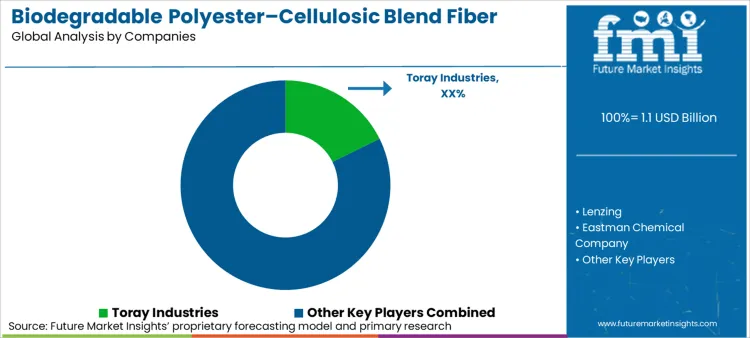
Competition is defined by access to biodegradable polymer inputs, control of blend ratios at scale, and application engineering support during trials. Suppliers differentiate on lot stability, reproducible bonding response, and speed of technical documentation support during qualification. Participants with strong upstream integration and predictable supply coverage are better positioned to secure multi-quarter allocations.
Contract capture is increasingly linked to the ability to co-develop recipes with converters and then protect those specifications through disciplined change control. Programs that use shared trial data and defined acceptance windows reduce customer risk and increase renewal likelihood. Competitive intensity rises as global fiber leaders expand biodegradable product families while regional producers compete on lead times and service responsiveness.
Innovation focus is shifting from single-parameter sustainability claims to verified performance repeatability at scale. Suppliers that can validate comfort cues, bonding response, and defect control across large production runs are more likely to be specified in long contract cycles.
Key Players
- Toray Industries
- Lenzing
- Eastman Chemical Company
- Birla Cellulose
- Teijin
- Far Eastern New Century
- Kelheim Fibres
- NatureWorks
- Sateri
- Mitsubishi Chemical Group
Scope of Report
| Items | Values |
|---|---|
| Quantitative Units | USD Billion |
| Polymer Segments | PLA & Co-Polyesters; Others |
| Blend Segments | Polyester Biodegradable Blends; Cellulose Blends; Polyester & Cellulosic; Other Biodegradable Blends |
| Application Segments | Hygiene & Disposable Textiles; Home & Institutional Textiles; Apparel & Fashion; Other Uses |
| Regions Covered | North America, Europe, Asia Pacific |
| Key Countries | USA, UK, Germany, South Korea, Japan |
| Key Companies Profiled | Toray Industries; Lenzing; Eastman Chemical Company; Birla Cellulose; Teijin; Far Eastern New Century; Kelheim Fibres; NatureWorks; Sateri; Mitsubishi Chemical Group |
Biodegradable Polyester-Cellulosic Blend Fiber Market by Segment
By Polymer
- PLA & Co-Polyesters
- Others
By Blend
- Polyester Biodegradable Blends
- Cellulose Blends
- Polyester & Cellulosic
- Other Biodegradable Blends
By Application
- Hygiene & Disposable Textiles
- Home & Institutional Textiles
- Apparel & Fashion
- Other Uses
By Region
- North America
- Latin America
- Western Europe
- Eastern Europe
- East Asia
- South Asia & Pacific
- Middle East & Africa
Bibliography
- International Organization for Standardization. (2023). ISO 14855-1: Determination of the ultimate aerobic biodegradability of plastic materials under controlled composting conditions. ISO.
- International Organization for Standardization. (2024). ISO 16620-1: Plastics - Biobased content - Determination of biobased carbon content. ISO.
- Organisation for Economic Co-operation and Development. (2023). Test No. 301: Ready biodegradability. OECD Publishing.
- European Commission. (2024). Proposal for a Regulation on packaging and packaging waste (PPWR). Publications Office of the European Union.
- USA Environmental Protection Agency. (2024). Advancing sustainable materials management: 2024 facts and figures. USA EPA.
- United States Department of Agriculture. (2024). BioPreferred Program annual report. USDA.
- United Nations Environment Programme. (2024). Turning off the tap: How the world can end plastic pollution and create a circular economy. UNEP.
- Shah, A. A., Hasan, F., Hameed, A., & Ahmed, S. (2023). Biological degradation of plastics: A comprehensive review. Polymer Degradation and Stability, 217, 110434.
Frequently Asked Questions
How big is the biodegradable polyester-cellulosic blend fiber market in 2026?
The biodegradable polyester-cellulosic blend fiber market is valued at USD 1.1 billion in 2026.
What will be the size of the biodegradable polyester-cellulosic blend fiber market in 2036?
The market size for biodegradable polyester-cellulosic blend fiber is projected to reach USD 2.7 billion by 2036.
How fast will the biodegradable polyester-cellulosic blend fiber market grow?
Demand for biodegradable polyester-cellulosic blend fiber is projected to grow at a 9.0% CAGR between 2026 and 2036.
Which polymer segment holds the largest market share?
PLA & co-polyesters are expected to account for a 66.0% share of the market in 2026.
Which application segment generates the highest demand?
Hygiene & disposable textiles are expected to represent a 34.5% share in the biodegradable polyester-cellulosic blend fiber market in 2026.
Preview the report firsthand - request a free sample
Get SampleGet the brochure for pricing and purchase details.
Get PDFTable of Content
- Executive Summary
- Global Market Outlook
- Demand-side Trends
- Supply-side Trends
- Technology Roadmap Analysis
- Market Overview
- Market Coverage / Taxonomy
- Market Definition / Scope / Limitations
- Research Methodology
- Chapter Orientation
- Analytical Lens and Working Hypotheses
- Market Structure, Signals, and Trend Drivers
- Benchmarking and Cross-market Comparability
- Market Sizing, Forecasting, and Opportunity Mapping
- Research Design and Evidence Framework
- Desk Research Programme (Secondary Evidence)
- Company Annual and Sustainability Reports
- Peer-reviewed Journals and Academic Literature
- Corporate Websites, Product Literature, and Technical Notes
- Earnings Decks and Investor Briefings
- Statutory Filings and Regulatory Disclosures
- Technical White Papers and Standards Notes
- Trade Journals, Industry Magazines, and Analyst Briefs
- Conference Proceedings, Webinars, and Seminar Materials
- Government Statistics Portals and Public Data Releases
- Press Releases and Reputable Media Coverage
- Specialist Newsletters and Curated Briefings
- Expert Input and Fieldwork (Primary Evidence)
- Primary Modes
- Qualitative Interviews and Expert Elicitation
- Quantitative Surveys and Structured Data Capture
- Blended A8oach
- Why Primary Evidence is Used
- Field Techniques
- Interviews
- Surveys
- Focus Groups
- Observational and In-context Research
- Social and Community Interactions
- Stakeholder Universe Engaged
- C-suite Leaders
- Board Members
- Presidents and Vice Presidents
- R&D and Innovation Heads
- Technical Specialists
- Domain Subject-matter Experts
- Scientists
- Physicians and Other Healthcare Professionals
- Governance, Ethics, and Data Stewardship
- Research Ethics
- Data Integrity and Handling
- Primary Modes
- Tooling, Models, and Reference Databases
- Data Engineering and Model Build
- Data Acquisition and Ingestion
- Cleaning, Normalisation, and Verification
- Synthesis, Triangulation, and Analysis
- Quality Assurance and Audit Trail
- Desk Research Programme (Secondary Evidence)
- Market Background
- Market Dynamics
- Drivers
- Restraints
- Opportunity
- Trends
- Scenario Forecast
- Demand in Optimistic Scenario
- Demand in Likely Scenario
- Demand in Conservative Scenario
- Opportunity Map Analysis
- Product Life Cycle Analysis
- Supply Chain Analysis
- Investment Feasibility Matrix
- Value Chain Analysis
- PESTLE and Porter’s Analysis
- Regulatory Landscape
- Regional Parent Market Outlook
- Production and Consumption Statistics
- Import and Export Statistics
- Market Dynamics
- Global Market Analysis 2021 to 2025 and Forecast, 2026 to 2036
- Historical Market Size Value (USD Million) Analysis, 2021 to 2025
- Current and Future Market Size Value (USD Million) Projections, 2026 to 2036
- Y-o-Y Growth Trend Analysis
- Absolute $ Opportunity Analysis
- Global Market Pricing Analysis 2021 to 2025 and Forecast 2026 to 2036
- Global Market Analysis 2021 to 2025 and Forecast 2026 to 2036, By Polymer
- Introduction / Key Findings
- Historical Market Size Value (USD Million) Analysis By Polymer , 2021 to 2025
- Current and Future Market Size Value (USD Million) Analysis and Forecast By Polymer , 2026 to 2036
- PLA & Co-Polyesters
- Others
- PLA & Co-Polyesters
- Y-o-Y Growth Trend Analysis By Polymer , 2021 to 2025
- Absolute $ Opportunity Analysis By Polymer , 2026 to 2036
- Global Market Analysis 2021 to 2025 and Forecast 2026 to 2036, By Blend
- Introduction / Key Findings
- Historical Market Size Value (USD Million) Analysis By Blend, 2021 to 2025
- Current and Future Market Size Value (USD Million) Analysis and Forecast By Blend, 2026 to 2036
- Polyester Biodegradable Blends
- Cellulose Blends
- Polyester & Cellulosic
- Other Biodegradable Blends
- Polyester Biodegradable Blends
- Y-o-Y Growth Trend Analysis By Blend, 2021 to 2025
- Absolute $ Opportunity Analysis By Blend, 2026 to 2036
- Global Market Analysis 2021 to 2025 and Forecast 2026 to 2036, By Application
- Introduction / Key Findings
- Historical Market Size Value (USD Million) Analysis By Application, 2021 to 2025
- Current and Future Market Size Value (USD Million) Analysis and Forecast By Application, 2026 to 2036
- Hygiene & Disposable Textiles
- Home & Institutional Textiles
- Apparel & Fashion
- Other Uses
- Hygiene & Disposable Textiles
- Y-o-Y Growth Trend Analysis By Application, 2021 to 2025
- Absolute $ Opportunity Analysis By Application, 2026 to 2036
- Global Market Analysis 2021 to 2025 and Forecast 2026 to 2036, By Region
- Introduction
- Historical Market Size Value (USD Million) Analysis By Region, 2021 to 2025
- Current Market Size Value (USD Million) Analysis and Forecast By Region, 2026 to 2036
- North America
- Latin America
- Western Europe
- Eastern Europe
- East Asia
- South Asia and Pacific
- Middle East & Africa
- Market Attractiveness Analysis By Region
- North America Market Analysis 2021 to 2025 and Forecast 2026 to 2036, By Country
- Historical Market Size Value (USD Million) Trend Analysis By Market Taxonomy, 2021 to 2025
- Market Size Value (USD Million) Forecast By Market Taxonomy, 2026 to 2036
- By Country
- USA
- Canada
- Mexico
- By Polymer
- By Blend
- By Application
- By Country
- Market Attractiveness Analysis
- By Country
- By Polymer
- By Blend
- By Application
- Key Takeaways
- Latin America Market Analysis 2021 to 2025 and Forecast 2026 to 2036, By Country
- Historical Market Size Value (USD Million) Trend Analysis By Market Taxonomy, 2021 to 2025
- Market Size Value (USD Million) Forecast By Market Taxonomy, 2026 to 2036
- By Country
- Brazil
- Chile
- Rest of Latin America
- By Polymer
- By Blend
- By Application
- By Country
- Market Attractiveness Analysis
- By Country
- By Polymer
- By Blend
- By Application
- Key Takeaways
- Western Europe Market Analysis 2021 to 2025 and Forecast 2026 to 2036, By Country
- Historical Market Size Value (USD Million) Trend Analysis By Market Taxonomy, 2021 to 2025
- Market Size Value (USD Million) Forecast By Market Taxonomy, 2026 to 2036
- By Country
- Germany
- UK
- Italy
- Spain
- France
- Nordic
- BENELUX
- Rest of Western Europe
- By Polymer
- By Blend
- By Application
- By Country
- Market Attractiveness Analysis
- By Country
- By Polymer
- By Blend
- By Application
- Key Takeaways
- Eastern Europe Market Analysis 2021 to 2025 and Forecast 2026 to 2036, By Country
- Historical Market Size Value (USD Million) Trend Analysis By Market Taxonomy, 2021 to 2025
- Market Size Value (USD Million) Forecast By Market Taxonomy, 2026 to 2036
- By Country
- Russia
- Poland
- Hungary
- Balkan & Baltic
- Rest of Eastern Europe
- By Polymer
- By Blend
- By Application
- By Country
- Market Attractiveness Analysis
- By Country
- By Polymer
- By Blend
- By Application
- Key Takeaways
- East Asia Market Analysis 2021 to 2025 and Forecast 2026 to 2036, By Country
- Historical Market Size Value (USD Million) Trend Analysis By Market Taxonomy, 2021 to 2025
- Market Size Value (USD Million) Forecast By Market Taxonomy, 2026 to 2036
- By Country
- China
- Japan
- South Korea
- By Polymer
- By Blend
- By Application
- By Country
- Market Attractiveness Analysis
- By Country
- By Polymer
- By Blend
- By Application
- Key Takeaways
- South Asia and Pacific Market Analysis 2021 to 2025 and Forecast 2026 to 2036, By Country
- Historical Market Size Value (USD Million) Trend Analysis By Market Taxonomy, 2021 to 2025
- Market Size Value (USD Million) Forecast By Market Taxonomy, 2026 to 2036
- By Country
- India
- ASEAN
- Australia & New Zealand
- Rest of South Asia and Pacific
- By Polymer
- By Blend
- By Application
- By Country
- Market Attractiveness Analysis
- By Country
- By Polymer
- By Blend
- By Application
- Key Takeaways
- Middle East & Africa Market Analysis 2021 to 2025 and Forecast 2026 to 2036, By Country
- Historical Market Size Value (USD Million) Trend Analysis By Market Taxonomy, 2021 to 2025
- Market Size Value (USD Million) Forecast By Market Taxonomy, 2026 to 2036
- By Country
- Kingdom of Saudi Arabia
- Other GCC Countries
- Turkiye
- South Africa
- Other African Union
- Rest of Middle East & Africa
- By Polymer
- By Blend
- By Application
- By Country
- Market Attractiveness Analysis
- By Country
- By Polymer
- By Blend
- By Application
- Key Takeaways
- Key Countries Market Analysis
- USA
- Pricing Analysis
- Market Share Analysis, 2025
- By Polymer
- By Blend
- By Application
- Canada
- Pricing Analysis
- Market Share Analysis, 2025
- By Polymer
- By Blend
- By Application
- Mexico
- Pricing Analysis
- Market Share Analysis, 2025
- By Polymer
- By Blend
- By Application
- Brazil
- Pricing Analysis
- Market Share Analysis, 2025
- By Polymer
- By Blend
- By Application
- Chile
- Pricing Analysis
- Market Share Analysis, 2025
- By Polymer
- By Blend
- By Application
- Germany
- Pricing Analysis
- Market Share Analysis, 2025
- By Polymer
- By Blend
- By Application
- UK
- Pricing Analysis
- Market Share Analysis, 2025
- By Polymer
- By Blend
- By Application
- Italy
- Pricing Analysis
- Market Share Analysis, 2025
- By Polymer
- By Blend
- By Application
- Spain
- Pricing Analysis
- Market Share Analysis, 2025
- By Polymer
- By Blend
- By Application
- France
- Pricing Analysis
- Market Share Analysis, 2025
- By Polymer
- By Blend
- By Application
- India
- Pricing Analysis
- Market Share Analysis, 2025
- By Polymer
- By Blend
- By Application
- ASEAN
- Pricing Analysis
- Market Share Analysis, 2025
- By Polymer
- By Blend
- By Application
- Australia & New Zealand
- Pricing Analysis
- Market Share Analysis, 2025
- By Polymer
- By Blend
- By Application
- China
- Pricing Analysis
- Market Share Analysis, 2025
- By Polymer
- By Blend
- By Application
- Japan
- Pricing Analysis
- Market Share Analysis, 2025
- By Polymer
- By Blend
- By Application
- South Korea
- Pricing Analysis
- Market Share Analysis, 2025
- By Polymer
- By Blend
- By Application
- Russia
- Pricing Analysis
- Market Share Analysis, 2025
- By Polymer
- By Blend
- By Application
- Poland
- Pricing Analysis
- Market Share Analysis, 2025
- By Polymer
- By Blend
- By Application
- Hungary
- Pricing Analysis
- Market Share Analysis, 2025
- By Polymer
- By Blend
- By Application
- Kingdom of Saudi Arabia
- Pricing Analysis
- Market Share Analysis, 2025
- By Polymer
- By Blend
- By Application
- Turkiye
- Pricing Analysis
- Market Share Analysis, 2025
- By Polymer
- By Blend
- By Application
- South Africa
- Pricing Analysis
- Market Share Analysis, 2025
- By Polymer
- By Blend
- By Application
- USA
- Market Structure Analysis
- Competition Dashboard
- Competition Benchmarking
- Market Share Analysis of Top Players
- By Regional
- By Polymer
- By Blend
- By Application
- Competition Analysis
- Competition Deep Dive
- Toray Industries
- Overview
- Product Portfolio
- Profitability by Market Segments (Product/Age /Sales Channel/Region)
- Sales Footprint
- Strategy Overview
- Marketing Strategy
- Product Strategy
- Channel Strategy
- Lenzing
- Eastman Chemical Company
- Birla Cellulose
- Teijin
- Far Eastern New Century
- Kelheim Fibres
- NatureWorks
- Sateri
- Mitsubishi Chemical Group
- Toray Industries
- Competition Deep Dive
- Assumptions & Acronyms Used


