

- Industry Size (2026)
- USD 1.3 Bn
- Forecast (2036)
- USD 2.5 Bn
- CAGR (2026 to 2036)
- 6.8%
Inherent FR Aramid-Viscose Blend Fiber for Protective Fabrics Market Forecast and Outlook 2026 to 2036
FMI expects the inherent FR aramid-viscose blend fiber for protective fabrics market to reach USD 1.3 billion in 2026, and ultimately to USD 2.5 billion by 2036. A 6.8% CAGR is forecasted for this industry from 2026 to 2036. This landscape is witnessing tighter occupational safety rules are converging with a strategic shift by major fiber producers toward higher-value specialty materials. These blends were once positioned mainly as comfort-oriented alternatives within protective fabrics. They are now being specified as core material platforms for industrial and institutional workwear programs.
In regulated work environments, compliance expectations are no longer limited to ignition resistance. Buyers are placing equal weight on fit, physiological tolerance, and performance stability across long duty cycles. Recent updates to safety frameworks, including the 2025 revisions issued by the Occupational Safety and Health Administration and EN ISO 11612, explicitly link thermal protection with wearer comfort and garment ergonomics.
This has pushed manufacturers to redesign blend structures with higher viscose content, using its moisture regain and breathability to offset the rigidity and heat retention associated with aramid-heavy constructions. Development programs from TenCate and Milliken show that skin-side comfort and moisture control are now treated as qualification requirements rather than optional enhancements.
Supply dynamics are also changing. Tier-1 producers are consolidating portfolios and realigning capacity toward specialty output. Strategic decisions by players such as Teijin Limited point to a gradual retreat from commodity-scale viscose and blended fibers in favor of traceable, specification-driven offerings. At the same time, investments such as Kaneka Corporation’s capacity expansions aligned with European sustainability thresholds indicate that future volume growth will concentrate in certified, low-impact FR blends. This shift is widening the price gap between premium, specification-led materials and non-certified alternatives.
The long-term viability of these premium blends is supported by a broader structural transformation within the Tier-1 supplier base, as noted by Teijin Limited’s President and CEO, Akimoto Uchikawa, regarding the company's commitment to evolving beyond traditional fiber manufacturing:
"Aiming to be a company that supports the society of the future, we will transform its business development from the conventional materials-only business to a value-added business, and respond to complex social issues by refining our ability to combine different technologies and functions." - Source: Teijin Limited Medium-Term Management Plan
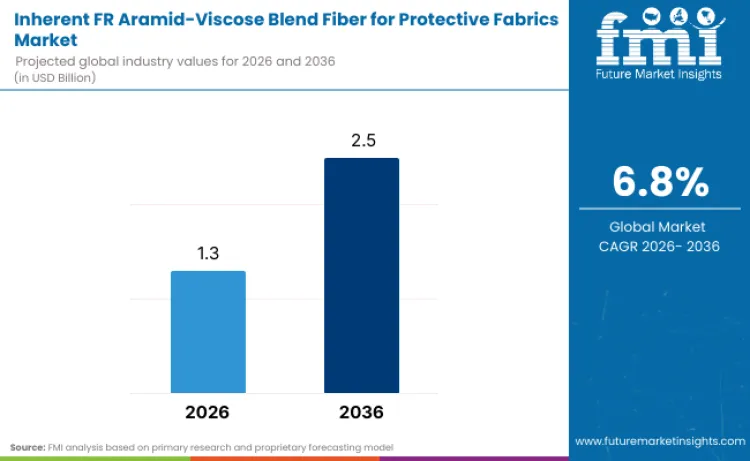
Summary of the Inherent FR Aramid-Viscose Blend Fiber for Protective Fabrics Market
How is FMI sizing the opportunity over the next decade?
Future Market Insights projects the inherent FR aramid-viscose blend fiber market to expand from USD 1.3 billion in 2026 to USD 2.5 billion by 2036, advancing at a 6.8% CAGR.
FMI Research Approach: Forecast modelling anchored in safety-mandate coverage, replacement cycles, and certified capacity expansion.
What structural shift is redefining buyer behaviour in this market?
FMI observes a move from optional protection upgrades to specification-locked procurement. Inherent FR blends are no longer evaluated as comfort-enhancing alternatives but as baseline materials required to clear updated safety frameworks that combine thermal protection, fit, and physiological tolerance.
FMI Research Approach: Analysis of tender language evolution, safety-code revisions, and procurement audit criteria.
Which compliance trigger is exerting the strongest pull on demand?
The most influential trigger is the integration of fit and wearability into formal safety rules, notably through revisions to EN ISO 11612 and OSHA guidance. These changes favour aramid-viscose architectures that balance non-melting thermal barriers with moisture management and ergonomic performance.
FMI Research Approach: Regulatory-to-material translation assessing how standards revisions alter fiber selection thresholds.
Which blend configuration is shaping material preferences in 2026?
Aramid-rich blends) remain dominant in high-risk environments where thermal stability and structural integrity under extreme heat outweigh comfort considerations. Their predictable carbonisation behaviour under fire exposure continues to secure first-line adoption in mission-critical apparel.
FMI Research Approach: Segment share estimation using hazard exposure intensity, testing benchmarks, and end-use criticality.
Which end-use sector is anchoring recurring volume?
The oil, gas, and petrochemical sector continues to anchor demand. Operators are prioritising lifetime protection over upfront garment cost, accelerating the shift from treated fabrics toward inherent FR blends that retain performance across repeated industrial laundering.
FMI Research Approach: End-use modelling based on regulatory enforcement, garment service life, and replacement economics.
What factors are limiting faster penetration despite regulatory tailwinds?
Cost inertia remains the principal constraint. Higher manufacturing complexity and volatile input economics are widening the price gap versus treated alternatives, leading some mid-tier buyers to defer upgrades even where the safety case is well established.
FMI Research Approach: Total cost-of-ownership analysis incorporating material premiums, wear life, and deferral behaviour.
Which geography is emerging as the most structurally important growth engine?
China is a key growth engine, supported by tighter enforcement of dust-explosion prevention standards and expanding scrutiny of ignition-risk control in industrial apparel. These dynamics are accelerating adoption of inherent FR aramid-viscose blends that deliver permanent flame resistance and durable anti-static performance.
FMI Research Approach: Country-level forecasting based on standards enforcement momentum, industrial workforce exposure, and certification uptake
Inherent FR Aramid-Viscose Blend Fiber for Protective Fabrics Market Key Takeaways
| Metrics | Value |
|---|---|
| Expected Market Size (2026E) | USD 1.3 billion |
| Projected Market Size (2036F) | USD 2.5 billion |
| CAGR (2026-2036) | 6.8% |
Source: FMI’s proprietary forecasting model and primary research
Why is Inherent FR Aramid-Viscose Blend Fiber for Protective Fabrics Market Growing?
Capital is directed toward a smaller set of certified, low-impact production hubs, quietly resetting expectations across the inherent FR aramid-viscose blend fiber for protective fabrics landscape. Leading producers are pulling back from broad, commodity-style fiber output and focusing investment on assets that are tied to regulatory compliance and traceability. In May 2025, Kaneka Corporation completed commissioning of its Belgium expansion, positioning the site to serve demand shaped by European Green Deal enforcement.
A similar logic underpins Lenzing AG’s commitment of more than €100 million through 2027 to upgrade its Austrian operations, with a clear emphasis on traceable, bio-based viscose inputs. Together, these investments are shifting competitive momentum toward certified blend systems, where verified sustainability credentials and supply transparency now determine eligibility for industrial workwear programs.
The formal embedding of PPE requirements into safety regulation across fast-industrializing regions is reinforcing demand patterns. In several growth economies, flame-resistant apparel is moving from a discretionary purchase to a mandated line item, turning procurement into recurring compliance expenditure.
In India, the August 15, 2025 enforcement of DOC REF: AHKIPL/QD/06 made FR clothing compulsory for plant and vessel operations, immediately expanding the addressable base for compliant workwear. Regulatory tightening across Asia-Pacific is aligning heat and flame protection with core industrial safety obligations. This shift is creating a more predictable and sustained consumption profile for aramid-viscose blends, rather than episodic, project-driven demand.
Ownership changes within the aramid value chain are concentrating capital and development effort around protection-focused platforms. The August 2025 agreement by DuPont to divest its Aramids business to Arclin for US$1.8 billion reflects a deliberate separation from broader chemical market cycles.
How is the Inherent FR Aramid-Viscose Blend Fiber Market Segmented?
Do Aramid-rich blends continue to lead because they deliver the most reliable thermal protection?
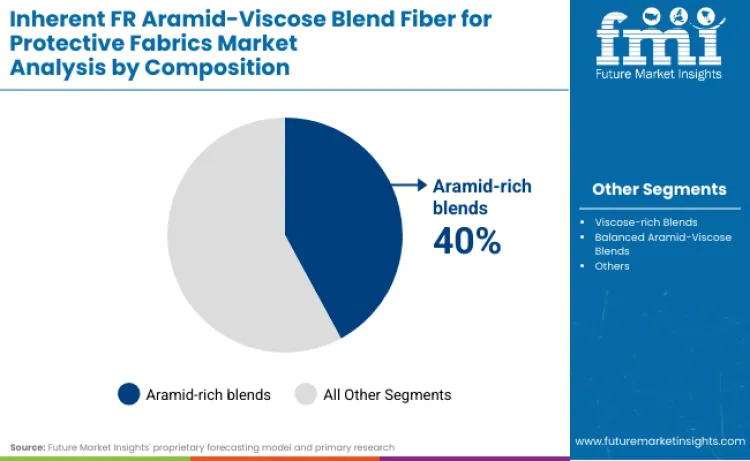
Aramid-rich blends account for 40% of demand, and their position is largely secured by where they are used rather than how they feel. In high-hazard environments, protection takes precedence over comfort. Buyers in these settings are focused on how a fabric behaves when exposed to extreme heat, not on breathability or softness. High concentrations of meta- or para-aramid fibers give these blends a clear advantage, as they carbonize rather than melt and retain structural integrity under intense thermal flux. That behaviour makes them a first-line barrier in applications where failure is not an option.
This preference is reinforced by tightening performance benchmarks. The 2023 revision of NFPA 2112 raised the bar by requiring all garment components to pass full-scale manikin testing under ASTM F1930, with predicted body burn limited to below 50%. In response, manufacturers have narrowed material specifications and leaned further into aramid-heavy constructions.
Suppliers such as DuPont and Bulwark have aligned their offerings with these thresholds, using platforms such as Nomex® Comfort to balance wearability while preserving a high thermal barrier. At the fiber level, Teijin has signalled the same direction in its 2024-2025 Medium-Term Management Plan, identifying safety and protection as a core growth priority and expanding Teijinconex® meta-aramid capacity to serve mission-critical industrial apparel programs.
Why is the Oil, Gas & Petrochemical Sector accelerating the move from Treated to Inherent FR Solutions?
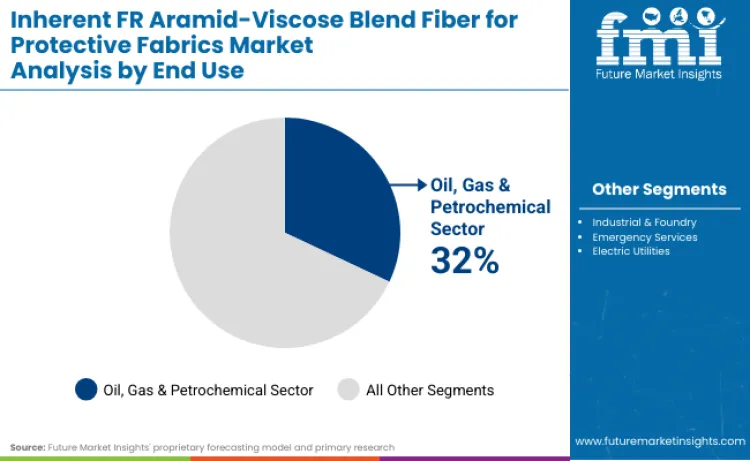
With a 32% share, the oil, gas & petrochemical sector remains the single largest end-use driver, and it is also where the shift away from treated flame-retardant fabrics is most visible. Operators are reassessing lifetime performance rather than upfront garment cost.
Treated fabrics may be cheaper to procure initially, but their protective properties degrade with repeated industrial laundering. Inherent aramid-viscose blends, by contrast, retain flame resistance for the full service life of the garment, which translates into more predictable protection and lower replacement frequency across long-term workwear programs.
Regulation is accelerating this transition. In the United States, the OSHA PPE rule effective January 13, 2025, requires protective clothing to fit each worker, pushing buyers toward blends that combine aramid thermal stability with the drape and physiological tolerance of viscose.
Similar pressures are emerging elsewhere. In India, the AHKIPL/QD/06 framework, effective August 15, 2025, mandates flame-resistant clothing for chemical, plant, and vessel operations. Suppliers such as Honeywell and Ansell are prioritising inherent FR platforms that satisfy both protection thresholds and wearer compliance in demanding industrial environments.
How is Growth of Inherent FR Aramid-Viscose Blend Fiber for Protective Fabrics Demand Influenced?
The inherent FR aramid-viscose blend fiber segment is no longer riding on optional safety upgrades. It is being pulled forward by hard compliance mandates that leave little room for buyer discretion. What is emerging is an "institutionalized safety" dynamic, where regulators in fast-expanding industrial hubs are tightening enforcement in ways that directly reshape procurement behavior. India’s August 2025 petrochemical safety directive (AHKIPL/QD/06) is a clear example.
By explicitly requiring FR clothing for plant operations, it has reset demand expectations almost overnight. These rules do more than lift volumes. They change how tenders are written, steering large regional contracts away from treated fabrics and toward inherent aramid-viscose blends that offer permanent, wash-durable protection without the risk of retreatment failure.
Adoption is not seamless. Cost remains the main friction point. A cost-inertia effect is setting limits on how quickly buyers move, driven by manufacturing complexity and unstable input economics. In early 2026, more than a third of producers reported elevated chemical and raw material costs, while viscose staple fiber pricing is unsettled by rising environmental compliance expenses. The knock-on effect is straightforward, higher blend prices feed directly into total cost-of-ownership models.
Nearly one in five industrial buyers has delayed upgrades as a result, particularly in mid-tier segments where cost per wear still outweighs long-term safety logic. An operating cost premium of around 18% versus treated alternatives is often enough to trigger deferral, even when the performance case is well understood.
Where momentum looks strongest is beyond conventional workwear replacement cycles. The shift toward e-mobility is opening adjacent demand streams for thermal barriers and facers, supported by product launches such as Ahlstrom’s flame-resistant battery insulation materials introduced in August 2025. For fiber producers, these applications provide a way to balance apparel cyclicality by tapping into EV infrastructure and smart-building insulation growth.
The most material risk ahead is regulatory rather than competitive. Circular-economy compliance is becoming a gatekeeping requirement. The EU’s 2026 ban on destroying unsold textiles, alongside the rollout of the Digital Product Passport, raises traceability and end-of-life accountability to a condition for market access.
Analysis of Inherent FR Aramid-Viscose Blend Fiber Market by Key Countries
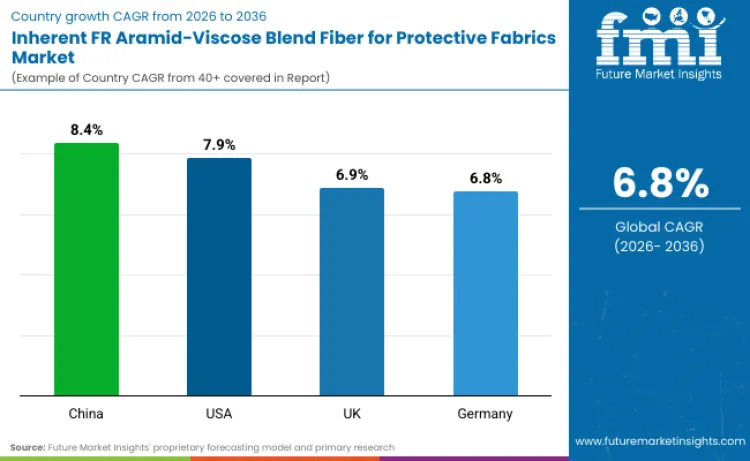
| Country | CAGR (2026-2036) |
|---|---|
| USA | 7.9% |
| UK | 6.9% |
| China | 8.4% |
| Germany | 6.8% |
Source: Future Market Insights - analysis driven by proprietary forecasting models and primary research
Can next-to-skin comfort sustain USA growth while still clearing arc-flash compliance?
In USA, a 7.9% CAGR is being underwritten by a quiet redesign of what compliance actually means on the jobsite. Demand is shifting toward next-to-skin flame-resistant layers that actively reduce heat strain while preserving predictable arc-flash performance. Occupational Safety and Health Administration, which has elevated properly fitting PPE from advisory language into an enforceable expectation for construction and industrial work, reinforce this change. Fit, mobility, and wearability are now treated as compliance variables rather than discretionary upgrades.
That enforcement stance is accelerating adoption of higher-viscose, skin-side FR architectures, where moisture regulation becomes part of the risk-control framework for high-load tasks. A clear signal comes from Milliken & Company and its development of FR undergarment fabrics for NASA Artemis. These programs illustrate how extreme-environment FR knit underlayers are being engineered first for aerospace use, then translated into industrial arc-rated systems without compromising protection thresholds.
Will the UK favour Suppliers that can Prove Durability across the Full Garment Life?
At a 6.9% CAGR, the UK market is being shaped less by incremental performance gains and more by institutional purchasing discipline. Public-sector and large industrial buyers are prioritising suppliers that can demonstrate stable protection across repeated wear, laundering, and repair cycles. This procurement logic naturally favours inherent FR fibre systems, including aramid-viscose blends, where protection remains intact without dependence on re-treatment.
Coats Group plc reflects this orientation in its UK-facing strategy. Company reporting highlights innovation and digital capability as mechanisms to move beyond commodity supply into service-rich workwear platforms. The emphasis aligns with a lifecycle-management model, where verification, traceability, and performance continuity increasingly function as contract qualifiers rather than added value.
Does hardening dust-explosion standards accelerate apparel upgrades in China?
China’s 8.4% CAGR is linked to safety enforcement in dust-intensive industries, where ignition control is treated as a system-wide problem rather than a single-point intervention. Multiple GB dust-explosion prevention standards already govern grain handling, feed processing, and bulk-material operations, creating a compliance baseline that is steadily extending into protective apparel requirements. Anti-static control and ignition-risk reduction are emerging as non-negotiable elements of that expansion.
This regulatory backdrop favours inherent aramid-viscose blends when they are engineered with durable anti-static behaviour that does not wash out or drift out of specification. Recent compliance notices have also begun highlighting "textile dust explosion prevention" as an area of heightened scrutiny heading into 2026. Even where individual GB standards differ by sector, enforcement momentum continues to move in the same direction.
Can EU Circularity Rules impart Traceability into Germany’s Protective Textiles Domain?
Germany’s 6.8% CAGR is shaped by regulatory pressure that increasingly links protective textiles to circularity obligations. The European Commission’s textiles strategy introduces a ban on destroying unsold textiles and footwear from July 2026 for large enterprises, raising the procurement value of fibre systems that support traceability and defined end-of-life handling.
On the supply side, Lenzing AG has reinforced this shift through its February 2026 announcement that it will become majority owner of TreeToTextile. For aramid-viscose protective blends used in Germany, this matters because buyers are increasingly required to document fibre inputs and disposal pathways alongside thermal and flame performance, tightening qualification criteria for institutional workwear programs.
Competitive Landscape
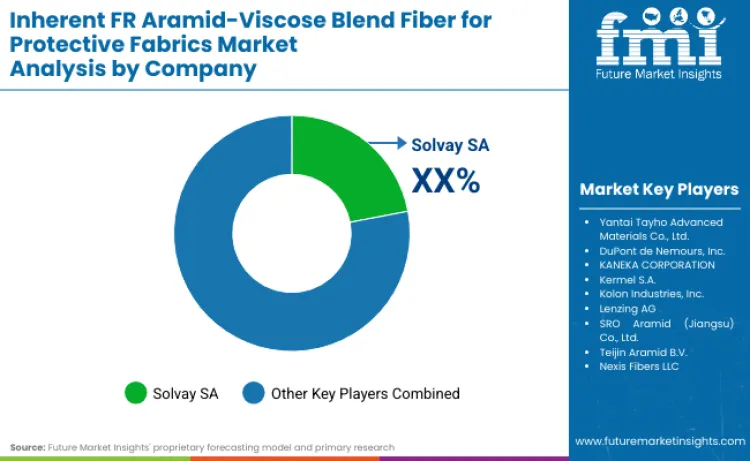
By 2026, competition in inherent FR aramid-viscose blends looks far more deliberate than crowded. Consolidation is taking place through structural realignment rather than headline mergers. Large chemical groups are separating high-performance fiber divisions into leaner, more focused businesses that can respond faster to regulatory pressure, including the 2025 PPE updates issued by the Occupational Safety and Health Administration. This restructuring is reshaping how suppliers position themselves and how buyers evaluate long-term partners.
Global producers are concentrating on building compliance-ready fiber systems where traceability and circular inputs are designed into the product from the outset. Digital product documentation and bio-based viscose are increasingly part of qualification, not marketing. Regional manufacturers, particularly in Asia, are expanding capacity to align with tightening National GB industrial safety standards. These suppliers are gaining relevance through execution speed, cost discipline, and familiarity with local enforcement dynamics.
Flame resistance itself no longer defines competitive position. It is treated as a given. Differentiation is emerging at the point where thermal protection intersects with human physiology. Suppliers that can combine the thermal stability of aramids with the moisture-handling properties of viscose are better placed to support consistent garment use in high-heat environments. This is directing research toward lighter fabric constructions and integrated textile systems designed to manage heat stress rather than only resist ignition.
Recent capacity expansions, carbon-reduction programs, and regulation-led product launches show how leading manufacturers are adjusting to this shift, moving away from standalone fiber supply toward performance-driven protective systems.
Recent Developments:
- Kolon Industries, Inc. reached full operating capacity at its Gumi complex in June 2025 following a USD 221 million expansion, transforming the site into a highly automated "smart factory." The facility now produces Heracron® para-aramid with roughly 30% lower carbon emissions, positioning Kolon to supply eco-certified aramid-viscose blends aligned with tightening 2026 sustainability and compliance thresholds.
- Yantai Tayho Advanced Materials repositioned its Newstar® meta-aramid platform in early 2026 as a core input for high-viscose inherent FR blends, targeting China’s May 2026 National GB dust-explosion prevention standards. This move directly addresses mandatory apparel upgrades across dust-risk industries, accelerating domestic adoption of permanent FR textiles that retain anti-static performance over repeated laundering.
- Solvay SA commissioned Europe’s first bio-circular silica facility in January 2026 to support eco-compliant, phosphorus-based flame-retardant additives. These inputs are critical for inherent viscose components in aramid blends, enabling manufacturers to meet EU Ecodesign and traceability requirements coming into force from mid-2026 without compromising wash-durable FR performance.
Key Players Profiled
- Solvay SA
- Yantai Tayho Advanced Materials Co., Ltd.
- DuPont de Nemours, Inc.
- KANEKA CORPORATION
- Kermel S.A.
- Kolon Industries, Inc.
- Lenzing AG
- SRO Aramid (Jiangsu) Co., Ltd.
- Teijin Aramid B.V.
- Nexis Fibers LLC
Market Definition
The inherent FR aramid-viscose blend fiber for protective fabrics market refers to the global demand and supply of engineered fibre blends that combine aramid fibres with viscose or FR-modified viscose to deliver permanent, built-in flame resistance for protective textile systems. The market is defined at the fiber and protective-fabric input level, capturing revenues tied to qualified blend fibres supplied into certified workwear and industrial protection programs, where thermal stability, non-melting behaviour, and service-life performance under repeated industrial laundering influence procurement outcomes.
This market includes aramid-viscose blend fibres used to manufacture protective fabrics for regulated or high-risk end uses such as oil, gas and petrochemical operations, heavy industry and foundries, emergency services, and electric utilities. It covers key blend configurations profiled in the report, including aramid-rich, viscose-rich, and balanced aramid-viscose blends, and assesses demand across major regions including North America, Europe, East Asia, South Asia, Latin America, and the Middle East & Africa.
The market excludes fibre categories outside the aramid-viscose blend architecture, including 100% aramid fibres, treated or finish-dependent FR fabrics where flame resistance relies primarily on topical chemical application, and non-protective apparel textiles not specified for regulated safety use. Downstream activities beyond the fibre input layer such as garment manufacturing, branding, distribution, and retail sales of finished protective clothing are also outside the scope of this market definition.
Scope of Report
| Items | Values |
|---|---|
| Quantitative Units (2026) | USD 1.3 billion |
| Composition | Aramid-rich Blends, Viscose-rich Blends, Balanced Aramid-Viscose Blends, Others |
| End Use | Oil, Gas & Petrochemical, Industrial & Foundry, Emergency Services, Electric Utilities |
| Regions Covered | North America, Western Europe, Eastern Europe, East Asia, South Asia, Latin America, Middle East & Africa |
| Countries Covered | USA, China, UK, Germany, Japan and 40+ Countries |
| Key Companies Profiled | Solvay SA, Yantai Tayho Advanced Materials Co., Ltd., DuPont de Nemours, Inc., KANEKA CORPORATION, Kermel S.A., Kolon Industries, Inc., Lenzing AG, SRO Aramid (Jiangsu) Co., Ltd., Teijin Aramid B.V., Nexis Fibers LLC |
Source: FMI analysis based on primary research and proprietary forecasting model
Inherent FR Aramid-Viscose Blend Fiber for Protective Fabrics Market Key Segments
By Composition:
- Aramid-rich Blends
- Viscose-rich Blends
- Balanced Aramid-Viscose Blends
- Others
By End Use:
- Oil, Gas & Petrochemical
- Industrial & Foundry
- Emergency Services
- Electric Utilities
By Region:
- North America
- Western Europe
- Eastern Europe
- East Asia
- South Asia & Pacific
- Latin America
- Middle East & Africa
Bibliography
- International Organization for Standardization. (2024). ISO 11612:2024 - Protective clothing against heat and flame - Minimum performance requirements. ISO.
- National Fire Protection Association. (2024). NFPA 2112:2024 - Standard on flame-resistant garments for protection of industrial personnel against flash fire. NFPA.
- Teijin Limited. (2024). Medium-term management plan 2024-2026: Advancing high-performance materials and protection businesses. Teijin Group.
- Lenzing AG. (2025). Sustainability and innovation report 2024/25: Traceable viscose pathways and specialty fiber investments. Lenzing Group.
- Kolon Industries, Inc. (2025). Integrated report 2025: Advanced aramid materials and low-carbon capacity expansion. Kolon Industries.
- Solvay S.A. (2026). Sustainable materials roadmap update 2026: Bio-circular inputs for flame-retardant and protective applications. Solvay.
Frequently Asked Questions
What is the current size of the inherent FR aramid–viscose blend fiber market?
The inherent FR aramid–viscose blend fiber market is valued at USD 1.3 billion in 2026, reflecting its transition from discretionary safety material to a specification-led input for protective fabrics.
How quickly is this market expected to expand over the next decade?
The market is expected to grow at a 6.8% CAGR between 2026 and 2036, reaching USD 2.5 billion.
Which end-use sectors are driving recurring demand?
Oil, gas, and petrochemical operations anchor demand due to their reliance on lifetime thermal protection and wash-durable performance. Additional volume comes from industrial and foundry workwear, emergency services, and electric utilities operating under strict safety frameworks.
Which country leads by growth in the Inherent FR Aramid-Viscose Blend Fiber for Protective Fabrics Market?
China is emerging as the fastest-growing market due to stricter enforcement of dust-explosion and ignition-risk standards.
What are the main barriers slowing wider adoption?
The primary constraint is cost inertia, driven by higher manufacturing complexity and volatile input prices. Longer qualification cycles and price sensitivity among mid-tier buyers are also delaying upgrades from treated fabrics, despite clear safety advantages.
Preview the report firsthand - request a free sample
Get SampleGet the brochure for pricing and purchase details.
Get PDFTable of Content
- Executive Summary
- Inherent FR Aramid-Viscose Blend Fiber for Protective Fabrics Market Forecast and Outlook (2026-2036)
- Inherent FR Aramid-Viscose Blend Fiber for Protective Fabrics Market Key Takeaways
- Why is the Inherent FR Aramid-Viscose Blend Fiber for Protective Fabrics Market Growing?
- How is the Inherent FR Aramid-Viscose Blend Fiber for Protective Fabrics Market Segmented?
- By Composition
- By End Use
- By Region
- How is Growth of Inherent FR Aramid-Viscose Blend Fiber for Protective Fabrics Demand Influenced?
- Analysis of Inherent FR Aramid-Viscose Blend Fiber for Protective Fabrics Market by Key Countries
- United States
- United Kingdom
- China
- Germany
- Competitive Landscape
- Market Structure Analysis
- Strategic Positioning of Leading Suppliers
- Recent Developments (2024-2026)
- Key Players Profiled
- Market Definition
- Scope of Report
- Inherent FR Aramid-Viscose Blend Fiber for Protective Fabrics Market Key Segments
- By Composition
- By End Use
- By Region
- Bibliography
- Frequently Asked Questions


