

- Market Size (2026)
- USD 96.0 Mn
- Forecast (2036)
- USD 235.7 Mn
- CAGR (2026 to 2036)
- 9.4%
Friction-Modifier Additives for EV Driveline Lubricants Market Size, Forecast, and Outlook By FMI
Summary of the Friction-Modifier Additives for EV Driveline Lubricants Market
- Demand and Growth Drivers
- E-axle integration raises demand for friction-modifier additives as compact drive units need low-loss gear contact.
- Copper contact in EV driveline fluids increases the need for additive packages with material compatibility.
- Low-viscosity electric drive fluids add value for friction chemistry as formulators balance range and wear protection.
- Product and Segment View
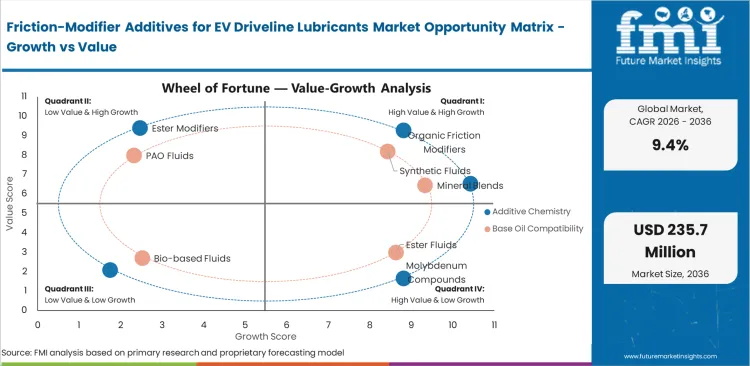
- Organic friction modifiers are estimated to capture 38.0% share in 2026, with ashless chemistry helping formulators manage friction without adding metal content.
- Synthetic fluids are set to represent 46.0% of base oil compatibility in 2026 since EV driveline programs need stronger thermal stability across compact systems.
- Compact e-axle layouts keep e-axle fluids in a high-value position as gear contact and bearing protection require carefully balanced additive packages.
- Geography and Competitive Outlook
- China is expected to record a CAGR of 11.6% through 2036, driven by EV output and e-fluid qualification work.
- India is projected to expand at 11.2% CAGR by 2036, as local EV sales and blending activity increase.
- Companies combining e-fluid testing depth with OEM approval access are strengthening their market position during the forecast period.
- Analyst Opinion
- Nikhil Kaitwade, Principal Consultant for the Automotive domain at FMI, says, “EV driveline lubricants face tougher formulation needs as e-axles combine gear protection with electrical exposure. Lubricant blenders need friction control and copper compatibility in one additive package. Bench testing and OEM approvals raise cost while stronger e-fluid testing reduces retesting.”
- Friction-Modifier Additives for EV Driveline Lubricants Market Value Analysis
- The friction-modifier additives for EV driveline lubricants market is moving from adapted transmission fluid chemistry into dedicated e-fluid additive design.
- Adoption is supported by e-axle fluid needs across BEV drivetrains and hybrid transmission platforms.
- The market is benefiting from deeper use of electric vehicle fluid programs across OEM factory-fill specifications.
- Low-friction film control is becoming important as EV driveline fluids must protect gears and limit copper-contact risks.
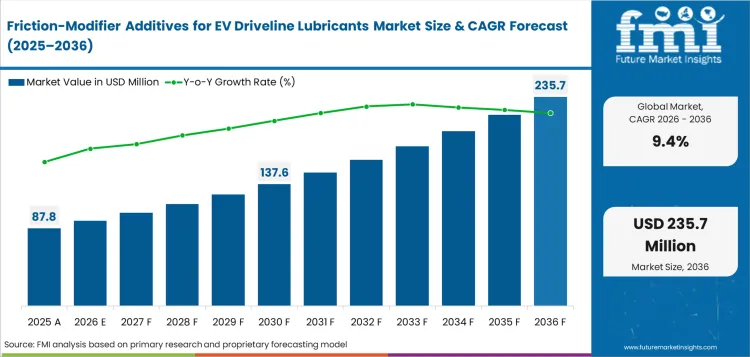
Key Takeaways, Market Size, and Forecast
- The friction-modifier additives for EV driveline lubricants market was valued at USD 87.8 million in 2025.
- By 2036, the friction-modifier additives for EV driveline lubricants market is expected to be worth USD 235.7 million.
- From 2026 to 2036, the market is projected to expand at a CAGR of 9.4%.
- The market is forecast to create an incremental opportunity of USD 139.7 million between 2026 and 2036.
- In 2026, BEV drivetrains are expected to account for 58.0% of vehicle platform demand.
- China at 11.6% CAGR and India at 11.2% CAGR are projected to witness stable adoption outlook over the forecast.
Copper compatibility is becoming a material compatibility risk as friction modifiers enter motor-contact driveline fluids. ASTM D8544-24 places conductive deposit testing across 80 °C to 180 °C and turns copper-safe chemistry into a formal screening need for e-axle programs. High-speed aeration adds a second approval burden for formulators. Infineum’s October 2024 work notes e-gearboxes above 20,000 rpm and HSAT simulation up to 27,000 rpm, so friction chemistry must avoid foam and air-release problems under fast gear motion. Treat-rate pressure then narrows the formulation room. Afton Chemical’s March 2024 patent states no more than about 0.30 wt % of specified friction modifiers in certain electric driveline fluids and makes additive efficiency per dose a supplier test. Formulators that combine copper screening, aeration control and low-dose film performance gain better access to OEM factory-fill programs and reduce repeat qualification work.
Friction-Modifier Additives for EV Driveline Lubricants Market Definition
The friction-modifier additives for EV driveline lubricants market includes chemical additives used to reduce friction in electric drive unit fluids. These additives serve e-axle fluids, EV gear oils, hybrid transmissions, and service-fill driveline lubricants. Scope includes organic friction modifiers, molybdenum compounds, ester modifiers, amide modifiers, and polymer modifiers. Finished lubricants, base oils, engine oil additives, coolants, and greases are outside the scope.
Friction-Modifier Additives for EV Driveline Lubricants Market Inclusions
Market scope covers all commercially traded friction-modifier additive products used in EV driveline lubricants categorized by additive chemistry, including organic friction modifiers, molybdenum compounds, ester modifiers, amide modifiers, and polymer modifiers; base oil compatibility, including synthetic fluids, ester fluids, PAO fluids, bio-based fluids, and mineral blends; lubricant applications, including e-axle fluids, EV gear oils, hybrid transmissions, EDU fluids, and service fluids; and sales channels, including factory fill, service fill, additive concentrates, blender direct, and aftermarket blends. Revenue scope covers 2026 to 2036. The participants include additive manufacturers, lubricant blenders, EV fluid formulators, base oil suppliers, automotive OEMs, e-axle manufacturers, transmission system suppliers, testing laboratories, aftermarket distributors, fleet maintenance networks, and regulatory bodies.
Friction-Modifier Additives for EV Driveline Lubricants Market Exclusions
Scope does not include finished EV fluids, base oil stocks, anti-wear additives sold alone, battery coolants, brake fluids, greases, or engine oil additives outside EV driveline use.
Friction-Modifier Additives for EV Driveline Lubricants Market Research Methodology
- Primary Research: FMI analysts interviewed additive manufacturers, lubricant blenders, EV fluid formulators, and automotive testing specialists in important markets.
- Desk Research: Desk review combined data from EV sales outlooks, additive portfolios, e-fluid technical references, and related lubricant additives demand indicators.
- Market sizing and forecasting: Forecast work added EV driveline fluid volume, additive treat-rate assumptions, country-level EV output, and service-fill timing from the bottom up.
- Data validation: FMI cross-checked assumptions every quarter against EV sales patterns, company e-fluid coverage, and parent friction modifier additives benchmarks.
Why is the Friction-Modifier Additives for EV Driveline Lubricants Market Growing?
- Electric drive units are using dedicated fluids earlier as gears and bearings face compact high-speed operation.
- Lubricant blenders are using friction-modifier chemistry to protect range performance without sacrificing wear control.
- OEM approval work is becoming more demanding as e-fluid chemistry must address electrical and metal compatibility.
Global electric car sales exceeded 17 million in 2024 and reached a sales share above 20%. Reported sales create a larger addressable pool for electric driveline fluids and additive packages. Friction-modifier additives draw specification interest as e-axle fluids need lower friction and stable protection across gear contacts. Additive makers with EV fluid testing records can help blenders shorten approval work and limit repeated formulation changes.
China’s electric car production reached 12.4 million units in 2024 and accounted for over 70% of global output. China’s production scale makes the country the main near-term testing ground for driveline additive chemistry in EV applications. Local fluid programs need additive packages to pass friction and wear checks together reliably. Additive packages must meet foam and copper performance requirements under operating conditions. Suppliers with regional technical service can gain earlier access to platform approval discussions.
Market Segmentation Analysis
- Organic friction modifiers are estimated to capture 38.0% share in 2026, as ashless chemistry helps EV fluid formulators manage friction without added metal content.
- Synthetic fluids are expected to represent 46.0% of base oil compatibility in 2026, supported by low-viscosity e-axle formulations that need thermal stability.
- E-axle fluids are projected to hold 44.0% share in 2026, reflecting direct use across integrated drive units requiring gear and bearing protection.
- BEV drivetrains are anticipated to account for 58.0% of vehicle platform use in 2026, backed by dedicated electric architectures and purpose-built fluid programs.
- Factory fill is forecast to contribute 52.0% share in 2026, as OEM approval programs define first-use lubricant chemistry for EV driveline systems.
The market for friction-modifier additives for EV driveline lubricants is divided into five primary segment groups based on additive chemistry, base oil compatibility, lubricant application, vehicle platform, and sales channel. Additive chemistry includes organic friction modifiers, molybdenum compounds, ester modifiers, amide modifiers, and polymer modifiers. Base oil compatibility includes synthetic fluids, ester fluids, PAO fluids, bio-based fluids, and mineral blends. Lubricant application includes e-axle fluids, EV gear oils, hybrid transmissions, EDU fluids, and service fluids. Vehicle platform includes BEV drivetrains, PHEV drivetrains, HEV drivetrains, electric LCVs, and electric trucks.
Insights into Friction-Modifier Additives for EV Driveline Lubricants Market by Additive Chemistry
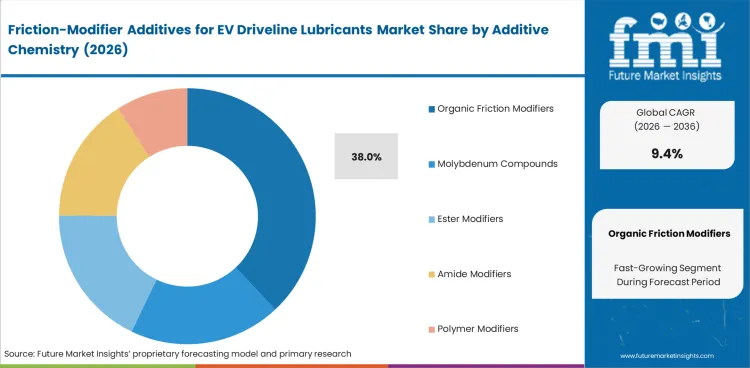
- Organic friction modifiers are estimated to make up 38.0% of additive chemistry demand in 2026. Ashless chemistry helps formulators reduce friction without adding metal content across low-conductivity EV driveline fluid packages.
- Molybdenum and ester options address selected high-load programs that need different film strength or polarity. Their use improves in specialty blends designed around gear durability and surface-film control requirements.
Insights into Friction-Modifier Additives for EV Driveline Lubricants Market by Base Oil Compatibility
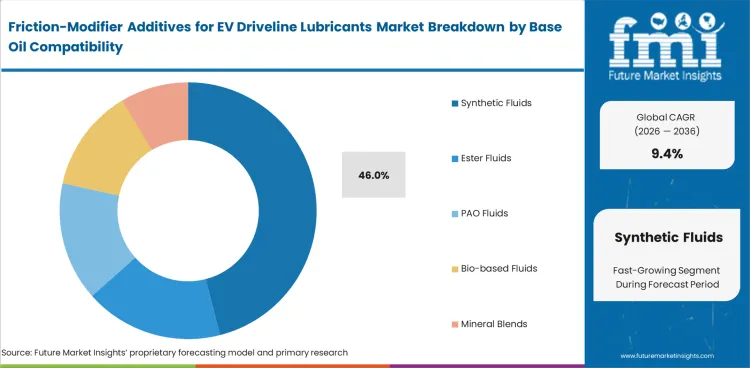
- Synthetic fluids are expected to hold 46.0% of base oil compatibility demand in 2026. Low-viscosity synthetic systems provide stable friction control across temperature swings and compact electrified driveline hardware.
- Ester fluids and PAO fluids serve programs with stricter thermal and seal performance needs. Their value improves in e-axle designs requiring balanced friction behavior across longer operating cycles.
Insights into Friction-Modifier Additives for EV Driveline Lubricants Market by Lubricant Application
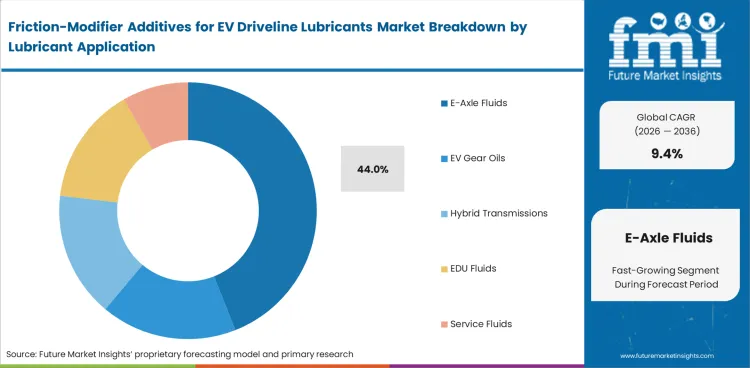
- E-axle fluids are projected to account for 44.0% of lubricant application demand in 2026. Integrated motors and reduction gears require friction control alongside gear protection inside compact drive housings.
- EV gear oils and EDU fluids address specific driveline layouts with different load profiles. Demand is shaped by gear noise targets and approval testing across electric drive platforms.
Insights into Friction-Modifier Additives for EV Driveline Lubricants Market by Vehicle Platform
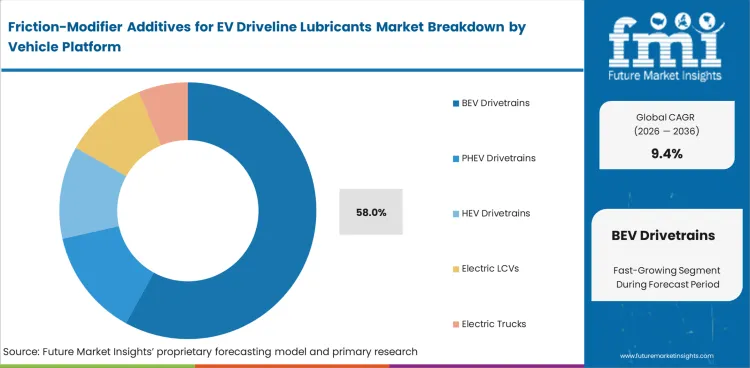
- BEV drivetrains are forecast to hold 58.0% of vehicle platform demand in 2026. Dedicated electric platforms create direct additive qualification paths for purpose-built driveline fluid programs.
- PHEV and HEV drivetrains require friction chemistry across mixed transmission and electric drive layouts. Their use favors additive packages able to balance legacy fluid needs with electrified components.
Insights into Friction-Modifier Additives for EV Driveline Lubricants Market by Sales Channel
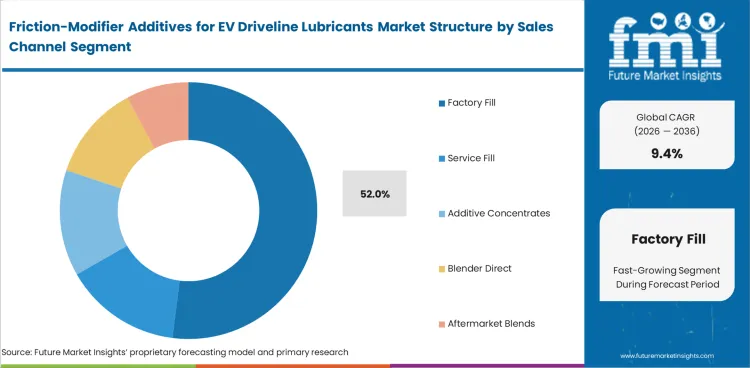
- Factory fill is projected to account for 52.0% of sales channel demand in 2026. OEM approval cycles lead to early volume access as first-fill lubricants define baseline chemistry for electric drive systems.
- Service fill and blender direct channels support replacement demand as EV platforms age. Their role expands as maintenance networks need approved fluids with stable friction and compatibility records.
Friction-Modifier Additives for EV Driveline Lubricants Market Drivers, Restraints, and Opportunities
- E-axle fluid design is creating demand for friction control across compact drive units.
- Copper compatibility increases formulation pressure for additive makers serving direct-cooled electric driveline systems.
- Service-fill demand improves opportunity as early EV fleets age into scheduled lubricant replacement cycles.
Friction-modifier additives for EV driveline lubricants continue to gain use as e-axles need low-friction fluid behavior and gear protection. Cost pressure and copper-contact testing can slow broader qualification across price-sensitive lubricant programs. Expansion continues through factory-fill approvals and service-fill demand across aging EV platforms.
E-Axle Testing Cost Stays Elevated
Dedicated e-fluid testing makes additive approval more expensive for smaller chemistry suppliers. Infineum stated in October 2024 that it had completed almost 3 million kilometers of field trials across its e-mobility portfolio. Validation at that scale favors suppliers with strong test budgets and long OEM relationships. Smaller additive makers can participate through targeted chemistry. Large factory-fill awards usually need broader test evidence.
Low-Viscosity Fluid Balance Tightens
Low-viscosity EV driveline fluids improve energy efficiency but raise the risk of wear if additive balance is weak. Lubrizol highlighted all-in-one e-fluid technology for e-axle applications in an April 2024 Charged EV event. Lubrizol’s webinar indicates that friction chemistry must work with anti-wear and thermal behavior. Formulators that reduce one test failure can save time across OEM approval cycles.
Analysis of Friction-Modifier Additives for EV Driveline Lubricants Market By Key Countries
.webp "Top Country Growth Comparison Friction Modifier Additives For Ev Driveline Lubricants Market Cagr (2026 2036)")
| Country | CAGR |
|---|---|
| China | 11.6% |
| India | 11.2% |
| USA | 8.9% |
| Germany | 7.6% |
| Japan | 6.5% |
Source: Future Market Insights, 2026.
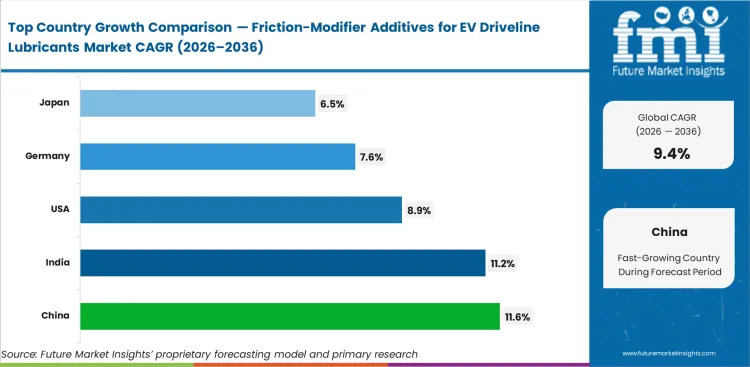
Friction-Modifier Additives for EV Driveline Lubricants Market CAGR Analysis By Country
- China is projected to record an 11.6% CAGR through 2036, backed by large EV output and deeper e-fluid qualification work.
- India is projected to rise at 11.2% CAGR due to rising EV sales and lubricant blending activity across automotive production hubs.
- USA demand is forecast to expand at an 8.9% CAGR through 2036, with OEM e-drive programs raising technical requirements for EV driveline fluids.
- Germany at an estimated 7.6% CAGR and Japan at 6.5% CAGR point to steadier expansion, shaped by mature automotive bases and controlled EV fluid adoption.
Demand for friction-modifier additives for EV driveline lubricants is forecast to rise at 9.4% CAGR from 2026 to 2036. Country-level analysis covers the major markets contributing to this forecast, with country summaries below.
Demand Outlook for Friction-Modifier Additives for EV Driveline Lubricants Market in China
China’s friction-modifier additives for EV driveline lubricants industry is projected to record a CAGR of 11.6% through 2036. China sold over 11 million electric cars in 2024, making it the leading use base for EV driveline fluid programs. China’s output base supports demand for domestic friction-modifier additives for EV driveline lubricants. Local additive suppliers and global package makers can gain from OEMs needing qualified friction chemistry for e-axle platforms.
- Large EV output in Guangdong and Shanghai increases demand for e-axle lubricant qualification and blender service.
- China’s EV production scale raises the need for copper-safe friction chemistry across compact drive unit programs.
- Local fluid makers need additive partners able to manage foam, wear, and friction testing together.
Sales Analysis of Friction-Modifier Additives for EV Driveline Lubricants Market in India
The friction-modifier additives for EV driveline lubricants sector in India is expected to expand at a CAGR of 11.2% during the assessment period. NITI Aayog reported that EV sales in India rose to 2.08 million in 2024, with EV penetration at 7.66%. Reported EV growth creates a smaller but fast-moving base for India friction-modifier additives for EV driveline lubricants. Local blending demand will rise as electric cars and commercial EVs need better drive unit fluids.
- Maharashtra and Tamil Nadu auto clusters lead to a stronger demand for EV fluid trials and local additive service.
- India’s 2030 EV penetration target of 30% makes a policy frame for e-fluid development.
- Domestic blenders need proven chemistry to fit local price limits and OEM quality files.
Demand Outlook for Friction-Modifier Additives for EV Driveline Lubricants Market in the United States
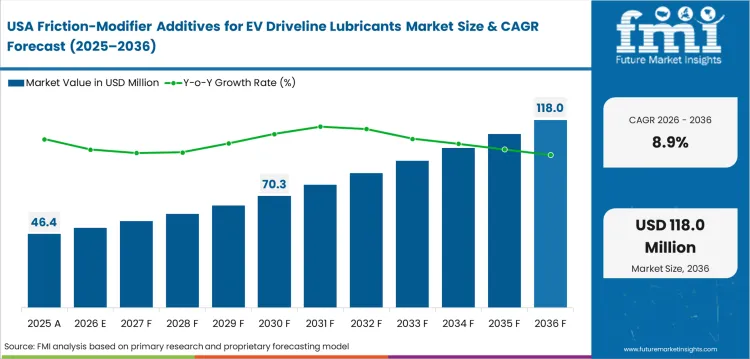
The USA friction-modifier additives for EV driveline lubricants industry is forecast to grow at a CAGR of 8.9% by 2036. Electric car sales in the United States increased to 1.6 million in 2024, with sales share above 10%. United States EV sales support USA friction-modifier additives for EV driveline lubricants across factory-fill and service-fill programs. Additive makers gain from OEMs seeking friction efficiency and copper compatibility inside e-drive fluids.
- Michigan and Ohio powertrain clusters enhance local demand for e-fluid testing and formulation review.
- USA automakers need additive packages to fit e-axle durability targets and warranty control.
- Service-fill demand will build as older EVs move into independent maintenance channels.
Opportunity Analysis of Friction-Modifier Additives for EV Driveline Lubricants Market in Germany
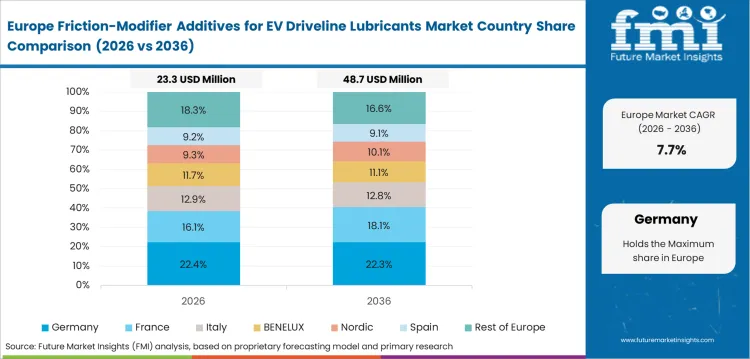
The friction-modifier additives for EV driveline lubricants segment in Germany is projected to advance at 7.6% CAGR over the forecast years. ACEA reported that EU battery-electric car registrations reached 1,880,370 in 2025, with Germany recording 43.2% BEV registration expansion. ACEA’s data supports Germany's friction-modifier additives for EV driveline lubricants as domestic OEMs refine e-axle fluid specifications. Testing demand is strongest for high-speed drive units that require quiet gear operation.
- Bavaria and Baden-Württemberg raise test demand through premium EV platform development.
- German OEM programs place high weight on gear noise control and long-term wear behavior.
- Local additive qualification often connects friction performance with anti-wear additives compatibility.
Future Outlook for Friction-Modifier Additives for EV Driveline Lubricants Market in Japan
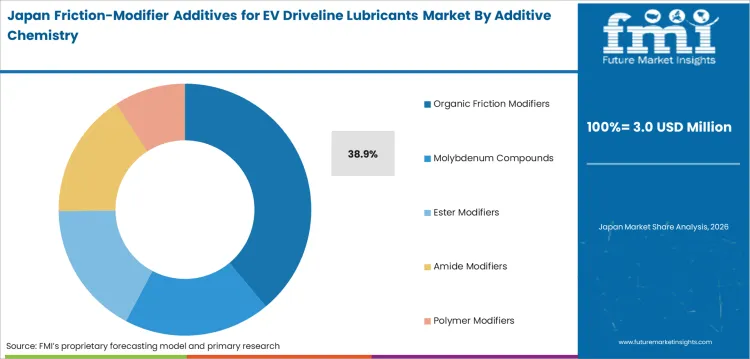
The Japan friction-modifier additives for EV driveline lubricants industry is expected to post 6.5% CAGR through 2036. JAMA September 2025 presentation reported that Japan’s next-generation vehicle share stood at 54%, covering hybrid and electric formats. JAMA’s data supports Japan friction-modifier additives for EV driveline lubricants as hybrid-heavy platforms need driveline fluid upgrades. Service providers with hybrid transmission knowledge can support additive qualification for both BEV and HEV systems.
- Aichi and Shizuoka automotive clusters increase steady demand for hybrid-compatible driveline friction chemistry.
- Japan’s 2030 target range of 50% to 70% next-generation vehicle sales backs long-term e-fluid work.
- Hybrid-heavy demand keeps friction testing important across friction modifiers used in transmission fluids.
Competitive Landscape and Strategic Positioning
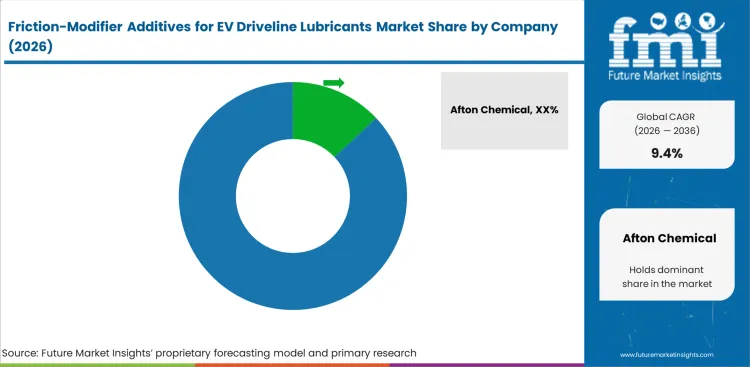
Friction-Modifier Additives for EV Driveline Lubricants Market Analysis By Company
- Afton Chemical competes from a broad driveline additive base, with friction modifiers used for wear control and noise reduction.
- Lubrizol and Infineum use electric driveline fluid programs built around OEM testing and platform approval needs.
- Component specialists such as BASF and Italmatch focus on organic friction chemistry for targeted lubricant formulation work.
Competition in this market centers on e-fluid testing evidence and additive chemistry suited to compact electric drive units. Afton Chemical holds a strong role through friction modifiers used to reduce wear, noise, scoring, and micropitting in driveline systems. Lubrizol serves OEM electric drivetrain needs through EVOGEN e-driveline fluid technologies. Infineum adds strength through e-fluid formulation work covering cooling behavior and material compatibility. Chevron Oronite focuses on driveline fluid additive systems for factory-fill and service-fill use. BASF and Italmatch expand the chemistry base with components used in organic friction modifier additives. Cargill adds to the chemistry base with inputs used in organic friction modifier additives.
High testing costs and copper safety requirements create entry barriers for smaller additive providers. Low viscosity performance and foam control are priorities across e-axle duty cycles in modern drivetrain systems. Stable friction film behavior remains a requirement for efficiency and durability across varying operating conditions. Lubricant blenders prefer partners able to provide friction results and compatibility evidence in one technical package. Companies with broader EV fluid portfolios and deeper testing records are better placed to win OEM approvals.
Key Companies in the Friction-Modifier Additives for EV Driveline Lubricants Market
Global companies active in the friction-modifier additives for EV driveline lubricants market include:
- Afton Chemical, Lubrizol, and Infineum have strong e-fluid chemistry depth for electric driveline programs.
- Chevron Oronite and BASF serve lubricant formulators through driveline additive systems and friction chemistry components.
- Italmatch and Cargill hold specialist positions across lubricant performance additives and organic friction-modifier chemistry.
Competitive Benchmarking: Friction-Modifier Additives for EV Driveline Lubricants Market
| Company | E-Fluid Chemistry Depth | Copper Compatibility Testing | OEM Program Access | Geographic Footprint |
|---|---|---|---|---|
| Afton Chemical | High | High | Strong | Global additive supply network with regional coverage across North America, Europe, Asia Pacific, India, Middle East and Africa. |
| Lubrizol | High | High | Strong | Global regional structure covering North America, Latin America, Europe, Asia Pacific, and India, Middle East and Africa. |
| Infineum | High | High | Strong | Manufacturing and technical presence across the USA, Brazil, France, Germany, Italy, Singapore, China, Japan, South Korea and India. |
| Chevron Oronite | High | Medium | Strong | Strong Asia Pacific footprint with manufacturing plants in Singapore, India, China and Japan, plus regional sales coverage. |
| BASF | Medium | Medium | Moderate | Broad global chemical footprint with presence in 93 countries and 234 production sites including seven Verbund sites. |
| Italmatch | Medium | Medium | Moderate | Manufacturing footprint includes Europe, Asia Pacific, North America, Saudi Arabia and Brazil, with 20 plants worldwide. |
| Cargill | Medium | Medium | Moderate | Global industrial and bioindustrial reach across 70 countries and regions, with presence across Asia Pacific, Europe and North America. |
Source: Future Market Insights, 2026.
Key Developments in Friction-Modifier Additives for EV Driveline Lubricants Market
- June 2024, Lubrizol presented an e-axle fluid webinar for a Charged EV event. The session covered all-in-one e-fluid technology for electric drive units and reinforced the need for combined efficiency and durability testing.
- October 2024, Infineum reported almost 3 million kilometers of field trials across its e-mobility portfolio. The testing work covered hybrid and electric vehicles and expanded its e-fluid validation base.
Key Players in the Friction-Modifier Additives for EV Driveline Lubricants Market
Major Global Players:
- Afton Chemical
- Lubrizol
- Infineum
- Chevron Oronite
- BASF
Specialist Players:
- Italmatch Chemicals
- Cargill Bioindustrial
Report Scope and Coverage
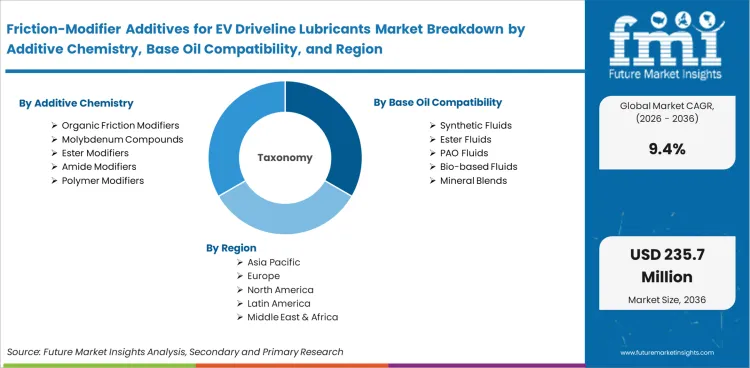
Friction-Modifier Additives for EV Driveline Lubricants Market Breakdown By Additive Chemistry, Lubricant Application, And Region
| Parameter | Details |
|---|---|
| Quantitative Units | USD 96.0 million to USD 235.7 million, at a CAGR of 9.4% |
| Market Definition | The market encompasses friction-modifier additives used in EV driveline lubricants for e-axles, EV gear oils, and hybrid transmissions. |
| Regions Covered | North America, Latin America, Europe, East Asia, South Asia and Pacific, Middle East and Africa |
| Countries Covered | USA, China, India, Germany, Japan, South Korea, France, and 30 plus countries |
| Key Companies Profiled | Afton Chemical, Lubrizol, Infineum, Chevron Oronite, BASF, Italmatch Chemicals, Cargill Bioindustrial |
| Forecast Period | 2026 to 2036 |
| Approach | Hybrid bottom-up and top-down methodology starting with EV driveline fluid demand and verified additive use patterns. |
Friction-Modifier Additives for EV Driveline Lubricants Market by Segments
Friction-Modifier Additives for EV Driveline Lubricants Market Segmented by Additive Chemistry:
- Organic Friction Modifiers
- Molybdenum Compounds
- Ester Modifiers
- Amide Modifiers
- Polymer Modifiers
Friction-Modifier Additives for EV Driveline Lubricants Market Segmented by Base Oil Compatibility:
- Synthetic Fluids
- Ester Fluids
- PAO Fluids
- Bio-based Fluids
- Mineral Blends
Friction-Modifier Additives for EV Driveline Lubricants Market Segmented by Lubricant Application:
- E-Axle Fluids
- EV Gear Oils
- Hybrid Transmissions
- EDU Fluids
- Service Fluids
Friction-Modifier Additives for EV Driveline Lubricants Market Segmented by Vehicle Platform:
- BEV Drivetrains
- PHEV Drivetrains
- HEV Drivetrains
- Electric LCVs
- Electric Trucks
Friction-Modifier Additives for EV Driveline Lubricants Market Segmented by Sales Channel:
- Factory Fill
- Service Fill
- Additive Concentrates
- Blender Direct
- Aftermarket Blends
Friction-Modifier Additives for EV Driveline Lubricants Market by Region:
- North America
- USA
- Canada
- Mexico
- Latin America
- Brazil
- Chile
- Rest of Latin America
- Europe
- Germany
- UK
- Italy
- Spain
- France
- Rest of Europe
- East Asia
- China
- Japan
- South Korea
- South Asia and Pacific
- India
- ASEAN
- Australia & New Zealand
- Rest of South Asia and Pacific
- Middle East and Africa
- Saudi Arabia
- Other GCC Countries
- South Africa
- Rest of Middle East and Africa
Research Sources and Bibliography
- International Energy Agency. (2025, May). Global EV Outlook 2025: Executive summary. IEA.
- International Energy Agency. (2025, May). Global EV Outlook 2025: Trends in the electric car industry. IEA.
- Infineum. (2024, October 1). Leading advances in driveline testing. Infineum Insight.
- Lubrizol. (2024, June). Lubrizol presents: e-Axle fluid webinar for Charged EV event. Lubrizol.
- Charged EVs. (2024, April 18). All-in-one e-fluid technology to cool inverter, e-motor and provide EV gear lubrication. Charged EVs.
- NITI Aayog. (2025, August). Electric vehicles in India. Government of India.
- European Automobile Manufacturers’ Association. (2026, January). New car registrations: +1.8% in 2025; battery-electric 17.4% market share. ACEA.
- Japan Automobile Manufacturers Association. (2025, September). Diversity in carbon neutrality. JAMA.
- Infineum. (2024, May). Energy efficient e-fluids. Infineum Insight.
- Afton Chemical. (2026). eMobility driveline solutions. Afton Chemical.
- Chevron Oronite. (2026). Additives for driveline fluids. Chevron Oronite.
This Report Answers
- What is the current and future size of the friction-modifier additives for EV driveline lubricants market?
- How fast is demand expected to expand for friction-modifier additives between 2026 and 2036?
- Which additive chemistry is expected to lead demand across EV driveline lubricant formulations?
- Which lubricant application creates the largest use case for friction-modifier additives in 2026?
- What factors are driving demand for EV driveline friction-modifier additives globally?
- How are copper compatibility and e-axle design changing additive selection?
- Which countries are projected to record faster expansion through 2036?
- Which companies are active in EV driveline friction-modifier additive supply?
- How does FMI estimate and validate the market forecast for this chemistry area?
Frequently Asked Questions
What is the global market demand for Friction-Modifier Additives for EV Driveline Lubricants in 2026?
In 2026, the global market for friction-modifier additives for EV driveline lubricants is expected to be worth USD 96.0 million.
How big will the market for Friction-Modifier Additives for EV Driveline Lubricants be in 2036?
By 2036, the market for friction-modifier additives for EV driveline lubricants is expected to be worth USD 235.7 million.
How much is demand for Friction-Modifier Additives for EV Driveline Lubricants expected to expand between 2026 and 2036?
Between 2026 and 2036, demand for friction-modifier additives for EV driveline lubricants is expected to expand at a CAGR of 9.4%.
Which additive chemistry segment is likely to be the best seller globally by 2026?
Organic Friction Modifiers will make up 38.0% of the additive chemistry segment in 2026.
What is causing demand to rise in China?
The China friction-modifier additives for EV driveline lubricants market is projected to record 11.6% CAGR through 2036, driven by EV production scale.
What is causing demand to rise in India?
The India friction-modifier additives for EV driveline lubricants market is projected to expand at 11.2% CAGR through 2036, backed by rising EV sales.
What does this report mean by Friction-Modifier Additives for EV Driveline Lubricants Market definition?
The market includes additives used to reduce friction in e-axle fluids, EV gear oils, hybrid transmissions, and related service-fill lubricants.
How does FMI make the Friction-Modifier Additives for EV Driveline Lubricants forecast and check it?
Forecasting models use a hybrid bottom-up and top-down approach, starting with EV driveline fluid demand and additive treat-rate assumptions.
Preview the report firsthand - request a free sample
Get SampleGet the brochure for pricing and purchase details.
Get PDFTable of Content
- Key Takeaways
- Market Size and CAGR
- Top Growth Driver
- Fastest Growing Segment
- Leading Region
- Key Companies
- Emerging Opportunities
- Executive Summary
- Global Market Outlook
- Demand-side Trends
- Supply-side Trends
- Technology Roadmap Analysis
- Analysis and Recommendations
- Analyst Perspective (What is happening? Why now? What should investors know?)
- Key Questions Answered
- How large is the market?
- What is the CAGR?
- What are key trends?
- Which region dominates?
- Who are the leaders?
- Market Overview
- Market Coverage / Taxonomy
- Market Definition / Scope / Limitations
- Research Methodology
- Chapter Orientation
- Analytical Lens and Working Hypotheses
- Market Structure, Signals, and Trend Drivers
- Benchmarking and Cross-market Comparability
- Market Sizing, Forecasting, and Opportunity Mapping
- Research Design and Evidence Framework
- Desk Research Programme (Secondary Evidence)
- Expert Input and Fieldwork (Primary Evidence)
- Tooling, Models, and Reference Databases
- Data Engineering and Model Build
- Quality Assurance and Audit Trail
- Market Background
- Market Dynamics (Drivers, Restraints, Opportunity, Trends)
- Scenario Forecast (Optimistic, Likely, Conservative)
- Impact Analysis
- AI Impact
- Sustainability Impact
- Regulatory Impact
- Technology Impact
- Consumer / Buyer Analysis
- Purchase Drivers
- Adoption Barriers
- Buyer Journey
- Opportunity Map Analysis
- Product Life Cycle Analysis
- Supply Chain Analysis
- Investment Feasibility Matrix
- Value Chain Analysis
- PESTLE and Porter's Analysis
- Regulatory Landscape
- Regional Parent Market Outlook
- Production and Consumption Statistics
- Import and Export Statistics
- Global Market Analysis and Forecast, 2021 to 2036
- Historical Market Size Value (USD Million) & Volume (Unit) Analysis, 2021 to 2025
- Current and Future Market Size Value (USD Million) & Volume (Unit) Projections, 2026 to 2036
- Y-o-Y Growth Trend Analysis
- Absolute $ Opportunity Analysis
- Global Market Pricing Analysis, 2021 to 2036
- Global Market Analysis and Forecast, By Additive Chemistry, 2021 to 2036
- Introduction / Key Findings
- Historical Market Size Value (USD Million) & Volume (Unit) Analysis By Additive Chemistry, 2021 to 2025
- Current and Future Market Size Value (USD Million) & Volume (Unit) Analysis and Forecast By Additive Chemistry, 2026 to 2036
- Organic Friction Modifiers
- Molybdenum Compounds
- Ester Modifiers
- Amide Modifiers
- Polymer Modifiers
- Organic Friction Modifiers
- Y-o-Y Growth Trend Analysis By Additive Chemistry, 2021 to 2025
- Absolute $ Opportunity Analysis By Additive Chemistry, 2026 to 2036
- Global Market Analysis and Forecast, By Base Oil Compatibility, 2021 to 2036
- Introduction / Key Findings
- Historical Market Size Value (USD Million) & Volume (Unit) Analysis By Base Oil Compatibility, 2021 to 2025
- Current and Future Market Size Value (USD Million) & Volume (Unit) Analysis and Forecast By Base Oil Compatibility, 2026 to 2036
- Synthetic Fluids
- Ester Fluids
- PAO Fluids
- Bio-based Fluids
- Mineral Blends
- Synthetic Fluids
- Y-o-Y Growth Trend Analysis By Base Oil Compatibility, 2021 to 2025
- Absolute $ Opportunity Analysis By Base Oil Compatibility, 2026 to 2036
- Global Market Analysis and Forecast, By Lubricant Application, 2021 to 2036
- Introduction / Key Findings
- Historical Market Size Value (USD Million) & Volume (Unit) Analysis By Lubricant Application, 2021 to 2025
- Current and Future Market Size Value (USD Million) & Volume (Unit) Analysis and Forecast By Lubricant Application, 2026 to 2036
- E-Axle Fluids
- EV Gear Oils
- Hybrid Transmissions
- EDU Fluids
- Service Fluids
- E-Axle Fluids
- Y-o-Y Growth Trend Analysis By Lubricant Application, 2021 to 2025
- Absolute $ Opportunity Analysis By Lubricant Application, 2026 to 2036
- Global Market Analysis and Forecast, By Vehicle Platform, 2021 to 2036
- Introduction / Key Findings
- Historical Market Size Value (USD Million) & Volume (Unit) Analysis By Vehicle Platform, 2021 to 2025
- Current and Future Market Size Value (USD Million) & Volume (Unit) Analysis and Forecast By Vehicle Platform, 2026 to 2036
- BEV Drivetrains
- PHEV Drivetrains
- HEV Drivetrains
- Electric LCVs
- Electric Trucks
- BEV Drivetrains
- Y-o-Y Growth Trend Analysis By Vehicle Platform, 2021 to 2025
- Absolute $ Opportunity Analysis By Vehicle Platform, 2026 to 2036
- Global Market Analysis and Forecast, By Sales Channel, 2021 to 2036
- Introduction / Key Findings
- Historical Market Size Value (USD Million) & Volume (Unit) Analysis By Sales Channel, 2021 to 2025
- Current and Future Market Size Value (USD Million) & Volume (Unit) Analysis and Forecast By Sales Channel, 2026 to 2036
- Factory Fill
- Service Fill
- Additive Concentrates
- Blender Direct
- Aftermarket Blends
- Factory Fill
- Y-o-Y Growth Trend Analysis By Sales Channel, 2021 to 2025
- Absolute $ Opportunity Analysis By Sales Channel, 2026 to 2036
- Global Market Analysis and Forecast, By Region, 2021 to 2036
- Introduction
- Historical Market Size Value (USD Million) & Volume (Unit) Analysis By Region, 2021 to 2025
- Current Market Size Value (USD Million) & Volume (Unit) Analysis and Forecast By Region, 2026 to 2036
- North America
- Latin America
- Western Europe
- Eastern Europe
- East Asia
- South Asia and Pacific
- Middle East & Africa
- Market Attractiveness Analysis By Region
- North America Market Analysis and Forecast, By Country, 2021 to 2036
- Historical Market Size Value (USD Million) & Volume (Unit) Trend Analysis By Market Taxonomy, 2021 to 2025
- Market Size Value (USD Million) & Volume (Unit) Forecast By Market Taxonomy, 2026 to 2036
- By Country
- USA
- Canada
- Mexico
- By Additive Chemistry
- By Base Oil Compatibility
- By Lubricant Application
- By Vehicle Platform
- By Sales Channel
- By Country
- Market Attractiveness Analysis
- By Country
- By Additive Chemistry
- By Base Oil Compatibility
- By Lubricant Application
- By Vehicle Platform
- By Sales Channel
- Key Takeaways
- Latin America Market Analysis and Forecast, By Country
- Historical Market Size Value (USD Million) & Volume (Unit) Trend Analysis By Market Taxonomy, 2021 to 2025
- Market Size Value (USD Million) & Volume (Unit) Forecast By Market Taxonomy, 2026 to 2036
- By Country
- Brazil
- Chile
- Rest of Latin America
- By Additive Chemistry
- By Base Oil Compatibility
- By Lubricant Application
- By Vehicle Platform
- By Sales Channel
- By Country
- Market Attractiveness Analysis
- By Country
- By Additive Chemistry
- By Base Oil Compatibility
- By Lubricant Application
- By Vehicle Platform
- By Sales Channel
- Key Takeaways
- Western Europe Market Analysis and Forecast, By Country
- Historical Market Size Value (USD Million) & Volume (Unit) Trend Analysis By Market Taxonomy, 2021 to 2025
- Market Size Value (USD Million) & Volume (Unit) Forecast By Market Taxonomy, 2026 to 2036
- By Country
- Germany
- UK
- Italy
- Spain
- France
- Nordic
- BENELUX
- Rest of Western Europe
- By Additive Chemistry
- By Base Oil Compatibility
- By Lubricant Application
- By Vehicle Platform
- By Sales Channel
- By Country
- Market Attractiveness Analysis
- By Country
- By Additive Chemistry
- By Base Oil Compatibility
- By Lubricant Application
- By Vehicle Platform
- By Sales Channel
- Key Takeaways
- Eastern Europe Market Analysis and Forecast, By Country
- Historical Market Size Value (USD Million) & Volume (Unit) Trend Analysis By Market Taxonomy, 2021 to 2025
- Market Size Value (USD Million) & Volume (Unit) Forecast By Market Taxonomy, 2026 to 2036
- By Country
- Russia
- Poland
- Hungary
- Balkan & Baltic
- Rest of Eastern Europe
- By Additive Chemistry
- By Base Oil Compatibility
- By Lubricant Application
- By Vehicle Platform
- By Sales Channel
- By Country
- Market Attractiveness Analysis
- By Country
- By Additive Chemistry
- By Base Oil Compatibility
- By Lubricant Application
- By Vehicle Platform
- By Sales Channel
- Key Takeaways
- East Asia Market Analysis and Forecast, By Country
- Historical Market Size Value (USD Million) & Volume (Unit) Trend Analysis By Market Taxonomy, 2021 to 2025
- Market Size Value (USD Million) & Volume (Unit) Forecast By Market Taxonomy, 2026 to 2036
- By Country
- China
- Japan
- South Korea
- By Additive Chemistry
- By Base Oil Compatibility
- By Lubricant Application
- By Vehicle Platform
- By Sales Channel
- By Country
- Market Attractiveness Analysis
- By Country
- By Additive Chemistry
- By Base Oil Compatibility
- By Lubricant Application
- By Vehicle Platform
- By Sales Channel
- Key Takeaways
- South Asia and Pacific Market Analysis and Forecast, By Country
- Historical Market Size Value (USD Million) & Volume (Unit) Trend Analysis By Market Taxonomy, 2021 to 2025
- Market Size Value (USD Million) & Volume (Unit) Forecast By Market Taxonomy, 2026 to 2036
- By Country
- India
- ASEAN
- Australia & New Zealand
- Rest of South Asia and Pacific
- By Additive Chemistry
- By Base Oil Compatibility
- By Lubricant Application
- By Vehicle Platform
- By Sales Channel
- By Country
- Market Attractiveness Analysis
- By Country
- By Additive Chemistry
- By Base Oil Compatibility
- By Lubricant Application
- By Vehicle Platform
- By Sales Channel
- Key Takeaways
- Middle East & Africa Market Analysis and Forecast, By Country
- Historical Market Size Value (USD Million) & Volume (Unit) Trend Analysis By Market Taxonomy, 2021 to 2025
- Market Size Value (USD Million) & Volume (Unit) Forecast By Market Taxonomy, 2026 to 2036
- By Country
- Kingdom of Saudi Arabia
- Other GCC Countries
- Türkiye
- South Africa
- Other African Union
- Rest of Middle East & Africa
- By Additive Chemistry
- By Base Oil Compatibility
- By Lubricant Application
- By Vehicle Platform
- By Sales Channel
- By Country
- Market Attractiveness Analysis
- By Country
- By Additive Chemistry
- By Base Oil Compatibility
- By Lubricant Application
- By Vehicle Platform
- By Sales Channel
- Key Takeaways
- Key Countries Market Analysis
- USA
- Pricing Analysis
- Market Share Analysis, 2025
- By Additive Chemistry
- By Base Oil Compatibility
- By Lubricant Application
- By Vehicle Platform
- By Sales Channel
- Canada
- Pricing Analysis
- Market Share Analysis, 2025
- By Additive Chemistry
- By Base Oil Compatibility
- By Lubricant Application
- By Vehicle Platform
- By Sales Channel
- Mexico
- Pricing Analysis
- Market Share Analysis, 2025
- By Additive Chemistry
- By Base Oil Compatibility
- By Lubricant Application
- By Vehicle Platform
- By Sales Channel
- Brazil
- Pricing Analysis
- Market Share Analysis, 2025
- By Additive Chemistry
- By Base Oil Compatibility
- By Lubricant Application
- By Vehicle Platform
- By Sales Channel
- Chile
- Pricing Analysis
- Market Share Analysis, 2025
- By Additive Chemistry
- By Base Oil Compatibility
- By Lubricant Application
- By Vehicle Platform
- By Sales Channel
- Germany
- Pricing Analysis
- Market Share Analysis, 2025
- By Additive Chemistry
- By Base Oil Compatibility
- By Lubricant Application
- By Vehicle Platform
- By Sales Channel
- UK
- Pricing Analysis
- Market Share Analysis, 2025
- By Additive Chemistry
- By Base Oil Compatibility
- By Lubricant Application
- By Vehicle Platform
- By Sales Channel
- Italy
- Pricing Analysis
- Market Share Analysis, 2025
- By Additive Chemistry
- By Base Oil Compatibility
- By Lubricant Application
- By Vehicle Platform
- By Sales Channel
- Spain
- Pricing Analysis
- Market Share Analysis, 2025
- By Additive Chemistry
- By Base Oil Compatibility
- By Lubricant Application
- By Vehicle Platform
- By Sales Channel
- France
- Pricing Analysis
- Market Share Analysis, 2025
- By Additive Chemistry
- By Base Oil Compatibility
- By Lubricant Application
- By Vehicle Platform
- By Sales Channel
- India
- Pricing Analysis
- Market Share Analysis, 2025
- By Additive Chemistry
- By Base Oil Compatibility
- By Lubricant Application
- By Vehicle Platform
- By Sales Channel
- ASEAN
- Pricing Analysis
- Market Share Analysis, 2025
- By Additive Chemistry
- By Base Oil Compatibility
- By Lubricant Application
- By Vehicle Platform
- By Sales Channel
- Australia & New Zealand
- Pricing Analysis
- Market Share Analysis, 2025
- By Additive Chemistry
- By Base Oil Compatibility
- By Lubricant Application
- By Vehicle Platform
- By Sales Channel
- China
- Pricing Analysis
- Market Share Analysis, 2025
- By Additive Chemistry
- By Base Oil Compatibility
- By Lubricant Application
- By Vehicle Platform
- By Sales Channel
- Japan
- Pricing Analysis
- Market Share Analysis, 2025
- By Additive Chemistry
- By Base Oil Compatibility
- By Lubricant Application
- By Vehicle Platform
- By Sales Channel
- South Korea
- Pricing Analysis
- Market Share Analysis, 2025
- By Additive Chemistry
- By Base Oil Compatibility
- By Lubricant Application
- By Vehicle Platform
- By Sales Channel
- Russia
- Pricing Analysis
- Market Share Analysis, 2025
- By Additive Chemistry
- By Base Oil Compatibility
- By Lubricant Application
- By Vehicle Platform
- By Sales Channel
- Poland
- Pricing Analysis
- Market Share Analysis, 2025
- By Additive Chemistry
- By Base Oil Compatibility
- By Lubricant Application
- By Vehicle Platform
- By Sales Channel
- Hungary
- Pricing Analysis
- Market Share Analysis, 2025
- By Additive Chemistry
- By Base Oil Compatibility
- By Lubricant Application
- By Vehicle Platform
- By Sales Channel
- Kingdom of Saudi Arabia
- Pricing Analysis
- Market Share Analysis, 2025
- By Additive Chemistry
- By Base Oil Compatibility
- By Lubricant Application
- By Vehicle Platform
- By Sales Channel
- Türkiye
- Pricing Analysis
- Market Share Analysis, 2025
- By Additive Chemistry
- By Base Oil Compatibility
- By Lubricant Application
- By Vehicle Platform
- By Sales Channel
- South Africa
- Pricing Analysis
- Market Share Analysis, 2025
- By Additive Chemistry
- By Base Oil Compatibility
- By Lubricant Application
- By Vehicle Platform
- By Sales Channel
- USA
- Market Structure Analysis
- Competition Dashboard
- Competition Benchmarking
- Market Share Analysis of Top Players
- By Regional
- By Additive Chemistry
- By Base Oil Compatibility
- By Lubricant Application
- By Vehicle Platform
- By Sales Channel
- Emerging Startups
- Innovation Benchmarking
- Competition Analysis
- Competition Deep Dive
- Afton Chemical
- Overview
- Product Portfolio
- Profitability by Market Segments (Product/Region/Sales Channel)
- Sales Footprint
- Strategy Overview
- Marketing Strategy
- Product Strategy
- Channel Strategy
- Lubrizol
- Infineum
- Chevron Oronite
- BASF
- Italmatch Chemicals
- Cargill Bioindustrial
- Afton Chemical
- Case Studies
- Success Stories
- Recent Developments
- Competition Deep Dive
- Assumptions & Acronyms Used


