

- Industry Size (2026)
- USD 4.0 Bn
- Forecast (2036)
- USD 5.8 Bn
- CAGR (2026 to 2036)
- 3.8%
Anti-Wear Additives Market Forecast and Outlook 2026 to 2036
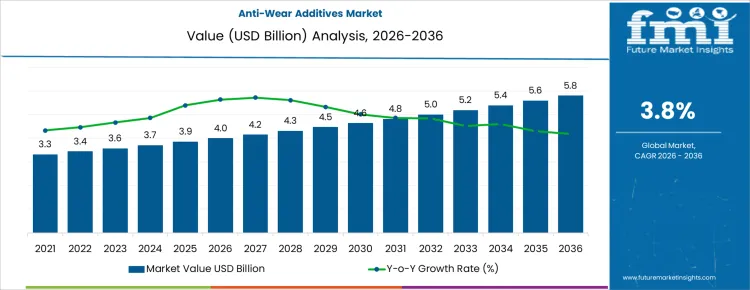
The anti-wear additives market is expected to expand from USD 4 billion in 2026 to USD 5.8 billion by 2036, reflecting a CAGR of 3.8%. Growth is supported by increasing demand for lubricants that enhance machinery and engine durability, minimize friction, and extend service life. Industrial machinery, automotive engines, and heavy-duty equipment remain primary applications, with formulations optimized for high-temperature and high-load conditions gaining traction.
Key end users include automotive OEMs, industrial equipment manufacturers, and aftermarket lubricant suppliers. Rising focus on efficiency and cost reduction in operations is driving adoption. Major players such as Lubrizol, Infineum, Afton Chemical, Chevron Oronite, BASF, and Croda are introducing advanced anti-wear additives with multifunctional properties, targeting improved performance, reduced maintenance costs, and compliance with evolving environmental regulations globally.
Quick Stats of the Anti-Wear Additives Market
- Anti-Wear Additives Market Value (2026): USD 4.0 billion
- Anti-Wear Additives Market Forecast Value (2036): USD 5.8 billion
- Anti-Wear Additives Market Forecast CAGR (2026 to 2036): 3.8%
- Leading Chemistry in the Market: ZDDP (46%)
- Key Growth Regions in the Market: China, Brazil, Germany, USA, UK
- Top Players in the Market: Lubrizol, Infineum, Afton Chemical, Chevron Oronite, BASF, LANXESS, Evonik, Vanderbilt Chemicals, Dorf Ketal, Sinopec
What is the Growth Forecast for the Anti-Wear Additives Market through 2036?
From 2026 to 2031, the anti-wear additives market grows from USD 4.0 billion to approximately USD 4.8 billion, representing the early adoption phase. Growth in this period is driven by rising demand in automotive, industrial machinery, and lubricant formulation applications, where enhanced wear protection improves engine and component longevity. Year-on-year absolute value additions increase steadily from USD 0.1 billion in 2026 to USD 0.18 billion in 2031. Adoption is concentrated in OEM and industrial lubricant formulations, with incremental uptake influenced by regulatory standards, performance testing, and rising maintenance cost optimization initiatives.
Between 2031 and 2036, the market expands from roughly USD 4.8 billion to USD 5.8 billion, illustrating the late adoption curve characterized by broader commercialization. Annual increments rise from USD 0.18 billion to USD 0.2 billion, supported by higher integration in multi-vehicle fleets, industrial machinery, and renewable energy equipment. Early growth relied on selective application in high-value sectors, while later expansion is driven by portfolio-wide deployment, repeat procurement, and structural embedding of anti-wear additives across global lubricant supply chains.
Anti-Wear Additives Market Key Takeaways
| Metric | Value |
|---|---|
| Market Value (2026) | USD 4.0 billion |
| Forecast Value (2036) | USD 5.8 billion |
| Forecast CAGR (2026 to 2036) | 3.8% |
What Is Driving the Demand for the Anti-Wear Additives Market?
Early demand for anti-wear additives emerged from practical limitations in base lubricant performance under increasing mechanical stress and load. Traditional mineral oils provided basic lubrication, but they struggled to protect sliding surfaces in engines, gearboxes, and industrial machinery where contact pressures and speeds intensified with evolving equipment designs. Components such as camshafts, bearings, and gear teeth exhibited accelerated wear, leading to maintenance costs and reduced service intervals. Anti-wear additives, including zinc dialkyldithiophosphate and ashless chemistries, were introduced to form protective surface films under boundary lubrication conditions.
Future demand for anti-wear additives is expected to reflect shifts in powertrain technologies, regulatory efficiency standards, and extended maintenance expectations rather than incremental symptom management alone. Electrification, hybridisation, and advanced industrial automation are altering load profiles, friction regimes, and lubricant behaviour in equipment systems. Additive chemistries are evolving to deliver multi-mode protection that addresses mixed lubrication, high temperature stability, and compatibility with alternative base fluids such as synthetic esters and bio-based oils. Demand will align with formalised component durability specifications, emissions reduction mandates, and extended drain intervals that emphasise lubricant performance over lifecycle cost.
What Factors Are Affecting the Demand for Anti Wear Additives Market in Terms of Chemistry and Application?
Demand for anti wear additives is shaped by chemistry selection and application requirements across automotive and industrial lubrication systems. ZDDP accounts for about 46% of total demand, making it the leading anti wear chemistry. Ashless phosphorus based additives, borate esters, and molybdenum based systems represent additional chemistries without disclosed share splits. These additives differ in film formation behavior, thermal stability, and compatibility with emission control systems. Application segmentation reflects operating pressure, temperature, and duty cycle. Engine oils account for about 38% of demand, followed by hydraulic fluids, gear oils, and industrial greases. Together, these segments explain demand formation driven by wear protection needs, regulatory constraints, and lubricant formulation standards rather than lubricant volume growth alone.
What Drives Demand by Chemistry in the Anti Wear Additives Market?
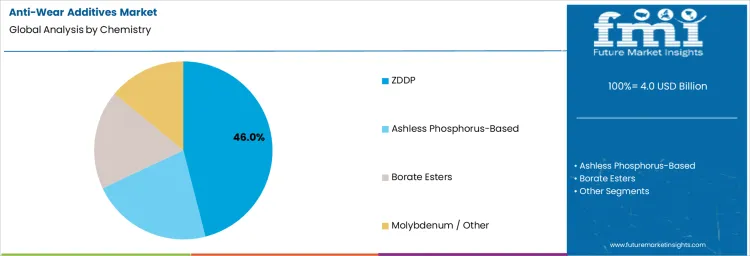
ZDDP leads demand with a 46% share due to proven boundary film formation and broad effectiveness across operating conditions. Its performance under high load and mixed lubrication regimes supports continued specification in many lubricant formulations. Ashless phosphorus based additives are adopted where catalyst compatibility and lower ash content are required. Borate esters are used to provide anti-wear protection with additional friction reduction benefits. Molybdenum and other systems support synergistic performance in formulated packages. Chemistry selection reflects balance between wear protection, emissions compliance, and additive stability. Demand therefore aligns with established formulation reliability rather than rapid shifts toward unproven chemistries.
Chemistry driven demand remains stable because anti wear systems are qualified through extensive engine and bench testing. ZDDP continues to be specified within regulated limits. Ashless systems expand selectively in sensitive applications. Borate and molybdenum additives are applied where formulation space allows. These patterns restrict rapid substitution. Chemistry segmentation highlights reliance on long validated performance data. Demand therefore follows lubricant specification continuity rather than short term regulatory or pricing changes.
How Does Application Shape Demand for Anti Wear Additives Market?
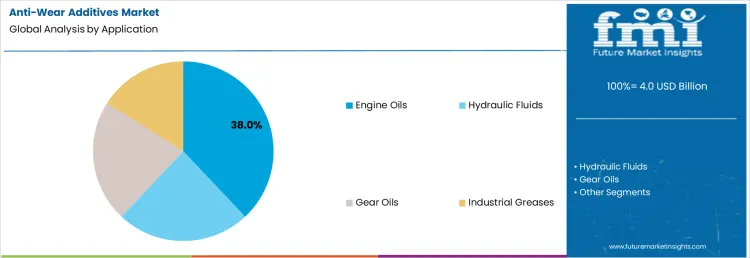
Engine oils account for about 38% of total demand, making them the leading application. These oils require consistent wear protection across varied temperatures and engine speeds. Hydraulic fluids adopt anti-wear additives to protect pumps and valves under sustained pressure. Gear oils require additives that withstand high contact stress and sliding motion. Industrial greases use anti wear systems to extend component life in slow speed or high load conditions. Application driven demand reflects mechanical stress profiles and maintenance expectations rather than lubricant consumption volume alone.
Engine oil applications maintain leadership due to large installed vehicle bases and stringent durability requirements. Hydraulic and gear oil demand follows industrial activity levels. Grease applications remain specialized but persistent. Once approved, additive systems are rarely changed due to qualification costs. This stabilizes demand by application. Application segmentation therefore reinforces concentration in high wear risk lubrication environments.
How Are Anti-Wear Additives Being Applied Across Lubricants and Industrial Fluids?
Use appears in engine oils, gear oils, hydraulic fluids, and industrial lubricants where metal-to-metal contact occurs under high pressure or sliding conditions. Automotive and commercial vehicle manufacturers integrate anti-wear additives to reduce component wear, extend service life, and maintain efficiency. Industrial machinery operators rely on treated oils for turbines, compressors, and presses to prevent scoring, pitting, and surface fatigue. These applications reflect operational and mechanical priorities rather than aesthetic or marketing considerations, with adoption driven by equipment protection, reliability, and performance consistency.
What Operational and Material Conditions Support Adoption of Anti-Wear Additives?
Selection aligns with lubricant formulations requiring extreme pressure tolerance, thermal stability, and compatibility with base oils. Chemists optimize additive chemistry to form protective films under boundary lubrication conditions without negatively affecting viscosity or oxidation stability. Maintenance teams depend on additives to maintain performance across diverse operating temperatures and load cycles. OEMs specify anti-wear performance to meet warranty requirements and industry standards. These conditions emerge from operational efficiency, component longevity, and reliability priorities in structured industrial and automotive workflows.
Which Practical Considerations Limit Wider Use of Anti-Wear Additives?
Cost per unit may increase compared with base lubricants. Additive compatibility with other formulation components must be validated to prevent precipitation or deposit formation. Regulatory approvals for environmental and health compliance can restrict certain chemistries. Overuse can alter lubricant viscosity or interact with seals. Supply chain consistency is required to maintain performance across batches. These factors lead to selective deployment where equipment protection, operational reliability, and performance assurance justify incremental cost and formulation complexity.
What is the Demand for Anti Wear Additives by Country?
| Country | CAGR (%) |
|---|---|
| USA | 3.6% |
| Germany | 3.4% |
| China | 4.5% |
| UK | 3.3% |
| Brazil | 4.2% |
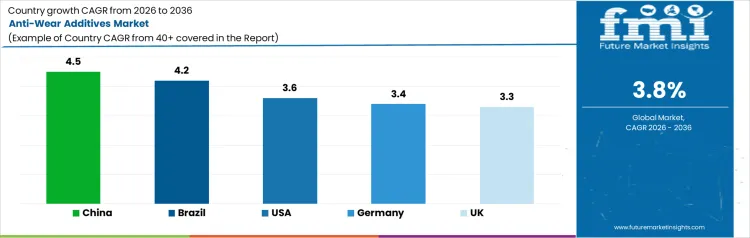
The demand for anti-wear additives varies across countries, driven by lubricant consumption, automotive production, and industrial machinery maintenance requirements. China leads with a 4.5% CAGR, supported by large scale automotive manufacturing, industrial machinery usage, and increasing adoption of advanced lubricants. Brazil follows at 4.2%, driven by growth in automotive and heavy equipment sectors. The USA grows at 3.6%, reflecting steady lubricant demand and industrial applications. Germany records 3.4%, shaped by mature automotive and machinery markets. The UK posts 3.3%, supported by consistent industrial maintenance needs and adoption of high performance lubricants.
How Is Wear Protection Driving Growth in the United States?
In the United States, revenue from the Anti-Wear Additives Market is expanding at a CAGR of 3.6% through 2035, driven by adoption of chemical additives that reduce friction, wear, and component degradation in automotive, industrial, and machinery applications. Manufacturers are integrating anti-wear additives into engine oils, gear oils, hydraulic fluids, and metalworking lubricants. Demand is concentrated in automotive OEMs, industrial machinery, and transportation sectors. Domestic suppliers provide high-performance additives compatible with base oils and standard lubrication systems. Equipment longevity requirements, regulatory compliance, and recurring maintenance cycles are sustaining predictable procurement nationwide.
- Automotive, industrial machinery, and transportation drive anti-wear additive adoption
- Additives reduce friction, wear, and component degradation
- Domestic suppliers provide high-performance, base oil-compatible additives
- Recurring maintenance cycles sustain predictable procurement
How Are Equipment Durability Standards Supporting Growth in Germany?
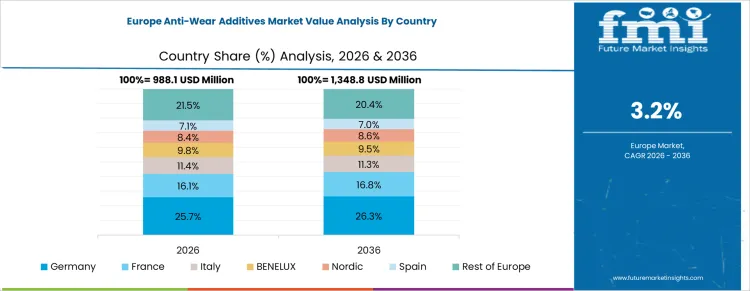
Germany continues to record steady growth in the Anti-Wear Additives Market at a CAGR of 3.4% through 2035, supported by strict industrial and automotive equipment durability standards. Manufacturers are integrating anti-wear additives into engine oils, hydraulic fluids, and lubricants for industrial machinery to extend component life. Demand is concentrated in automotive production, industrial facilities, and transport equipment. Domestic suppliers provide additives engineered for high performance, compatibility with base oils, and thermal stability. Compliance with equipment standards and recurring maintenance requirements are sustaining measured adoption nationwide.
- Engine oils, hydraulic fluids, and lubricants anchor demand
- Additives extend component life and improve durability
- Domestic suppliers provide high-performance, base oil-compatible additives
- Recurring maintenance cycles sustain steady adoption
How Is Industrial and Automotive Expansion Accelerating Adoption in China?
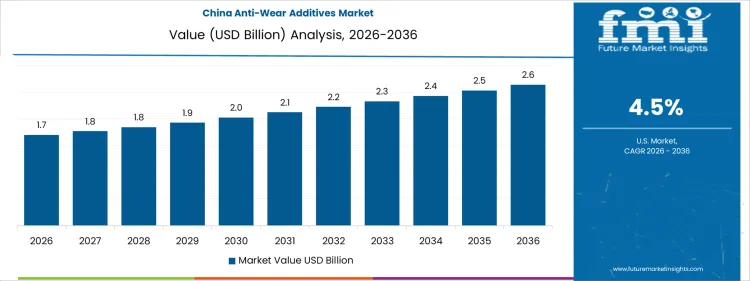
In China, revenue from the Anti-Wear Additives Market is growing at a CAGR of 4.5% through 2035, driven by rapid expansion of automotive production and industrial machinery operations. Manufacturers are using anti-wear additives in lubricants to reduce friction, improve equipment longevity, and maintain operational efficiency. Demand is strong across automotive OEMs, industrial facilities, and transportation sectors. Domestic suppliers are scaling production of high-performance anti-wear additives compatible with standard base oils and lubrication systems. High equipment production volumes and structured maintenance programs are sustaining rapid adoption nationwide.
- Automotive production and industrial operations drive anti-wear additive adoption
- Additives reduce friction, improve longevity, and enhance efficiency
- Domestic suppliers scale high-performance, base oil-compatible additives
- Maintenance programs sustain consistent adoption
How Is Equipment Maintenance Supporting Growth in the United Kingdom?
In the United Kingdom, revenue from the Anti-Wear Additives Market is expanding at a CAGR of 3.3% through 2035, supported by adoption of additives to extend service life and reliability of automotive, industrial, and transportation equipment. Manufacturers are integrating anti-wear additives in engine oils, gear oils, and hydraulic fluids to minimize friction and wear. Demand is concentrated in automotive, industrial machinery, and transportation applications. Domestic suppliers provide additives compatible with base oils and lubrication systems. Recurring maintenance schedules and durability requirements are sustaining predictable procurement nationwide.
- Engine oils, gear oils, and hydraulic fluids anchor demand
- Additives extend service life and reduce friction
- Domestic suppliers provide base oil-compatible, high-performance additives
- Recurring maintenance schedules sustain predictable procurement
How Is Industrial and Automotive Equipment Growth Supporting Adoption in Brazil?
Brazil is seeing strong growth in the Anti-Wear Additives Market at a CAGR of 4.2% through 2035, supported by expansion of automotive, industrial, and transportation equipment. Manufacturers are adopting anti-wear additives in lubricants to reduce friction, minimize component wear, and extend service life. Demand is concentrated in automotive OEMs, industrial machinery, and transport fleets. Domestic suppliers are expanding production of high-performance additives compatible with base oils and standard lubrication systems. Growth in equipment deployment, maintenance programs, and recurring lubricant applications are sustaining robust procurement nationwide.
- Automotive, industrial, and transport equipment drive anti-wear additive adoption
- Additives reduce friction, minimize wear, and extend service life
- Domestic suppliers expand high-performance, base oil-compatible additives
- Maintenance programs and recurring lubricant use sustain robust procurement
Which Companies Are Shaping Competition in the Anti Wear Additives Market Through Formulation Control and OEM Qualification?
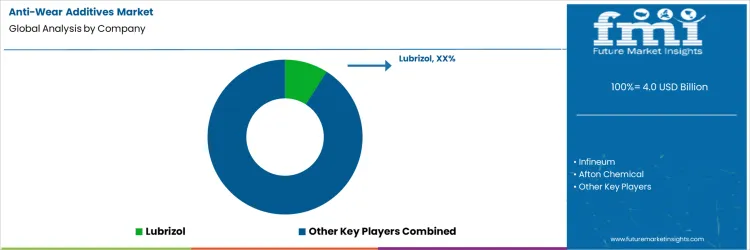
Competition in the Anti Wear Additives Market is governed by how additives perform within tightly specified lubricant systems rather than as standalone products. Lubrizol, Infineum, Afton Chemical, and Chevron Oronite occupy a central position because their chemistries are embedded in fully formulated engine and industrial lubricants approved by OEMs. These suppliers influence performance through phosphorus, sulfur, and ash optimized additives that balance wear protection with emissions system compatibility. BASF, LANXESS, and Evonik participate through upstream additive chemistries and intermediates that support formulation flexibility across automotive and industrial oils. Selection is driven by durability under boundary lubrication, interaction with detergents and dispersants, and repeatability across long drain intervals.
Regional suppliers and application focused specialists shape competitive dynamics beyond global formulation platforms. Vanderbilt Chemicals contributes niche anti wear solutions used in industrial greases, metalworking fluids, and specialty lubricants where load conditions differ from automotive engines. Dorf Ketal supports customized additive packages tailored to refinery and blending operations, particularly in emerging markets. Sinopec participates through additives developed for domestic lubricant formulations aligned with local engine standards and industrial requirements. Lubricant blenders play a decisive role by qualifying additives through in house testing and field trials, limiting rapid substitution. Competitive positioning depends on technical service depth, regulatory alignment, and consistency across production batches rather than marketing reach or portfolio breadth.
Key Players in the Anti Wear Additives Market
- Lubrizol
- Infineum
- Afton Chemical
- Chevron Oronite
- BASF
- LANXESS
- Evonik
- Vanderbilt Chemicals
- Dorf Ketal
- Sinopec
Scope of the Report
| Items | Values |
|---|---|
| Quantitative Units (2026) | USD billion |
| Chemistry | ZDDP; Ashless Phosphorus-Based; Borate Esters; Molybdenum / Other |
| Application | Engine Oils; Hydraulic Fluids; Gear Oils; Industrial Greases |
| End Industry | Automotive; Industrial Manufacturing; Energy & Mining; Marine & Aviation |
| Packaging | Single-Component AW; Additive Packages; Pre-Blends / Masterbatches; Other |
| Region | Asia Pacific; Europe; North America; Latin America; Middle East & Africa |
| Countries Covered | China; Japan; South Korea; India; Australia & New Zealand; ASEAN; Rest of Asia Pacific; Germany; United Kingdom; France; Italy; Spain; Nordic; BENELUX; Rest of Europe; United States; Canada; Mexico; Brazil; Chile; Rest of Latin America; Kingdom of Saudi Arabia; Other GCC Countries; Turkey; South Africa; Other African Union; Rest of Middle East & Africa |
| Key Companies Profiled | Lubrizol; Infineum; Afton Chemical; Chevron Oronite; BASF; LANXESS; Evonik; Vanderbilt Chemicals; Dorf Ketal; Sinopec |
| Additional Attributes | Dollar by sales across chemistry, application, and end industry; ZDDP leads demand for proven boundary film formation and high-load protection; Engine oils account for the largest application share due to stringent durability requirements; Base oil compatibility and thermal stability are critical selection criteria; Demand formation influenced by automotive OEMs, industrial machinery specifications, and maintenance optimization; Adoption reinforced by regulatory standards, emissions compliance, and multi-mode protection requirements; Packaging formats include single-component, packages, and pre-blends for formulation flexibility; Market growth shaped by recurring maintenance cycles, equipment longevity, and operational reliability rather than total lubricant volume. |
Anti-Wear Additives Market Segmentation
By Chemistry:
- ZDDP
- Ashless Phosphorus-Based
- Borate Esters
- Molybdenum / Other
By Application:
- Engine Oils
- Hydraulic Fluids
- Gear Oils
- Industrial Greases
By End Industry:
- Automotive
- Industrial Manufacturing
- Energy & Mining
- Marine & Aviation
By Packaging:
- Single-Component AW
- Additive Packages
- Pre-Blends / Masterbatches
- Other
By Region:
- Asia Pacific
- China
- Japan
- South Korea
- India
- Australia & New Zealand
- ASEAN
- Rest of Asia Pacific
- Europe
- Germany
- United Kingdom
- France
- Italy
- Spain
- Nordic
- BENELUX
- Rest of Europe
- North America
- United States
- Canada
- Mexico
- Latin America
- Brazil
- Chile
- Rest of Latin America
- Middle East & Africa
- Kingdom of Saudi Arabia
- Other GCC Countries
- Turkey
- South Africa
- Other African Union
- Rest of Middle East & Africa
Frequently Asked Questions
How big is the anti-wear additives market in 2026?
The global anti-wear additives market is estimated to be valued at USD 4.0 billion in 2026.
What will be the size of anti-wear additives market in 2036?
The market size for the anti-wear additives market is projected to reach USD 5.8 billion by 2036.
How much will be the anti-wear additives market growth between 2026 and 2036?
The anti-wear additives market is expected to grow at a 3.8% CAGR between 2026 and 2036.
What are the key product types in the anti-wear additives market?
The key product types in anti-wear additives market are zddp, ashless phosphorus-based, borate esters and molybdenum / other.
Which application segment to contribute significant share in the anti-wear additives market in 2026?
In terms of application, engine oils segment to command 38.0% share in the anti-wear additives market in 2026.
Preview the report firsthand - request a free sample
Get SampleGet the brochure for pricing and purchase details.
Get PDFTable of Content
- Executive Summary
- Global Market Outlook
- Demand-side Trends
- Supply-side Trends
- Technology Roadmap Analysis
- Analysis and Recommendations
- Market Overview
- Market Coverage / Taxonomy
- Market Definition / Scope / Limitations
- Market Background
- Market Dynamics
- Drivers
- Restraints
- Opportunity
- Trends
- Scenario Forecast
- Demand in Optimistic Scenario
- Demand in Likely Scenario
- Demand in Conservative Scenario
- Opportunity Map Analysis
- Product Life Cycle Analysis
- Supply Chain Analysis
- Investment Feasibility Matrix
- Value Chain Analysis
- PESTLE and Porter’s Analysis
- Regulatory Landscape
- Regional Parent Market Outlook
- Production and Consumption Statistics
- Import and Export Statistics
- Market Dynamics
- Global Market Analysis 2021 to 2025 and Forecast, 2026 to 2036
- Historical Market Size Value (USD Million) Analysis, 2021 to 2025
- Current and Future Market Size Value (USD Million) Projections, 2026 to 2036
- Y-o-Y Growth Trend Analysis
- Absolute $ Opportunity Analysis
- Global Market Pricing Analysis 2021 to 2025 and Forecast 2026 to 2036
- Global Market Analysis 2021 to 2025 and Forecast 2026 to 2036, By Chemistry
- Introduction / Key Findings
- Historical Market Size Value (USD Million) Analysis By Chemistry , 2021 to 2025
- Current and Future Market Size Value (USD Million) Analysis and Forecast By Chemistry , 2026 to 2036
- ZDDP
- Ashless Phosphorus-Based
- Borate Esters
- Molybdenum / Other
- Y-o-Y Growth Trend Analysis By Chemistry , 2021 to 2025
- Absolute $ Opportunity Analysis By Chemistry , 2026 to 2036
- Global Market Analysis 2021 to 2025 and Forecast 2026 to 2036, By Application
- Introduction / Key Findings
- Historical Market Size Value (USD Million) Analysis By Application, 2021 to 2025
- Current and Future Market Size Value (USD Million) Analysis and Forecast By Application, 2026 to 2036
- Engine Oils
- Hydraulic Fluids
- Gear Oils
- Industrial Greases
- Y-o-Y Growth Trend Analysis By Application, 2021 to 2025
- Absolute $ Opportunity Analysis By Application, 2026 to 2036
- Global Market Analysis 2021 to 2025 and Forecast 2026 to 2036, By End Industry
- Introduction / Key Findings
- Historical Market Size Value (USD Million) Analysis By End Industry, 2021 to 2025
- Current and Future Market Size Value (USD Million) Analysis and Forecast By End Industry, 2026 to 2036
- Automotive
- Industrial Manufacturing
- Energy & Mining
- Marine & Aviation
- Y-o-Y Growth Trend Analysis By End Industry, 2021 to 2025
- Absolute $ Opportunity Analysis By End Industry, 2026 to 2036
- Global Market Analysis 2021 to 2025 and Forecast 2026 to 2036, By Packaging
- Introduction / Key Findings
- Historical Market Size Value (USD Million) Analysis By Packaging, 2021 to 2025
- Current and Future Market Size Value (USD Million) Analysis and Forecast By Packaging, 2026 to 2036
- Single-Component AW
- Additive Packages
- Pre-Blends / Masterbatches
- Other
- Y-o-Y Growth Trend Analysis By Packaging, 2021 to 2025
- Absolute $ Opportunity Analysis By Packaging, 2026 to 2036
- Global Market Analysis 2021 to 2025 and Forecast 2026 to 2036, By Region
- Introduction
- Historical Market Size Value (USD Million) Analysis By Region, 2021 to 2025
- Current Market Size Value (USD Million) Analysis and Forecast By Region, 2026 to 2036
- North America
- Latin America
- Western Europe
- Eastern Europe
- East Asia
- South Asia and Pacific
- Middle East & Africa
- Market Attractiveness Analysis By Region
- North America Market Analysis 2021 to 2025 and Forecast 2026 to 2036, By Country
- Historical Market Size Value (USD Million) Trend Analysis By Market Taxonomy, 2021 to 2025
- Market Size Value (USD Million) Forecast By Market Taxonomy, 2026 to 2036
- By Country
- USA
- Canada
- Mexico
- By Chemistry
- By Application
- By End Industry
- By Packaging
- By Country
- Market Attractiveness Analysis
- By Country
- By Chemistry
- By Application
- By End Industry
- By Packaging
- Key Takeaways
- Latin America Market Analysis 2021 to 2025 and Forecast 2026 to 2036, By Country
- Historical Market Size Value (USD Million) Trend Analysis By Market Taxonomy, 2021 to 2025
- Market Size Value (USD Million) Forecast By Market Taxonomy, 2026 to 2036
- By Country
- Brazil
- Chile
- Rest of Latin America
- By Chemistry
- By Application
- By End Industry
- By Packaging
- By Country
- Market Attractiveness Analysis
- By Country
- By Chemistry
- By Application
- By End Industry
- By Packaging
- Key Takeaways
- Western Europe Market Analysis 2021 to 2025 and Forecast 2026 to 2036, By Country
- Historical Market Size Value (USD Million) Trend Analysis By Market Taxonomy, 2021 to 2025
- Market Size Value (USD Million) Forecast By Market Taxonomy, 2026 to 2036
- By Country
- Germany
- UK
- Italy
- Spain
- France
- Nordic
- BENELUX
- Rest of Western Europe
- By Chemistry
- By Application
- By End Industry
- By Packaging
- By Country
- Market Attractiveness Analysis
- By Country
- By Chemistry
- By Application
- By End Industry
- By Packaging
- Key Takeaways
- Eastern Europe Market Analysis 2021 to 2025 and Forecast 2026 to 2036, By Country
- Historical Market Size Value (USD Million) Trend Analysis By Market Taxonomy, 2021 to 2025
- Market Size Value (USD Million) Forecast By Market Taxonomy, 2026 to 2036
- By Country
- Russia
- Poland
- Hungary
- Balkan & Baltic
- Rest of Eastern Europe
- By Chemistry
- By Application
- By End Industry
- By Packaging
- By Country
- Market Attractiveness Analysis
- By Country
- By Chemistry
- By Application
- By End Industry
- By Packaging
- Key Takeaways
- East Asia Market Analysis 2021 to 2025 and Forecast 2026 to 2036, By Country
- Historical Market Size Value (USD Million) Trend Analysis By Market Taxonomy, 2021 to 2025
- Market Size Value (USD Million) Forecast By Market Taxonomy, 2026 to 2036
- By Country
- China
- Japan
- South Korea
- By Chemistry
- By Application
- By End Industry
- By Packaging
- By Country
- Market Attractiveness Analysis
- By Country
- By Chemistry
- By Application
- By End Industry
- By Packaging
- Key Takeaways
- South Asia and Pacific Market Analysis 2021 to 2025 and Forecast 2026 to 2036, By Country
- Historical Market Size Value (USD Million) Trend Analysis By Market Taxonomy, 2021 to 2025
- Market Size Value (USD Million) Forecast By Market Taxonomy, 2026 to 2036
- By Country
- India
- ASEAN
- Australia & New Zealand
- Rest of South Asia and Pacific
- By Chemistry
- By Application
- By End Industry
- By Packaging
- By Country
- Market Attractiveness Analysis
- By Country
- By Chemistry
- By Application
- By End Industry
- By Packaging
- Key Takeaways
- Middle East & Africa Market Analysis 2021 to 2025 and Forecast 2026 to 2036, By Country
- Historical Market Size Value (USD Million) Trend Analysis By Market Taxonomy, 2021 to 2025
- Market Size Value (USD Million) Forecast By Market Taxonomy, 2026 to 2036
- By Country
- Kingdom of Saudi Arabia
- Other GCC Countries
- Turkiye
- South Africa
- Other African Union
- Rest of Middle East & Africa
- By Chemistry
- By Application
- By End Industry
- By Packaging
- By Country
- Market Attractiveness Analysis
- By Country
- By Chemistry
- By Application
- By End Industry
- By Packaging
- Key Takeaways
- Key Countries Market Analysis
- USA
- Pricing Analysis
- Market Share Analysis, 2025
- By Chemistry
- By Application
- By End Industry
- By Packaging
- Canada
- Pricing Analysis
- Market Share Analysis, 2025
- By Chemistry
- By Application
- By End Industry
- By Packaging
- Mexico
- Pricing Analysis
- Market Share Analysis, 2025
- By Chemistry
- By Application
- By End Industry
- By Packaging
- Brazil
- Pricing Analysis
- Market Share Analysis, 2025
- By Chemistry
- By Application
- By End Industry
- By Packaging
- Chile
- Pricing Analysis
- Market Share Analysis, 2025
- By Chemistry
- By Application
- By End Industry
- By Packaging
- Germany
- Pricing Analysis
- Market Share Analysis, 2025
- By Chemistry
- By Application
- By End Industry
- By Packaging
- UK
- Pricing Analysis
- Market Share Analysis, 2025
- By Chemistry
- By Application
- By End Industry
- By Packaging
- Italy
- Pricing Analysis
- Market Share Analysis, 2025
- By Chemistry
- By Application
- By End Industry
- By Packaging
- Spain
- Pricing Analysis
- Market Share Analysis, 2025
- By Chemistry
- By Application
- By End Industry
- By Packaging
- France
- Pricing Analysis
- Market Share Analysis, 2025
- By Chemistry
- By Application
- By End Industry
- By Packaging
- India
- Pricing Analysis
- Market Share Analysis, 2025
- By Chemistry
- By Application
- By End Industry
- By Packaging
- ASEAN
- Pricing Analysis
- Market Share Analysis, 2025
- By Chemistry
- By Application
- By End Industry
- By Packaging
- Australia & New Zealand
- Pricing Analysis
- Market Share Analysis, 2025
- By Chemistry
- By Application
- By End Industry
- By Packaging
- China
- Pricing Analysis
- Market Share Analysis, 2025
- By Chemistry
- By Application
- By End Industry
- By Packaging
- Japan
- Pricing Analysis
- Market Share Analysis, 2025
- By Chemistry
- By Application
- By End Industry
- By Packaging
- South Korea
- Pricing Analysis
- Market Share Analysis, 2025
- By Chemistry
- By Application
- By End Industry
- By Packaging
- Russia
- Pricing Analysis
- Market Share Analysis, 2025
- By Chemistry
- By Application
- By End Industry
- By Packaging
- Poland
- Pricing Analysis
- Market Share Analysis, 2025
- By Chemistry
- By Application
- By End Industry
- By Packaging
- Hungary
- Pricing Analysis
- Market Share Analysis, 2025
- By Chemistry
- By Application
- By End Industry
- By Packaging
- Kingdom of Saudi Arabia
- Pricing Analysis
- Market Share Analysis, 2025
- By Chemistry
- By Application
- By End Industry
- By Packaging
- Turkiye
- Pricing Analysis
- Market Share Analysis, 2025
- By Chemistry
- By Application
- By End Industry
- By Packaging
- South Africa
- Pricing Analysis
- Market Share Analysis, 2025
- By Chemistry
- By Application
- By End Industry
- By Packaging
- USA
- Market Structure Analysis
- Competition Dashboard
- Competition Benchmarking
- Market Share Analysis of Top Players
- By Regional
- By Chemistry
- By Application
- By End Industry
- By Packaging
- Competition Analysis
- Competition Deep Dive
- Lubrizol
- Overview
- Product Portfolio
- Profitability by Market Segments (Product/Age /Sales Channel/Region)
- Sales Footprint
- Strategy Overview
- Marketing Strategy
- Product Strategy
- Channel Strategy
- Infineum
- Afton Chemical
- Chevron Oronite
- BASF
- LANXESS
- Evonik
- Vanderbilt Chemicals
- Dorf Ketal
- Sinopec
- Lubrizol
- Competition Deep Dive
- Assumptions & Acronyms Used
- Research Methodology


