

- Market Size (2026)
- USD 13.6 Bn
- Forecast (2036)
- USD 56.9 Bn
- CAGR (2026 to 2036)
- 15.4%
E-Axle Inverter and Control Unit Systems Market Size, Market Forecast and Outlook By FMI
Summary of the E-Axle Inverter and Control Unit Systems Market
- Demand and Growth Drivers
- EV platform build-out supports demand for e-axle inverter and control unit systems as automakers combine drive control and power electronics earlier.
- Higher voltage vehicle programs increase inverter value as 800 V layouts need stronger switching and heat control.
- Software-defined drivetrain work raises demand for control units, which can manage torque response and fault handling.
- Product and Segment View
- Integrated inverter units are expected to lead the system architecture segment with 46.0% share in 2026, driven by compact e-axle packaging needs.
- OEM first fit is expected to lead sales channel demand with 93.0% share in 2026, reflecting early sourcing during vehicle platform planning.
- Silicon IGBT is expected to hold high-volume semiconductor demand as mainstream EV programs need cost-stable switching devices.
- Geography and Competitive Outlook
- China is expected to record a CAGR of 18.2% through 2036, driven by EV output scale and local inverter manufacturing depth.
- India is projected to expand at 16.9% CAGR through 2036, as electric buses and light EV programs increase domestic system demand.
- Companies combining inverter thermal design with control software depth are improving supplier position during the forecast period.
- Analyst Opinion
- Nikhil Kaitwade, Associate Vice President at FMI says, “E-axle inverter and control unit sourcing now shapes vehicle platform planning as automakers cut drivetrain complexity. Automakers need validated power conversion with cooling behavior. Cost pressure is strong in 400 V systems and 800 V programs lift silicon carbide demand.”
- E-Axle Inverter and Control Unit Systems Market Value Analysis
- The e-axle inverter and control unit systems market is changing from separate inverter sourcing into a more integrated drivetrain supply base.
- Compact electric axle designs and higher propulsion software content are increasing the use of integrated inverter and control unit systems.
- The market is benefiting from broader use of electric vehicle e-axle systems across passenger EV platforms.
- Inverter validation records now matter as vehicle makers review thermal behavior and efficiency performance before platform approval.
- These records help vehicle makers manage release timing and reduce late-stage drivetrain redesign.
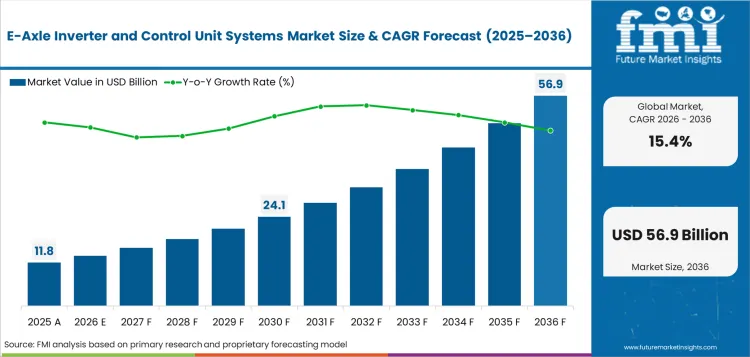
Key Takeaways, Market Size, and Forecast
- The e-axle inverter and control unit systems market was valued at USD 11.8 billion in 2025.
- By 2036, the e-axle inverter and control unit systems market is expected to be worth USD 56.9 billion.
- From 2026 to 2036, the market is projected to expand at a CAGR of 15.4%.
- The market is projected to create an incremental opportunity of USD 43.3 billion between 2026 and 2036.
- In 2026, OEM first fit is estimated to account for 93.0% of sales channel demand.
- China at 18.2% and India at 16.9% are two of the faster-growing country markets.
EV packaging pressure is pushing e-axle inverter and control unit systems toward higher integration. Valeo stated in September 2024 that its high-voltage 3-in-1 eAxle combines an electric motor, inverter and reducer in shared packaging. Its 60 to 350 kWp range gives OEMs a scalable route across primary and secondary axle layouts. Aisin stated in October 2025 that the new bZ4X eAxle uses a flat double-sided cooling inverter with advanced SiC power semiconductors. The 167 kW front-mounted unit shows how cooling design supports output density in compact space. Magna stated in February 2024 that its 800V eDS Duo variant integrates two inverters with two motors and two gearboxes. The 726 kW system points to premium EV programs where suppliers need full e-drive integration rather than standalone inverter supply.
E-Axle Inverter and Control Unit Systems Market Definition
The e-axle inverter and control unit systems market includes inverter assemblies and control hardware used inside electric axle drive units. These systems convert battery power into motor drive power and manage torque delivery for electric vehicles. Scope includes integrated inverter units, discrete control units, power module assemblies, and related control electronics. Battery packs, standalone chargers, conventional axle hardware, and full vehicle software platforms are outside the scope.
E-Axle Inverter and Control Unit Systems Market Inclusions
Market scope covers all commercially traded e-axle inverter and control unit systems categorized by system architecture, including integrated inverter units, discrete control units, and power module assemblies; semiconductor platform, including silicon IGBT, silicon carbide, and gallium nitride; voltage class, including 400 V, 800 V, and above 800 V systems; vehicle type, including passenger EVs, electric buses, and light commercial EVs; and sales channel, including OEM first fit and service replacement. Revenue scope covers 2026 to 2036. Market participants include automotive OEMs, e-axle system manufacturers, inverter suppliers, control unit providers, power semiconductor companies, Tier-1 drivetrain suppliers, EV platform developers, testing service providers, component distributors, charging infrastructure participants, and regulatory bodies.
E-Axle Inverter and Control Unit Systems Market Exclusions
Scope does not include battery cells, full e-axle assemblies, onboard chargers, DC fast chargers, battery management systems, or standalone vehicle operating systems.
E-Axle Inverter and Control Unit Systems Market Research Methodology
- Primary Research: FMI analysts talked to automotive OEMs, Tier-1 drivetrain suppliers, inverter specialists, and vehicle electronics engineers in major markets.
- Desk Research: Combined data from EV production records, company product portfolios, government mobility programs, and inverter platform specifications.
- Market sizing and forecasting: Added system use across vehicle types and voltage classes from the bottom up.
- Data validation: Cross-checked every three months against EV production trends, inverter supply activity, and related E-axle and inverter efficiency and reliability test platforms.
Why is the E-Axle Inverter and Control Unit Systems Market Growing?
- Automakers are using integrated inverter systems earlier to reduce wiring complexity before vehicle launch.
- Inverter suppliers now matter as EV platforms combine power electronics and control software.
- Manufacturers are sourcing validated systems from suppliers with stronger heat control and semiconductor access.
Electric vehicle production scale is raising inverter and control unit demand across global drivetrain programs. IEA reported 17.3 million electric cars produced worldwide in 2024, with China producing 12.4 million units and accounting for over 70% of global production. This scale makes inverter reliability a platform-level cost concern for vehicle makers. Suppliers with validated power electronics can help reduce warranty risk and launch delays.
Charging infrastructure expansion is strengthening the case for higher voltage e-axle programs. IEA reported over 1.3 million public charging points added globally in 2024, increasing public charging stock by 30% compared to the prior year. Faster charging access raises buyer interest in vehicles designed for higher voltage operation. This raises demand for inverter systems with stronger insulation and heat control.
Market Segmentation Analysis
- Integrated Inverter Units are estimated to hold 46.0% of system architecture demand in 2026, supported by strong use across compact EV platforms.
- Silicon IGBT is expected to account for 58.0% of semiconductor platform demand in 2026, and it is anticipated to have a high use across cost-sensitive vehicle programs.
- 400 V systems are estimated to account for 55.0% of voltage class demand in 2026, with high use across mainstream passenger EVs.
- Passenger EVs are projected to hold 72.0% of vehicle type demand in 2026, and they will have direct use across high-volume platforms.
- OEM First Fit is predicted to contribute 93.0% of sales channel demand in 2026, due to early selection across vehicle development programs.
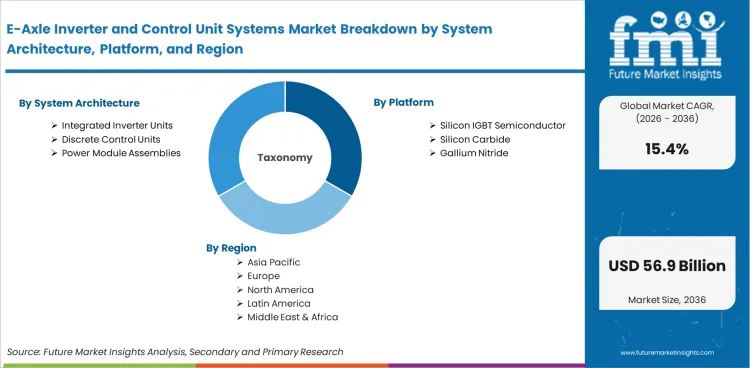
The market for e-axle inverter and control unit systems is divided into five primary segment groups based on system architecture, semiconductor platform, voltage class, vehicle type, and sales channel. System architecture includes Integrated Inverter Units, Discrete Control Units, and Power Module Assemblies. Semiconductor platform includes Silicon IGBT, Silicon Carbide, and Gallium Nitride. Voltage class includes 400 V, 800 V, and Above 800 V. Vehicle type includes Passenger EVs, Electric Buses, and Light Commercial EVs. Sales channel includes OEM First Fit and Service Replacement.
Insights into the Integrated Inverter Units System Architecture Segment
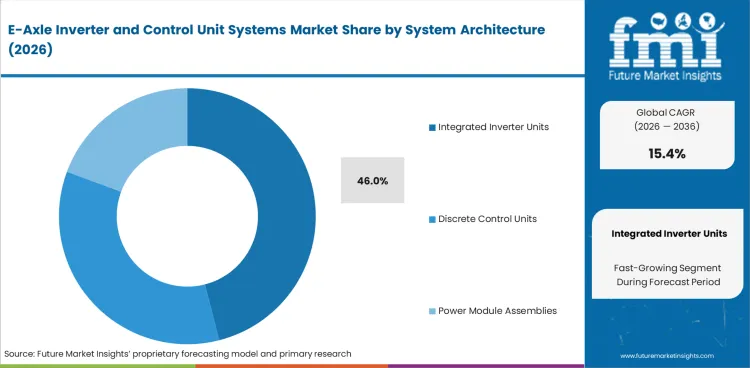
- In 2026, Integrated Inverter Units are expected to make up 46.0% of system architecture demand. Compact inverter packaging helps automakers reduce wiring work and improve control response across e-axle programs.
- Discrete control unit options address platforms needing separate access for calibration and service work during launch reviews. Their use is enhanced in programs preferring electronics separation for simpler repair planning.
Insights into the Silicon IGBT Semiconductor Platform Segment
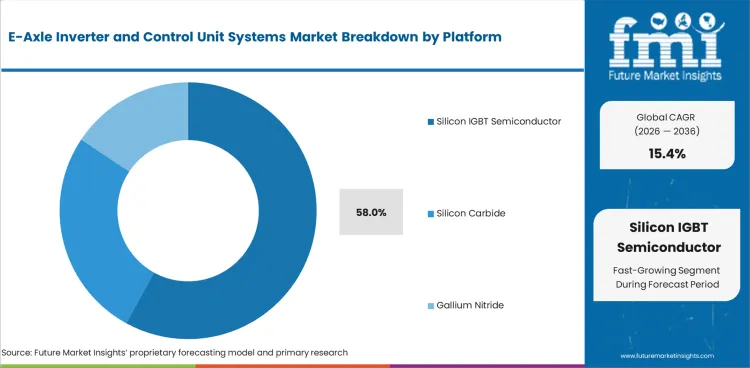
- Silicon IGBT is projected to account for 58.0% of the semiconductor platform segment in 2026. Mainstream EV platforms use IGBT devices to keep inverter cost and supply risk under control.
- Silicon carbide options serve higher voltage programs with stronger switching speed and heat performance needs. Their value rises in premium EV platforms requiring better efficiency under heavier load cycles.
Insights into the 400 V Voltage Class Segment
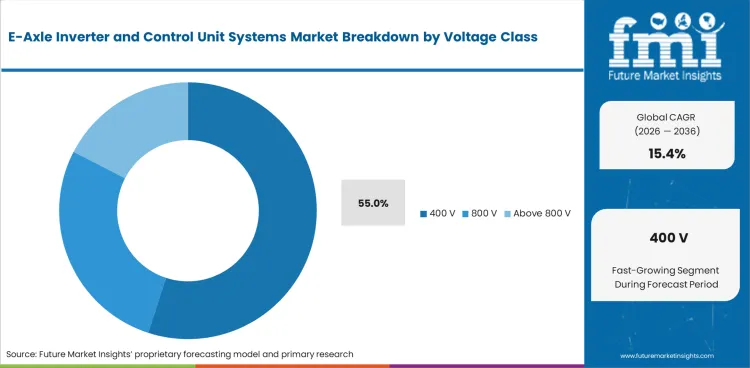
- In 2026, 400 V systems are estimated to account for 55.0% of the voltage class segment. Mainstream passenger EVs use this voltage base to manage inverter cost and battery packaging complexity.
- 800 V platforms address selected premium EV programs with faster charging and higher efficiency needs. Adoption rises in vehicles requiring stronger insulation and tighter thermal control.
- Insights into the Passenger EVs Vehicle Type Segment
- Passenger EVs are predicted to account for 72.0% of the vehicle type segment in 2026. High passenger car volumes create the largest demand base for inverter and control unit systems.
- Electric buses require heavier duty cycles and stronger cooling capacity across propulsion electronics. Light commercial EVs add demand from delivery fleets needing durable and serviceable drive systems.
Insights into the OEM First Fit Sales Channel Segment
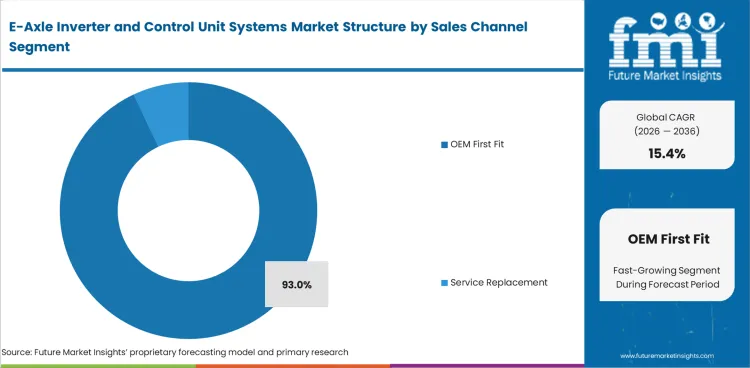
- OEM First Fit is expected to hold 93.0% share of the sales channel segment in 2026. Vehicle makers select inverter and control unit systems during platform design and production release planning.
- Service replacement demand is limited across the forecast period due to warranty controls and module-level repair practices. Dealer networks handle most replacement work through approved parts and trained service channels.
E-Axle Inverter and Control Unit Systems Market Drivers, Restraints, and Opportunities
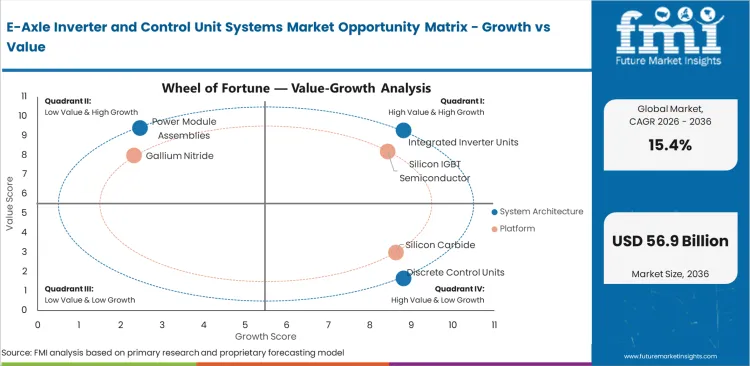
- Platform integration pressure is creating structured demand for inverter assemblies across compact electric axle programs.
- The need for skilled validation and costly power semiconductors creates pricing pressure for smaller suppliers.
- Higher voltage platforms create service opportunity through stronger heat control and faster switching requirements.
Demand for e-axle inverter and control unit systems rises because electric vehicles need compact power conversion and accurate drivetrain control. Cost pressure and semiconductor supply limits can slow faster use in entry-level EV platforms. Growth continues through integrated inverter units and high-voltage passenger EV applications.
Drive-System Cost Benchmarks Are Moving Lower
January 2025 DOE reporting gives E-Axle inverter and control unit suppliers clearer pricing because the inverter forms part of the electric drive cost stack, which OEM buyers benchmark in $/kW. DOE stated its FY 2024 electric drive system cost target of $7/kW was met, and the current cost estimate is below $6.5/kW for systems exceeding 12 kW/L, based on production volumes above 100,000 units per year. For the E-Axle inverter and control unit systems market, this trend points to more aggressive RFQs for integrated inverter and gate-drive solutions. It signals stronger demand for sensing and control electronics packages in future platform sourcing strategies. Suppliers with scale-ready thermal design and software-calibration efficiency can defend margins. Low-volume assemblers face sharper price concessions.
EV Affordability Is Compressing Supplier Quotes
IEA’s May 2025 EV pricing evidence indicates automakers face pressure to lower the complete electrified propulsion bill, including components beyond battery packs. Battery pack prices fell in all markets in 2024; in China, “prices fell by about 30%, compared with 10-15% in Europe and the United States.” For E-Axle inverter and control unit systems, this matters as battery deflation exposes power electronics as the next negotiable cost block.
Analysis of E-Axle Inverter and Control Unit Systems Market By Key Countries
.webp "Top Country Growth Comparison E Axle Inverter And Control Unit Systems Market Cagr (2026 2036)")
| Country | CAGR |
|---|---|
| China | 18.2% |
| India | 16.9% |
| United States | 13.6% |
| Germany | 12.8% |
| United Kingdom | 11.7% |
Source: Future Market Insights, 2026.
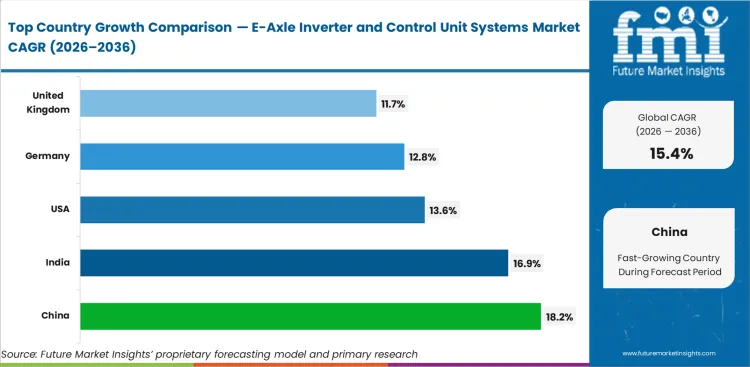
E-Axle Inverter and Control Unit Systems Market CAGR Analysis By Country
- China leads with an 18.2% CAGR through 2036 as EV production scale and inverter supply depth expand.
- India at 16.9% CAGR reflects electric bus sourcing and domestic EV policy work across urban mobility programs.
- United States demand is forecast at 13.6% CAGR by 2036 as advanced EV platforms raise power electronics requirements.
- Germany at 12.8% CAGR and the United Kingdom at 11.7% CAGR show measured expansion across mature EV production and validation bases.
Demand for e-axle inverter and control unit systems is forecast to rise at 15.4% CAGR from 2026 to 2036. Country-level analysis covers the major markets contributing to this forecast, with the key markets listed below.
Demand Outlook for E-Axle Inverter and Control Unit Systems Market in China
China’s e-axle inverter and control unit systems industry is projected to record a CAGR of 18.2% through 2036. China has the world’s largest EV demand base, which strengthens local need for e-axle inverter and control unit systems. This manufacturing scale enhances China e-axle inverter and control unit systems demand. Local suppliers may receive OEMs requiring fast validation processes and stable electronics costs across production programs.
- Local EV output increases demand for inverter assemblies and high-voltage control units.
- Silicon carbide production activity strengthens China’s role in advanced inverter sourcing.
- Domestic OEMs need suppliers capable of shortening release cycles across passenger EV platforms through faster development processes.
Sales Analysis of E-Axle Inverter and Control Unit Systems Market in India
The e-axle inverter and control unit systems sector in India is expected to expand at a CAGR of 16.9% during the assessment period. PM E-DRIVE recorded 22.12 lakh EVs sold under the scheme as of January 27, 2026. The policy improves India’s e-axle inverter and control unit systems demand as electric buses and light EVs move into structured supply programs. Local suppliers may receive system assembly and testing work.
- Electric bus orders favor demand for inverter units and low-floor axle control hardware.
- Local vehicle programs raise demand for cost-stable systems with reliable service records.
- Domestic manufacturers need control unit partners who can reduce import exposure over time.
Demand Outlook for E-Axle Inverter and Control Unit Systems Market in the United States
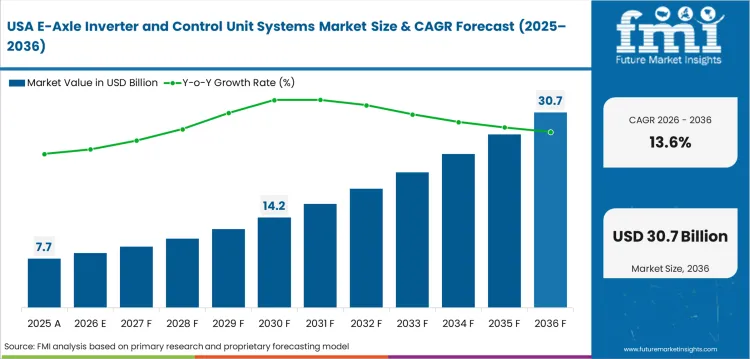
The USA e-axle inverter and control unit systems industry is forecast to grow at a CAGR of 13.6% by 2036. USA electric car demand is entering more mainstream vehicle programs, which creates higher need for advanced e-axle inverter and control unit systems. Vehicle makers value inverter suppliers with high-voltage design experience and software validation skill.
- USA EV platform programs improve premium demand for tested inverter and control packages.
- Heavy vehicle electrification creates added demand for high-current power electronics.
- Control architecture work links this market with automotive ECU sourcing decisions.
Opportunity Analysis of E-Axle Inverter and Control Unit Systems Market in Germany
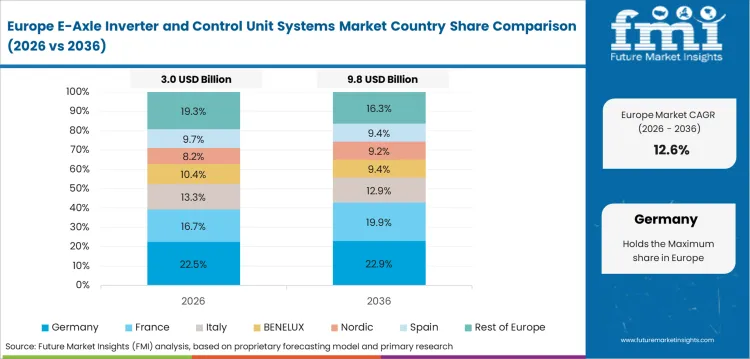
The e-axle inverter and control unit systems segment in Germany is forecast to advance at 12.8% CAGR over the forecast years. KBA reported 545,142 new BEV registrations in Germany for 2025, reflecting a 43.2% increase from the prior year. Established vehicle engineering depth amplifies Germany e-axle inverter and control unit systems demand. Testing demand is strongest for high-voltage platforms which need rigorous efficiency records.
- Premium EV programs support demand for 800 V inverter and silicon carbide hardware.
- Power electronics validation work increases demand for power electronics GaN and SiC device reliability test systems.
- German suppliers need tighter links between inverter design and vehicle release testing.
Future Outlook for E-Axle Inverter and Control Unit Systems Market in the United Kingdom
The United Kingdom e-axle inverter and control unit systems industry is expected to post 11.7% CAGR through 2036. United Kingdom vehicle licensing statistics reported 473,000 zero emission cars registered for the first time in 2025, up 24% from 2024. ZEV policy favors UK e-axle inverter and control unit systems demand as ZEV policy raises pressure on electric platform readiness. Suppliers with fast validation and reliable records can improve vehicle programs.
- Zero emission vehicle policy boosts the demand for high-efficiency inverter systems.
- Public charging expansion improves the case for higher voltage vehicle programs.
- United Kingdom control electronics demand links with electronic control unit in automotive systems planning.
Competitive Landscape and Strategic Positioning
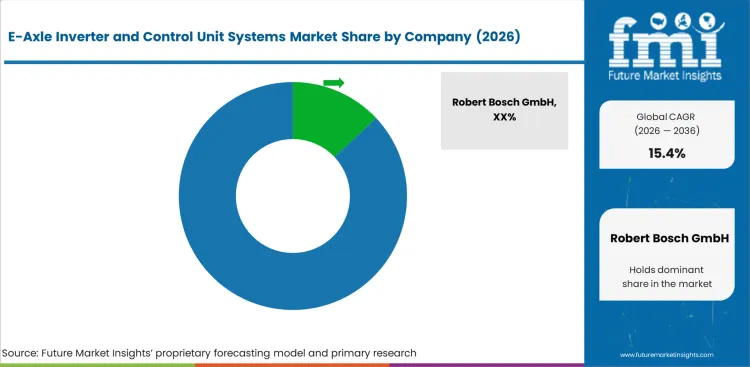
- Robert Bosch GmbH is a leading provider through integrated eAxle system coverage and high-voltage inverter capability.
- BorgWarner Inc. and Schaeffler AG are involved in inverter modules and silicon carbide power electronics.
- Specialist providers focus on control boards and validation services while delivering program-specific engineering support.
The competitive landscape for e‑axle inverter and control unit systems is defined by global Tier‑1 suppliers competing on system integration capability, depth of power electronics expertise and the ability to support OEM programs at scale. Success in this market depends on delivering validated inverter hardware and control systems that meet cost and reliability expectations across both mainstream and high‑voltage electric vehicle platforms.
Bosch holds a strong position through its established presence in fully integrated eAxle systems, covering motor, inverter, and transmission functions. BorgWarner is recognized for its focus on dual‑inverter programs and strong capabilities in power module design. Schaeffler has expanded its electric drivetrain portfolio following the Vitesco integration, strengthening its reach in inverter and control technologies. ZF brings depth in electric axle systems and commercial vehicle platforms, supporting a broad range of applications. Denso and Hitachi Astemo benefit from long‑standing OEM relationships and deep expertise in control electronics. Magna is positioned through its global OEM partnerships and experience in developing and integrating control electronics within complete drivetrain solutions.
Key Companies in the E-Axle Inverter and Control Unit Systems Market
Key global companies leading the e-axle inverter and control unit systems market include:
- Robert Bosch GmbH, BorgWarner Inc., and Schaeffler AG have established infrastructure for integrated inverter design and global service delivery.
- ZF Friedrichshafen AG, Denso Corporation, and Hitachi Astemo serve manufacturers through electric drivetrain coverage and control electronics systems.
- Magna International, Marelli Holdings, Nidec Corporation, and Valeo hold specialist positions across inverter modules and electric powertrain systems.
Competitive Benchmarking: E-Axle Inverter and Control Unit Systems Market
| Company | Inverter Thermal Depth | Control Software Readiness | High-Voltage Platform Reach | Geographic Footprint |
|---|---|---|---|---|
| Robert Bosch GmbH | High | High | Strong | Operations across Europe, Asia, and North America |
| BorgWarner Inc. | High | High | Strong | Operations across North America, Europe, and Asia |
| Schaeffler AG | High | Medium | Strong | Strong presence across Europe, China, India, and North America |
| ZF Friedrichshafen AG | High | Medium | Strong | Supply base across Europe, North America, and Asia |
| Denso Corporation | Medium | High | Strong | Japan-led global network across Asia, North America, and Europe |
| Hitachi Astemo | Medium | Medium | Moderate | Strong Asian base with operations across Europe and North America |
| Magna International | Medium | Medium | Strong | Five-continent footprint across 28 countries |
| Marelli Holdings | Medium | Medium | Moderate | Presence across 23 countries with sites in major automotive hubs |
| Nidec Corporation | Medium | Medium | Strong | Global base across Asia, Europe, and the Americas |
| Valeo | Medium | Medium | Moderate | Operations across 29 countries with large Europe and Asia coverage |
Source: Future Market Insights, 2026.
Key Developments in E-Axle Inverter and Control Unit Systems Market
- In February 2026, ZF secured a major India city bus order for several thousand AxTrax 2 LF electric portal axle units. First deliveries are scheduled for 2026 under the multi-year agreement.
- In February 2026, BorgWarner announced an 800 V integrated drive module and generator module with a dual inverter for a North American OEM. The program increases high-voltage electrified propulsion applications.
Key Players in the E-Axle Inverter and Control Unit Systems Market
Major Global Players:
- Robert Bosch GmbH
- BorgWarner Inc.
- Schaeffler AG
- ZF Friedrichshafen AG
- Denso Corporation
- Hitachi Astemo
- Magna International
Specialist Players:
- Marelli Holdings
- Nidec Corporation
- Valeo
Report Scope and Coverage
| Parameter | Details |
|---|---|
| Quantitative Units | USD 13.6 billion to USD 56.9 billion, at a CAGR of 15.4% |
| Market Definition | The e-axle inverter and control unit systems market encompasses inverter and control hardware used inside electric axle propulsion systems. |
| Regions Covered | North America, Latin America, Europe, East Asia, South Asia and Pacific, Middle East and Africa |
| Countries Covered | United States, United Kingdom, Germany, China, India, Japan, South Korea, and more than 30 countries |
| Key Companies Profiled | Robert Bosch GmbH, BorgWarner Inc., Schaeffler AG, ZF Friedrichshafen AG, Denso Corporation, Hitachi Astemo, Magna International, Marelli Holdings, Nidec Corporation, Valeo |
| Forecast Period | 2026 to 2036 |
| Approach | Hybrid bottom-up and top-down methodology starting with EV platform demand and verified inverter use patterns. |
Source: Future Market Insights, 2026.
E-Axle Inverter and Control Unit Systems Market by Segments
E-Axle Inverter and Control Unit Systems Market Segmented by System Architecture:
- Integrated Inverter Units
- Discrete Control Units
- Power Module Assemblies
E-Axle Inverter and Control Unit Systems Market Segmented by Semiconductor Platform:
- Silicon IGBT
- Silicon Carbide
- Gallium Nitride
E-Axle Inverter and Control Unit Systems Market Segmented by Voltage Class:
- 400 V
- 800 V
- Above 800 V
E-Axle Inverter and Control Unit Systems Market Segmented by Vehicle Type:
- Passenger EVs
- Electric Buses
- Light Commercial EVs
E-Axle Inverter and Control Unit Systems Market Segmented by Sales Channel:
- OEM First Fit
- Service Replacement
E-Axle Inverter and Control Unit Systems Market by Region:
- North America
- USA
- Canada
- Mexico
- Latin America
- Brazil
- Chile
- Rest of Latin America
- Europe
- Germany
- United Kingdom
- Italy
- Spain
- France
- Rest of Europe
- East Asia
- China
- Japan
- South Korea
- South Asia and Pacific
- India
- ASEAN
- Australia & New Zealand
- Rest of South Asia and Pacific
- Middle East and Africa
- Saudi Arabia
- Other GCC Countries
- South Africa
- Rest of Middle East and Africa
Bibliography
- USA Department of Energy. (2025). Fiscal year 2024 annual performance report.
- International Energy Agency. (2025, May). Global EV Outlook 2025: Trends in electric car markets. IEA.
- International Energy Agency. (2025, May). Global EV Outlook 2025: Trends in the electric car industry. IEA.
- Press Information Bureau. (2026, February). PM E-DRIVE Scheme. Government of India.
- Kraftfahrt-Bundesamt. (2026, January 16). Neuzulassungen von Personenkraftwagen (Pkw) mit alternativen Antrieben im Dezember 2025.
- Department for Transport. (2026, April). Vehicle licensing statistics, United Kingdom: 2025. GOV.UK.
- Bosch Mobility. (2025, August). Bosch debuts powerful 800-volt electric drive. Bosch.
- BorgWarner Inc. (2026, February 11). BorgWarner set to deliver integrated drive module and generator module with dual inverter to major North American OEM. BorgWarner.
- Schaeffler Group. (2025, September). Schaeffler starts volume production of its high voltage inverter brick. Schaeffler.
- ZF Friedrichshafen AG. (2026, February). AxTrax 2 LF: ZF secures major India city bus order. ZF.
This Report Answers
- What is the current and future size of the e-axle inverter and control unit systems market?
- How fast is the e-axle inverter and control unit systems market expected to expand between 2026 and 2036?
- Which system architecture is expected to lead the market by 2026?
- Which sales channel is expected to account for the highest demand by 2026?
- What factors are driving demand for e-axle inverter and control unit systems globally?
- How are high-voltage platforms influencing inverter and control unit design?
- Why are OEM first fit programs the main demand base for these systems?
- How are passenger EVs creating demand for integrated inverter systems?
- Which countries are projected to record faster expansion through 2036?
- What is driving market expansion in China and India?
- Who are the key companies active in the e-axle inverter and control unit systems market?
- How does FMI estimate and validate the market forecast?
Frequently Asked Questions
· What is the global market demand for E-Axle Inverter and Control Unit Systems in 2026?
In 2026, the global market for e-axle inverter and control unit systems is expected to be worth USD 13.6 billion.
· How big will the market for E-Axle Inverter and Control Unit Systems be in 2036?
By 2036, the market for e-axle inverter and control unit systems is expected to be worth USD 56.9 billion.
· How much is demand for E-Axle Inverter and Control Unit Systems expected to expand between 2026 and 2036?
Between 2026 and 2036, demand for e-axle inverter and control unit systems is expected to expand at a CAGR of 15.4%.
· Which sales channel segment is likely to be the best seller globally by 2026?
OEM First Fit will make up 93.0% of the sales channel segment in 2026.
· What is causing demand to rise in China?
The China e-axle inverter and control unit systems market is projected to record 18.2% CAGR through 2036, backed by EV output scale and local inverter production.
· What is causing demand to rise in India?
The India e-axle inverter and control unit systems market is projected to expand at 16.9% CAGR through 2036, backed by electric bus programs and domestic EV policy work.
· What does this report mean by E-Axle Inverter and Control Unit Systems Market definition?
The e-axle inverter and control unit systems market includes inverter and control hardware used to manage electric axle propulsion.
· How does FMI make the E-Axle Inverter and Control Unit Systems forecast and check it?
Forecasting models use a hybrid bottom-up and top-down approach, starting with EV platform demand and checking it against inverter use patterns.
Preview the report firsthand - request a free sample
Get SampleGet the brochure for pricing and purchase details.
Get PDFTable of Content
- Executive Summary
- Global Market Outlook
- Demand-side Trends
- Supply-side Trends
- Technology Roadmap Analysis
- Analysis and Recommendations
- Market Overview
- Market Coverage / Taxonomy
- Market Definition / Scope / Limitations
- Research Methodology
- Chapter Orientation
- Analytical Lens and Working Hypotheses
- Market Structure, Signals, and Trend Drivers
- Benchmarking and Cross-market Comparability
- Market Sizing, Forecasting, and Opportunity Mapping
- Research Design and Evidence Framework
- Desk Research Programme (Secondary Evidence)
- Company Annual and Sustainability Reports
- Peer-reviewed Journals and Academic Literature
- Corporate Websites, Product Literature, and Technical Notes
- Earnings Decks and Investor Briefings
- Statutory Filings and Regulatory Disclosures
- Technical White Papers and Standards Notes
- Trade Journals, Industry Magazines, and Analyst Briefs
- Conference Proceedings, Webinars, and Seminar Materials
- Government Statistics Portals and Public Data Releases
- Press Releases and Reputable Media Coverage
- Specialist Newsletters and Curated Briefings
- Sector Databases and Reference Repositories
- FMI Internal Proprietary Databases and Historical Market Datasets
- Subscription Datasets and Paid Sources
- Social Channels, Communities, and Digital Listening Inputs
- Additional Desk Sources
- Expert Input and Fieldwork (Primary Evidence)
- Primary Modes
- Qualitative Interviews and Expert Elicitation
- Quantitative Surveys and Structured Data Capture
- Blended Approach
- Why Primary Evidence is Used
- Field Techniques
- Interviews
- Surveys
- Focus Groups
- Observational and In-context Research
- Social and Community Interactions
- Stakeholder Universe Engaged
- C-suite Leaders
- Board Members
- Presidents and Vice Presidents
- R&D and Innovation Heads
- Technical Specialists
- Domain Subject-matter Experts
- Scientists
- Physicians and Other Healthcare Professionals
- Governance, Ethics, and Data Stewardship
- Research Ethics
- Data Integrity and Handling
- Primary Modes
- Tooling, Models, and Reference Databases
- Desk Research Programme (Secondary Evidence)
- Data Engineering and Model Build
- Data Acquisition and Ingestion
- Cleaning, Normalisation, and Verification
- Synthesis, Triangulation, and Analysis
- Quality Assurance and Audit Trail
- Market Background
- Market Dynamics
- Drivers
- Restraints
- Opportunity
- Trends
- Scenario Forecast
- Demand in Optimistic Scenario
- Demand in Likely Scenario
- Demand in Conservative Scenario
- Opportunity Map Analysis
- Product Life Cycle Analysis
- Supply Chain Analysis
- Investment Feasibility Matrix
- Value Chain Analysis
- PESTLE and Porter’s Analysis
- Regulatory Landscape
- Regional Parent Market Outlook
- Production and Consumption Statistics
- Import and Export Statistics
- Market Dynamics
- Global Market Analysis 2021 to 2025 and Forecast, 2026 to 2036
- Historical Market Size Value (USD Million) Analysis, 2021 to 2025
- Current and Future Market Size Value (USD Million) Projections, 2026 to 2036
- Y-o-Y Growth Trend Analysis
- Absolute $ Opportunity Analysis
- Global Market Pricing Analysis 2021 to 2025 and Forecast 2026 to 2036
- Global Market Analysis 2021 to 2025 and Forecast 2026 to 2036, By System Architecture
- Introduction / Key Findings
- Historical Market Size Value (USD Million) Analysis By System Architecture , 2021 to 2025
- Current and Future Market Size Value (USD Million) Analysis and Forecast By System Architecture , 2026 to 2036
- Integrated Inverter Value (USD Million)s
- Discrete Control Value (USD Million)s
- Power Module Assemblies
- Integrated Inverter Value (USD Million)s
- Y-o-Y Growth Trend Analysis By System Architecture , 2021 to 2025
- Absolute $ Opportunity Analysis By System Architecture , 2026 to 2036
- Global Market Analysis 2021 to 2025 and Forecast 2026 to 2036, By Platform
- Introduction / Key Findings
- Historical Market Size Value (USD Million) Analysis By Platform, 2021 to 2025
- Current and Future Market Size Value (USD Million) Analysis and Forecast By Platform, 2026 to 2036
- Silicon IGBT Semiconductor
- Silicon Carbide
- Gallium Nitride
- Silicon IGBT Semiconductor
- Y-o-Y Growth Trend Analysis By Platform, 2021 to 2025
- Absolute $ Opportunity Analysis By Platform, 2026 to 2036
- Global Market Analysis 2021 to 2025 and Forecast 2026 to 2036, By Voltage Class
- Introduction / Key Findings
- Historical Market Size Value (USD Million) Analysis By Voltage Class, 2021 to 2025
- Current and Future Market Size Value (USD Million) Analysis and Forecast By Voltage Class, 2026 to 2036
- 400 V
- 800 V
- Above 800 V
- 400 V
- Y-o-Y Growth Trend Analysis By Voltage Class, 2021 to 2025
- Absolute $ Opportunity Analysis By Voltage Class, 2026 to 2036
- Global Market Analysis 2021 to 2025 and Forecast 2026 to 2036, By Vehicle Type
- Introduction / Key Findings
- Historical Market Size Value (USD Million) Analysis By Vehicle Type, 2021 to 2025
- Current and Future Market Size Value (USD Million) Analysis and Forecast By Vehicle Type, 2026 to 2036
- Passenger EVs
- Electric Buses
- Light Commercial EVs
- Passenger EVs
- Y-o-Y Growth Trend Analysis By Vehicle Type, 2021 to 2025
- Absolute $ Opportunity Analysis By Vehicle Type, 2026 to 2036
- Global Market Analysis 2021 to 2025 and Forecast 2026 to 2036, By Sales Channel
- Introduction / Key Findings
- Historical Market Size Value (USD Million) Analysis By Sales Channel, 2021 to 2025
- Current and Future Market Size Value (USD Million) Analysis and Forecast By Sales Channel, 2026 to 2036
- OEM First Fit
- Service Replacement
- OEM First Fit
- Y-o-Y Growth Trend Analysis By Sales Channel, 2021 to 2025
- Absolute $ Opportunity Analysis By Sales Channel, 2026 to 2036
- Global Market Analysis 2021 to 2025 and Forecast 2026 to 2036, By Region
- Introduction
- Historical Market Size Value (USD Million) Analysis By Region, 2021 to 2025
- Current Market Size Value (USD Million) Analysis and Forecast By Region, 2026 to 2036
- North America
- Latin America
- Western Europe
- Eastern Europe
- East Asia
- South Asia and Pacific
- Middle East & Africa
- Market Attractiveness Analysis By Region
- North America Market Analysis 2021 to 2025 and Forecast 2026 to 2036, By Country
- Historical Market Size Value (USD Million) Trend Analysis By Market Taxonomy, 2021 to 2025
- Market Size Value (USD Million) Forecast By Market Taxonomy, 2026 to 2036
- By Country
- USA
- Canada
- Mexico
- By System Architecture
- By Platform
- By Voltage Class
- By Vehicle Type
- By Sales Channel
- By Country
- Market Attractiveness Analysis
- By Country
- By System Architecture
- By Platform
- By Voltage Class
- By Vehicle Type
- By Sales Channel
- Key Takeaways
- Latin America Market Analysis 2021 to 2025 and Forecast 2026 to 2036, By Country
- Historical Market Size Value (USD Million) Trend Analysis By Market Taxonomy, 2021 to 2025
- Market Size Value (USD Million) Forecast By Market Taxonomy, 2026 to 2036
- By Country
- Brazil
- Chile
- Rest of Latin America
- By System Architecture
- By Platform
- By Voltage Class
- By Vehicle Type
- By Sales Channel
- By Country
- Market Attractiveness Analysis
- By Country
- By System Architecture
- By Platform
- By Voltage Class
- By Vehicle Type
- By Sales Channel
- Key Takeaways
- Western Europe Market Analysis 2021 to 2025 and Forecast 2026 to 2036, By Country
- Historical Market Size Value (USD Million) Trend Analysis By Market Taxonomy, 2021 to 2025
- Market Size Value (USD Million) Forecast By Market Taxonomy, 2026 to 2036
- By Country
- Germany
- UK
- Italy
- Spain
- France
- Nordic
- BENELUX
- Rest of Western Europe
- By System Architecture
- By Platform
- By Voltage Class
- By Vehicle Type
- By Sales Channel
- By Country
- Market Attractiveness Analysis
- By Country
- By System Architecture
- By Platform
- By Voltage Class
- By Vehicle Type
- By Sales Channel
- Key Takeaways
- Eastern Europe Market Analysis 2021 to 2025 and Forecast 2026 to 2036, By Country
- Historical Market Size Value (USD Million) Trend Analysis By Market Taxonomy, 2021 to 2025
- Market Size Value (USD Million) Forecast By Market Taxonomy, 2026 to 2036
- By Country
- Russia
- Poland
- Hungary
- Balkan & Baltic
- Rest of Eastern Europe
- By System Architecture
- By Platform
- By Voltage Class
- By Vehicle Type
- By Sales Channel
- By Country
- Market Attractiveness Analysis
- By Country
- By System Architecture
- By Platform
- By Voltage Class
- By Vehicle Type
- By Sales Channel
- Key Takeaways
- East Asia Market Analysis 2021 to 2025 and Forecast 2026 to 2036, By Country
- Historical Market Size Value (USD Million) Trend Analysis By Market Taxonomy, 2021 to 2025
- Market Size Value (USD Million) Forecast By Market Taxonomy, 2026 to 2036
- By Country
- China
- Japan
- South Korea
- By System Architecture
- By Platform
- By Voltage Class
- By Vehicle Type
- By Sales Channel
- By Country
- Market Attractiveness Analysis
- By Country
- By System Architecture
- By Platform
- By Voltage Class
- By Vehicle Type
- By Sales Channel
- Key Takeaways
- South Asia and Pacific Market Analysis 2021 to 2025 and Forecast 2026 to 2036, By Country
- Historical Market Size Value (USD Million) Trend Analysis By Market Taxonomy, 2021 to 2025
- Market Size Value (USD Million) Forecast By Market Taxonomy, 2026 to 2036
- By Country
- India
- ASEAN
- Australia & New Zealand
- Rest of South Asia and Pacific
- By System Architecture
- By Platform
- By Voltage Class
- By Vehicle Type
- By Sales Channel
- By Country
- Market Attractiveness Analysis
- By Country
- By System Architecture
- By Platform
- By Voltage Class
- By Vehicle Type
- By Sales Channel
- Key Takeaways
- Middle East & Africa Market Analysis 2021 to 2025 and Forecast 2026 to 2036, By Country
- Historical Market Size Value (USD Million) Trend Analysis By Market Taxonomy, 2021 to 2025
- Market Size Value (USD Million) Forecast By Market Taxonomy, 2026 to 2036
- By Country
- Kingdom of Saudi Arabia
- Other GCC Countries
- Turkiye
- South Africa
- Other African Union
- Rest of Middle East & Africa
- By System Architecture
- By Platform
- By Voltage Class
- By Vehicle Type
- By Sales Channel
- By Country
- Market Attractiveness Analysis
- By Country
- By System Architecture
- By Platform
- By Voltage Class
- By Vehicle Type
- By Sales Channel
- Key Takeaways
- Key Countries Market Analysis
- USA
- Pricing Analysis
- Market Share Analysis, 2025
- By System Architecture
- By Platform
- By Voltage Class
- By Vehicle Type
- By Sales Channel
- Canada
- Pricing Analysis
- Market Share Analysis, 2025
- By System Architecture
- By Platform
- By Voltage Class
- By Vehicle Type
- By Sales Channel
- Mexico
- Pricing Analysis
- Market Share Analysis, 2025
- By System Architecture
- By Platform
- By Voltage Class
- By Vehicle Type
- By Sales Channel
- Brazil
- Pricing Analysis
- Market Share Analysis, 2025
- By System Architecture
- By Platform
- By Voltage Class
- By Vehicle Type
- By Sales Channel
- Chile
- Pricing Analysis
- Market Share Analysis, 2025
- By System Architecture
- By Platform
- By Voltage Class
- By Vehicle Type
- By Sales Channel
- Germany
- Pricing Analysis
- Market Share Analysis, 2025
- By System Architecture
- By Platform
- By Voltage Class
- By Vehicle Type
- By Sales Channel
- UK
- Pricing Analysis
- Market Share Analysis, 2025
- By System Architecture
- By Platform
- By Voltage Class
- By Vehicle Type
- By Sales Channel
- Italy
- Pricing Analysis
- Market Share Analysis, 2025
- By System Architecture
- By Platform
- By Voltage Class
- By Vehicle Type
- By Sales Channel
- Spain
- Pricing Analysis
- Market Share Analysis, 2025
- By System Architecture
- By Platform
- By Voltage Class
- By Vehicle Type
- By Sales Channel
- France
- Pricing Analysis
- Market Share Analysis, 2025
- By System Architecture
- By Platform
- By Voltage Class
- By Vehicle Type
- By Sales Channel
- India
- Pricing Analysis
- Market Share Analysis, 2025
- By System Architecture
- By Platform
- By Voltage Class
- By Vehicle Type
- By Sales Channel
- ASEAN
- Pricing Analysis
- Market Share Analysis, 2025
- By System Architecture
- By Platform
- By Voltage Class
- By Vehicle Type
- By Sales Channel
- Australia & New Zealand
- Pricing Analysis
- Market Share Analysis, 2025
- By System Architecture
- By Platform
- By Voltage Class
- By Vehicle Type
- By Sales Channel
- China
- Pricing Analysis
- Market Share Analysis, 2025
- By System Architecture
- By Platform
- By Voltage Class
- By Vehicle Type
- By Sales Channel
- Japan
- Pricing Analysis
- Market Share Analysis, 2025
- By System Architecture
- By Platform
- By Voltage Class
- By Vehicle Type
- By Sales Channel
- South Korea
- Pricing Analysis
- Market Share Analysis, 2025
- By System Architecture
- By Platform
- By Voltage Class
- By Vehicle Type
- By Sales Channel
- Russia
- Pricing Analysis
- Market Share Analysis, 2025
- By System Architecture
- By Platform
- By Voltage Class
- By Vehicle Type
- By Sales Channel
- Poland
- Pricing Analysis
- Market Share Analysis, 2025
- By System Architecture
- By Platform
- By Voltage Class
- By Vehicle Type
- By Sales Channel
- Hungary
- Pricing Analysis
- Market Share Analysis, 2025
- By System Architecture
- By Platform
- By Voltage Class
- By Vehicle Type
- By Sales Channel
- Kingdom of Saudi Arabia
- Pricing Analysis
- Market Share Analysis, 2025
- By System Architecture
- By Platform
- By Voltage Class
- By Vehicle Type
- By Sales Channel
- Turkiye
- Pricing Analysis
- Market Share Analysis, 2025
- By System Architecture
- By Platform
- By Voltage Class
- By Vehicle Type
- By Sales Channel
- South Africa
- Pricing Analysis
- Market Share Analysis, 2025
- By System Architecture
- By Platform
- By Voltage Class
- By Vehicle Type
- By Sales Channel
- USA
- Market Structure Analysis
- Competition Dashboard
- Competition Benchmarking
- Market Share Analysis of Top Players
- By Regional
- By System Architecture
- By Platform
- By Voltage Class
- By Vehicle Type
- By Sales Channel
- Competition Analysis
- Competition Deep Dive
- Robert Bosch GmbH
- Overview
- Product Portfolio
- Profitability by Market Segments (Product/Age /Sales Channel/Region)
- Sales Footprint
- Strategy Overview
- Marketing Strategy
- Product Strategy
- Channel Strategy
- BorgWarner Inc.
- Schaeffler AG
- ZF Friedrichshafen AG
- Denso Corporation
- Hitachi Astemo
- Magna International
- Robert Bosch GmbH
- Competition Deep Dive
- Assumptions & Acronyms Used


