

- Industry Size (2026)
- USD 1.1 Bn
- Forecast (2036)
- USD 2.3 Bn
- CAGR (2026 to 2036)
- 7.7%
Halogen-free FR Polyester Fibers for Workwear Market Forecast and Outlook 2026 to 2036
The global halogen-free FR polyester fibers for workwear market is expected to reach USD 1.1 billion in 2026, and advance further to USD 2.3 billion, following a 7.7% CAGR. The halogen-free flame-retardant polyester fiber segment for workwear is moving into a new phase where compliance, not sustainability signaling, sets the rules.
Regulatory acceptance now determines which materials qualify for protective apparel programs across Europe, East Asia, and export-oriented manufacturing hubs. The removal of substances of concern has shifted from a secondary requirement to a baseline condition for participation.
Between 2024 and 2026, producer disclosures show a steady pullback from additive-based flame-retardant systems. Polyester architectures are being redesigned so flame resistance is built into the polymer itself rather than applied after spinning. This approach reduces exposure to regulatory reversals and improves performance stability over long service cycles. In workwear procurement, durability under repeated laundering and audit certainty now outweigh small differences in material cost.
Circularity is no longer treated as a parallel objective. It is being engineered directly into fiber design. Under its IVL 2.0 strategy, Indorama Ventures has aligned recycled feedstocks with intrinsic flame-retardant performance. The January 2026 rollout of Trevira CS Eco filament yarns, produced with fifty percent recycled content, reflects how safety performance and circular chemistry are being developed jointly.
Manufacturing footprints are also adjusting to this reality. Indorama’s decision in September 2024 to concentrate European yarn production in Italy points to a focus on high-specification technical textiles, particularly protective workwear where stable certification outcomes support pricing and long-term contracts.
Regulatory pressure continues to narrow the field. The EU’s Ecodesign for Sustainable Products Regulation, active since mid-2024, and the Digital Product Passport requirements scheduled for 2026 are accelerating the phase-out of halogenated systems. Producers such as Teijin and Toray Industries are reorganizing portfolios around traceable, compliance-ready polyester platforms.
By early 2026, intrinsic flame-retardant polyester fibers represented more than forty percent of production volumes. Their ability to maintain flame resistance after over one hundred industrial wash cycles has positioned them as the default option for professional workwear programs where lifecycle reliability defines value.
Under these conditions, where intrinsic compliance and high-value material innovation are increasingly tied to capital discipline and portfolio restructuring, this shift has become a core financial strategy for leading producers, an alignment clearly articulated by Mitsuo Ohya, President of Toray Industries, in the company’s 2025-2026 outlook:
"Toward ‘a truly sustainable company,’ we will improve ROIC with two wheels growth strategies and business structure reform... creating high-added-value products and services based on our development capability of cutting-edge materials." - Source: Toray Report 2025
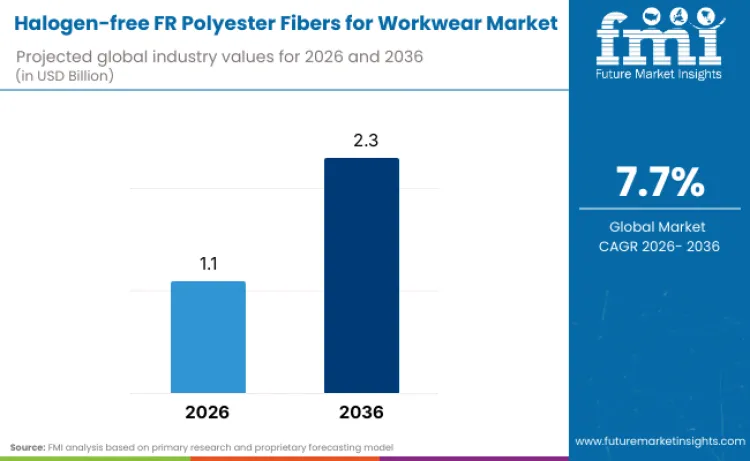
Summary of the Halogen-free FR Polyester Fibers for Workwear Market
What trajectory is FMI projecting for this market through 2036?
FMI estimates the halogen-free FR polyester fibers for workwear market to grow from USD 1.1 billion in 2026 to USD 2.3 billion by 2036, reflecting a 7.7% CAGR.
FMI Research Approach: Bottom-up forecasting linked to producer portfolio shifts, certification cycles, and contract tenure in regulated workwear segments.
How does FMI interpret the current phase of market evolution?
FMI views the market as entering a compliance-stabilisation phase, where intrinsic, halogen-free flame retardancy at the polymer level is becoming a baseline requirement. Competitive advantage is consolidating around audit certainty, laundering stability, and regulatory survivability rather than incremental performance claims.
FMI Research Approach: Qualification-led demand modelling using regulatory screening thresholds and buyer risk-avoidance behaviour.
Which factor is most directly shaping near-term demand visibility?
The dominant driver is the global retreat from additive and halogenated FR systems, reinforced by Ecodesign rules, Digital Product Passport requirements, and tightening substance controls. These pressures are accelerating substitution toward inherently flame-retardant polyester architectures designed at polymer stage.
FMI Research Approach: Policy-to-procurement mapping that converts regulatory milestones into material requalification timelines.
Which technology platform is setting the reference point in 2026?
Phosphorus-modified polymers, accounting for around 45% share, are setting the reference standard. Their ability to retain flame resistance after extensive industrial laundering and limit chemical migration over multi-year service life is aligning with buyer expectations in rental and utility workwear programs.
FMI Research Approach: Technology scoring based on wash durability evidence, alkaline stability, and ease of certification.
Where is demand most concentrated by end use?
Industrial and utility workwear remains the primary demand anchor at 39% share. Procurement frameworks are shifting toward multi-risk garments that balance flame resistance with heat-stress mitigation, durability, and repeatable compliance over long replacement cycles.
FMI Research Approach: End-use sizing using safety-standard exposure, laundering intensity, and replacement-cycle analysis.
What supplier actions best indicate structural commitment to this market?
Clear signals include portfolio consolidation around intrinsic FR polyester platforms and investments that integrate circular feedstocks with compliance-ready chemistries. Moves by large polyester producers to align recycled inputs with permanent flame-retardant performance illustrate how safety and circularity are being engineered together rather than traded off.
FMI Research Approach: Strategic move tracking across polymer redesign, recycled content integration, and regional manufacturing realignment.
Which country is acting as a structural growth anchor through the forecast?
China stands out as a structural growth anchor, supported by intrinsic-versus-treated labelling requirements, tighter enforcement of national workwear standards, and export-oriented safety compliance.
FMI Research Approach: Country-level forecasting using regulatory enforcement intensity, industrial employment exposure, and supplier qualification density.
Halogen-free FR Polyester Fibers for Workwear Market Key Takeaways
| Metric | Value |
|---|---|
| Expected Value (2026E) | USD 1.1 billion |
| Forecast Value (2036F) | USD 2.3 billion |
| CAGR (2026-2036) | 7.7% |
Source: Future Market Insights (FMI) analysis, based on proprietary forecasting model and primary research
Why is Halogen-free PR Polyester Fibers for Workwear Market Expanding?
Growth in halogen-free flame-retardant polyester fibers for workwear is being shaped by a clear change in how industrial buyers make decisions. Compliance readiness has moved ahead of optional protection, with procurement teams prioritising materials that meet chemical, durability, and worker-safety requirements without triggering repeated testing or requalification. Workwear programs are being rebuilt around fabrics that can stay compliant throughout long service lives.
This shift is unfolding against a tightening global regulatory backdrop that is steadily narrowing the role of halogenated chemistries. New certification requirements and tougher expectations around lifecycle safety are reducing tolerance for legacy FR systems that struggle with chemical transparency or long-term stability. In this environment, halogen-free FR polyester fibers are no longer treated as premium add-ons but as baseline inputs for compliant workwear programs.
At the same time, manufacturers are moving away from additive and surface-applied flame-retardant treatments. Between 2024 and 2026, many suppliers began redesigning polyester at the polymer level so flame resistance is built into the fiber itself while remaining halogen-free. This approach reduces the risk of chemical migration and delivers consistent protection through more than 100 industrial wash cycles, which aligns with the durability demands of rental, utility, and heavy-industry garments.
In Europe, sustainability policy is reinforcing this transition by turning chemical traceability into a commercial gatekeeper. New product design and passport requirements mean workwear sold into the EU must demonstrate clear, halogen-free chemistry at the fiber stage. Materials that rely on restricted or poorly documented additives are being phased out faster.
USA sees occupational heat-stress rules introduced in 2024 and 2025 are reshaping material choices in protective clothing. Employers are seeking lighter, more breathable garments that still meet flame-resistance standards. Halogen-free FR polyester fibers support moisture management and thermal comfort in ways that heavier, coated fabrics often cannot, especially in construction, energy, utilities, and maintenance roles.
Suppliers are responding by consolidating portfolios around regulation-proof polyester platforms that combine intrinsic flame resistance with circularity and compliance. Investment is shifting toward high-specification technical textiles, particularly in Europe, as producers focus on margin protection through regulatory resilience rather than sheer volume growth.
Similar pressures are visible across regions. Asia-Pacific standards in China and India are formalising non-halogenated, intrinsic FR performance as a requirement for certification. European sustainability laws continue to accelerate the exit of halogenated systems. Large industrial projects in MEA are driving demand for ISO-certified FR workwear, while heat-stress compliance in the Americas is pushing buyers toward breathable, halogen-free polyester filaments.
What is the Segment Profile of the Halogen-free FR Polyester Fibers for Workwear Market?
Why are Phosphorus-Modified Polymers Consolidating Dominance?
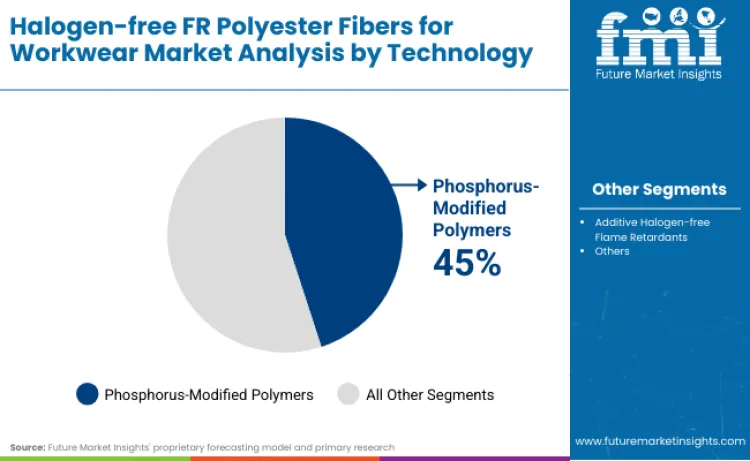
Phosphorus-modified polymers will account for 45% of the total share in 2026. Phosphorus-modified polymers strengthen lead as buyers redefine flame retardancy around long-term stability. In industrial laundries and extended-life workwear programs, protection is evaluated after repeated alkaline washing, thermal exposure, and mechanical abrasion. This has pushed inherent, non-leaching chemistries ahead of surface-applied systems that degrade in service.
Durability under industrial laundering has become a decisive qualification filter. Comparative testing conducted in August 2025 showed phosphorus-modified fibers maintaining Limiting Oxygen Index values above 29% after more than 20 high-alkali wash cycles using 2% sodium carbonate. Conventional coated textiles showed clear performance loss within 5-10 cycles. Manufacturing processes entering commercial use in 2026 further strengthen this position.
How is Industrial and Utility Workwear Redefining Demand for Halogen-free FR Polyester Fibers?
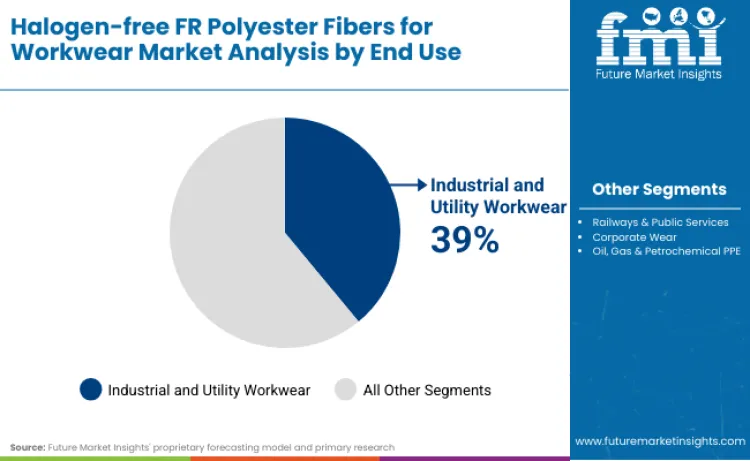
Industrial and utility workwear remains the largest application segment, accounting for 39% of total demand, as specification frameworks evolve from single-hazard fire protection toward multi-risk performance. Between 2025 and 2026, the simultaneous enforcement of heat-stress mitigation and chemical-restriction mandates accelerated this shift, displacing heavy treated-cotton garments with lightweight, inherently flame-retardant polyester constructions that meet multiple compliance requirements without halogenated or fluorinated additives.
Regulatory developments are reinforcing this transition. Technical updates issued in July 2025 under EN 13034 indicate that utility laundries are actively moving away from fluorochemical finishes in anticipation of PFAS restrictions. USA utility procurement aligned with revised OSHA 29 CFR Part 1926 provisions is prioritizing PPE that reduces metabolic heat load.
Major procurement bodies in Europe and North America have begun specifying intrinsic-only fibers for multi-year utility contracts since early 2026, citing verified durability across a full three-year service life, including consistent performance in DIN 4102-16 flue testing well above minimum residual length thresholds.
What factors influence Demand for Halogen-free FR Polyester Fibers for Workwear?
The halogen-free flame-retardant polyester fiber market is moving into a different growth phase. Access to specifications is now shaped more by long-term regulatory durability than by marginal performance gains. Expansion is being driven by a compliance-first design logic, where fibers must clear toxicity disclosure, thermal safety, and circularity requirements at the same time to remain viable in regulated workwear and PPE programs.
Regulatory enforcement is the main accelerator. The US EPA’s finalized PIP (3:1) prohibition, effective October 31, 2026, has sharply narrowed the use of halogenated additive systems in coated and treated textiles. This has pushed manufacturers toward inherently flame-retardant polyester structures, particularly phosphorus-modified variants that can be qualified at the polymer stage under TSCA and REACH.
OSHA’s 2025 Heat Injury and Illness Prevention rule has shifted PPE priorities toward lighter, more breathable constructions. Procurement teams are favoring FR polyester filaments that deliver no-melt, no-drip behavior without relying on heavy coatings that increase heat load and reduce wear comfort.
Adoption remains constrained by technical and cost trade-offs. Halogen-free mineral systems often require high loading levels to meet fire standards, which can reduce fiber flexibility, drape, and comfort. These limitations matter in workwear categories where mobility and wearability are tightly specified.
Updated conformity frameworks, including ECAS alignment and the 2026 SABER revisions, have added near-term friction in GCC countries. Expanded digital verification and harmonized tariff processes are extending approval timelines for global suppliers, slowing initial rollout in the region.
Opportunity is consolidating around circularity execution rather than new chemistries. The use of recycled polyester feedstocks in intrinsically flame-retardant fibers has shown that recycled content and permanent FR performance can be delivered at industrial scale. This capability is opening a green PPE segment where environmental compliance now acts as a qualification filter, not a marketing add-on.
Tightening PFAS restrictions in Europe and North America are increasing demand for halogen-free polyester fibers compatible with hydrocarbon-based, C0 water-repellent finishes, allowing full chemical compliance across combined flame- and water-resistant workwear systems.
Competitive positioning is increasingly defined by molecular control and audit reliability. Producers are shifting away from additive-dependent approaches toward intrinsic FR fibers that maintain performance through repeated industrial laundering, reducing requalification risk for large uniform contracts.
Early investment in digital traceability is also creating an advantage, as suppliers prepare for Digital Product Passport requirements that will require verified disclosure of non-halogenated status, recycled content, and end-of-life compatibility.
How will Halogen-free FR Polyester Fibers Demand assume shape in Major Countries?
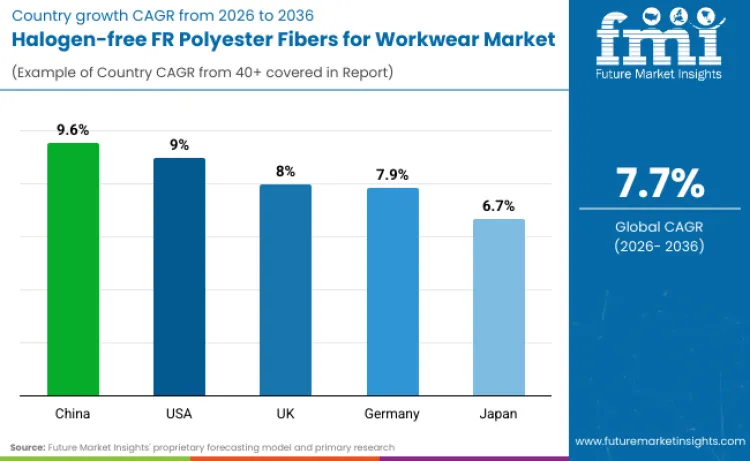
| Country | CAGR (2026-2036) |
|---|---|
| USA | 9.0% |
| China | 9.6% |
| UK | 8.0% |
| Germany | 7.9% |
| Japan | 6.7% |
Source: FMI’s proprietary forecasting model and primary research
Will Compliance Expansion beyond Fire Resistance Generate Demand in USA?
Demand for halogen-free FR polyester fibers for workwear in USA continues to anchor North American growth, with the segment forecast to expand at a CAGR of 5.8% from 2026 to 2036. What sets the current cycle apart is the way compliance expectations are widening beyond ignition resistance into physiological risk management.
Federal safety policy is now treating heat load and metabolic strain as co-equal hazards alongside fire exposure. This shift is formalized in the 2026 Safety Agenda of the Occupational Safety and Health Administration, which advances a federal Heat Injury and Illness Prevention rule. Procurement specifications are increasingly favoring moisture-regulating, phosphorus-modified polyester platforms that reduce thermal burden while retaining the no-melt, no-drip behavior required under NFPA 2112.
The electrical utility sector illustrates this transition most clearly. Buyers are moving toward inherently flame-retardant garments based on halogen-free FR polyester fibers for workwear that maintain certified performance beyond 100 industrial laundering cycles, materially exceeding the durability ceiling of treated cotton blends and lowering long-term requalification exposure.
How do Fiscal Policies Accelerates Halogen-Free Fiber Investment in Germany?
Germany remains a central force within Europe’s halogen-free FR polyester fibers for workwear landscape, supporting a regional CAGR of 6.3% through 2036. Policy instruments that directly reduce the capital intensity of compliance-ready fiber production are reinforcing growth.
Between July 2025 and December 2027, German manufacturers can claim a 30% super-deduction on qualifying investments in green machinery and sustainable R&D assets. This incentive is accelerating the deployment of extrusion and compounding platforms for molecularly modified, halogen-free polyester fibers, particularly phosphorus-integrated systems aligned with the EU Ecodesign for Sustainable Products Regulation and its forthcoming substances-of-concern thresholds.
Strategic realignment is already visible. BASF SE confirmed in early 2026 that restructuring efforts are redirecting capital toward sustainable specialty materials, with explicit emphasis on replacing brominated flame retardants with circular, halogen-free alternatives suitable for long-term regulatory defense.
Do Standards Enforcement favor Halogen-free FR Polyester Fibers for Workwear Development in China?
China’s halogen-free FR polyester fibers for workwear segment is projected to advance at a 9.6% CAGR from 2026 to 2036, supported by tighter national standards that prioritize intrinsic, polymer-level flame resistance. Enforcement of GB 8965.1-2020, reinforced through 2025-2026 implementation updates, now requires manufacturers to label garments explicitly as either "Intrinsic" or "Post-Treatment." This transparency requirement is accelerating the phase-out of surface-applied chemistries associated with formaldehyde release, particularly in lightweight summer workwear where prolonged skin contact is unavoidable.
Additional differentiation is emerging through strengthened Grade A performance benchmarks that cap allowable burn rates at 25%. These criteria are aligning domestic production of halogen-free FR polyester fibers for workwear with international safety norms, improving export eligibility over the forecast period.
How will UK’s REACH Framework Compress Transition Timelines?
UK’s market for halogen-free FR polyester fibers for workwear is entering a decisive compliance phase, with demand projected to grow at a CAGR of 5.5% from 2026 to 2036. Regulatory pressure is intensifying as UK REACH progressively narrows the range of permitted flame-retardant chemistries.
Registration deadlines set for October 27, 2026 apply to substances exceeding 1,000 tonnes annually and those classified as substances of very high concern. These milestones are compelling importers and brand owners to verify that polyester fibers are free from restricted halogenated additives, accelerating substitution toward low-migration, phosphorus-based polyester systems.
Manufacturers unable to submit complete registration dossiers by the cutoff face mandatory suspension of import activity, creating a clearly defined substitution window for certified halogen-free FR polyester fiber suppliers across the forecast horizon.
How do Standards-Led Procurement Sustain Halogen-Free FR Polyester Fibers for Workwear Adoption in Japan?
Halogen-free FR polyester fibers for workwear demand in Japan is expanding steadily at a CAGR of 6.7%. A procurement framework that is tightly anchored to national standards rather than short-term regulatory shocks shapes expansion. Industrial standards in Japan function as the primary qualification filter for government and municipal tenders.
In January 2026, the Ministry of Economy, Trade and Industry revised 25 JIS standards to reflect advances in material safety and durability. Compliance with these revisions has become a decisive criterion in bids for large-scale infrastructure projects, including rail and energy utilities.
Industry alignment has followed quickly. Toray Industries began mass production of its ARTORAY™ series in 2025, targeting PFAS-free, heat-resistant applications based on halogen-free polyester platforms. The company’s one-billion-yen annual revenue target by 2026 signals sustained commitment to public-sector safety specifications.
How Competitive is the Halogen-free FR Polyester Fibers for Workwear Market?
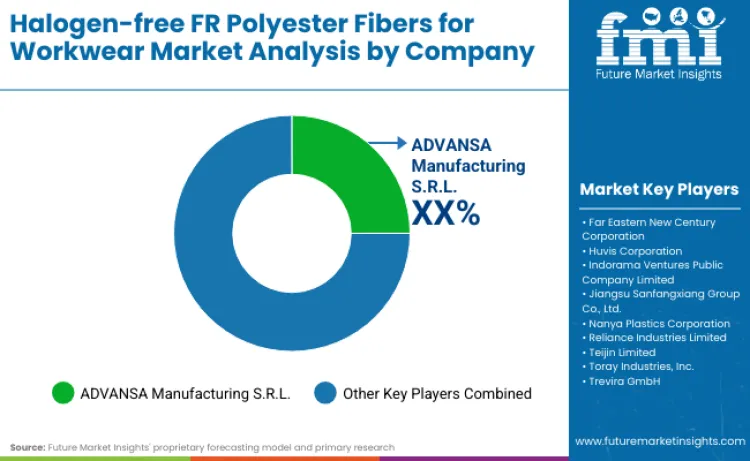
Competition in halogen-free flame-retardant polyester fibers is tightening around a small set of capabilities that buyers now treat as mandatory. The first is flame resistance engineered at the molecular level. Leading producers are stepping away from topical or additive FR finishes, which tend to raise concerns around wash durability, chemical migration, and repeated requalification. Instead, advantage is shifting toward polyester systems where phosphorus-based flame retardancy is built directly into the polymer chain, delivering stable protection through repeated industrial laundering and long service lives.
This technical shift is being reinforced by how global buyers structure procurement. ESG-linked sourcing criteria increasingly require halogen-free performance to be paired with recycled inputs, particularly rPET. Inherently flame-retardant polyester fibers are being positioned not as premium options, but as low-risk, specification-ready materials for regulated workwear, transport interiors, and industrial PPE programs.
Larger producers are using vertical integration as a competitive lever, retaining tighter control over PTA and MEG sourcing, polymer formulation, and the chemical profile of finished FR yarns. This level of control supports consistent compliance and reduces exposure to regulatory or audit disruptions across international supply chains.
Key Developments
- In January 2026, Trevira CS launched a permanently flame-retardant polyester fiber incorporating 50% chemically recycled textile waste. This marked one of the first commercial textile-to-textile recycled inherently flame-retardant polyester fibers to reach the market. The development followed a partnership with Jiaren Chemical Recycling, formalized in November 2025, which enabled the supply of chemically recycled polyester chips suitable for high-specification FR yarn applications.
- In FY 2026, Reliance expanded the application scope of its Recron® FS polyester for transportation and hospitality uses. The company demonstrated multi-functional performance by integrating antimicrobial and UV-resistant properties directly within the inherent FR polyester matrix. Fire-performance retention after repeated laundering was showcased at Heimtextil 2026, reinforcing Recron® FS as a scalable, export-oriented solution.
- In late 2025, Huvis entered a collaboration with SK Chemicals to commercialize the Ecoever CR platform, based on chemically recycled PET. The partnership provides Huvis with access to high-purity CR-PET feedstock for halogen-free inherent FR polyester fibers, offering improved durability and colour consistency compared with mechanically recycled inputs. The platform is positioned to support compliance with upcoming European end-of-life vehicle material requirements.
Key Companies Profiled
- ADVANSA Manufacturing S.R.L.
- Far Eastern New Century Corporation
- Huvis Corporation
- Indorama Ventures Public Company Limited
- Jiangsu Sanfangxiang Group Co., Ltd.
- Nanya Plastics Corporation
- Reliance Industries Limited
- Teijin Limited
- Toray Industries, Inc.
- Trevira GmbH
Market Definition
The halogen-free flame-retardant (FR) polyester fibers for workwear market comprises polyester staple fibers, filament yarns, and spun yarns engineered to provide permanent or durable flame resistance without the use of halogenated chemistries, specifically intended for professional, industrial, and regulated workwear applications. These fibers are designed to meet fire-safety, durability, and chemical-compliance requirements across repeated industrial laundering cycles and extended garment service lives.
This market focuses on fiber-level solutions, where flame retardancy is achieved through intrinsic polymer modification such as phosphorus-modified polyester backbones or non-halogenated additive systems that comply with global chemical regulations. Demand is primarily driven by occupational safety standards, regulatory restrictions on halogenated flame retardants, and procurement frameworks governing industrial uniforms, utility workwear, and multi-risk PPE. The market scope is limited to polyester-based fibers used in workwear fabrics and garments, rather than finished apparel or downstream garment manufacturing.
Scope of Report
| Items | Values |
|---|---|
| Quantitative Units (2026) | USD 1.1 billion |
| Technology | Phosphorus-modified Polymer, Additive Halogen-free Flame Retardants, Others |
| End Use | Industrial & Utility Workwear, Railways & Public Services, Corporate Wear, Oil, Gas & Petrochemical PPE |
| Regions Covered | North America, Western Europe, Eastern Europe, East Asia, South Asia, Latin America, Middle East & Africa |
| Countries Covered | USA, China, UK, Germany, Japan and 40+ Countries |
| Key Companies Profiled | ADVANSA Manufacturing S.R.L., Far Eastern New Century Corporation, Huvis Corporation, Indorama Ventures Public Company Limited, Jiangsu Sanfangxiang Group Co., Ltd., Nanya Plastics Corporation, Reliance Industries Limited, Teijin Limited, Toray Industries, Inc., Trevira GmbH |
Source: Future Market Insights’ proprietary forecasting model and primary research
Halogen-free FR Polyester Fibers for Workwear Market
By Technology:
- Phosphorus-modified Polymer
- Additive Halogen-free Flame Retardants
- Others
By End Use:
- Industrial & Utility Workwear
- Railways & Public Services
- Corporate Wear
- Oil, Gas & Petrochemical PPE
By Region:
- North America
- Western Europe
- Eastern Europe
- East Asia
- South Asia & Pacific
- Latin America
- Middle East & Africa
Bibliography
- European Commission. (2024). Ecodesign for Sustainable Products Regulation (ESPR): Establishing a framework for sustainable product requirements.
- European Chemicals Agency. (2023). Guidance on requirements for substances in articles under REACH.
- International Organization for Standardization. (2023). ISO 11612:2023 - Protective clothing against heat and flame.
- Occupational Safety and Health Administration. (2024). Heat injury and illness prevention in outdoor and indoor work settings (Proposed Rule).
- Toray Industries, Inc. (2025). Toray Group integrated report 2025-2026.
- Trevira GmbH. (2026). Trevira CS Eco: Permanently flame-retardant polyester yarns with recycled content (Technical product disclosure).a
Frequently Asked Questions
How big is the global halogen-free FR polyester fibers for workwear market?
The global halogen-free flame-retardant polyester fibers for workwear market is valued at USD 1.1 billion in 2026.
What is the growth outlook for the halogen-free FR polyester fibers for workwear market over the next 10 years?
The market is projected to grow at a 7.7% CAGR between 2026 and 2036, reaching USD 2.3 billion by 2036.
Which applications or end uses drive demand for halogen-free FR polyester fibers?
Industrial and utility workwear is the primary demand driver, accounting for the largest share due to strict fire-safety, durability, and lifecycle compliance requirements.
What are the key regional differences in the halogen-free FR polyester fibers market?
Regional demand is shaped mainly by regulatory enforcement intensity. China leads growth through intrinsic-versus-treated labelling rules and tighter workwear standards. North America is driven by heat-stress regulation and the phase-out of halogenated systems.
What are the main risks and constraints affecting this market?
Key constraints include cost-performance trade-offs, extended material qualification timelines, and comfort limitations linked to certain halogen-free systems. Increasing audit requirements and digital compliance frameworks are also raising entry barriers, favoring suppliers with intrinsic, polymer-level flame-retardant technologies and established certification track records.
Preview the report firsthand - request a free sample
Get SampleGet the brochure for pricing and purchase details.
Get PDFTable of Content
- Executive Summary
- Market Overview
- Market Coverage / Taxonomy
- Market Definition, Scope, and Limitations
- Research Methodology
- Analytical Framework and Working Assumptions
- Market Background and Dynamics
- Global Market Analysis 2021 to 2025 and Forecast 2026 to 2036
- Global Market Pricing Analysis and Forecast
- Global Market Analysis by Technology
- Global Market Analysis by End Use
- Global Market Analysis by Region
- North America Market Analysis
- Latin America Market Analysis
- Western Europe Market Analysis
- Eastern Europe Market Analysis
- East Asia Market Analysis
- South Asia and Pacific Market Analysis
- Middle East and Africa Market Analysis
- Key Countries Market Analysis
- Market Structure and Competition Analysis
- Company Profiles
- Assumptions and Acronyms Used


