

- Industry Size (2026)
- USD 1.8 Bn
- Forecast (2036)
- USD 3.3 Bn
- CAGR (2026 to 2036)
- 44.0%
Fruit Vinegar Market Size, Market Forecast and Outlook By FMI
The fruit vinegar market was valued at USD 1.7 billion in 2025. Demand is estimated to reach USD 1.8 billion in 2026 and is projected to rise at a CAGR of 5.9% from 2026 to 2036. Total market valuation is expected to reach USD 3.3 billion by 2036 as usage gradually broadens from culinary applications into wellness-oriented product formats.
Manufacturers face margin pressure when fermented fruit input costs and vinegar-grade stock availability move out of line with packaged product pricing. Access to consistent fermented stock influences whether brands can hold premium shelf positioning or compete mainly in lower-priced retail tiers. Delayed contracting can raise exposure to spot-price fluctuations in fruit inputs and bulk vinegar supply. Demand patterns also remain closely tied to regional fruit availability and harvest variability. Sourcing models tend to align with crop cycles in major fruit-producing regions.
Summary of Fruit Vinegar Market
- Market Snapshot
- The fruit vinegar market was valued at USD 1.7 billion in 2025 and is projected to reach USD 3.3 billion by 2036.
- The industry is expected to rise at a 5.9% CAGR from 2026 to 2036, creating an incremental opportunity of USD 1.4 billion over the period.
- Consumer demand is shaped by culinary preservation, flavor use, wellness-led consumption, and continued preference for apple-based, balsamic-style, and other premium fruit vinegar variants.
- Demand and Growth Drivers
- Demand drivers are fueled by increasing consumer interest in natural support for digestion, positioning for metabolic health, and clean labeling for pantry items.
- Premium culinary usage can also drive growth, especially for dressings, marinades, gourmet condiments, and flavor-based products.
- Supply-side growth drivers include an abundance of various fruits in key production areas, which support apple, grape, berry, and citrus vinegars.
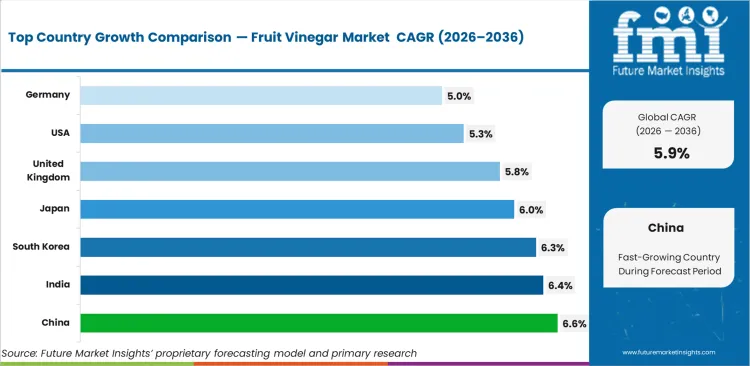
- China is projected to lead growth at 6.6% CAGR from 2026 to 2036, followed by India at 6.4%, South Korea at 6.3%, Japan at 6.0%, the United Kingdom at 5.8%, the United States at 5.3%, and Germany at 5.0%.
- Expansion remains moderated by flavor-standardization costs, fermentation lead times, raw-fruit price variability, and the challenge of converting wellness interest into repeat grocery demand.
- Product and Segment View
- The market is about vinegars made from apples, grapes, berries, and other fruits. These vinegars are sold as condiments and pantry products for wellness.
- Demand for these vinegars is mainly arising from food and beverage makers and households. Consumers use them for dressings, marinades, and some personal care products. Vinegars are mainly consumed at home.
- Apple Vinegar is estimated to lead the Product Type segment with a 44.0% market share in 2026, supported by strong wellness positioning and broad international commercialization.
- Food and beverage is projected to account for 49.0% of the Application segment in 2026, reflecting direct culinary usage alongside inclusion in functional drinks, shots, and recipe systems.
- Supermarkets are estimated to hold a 41.0% share of the Distribution Channel segment in 2026, supported by the category’s continued dependence on mainstream grocery visibility.
- Liquid is expected to dominate the Form segment with a 94.0% share in 2026, as bottled vinegar remains the standard format across retail and foodservice demand.
- Households are projected to represent 63.0% of End Use demand in 2026, with at-home cooking and wellness routines continuing to anchor category turnover.
- Scope includes bottled fruit vinegars, infused fruit vinegars, ACV-style products, and culinary specialty fruit vinegars, but excludes non-vinegar fermented beverages, synthetic acetic acid solutions, and non-food wood vinegar categories.
- Geography and Competitive Outlook
- China, India, and South Korea are the fastest-growing demand pockets, while the United States, Japan, Germany, and the United Kingdom remain the more established premium retail bases.
- Competition is shaped by heritage vinegar houses, health-led ACV specialists, premium flavor portfolios, and private-label manufacturing rather than by a single global oligopoly.
- Key companies include Mizkan Holdings, Bragg, Carl Kühne, Marukan, Borges International, Australian Vinegar, and Eden Foods. Industry remains fragmented, with the leading company holding a larger number of shares, leaving room for regional premium brands and retailer-owned labels.
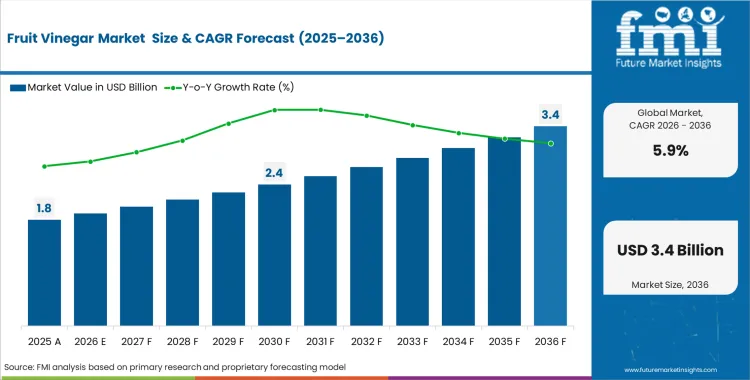
Crop-linked supply conditions continue to shape both cost discipline and product mix across the category. When buyers require documented quality, traceability, or functional-positioning claims, scaled fruit vinegar production can secure better pricing than standard culinary-grade formats. Such requirements can make entry into ingredient-grade supply more difficult for brands built primarily around tabletop retail distribution.
China is estimated to expand at a CAGR of 6.6% from 2026 to 2036 as processors widen fruit-acid usage across ready-to-drink and functional beverage formats. India is projected to record 6.4% over the same period, supported by urban food retail expansion and rising interest in differentiated pantry products. South Korea is expected to grow at 6.3%, reflecting active experimentation in health-oriented drinks and fermented product positioning. Japan is likely to see 6.0% CAGR through 2036, supported by long-standing culinary familiarity with vinegar-based formulations. The United Kingdom is estimated at 5.8%, with premium retail and natural-food positioning supporting category development. Demand in the United States is projected to rise at 5.3% as wellness-led household usage remains the main demand anchor. Germany is expected to grow at 5.0%, where mature pantry habits and slower premium turnover keep expansion below the global average. This pattern keeps Asia on the emerging industry list, while Western markets remain comparatively mature and retail-led.
Segmental Analysis
Fruit Vinegar Market Analysis by Product Type
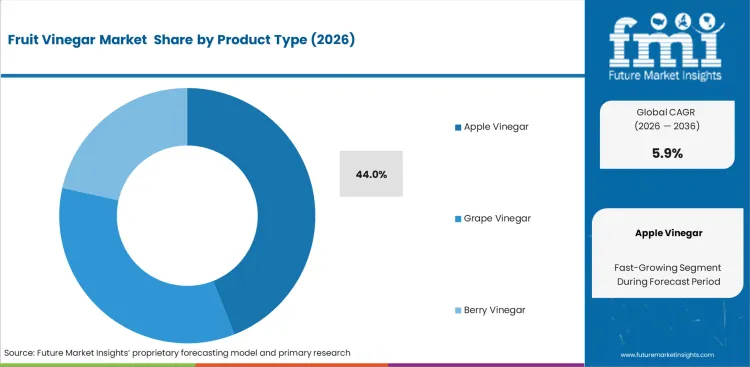
Apple vinegar leads the product type segment because it offers the most reliable balance of raw material availability, acidity consistency, and manufacturing ease. Much of the fruit vinegar vs apple cider vinegar comparison comes back to this advantage, as apple-based variants remain easier to scale across mainstream food and wellness applications. Abundant apple pomace from juice and processing streams improves fermentation economics and gives manufacturers a steadier supply base than niche fruit variants with narrower harvest windows and greater compositional variability. Stable acidity also reduces recipe adjustment during scale-up across dressings, beverages, wellness shots, and related formats. Apple vinegar is projected to secure 44.0% share of the product type segment in 2026. Higher seasonality, narrower supply depth, and less consistent acidity in alternative fruit bases continue to support apple vinegar as the preferred foundation for scaled vinegar and vinaigrette production.
Supply advantage: Apple processing generates large volumes of pomace suitable for secondary fermentation, improving feedstock availability and supporting better raw material economics than most alternative fruit bases.
Processing friction: Unfiltered and raw variants can increase filtration load, cleaning requirements, and maintenance frequency on standard industrial lines.
Portfolio efficiency: Standardizing on apple vinegar can simplify inventory planning, reduce formulation duplication, and support supplier consolidation across multiple products.
Fruit Vinegar Market Analysis by Application
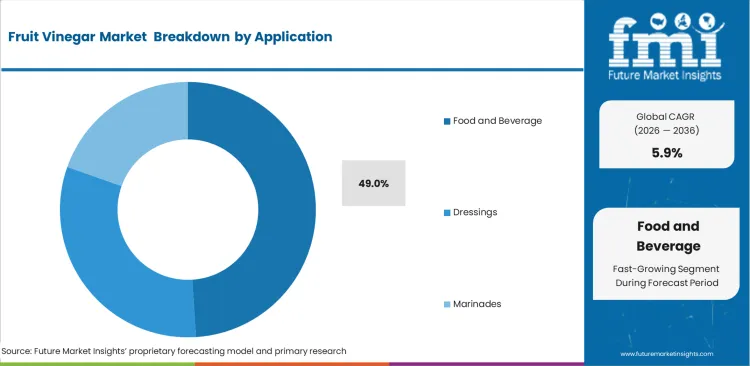
Food and beverage remains the leading application because fruit vinegar supports preservation, acidity control, and cleaner ingredient positioning within one commercially versatile input. Much of the vinaigrette share analysis also points back to this advantage, since fruit vinegar for marinades, dressings, sauces, and processed foods continues to benefit from the same combination of flavor value and formulation utility. Food and beverage is expected to hold 49.0% share of the application segment in 2026. Manufacturers continue to favor multifunctional acidic inputs that support both product stability and commercial label appeal. A meaningful portion of category volume is absorbed into products where microbial control and label simplification matter more than overt product visibility, which keeps this application structurally ahead of narrower end uses. Once incorporated into validated recipes, replacement becomes difficult because preservative performance, sensory balance, and clean-label positioning have to remain aligned at the same time.
- Formulation trigger: Fruit vinegar becomes more relevant when manufacturers need to replace synthetic preservatives without weakening label appeal or product stability.
- Stability validation: Commercial rollout depends on confirming that pH control and microbial inhibition remain consistent through the required shelf-life window.
- Expansion mandate: Once a successful reformulation proves commercially viable, usage often extends across adjacent products to reduce ingredient complexity and maintain label consistency.
Fruit Vinegar Market Analysis by Distribution Channel
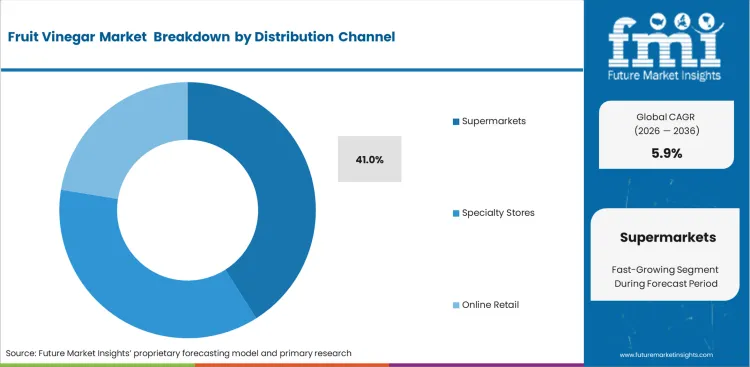
Supermarkets lead the distribution channel segment because they combine shelf visibility, repeat household purchase, and premium brand discovery at a scale that other outlets rarely match. Placement in this channel remains especially important for the best fruit vinegar brands, as mainstream retail is still where organic condiments gain the broadest consumer exposure and where fruit vinegar wholesale volumes translate into sustained turnover. Supermarkets are projected to secure 41.0% share of the distribution channel segment in 2026. Shelf access also favors suppliers that can maintain packaging stability, replenishment consistency, and multi-location service reliability without interrupting display continuity. Channel leadership remains concentrated here because weaker replenishment discipline or unstable product performance can limit retail expansion much faster than in smaller specialty outlets.
- Consolidated capacity: Large supermarket programs require dependable bottling, labeling, and replenishment capacity to support multi-location retail coverage.
- Inventory bottlenecks: Shelf-ready performance matters because unstable or poorly handled products can raise return risk, retailer penalties, and listing pressure.
- Future localization: Localized assortment strategies are becoming more relevant as retailers balance national brands with regional flavor preferences and smaller specialty suppliers.
Fruit Vinegar Market Analysis by Form
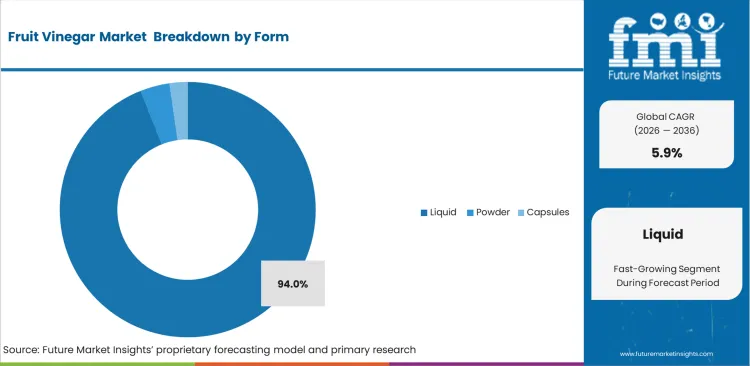
Liquid dominates the form segment because it fits directly into existing production, filling, and usage systems across both consumer and industrial demand. This advantage is especially clear for a private label fruit vinegar manufacturer supplying large retail programs, where liquid input remains easier to batch, dose, transport, and integrate across sauces and condiments than any dehydrated alternative. Powdered formats remain limited because dehydration can weaken aroma retention, flatten sensory depth, and add process cost in applications where liquid vinegar already performs with far less handling friction. Preference for the dominant format also reflects the fact that most commercial vinegar systems are already designed around liquid storage and transfer. On that basis, liquid is anticipated to account for 94.0% share of the form segment in 2026. Dry conversion remains commercially difficult to justify while liquid formats continue to deliver better formulation compatibility and lower adoption resistance.
- Baseline functionality: Liquid fruit vinegar fits existing mixing, filling, and batching systems with minimal process adjustment.
- Handling limitation: Acidic liquids still require corrosion-resistant storage, seals, and transfer systems, which raises maintenance discipline even within the dominant format.
- Concentration standards: Commercial buyers continue to prioritize tightly controlled acidity levels and batch consistency before accepting bulk liquid supply.
Fruit Vinegar Market Analysis by End Use
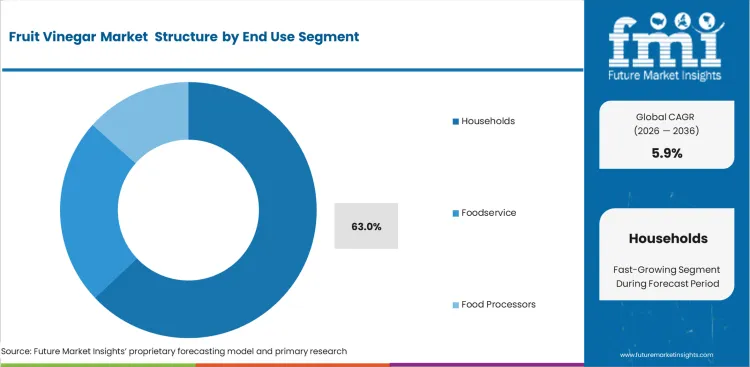
Households remain the leading end-use segment because fruit vinegar is still purchased primarily as a repeat-use pantry product rather than as a dedicated industrial ingredient. Households are forecast to command 63.0% share of the end-use segment in 2026. Demand from this group extends beyond cooking into wellness-led routines associated with clean-label condiments and adjacent consumption patterns seen across fermented foods beverages, giving household usage a broader base than foodservice or industrial channels alone. Consumer familiarity also supports repeat purchase across apple-based, flavored, and wellness-positioned variants, particularly where home use spans salads, marinades, sauces, and routine pantry applications. This lead is likely to hold because category expansion still depends more on at-home frequency and retail conversion than on large-scale institutional substitution.
- Early enthusiasts: Health-focused consumers often drive first purchases through wellness-led routines such as diluted daily intake and functional pantry use.
- Mainstream integration: Home cooks broaden the category by adopting fruit vinegar across salads, marinades, sauces, and general recipe preparation.
- Laggard conversion: Private-label entry points remain important for bringing more price-sensitive households into the category and widening repeat purchase beyond premium buy.
Fruit Vinegar Market Drivers, Restraints, and Opportunities
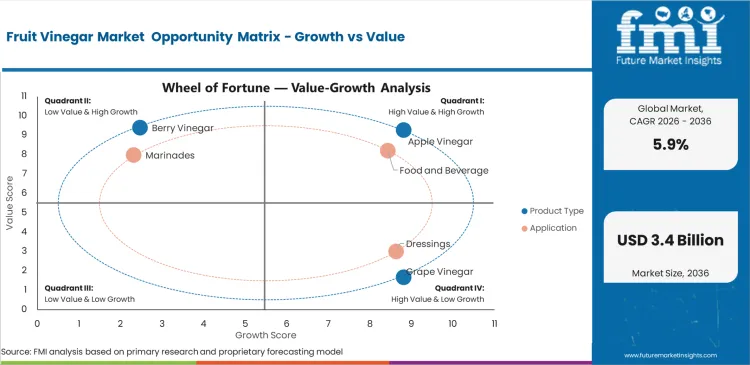
Formulation scientists at major consumer packaged goods companies face urgent mandates to source functional food ingredients vinegar before the upcoming fiscal year. Failing to execute this transition means losing distribution contracts with major health-conscious retail chains that strictly enforce clean-label standards. This intense commercial pressure compels buyers to aggressively source natural fruit vinegars as direct replacements for artificial microbial inhibitors. Delaying this transition exposes manufacturers to rapid share erosion as competitors launch compliant product lines. Tracking cider sector dependencies proves critical here.
Specialized filtration requirements create severe operational friction that slows the adoption of the specialty food vinegar category in commercial settings. Standard industrial pumping and mixing equipment is engineered for clear sterile liquids rather than biologically active solutions containing suspended cellulosic cultures. Facility managers resist introducing these raw ingredients because the natural mother culture clogs inline screens and requires costly cleaning protocols between production runs. While centrifugal separation offers a partial solution, the high capital expenditure required for this machinery prevents mid-sized manufacturers from easily updating their capabilities. Observing kombucha adoption patterns reveals identical manufacturing limitations.
Opportunities in the Fruit Vinegar Market
- Waste-stream valorization: Agricultural processors face rising disposal costs for fruit pomace and skins. Facility operators capture significant new revenue by diverting this specific byproduct into low-cost fermentation feedstocks.
- Beverage hybridization: Functional drink manufacturers seek novel flavor profiles that mask harsh active ingredients. Securing premium pricing by blending mild berry vinegars into sparkling naturally fermented food formats.
- Dehydrated encapsulation: Nutraceutical companies require shelf-stable functional powders for supplement manufacturing. Formulation chemists generate high-margin product lines by successfully spray-drying acetic solutions without destroying their aromatic properties.
Regional Analysis
.webp "Top Country Growth Comparison Fruit Vinegar Market Cagr (2026 2036)")
Based on regional analysis, Fruit Vinegar Market is segmented into East Asia, South Asia, North America, and Europe across 40 plus countries.
| Country | CAGR (2026 to 2036) |
|---|---|
| China | 6.6% |
| India | 6.4% |
| South Korea | 6.3% |
| Japan | 6.0% |
| United Kingdom | 5.8% |
| United States | 5.3% |
| Germany | 5.0% |
Source: Future Market Insights (FMI) analysis, based on proprietary forecasting model and primary research
East Asia Fruit Vinegar Market Analysis
East Asia remains one of the most structurally favorable regions for fruit vinegar because fruit processing capacity, fermentation know-how, and consumer familiarity with vinegar-based products are already well-established across the food and beverage chain. Regional growth is supported by strong integration between agricultural processing and packaged food manufacturing, which allows seasonal fruit supply to be converted into stable commercial output with lower dependence on long import chains. Consumer acceptance also runs deeper here than in many sectors in West, especially in formats linked to drinking vinegar, functional beverages, and premium flavor extensions. Wider revenue potential in the region depends less on introducing vinegar as a category and more on broadening usage into higher-value beverage and wellness applications. Alignment with broader Asia Pacific vinegar consumption patterns continues to keep East Asia commercially important through the forecast period.
- China: Domestic processing depth keeps China at the center of regional fruit vinegar supply, especially where ready-to-drink and natural acidulant applications are expanding across packaged food and beverage lines. Fruit vinegar industry in China is expected to rise at a CAGR of 6.6% from 2026 to 2036. Strong local supply capability continues to favor domestic manufacturers by improving input access, reducing logistics exposure, and supporting faster scale-up in mass retail channels.
- South Korea: Product innovation remains a stronger growth lever in South Korea than in most neighboring markets, particularly where health-positioned beverages and premium fermented products move quickly through retail cycles. Fruit vinegar demand in South Korea is projected to increase at a 6.3% CAGR. Shorter product lifecycles keep the market commercially attractive, but they also raise pressure on brands to refresh flavor profiles and usage formats more frequently than in slower-moving categories.
- Japan: Distribution discipline and product qualification standards give Japan a more structured market profile, where established retail expectations favor consistency, documentation, and premium presentation. Sales of fruit vinegar in Japan are estimated to expand at a 6.0% CAGR through 2036, supported by steady demand for refined vinegar formats within a quality-sensitive retail environment. Stable progress in this market continues to depend on meeting exacting product standards while aligning with consumer preference for trusted, well-positioned offerings.
FMI's report includes Taiwan and regional autonomous territories within the broader East Asian bloc. Taiwan adds regional relevance through its dense packaged food, beverage, and specialty retail base, where premium fermented products can gain traction through health-led positioning and flavor differentiation.
Europe Fruit Vinegar Market Analysis
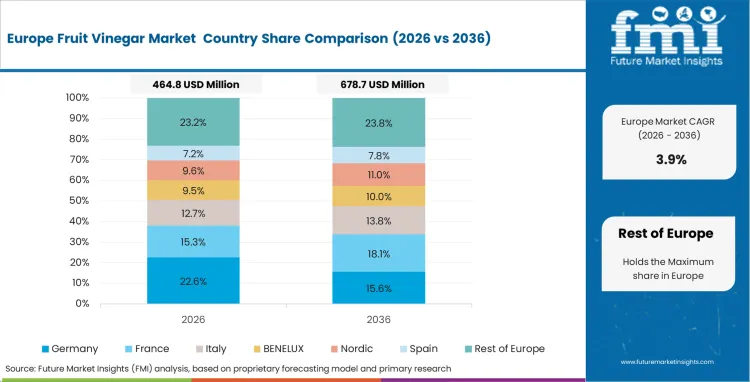
Europe remains a more regulation-sensitive market because product labeling, origin traceability, and fermentation definitions influence how fruit vinegar is positioned, imported, and commercialized across the region. Demand is supported by premium food culture, natural ingredient preference, and steady interest in specialty condiments. However, category expansion still depends on navigating a tighter documentation environment than in markets in Asia. Mature culinary usage provides a solid base, though newer wellness-led formats move more selectively because consumer adoption varies widely by country and retail channel. Labeling discipline and formulation compliance continue to shape which suppliers can scale successfully across the region. Operational progress in the Europe vinegar industry depends as much on legal positioning and retail fit as on consumer demand alone.
- United Kingdom: Premium grocery placement and natural-product merchandising continue to support the market in the United Kingdom, where fruit vinegar benefits from stronger shelf visibility in health-led and specialty condiment assortments. Fruit vinegar demand in the United Kingdom is likely to advance at a CAGR of 5.8% from 2026 to 2036. Retail growth here remains closely tied to premium trade-up behavior, making supermarket acceptance and product positioning central to sustained sales expansion.
- Germany: Mature condiment habits make Germany a steadier but less experimental market, especially where household usage still favors established pantry products over wellness-led vinegar formats. Slower expansion keeps the market relevant for premium culinary applications, though broader adoption remains more limited where consumers continue to treat fruit vinegar as a niche upgrade rather than a daily-use staple. Demand for fruit vinegar in Germany is forecast to grow at a CAGR of 5.0% through 2036, where recipe quality, specialty retail positioning, and established condiment demand matter more than fast category conversion.
FMI's report includes France, Spain, Italy, the Netherlands, and broader Nordic territories. France and Italy add depth to the European market through strong culinary heritage, premium food retail, and established consumer familiarity with vinegar-based dressings, reductions, and flavor-led condiments.
North America Fruit Vinegar Market Analysis
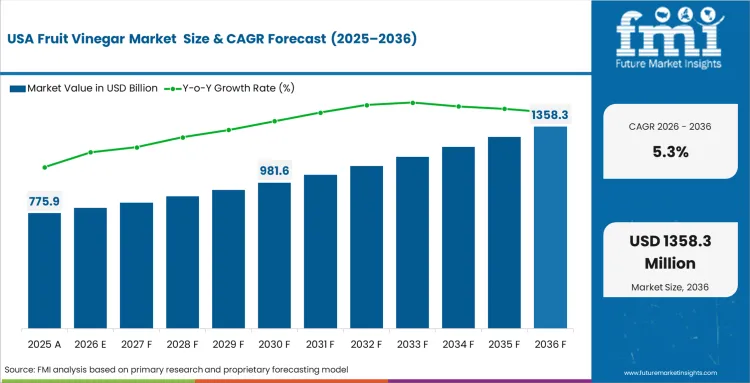
North America remains a demand-led market where category value is shaped by wellness positioning. Consumer usage has broadened beyond pantry staples into daily functional routines, which supports higher retail pricing but also increases dependence on branding, repeat purchase, and reliable contract manufacturing. Domestic scale-up can be constrained by processing and bottling requirements for active or minimally processed liquid products. Commercial success in this region depends on sustaining premium consumer relevance while maintaining enough packaging and production flexibility to support new product launches.
- United States: Daily wellness usage and premium pantry adoption continue to anchor demand in the United States, where fruit vinegar has expanded into shots, beverages, dressings, and broader functional food positioning. Fruit vinegar demand in the United States is set to rise at a 5.3% CAGR from 2026 to 2036. Scaling remains most effective where brands can secure dependable bottling, maintain sensory consistency, and extend usage beyond early wellness-focused consumers into broader household routines.
FMI's report includes Canada and Mexico as critical components of the continental supply architecture. Canada adds relevance through premium grocery demand, health-oriented pantry adoption, and a retail environment that supports higher-value fermented products with cleaner positioning.
Competitive Aligners for Market Players
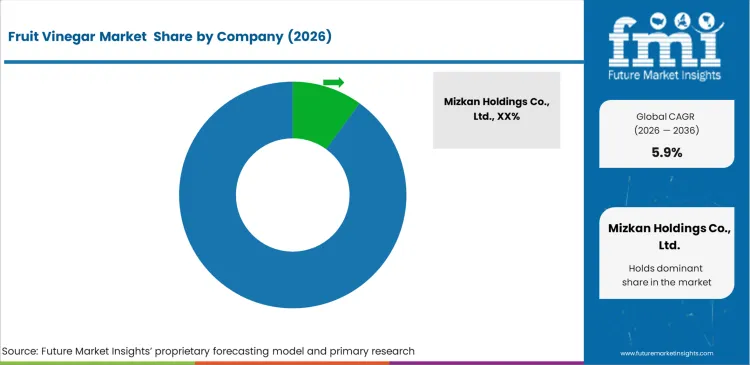
Competition in fruit vinegar remains fragmented because legacy culinary suppliers and wellness-focused brands compete for the same fermentation capacity while serving very different demand pools. Established producers retain an advantage in mainstream food applications through long-standing distribution depth and larger operating scale, while health-positioned brands remain stronger in premium wellness formats where raw, functional, and lifestyle-led variants command better pricing. Competitive pressure centers less on branding alone and more on dependable access to high-quality fermented input. Control over stable supply of high-quality fermented ingredients continues to shape who can serve industrial food demand, retail wellness channels, and private-label programs without exposing margins to input volatility.
Established fruit vinegar manufacturers also benefit from fermentation infrastructure that is expensive to replicate and difficult to operate efficiently at scale. Existing stainless-steel capacity, supplier relationships, and process familiarity help larger producers absorb raw material cost swings more effectively than smaller challengers. Competing in this category requires more than bottling capability, as handling unpasteurized biological liquids demands tighter process control, stronger sanitation discipline, and closer coordination with agricultural supply networks. Securing fermented flavours supply chains is better positioned where consistency, throughput, and fruit sourcing reliability matter as much as brand presence.
Large food manufacturers continue to resist dependence on a single supplier, which keeps consolidation in check even as scale advantages favor established producers. Fruit vinegar supply is easier to diversify, where acetic acid specifications, titration consistency, and backup production capability can be matched across multiple vendors. Full consolidation remains unlikely because suppliers still have to balance two different requirements: lot-to-lot uniformity for industrial buyers and active, less-processed variants for wellness-oriented retail demand. Commercial success through 2036 is likely to depend on how effectively suppliers manage both needs within the same operating model, especially where industrial standardization and premium raw positioning must coexist.
Key Players in the Fruit Vinegar Market
- Mizkan Holdings Co., Ltd.
- Bragg Live Food Products, LLC
- Carl Kühne KG
- Marukan Vinegar (USA) Inc.
- Borges International Group
- Australian Vinegar
- Eden Foods, Inc.
Scope of the Report
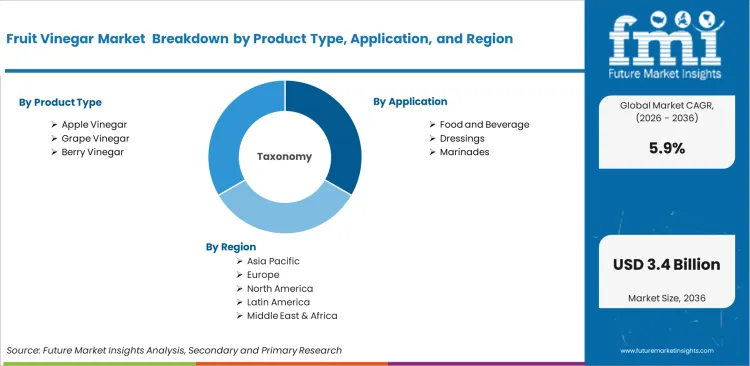
| Metric | Value |
|---|---|
| Quantitative Units | USD 1.88 billion to USD 3.35 billion, at a CAGR of 5.9% |
| Market Definition | This sector covers naturally fermented acetic solutions originating from fruit sugars. Products serve functional wellness, culinary applications, and industrial food processing. |
| Segmentation | Product Type, Application, Distribution Channel, Form, End Use, and Region |
| Regions Covered | North America, Latin America, Europe, East Asia, South Asia, Oceania, Middle East and Africa |
| Countries Covered | United States, Canada, Brazil, Mexico, Germany, United Kingdom, France, Spain, Italy, China, Japan, South Korea, India, Australia, New Zealand, GCC Countries, South Africa |
| Key Companies Profiled | Mizkan Holdings Co., Ltd., Bragg Live Food Products, LLC, Carl Kühne KG, Marukan Vinegar (USA) Inc., Borges International Group, Australian Vinegar, Eden Foods, Inc. |
| Forecast Period | 2026 to 2036 |
| Approach | Wholesale ingredient purchasing contracts anchored industrial volume estimates while retail point-of-sale data defined household consumption. |
Source: Future Market Insights (FMI) analysis, based on proprietary forecasting model and primary research
Fruit Vinegar Market Analysis by Segments
Product Type
- Apple Vinegar
- Grape Vinegar
- Berry Vinegar
- Citrus Vinegar
- Others
Application
- Food Beverage
- Dressings
- Marinades
- Wellness
- Personal Care
Distribution Channel
- Supermarkets
- Specialty Stores
- Online Retail
- Foodservice
- Direct Sales
Form
- Liquid
- Powder
- Capsules
End Use
- Households
- Foodservice
- Food Processors
- Nutraceuticals
Region
- North America
- Latin America
- Europe
- East Asia
- South Asia
- Oceania
- Middle East and Africa
Bibliography
[1]. Food and Agriculture Organization of the United Nations. (2025, December 31). Agricultural production statistics 2010–2024.
[2]. Soldo, T., Gavran, S., Babić, J., Miličević, B., & Kovač, T. (2025). Fruit vinegar production. IntechOpen.
[3]. Khalifa, S. A. M., Alhumaydhi, F. A., Abdel-Maksoud, M. A., Joseph, B., Fayez, K., El-Seedi, H. R., & Farag, M. A. (2024). Vinegar – a beneficial food additive: Production, safety, possibilities, and applications from ancient to modern times. Food & Function.
[4]. Hosseini, E., Maske, B. L., Ferdous, J., Khan, M. H., Hossain, M. I., Choudhury, T. R., Khandaker, M. U., & Goala, M. (2025). Lactic acid bacteria in vinegar fermentation: Diversity, functionality and health benefits. Foods, 14(4), 698.
[5]. Zhang, Z., Zhang, Z.-H., He, R., Zhao, G., Yu, Y., & Zhang, R. (2024). Research advances in technologies and mechanisms to regulate vinegar flavor. Food Chemistry, 465, 140783.
[6]. Arjmandfard, D., Behzadi, M., Sohrabi, Z., & Mohammadi Sartang, M. (2025). Effects of apple cider vinegar on glycemic control and insulin sensitivity in patients with type 2 diabetes: A GRADE-assessed systematic review and dose–response meta-analysis of controlled clinical trials. Frontiers in Nutrition, 12, 1528383.
[7]. U.S. Department of Agriculture, Foreign Agricultural Service. (2025, November 19). Retail foods annual: Korea – Republic of.
[8]. Tidjani, F., Selten, M., & van Galen, M. (2025). The EU food and drink industry: A competitiveness analysis (Report 2025-035). Wageningen Social & Economic Research.
This bibliography is provided for reader reference. The full FMI report contains the complete reference list with primary source documentation.
This Report Addresses
- Specific volume metrics for apple, grape, and berry vinegar displacement of synthetic acetic acid.
- Capital expenditure requirements for filtering active biological cultures in commercial bottling lines.
- Structural barriers preventing raw unpasteurized vinegar formats from scaling in legacy retail channels.
- Titration consistency demands enforced by major industrial food processors.
- Margin profiles for functional wellness shots versus traditional culinary dressings.
- Localized agricultural supply chain dependencies for major fruit pomace sourcing.
- Regulatory compliance burdens for importing active fermented liquids into European sectors.
- Competitive advantages held by legacy producers with depreciated stainless-steel fermentation infrastructure. Tracking kombucha tea similarities helps define these advantages.
Frequently Asked Questions
What is fruit vinegar size projected for 2026?
Demand is expected to reach USD 1.88 billion in 2026. This baseline reflects the immediate transition by major food processors away from synthetic chemical preservatives toward natural fermented alternatives for clean-label compliance.
Tell me the fruit vinegar forecast to 2036.
Total cumulative output reaches USD 3.35 billion by 2036. Sustained expansion relies entirely on consumers adopting premium functional wellness formats rather than just maintaining traditional household culinary usage.
Why is fruit vinegar demand growing globally?
The 5.9% compound growth rate reflects steady industrial substitution. Achieving this trajectory requires suppliers to successfully scale raw material sourcing networks to prevent seasonal fruit shortages from disrupting commercial bottling operations.
Which fruit vinegar type leads overall sales?
Holding 44.0% share, Apple Vinegar offers the most reliable volume-to-price ratio for industrial formulation. Apple pressing yields massive amounts of pomace, ensuring predictable low-cost baseline feedstock that rarer fruit bases simply cannot match.
What operational consequence follows choosing rare berry vinegars?
Procurement directors specifying niche berry ferments face severe seasonal supply shocks. Relying on low-yield agricultural inputs forces manufacturers to maintain massive safety stocks, tying up working capital and complicating warehouse storage protocols.
What are fruit vinegar applications driving industrial use?
Controlling 49.0% share, the Food Beverage segment consumes massive hidden volumes as a functional microbial inhibitor. Replacing chemical preservatives in ready-to-drink formats demands natural acidulants that satisfy strict retail clean-label requirements without ruining flavor profiles.
What stops industrial buyers from using dehydrated forms?
Dehydrating these biologically active liquids destroys delicate aromatic esters. Process engineers reject powdered formats because they yield flat sensory profiles and require expensive dust-mitigation retrofits to handle safely within standard mixing facilities.
How big is the fruit vinegar distribution footprint in supermarkets?
Accounting for 41.0% share, national grocery chains optimize their shelf space for high-margin functional items. Achieving placement requires suppliers to guarantee uninterrupted replenishment across hundreds of locations, a logistical hurdle smaller producers cannot clear.
What happens when brands supply unstable raw vinegar to retail?
Merchandising directors immediately delist products that demonstrate biological instability on warm shelves. Continued active fermentation causes bottles to leak or burst, resulting in severe punitive chargebacks and permanent loss of premium shelf placement.
Why does the liquid form control 94.0% share?
Liquid solutions integrate flawlessly into existing high-speed bottling infrastructure. Production supervisors favor this traditional state because it requires zero capital expenditure, whereas handling caustic acidic powders degrades standard factory seals and processing equipment rapidly.
What drives the 63.0% share for Household end use?
Direct consumer purchasing provides the baseline volume necessary for sustained production. Brand managers prioritize this demographic because direct retail sales generate significantly higher margins than bulk wholesale ingredient contracts negotiated by aggressive procurement teams.
What non-obvious usage patterns exist within households?
Consumers routinely deploy premium culinary ferments as topical skin treatments and household cleaners. Regulatory agencies strictly forbid advertising these off-label applications, forcing marketing departments to focus solely on recipe creation despite actual consumption habits.
Which region is growing fastest in fruit vinegar usage?
China leads regional expansion at 6.6%. Domestic food processors execute massive capacity upgrades specifically targeting the ready-to-drink functional beverage sector. Operations directors secure state-backed agricultural subsidies to modernize fermentation facilities, effectively blocking foreign competitors from capturing lucrative domestic contracts.
How does India's 6.4% trajectory differ structurally?
Rapid urbanization pushes middle-tier consumers toward novel fermented condiments. While Chinese output focuses on industrial beverage integration, Indian purchasing managers prioritize securing stable acidulant supplies for rapidly expanding domestic snack and sauce manufacturing lines.
What defines the 6.3% growth in South Korea?
Intense cosmetic and wellness trends force formulation chemists to integrate these extracts into both consumable and topical items. This aggressive health-beverage experimentation creates extremely short product lifecycles, demanding constant supply chain agility.
Why does Japan track slightly slower at 6.0%?
Established heritage houses control almost all distribution networks, forcing challengers to compete entirely on novel health claims. Retail buyers demand immaculate documentation, creating a strict qualification environment that purposefully slows new market entrants.
What drives the 5.8% expansion in the United Kingdom?
Supermarket category managers aggressively replace synthetic white vinegars with raw, unfiltered variants. This deliberate shelf-space reallocation targets digestion-focused shoppers, fundamentally altering profit margins across the entire condiment aisle in major retail chains.
Which companies lead the fruit vinegar sector?
Legacy operators control fully depreciated stainless-steel fermentation infrastructure. This massive capital asset allows established firms to absorb raw material price shocks that routinely force smaller specialized wellness brands into bankruptcy during poor harvest seasons.
Compare fruit vinegar and apple cider vinegar dynamics?
Quality assurance teams mandate strict acetic acid titration standards that multiple suppliers can meet simultaneously. Procurement directors routinely audit backup facilities ensuring immediate alternative supply if a primary vendor attempts to raise contract pricing aggressively.
What separates fruit vinegar vs balsamic vinegar structurally?
Industrial processors aggressively resist sole-source vendor lock-in by mandating strict chemical limits that traditional authentic balsamic cannot meet consistently. The structural tension between maintaining biologically active mother cultures and achieving absolute lot-to-lot consistency prevents complete sector consolidation.
Preview the report firsthand - request a free sample
Get SampleGet the brochure for pricing and purchase details.
Get PDFTable of Content
- Executive Summary
- Global Market Outlook
- Demand-side Trends
- Supply-side Trends
- Technology Roadmap Analysis
- Analysis and Recommendations
- Market Overview
- Market Coverage / Taxonomy
- Market Definition / Scope / Limitations
- Research Methodology
- Chapter Orientation
- Analytical Lens and Working Hypotheses
- Market Structure, Signals, and Trend Drivers
- Benchmarking and Cross-market Comparability
- Market Sizing, Forecasting, and Opportunity Mapping
- Research Design and Evidence Framework
- Desk Research Programme (Secondary Evidence)
- Company Annual and Sustainability Reports
- Peer-reviewed Journals and Academic Literature
- Corporate Websites, Product Literature, and Technical Notes
- Earnings Decks and Investor Briefings
- Statutory Filings and Regulatory Disclosures
- Technical White Papers and Standards Notes
- Trade Journals, Industry Magazines, and Analyst Briefs
- Conference Proceedings, Webinars, and Seminar Materials
- Government Statistics Portals and Public Data Releases
- Press Releases and Reputable Media Coverage
- Specialist Newsletters and Curated Briefings
- Sector Databases and Reference Repositories
- FMI Internal Proprietary Databases and Historical Market Datasets
- Subscription Datasets and Paid Sources
- Social Channels, Communities, and Digital Listening Inputs
- Additional Desk Sources
- Expert Input and Fieldwork (Primary Evidence)
- Primary Modes
- Qualitative Interviews and Expert Elicitation
- Quantitative Surveys and Structured Data Capture
- Blended Approach
- Why Primary Evidence is Used
- Field Techniques
- Interviews
- Surveys
- Focus Groups
- Observational and In-context Research
- Social and Community Interactions
- Stakeholder Universe Engaged
- C-suite Leaders
- Board Members
- Presidents and Vice Presidents
- R&D and Innovation Heads
- Technical Specialists
- Domain Subject-matter Experts
- Scientists
- Physicians and Other Healthcare Professionals
- Governance, Ethics, and Data Stewardship
- Research Ethics
- Data Integrity and Handling
- Primary Modes
- Tooling, Models, and Reference Databases
- Desk Research Programme (Secondary Evidence)
- Data Engineering and Model Build
- Data Acquisition and Ingestion
- Cleaning, Normalisation, and Verification
- Synthesis, Triangulation, and Analysis
- Quality Assurance and Audit Trail
- Market Background
- Market Dynamics
- Drivers
- Restraints
- Opportunity
- Trends
- Scenario Forecast
- Demand in Optimistic Scenario
- Demand in Likely Scenario
- Demand in Conservative Scenario
- Opportunity Map Analysis
- Product Life Cycle Analysis
- Supply Chain Analysis
- Investment Feasibility Matrix
- Value Chain Analysis
- PESTLE and Porter’s Analysis
- Regulatory Landscape
- Regional Parent Market Outlook
- Production and Consumption Statistics
- Import and Export Statistics
- Market Dynamics
- Global Market Analysis 2021 to 2025 and Forecast, 2026 to 2036
- Historical Market Size Value (USD Million) Analysis, 2021 to 2025
- Current and Future Market Size Value (USD Million) Projections, 2026 to 2036
- Y-o-Y Growth Trend Analysis
- Absolute $ Opportunity Analysis
- Global Market Pricing Analysis 2021 to 2025 and Forecast 2026 to 2036
- Global Market Analysis 2021 to 2025 and Forecast 2026 to 2036, By Product Type
- Introduction / Key Findings
- Historical Market Size Value (USD Million) Analysis By Product Type , 2021 to 2025
- Current and Future Market Size Value (USD Million) Analysis and Forecast By Product Type , 2026 to 2036
- Apple Vinegar
- Grape Vinegar
- Berry Vinegar
- Apple Vinegar
- Y-o-Y Growth Trend Analysis By Product Type , 2021 to 2025
- Absolute $ Opportunity Analysis By Product Type , 2026 to 2036
- Global Market Analysis 2021 to 2025 and Forecast 2026 to 2036, By Application
- Introduction / Key Findings
- Historical Market Size Value (USD Million) Analysis By Application, 2021 to 2025
- Current and Future Market Size Value (USD Million) Analysis and Forecast By Application, 2026 to 2036
- Food and Beverage
- Dressings
- Marinades
- Food and Beverage
- Y-o-Y Growth Trend Analysis By Application, 2021 to 2025
- Absolute $ Opportunity Analysis By Application, 2026 to 2036
- Global Market Analysis 2021 to 2025 and Forecast 2026 to 2036, By Distribution Channel
- Introduction / Key Findings
- Historical Market Size Value (USD Million) Analysis By Distribution Channel, 2021 to 2025
- Current and Future Market Size Value (USD Million) Analysis and Forecast By Distribution Channel, 2026 to 2036
- Supermarkets
- Specialty Stores
- Online Retail
- Supermarkets
- Y-o-Y Growth Trend Analysis By Distribution Channel, 2021 to 2025
- Absolute $ Opportunity Analysis By Distribution Channel, 2026 to 2036
- Global Market Analysis 2021 to 2025 and Forecast 2026 to 2036, By Form
- Introduction / Key Findings
- Historical Market Size Value (USD Million) Analysis By Form, 2021 to 2025
- Current and Future Market Size Value (USD Million) Analysis and Forecast By Form, 2026 to 2036
- Liquid
- Powder
- Capsules
- Liquid
- Y-o-Y Growth Trend Analysis By Form, 2021 to 2025
- Absolute $ Opportunity Analysis By Form, 2026 to 2036
- Global Market Analysis 2021 to 2025 and Forecast 2026 to 2036, By End Use
- Introduction / Key Findings
- Historical Market Size Value (USD Million) Analysis By End Use, 2021 to 2025
- Current and Future Market Size Value (USD Million) Analysis and Forecast By End Use, 2026 to 2036
- Households
- Foodservice
- Food Processors
- Households
- Y-o-Y Growth Trend Analysis By End Use, 2021 to 2025
- Absolute $ Opportunity Analysis By End Use, 2026 to 2036
- Global Market Analysis 2021 to 2025 and Forecast 2026 to 2036, By Region
- Introduction
- Historical Market Size Value (USD Million) Analysis By Region, 2021 to 2025
- Current Market Size Value (USD Million) Analysis and Forecast By Region, 2026 to 2036
- North America
- Latin America
- Western Europe
- Eastern Europe
- East Asia
- South Asia and Pacific
- Middle East & Africa
- Market Attractiveness Analysis By Region
- North America Market Analysis 2021 to 2025 and Forecast 2026 to 2036, By Country
- Historical Market Size Value (USD Million) Trend Analysis By Market Taxonomy, 2021 to 2025
- Market Size Value (USD Million) Forecast By Market Taxonomy, 2026 to 2036
- By Country
- USA
- Canada
- Mexico
- By Product Type
- By Application
- By Distribution Channel
- By Form
- By End Use
- By Country
- Market Attractiveness Analysis
- By Country
- By Product Type
- By Application
- By Distribution Channel
- By Form
- By End Use
- Key Takeaways
- Latin America Market Analysis 2021 to 2025 and Forecast 2026 to 2036, By Country
- Historical Market Size Value (USD Million) Trend Analysis By Market Taxonomy, 2021 to 2025
- Market Size Value (USD Million) Forecast By Market Taxonomy, 2026 to 2036
- By Country
- Brazil
- Chile
- Rest of Latin America
- By Product Type
- By Application
- By Distribution Channel
- By Form
- By End Use
- By Country
- Market Attractiveness Analysis
- By Country
- By Product Type
- By Application
- By Distribution Channel
- By Form
- By End Use
- Key Takeaways
- Western Europe Market Analysis 2021 to 2025 and Forecast 2026 to 2036, By Country
- Historical Market Size Value (USD Million) Trend Analysis By Market Taxonomy, 2021 to 2025
- Market Size Value (USD Million) Forecast By Market Taxonomy, 2026 to 2036
- By Country
- Germany
- UK
- Italy
- Spain
- France
- Nordic
- BENELUX
- Rest of Western Europe
- By Product Type
- By Application
- By Distribution Channel
- By Form
- By End Use
- By Country
- Market Attractiveness Analysis
- By Country
- By Product Type
- By Application
- By Distribution Channel
- By Form
- By End Use
- Key Takeaways
- Eastern Europe Market Analysis 2021 to 2025 and Forecast 2026 to 2036, By Country
- Historical Market Size Value (USD Million) Trend Analysis By Market Taxonomy, 2021 to 2025
- Market Size Value (USD Million) Forecast By Market Taxonomy, 2026 to 2036
- By Country
- Russia
- Poland
- Hungary
- Balkan & Baltic
- Rest of Eastern Europe
- By Product Type
- By Application
- By Distribution Channel
- By Form
- By End Use
- By Country
- Market Attractiveness Analysis
- By Country
- By Product Type
- By Application
- By Distribution Channel
- By Form
- By End Use
- Key Takeaways
- East Asia Market Analysis 2021 to 2025 and Forecast 2026 to 2036, By Country
- Historical Market Size Value (USD Million) Trend Analysis By Market Taxonomy, 2021 to 2025
- Market Size Value (USD Million) Forecast By Market Taxonomy, 2026 to 2036
- By Country
- China
- Japan
- South Korea
- By Product Type
- By Application
- By Distribution Channel
- By Form
- By End Use
- By Country
- Market Attractiveness Analysis
- By Country
- By Product Type
- By Application
- By Distribution Channel
- By Form
- By End Use
- Key Takeaways
- South Asia and Pacific Market Analysis 2021 to 2025 and Forecast 2026 to 2036, By Country
- Historical Market Size Value (USD Million) Trend Analysis By Market Taxonomy, 2021 to 2025
- Market Size Value (USD Million) Forecast By Market Taxonomy, 2026 to 2036
- By Country
- India
- ASEAN
- Australia & New Zealand
- Rest of South Asia and Pacific
- By Product Type
- By Application
- By Distribution Channel
- By Form
- By End Use
- By Country
- Market Attractiveness Analysis
- By Country
- By Product Type
- By Application
- By Distribution Channel
- By Form
- By End Use
- Key Takeaways
- Middle East & Africa Market Analysis 2021 to 2025 and Forecast 2026 to 2036, By Country
- Historical Market Size Value (USD Million) Trend Analysis By Market Taxonomy, 2021 to 2025
- Market Size Value (USD Million) Forecast By Market Taxonomy, 2026 to 2036
- By Country
- Kingdom of Saudi Arabia
- Other GCC Countries
- Turkiye
- South Africa
- Other African Union
- Rest of Middle East & Africa
- By Product Type
- By Application
- By Distribution Channel
- By Form
- By End Use
- By Country
- Market Attractiveness Analysis
- By Country
- By Product Type
- By Application
- By Distribution Channel
- By Form
- By End Use
- Key Takeaways
- Key Countries Market Analysis
- USA
- Pricing Analysis
- Market Share Analysis, 2025
- By Product Type
- By Application
- By Distribution Channel
- By Form
- By End Use
- Canada
- Pricing Analysis
- Market Share Analysis, 2025
- By Product Type
- By Application
- By Distribution Channel
- By Form
- By End Use
- Mexico
- Pricing Analysis
- Market Share Analysis, 2025
- By Product Type
- By Application
- By Distribution Channel
- By Form
- By End Use
- Brazil
- Pricing Analysis
- Market Share Analysis, 2025
- By Product Type
- By Application
- By Distribution Channel
- By Form
- By End Use
- Chile
- Pricing Analysis
- Market Share Analysis, 2025
- By Product Type
- By Application
- By Distribution Channel
- By Form
- By End Use
- Germany
- Pricing Analysis
- Market Share Analysis, 2025
- By Product Type
- By Application
- By Distribution Channel
- By Form
- By End Use
- UK
- Pricing Analysis
- Market Share Analysis, 2025
- By Product Type
- By Application
- By Distribution Channel
- By Form
- By End Use
- Italy
- Pricing Analysis
- Market Share Analysis, 2025
- By Product Type
- By Application
- By Distribution Channel
- By Form
- By End Use
- Spain
- Pricing Analysis
- Market Share Analysis, 2025
- By Product Type
- By Application
- By Distribution Channel
- By Form
- By End Use
- France
- Pricing Analysis
- Market Share Analysis, 2025
- By Product Type
- By Application
- By Distribution Channel
- By Form
- By End Use
- India
- Pricing Analysis
- Market Share Analysis, 2025
- By Product Type
- By Application
- By Distribution Channel
- By Form
- By End Use
- ASEAN
- Pricing Analysis
- Market Share Analysis, 2025
- By Product Type
- By Application
- By Distribution Channel
- By Form
- By End Use
- Australia & New Zealand
- Pricing Analysis
- Market Share Analysis, 2025
- By Product Type
- By Application
- By Distribution Channel
- By Form
- By End Use
- China
- Pricing Analysis
- Market Share Analysis, 2025
- By Product Type
- By Application
- By Distribution Channel
- By Form
- By End Use
- Japan
- Pricing Analysis
- Market Share Analysis, 2025
- By Product Type
- By Application
- By Distribution Channel
- By Form
- By End Use
- South Korea
- Pricing Analysis
- Market Share Analysis, 2025
- By Product Type
- By Application
- By Distribution Channel
- By Form
- By End Use
- Russia
- Pricing Analysis
- Market Share Analysis, 2025
- By Product Type
- By Application
- By Distribution Channel
- By Form
- By End Use
- Poland
- Pricing Analysis
- Market Share Analysis, 2025
- By Product Type
- By Application
- By Distribution Channel
- By Form
- By End Use
- Hungary
- Pricing Analysis
- Market Share Analysis, 2025
- By Product Type
- By Application
- By Distribution Channel
- By Form
- By End Use
- Kingdom of Saudi Arabia
- Pricing Analysis
- Market Share Analysis, 2025
- By Product Type
- By Application
- By Distribution Channel
- By Form
- By End Use
- Turkiye
- Pricing Analysis
- Market Share Analysis, 2025
- By Product Type
- By Application
- By Distribution Channel
- By Form
- By End Use
- South Africa
- Pricing Analysis
- Market Share Analysis, 2025
- By Product Type
- By Application
- By Distribution Channel
- By Form
- By End Use
- USA
- Market Structure Analysis
- Competition Dashboard
- Competition Benchmarking
- Market Share Analysis of Top Players
- By Region
- By Product Type
- By Application
- By Distribution Channel
- By Form
- By End Use
- Competition Analysis
- Competition Deep Dive
- Mizkan Holdings Co., Ltd.
- Overview
- Product Portfolio
- Profitability by Market Segments (Product/Age /Sales Channel/Region)
- Sales Footprint
- Strategy Overview
- Marketing Strategy
- Product Strategy
- Channel Strategy
- Bragg Live Food Products, LLC
- Carl Kühne KG
- Marukan Vinegar (USA) Inc.
- Borges International Group
- Australian Vinegar
- Mizkan Holdings Co., Ltd.
- Competition Deep Dive
- Assumptions & Acronyms Used


