

- Industry Size (2026)
- USD 3.7 Bn
- Forecast (2036)
- USD 5.5 Bn
- CAGR (2026 to 2036)
- 3.9%
Fruit Juice Packaging Market Outlook from 2025 to 2035
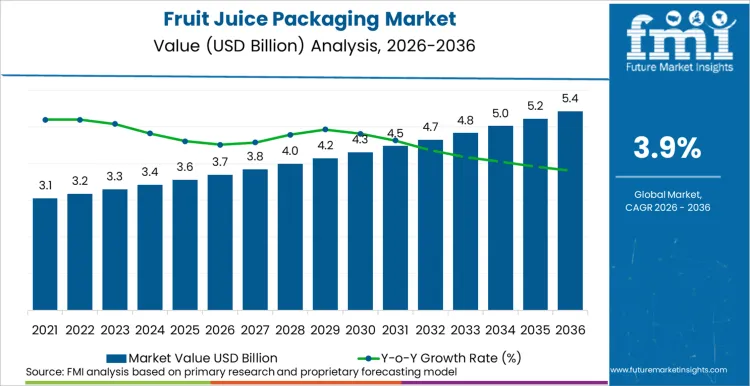
The global fruit juice packaging sector is on track to achieve a valuation of USD 5.5 billion by 2036, accelerating from USD 3.7 billion in 2026 at a CAGR of 3.9%. As per Future Market Insights, expansion is structurally underpinned by the sustained consumer shift toward packaged, shelf-stable juice formats and the regulatory push to eliminate aluminium and multi-material laminates from aseptic cartons. Tetra Pak, in collaboration with Spanish beverage leader Garcia Carrion, launched the first-ever juice portion pack featuring a paper-based barrier in December 2025, replacing the traditional aluminium foil layer and increasing renewable content to 92%.
This breakthrough compels packaging converters to move beyond incremental material substitution and invest in full-barrier paper-based technologies that can deliver ambient shelf life without fossil-fuel inputs. Simultaneously the regulatory landscape is shifting from voluntary sustainability targets to binding collection and recycling mandates which forces a major overhaul in packaging design across the supply chain.
Tatiana Liceti, EVP Packaging Solutions at Tetra Pak, stated: 'This launch represents a significant step in our journey towards fully renewable and recyclable packaging.' This alignment between material science capability and commercial deployment confirms that barrier innovation is no longer experimental but a central pillar of competitive strategy.
FMI opines that the operational reality for juice packaging converters is defined by the need to balance barrier performance with circularity. SIG announced the global commercial launch of SIG Terra Alu-free + Full barrier for multi-serve aseptic cartons in May 2025, targeting oxygen-sensitive products like fruit juices and reducing the carbon footprint by up to 61% compared to standard aseptic cartons.
Amcor completed its all-stock combination with Berry Global in April 2025, forming one of the largest consumer packaging entities with expanded capabilities in both flexible and rigid formats for the beverage sector. Ron Lewis, CEO of Ball Corporation, stated: 'In 2026, for North America specifically, quite frankly, we're sold out, and we are a bit capacity constrained until we can get our Millersburg asset up and running.' This confirms that supply tightness in aluminium cans is redirecting juice brands toward carton and flexible alternatives.
Key Takeaways
The fruit juice packaging market is controlled by a concentrated group of aseptic carton and can manufacturers, with Tetra Pak, SIG, and Ball Corporation holding decisive influence over format availability, material access, and pricing for juice brands globally.
Pricing asymmetry exists between converters who absorb raw material volatility in aluminium and polymer markets and juice brands who face rising packaging costs without proportional retail price pass-through, compressing brand margins in the mid-tier segment.
Sourcing fragility centers on aluminium supply concentration and the nascent state of paper-based barrier production, where a limited number of facilities globally can produce food-grade alu-free structures at commercial scale.
Brand and compliance risks are intensifying as the EU Single-Use Plastics Directive mandates separate collection targets for plastic bottles by 2025 and the PPWR introduces binding waste reduction targets, forcing reformulation of multi-material juice packs or risk losing shelf access in European retail.
Geographically, North America faces aluminium can capacity constraints driving carton substitution, Europe leads in regulatory mandates for renewable packaging, Asia Pacific benefits from rising per-capita juice consumption in India and Southeast Asia, and Latin America capitalizes on local fruit processing scale.
FMI analysts are of the opinion that the strategic reframing is the transition from aluminium-dependent aseptic structures to paper-based full-barrier systems, where the first movers in alu-free technology will capture premium positioning and regulatory compliance advantages.
Summary of Fruit Juice Packaging Market
What Is Growth Outlook for Fruit Juice Packaging Market as per Future Market Insights Projection?
Future Market Insights projects the fruit juice packaging industry to expand at a CAGR of 3.9% from 2026 to 2036, increasing from USD 3.7 Billion in 2026 to USD 5.5 Billion by 2036.
FMI Research Approach: FMI proprietary forecasting model based on juice production volumes and packaging format mix.
How Do FMI Analysts Perceive Fruit Juice Packaging Market to Evolve?
FMI analysts perceive the market evolving toward fully renewable barrier systems where paper-based aseptic structures replace aluminium laminates to meet binding EU waste reduction targets.
FMI Research Approach: Regulatory convergence under the EU PPWR and Single-Use Plastics Directive mandating collection and recycling targets.
Which Country Holds Largest Share in Global Fruit Juice Packaging Market?
The United States holds a significant share of the global fruit juice packaging market by value which is supported by aluminium can capacity constraints and the resulting acceleration in carton substitution.
FMI Research Approach: FMI country-level revenue modeling by production volumes and format share.
How Large Will Fruit Juice Packaging Market Be by 2036?
The global fruit juice packaging market is projected to reach USD 5.5 Billion by 2036.
FMI Research Approach: FMI long-term revenue forecast derived from juice consumption trends and material substitution modeling.
What Is Definition of Fruit Juice Packaging Market?
The fruit juice packaging market includes primary and secondary packaging solutions designed for fruit juices, nectars, and juice-based beverages, covering aseptic cartons, PET bottles, glass bottles, aluminium cans, flexible pouches, and associated closures.
FMI Research Approach: FMI market taxonomy and inclusion-exclusion framework.
What Are Globally Unique Trends Shaping Fruit Juice Packaging Market?
Globally unique trends include the commercialization of aluminium-free paper-based barriers for aseptic cartons, the capacity constraints in aluminium can production driving format switching, and the rise of certified recycled polymer content in PET juice bottles.
FMI Research Approach: Tetra Pak and SIG product disclosures and Ball Corporation capacity announcements.
Fruit Juice Packaging Market Key Takeaways
| Metric | Details |
|---|---|
| Industry Size (2026) | USD 3.7 Billion |
| Industry Value (2036) | USD 5.5 Billion |
| CAGR (2026 to 2036) | 3.9% |
Source: Future Market Insights (FMI) analysis, based on proprietary forecasting model and primary research
Semi Annual Market Update
The below table presents the expected CAGR for the global fruit juice packaging market over several semi-annual periods spanning from 2026 to 2036.
| Particular | Value CAGR |
|---|---|
| H1 | 3.7% (2025 to 2035) |
| H2 | 4.1% (2025 to 2035) |
| H1 | 2.9% (2026 to 2036) |
| H2 | 4.9% (2026 to 2036) |
In the first half (H1) of the decade from 2025 to 2035, the business is predicted to surge at a CAGR of 3.7%, followed by a slightly higher growth rate of 4.1% in the second half (H2) of the same decade. Moving into the subsequent period, from H1 2026 to H2 2036, the CAGR is projected to decrease slightly to 2.9% in the first half and remain relatively moderate at 4.9% in the second half. In the first half (H1) the market witnessed a decrease of 80 BPS while in the second half (H2), the market witnessed an increase of 80 BPS.
What Trends Are Shaping Industry Evolution?
The elimination of aluminium from aseptic carton structures is the defining material trend. Tetra Pak launched the first-ever juice portion pack with a paper-based barrier in December 2025, reducing the carbon footprint by 43% and increasing renewable content to 92%. SIG followed with the global commercial launch of Terra Alu-free + Full barrier for multi-serve aseptic cartons in May 2025, achieving a 61% carbon footprint reduction. These parallel launches confirm that alu-free technology has moved from pilot to production scale.
Consolidation among packaging converters is reshaping competitive dynamics. Amcor completed its all-stock combination with Berry Global in April 2025, creating a combined entity with an enterprise value of approximately USD 37 billion. Scott Fallon, GM Protein at Amcor Flexibles, stated: 'This investment reflects Amcor's long-term strategy for growth and our continued leadership in developing the next generation of high-performance and sustainable packaging.' This confirms that scale is now a prerequisite for competing in beverage packaging.
As per FMI, the regional diversification of juice packaging production is accelerating. Asahi Group Japan launched its first yeast-based beverage in SIG SmallBloc aseptic cartons in December 2025, and Benefitt launched Thailand's first high-protein UHT milk in SIG's on-the-go carton packs in January 2026. Ball Corporation's new aluminium can plant in Millersburg, Oregon, is scheduled for startup in the second half of 2026 to address North American capacity constraints.
Key Industry Highlights
Technological Advancement Boost the Demand for Fruit Juice Packaging
The technological evolutions of fruit juice are making the products safer, easier, and more eco-friendly for consumption. Some of the significant novelties include intelligent packaging whereby freshness indicators can be used, showing whether or not the juice can be consumed. This way, consumers trust the product and reduce waste.
The other trend is that lightweight materials, such as PET bottles, are lighter to manufacture and transport and will save energy and cost. Moreover, biodegradable materials like paper-based bottles are coming to minimize environmental impacts. Automation in packaging processes also improves efficiency and ensures that products are sealed properly and hygienically. Finally, packaged designs and resealing options are being developed to suit the modern consumer's need for portability and convenience. These technologies make packaging smarter, greener, and friendlier for consumers, fulfilling both customer needs and the requirements of the environment.
Health Awareness Propel Pushes the Market Growth of Fruit Juice Packaging
Juices satisfy the well-being and nourishment craze among consumers; beverages should bring vitamins, antioxidants, and hydrate. Believing in these ideas, even the fact that juices, natural, organic, or cold-pressed, have been believed to keep one on a healthy path. Increased demand for juices results from surges in the movements of healthy lifestyles, plant-based diets, and clean eating.
Juice with a focus on superfoods such as ginger, turmeric, or kale is taken in by customers, especially people doing exercises and for functional purposes, like having their immune systems improved or detoxed. Health promotion via juice with beneficial and pleasingly packaged packages for the juices would boost customer demand. With consumers taking their health-conscious life choices forward, the juice market remains on a boom, in tune with emerging lifestyles and preferences.
Fluctuation in Raw Material Cost May Restrict the Market
There is inflation in raw material costs, which impacts the production cost of fruit juice highly. A major input into the production is fruits, and their supply depends on seasonal availability. Climate change and crop diseases are also factors affecting prices generally. For example, bad weather reduces the harvest, hence raising the cost of such fruits to the producers.
In the same way, the prices of packaging materials like plastics (PET), glass, or cartons are a positive function of the global prices of oil, supply chain considerations, and the general move of consumers towards more sustainable options. Transportation costs, due to increased fuel prices and logistics issues, add to the increase in raw material costs.
2021 to 2025 Global Fruit Juice Packaging Sales Outlook Compared to Demand Forecast from 2026 to 2036
The fruit juice packaging market was witnessing steady growth between 2021 and 2025 due to the continuously increasing consumer demand for sustainable packaging. Sustainability attributes such as recyclable content and premium look helped the sale of fruit juice packaging better. Also, innovations like self-chilling cans and tamper-evident packaging are enhancing the convenience and safety aspects of the market.
In the assessment period, global demand for fruit juice packaging is expected to grow strongly. The drivers for this are mainly sustainability regulations, technological advancements, and consumer’s preference for convenience.
Market Concentration
Tier 1 companies comprise market leaders with significant market share in fruit juice packaging market. These market leaders are characterized by high production capacity and a wide product portfolio. These market leaders are distinguished by their extensive expertise in manufacturing across multiple packaging formats and a broad geographical reach, underpinned by a robust consumer base. They provide a wide range of series including recycling and manufacturing utilizing the latest technology and meeting the regulatory standards providing the highest quality. Prominent companies within tier 1 include Amcor Plc, Ball Corporation, Smurfit Kappa Group, Tetra Laval International S.A.
Tier 2 companies include mid-size players having presence in specific regions and highly influencing the local market. These are characterized by a strong presence overseas and strong market knowledge. These market players have good technology and ensure regulatory compliance but may not have advanced technology and wide global reach. Prominent companies in tier 2 include DS Smith Plc., Evergreen Packaging Inc., Tetra Pak International, Ester Industries Limited
Tier 3 includes the majority of small-scale companies operating at the local presence and serving niche markets. These companies are notably oriented towards fulfilling local market demands and are consequently classified within the tier 3 share segment. They are small-scale players and have limited geographical reach. Tier 3, within this context, is recognized as an unorganized market, denoting a sector characterized by a lack of extensive structure and formalization when compared to organized competitors.
Country-wise Insights
The section below covers the future forecast for the fruit juice packaging market in terms of countries. Information on key countries in several parts of the globe, including North America, Latin America, East Asia, South Asia and Pacific, Western Europe, Eastern Europe and MEA is provided. Canada is anticipated to remain at the forefront in North America, with a CAGR of 3.4% through 2036. In Europe, Spain is projected to witness a CAGR 3.3% by 2036.
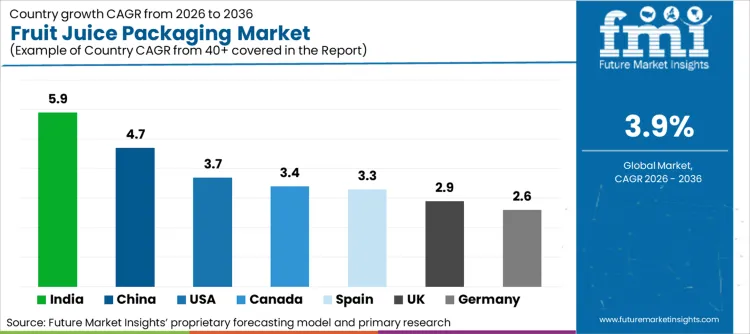
| Countries | Value CAGR (2026 to 2036) |
|---|---|
| USA | 3.7% |
| Germany | 2.6% |
| China | 4.7% |
| UK | 2.9% |
| Spain | 3.3% |
| India | 5.9% |
| Canada | 3.4% |
American Lifestyle Boosts Demand for Fruit Juice Market
The changing lifestyle of consumers in the USA, along with that of their consumption habits, provides growth for fruit juice. Changing lifestyles and work schedules have influenced the demand from consumers for fast, convenient-on-the-go food and beverage preparation and consumption - and fruit juices are no different. Consumers favor quick and simple ways to ingest their beverages: single-serve bottles, pouches, resalable, and ready-to-drink formats. Major drivers of health-conscious trends are also very important. The American consumer is now very concerned with nutrition and demands juices labelled as natural, organic, or fortified with functional benefits such as vitamins, antioxidants, and probiotics. Cold-pressed and fresh juices are also gaining popularity among people who lead healthy lifestyles.
Consumer Preference for Convenience in China Is Very Significantly Increasing Demand for Fruit Juices
The fast urban lifestyle and growing population of the middle-class demand quicker and easy-to-consumer products. Single-serve juice bottles, ready-to-drink pouches, and resalable packaging have high demand among busy professionals and on-the-go consumers. Increased e-commerce penetration into China has made it even more convenient. Online platforms have also made it easier for consumers to purchase juices directly from the comfort of their homes, with many brands offering delivery services and subscription models. Younger consumers in China also are attracted to novel and fashionable packages that are at the same time portable and good-looking. Clever packaging designs, such as eco-friendly designs or interactive elements with QR codes, appeal to smart buyers. With these preferences toward accessible, time-saving, and aesthetic options, growth in the fruit juice market can be seen.
Category-wise Insights
The section contains information about the leading segments in the industry. In terms of opening type, cap opening is estimated to account for a share of 49.2% by 2036. By material formats, plastic is projected to dominate by holding a share of 53.8% by the end 2036.
Reseal Ability Propel Accelerate the Market Growth
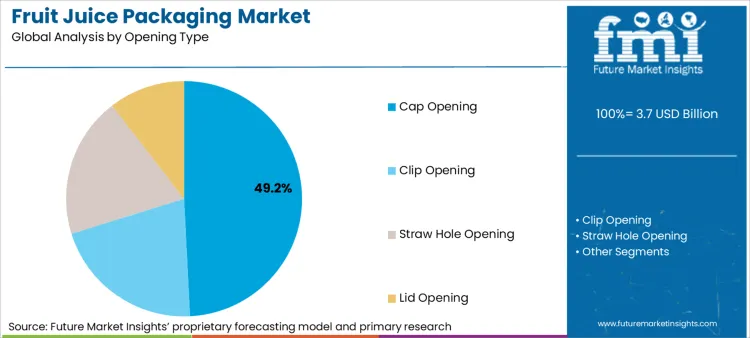
| Opening Type | Market Share (2036) |
|---|---|
| Cap Opening | 49.2% |
Cap opening is the largest in the fruit juice packaging market. It is practical, user-friendly, and versatile. Caps are reusable on plastic bottles and a few cartons, so this is highly convenient for a consumer who will not consume all the juice in one sitting. This retains the freshness and doesn't waste it. The caps are very strong, so nothing will spill. Good for use on the go, these products fit perfectly with the busy lives of modern humans.
Also easy to handle, it can be consumed by every age and is variable in size and shape according to the shape and size of bottles. From a manufacturing point of view, it is economical and thus compatible with automated packaging processes, ensuring that the makers are not wasting much time. It is also tamper-evident, which gives assurance to consumers about product safety.
Plastic’s Adaptability and Portability Make Them Popular in Fruit Juice Packaging
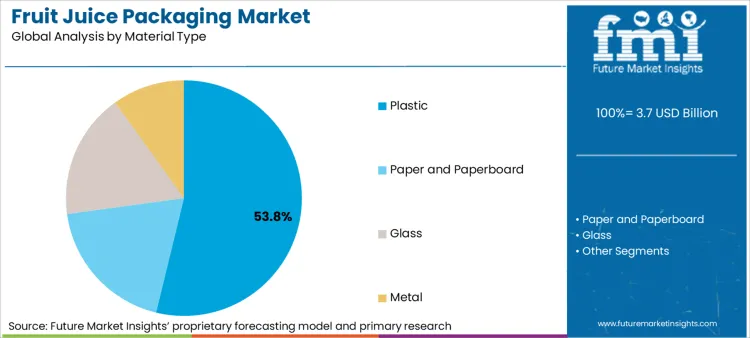
| Material Type | Market Share (2036) |
|---|---|
| Plastic | 53.8% |
Plastic bottles are light in weight and very resistant, which makes them easy to transport and handle without breakage. Therefore, shipping cost is lowered with the minimum loss of the product through breakage.
Plastic is much cheaper to manufacture and transport compared to alternatives like glass. As plastic has its effects on the environment, manufacturers still produce recyclable and biodegradable plastics as a way to rectify sustainability concerns. All factors, such as price, durability, convenience, and adaptability, make it the most-used packaging material of fruit juices internationally.
What Strategic Moves Are Defining Competitive Landscape?
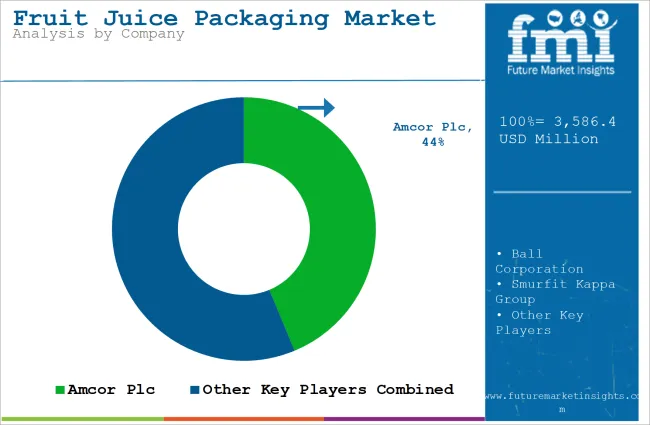
The competitive landscape is shaped by a dual strategy of material innovation and geographic capacity expansion. Amcor announced one of its largest investments to date in November 2025 to expand converting and printing capabilities in North America, with installation of new equipment to increase production through the first half of 2026. Ball Corporation entered into definitive agreements to acquire a majority stake in European beverage can manufacturer Benepack in December 2025, confirming the push to expand European aluminium can capacity.
Recent Developments:
- In December 2025, Tetra Pak launched the first-ever juice portion pack with a paper-based barrier in collaboration with Garcia Carrion, reducing carbon footprint by 43%.
- In May 2025, SIG announced the global commercial launch of SIG Terra Alu-free + Full barrier for multi-serve aseptic cartons targeting fruit juices.
- In April 2025, Amcor completed its all-stock combination with Berry Global, forming one of the largest consumer packaging entities globally.
Key Players in Fruit Juice Packaging Market
- Tetra Pak International S.A.
- SIG Group AG Ball Corporation Amcor plc Berry Global Group Inc.
- Ardagh Group S.A.
- Crown Holdings Inc.
- Huhtamaki Oyj Greatview Aseptic Packaging Co. Ltd.
- Elopak ASA
Market Definition
The fruit juice packaging market represents revenue generated from primary and secondary packaging solutions designed for fruit juices, nectars, and juice-based beverages. The market measures the value of aseptic cartons, PET bottles, glass bottles, aluminium cans, flexible pouches, and closures sold to juice producers and co-packers.
Inclusions cover packaging for 100% fruit juices, reconstituted juices, nectars, juice drinks, and smoothies. It includes materials such as paperboard, aluminium, PET, HDPE, glass, and bio-based polymers used in retail-facing applications. Packaging technologies such as aseptic filling, hot-fill, and cold-press are included.
Exclusions include bulk industrial juice concentrate packaging, intermediate bulk containers, and tertiary logistics packaging not intended for the retail consumer. Raw material procurement and upstream pulp or resin production are outside the scope.
Scope of Report
| Items | Values |
|---|---|
| Quantitative Units (2026) | USD 3.7 Billion |
| Product Type | Aseptic Cartons, PET Bottles, Glass Bottles, Aluminium Cans, Flexible Pouches |
| Material Type | Paperboard, Aluminium, PET, Glass, Bio-based Polymers |
| Regions Covered | North America, Europe, Asia Pacific, Latin America, Middle East & Africa |
| Key Companies Profiled | Tetra Pak, SIG, Ball Corporation, Amcor, Berry Global, Elopak |
Fruit Juice Packaging Market by Segments
By Product Type:
Aseptic Cartons PET Bottles Glass Bottles Aluminium Cans Flexible Pouches
By Material Type:
Paperboard Aluminium PET Glass Bio-based Polymers
By Region:
North America Europe East Asia South Asia Latin America Middle East and Africa
Bibliography
- Tetra Pak International S.A. (2025, December). Paper-based barrier for juice packaging launch. Tetra Pak Newsroom.
- SIG Group AG. (2025, May). SIG Terra Alu-free + Full barrier commercial launch. SIG Media.
- Ball Corporation. (2026, February). Fourth quarter and full year 2025 results and Millersburg plant update. Ball Investor Relations.
- Amcor plc. (2025, November). North American flexible packaging expansion announcement. Amcor Investor Relations.
Frequently Asked Questions
What is the current global market size for Fruit Juice Packaging?
The global market is valued at USD 3.7 Billion in 2026, driven by the shift toward paper-based aseptic barriers and sustained juice consumption growth.
What is the projected Compound Annual Growth Rate (CAGR) for the market over the next 10 years?
The market is projected to grow at a CAGR of 3.9% from 2026 to 2036.
Which regions are experiencing the fastest expansion?
Asia Pacific leads with rising per-capita juice consumption in India and Southeast Asia, while North America faces aluminium can capacity constraints driving carton adoption.
What are the primary market drivers?
The commercialization of aluminium-free paper-based barrier technology and binding EU recycling mandates are fueling adoption.
Who are the leading suppliers in the industry?
Tetra Pak, SIG, Ball Corporation, and Amcor are key players, differentiating through barrier material innovation and geographic capacity expansion.
Preview the report firsthand - request a free sample
Get SampleGet the brochure for pricing and purchase details.
Get PDFTable of Content
- Executive Summary
- Global Market Outlook
- Demand-side Trends
- Supply-side Trends
- Technology Roadmap Analysis
- Analysis and Recommendations
- Market Overview
- Market Coverage / Taxonomy
- Market Definition / Scope / Limitations
- Research Methodology
- Chapter Orientation
- Analytical Lens and Working Hypotheses
- Market Structure, Signals, and Trend Drivers
- Benchmarking and Cross-market Comparability
- Market Sizing, Forecasting, and Opportunity Mapping
- Research Design and Evidence Framework
- Desk Research Programme (Secondary Evidence)
- Company Annual and Sustainability Reports
- Peer-reviewed Journals and Academic Literature
- Corporate Websites, Product Literature, and Technical Notes
- Earnings Decks and Investor Briefings
- Statutory Filings and Regulatory Disclosures
- Technical White Papers and Standards Notes
- Trade Journals, Industry Magazines, and Analyst Briefs
- Conference Proceedings, Webinars, and Seminar Materials
- Government Statistics Portals and Public Data Releases
- Press Releases and Reputable Media Coverage
- Specialist Newsletters and Curated Briefings
- Sector Databases and Reference Repositories
- FMI Internal Proprietary Databases and Historical Market Datasets
- Subscription Datasets and Paid Sources
- Social Channels, Communities, and Digital Listening Inputs
- Additional Desk Sources
- Expert Input and Fieldwork (Primary Evidence)
- Primary Modes
- Qualitative Interviews and Expert Elicitation
- Quantitative Surveys and Structured Data Capture
- Blended Approach
- Why Primary Evidence is Used
- Field Techniques
- Interviews
- Surveys
- Focus Groups
- Observational and In-context Research
- Social and Community Interactions
- Stakeholder Universe Engaged
- C-suite Leaders
- Board Members
- Presidents and Vice Presidents
- R&D and Innovation Heads
- Technical Specialists
- Domain Subject-matter Experts
- Scientists
- Physicians and Other Healthcare Professionals
- Governance, Ethics, and Data Stewardship
- Research Ethics
- Data Integrity and Handling
- Primary Modes
- Tooling, Models, and Reference Databases
- Desk Research Programme (Secondary Evidence)
- Data Engineering and Model Build
- Data Acquisition and Ingestion
- Cleaning, Normalisation, and Verification
- Synthesis, Triangulation, and Analysis
- Quality Assurance and Audit Trail
- Market Background
- Market Dynamics
- Drivers
- Restraints
- Opportunity
- Trends
- Scenario Forecast
- Demand in Optimistic Scenario
- Demand in Likely Scenario
- Demand in Conservative Scenario
- Opportunity Map Analysis
- Product Life Cycle Analysis
- Supply Chain Analysis
- Investment Feasibility Matrix
- Value Chain Analysis
- PESTLE and Porter’s Analysis
- Regulatory Landscape
- Regional Parent Market Outlook
- Production and Consumption Statistics
- Import and Export Statistics
- Market Dynamics
- Global Market Analysis 2021 to 2025 and Forecast, 2026 to 2036
- Historical Market Size Value (USD Million) Analysis, 2021 to 2025
- Current and Future Market Size Value (USD Million) Projections, 2026 to 2036
- Y-o-Y Growth Trend Analysis
- Absolute $ Opportunity Analysis
- Global Market Pricing Analysis 2021 to 2025 and Forecast 2026 to 2036
- Global Market Analysis 2021 to 2025 and Forecast 2026 to 2036, By Opening Type
- Introduction / Key Findings
- Historical Market Size Value (USD Million) Analysis By Opening Type , 2021 to 2025
- Current and Future Market Size Value (USD Million) Analysis and Forecast By Opening Type , 2026 to 2036
- Cap Opening
- Clip Opening
- Straw Hole Opening
- Lid Opening
- Cap Opening
- Y-o-Y Growth Trend Analysis By Opening Type , 2021 to 2025
- Absolute $ Opportunity Analysis By Opening Type , 2026 to 2036
- Global Market Analysis 2021 to 2025 and Forecast 2026 to 2036, By Material Type
- Introduction / Key Findings
- Historical Market Size Value (USD Million) Analysis By Material Type, 2021 to 2025
- Current and Future Market Size Value (USD Million) Analysis and Forecast By Material Type, 2026 to 2036
- Plastic
- Paper and Paperboard
- Glass
- Metal
- Plastic
- Y-o-Y Growth Trend Analysis By Material Type, 2021 to 2025
- Absolute $ Opportunity Analysis By Material Type, 2026 to 2036
- Global Market Analysis 2021 to 2025 and Forecast 2026 to 2036, By Region
- Introduction
- Historical Market Size Value (USD Million) Analysis By Region, 2021 to 2025
- Current Market Size Value (USD Million) Analysis and Forecast By Region, 2026 to 2036
- North America
- Latin America
- Western Europe
- Eastern Europe
- East Asia
- South Asia and Pacific
- Middle East & Africa
- Market Attractiveness Analysis By Region
- North America Market Analysis 2021 to 2025 and Forecast 2026 to 2036, By Country
- Historical Market Size Value (USD Million) Trend Analysis By Market Taxonomy, 2021 to 2025
- Market Size Value (USD Million) Forecast By Market Taxonomy, 2026 to 2036
- By Country
- USA
- Canada
- Mexico
- By Opening Type
- By Material Type
- By Country
- Market Attractiveness Analysis
- By Country
- By Opening Type
- By Material Type
- Key Takeaways
- Latin America Market Analysis 2021 to 2025 and Forecast 2026 to 2036, By Country
- Historical Market Size Value (USD Million) Trend Analysis By Market Taxonomy, 2021 to 2025
- Market Size Value (USD Million) Forecast By Market Taxonomy, 2026 to 2036
- By Country
- Brazil
- Chile
- Rest of Latin America
- By Opening Type
- By Material Type
- By Country
- Market Attractiveness Analysis
- By Country
- By Opening Type
- By Material Type
- Key Takeaways
- Western Europe Market Analysis 2021 to 2025 and Forecast 2026 to 2036, By Country
- Historical Market Size Value (USD Million) Trend Analysis By Market Taxonomy, 2021 to 2025
- Market Size Value (USD Million) Forecast By Market Taxonomy, 2026 to 2036
- By Country
- Germany
- UK
- Italy
- Spain
- France
- Nordic
- BENELUX
- Rest of Western Europe
- By Opening Type
- By Material Type
- By Country
- Market Attractiveness Analysis
- By Country
- By Opening Type
- By Material Type
- Key Takeaways
- Eastern Europe Market Analysis 2021 to 2025 and Forecast 2026 to 2036, By Country
- Historical Market Size Value (USD Million) Trend Analysis By Market Taxonomy, 2021 to 2025
- Market Size Value (USD Million) Forecast By Market Taxonomy, 2026 to 2036
- By Country
- Russia
- Poland
- Hungary
- Balkan & Baltic
- Rest of Eastern Europe
- By Opening Type
- By Material Type
- By Country
- Market Attractiveness Analysis
- By Country
- By Opening Type
- By Material Type
- Key Takeaways
- East Asia Market Analysis 2021 to 2025 and Forecast 2026 to 2036, By Country
- Historical Market Size Value (USD Million) Trend Analysis By Market Taxonomy, 2021 to 2025
- Market Size Value (USD Million) Forecast By Market Taxonomy, 2026 to 2036
- By Country
- China
- Japan
- South Korea
- By Opening Type
- By Material Type
- By Country
- Market Attractiveness Analysis
- By Country
- By Opening Type
- By Material Type
- Key Takeaways
- South Asia and Pacific Market Analysis 2021 to 2025 and Forecast 2026 to 2036, By Country
- Historical Market Size Value (USD Million) Trend Analysis By Market Taxonomy, 2021 to 2025
- Market Size Value (USD Million) Forecast By Market Taxonomy, 2026 to 2036
- By Country
- India
- ASEAN
- Australia & New Zealand
- Rest of South Asia and Pacific
- By Opening Type
- By Material Type
- By Country
- Market Attractiveness Analysis
- By Country
- By Opening Type
- By Material Type
- Key Takeaways
- Middle East & Africa Market Analysis 2021 to 2025 and Forecast 2026 to 2036, By Country
- Historical Market Size Value (USD Million) Trend Analysis By Market Taxonomy, 2021 to 2025
- Market Size Value (USD Million) Forecast By Market Taxonomy, 2026 to 2036
- By Country
- Kingdom of Saudi Arabia
- Other GCC Countries
- Turkiye
- South Africa
- Other African Union
- Rest of Middle East & Africa
- By Opening Type
- By Material Type
- By Country
- Market Attractiveness Analysis
- By Country
- By Opening Type
- By Material Type
- Key Takeaways
- Key Countries Market Analysis
- USA
- Pricing Analysis
- Market Share Analysis, 2025
- By Opening Type
- By Material Type
- Canada
- Pricing Analysis
- Market Share Analysis, 2025
- By Opening Type
- By Material Type
- Mexico
- Pricing Analysis
- Market Share Analysis, 2025
- By Opening Type
- By Material Type
- Brazil
- Pricing Analysis
- Market Share Analysis, 2025
- By Opening Type
- By Material Type
- Chile
- Pricing Analysis
- Market Share Analysis, 2025
- By Opening Type
- By Material Type
- Germany
- Pricing Analysis
- Market Share Analysis, 2025
- By Opening Type
- By Material Type
- UK
- Pricing Analysis
- Market Share Analysis, 2025
- By Opening Type
- By Material Type
- Italy
- Pricing Analysis
- Market Share Analysis, 2025
- By Opening Type
- By Material Type
- Spain
- Pricing Analysis
- Market Share Analysis, 2025
- By Opening Type
- By Material Type
- France
- Pricing Analysis
- Market Share Analysis, 2025
- By Opening Type
- By Material Type
- India
- Pricing Analysis
- Market Share Analysis, 2025
- By Opening Type
- By Material Type
- ASEAN
- Pricing Analysis
- Market Share Analysis, 2025
- By Opening Type
- By Material Type
- Australia & New Zealand
- Pricing Analysis
- Market Share Analysis, 2025
- By Opening Type
- By Material Type
- China
- Pricing Analysis
- Market Share Analysis, 2025
- By Opening Type
- By Material Type
- Japan
- Pricing Analysis
- Market Share Analysis, 2025
- By Opening Type
- By Material Type
- South Korea
- Pricing Analysis
- Market Share Analysis, 2025
- By Opening Type
- By Material Type
- Russia
- Pricing Analysis
- Market Share Analysis, 2025
- By Opening Type
- By Material Type
- Poland
- Pricing Analysis
- Market Share Analysis, 2025
- By Opening Type
- By Material Type
- Hungary
- Pricing Analysis
- Market Share Analysis, 2025
- By Opening Type
- By Material Type
- Kingdom of Saudi Arabia
- Pricing Analysis
- Market Share Analysis, 2025
- By Opening Type
- By Material Type
- Turkiye
- Pricing Analysis
- Market Share Analysis, 2025
- By Opening Type
- By Material Type
- South Africa
- Pricing Analysis
- Market Share Analysis, 2025
- By Opening Type
- By Material Type
- USA
- Market Structure Analysis
- Competition Dashboard
- Competition Benchmarking
- Market Share Analysis of Top Players
- By Regional
- By Opening Type
- By Material Type
- Competition Analysis
- Competition Deep Dive
- Amcor Plc
- Overview
- Product Portfolio
- Profitability by Market Segments (Product/Age /Sales Channel/Region)
- Sales Footprint
- Strategy Overview
- Marketing Strategy
- Product Strategy
- Channel Strategy
- Ball Corporation
- Smurfit Kappa Group
- Tetra Laval International S.A.
- DS Smith Plc.
- Evergreen Packaging Inc.
- Amcor Plc
- Competition Deep Dive
- Assumptions & Acronyms Used


