

- Industry Size (2026)
- USD 748 Mn
- Forecast (2036)
- USD 1940.1 Mn
- CAGR (2026 to 2036)
- 10.0%
PLA-PHA Co-Polyester Fibers Market Forecast and Outlook 2026 to 2036
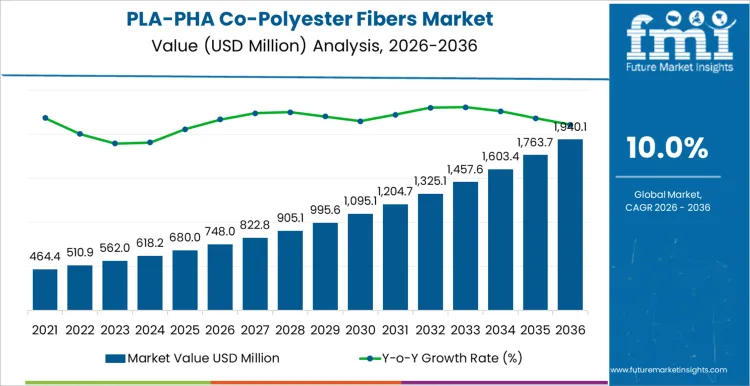
Measured at USD 748 million at the opening of 2026, the PLA-PHA co-polyester fibers market is projected to reach USD 1,940.1 million by 2036 at a 10.0% CAGR. Demand is shaped by compostability claims, melt behavior, and mechanical retention within nonwovens, packaging substrates, and molded fiber structures. Product teams set blend ratios, crystallization windows, and draw limits during material definition. Approved constructions remain fixed across program lifetimes because certification scope and performance guarantees attach to specific recipes. Volume growth follows adoption in hygiene, food service, and filtration where disposal pathways and labeling rules guide material choice and portfolio planning cycles.
Specification control defines participation in the PLA–PHA co-polyester fibers market through approved constructions, certification files, and customer material lists. Entry depends on documented compostability outcomes, tensile retention, and process window stability under production conditions.
Product families persist across extended cycles since relabeling and recertification carry cost and timing risk. Supplier rotation occurs during platform refresh events tied to portfolio resets. Revenue expansion tracks the count of lines converted to bio-based structures rather than price movement. Competitive position reflects access to early design stages and continuity inside standardized specifications. Investment priorities center on feedstock contracts, compounding capacity, and quality documentation systems.
PLA–PHA Co-Polyester Fibers Market Quick Stats
- PLA–PHA Co-Polyester Fibers Market Value (2026): USD 748 million
- PLA–PHA Co-Polyester Fibers Market Forecast Value (2036): USD 1,940.1 million
- PLA–PHA Co-Polyester Fibers Market Forecast CAGR (2026–2036): 10.0%
- Leading Type in PLA–PHA Co-Polyester Fibers Market: PLA-rich blends
- Key Growth Regions in PLA–PHA Co-Polyester Fibers Market: China, USA, Germany, South Korea, Japan
- Top Players in PLA–PHA Co-Polyester Fibers Market: NatureWorks, Danimer Scientific, TotalEnergies Corbion, Mitsubishi Chemical Group, Far Eastern New Century, Indorama Ventures, Toray Industries, Teijin, Sukano, Biome Bioplastics
What is the Growth Forecast for the PLA PHA Co Polyester Fibers Market through 2036?
The PLA PHA co polyester fibers market in 2026 stands near USD 748.0 million, anchored in applications where controlled degradation and process stability share equal weight. Buyers evaluate these fibers through spinning behavior, draw stability, bonding response, and consistency across long campaigns. Product adoption depends on how well the material runs on existing lines rather than on theoretical material benefits. Approval work focuses on web formation, tensile retention, and behavior during thermal bonding or calendaring. Volume builds inside hygiene, wipes, filtration, and lightweight technical fabrics that carry defined disposal pathways. The climb toward USD 1,940.1 million in 2036 aligns with a 10.0% growth profile supported by broader platform inclusion and higher fiber content per square meter in finished structures.
Commercial execution shapes supplier positioning in the PLA PHA co polyester fibers market. Orders track program lifetimes, tender awards, and multi month production schedules. Inventory planning favors continuity of certified grades and predictable lot performance. Cost structure reflects polymer sourcing, spinning yield, filtration load, and quality inspection intensity. Technical teams at converter sites prioritize stable running speeds, low break rates, and uniform bonding outcomes. Annual values move through the low and mid one billions during the early 2030s as more product families shift base recipes. The rise to USD 1,940.1 million in 2036 comes from thicker constructions, wider use across disposables and technical webs, and longer supply agreements that place this fiber type into fixed material specifications across multiple production lines.
PLA–PHA Co-Polyester Fibers Market Key Takeaways
| Metric | Value |
|---|---|
| Market Value (2026) | USD 748 million |
| Forecast Value (2036) | USD 1,940.1 million |
| Forecast CAGR (2026–2036) | 10.0% |
How Is the PLA–PHA Co Polyester Fibers Market Being Positioned for Process Control and End Use Certification in Regulated Textile Chains?
The PLA–PHA co polyester fibers market is specified inside production systems that already rely on compostable polymer feedstocks, biodegradable textile filaments, fiber melt spinning operations, industrial compostability certification, medical and hygiene nonwovens, sustainable apparel yarns, and controlled waste collection systems. Producers use these fibers to balance mechanical performance with defined breakdown behavior. Qualification focuses on melt stability, draw ratio tolerance, and crystallization control because small shifts change tenacity and elongation. Spinning lines track pressure, quench balance, and filament cohesion since each affects downstream winding and conversion yield. Converters review bonding response and surface behavior in fabric formation. Purchasing teams examine certificate scope, resin origin, and batch traceability because nonconforming material blocks shipment approval and downstream compliance claims.
The PLA–PHA co polyester fibers market is managed through audit survival and process repeatability rather than material novelty. Programs tied to compostable polymer feedstocks depend on stable formulation windows and documented sourcing. Lines serving biodegradable textile filaments measure value through roll consistency and inspection acceptance. Integration with fiber melt spinning operations links material choice to uptime and break frequency. Oversight by industrial compostability certification fixes allowable drift in composition and performance. Supply into medical and hygiene nonwovens places weight on consistency and contamination control. Use in sustainable apparel yarns connects fiber behavior to dyeing yield and finishing losses. Interaction with controlled waste collection systems shapes labeling and segregation rules. Contracts define acceptance limits for viscosity, strength, and disintegration behavior because release decisions depend on documented conformity rather than internal judgment.
How do property balancing requirements and cost envelopes shape demand in the PLA–PHA Co-Polyester Fibers Market by blend ratio and application in 2026?
In the PLA–PHA Co-Polyester Fibers Market, specification files define blend choice before purchasing begins. Engineers set targets for stiffness, tear growth, and recovery, then choose ratios that run inside existing spinning and bonding limits. Demand comes from nonwoven web forming lines, flexible packaging converting, and agricultural textile fabrication, where small shifts in stress–strain behavior change yield. By blend ratio, use spans PLA-rich, balanced, PHA-rich, and other systems. By application, demand covers hygiene and disposable textiles, packaging and agriculture, apparel and technical textiles, and other uses. Once a ratio enters drawings, tooling, and audit records, change triggers trials and re-approvals only.
Why do PLA-rich blends dominate programs that prioritize dimensional control?
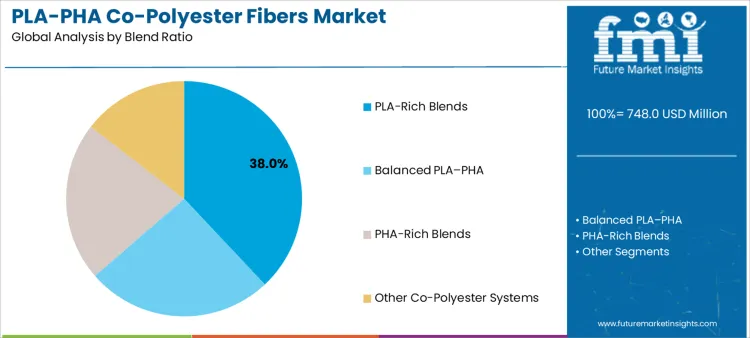
PLA-rich blends account for about 38% of demand because they preserve dimensional control while adding limited ductility. These ratios keep draw stability and filament placement predictable on high-speed lines. Balanced systems move the window toward toughness for folding and puncture.
PHA-rich systems push flexibility for products that must bend repeatedly. Other constructions stay tied to narrow equipment envelopes. Teams screen ratios using creep under load, tear propagation, and recovery after compression. Process groups also watch break frequency, winding tension, and bonding response. A ratio that passes these checks becomes standard for years across multiple product families and approved platforms globally.
Once a ratio is selected, it becomes embedded in spinneret geometry, draw profiles, and bonding settings. Changing the ratio forces new temperature maps, new witness tests, and new downstream parameters. Documentation must be refreshed to keep claims aligned with shipping labels. Production plans then protect the approved window with dedicated schedules.
Inventory rules follow to avoid mixing lots. Engineering sign-off becomes the pacing item for any alteration. The result is incremental tuning inside the same family with infrequent chemistry rebalancing. Capacity additions repeat the ratio across positions while scheduling protects changeover risk and maintains audited shipping cadence globally at scale.
How do end-use mechanics and converting routes define where each blend is used?
Hygiene and disposable textiles represent about 30% of demand because converters need predictable web formation and stable cutting at high speed. Excess ductility causes edge wander and nesting errors. Excess stiffness creates cracking during folding and packing. Approval files link basis weight, tensile, and disintegration results to lot identity. Packaging and agriculture follow where puncture resistance and flex life matter during handling and storage. Apparel and technical textiles accept softer systems where drape and fatigue resistance define value. Other uses remain tied to narrow machinery windows. Converters sign off through forming speed, bonding response, and downstream scrap rates per shipment.
Once an application route is approved, schedules and tooling are written around that choice. Switching fibers resets trials, updates control plans, and triggers customer sign-offs. Planning then assigns dedicated slots to protect repeatability. Service teams define inspection intervals that assume the same behavior over time.
Sales commits to lead times based on stable yields. The commercial result favors scale over experimentation. Capacity grows by adding width and shifts. Tooling life improves with fewer changeovers. Demand follows routes where acceptance depends on process discipline and documentation, with purchasing cycles playing a minor role during multi-year supply programs with fixed specifications globally.
Why Are Performance and End-Use Requirements Supporting the PLA–PHA Co-Polyester Fibers Market?
PLA–PHA Co-Polyester Fibers Market demand is increasing because product developers require fibers that combine predictable mechanical properties with controlled degradation profiles for targeted lifecycle requirements. Combining polylactic acid (PLA) with polyhydroxyalkanoate (PHA) results in fibers with balanced strength, elongation, and processability suitable for nonwovens, woven textiles, and technical yarn applications. Brands and converters specify PLA–PHA co-polyester because it helps maintain production throughput on melt spinning and bonding lines without significant equipment changes. Buyers evaluate melt flow behavior, thermal window compatibility, and consistency across batches to ensure reliable line performance and finished product quality.
What Constraints Are Affecting Adoption in the PLA–PHA Co-Polyester Fibers Market?
PLA–PHA Co-Polyester Fibers Market growth is limited by raw material cost differentials, process integration challenges, and qualification timelines required by converters and OEM buyers. PLA and PHA polymers exhibit distinct thermal and rheological behavior compared with conventional polyesters, requiring careful alignment of melt temperature, draw ratio, quenching, and bonding settings to achieve target fiber properties. Cost per unit remains higher than commodity polyester, which affects price-sensitive segments such as mass-market apparel and consumer nonwovens. Variability in feedstock supply and polymer purity can influence melt stability and filament consistency, increasing testing cycles and delaying rollout in high volume product lines.
How Are Product Offerings and Commercial Practices Shaping the PLA–PHA Co-Polyester Fibers Market?
PLA–PHA Co-Polyester Fibers Market product strategies focus on grade segmentation defined by melt point windows, modulus targets, and conversion performance metrics that align with existing production equipment. Fiber suppliers provide detailed processing maps that link melt conditions to draw ratios and mechanical outcomes, helping converters reduce trial runs. Portfolio organization around core performance buckets streamlines selection for hygiene, packaging, and technical textile applications. Commercially, companies are securing feedstock volumes through forward purchase agreements to stabilize pricing and supply continuity. Technical support emphasizes line setup, defect reduction, and throughput optimization, enabling converters to maintain productivity while integrating these co-polyester fibers into established workflows.
What is the Demand for PLA PHA Co Polyester Fibers by Country?
| Country | CAGR (%) |
|---|---|
| USA | 9.7% |
| Japan | 8.5% |
| South Korea | 9.2% |
| Germany | 9.6% |
| China | 11.2% |
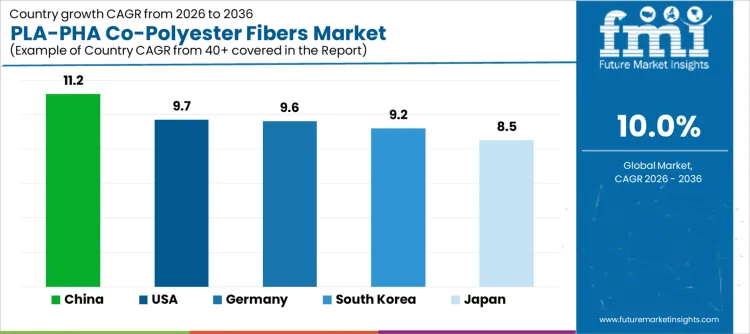
The demand for PLA PHA co polyester fibers is increasing across packaging, hygiene, and technical textile applications where material origin and end of life options influence material selection. China leads at 11.2% CAGR, supported by scale driven production of bio based fibers and strong integration with nonwoven and packaging value chains. The USA grows at 9.7%, driven by adoption in compostable nonwovens, specialty packaging, and consumer products. Germany records 9.6%, shaped by technical textile and packaging producers seeking certified bio based materials. South Korea advances at 9.2%, reflecting steady demand in hygiene and industrial nonwovens. Japan posts 8.5%, within a mature but quality focused fiber manufacturing environment.
How Do Polymer Qualification Protocols Shape Buying in the PLA–PHA Co-Polyester Fibers Market in the USA?
In the United States, the PLA–PHA Co-Polyester Fibers Market is advancing in line with a 9.7% CAGR. Adoption is governed by polymer qualification protocols that define acceptable melt behavior, crystallization control, and mechanical stability on production lines. Process owners evaluate tensile retention, elongation balance, thermal response, and spinning consistency before any material is released for routine use. Once a fiber grade clears these trials, the same approval package anchors downstream audits and material substitution remains rare. Volume increases only when approved textile and nonwoven programs secure new contracts. Technical committees retain authority over any change request. Supplier access depends on documentation depth and audit performance. Inventory planning follows line schedules rather than opportunistic demand. Commercial success depends on specification entry and repeatable batch behavior across several production sites.
How Do Manufacturing Control Systems Govern Adoption in the PLA–PHA Co-Polyester Fibers Market in Japan?
Within Japanese operations, material governance is directing the PLA–PHA Co-Polyester Fibers Market along a trajectory consistent with an 8.5% CAGR. Fiber selection is treated as a manufacturing control variable rather than as a procurement choice. Any proposed change enters a formal review cycle that includes extended spinning stability checks and yarn uniformity assessments. Engineers examine filament consistency, drawability, thermal response, and tolerance to speed variation. Once approved, the same fiber remains embedded in identical constructions for extended production cycles. Change requests trigger complete revalidation procedures. Supplier access depends on documentation completeness and inspection outcomes. Local sources benefit from proximity to audit teams and quality oversight groups. Volume growth follows gradual portfolio renewal rather than replacement programs. Commercial positioning relies on consistency, procedural discipline, and sustained process support over long operating periods.
How Do Platform Material Definitions Drive Scale in the PLA–PHA Co-Polyester Fibers Market in South Korea?
Product platform governance explains why the PLA–PHA Co-Polyester Fibers Market in South Korea is progressing in line with a 9.2% CAGR. Development organizations define standard polymer sets that apply across several product families. A single fiber decision can influence multiple lines without separate approvals. Evaluation centers on melt stability, orientation control, surface quality, and run speed tolerance. When a fiber enters the platform baseline, scale follows through synchronized product introductions. Plant level changes remain limited because the platform file governs material use. Suppliers secure positions through joint trials and alignment with documentation requirements. Volume growth mirrors platform rollout schedules. Inventory planning aligns with coordinated start-up programs. Commercial success depends on early inclusion in platform definitions and stable execution during multi-line production deployments across several manufacturing locations.
How Do Central Approval Structures Control Material Choice in the PLA–PHA Co-Polyester Fibers Market in Germany?
In Germany, corporate technical governance is directing the PLA–PHA Co-Polyester Fibers Market in accordance with a 9.6% CAGR. Material access is controlled through central approval registers that apply across multiple sites. Individual plants do not possess authority to introduce new fibers independently. Reviews focus on reproducibility, processing stability, and audit completeness across operations. After approval, the same fiber grade is released for use in several factories under identical process rules. Volume expansion follows program growth rather than local purchasing initiatives. Supplier positioning depends on audit performance and documentation discipline. Change control remains formal and closely supervised. Inventory policies reflect coordinated production planning. Commercial success depends on passing central reviews and maintaining identical behavior across distributed manufacturing environments over extended production cycles.
How Do Replication Programs Create Scale in the PLA–PHA Co-Polyester Fibers Market in China?
Replication across manufacturing networks explains why the PLA–PHA Co-Polyester Fibers Market in China is advancing in line with an 11.2% CAGR. Once a fiber performs within defined spinning and throughput limits in one plant, it is transferred into parallel lines with limited redesign. Approval focuses on consistency and tolerance to high speed operation rather than incremental optimization. Expansion teams rely on standardized process transfer files and commissioning checklists. Domestic suppliers dominate because they can follow capacity additions and line relocations. Imports remain concentrated in higher specification applications. Volume growth results from repeating approved constructions across sites. Commercial advantage depends on being present when a construction becomes a reference template rather than competing for each individual production line.
How Do Suppliers Compete in the PLA–PHA Co-Polyester Fibers Market?
Performance in the PLA–PHA Co-Polyester Fibers Market is driven by biodegradability, mechanical properties, and processing stability rather than catalog breadth. NatureWorks, Danimer Scientific, TotalEnergies Corbion, Mitsubishi Chemical Group, Far Eastern New Century, Indorama Ventures, Toray Industries, Teijin, Sukano, and Biome Bioplastics compete during fiber development, pilot spinning, and industrial integration stages. Once a fiber is incorporated into nonwovens, textiles, or specialty applications, filament uniformity, thermal behavior, and bio-content certification anchor supplier adoption. NatureWorks supplies PLA-PHA fibers through partner networks for compostable applications. Danimer Scientific focuses on flexible, biodegradable fibers for packaging and hygiene. TotalEnergies Corbion provides polymer blends optimized for fiber extrusion. Mitsubishi Chemical and Far Eastern New Century target high-performance applications requiring process-stable fibers. Indorama Ventures and Toray Industries supply fibers for durable textiles. Teijin delivers fibers for specialty industrial applications. Sukano and Biome Bioplastics focus on polymer additives and formulations to enhance processability and sustainability.
Thermal stability, fiber consistency, and sustainability compliance define competitive positioning in the PLA–PHA Co-Polyester Fibers Market rather than pricing. Engineers assess tensile strength, elongation, melt behavior, filament diameter, and biodegradation rate during qualification. Production teams favor suppliers capable of reproducible lots, scalable output, and integration support. NatureWorks secures adoption through traceable bio-content and technical service. Danimer Scientific holds share in hygiene and flexible packaging applications. TotalEnergies Corbion competes in programs requiring predictable polymer blends. Mitsubishi Chemical and Far Eastern New Century maintain positions in industrial fiber applications. Indorama Ventures and Toray Industries capture adoption in durable textile programs. Teijin supports specialty industrial fibers requiring high thermal and mechanical performance. Sukano and Biome Bioplastics gain adoption through additive solutions improving extrusion and fiber processing. Market positions vary by fiber composition, application, process method, and regulatory standards for biodegradability.
Key Players in PLA–PHA Co-Polyester Fibers Market
- NatureWorks
- Danimer Scientific
- TotalEnergies Corbion
- Mitsubishi Chemical Group
- Far Eastern New Century
- Indorama Ventures
- Toray Industries
- Teijin
- Sukano
- Biome Bioplastics
Scope of the Report
| Items | Values |
|---|---|
| Quantitative Units (2026) | USD million |
| Blend Ratio | PLA-rich blends, balanced PLA–PHA systems, PHA-rich blends, other co-polyester systems |
| Application | Hygiene and disposable textiles, packaging and agriculture, apparel and technical textiles, other uses |
| Processing Route | Staple fiber, filament and yarn, nonwoven and meltblown |
| End Sector | Consumer and personal care, industrial and agriculture, other sectors |
| Regions Covered | Asia Pacific, Europe, North America, Latin America, Middle East & Africa |
| Countries Covered | United States, Canada, Mexico, Germany, United Kingdom, France, Italy, Spain, Nordics, BENELUX, China, Japan, South Korea, India, Australia & New Zealand, ASEAN, Brazil, Chile, Saudi Arabia, Turkey, South Africa, and other regional markets |
| Key Companies Profiled | NatureWorks, Danimer Scientific, TotalEnergies Corbion, Mitsubishi Chemical Group, Far Eastern New Century, Indorama Ventures, Toray Industries, Teijin, Sukano, Biome Bioplastics |
| Additional Attributes | Dollar sales by blend ratio, application, processing route, and end sector, audit- and certification-driven procurement frameworks, integration into melt spinning, nonwoven, and textile production lines, processing constraints linked to melt stability, drawability, and crystallization control, lot traceability and compostability claim documentation requirements, substitution of conventional polyesters in hygiene, packaging, and technical textiles, long qualification cycles tied to product architecture and labeling scope, and regional demand patterns linked to replication of approved constructions across multi-site manufacturing networks |
PLA–PHA Co-Polyester Fibers Market Segmentation
Blend Ratio:
- PLA-Rich Blends
- Balanced PLA–PHA
- PHA-Rich Blends
- Other Co-Polyester Systems
Application:
- Hygiene & Disposable Textiles
- Packaging & Agriculture
- Apparel & Technical Textiles
- Other Uses
Processing Route:
- Staple Fiber
- Filament & Yarn
- Nonwoven & Meltblown
End Sector:
- Consumer & Personal Care
- Industrial & Agriculture
- Other Sectors
Region:
- Asia Pacific
- China
- Japan
- South Korea
- India
- Australia & New Zealand
- ASEAN
- Rest of Asia Pacific
- Europe
- Germany
- United Kingdom
- France
- Italy
- Spain
- Nordic
- BENELUX
- Rest of Europe
- North America
- United States
- Canada
- Mexico
- Latin America
- Brazil
- Chile
- Rest of Latin America
- Middle East & Africa
- Kingdom of Saudi Arabia
- Other GCC Countries
- Turkey
- South Africa
- Other African Union
- Rest of Middle East & Africa
Bibliography
- International Organization for Standardization. (2023). ISO 20200:2023—Plastics—Determination of the degree of disintegration of plastic materials under composting conditions in a laboratory‑scale test. International Organization for Standardization.
- United Nations Environment Programme. (2024). Global waste management outlook 2024. United Nations Environment Programme.
- Organisation for Economic Co‑operation and Development. (2024). Policy scenarios for eliminating plastic pollution by 2040. OECD Publishing.
- Organisation for Economic Co‑operation and Development. (2025). Regional plastics outlook for Southeast and East Asia. OECD Publishing.
Preview the report firsthand - request a free sample
Get SampleGet the brochure for pricing and purchase details.
Get PDFTable of Content
- Executive Summary
- Global Market Outlook
- Demand-side Trends
- Supply-side Trends
- Technology Roadmap Analysis
- Analysis and Recommendations
- Market Overview
- Market Coverage / Taxonomy
- Market Definition / Scope / Limitations
- Market Background
- Market Dynamics
- Drivers
- Restraints
- Opportunity
- Trends
- Scenario Forecast
- Demand in Optimistic Scenario
- Demand in Likely Scenario
- Demand in Conservative Scenario
- Opportunity Map Analysis
- Product Life Cycle Analysis
- Supply Chain Analysis
- Investment Feasibility Matrix
- Value Chain Analysis
- PESTLE and Porter’s Analysis
- Regulatory Landscape
- Regional Parent Market Outlook
- Production and Consumption Statistics
- Import and Export Statistics
- Market Dynamics
- Global Market Analysis 2021 to 2025 and Forecast, 2026 to 2036
- Historical Market Size Value (USD Million) Analysis, 2021 to 2025
- Current and Future Market Size Value (USD Million) Projections, 2026 to 2036
- Y-o-Y Growth Trend Analysis
- Absolute $ Opportunity Analysis
- Global Market Pricing Analysis 2021 to 2025 and Forecast 2026 to 2036
- Global Market Analysis 2021 to 2025 and Forecast 2026 to 2036, By Blend Ratio
- Introduction / Key Findings
- Historical Market Size Value (USD Million) Analysis By Blend Ratio , 2021 to 2025
- Current and Future Market Size Value (USD Million) Analysis and Forecast By Blend Ratio , 2026 to 2036
- PLA-Rich Blends
- Balanced PLA–PHA
- PHA-Rich Blends
- Other Co-Polyester Systems
- PLA-Rich Blends
- Y-o-Y Growth Trend Analysis By Blend Ratio , 2021 to 2025
- Absolute $ Opportunity Analysis By Blend Ratio , 2026 to 2036
- Global Market Analysis 2021 to 2025 and Forecast 2026 to 2036, By Application
- Introduction / Key Findings
- Historical Market Size Value (USD Million) Analysis By Application, 2021 to 2025
- Current and Future Market Size Value (USD Million) Analysis and Forecast By Application, 2026 to 2036
- Hygiene & Disposable Textiles
- Packaging & Agriculture
- Apparel & Technical Textiles
- Other Uses
- Hygiene & Disposable Textiles
- Y-o-Y Growth Trend Analysis By Application, 2021 to 2025
- Absolute $ Opportunity Analysis By Application, 2026 to 2036
- Global Market Analysis 2021 to 2025 and Forecast 2026 to 2036, By Processing Route
- Introduction / Key Findings
- Historical Market Size Value (USD Million) Analysis By Processing Route, 2021 to 2025
- Current and Future Market Size Value (USD Million) Analysis and Forecast By Processing Route, 2026 to 2036
- Staple Fiber
- Filament & Yarn
- Nonwoven & Meltblown
- Staple Fiber
- Y-o-Y Growth Trend Analysis By Processing Route, 2021 to 2025
- Absolute $ Opportunity Analysis By Processing Route, 2026 to 2036
- Global Market Analysis 2021 to 2025 and Forecast 2026 to 2036, By End Sector
- Introduction / Key Findings
- Historical Market Size Value (USD Million) Analysis By End Sector, 2021 to 2025
- Current and Future Market Size Value (USD Million) Analysis and Forecast By End Sector, 2026 to 2036
- Consumer & Personal Care
- Industrial & Agriculture
- Other Sectors
- Consumer & Personal Care
- Y-o-Y Growth Trend Analysis By End Sector, 2021 to 2025
- Absolute $ Opportunity Analysis By End Sector, 2026 to 2036
- Global Market Analysis 2021 to 2025 and Forecast 2026 to 2036, By Region
- Introduction
- Historical Market Size Value (USD Million) Analysis By Region, 2021 to 2025
- Current Market Size Value (USD Million) Analysis and Forecast By Region, 2026 to 2036
- North America
- Latin America
- Western Europe
- Eastern Europe
- East Asia
- South Asia and Pacific
- Middle East & Africa
- Market Attractiveness Analysis By Region
- North America Market Analysis 2021 to 2025 and Forecast 2026 to 2036, By Country
- Historical Market Size Value (USD Million) Trend Analysis By Market Taxonomy, 2021 to 2025
- Market Size Value (USD Million) Forecast By Market Taxonomy, 2026 to 2036
- By Country
- USA
- Canada
- Mexico
- By Blend Ratio
- By Application
- By Processing Route
- By End Sector
- By Country
- Market Attractiveness Analysis
- By Country
- By Blend Ratio
- By Application
- By Processing Route
- By End Sector
- Key Takeaways
- Latin America Market Analysis 2021 to 2025 and Forecast 2026 to 2036, By Country
- Historical Market Size Value (USD Million) Trend Analysis By Market Taxonomy, 2021 to 2025
- Market Size Value (USD Million) Forecast By Market Taxonomy, 2026 to 2036
- By Country
- Brazil
- Chile
- Rest of Latin America
- By Blend Ratio
- By Application
- By Processing Route
- By End Sector
- By Country
- Market Attractiveness Analysis
- By Country
- By Blend Ratio
- By Application
- By Processing Route
- By End Sector
- Key Takeaways
- Western Europe Market Analysis 2021 to 2025 and Forecast 2026 to 2036, By Country
- Historical Market Size Value (USD Million) Trend Analysis By Market Taxonomy, 2021 to 2025
- Market Size Value (USD Million) Forecast By Market Taxonomy, 2026 to 2036
- By Country
- Germany
- UK
- Italy
- Spain
- France
- Nordic
- BENELUX
- Rest of Western Europe
- By Blend Ratio
- By Application
- By Processing Route
- By End Sector
- By Country
- Market Attractiveness Analysis
- By Country
- By Blend Ratio
- By Application
- By Processing Route
- By End Sector
- Key Takeaways
- Eastern Europe Market Analysis 2021 to 2025 and Forecast 2026 to 2036, By Country
- Historical Market Size Value (USD Million) Trend Analysis By Market Taxonomy, 2021 to 2025
- Market Size Value (USD Million) Forecast By Market Taxonomy, 2026 to 2036
- By Country
- Russia
- Poland
- Hungary
- Balkan & Baltic
- Rest of Eastern Europe
- By Blend Ratio
- By Application
- By Processing Route
- By End Sector
- By Country
- Market Attractiveness Analysis
- By Country
- By Blend Ratio
- By Application
- By Processing Route
- By End Sector
- Key Takeaways
- East Asia Market Analysis 2021 to 2025 and Forecast 2026 to 2036, By Country
- Historical Market Size Value (USD Million) Trend Analysis By Market Taxonomy, 2021 to 2025
- Market Size Value (USD Million) Forecast By Market Taxonomy, 2026 to 2036
- By Country
- China
- Japan
- South Korea
- By Blend Ratio
- By Application
- By Processing Route
- By End Sector
- By Country
- Market Attractiveness Analysis
- By Country
- By Blend Ratio
- By Application
- By Processing Route
- By End Sector
- Key Takeaways
- South Asia and Pacific Market Analysis 2021 to 2025 and Forecast 2026 to 2036, By Country
- Historical Market Size Value (USD Million) Trend Analysis By Market Taxonomy, 2021 to 2025
- Market Size Value (USD Million) Forecast By Market Taxonomy, 2026 to 2036
- By Country
- India
- ASEAN
- Australia & New Zealand
- Rest of South Asia and Pacific
- By Blend Ratio
- By Application
- By Processing Route
- By End Sector
- By Country
- Market Attractiveness Analysis
- By Country
- By Blend Ratio
- By Application
- By Processing Route
- By End Sector
- Key Takeaways
- Middle East & Africa Market Analysis 2021 to 2025 and Forecast 2026 to 2036, By Country
- Historical Market Size Value (USD Million) Trend Analysis By Market Taxonomy, 2021 to 2025
- Market Size Value (USD Million) Forecast By Market Taxonomy, 2026 to 2036
- By Country
- Kingdom of Saudi Arabia
- Other GCC Countries
- Turkiye
- South Africa
- Other African Union
- Rest of Middle East & Africa
- By Blend Ratio
- By Application
- By Processing Route
- By End Sector
- By Country
- Market Attractiveness Analysis
- By Country
- By Blend Ratio
- By Application
- By Processing Route
- By End Sector
- Key Takeaways
- Key Countries Market Analysis
- USA
- Pricing Analysis
- Market Share Analysis, 2025
- By Blend Ratio
- By Application
- By Processing Route
- By End Sector
- Canada
- Pricing Analysis
- Market Share Analysis, 2025
- By Blend Ratio
- By Application
- By Processing Route
- By End Sector
- Mexico
- Pricing Analysis
- Market Share Analysis, 2025
- By Blend Ratio
- By Application
- By Processing Route
- By End Sector
- Brazil
- Pricing Analysis
- Market Share Analysis, 2025
- By Blend Ratio
- By Application
- By Processing Route
- By End Sector
- Chile
- Pricing Analysis
- Market Share Analysis, 2025
- By Blend Ratio
- By Application
- By Processing Route
- By End Sector
- Germany
- Pricing Analysis
- Market Share Analysis, 2025
- By Blend Ratio
- By Application
- By Processing Route
- By End Sector
- UK
- Pricing Analysis
- Market Share Analysis, 2025
- By Blend Ratio
- By Application
- By Processing Route
- By End Sector
- Italy
- Pricing Analysis
- Market Share Analysis, 2025
- By Blend Ratio
- By Application
- By Processing Route
- By End Sector
- Spain
- Pricing Analysis
- Market Share Analysis, 2025
- By Blend Ratio
- By Application
- By Processing Route
- By End Sector
- France
- Pricing Analysis
- Market Share Analysis, 2025
- By Blend Ratio
- By Application
- By Processing Route
- By End Sector
- India
- Pricing Analysis
- Market Share Analysis, 2025
- By Blend Ratio
- By Application
- By Processing Route
- By End Sector
- ASEAN
- Pricing Analysis
- Market Share Analysis, 2025
- By Blend Ratio
- By Application
- By Processing Route
- By End Sector
- Australia & New Zealand
- Pricing Analysis
- Market Share Analysis, 2025
- By Blend Ratio
- By Application
- By Processing Route
- By End Sector
- China
- Pricing Analysis
- Market Share Analysis, 2025
- By Blend Ratio
- By Application
- By Processing Route
- By End Sector
- Japan
- Pricing Analysis
- Market Share Analysis, 2025
- By Blend Ratio
- By Application
- By Processing Route
- By End Sector
- South Korea
- Pricing Analysis
- Market Share Analysis, 2025
- By Blend Ratio
- By Application
- By Processing Route
- By End Sector
- Russia
- Pricing Analysis
- Market Share Analysis, 2025
- By Blend Ratio
- By Application
- By Processing Route
- By End Sector
- Poland
- Pricing Analysis
- Market Share Analysis, 2025
- By Blend Ratio
- By Application
- By Processing Route
- By End Sector
- Hungary
- Pricing Analysis
- Market Share Analysis, 2025
- By Blend Ratio
- By Application
- By Processing Route
- By End Sector
- Kingdom of Saudi Arabia
- Pricing Analysis
- Market Share Analysis, 2025
- By Blend Ratio
- By Application
- By Processing Route
- By End Sector
- Turkiye
- Pricing Analysis
- Market Share Analysis, 2025
- By Blend Ratio
- By Application
- By Processing Route
- By End Sector
- South Africa
- Pricing Analysis
- Market Share Analysis, 2025
- By Blend Ratio
- By Application
- By Processing Route
- By End Sector
- USA
- Market Structure Analysis
- Competition Dashboard
- Competition Benchmarking
- Market Share Analysis of Top Players
- By Regional
- By Blend Ratio
- By Application
- By Processing Route
- By End Sector
- Competition Analysis
- Competition Deep Dive
- NatureWorks
- Overview
- Product Portfolio
- Profitability by Market Segments (Product/Age /Sales Channel/Region)
- Sales Footprint
- Strategy Overview
- Marketing Strategy
- Product Strategy
- Channel Strategy
- Danimer Scientific
- TotalEnergies Corbion
- Mitsubishi Chemical Group
- Far Eastern New Century
- Indorama Ventures
- Toray Industries
- Teijin
- Sukano
- Biome Bioplastics
- NatureWorks
- Competition Deep Dive
- Assumptions & Acronyms Used
- Research Methodology


