

- Industry Size (2026)
- USD 2460.0 Mn
- Forecast (2036)
- USD 4794.2 Mn
- CAGR (2026 to 2036)
- 6.9%
Low-Fermentability Dietary Fibers Market Forecast and Outlook 2026 to 2036
The low-fermentability dietary fibers market is forecasted to be valued at USD 2,460.0 million in 2026, and reach USD 4,794.2 million by 2036, at a 6.9% CAGR over the assessment period. Expansion reflects growing preference for fiber ingredients that deliver bulking, satiety, and digestive support without rapid colonic fermentation. Conventional fermentable fibers often generate gas and discomfort, limiting suitability for daily-use nutrition formats. Low-fermentability fibers address this constraint by providing slower microbial breakdown and predictable hydration behavior. Their inclusion is strongest in nutrition bars, meal replacements, fortified beverages, and medical foods where tolerance consistency determines repeat consumption rather than one-time trial.
Demand formation remains anchored in applications where digestive comfort directly affects compliance and brand trust. Clinical nutrition, elderly nutrition, sports formulations, and low-FODMAP positioned products specify these fibers to avoid bloating during regular intake cycles. Formulators favor systems with minimal sweetness contribution, neutral flavor impact, and stable solubility across processing and storage conditions. Cost considerations further guide selection toward fibers that deliver tolerance benefits at moderate inclusion levels without requiring compensatory texturizers. Regulatory interpretation of fiber definitions and claim eligibility influences formulation strategy across regions, reinforcing use of well-established low-fermentability fiber types. Overall adoption reflects prioritization of gastrointestinal comfort and formulation reliability rather than maximization of fermentable fiber load.
Quick Stats for Low-Fermentability Dietary Fibers Market
- Low-Fermentability Dietary Fibers Market Value (2026): USD 2,460.0 million
- Low-Fermentability Dietary Fibers Market Forecast Value (2036): USD 4,794.2 million
- Low-Fermentability Dietary Fibers Market Forecast CAGR 2026 to 2036: 6.9%
- Leading Fiber Type by Demand Share: Polydextrose
- Fastest-Growing Countries: India, China, Brazil, USA, UK
- Top Players in Global Demand: Ingredion, Tate & Lyle, Cargill, ADM, Roquette
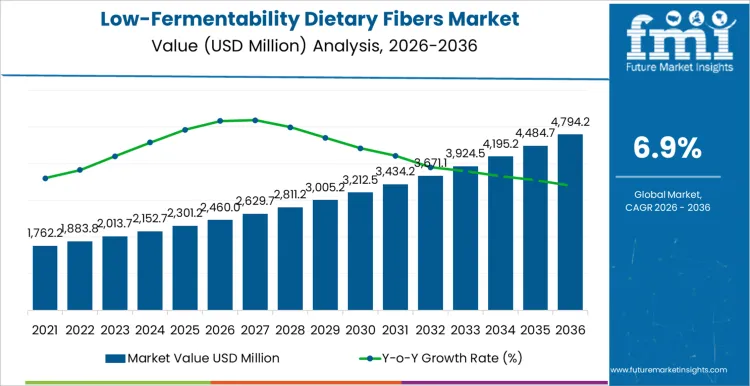
Low-Fermentability Dietary Fibers Market Key Takeaways
| Metric | Value |
|---|---|
| Market Value (2026) | USD 2,460.0 million |
| Market Forecast Value (2036) | USD 4,794.2 million |
| Forecast CAGR 2026 to 2036 | 6.9% |
Why is the Demand for Low-Fermentability Dietary Fibers Market Growing?
Product developers targeting digestive tolerance increasingly select low-fermentability dietary fibers due to their ability to deliver fiber functionality without triggering gastrointestinal discomfort. Rapidly fermentable fibers often generate gas and bloating, creating barriers for consumers with sensitive digestion or irritable bowel concerns. Low-fermentability fibers provide bulking and stool normalization benefits while maintaining slower microbial breakdown in the colon. This characteristic supports inclusion in nutrition bars, clinical beverages, and fortified foods intended for daily consumption. Formulators value these fibers for their neutral sensory impact, predictable hydration behavior, and compatibility with protein rich or reduced sugar matrices that already challenge digestive comfort.
Clinical nutrition, medical food, and active lifestyle segments reinforce demand as tolerance and compliance influence repeat consumption. Meal replacements and weight management products incorporate these fibers to support satiety without compromising gut comfort across frequent use occasions. Beverage manufacturers favor low-fermentability options that maintain clarity and stability while delivering labeled fiber content. Ingredient suppliers refine particle size, solubility, and water binding profiles to ensure consistent performance across processing conditions. Regulatory focus on fiber disclosure and digestive claims guides manufacturers toward fiber sources associated with gentler physiological response, supporting sustained integration across mainstream and specialized nutrition portfolios.
How Is the Low-Fermentability Dietary Fibers Industry Segmented by Fiber Type, Functional Benefit, and Application?
Low-fermentability dietary fibers are gaining attention as formulators balance digestive tolerance with fiber enrichment goals. These ingredients are selected to minimize gastrointestinal discomfort while supporting sugar reduction, calorie control, and texture performance. Adoption varies based on molecular structure, fermentation profile, and compatibility with different food matrices. Segmentation by fiber type, functional benefit, and application highlights how manufacturers align formulation objectives with consumer tolerance expectations.
Which Fiber Type Accounts for the Largest Share in Low-Fermentability Dietary Fibers?
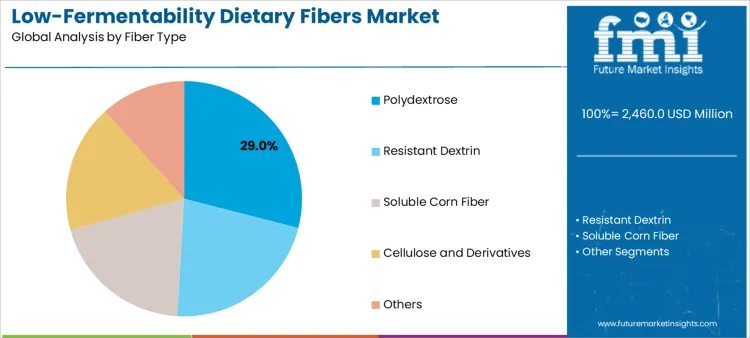
Polydextrose holds 29.0%, reflecting broad usage as a low-fermentable bulking agent with minimal impact on digestion. Resistant dextrin follows at 26.0%, supported by its solubility and stable performance in beverages and baked goods. Soluble corn fiber represents 21.0%, driven by clean sensory properties and regulatory acceptance across regions. Cellulose and derivatives account for 14.0%, primarily used where insoluble fiber structure and minimal fermentation are required. Other fiber types collectively represent 10.0%. Fiber type segmentation indicates preference for multifunctional, well-tolerated soluble systems.
Key Points
- Polydextrose leads due to bulking and tolerance balance.
- Resistant dextrin supports multi-category formulations.
- Soluble corn fiber aligns with clean taste requirements.
How Do Functional Benefits Influence Demand for Low-Fermentability Fibers?

Digestive tolerance improvement represents the largest functional benefit at 38.0%, driven by consumer sensitivity to highly fermentable fibers. Sugar and calorie reduction account for 27.0%, as fibers replace sugars while maintaining mouthfeel. Bulking and texture enhancement hold 21.0%, supporting structure in reduced-sugar or reduced-fat formulations. Glycemic response management represents 14.0%, applied in products targeting blood sugar moderation. Functional segmentation shows priority placed on gastrointestinal comfort alongside nutritional reformulation goals.
Key Points
- Digestive tolerance remains the primary driver.
- Sugar reduction supports reformulation strategies.
- Texture performance reinforces product acceptance.
Which Application Segments Drive Usage of Low-Fermentability Dietary Fibers?
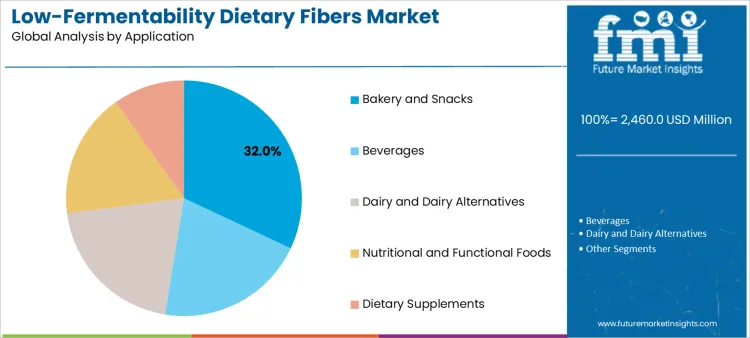
Bakery and snacks account for 32.0%, reflecting demand for fiber enrichment without compromising digestion or texture. Beverages represent 24.0%, where solubility and low gas formation are critical. Dairy and dairy alternatives hold 18.0%, using fibers for body and sugar reduction. Nutritional and functional foods account for 16.0%, aligned with digestive health positioning. Dietary supplements represent 10.0%, focused on tolerance-friendly fiber delivery. Application segmentation shows strongest uptake in everyday food categories with repeat consumption patterns.
Key Points
- Bakery and snacks lead due to high reformulation activity.
- Beverages require low-fermentation solubility.
- Dairy systems focus on balance between nutrition and comfort.
What are the Key Dynamics in the Low-Fermentability Dietary Fibers market?
Demand dynamics in the low-fermentability dietary fibers market reflect rising emphasis on digestive comfort rather than aggressive microbiome stimulation. Market activity centers on fibers designed to pass through the colon with limited gas generation while still contributing bulking and metabolic benefits. Value creation depends on controlled fermentation kinetics, sensory neutrality, and compatibility with sensitive-digestion positioning. Commercial momentum aligns with clinical nutrition, wellness foods, and daily-use formats where tolerance consistency influences repeat consumption.
How do digestive comfort positioning and daily-use nutrition formats shape adoption?
Adoption is strongest in products consumed frequently where gastrointestinal tolerance determines user adherence. Low-fermentability fibers gain preference in medical nutrition drinks, IBS-oriented foods, elderly nutrition, and weight management formulations that target regular intake. Demand increases for fibers that support stool formation without rapid microbial breakdown that leads to bloating or discomfort. Ready-to-drink shakes and meal replacements specify these fibers to maintain comfort during consecutive daily servings. Sports nutrition applications favor low-fermentability options to avoid gastrointestinal distress during training or competition. Product developers prioritize fibers with neutral taste, low sweetness contribution, and minimal viscosity impact to preserve sensory acceptance while meeting fiber enrichment thresholds required for on-pack claims.
How do formulation constraints and fiber definition rules limit scalability?
Scalability is constrained by functional limits and regulatory interpretation of dietary fiber classifications. Certain low-fermentability fibers exhibit low solubility or weak water-binding behavior, restricting use in products requiring thickness or creaminess. Regional differences in fiber recognition affect labeling strategy and claim eligibility, complicating multinational product rollouts. Processing intensity required to suppress fermentability raises ingredient cost and narrows price flexibility in mass-market foods. Blending with texturizers or bulking agents increases formulation complexity and validation effort. Clinical substantiation expectations tied to digestive tolerance claims extend development timelines, particularly in regulated nutrition categories where evidence standards remain high.
How Is Demand for the Low-Fermentability Dietary Fibers Market Evolving Globally?
Global demand for low-fermentability dietary fibers is increasing as food and nutrition brands address digestive tolerance concerns linked to traditional fiber ingredients. Growth reflects rising incidence of gastrointestinal sensitivity, demand for gut-friendly formulations, and expansion of functional foods positioned around comfort and wellness. Manufacturers increasingly specify low-fermentability fibers to manage bloating, gas, and discomfort while retaining fiber claims. India records 8.1% CAGR, China records 7.8% CAGR, Brazil records 7.4% CAGR, USA records 6.2% CAGR, and UK records 6.0% CAGR. Adoption remains driven by formulation complexity in digestive health products rather than overall fiber consumption growth.
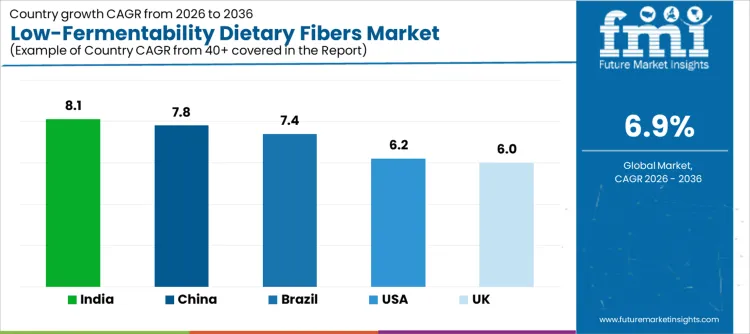
| Country | CAGR (%) |
|---|---|
| India | 8.1% |
| China | 7.8% |
| Brazil | 7.4% |
| USA | 6.2% |
| UK | 6.0% |
What is driving growth of low-fermentability dietary fibers demand in India?
Demand for low-fermentability dietary fibers in India is expanding as nutraceutical, functional food, and fortified beverage manufacturers address digestive tolerance challenges. Growth at 8.1% CAGR reflects increased use in fiber-enriched drinks, supplements, and medical nutrition products targeting urban consumers. Rising awareness of bloating and gastrointestinal discomfort linked to highly fermentable fibers drives ingredient substitution. Domestic formulators prioritize fibers compatible with heat processing and high-humidity storage conditions. Cost sensitivity supports adoption of fibers delivering digestive benefits at moderate inclusion levels. Demand remains concentrated in digestive health supplements, fortified beverages, and diabetic nutrition products.
- Rising digestive sensitivity awareness
- Expansion of functional nutrition products
- Preference for low-bloating fiber systems
- Growth of urban health-focused consumption
Why is China seeing expansion in low-fermentability dietary fibers adoption?
Low-fermentability dietary fibers demand in China is rising as functional food and medical nutrition categories expand. Growth at 7.8% CAGR reflects strong activity in meal replacements, nutritional powders, and digestive health beverages. High incidence of gastrointestinal discomfort linked to dietary transitions increases demand for gentler fiber solutions. Large-scale processors favor fibers offering stable viscosity and minimal fermentation impact. Domestic ingredient suppliers scale resistant dextrins and modified fibers for industrial use. Demand strength remains concentrated within hospital nutrition, elderly care foods, and functional beverage segments.
- Growth of medical nutrition products
- Dietary transition driven digestive sensitivity
- Industrial-scale functional food processing
- Expansion of elderly nutrition categories
What factors are shaping low-fermentability dietary fibers sales in Brazil?
Sales of low-fermentability dietary fibers in Brazil are increasing as nutrition labeling and wellness positioning influence product development. Growth at 7.4% CAGR reflects reformulation of fiber-fortified beverages, dairy alternatives, and nutrition bars. Consumer sensitivity to digestive comfort supports adoption of fibers with lower gas formation. Tropical diets rich in fermentable carbohydrates increase relevance of tolerance-focused fiber systems. Local manufacturers emphasize balance between digestive comfort and fiber content claims. Demand remains strongest in mass-market functional foods and beverages targeting digestive wellness.
- Digestive comfort driven reformulation
- Expansion of fiber-fortified beverages
- Sensitivity to gastrointestinal tolerance
- Focus on mass-market wellness positioning
How is the USA supporting growth of low-fermentability dietary fibers demand?
Low-fermentability dietary fibers market demand in the USA is advancing as digestive health awareness shapes formulation strategies. Growth at 6.2% CAGR reflects adoption across supplements, protein beverages, meal replacements, and low-FODMAP positioned foods. Clinical nutrition and sports nutrition segments prioritize fibers that minimize gastrointestinal distress. Regulatory clarity around fiber definitions supports ingredient selection. Large brands favor fibers with proven tolerance data and clean label compatibility. Demand is driven by digestive comfort assurance rather than incremental fiber fortification volume.
- Growth of low-FODMAP product positioning
- Expansion of clinical and sports nutrition
- Emphasis on digestive tolerance validation
- Clean label fiber ingredient preference
What is driving expansion of low-fermentability dietary fibers demand in the UK?
Demand for low-fermentability dietary fibers in the UK is rising as digestive health claims gain prominence across food and supplement categories. Growth at 6.0% CAGR reflects reformulation of fiber-enriched beverages, snacks, and nutrition powders. High consumer awareness of bloating and gut discomfort influences ingredient selection. Retail standards emphasize substantiated digestive tolerance benefits. Manufacturers prioritize fibers that support fiber claims without adverse sensory or digestive effects. Demand remains linked to digestive wellness positioning rather than growth in overall fiber intake.
- High consumer awareness of gut comfort
- Retail focus on digestive tolerance claims
- Reformulation of fiber-enriched foods
- Preference for clinically supported fiber ingredients
What is the competitive landscape of demand for the low fermentability dietary fibers market globally?
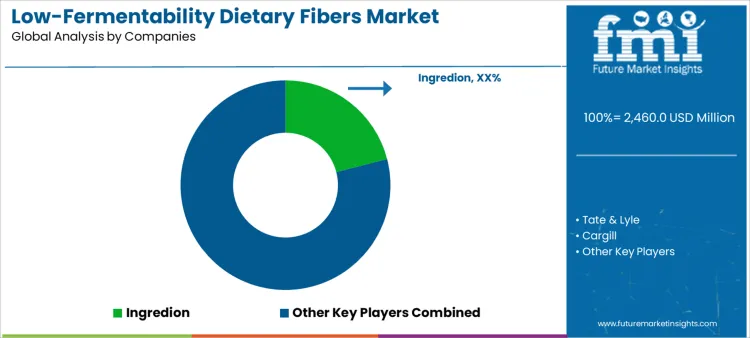
Digestive comfort considerations are shaping demand for low fermentability dietary fibers across functional foods, beverages, and medical nutrition. Product developers focus on minimizing gas production, maintaining low osmotic effects, and preserving neutral taste profiles in finished formulations. Evaluation criteria include solubility, sweetness contribution, glycemic response moderation, and performance stability in ready-to-drink and baked applications. Buyer assessment extends to regulatory labeling acceptance, tolerance thresholds for sensitive consumers, and compatibility with proteins and sweeteners. Procurement behavior favors suppliers offering formulation guidance, clinical tolerance data, and reliable global supply. Trend in the low fermentability dietary fibers market reflects prioritization of gut comfort positioning over maximum fiber loading.
Ingredion holds leading positioning through a diversified portfolio of low fermentable fibers engineered for digestive tolerance and broad formulation use. Tate and Lyle competes by supplying fibers aligned with reduced sugar and calorie optimization while maintaining gastrointestinal comfort. Cargill supports demand through fiber systems integrated with texturizers and sweeteners to maintain sensory balance. ADM maintains relevance via scalable fiber ingredients supported by formulation expertise across nutrition and beverage segments. Roquette participates with plant-based fiber solutions emphasizing tolerance, functional performance, and consistency under varied processing conditions. Competitive differentiation centers on digestive tolerance evidence, formulation flexibility, regulatory clarity, and supplier technical collaboration depth.
Key Players in the Low-Fermentability Dietary Fibers Market
- Ingredion
- Tate & Lyle
- Cargill
- ADM
- Roquette
- Others
Scope of the Report
| Items | Values |
|---|---|
| Quantitative Units | USD million |
| Fiber Type | Polydextrose; Resistant Dextrin; Soluble Corn Fiber; Cellulose and Derivatives; Others |
| Functional Benefit | Digestive Tolerance Improvement; Sugar and Calorie Reduction; Bulking and Texture Enhancement; Glycemic Response Management |
| Application | Bakery and Snacks; Beverages; Dairy and Dairy Alternatives; Nutritional and Functional Foods; Dietary Supplements |
| Regions Covered | Asia Pacific, Europe, North America, Latin America, Middle East & Africa |
| Countries Covered | India, China, Brazil, USA, UK, and 40+ countries |
| Key Companies Profiled | Ingredion; Tate & Lyle; Cargill; ADM; Roquette; Others |
| Additional Attributes | Dollar sales by fiber type, functional benefit, application, and sales channel; low fermentability performance supporting improved digestive tolerance and reduced gastrointestinal discomfort; contribution to sugar and calorie reduction without compromising texture; impact on bulking, viscosity, and mouthfeel in bakery, beverage, and dairy systems; glycemic response modulation across functional foods; procurement dynamics driven by reformulation programs, clean-label positioning, and long-term ingredient supply partnerships. |
Low-Fermentability Dietary Fibers Market by Segment
Fiber Type:
- Polydextrose
- Resistant Dextrin
- Soluble Corn Fiber
- Cellulose and Derivatives
- Others
Functional Benefit:
- Digestive Tolerance Improvement
- Sugar and Calorie Reduction
- Bulking and Texture Enhancement
- Glycemic Response Management
Application:
- Bakery and Snacks
- Beverages
- Dairy and Dairy Alternatives
- Nutritional and Functional Foods
- Dietary Supplements
Region:
- Asia Pacific
- China
- Japan
- South Korea
- India
- Australia & New Zealand
- ASEAN
- Rest of Asia Pacific
- Europe
- Germany
- United Kingdom
- France
- Italy
- Spain
- Nordic
- BENELUX
- Rest of Europe
- North America
- United States
- Canada
- Mexico
- Latin America
- Brazil
- Chile
- Rest of Latin America
- Middle East & Africa
- Kingdom of Saudi Arabia
- Other GCC Countries
- Turkey
- South Africa
- Other African Union
- Rest of Middle East & Africa
Bibliography
- European Food Safety Authority. (2023). Scientific opinion on dietary fibre definitions, fermentability characteristics, and gastrointestinal tolerance. EFSA Journal.
- Food and Agriculture Organization of the United Nations. (2023). Dietary fibre in food reformulation: Functional properties, fermentability, and digestive tolerance considerations. FAO.
- World Health Organization. (2023). Healthy diet and dietary fibre intake: Implications for gastrointestinal comfort and product formulation. World Health Organization.
- USA Food and Drug Administration. (2024). Dietary fiber guidance for food labeling: Low-fermentability fibers and physiological health benefits. USA Department of Health and Human Services.
- European Commission. (2024). Guidance on the application of EU food law to dietary fibre claims and fibre classification in foods. European Union.
- International Organization for Standardization. (2023). ISO 5492: Sensory analysis - Vocabulary relevant to texture, mouthfeel, and fibre-related sensory effects. ISO.
Frequently Asked Questions
How big is the low-fermentability dietary fibers market in 2026?
The global low-fermentability dietary fibers market is estimated to be valued at USD 2,460.0 million in 2026.
What will be the size of low-fermentability dietary fibers market in 2036?
The market size for the low-fermentability dietary fibers market is projected to reach USD 4,794.2 million by 2036.
How much will be the low-fermentability dietary fibers market growth between 2026 and 2036?
The low-fermentability dietary fibers market is expected to grow at a 6.9% CAGR between 2026 and 2036.
What are the key product types in the low-fermentability dietary fibers market?
The key product types in low-fermentability dietary fibers market are polydextrose, resistant dextrin, soluble corn fiber, cellulose and derivatives and others.
Which functional benefit segment to contribute significant share in the low-fermentability dietary fibers market in 2026?
In terms of functional benefit, digestive tolerance improvement segment to command 38.0% share in the low-fermentability dietary fibers market in 2026.
Preview the report firsthand - request a free sample
Get SampleGet the brochure for pricing and purchase details.
Get PDFTable of Content
- Executive Summary
- Global Market Outlook
- Demand-side Trends
- Supply-side Trends
- Technology Roadmap Analysis
- Analysis and Recommendations
- Market Overview
- Market Coverage / Taxonomy
- Market Definition / Scope / Limitations
- Market Background
- Market Dynamics
- Drivers
- Restraints
- Opportunity
- Trends
- Scenario Forecast
- Demand in Optimistic Scenario
- Demand in Likely Scenario
- Demand in Conservative Scenario
- Opportunity Map Analysis
- Product Life Cycle Analysis
- Supply Chain Analysis
- Investment Feasibility Matrix
- Value Chain Analysis
- PESTLE and Porter’s Analysis
- Regulatory Landscape
- Regional Parent Market Outlook
- Production and Consumption Statistics
- Import and Export Statistics
- Market Dynamics
- Global Market Analysis 2021 to 2025 and Forecast, 2026 to 2036
- Historical Market Size Value (USD Million) Analysis, 2021 to 2025
- Current and Future Market Size Value (USD Million) Projections, 2026 to 2036
- Y-o-Y Growth Trend Analysis
- Absolute $ Opportunity Analysis
- Global Market Pricing Analysis 2021 to 2025 and Forecast 2026 to 2036
- Global Market Analysis 2021 to 2025 and Forecast 2026 to 2036, By Fiber Type
- Introduction / Key Findings
- Historical Market Size Value (USD Million) Analysis By Fiber Type , 2021 to 2025
- Current and Future Market Size Value (USD Million) Analysis and Forecast By Fiber Type , 2026 to 2036
- Polydextrose
- Resistant Dextrin
- Soluble Corn Fiber
- Cellulose and Derivatives
- Others
- Polydextrose
- Y-o-Y Growth Trend Analysis By Fiber Type , 2021 to 2025
- Absolute $ Opportunity Analysis By Fiber Type , 2026 to 2036
- Global Market Analysis 2021 to 2025 and Forecast 2026 to 2036, By Functional Benefit
- Introduction / Key Findings
- Historical Market Size Value (USD Million) Analysis By Functional Benefit, 2021 to 2025
- Current and Future Market Size Value (USD Million) Analysis and Forecast By Functional Benefit, 2026 to 2036
- Digestive Tolerance Improvement
- Sugar and Calorie Reduction
- Bulking and Texture Enhancement
- Glycemic Response Management
- Digestive Tolerance Improvement
- Y-o-Y Growth Trend Analysis By Functional Benefit, 2021 to 2025
- Absolute $ Opportunity Analysis By Functional Benefit, 2026 to 2036
- Global Market Analysis 2021 to 2025 and Forecast 2026 to 2036, By Application
- Introduction / Key Findings
- Historical Market Size Value (USD Million) Analysis By Application, 2021 to 2025
- Current and Future Market Size Value (USD Million) Analysis and Forecast By Application, 2026 to 2036
- Bakery and Snacks
- Beverages
- Dairy and Dairy Alternatives
- Nutritional and Functional Foods
- Dietary Supplements
- Bakery and Snacks
- Y-o-Y Growth Trend Analysis By Application, 2021 to 2025
- Absolute $ Opportunity Analysis By Application, 2026 to 2036
- Global Market Analysis 2021 to 2025 and Forecast 2026 to 2036, By Region
- Introduction
- Historical Market Size Value (USD Million) Analysis By Region, 2021 to 2025
- Current Market Size Value (USD Million) Analysis and Forecast By Region, 2026 to 2036
- North America
- Latin America
- Western Europe
- Eastern Europe
- East Asia
- South Asia and Pacific
- Middle East & Africa
- Market Attractiveness Analysis By Region
- North America Market Analysis 2021 to 2025 and Forecast 2026 to 2036, By Country
- Historical Market Size Value (USD Million) Trend Analysis By Market Taxonomy, 2021 to 2025
- Market Size Value (USD Million) Forecast By Market Taxonomy, 2026 to 2036
- By Country
- USA
- Canada
- Mexico
- By Fiber Type
- By Functional Benefit
- By Application
- By Country
- Market Attractiveness Analysis
- By Country
- By Fiber Type
- By Functional Benefit
- By Application
- Key Takeaways
- Latin America Market Analysis 2021 to 2025 and Forecast 2026 to 2036, By Country
- Historical Market Size Value (USD Million) Trend Analysis By Market Taxonomy, 2021 to 2025
- Market Size Value (USD Million) Forecast By Market Taxonomy, 2026 to 2036
- By Country
- Brazil
- Chile
- Rest of Latin America
- By Fiber Type
- By Functional Benefit
- By Application
- By Country
- Market Attractiveness Analysis
- By Country
- By Fiber Type
- By Functional Benefit
- By Application
- Key Takeaways
- Western Europe Market Analysis 2021 to 2025 and Forecast 2026 to 2036, By Country
- Historical Market Size Value (USD Million) Trend Analysis By Market Taxonomy, 2021 to 2025
- Market Size Value (USD Million) Forecast By Market Taxonomy, 2026 to 2036
- By Country
- Germany
- UK
- Italy
- Spain
- France
- Nordic
- BENELUX
- Rest of Western Europe
- By Fiber Type
- By Functional Benefit
- By Application
- By Country
- Market Attractiveness Analysis
- By Country
- By Fiber Type
- By Functional Benefit
- By Application
- Key Takeaways
- Eastern Europe Market Analysis 2021 to 2025 and Forecast 2026 to 2036, By Country
- Historical Market Size Value (USD Million) Trend Analysis By Market Taxonomy, 2021 to 2025
- Market Size Value (USD Million) Forecast By Market Taxonomy, 2026 to 2036
- By Country
- Russia
- Poland
- Hungary
- Balkan & Baltic
- Rest of Eastern Europe
- By Fiber Type
- By Functional Benefit
- By Application
- By Country
- Market Attractiveness Analysis
- By Country
- By Fiber Type
- By Functional Benefit
- By Application
- Key Takeaways
- East Asia Market Analysis 2021 to 2025 and Forecast 2026 to 2036, By Country
- Historical Market Size Value (USD Million) Trend Analysis By Market Taxonomy, 2021 to 2025
- Market Size Value (USD Million) Forecast By Market Taxonomy, 2026 to 2036
- By Country
- China
- Japan
- South Korea
- By Fiber Type
- By Functional Benefit
- By Application
- By Country
- Market Attractiveness Analysis
- By Country
- By Fiber Type
- By Functional Benefit
- By Application
- Key Takeaways
- South Asia and Pacific Market Analysis 2021 to 2025 and Forecast 2026 to 2036, By Country
- Historical Market Size Value (USD Million) Trend Analysis By Market Taxonomy, 2021 to 2025
- Market Size Value (USD Million) Forecast By Market Taxonomy, 2026 to 2036
- By Country
- India
- ASEAN
- Australia & New Zealand
- Rest of South Asia and Pacific
- By Fiber Type
- By Functional Benefit
- By Application
- By Country
- Market Attractiveness Analysis
- By Country
- By Fiber Type
- By Functional Benefit
- By Application
- Key Takeaways
- Middle East & Africa Market Analysis 2021 to 2025 and Forecast 2026 to 2036, By Country
- Historical Market Size Value (USD Million) Trend Analysis By Market Taxonomy, 2021 to 2025
- Market Size Value (USD Million) Forecast By Market Taxonomy, 2026 to 2036
- By Country
- Kingdom of Saudi Arabia
- Other GCC Countries
- Turkiye
- South Africa
- Other African Union
- Rest of Middle East & Africa
- By Fiber Type
- By Functional Benefit
- By Application
- By Country
- Market Attractiveness Analysis
- By Country
- By Fiber Type
- By Functional Benefit
- By Application
- Key Takeaways
- Key Countries Market Analysis
- USA
- Pricing Analysis
- Market Share Analysis, 2025
- By Fiber Type
- By Functional Benefit
- By Application
- Canada
- Pricing Analysis
- Market Share Analysis, 2025
- By Fiber Type
- By Functional Benefit
- By Application
- Mexico
- Pricing Analysis
- Market Share Analysis, 2025
- By Fiber Type
- By Functional Benefit
- By Application
- Brazil
- Pricing Analysis
- Market Share Analysis, 2025
- By Fiber Type
- By Functional Benefit
- By Application
- Chile
- Pricing Analysis
- Market Share Analysis, 2025
- By Fiber Type
- By Functional Benefit
- By Application
- Germany
- Pricing Analysis
- Market Share Analysis, 2025
- By Fiber Type
- By Functional Benefit
- By Application
- UK
- Pricing Analysis
- Market Share Analysis, 2025
- By Fiber Type
- By Functional Benefit
- By Application
- Italy
- Pricing Analysis
- Market Share Analysis, 2025
- By Fiber Type
- By Functional Benefit
- By Application
- Spain
- Pricing Analysis
- Market Share Analysis, 2025
- By Fiber Type
- By Functional Benefit
- By Application
- France
- Pricing Analysis
- Market Share Analysis, 2025
- By Fiber Type
- By Functional Benefit
- By Application
- India
- Pricing Analysis
- Market Share Analysis, 2025
- By Fiber Type
- By Functional Benefit
- By Application
- ASEAN
- Pricing Analysis
- Market Share Analysis, 2025
- By Fiber Type
- By Functional Benefit
- By Application
- Australia & New Zealand
- Pricing Analysis
- Market Share Analysis, 2025
- By Fiber Type
- By Functional Benefit
- By Application
- China
- Pricing Analysis
- Market Share Analysis, 2025
- By Fiber Type
- By Functional Benefit
- By Application
- Japan
- Pricing Analysis
- Market Share Analysis, 2025
- By Fiber Type
- By Functional Benefit
- By Application
- South Korea
- Pricing Analysis
- Market Share Analysis, 2025
- By Fiber Type
- By Functional Benefit
- By Application
- Russia
- Pricing Analysis
- Market Share Analysis, 2025
- By Fiber Type
- By Functional Benefit
- By Application
- Poland
- Pricing Analysis
- Market Share Analysis, 2025
- By Fiber Type
- By Functional Benefit
- By Application
- Hungary
- Pricing Analysis
- Market Share Analysis, 2025
- By Fiber Type
- By Functional Benefit
- By Application
- Kingdom of Saudi Arabia
- Pricing Analysis
- Market Share Analysis, 2025
- By Fiber Type
- By Functional Benefit
- By Application
- Turkiye
- Pricing Analysis
- Market Share Analysis, 2025
- By Fiber Type
- By Functional Benefit
- By Application
- South Africa
- Pricing Analysis
- Market Share Analysis, 2025
- By Fiber Type
- By Functional Benefit
- By Application
- USA
- Market Structure Analysis
- Competition Dashboard
- Competition Benchmarking
- Market Share Analysis of Top Players
- By Regional
- By Fiber Type
- By Functional Benefit
- By Application
- Competition Analysis
- Competition Deep Dive
- Ingredion
- Overview
- Product Portfolio
- Profitability by Market Segments (Product/Age /Sales Channel/Region)
- Sales Footprint
- Strategy Overview
- Marketing Strategy
- Product Strategy
- Channel Strategy
- Tate & Lyle
- Cargill
- ADM
- Roquette
- Others
- Ingredion
- Competition Deep Dive
- Assumptions & Acronyms Used
- Research Methodology


