

- Industry Size (2026)
- USD 2.46 Bn
- Forecast (2036)
- USD 4.89 Bn
- CAGR (2026 to 2036)
- 7.1%
Veterinary Dietary Supplements Market Size, Market Forecast and Outlook By FMI
In 2025, the Veterinary Dietary Supplements market was valued at USD 2.30 billion. Based on Future Market Insights' analysis, demand is estimated to grow to USD 2.46 billion in 2026 and USD 4.89 billion by 2036. FMI projects a CAGR of 7.1% during the forecast period.
The absolute dollar expansion from 2026 to 2036 amounts to approximately USD 2.43 billion. Growth is structurally driven by the humanisation of pets trend across major consumer markets, where pet owners increasingly mirror human preventive health supplement consumption patterns by purchasing supplements for companion animal joint health, anxiety management, digestive wellness, and skin and coat condition. The rapid growth of pet ownership in India, China, and South Korea is creating incremental demand for veterinary dietary supplement products in markets where the companion animal category is expanding from a lower base. Growth constraints include regulatory variation across markets in the classification and permitted health claims for animal dietary supplement products, and consumer price sensitivity in emerging markets.
Summary of Veterinary Dietary Supplements Market
- Veterinary Dietary Supplements Market Definition
- The global Veterinary Dietary Supplements industry recorded a CAGR of 6.6% during the historical period between 2020 and 2025. The growth of Veterinary Dietary Supplements industry was positive as it reached a value of USD 1,400.6 million in 2025 from USD 1,970.5 million in 2020.
- Demand Drivers in the Market
- Rising demand for veterinary dietary supplements across food processing and industrial applications accelerates procurement volumes among large-scale manufacturers targeting cost efficiency.
- Expanding companion animals adoption within USA and adjacent high-growth economies drives volume commitments that justify dedicated supply chain investments.
- Regulatory and sustainability mandates compel formulation teams to source certified veterinary dietary supplements inputs, shifting purchasing decisions toward verified, compliant suppliers.
- Key Segments Analyzed in the FMI Report
- Companion Animals: 61.8% share in 2026, representing the dominant category as buyers prioritize established companion animals configurations that align with existing processing and formulation infrastructure.
- Joint Health Support: 28.4% share in 2026, driven by end-use applications where joint health support characteristics deliver measurable performance advantages over alternative product forms.
- USA: 2.2% compound growth anchored by expanding manufacturing capacity and government-supported industrial development programs targeting veterinary dietary supplements production and processing.
- Analyst Opinion at FMI
- Nandini Roy Choudhury, Principal Consultant for Food & Beverage, opines: 'In my analysis of the Veterinary Dietary Supplements Market, I observe that the central procurement challenge is not product availability but supplier qualification and traceability. Buyers consolidating volumes around companion animals face concentration risk when Tier-1 suppliers cannot demonstrate regulatory compliance documentation at scale. USA and comparable high-growth markets at 2.2% CAGR signal structural demand expansion, yet the absence of standardized procurement frameworks creates margin compression for distributors operating without certified channel agreements. Executives who delay formalizing supplier diversification strategies will find their cost structures exposed once regulatory enforcement cycles intensify across major importing economies.'
- Strategic Implications / Executive Takeaways
- Suppliers must establish verified certification pathways for veterinary dietary supplements to qualify for procurement tenders issued by large food, health, and industrial buyers.
- Investment priorities should target capacity expansion in high-CAGR geographies to capture incremental demand before supply concentration shifts pricing power.
- Product development teams should align veterinary dietary supplements formulations with evolving regulatory thresholds in the European Union, United States, and Asia Pacific to maintain market access.
- Methodology
- Primary Research: FMI conducted detailed technical interviews with procurement directors, formulation specialists, and supply chain engineers across 40 countries to validate adoption timelines and demand assumptions.
- Desk Research: Analysts aggregated public regulatory filings, trade association publications, government statistical releases, and company annual reports to establish verifiable baseline data.
- Market-Sizing and Forecasting: Forecasting models apply a bottom-up methodology starting with verified production capacity and consumption volume data, applying region-specific growth assumptions to project adoption trajectories.
- Data Validation and Update Cycle: Segment forecasts undergo cross-validation against publicly reported revenue volumes from leading industry participants and are updated on a rolling quarterly basis.
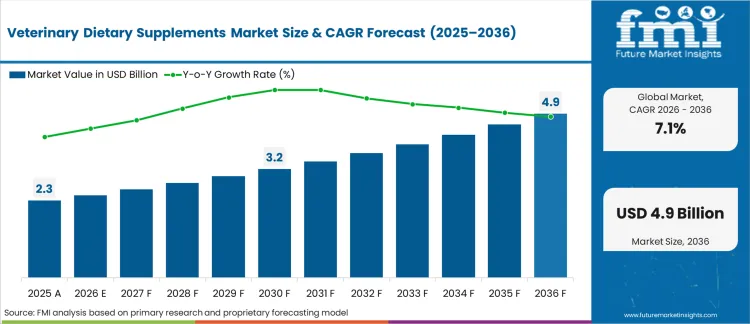
Veterinary Dietary Supplements Market Key Takeaways
| Metric | Details |
|---|---|
| Industry Size (2026) | USD 2.46 billion |
| Industry Value (2036) | USD 4.89 billion |
| CAGR (2026-2036) | 7.1% |
| Source | Future Market Insights, 2026 |
FMI analysts observe that the gummies and chewable dosage form is growing fastest within the veterinary dietary supplement market as palatable formats that dogs and cats readily accept without owner difficulty drive adoption among the growing population of pet owners who struggle to administer traditional tablets and capsules to companion animals. Nutramax Laboratories and Ark Naturals supply flavored chewable joint health and calming supplement products for dogs through veterinary channels and pet specialty retail.
Veterinary Dietary Supplements Market Definition
Veterinary Dietary Supplements are nutritional products containing vitamins, minerals, amino acids, fatty acids, probiotics, prebiotics, joint support compounds, herbal extracts, and functional nutraceutical ingredients formulated specifically for companion animals including dogs, cats, and horses, and for livestock animals including cattle, pigs, and poultry, supplied in tablet, capsule, gummy, chewable, powder, and liquid delivery formats to support joint health, digestive wellness, skin and coat condition, stress and anxiety management, immune function, and energy and electrolyte balance in animals.
Veterinary Dietary Supplements Market Inclusions
The report covers global and regional market sizes for veterinary dietary supplements across all animal type, application, and dosage form categories, forecast data from 2026 to 2036, and country-level CAGR analysis for USA, Germany, France, Spain, China, India, South Korea, and Australia, with additional regional coverage across more than 40 countries.
Veterinary Dietary Supplements Market Exclusions
The scope excludes veterinary pharmaceutical drugs and prescription medications regulated as licensed veterinary medicines, complete and balanced pet foods and animal feed products where nutritional supplements are incorporated as minor fortification additives rather than standalone supplement products, and animal health diagnostics and veterinary medical devices that are not classified as dietary or nutritional supplement products.
Veterinary Dietary Supplements Market Research Methodology
- Primary Research: Analysts engaged with veterinary practitioners and clinic managers, pet specialty retail buyers, companion animal supplement product developers at Nutramax Laboratories and Virbac, and pet owner consumer research specialists across the USA, Germany, France, China, India, and South Korea to validate demand volumes and product trend assumptions.
- Desk Research: Data collection phases aggregated pet ownership statistics from national veterinary and pet industry associations, regulatory frameworks from FDA CVM and EMA governing veterinary dietary supplements, and company annual reports from Boehringer Ingelheim and Nestle covering their animal health and pet nutrition segment reporting.
- Market-Sizing and Forecasting: Baseline values derive from a bottom-up aggregation of companion animal population data by country and supplement penetration rate assumptions, applying application segment growth rates and dosage form adoption curves to project forward market values across the 2026 to 2036 forecast period.
- Data Validation and Update Cycle: Projections are validated against publicly reported animal health product sales data from industry associations, veterinary practice management data from national veterinary associations, and company-level animal health revenue disclosures from Boehringer Ingelheim and Virbac annual reports.
Key Industry Highlights
Increased Consumer Spending on Veterinary Care Drives the Growth of the Market
The American Pet Products Association reports that spending for veterinary care has increased at a rate higher than that of GDP over the past two years. With the climbing numbers of pet owners, total spend on veterinary care surges, which markedly boosts expenditure per pet.
This increase in consumer spending for veterinary care reflects almost an unconscious shift in societal attitude towards pets. Most often, pets are more than just animals and are considered part of the family-thus worthy of complete health care. Increased awareness thus reflects in how preventive medicine, advanced treatments, and specialized care can help safeguard the well-being and long life of beloved companions.
The projected USA pet industry expenditures for 2026 are forecasted to rise from USD 2.3.0 billion in 2026 to USD 2.3 billion. Estimated sales for 2026 break out as: Pet Food & Treats, USD 66.9 billion; Supplies, Live Animals & OTC Medicine, USD 32.0 billion; Veterinary Care & Product Sales, USD 39.1 billion; Other Services, USD 12.6 billion.
This rise in consumer spending in relation to veterinary care underlines the changed role that pets play in our lives and a raising awareness that they are important members of our families. With the actions of a responsible owner who wants better health for his or her furry pet, demand for advanced treatments and specialized care just keeps on growing.
However, it is concerns of affordability and accessibility which are all-important to ensure that all pets receive the full healthcare they need to thrive. With the rise in consumer spending on veterinary care, the veterinary dietary supplements market is anticipated to generate more revenue.
The Rising Adoption of Pets Fuels the Expansion of the Veterinary Dietary Supplements
Higher adoption of pets is one of the major drivers of the veterinary dietary supplements market. Increasingly, pet adoption across the world results in higher demand for all associated veterinary services, including dietary care.
Nowadays, pets are regarded as family members whose part of life is no different from the rest of their owners' lives. This change in thinking has increased the number of families owning them-for instance, dogs, cats, and sometimes even exotic pets. With this increasing trend in pet-keeping, there comes a need for qualified and entire veterinary care, including orthopedic treatments.
This higher spending on the health of pets includes not only regular follow-ups and vaccinations but also costly medical treatments. Dietary care is an important component of this investment, most particularly for those pets that are prone to nutritional problems. Their owners are ever ready to make any kind of investments in the health of their pets, hence leading to growing demand for supplements.
Increasing adoption of pets is one of the major drivers for the veterinary dietary supplements market. Growing popularity of pets, increased spending on pet health, heightened awareness, advancements in veterinary medicine, and expansion of veterinary practices and pet insurance act together in accelerating the demand for orthopedic care.
Personalized nutrition is extending to the pet industry, boosting demand for veterinary supplements
While the idea of personalized nutrition was previously mainly focused on human health, it is now breaking into providing pet care in a major way. That essentially means increased understanding of the unique health potentials of individual animals.
This is propelled by advancements in veterinary science combined with the growing interest in tailor-made wellness solutions. With the interest of making sure pets are at their best through tailor-made approaches, veterinary dietary supplements are therefore increasingly growing and changing.
Recent breakthroughs in veterinary nutrition have opened the door to developing custom dietary additives for pets. In fact, veterinary professionals are increasingly employing in-depth health profiling and even nutritional analysis to ensure such tailoring. This is usually done in consideration of a detailed pet health past, present, eating habits, and more essentially lifestyle elements.
To this end, most of them resort to high-quality ingredients and evidence-based formulations. It is usually the case that companies specializing in personalized nutrition demonstrate a longstanding commitment to the use of quality ingredients and rigorous testing for purity to ensure the safety and effectiveness of their offerings.
Increased quality focus has not only maximally boosted trust and satisfaction levels of pet owners but also acted to support general growth of the personalized nutrition market.
The Presence of Counterfeit or Substandard Supplements Can Severely Impact Consumer Confidence and Animal Health
Many counterfeit veterinary dietary supplements contain unsafe or inadequate components. Such products are highly potentially dangerous for animal health, ranging from side effects to a totally missing therapeutic effect. In contrast to pharmaceuticals, where the effects of counterfeit drugs are directly life-threatening, in dietary supplements their after-effects can be invisible but at the same time very dangerous in the long term.
For instance, a pet joint supplement may not really contain glucosamine or chondroitin as claimed, and treatment only prolongs the suffering of pets. There are some that are contaminated or dosed incorrectly and cause toxicity or other health problems, which is dangerous for animals. This is also related to high liability and even legal problems for manufacturers and retailers, as well as possible economic losses.
If the benefit from such supplements is not visible or if there are some adverse effects, pet owners lose trust in the entire category of dietary supplements. Demand for the legitimate products reduces as a result of this since all supplements will be viewed with a lot of skepticism on their effectiveness and safety by the pet owners.
Consumer trust within the veterinary sector is important because the well-being of pets is essential. Just one case of high-end counterfeit supplements could create a ripple effect, impacting negatively on the perception of the whole market.
A problem such requires stringent regulatory measures, improved security technologies, consumer education, and stakeholder collaboration. Veterinary dietary supplements will not be in a position to post sustainable growth until the issue of the counterfeit products is taken seriously and properly addressed to ensure the safety and well-being of pets.
2021 to 2025 Global Veterinary Dietary Supplements Sales Outlook Compared to Demand Forecast from 2026 to 2036
The global Veterinary Dietary Supplements industry recorded a CAGR of 6.6% during the historical period between 2020 and 2026. The growth of Veterinary Dietary Supplements industry was positive as it reached a value of USD 1,400.6 million in 2026 from USD 1,970.5 million in 2020.
The trend of rising pet adoption in the emerging markets largely boosts growth of the global veterinary dietary supplements market. Increase in the number of pet-owning households increases the potential market for veterinary dietary supplements.
When a market is anticipated to grow larger-with a seriously increasing number of households acquiring pets-there will be an expanding market for products supporting pet health to also encompass supplements for joint health, digestive issues, and skin health. It is encouraging market growth and stimulating businesses to invest in products catered to the needs of pets in that nation.
Market Concentration
Tier 1 companies comprise market leaders with a market revenue of above USD 100 million capturing significant market share of 29.5% in global market. These companies tend to research and create new formulations with advanced delivery systems to meet certain specific health needs in pets.
This may further include personalized supplements on the basis of a genetic profile, or tailored solutions for certain health conditions. With a view to enter more markets, these companies also spend on increasing their channels of distribution.
This will include developing veterinary clinics, pet shops, and e-commerce platforms for convenience and easy accessibility to the owners of the pets. Prominent companies in tier 1 include Nestle, Boehringer Ingelheim, Virbac, Beaphar., and Nutramax Laboratories, Inc.
Tier 2 companies include mid-size players with revenue of USD 50 to 100 million having presence in specific regions and highly influencing the local market and holds around 31.9% market share. The Tier 2 companies usually target some niches in the veterinary dietary supplements market.
ompanies in this tier work on developing specialty products designed for specific health conditions or pet types, for instance, supplements for senior pets or those with special dietary needs. Companies in this tier strive to develop unique solutions that will be more cost-effective by formulating products balancing efficacy and affordability.
To achieve this, they use alternative ingredients or even develop leaner production processes so as to allow competitive pricing without compromising on quality. Prominent companies in tier 2 include Nutri-Pet Research, Inc., Ceva and Canna Companion.
Finally, Tier 3 companies, such as FoodScience and NOW Foods. They specialize in specific products and cater to niche markets, adding diversity to the industry.
Overall, while Tier 1 companies are the primary drivers of the market, Tier 2 and 3 companies also make significant contributions, ensuring the Veterinary Dietary Supplements sales remains dynamic and competitive.
Veterinary Dietary Supplements Market Drivers, Restraints, and Opportunities
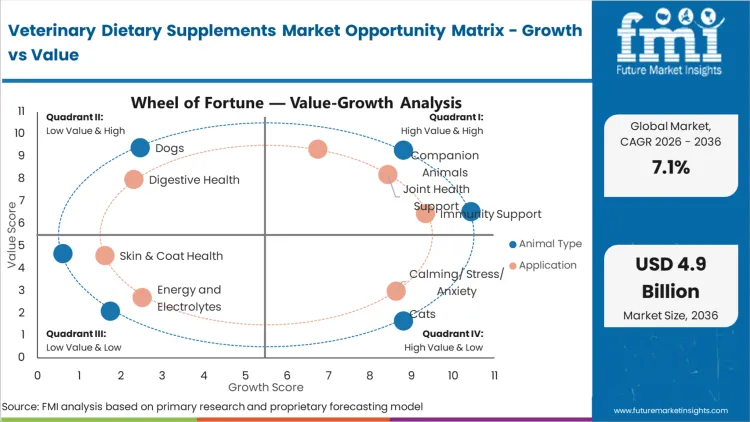
Future Market Insights analysis of the Veterinary Dietary Supplements market shows the sector is in a high-growth phase in Asia Pacific emerging markets and a steady premiumisation phase in North America and European mature markets. The market's 7.1% CAGR reflects the powerful humanisation of pets macro trend that is driving companion animal health spending growth above GDP growth rates across all major consumer markets globally.
FMI analysts observe that the companion animal joint health support segment is the largest and most established application category, driven by the high prevalence of osteoarthritis and hip dysplasia in ageing dog and cat populations and the established veterinary recommendation of glucosamine and chondroitin-based supplements. Nutramax Laboratories' Cosequin brand and Virbac's Movoflex range represent leading joint health supplement products for dogs that command strong veterinary channel endorsement across North America and Europe.
- Pet Humanisation Driving Preventive Supplement Adoption Among Companion Animal Owners: The accelerating humanisation of companion animals, where pet owners increasingly treat cats and dogs as family members deserving human-equivalent preventive health care, is driving supplement category expansion as pet owners adopt supplement regimens for joint health, anxiety, gut health, and immunity management mirroring human wellness supplement consumption. Nutramax Laboratories, the leading US pet supplement brand, supplies Cosequin and Proviable probiotic supplements through veterinary and pet specialty retail channels, with growing consumer demand for functional health claims supported by veterinary clinical evidence. Ark Naturals and Canna Companion supply natural and botanical ingredient-based companion animal supplements targeting health-conscious pet owner segments in the United States and Europe who prefer natural ingredient formulations for their pets.
- Asia Pacific Pet Ownership Expansion Creating Incremental Market Demand in India, China, and South Korea: The rapid growth of companion animal ownership in India, China, and South Korea is creating structurally incremental demand for veterinary dietary supplement products as new pet owner cohorts adopt supplement-based preventive health management practices for their companion animals. Boehringer Ingelheim and Virbac are expanding their veterinary dietary supplement product distribution through Asian pet specialty retail and veterinary clinic channels, with Nestle Purina investing in companion animal nutrition products including supplements for the growing Asian premium pet food and supplement market. The increasing availability of pet specialty retail formats and online pet care e-commerce platforms in India and China is improving consumer access to veterinary dietary supplement products beyond traditional veterinary clinic distribution channels.
- Palatable Dosage Form Innovation Improving Pet Owner Supplement Administration Compliance: The development of flavored gummy, chewable, and soft treat dosage forms that dogs and cats consume willingly without owner difficulty is driving adoption of veterinary dietary supplement regimens by reducing the administration challenge that limited tablet and capsule supplement compliance among companion animal owners. Beaphar and FoodScience supply flavored chewable veterinary supplement products for companion animal joint health, digestive support, and calming applications through European pet retail channels, while Nutramax supplies beef and chicken-flavored chewable Cosequin joint health supplements that dogs consume as treats without requiring concealment in food. These palatable formats enable pet owners to maintain consistent daily supplement administration, improving product efficacy outcomes and driving repeat purchase behaviour.
Regional Analysis
The Veterinary Dietary Supplements market is analysed across North America, Europe, Asia Pacific, Latin America, and Middle East and Africa. FMI's analysis is based on proprietary forecasting model and primary research.
.webp "Top Country Growth Comparison Veterinary Dietary Supplements Market Cagr (2026 2036)")
| Country / Region | CAGR (2026-2036) |
|---|---|
| India | 8.0% |
| China | 7.1% |
| South Korea | 5.6% |
| Spain | 4.1% |
| France | 3.6% |
| Australia | 3.3% |
| Germany | 2.2% |
| USA | 2.2% |
Source: Future Market Insights (FMI) analysis, based on proprietary forecasting model and primary research
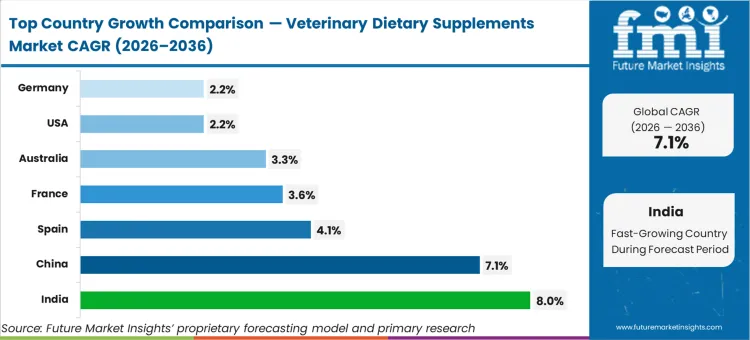
India leads country-level growth at 8.0% CAGR through 2036, driven by the rapid expansion of urban companion animal ownership, increasing veterinarian recommendation of dietary supplements for pet health management, and growing pet owner awareness of preventive nutrition for dogs and cats through social media and veterinary clinics. China follows at 7.1% CAGR, with Boehringer Ingelheim and Virbac expanding their veterinary dietary supplement distribution through Chinese pet specialty retail channels targeting the rapidly growing urban pet owner segment. South Korea advances at 5.6% CAGR in its mature premium pet care market where Nutramax and Beaphar supply joint health and skin care supplements for companion animals through veterinary clinics and pet specialty retailers.
Spain grows at 4.1% CAGR and France at 3.6% CAGR, driven by established pet ownership cultures and growing demand for functional pet supplements through veterinary prescription and over-the-counter pet health retail channels. Australia advances at 3.3% CAGR, Germany and the USA both grow at 2.2% CAGR, reflecting the relative maturity of these well-established companion animal supplement markets where category growth is driven by product premiumisation rather than new buyer acquisition.
Category-wise Insights
The section contains information about the leading segments in the industry. By dosage form, the gummies and chewable segment holds the highest market share of 45.1% in 2026.
Gummies and chewables come in various formulations, allowing manufacturers to address a wide range of health issues.
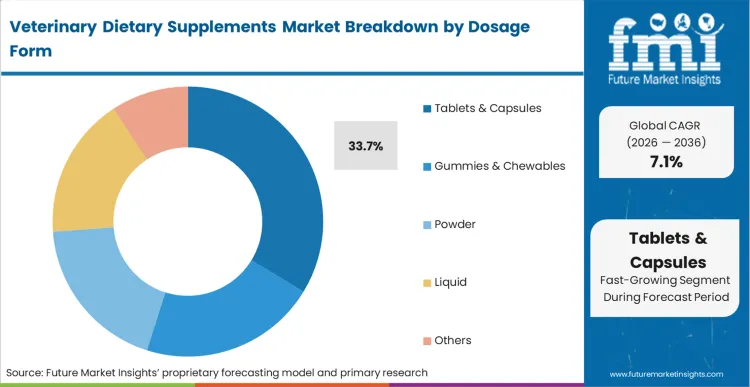
| By Dosage Form | Gummies and Chewable |
|---|---|
| Value Share (2026) | 25.1% |
These dosage forms have been particularly popular among pet owners because they greatly facilitate the supplement feeding to pets. Unlike pills or powders, which may be tricky to give, gummies and chewables are more palatable and easier for pets to take in. This ease of use creates higher compliance and more consistent use of the supplements.
Gummies and chewables are made to be palatable and more palatable to pets in general. The assured palatability by these delicious flavors and ingredients makes the supplement more attractive to animals, and they are much willing to take up their supplements willingly. This increased palatability solves one of the common problems associated with other forms of supplements, tablets, or powders that pets have refused to consume owing to taste or texture.
Joint Health Support as a Leading Application
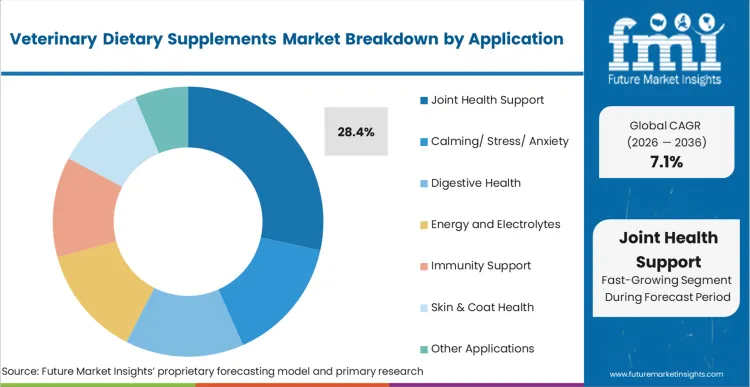
| By Application | Joint Health Support |
|---|---|
| Value Share (2036) | 28.4% |
There is a great demand for joint health supplements due to the occurrence of joint disorders like arthritis and hip dysplasia, especially in older pets. This impacts the quality of life so much that joint health supplements are very important to most owners. Joint health supplements are used both preventively and therapeutically.
These supplements can help maintain joint health and prevent future problems in younger animals or in animals with a risk of disease. In the case of older animals, or those who are already suffering from disease or disorder, they provide an essential support in controlling and alleviating their symptoms, thus improving their general well-being.
Competitive Landscape
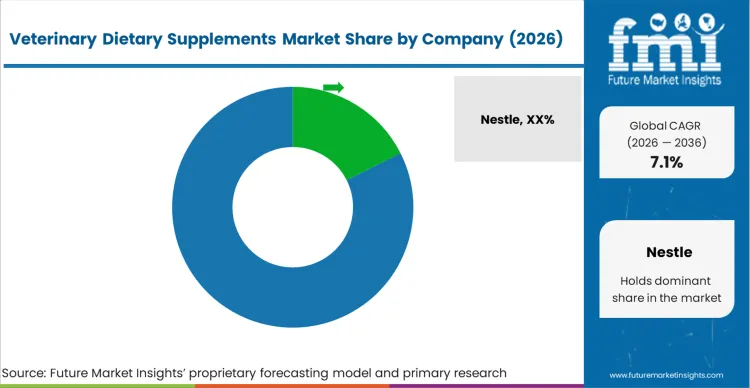
The Veterinary Dietary Supplements market is moderately fragmented, with Nestle (Purina), Boehringer Ingelheim, Nutramax Laboratories, and Virbac representing the leading market participants across companion animal and veterinary distribution channels. The consumer pet supplement segment is highly fragmented with numerous speciality brands competing in joint health, calming, digestive, and skin health application categories.
As per FMI, companies with established veterinary distribution networks and clinical evidence supporting product health claims hold structural advantages in the companion animal segment, where veterinarian recommendations are the primary purchase driver for joint health, digestive, and calming supplement categories. Nutramax Laboratories' investment in randomised controlled clinical trials for its Cosequin and Proviable brands creates a product differentiation platform that supports premium pricing relative to undifferentiated commodity supplement alternatives.
The pet specialty retail and e-commerce channels are growing rapidly as important distribution routes alongside the traditional veterinary clinic channel, creating new market access opportunities for direct-to-consumer pet supplement brands. Companies including NOW Foods and Canna Companion are leveraging online retail distribution to build companion animal supplement brands outside the traditional veterinary prescription channel.
Key Players in Veterinary Dietary Supplements Market
- Nestle (Purina)
- Boehringer Ingelheim
- Virbac
- Ark Naturals Company
- Beaphar
- FoodScience
- NOW Foods
- Nutramax Laboratories Inc.
- Nutri-Pet Research Inc.
- Ceva
- Canna Companion
Scope of the Report
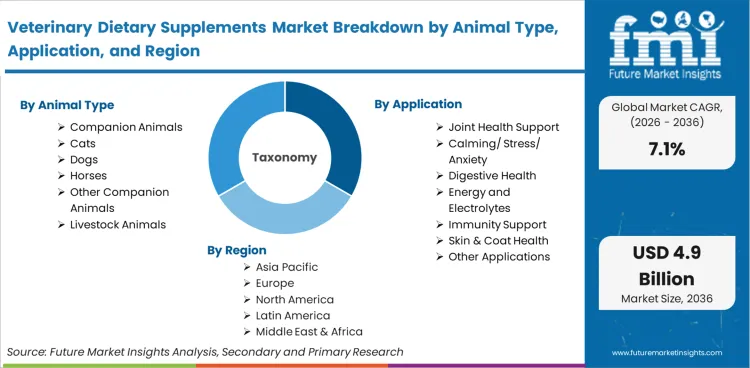
| Metric | Value |
|---|---|
| Quantitative Units | USD 2.46 billion to USD 4.89 billion, at a CAGR of 7.1% |
| Market Definition | Veterinary Dietary Supplements are nutritional products containing vitamins, minerals, amino acids, fatty acids, probiotics, prebiotics, joint support compounds, herbal extracts, and functional nutrac... |
| Animal Type Segmentation | Companion Animals (Cats, Dogs, Horses, Other Companion Animals), Livestock Animals |
| Application Segmentation | Joint Health Support, Calming/Stress/Anxiety, Digestive Health, Energy and Electrolytes, Immunity Support, Skin and Coat Health, Others |
| Dosage Form Segmentation | Tablets and Capsules, Gummies and Chewables, Powder, Liquid, Others |
| Regions Covered | North America, Latin America, Europe, East Asia, South Asia, Oceania, Middle East and Africa |
| Countries Covered | USA, Germany, France, Spain, China, India, South Korea, Australia, and 40 plus countries |
| Forecast Period | 2026 to 2036 |
| Approach | Bottom-up methodology with country-specific demand curves validated against primary research |
| Key Companies Profiled | Nestle (Purina), Boehringer Ingelheim, Virbac, Ark Naturals Company, Beaphar, FoodScience, NOW Foods, Nutramax Laboratories Inc., Nutri-Pet Research Inc., Ceva, Canna Companion |
Key Segments of Veterinary Dietary Supplements Market
Animal Type Segmentation:
- Companion Animals (Cats, Dogs, Horses, Other Companion Animals)
- Livestock Animals
Application Segmentation:
- Joint Health Support
- Calming/Stress/Anxiety
- Digestive Health
- Energy and Electrolytes
- Immunity Support
- Skin and Coat Health
- Others
Dosage Form Segmentation:
- Tablets and Capsules
- Gummies and Chewables
- Powder
- Liquid
- Others
Regions Covered:
- North America
- Latin America
- Europe
- East Asia
- South Asia
- Oceania
- Middle East and Africa
Countries Covered:
- USA
- Germany
- France
- Spain
- China
- India
- South Korea
- Australia, and 40 plus countries
Bibliography
- 1. American Pet Products Association (APPA). (2024, March). APPA national pet owners survey 2023-2024: Pet ownership and veterinary care spending data. APPA. https://www.americanpetproducts.org/
- 2. Boehringer Ingelheim Animal Health. (2024, February). Annual report 2023: Animal health division revenue and pet supplement segment. Boehringer Ingelheim. https://www.boehringer-ingelheim.com/
- 3. United States Food and Drug Administration, Center for Veterinary Medicine (FDA CVM). (2024, January). Guidance for industry: Regulation of animal dietary supplements. FDA. https://www.fda.gov/animal-veterinary/
- 4. European Medicines Agency (EMA). (2023, October). Guideline on veterinary medicinal products and animal dietary supplement classification. EMA. https://www.ema.europa.eu/
- 5. Nutramax Laboratories Inc. (2024, February). Corporate overview: Cosequin and veterinary nutritional supplement clinical research portfolio. Nutramax. https://www.numaxlabs.com/
- 6. Virbac S.A. (2024, March). Annual report 2023: Animal health product segment revenue including dietary supplements. Virbac. https://www.virbac.com/
This bibliography is provided for reader reference and is not exhaustive. The full report contains the complete reference list and detailed citations.
Frequently Asked Questions
How large is the Veterinary Dietary Supplements market in 2026?
The Veterinary Dietary Supplements market is estimated to be valued at USD 2.46 billion in 2026.
What will the Veterinary Dietary Supplements market size be by 2036?
The Veterinary Dietary Supplements market is projected to reach USD 4.89 billion by 2036.
What is the expected CAGR for Veterinary Dietary Supplements between 2026 and 2036?
The Veterinary Dietary Supplements market is expected to grow at a CAGR of 7.1% between 2026 and 2036.
Which animal type leads the Veterinary Dietary Supplements market in 2026?
Companion Animals accounts for approximately 61.8% share in 2026, driven by the pet humanisation trend where dog and cat owners increasingly adopt supplement-based preventive health management practices mirroring human wellness supplement consumption patterns.
Which application leads the Veterinary Dietary Supplements market in 2026?
Joint Health Support accounts for approximately 28.4% application share in 2026, driven by the high prevalence of osteoarthritis and joint degeneration in ageing companion animal populations and strong veterinarian endorsement of glucosamine and chondroitin-based joint supplement protocols.
Which country leads growth in the Veterinary Dietary Supplements market?
India leads country-level growth at 8.0% CAGR through 2036, driven by the rapid expansion of urban companion animal ownership and growing pet owner awareness of preventive dietary supplement nutrition for companion animal health management.
Which dosage form leads the Veterinary Dietary Supplements market in 2026?
Tablets and Capsules accounts for approximately 33.7% dosage form share in 2026, representing the established veterinary supplement administration format widely used across joint health, digestive, and immunity support product categories through both veterinary prescription and over-the-counter retail distribution channels.
Preview the report firsthand - request a free sample
Get SampleGet the brochure for pricing and purchase details.
Get PDFTable of Content
- Executive Summary
- Global Market Outlook
- Demand-side Trends
- Supply-side Trends
- Technology Roadmap Analysis
- Analysis and Recommendations
- Market Overview
- Market Coverage / Taxonomy
- Market Definition / Scope / Limitations
- Research Methodology
- Chapter Orientation
- Analytical Lens and Working Hypotheses
- Market Structure, Signals, and Trend Drivers
- Benchmarking and Cross-market Comparability
- Market Sizing, Forecasting, and Opportunity Mapping
- Research Design and Evidence Framework
- Desk Research Programme (Secondary Evidence)
- Company Annual and Sustainability Reports
- Peer-reviewed Journals and Academic Literature
- Corporate Websites, Product Literature, and Technical Notes
- Earnings Decks and Investor Briefings
- Statutory Filings and Regulatory Disclosures
- Technical White Papers and Standards Notes
- Trade Journals, Industry Magazines, and Analyst Briefs
- Conference Proceedings, Webinars, and Seminar Materials
- Government Statistics Portals and Public Data Releases
- Press Releases and Reputable Media Coverage
- Specialist Newsletters and Curated Briefings
- Sector Databases and Reference Repositories
- FMI Internal Proprietary Databases and Historical Market Datasets
- Subscription Datasets and Paid Sources
- Social Channels, Communities, and Digital Listening Inputs
- Additional Desk Sources
- Expert Input and Fieldwork (Primary Evidence)
- Primary Modes
- Qualitative Interviews and Expert Elicitation
- Quantitative Surveys and Structured Data Capture
- Blended Approach
- Why Primary Evidence is Used
- Field Techniques
- Interviews
- Surveys
- Focus Groups
- Observational and In-context Research
- Social and Community Interactions
- Stakeholder Universe Engaged
- C-suite Leaders
- Board Members
- Presidents and Vice Presidents
- R&D and Innovation Heads
- Technical Specialists
- Domain Subject-matter Experts
- Scientists
- Physicians and Other Healthcare Professionals
- Governance, Ethics, and Data Stewardship
- Research Ethics
- Data Integrity and Handling
- Primary Modes
- Tooling, Models, and Reference Databases
- Desk Research Programme (Secondary Evidence)
- Data Engineering and Model Build
- Data Acquisition and Ingestion
- Cleaning, Normalisation, and Verification
- Synthesis, Triangulation, and Analysis
- Quality Assurance and Audit Trail
- Market Background
- Market Dynamics
- Drivers
- Restraints
- Opportunity
- Trends
- Scenario Forecast
- Demand in Optimistic Scenario
- Demand in Likely Scenario
- Demand in Conservative Scenario
- Opportunity Map Analysis
- Product Life Cycle Analysis
- Supply Chain Analysis
- Investment Feasibility Matrix
- Value Chain Analysis
- PESTLE and Porter’s Analysis
- Regulatory Landscape
- Regional Parent Market Outlook
- Production and Consumption Statistics
- Import and Export Statistics
- Market Dynamics
- Global Market Analysis 2021 to 2025 and Forecast, 2026 to 2036
- Historical Market Size Value (USD Million) Analysis, 2021 to 2025
- Current and Future Market Size Value (USD Million) Projections, 2026 to 2036
- Y-o-Y Growth Trend Analysis
- Absolute $ Opportunity Analysis
- Global Market Pricing Analysis 2021 to 2025 and Forecast 2026 to 2036
- Global Market Analysis 2021 to 2025 and Forecast 2026 to 2036, By Animal Type
- Introduction / Key Findings
- Historical Market Size Value (USD Million) Analysis By Animal Type , 2021 to 2025
- Current and Future Market Size Value (USD Million) Analysis and Forecast By Animal Type , 2026 to 2036
- Companion Animals
- Cats
- Dogs
- Horses
- Other Companion Animals
- Livestock Animals
- Companion Animals
- Y-o-Y Growth Trend Analysis By Animal Type , 2021 to 2025
- Absolute $ Opportunity Analysis By Animal Type , 2026 to 2036
- Global Market Analysis 2021 to 2025 and Forecast 2026 to 2036, By Application
- Introduction / Key Findings
- Historical Market Size Value (USD Million) Analysis By Application, 2021 to 2025
- Current and Future Market Size Value (USD Million) Analysis and Forecast By Application, 2026 to 2036
- Joint Health Support
- Calming/ Stress/ Anxiety
- Digestive Health
- Energy and Electrolytes
- Immunity Support
- Skin & Coat Health
- Other Applications
- Joint Health Support
- Y-o-Y Growth Trend Analysis By Application, 2021 to 2025
- Absolute $ Opportunity Analysis By Application, 2026 to 2036
- Global Market Analysis 2021 to 2025 and Forecast 2026 to 2036, By Dosage Form
- Introduction / Key Findings
- Historical Market Size Value (USD Million) Analysis By Dosage Form, 2021 to 2025
- Current and Future Market Size Value (USD Million) Analysis and Forecast By Dosage Form, 2026 to 2036
- Tablets & Capsules
- Gummies & Chewables
- Powder
- Liquid
- Others
- Tablets & Capsules
- Y-o-Y Growth Trend Analysis By Dosage Form, 2021 to 2025
- Absolute $ Opportunity Analysis By Dosage Form, 2026 to 2036
- Global Market Analysis 2021 to 2025 and Forecast 2026 to 2036, By Region
- Introduction
- Historical Market Size Value (USD Million) Analysis By Region, 2021 to 2025
- Current Market Size Value (USD Million) Analysis and Forecast By Region, 2026 to 2036
- North America
- Latin America
- Western Europe
- Eastern Europe
- East Asia
- South Asia and Pacific
- Middle East & Africa
- Market Attractiveness Analysis By Region
- North America Market Analysis 2021 to 2025 and Forecast 2026 to 2036, By Country
- Historical Market Size Value (USD Million) Trend Analysis By Market Taxonomy, 2021 to 2025
- Market Size Value (USD Million) Forecast By Market Taxonomy, 2026 to 2036
- By Country
- USA
- Canada
- Mexico
- By Animal Type
- By Application
- By Dosage Form
- By Country
- Market Attractiveness Analysis
- By Country
- By Animal Type
- By Application
- By Dosage Form
- Key Takeaways
- Latin America Market Analysis 2021 to 2025 and Forecast 2026 to 2036, By Country
- Historical Market Size Value (USD Million) Trend Analysis By Market Taxonomy, 2021 to 2025
- Market Size Value (USD Million) Forecast By Market Taxonomy, 2026 to 2036
- By Country
- Brazil
- Chile
- Rest of Latin America
- By Animal Type
- By Application
- By Dosage Form
- By Country
- Market Attractiveness Analysis
- By Country
- By Animal Type
- By Application
- By Dosage Form
- Key Takeaways
- Western Europe Market Analysis 2021 to 2025 and Forecast 2026 to 2036, By Country
- Historical Market Size Value (USD Million) Trend Analysis By Market Taxonomy, 2021 to 2025
- Market Size Value (USD Million) Forecast By Market Taxonomy, 2026 to 2036
- By Country
- Germany
- UK
- Italy
- Spain
- France
- Nordic
- BENELUX
- Rest of Western Europe
- By Animal Type
- By Application
- By Dosage Form
- By Country
- Market Attractiveness Analysis
- By Country
- By Animal Type
- By Application
- By Dosage Form
- Key Takeaways
- Eastern Europe Market Analysis 2021 to 2025 and Forecast 2026 to 2036, By Country
- Historical Market Size Value (USD Million) Trend Analysis By Market Taxonomy, 2021 to 2025
- Market Size Value (USD Million) Forecast By Market Taxonomy, 2026 to 2036
- By Country
- Russia
- Poland
- Hungary
- Balkan & Baltic
- Rest of Eastern Europe
- By Animal Type
- By Application
- By Dosage Form
- By Country
- Market Attractiveness Analysis
- By Country
- By Animal Type
- By Application
- By Dosage Form
- Key Takeaways
- East Asia Market Analysis 2021 to 2025 and Forecast 2026 to 2036, By Country
- Historical Market Size Value (USD Million) Trend Analysis By Market Taxonomy, 2021 to 2025
- Market Size Value (USD Million) Forecast By Market Taxonomy, 2026 to 2036
- By Country
- China
- Japan
- South Korea
- By Animal Type
- By Application
- By Dosage Form
- By Country
- Market Attractiveness Analysis
- By Country
- By Animal Type
- By Application
- By Dosage Form
- Key Takeaways
- South Asia and Pacific Market Analysis 2021 to 2025 and Forecast 2026 to 2036, By Country
- Historical Market Size Value (USD Million) Trend Analysis By Market Taxonomy, 2021 to 2025
- Market Size Value (USD Million) Forecast By Market Taxonomy, 2026 to 2036
- By Country
- India
- ASEAN
- Australia & New Zealand
- Rest of South Asia and Pacific
- By Animal Type
- By Application
- By Dosage Form
- By Country
- Market Attractiveness Analysis
- By Country
- By Animal Type
- By Application
- By Dosage Form
- Key Takeaways
- Middle East & Africa Market Analysis 2021 to 2025 and Forecast 2026 to 2036, By Country
- Historical Market Size Value (USD Million) Trend Analysis By Market Taxonomy, 2021 to 2025
- Market Size Value (USD Million) Forecast By Market Taxonomy, 2026 to 2036
- By Country
- Kingdom of Saudi Arabia
- Other GCC Countries
- Turkiye
- South Africa
- Other African Union
- Rest of Middle East & Africa
- By Animal Type
- By Application
- By Dosage Form
- By Country
- Market Attractiveness Analysis
- By Country
- By Animal Type
- By Application
- By Dosage Form
- Key Takeaways
- Key Countries Market Analysis
- USA
- Pricing Analysis
- Market Share Analysis, 2025
- By Animal Type
- By Application
- By Dosage Form
- Canada
- Pricing Analysis
- Market Share Analysis, 2025
- By Animal Type
- By Application
- By Dosage Form
- Mexico
- Pricing Analysis
- Market Share Analysis, 2025
- By Animal Type
- By Application
- By Dosage Form
- Brazil
- Pricing Analysis
- Market Share Analysis, 2025
- By Animal Type
- By Application
- By Dosage Form
- Chile
- Pricing Analysis
- Market Share Analysis, 2025
- By Animal Type
- By Application
- By Dosage Form
- Germany
- Pricing Analysis
- Market Share Analysis, 2025
- By Animal Type
- By Application
- By Dosage Form
- UK
- Pricing Analysis
- Market Share Analysis, 2025
- By Animal Type
- By Application
- By Dosage Form
- Italy
- Pricing Analysis
- Market Share Analysis, 2025
- By Animal Type
- By Application
- By Dosage Form
- Spain
- Pricing Analysis
- Market Share Analysis, 2025
- By Animal Type
- By Application
- By Dosage Form
- France
- Pricing Analysis
- Market Share Analysis, 2025
- By Animal Type
- By Application
- By Dosage Form
- India
- Pricing Analysis
- Market Share Analysis, 2025
- By Animal Type
- By Application
- By Dosage Form
- ASEAN
- Pricing Analysis
- Market Share Analysis, 2025
- By Animal Type
- By Application
- By Dosage Form
- Australia & New Zealand
- Pricing Analysis
- Market Share Analysis, 2025
- By Animal Type
- By Application
- By Dosage Form
- China
- Pricing Analysis
- Market Share Analysis, 2025
- By Animal Type
- By Application
- By Dosage Form
- Japan
- Pricing Analysis
- Market Share Analysis, 2025
- By Animal Type
- By Application
- By Dosage Form
- South Korea
- Pricing Analysis
- Market Share Analysis, 2025
- By Animal Type
- By Application
- By Dosage Form
- Russia
- Pricing Analysis
- Market Share Analysis, 2025
- By Animal Type
- By Application
- By Dosage Form
- Poland
- Pricing Analysis
- Market Share Analysis, 2025
- By Animal Type
- By Application
- By Dosage Form
- Hungary
- Pricing Analysis
- Market Share Analysis, 2025
- By Animal Type
- By Application
- By Dosage Form
- Kingdom of Saudi Arabia
- Pricing Analysis
- Market Share Analysis, 2025
- By Animal Type
- By Application
- By Dosage Form
- Turkiye
- Pricing Analysis
- Market Share Analysis, 2025
- By Animal Type
- By Application
- By Dosage Form
- South Africa
- Pricing Analysis
- Market Share Analysis, 2025
- By Animal Type
- By Application
- By Dosage Form
- USA
- Market Structure Analysis
- Competition Dashboard
- Competition Benchmarking
- Market Share Analysis of Top Players
- By Regional
- By Animal Type
- By Application
- By Dosage Form
- Competition Analysis
- Competition Deep Dive
- Nestle
- Overview
- Product Portfolio
- Profitability by Market Segments (Product/Age /Sales Channel/Region)
- Sales Footprint
- Strategy Overview
- Marketing Strategy
- Product Strategy
- Channel Strategy
- Boehringer Ingelheim
- Virbac
- Ark Naturals Company
- Beaphar
- FoodScience
- NOW Foods
- Nutramax Laboratories, Inc.
- Nutri-Pet Research, Inc.
- Ceva
- Canna Companion
- Nestle
- Competition Deep Dive
- Assumptions & Acronyms Used


