

- Industry Size (2025)
- USD 651.1 Mn
- Forecast (2035)
- USD 996.7 Mn
- CAGR (2025 to 2035)
- 4.4%
Demand for Dietary Supplements Packaging in Japan Forecast and Outlook 2025 to 2035
Demand for dietary supplements packaging in Japan is expected to grow from USD 651.1 million in 2025 to USD 996.7 million by 2035, reflecting a compound annual growth rate (CAGR) of 4.4%. Growth is driven by the increasing popularity of dietary supplements, particularly among Japan’s aging population, which is increasingly seeking preventive health solutions and products that support overall wellness. As demand for dietary supplements continues to rise, the need for effective, safe, and innovative packaging solutions will also increase. Packaging plays a critical role in protecting the integrity of dietary supplements, ensuring product stability, and enhancing consumer convenience.
Industry is further supported by advancements in packaging technologies, such as eco-friendly materials, child-resistant packaging, and the growing trend of personalized supplement products. Japan’s strong focus on quality and safety in consumer products, combined with rising environmental concerns, is pushing the packaging industry to adopt sustainable and technologically advanced solutions.
Quick Stats of the Demand for Dietary Supplements Packaging in Japan
- Demand for Dietary Supplements Packaging in Japan Value (2025): USD 651.1 million
- Demand for Dietary Supplements Packaging in Japan Forecast Value (2035): USD 996.7 million
- Demand for Dietary Supplements Packaging in Japan Forecast CAGR (2025-2035): 4.4%
- Demand for Dietary Supplements Packaging in Japan Leading Supplement Form: Liquid (65.0%)
- Demand for Dietary Supplements Packaging in Japan Key Growth Regions: Kyushu & Okinawa, Kanto, Kansai, Chubu, Tohoku, Rest of Japan
- Demand for Dietary Supplements Packaging in Japan Key Players: Altium Packaging, Assemblies Unlimited, CarePac, Comar, Eagle Flexible Packaging
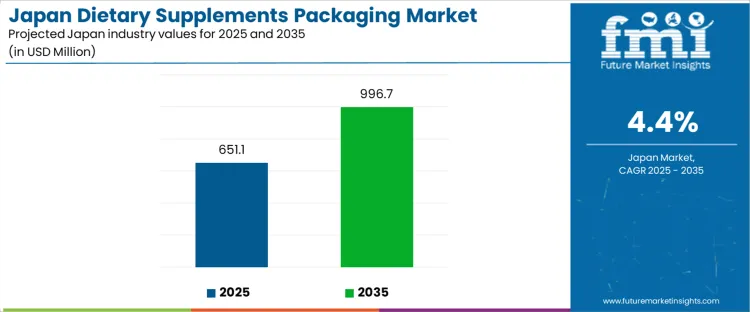
What is the Growth Forecast for the Dietary Supplements Packaging Market through 2035?
Growth curve for dietary supplements packaging in Japan shows a consistent upward trajectory, with gradual acceleration over time. Starting at USD 651.1 million in 2025, the market grows steadily in the early years, reaching USD 679.4 million in 2026 and USD 709.0 million in 2027. This early phase represents the gradual adoption of new packaging technologies and the continued expansion of the dietary supplement market as consumer interest grows.
From 2027 to 2030, the growth rate accelerates slightly, with the market reaching USD 739.8 million in 2028, USD 772.0 million in 2029, and USD 805.6 million in 2030. This acceleration is driven by the increasing demand for more sustainable, convenient, and innovative packaging solutions as manufacturers respond to consumer preferences and regulatory changes. From 2031 onward, the growth continues, reaching USD 840.6 million in 2031, USD 877.2 million in 2032, and USD 915.4 million in 2033.
By 2035, industry is expected to reach USD 996.7 million, reflecting the maturation of the market with continued incremental increases. Growth curve shape analysis shows a steady and consistent increase in demand for dietary supplements packaging, with an acceleration in the mid-to-late stages as packaging innovations, sustainability demands, and the increasing need for secure and high-quality packaging continue to drive growth.
Key Takeaways of Dietary Supplements Packaging Industry in Japan
| Metric | Value |
|---|---|
| Industry Sales Value (2025) | USD 651.1 million |
| Industry Forecast Value (2035) | USD 996.7 million |
| Industry Forecast CAGR (2025-2035) | 4.4% |
What Is Driving the Demand for Dietary Supplements Packaging in Japan?
Demand for dietary supplements packaging in Japan has been shaped by rising consumption of dietary and nutritional supplements. The domestic market for dietary supplements has been growing, supported by increased health awareness among consumers and a demographic trend toward an older population. As more individuals rely on vitamins, minerals, and nutraceutical products for health maintenance, packaging demand rises in parallel with the volume of products marketed and sold. The established supplement sector requires safe, convenient and regulatory compliant packaging formats to store pills, capsules, powders or liquids. The broader packaging industry growth in Japan supports this need, providing infrastructure and supply chain capacity for supplement packaging solutions.
Future demand for dietary supplements packaging in Japan is expected to increase as supplement consumption continues to expand. Growth of the supplements market will drive higher volume of packaging needed for tablets, capsules, softgels, powders and other dosage forms. Packaging materials that ensure long shelf life, product integrity, and user convenience will continue to be required. Trends toward packaging diversification-including bottles, blister packs, pouches and sachets-are likely to strengthen as manufacturers seek to cater to different supplement formats and consumer preferences. Packaging segment may also grow if regulatory standards for safety and labeling remain strict, pushing producers to adopt more robust, compliant packaging solutions.
What Are the Key Segments in Dietary Supplements Packaging Market in Japan?
Dietary supplements packaging market in Japan is segmented by material type and supplement form. Plastic is the leading material type, holding 46% of the market share. By supplement form, liquid supplements dominate, representing 65% of the market. The growing demand for dietary supplements and the need for convenient, effective packaging solutions are driving market growth in Japan.
Which Material Type Drives Dietary Supplements Packaging Demand in Japan?
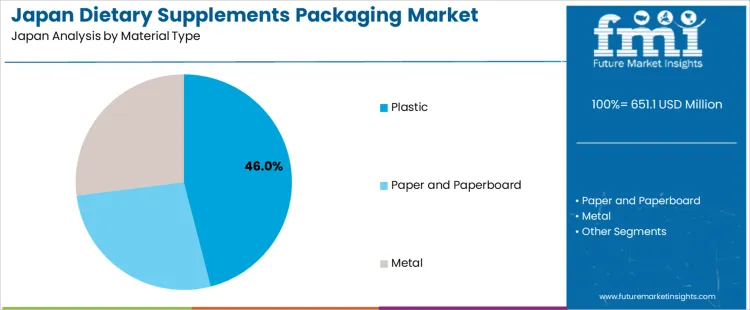
Plastic is the most widely used material in the dietary supplements packaging market in Japan, accounting for 46% of the market share. Plastic packaging is favored for its durability, flexibility, and cost-effectiveness, making it suitable for a wide range of supplement forms, particularly liquids. It provides an excellent barrier against moisture, light, and air, which helps maintain the stability and efficacy of dietary supplements. The convenience of plastic packaging, such as bottles, sachets, and pouches, is another driving factor in its widespread use. While paper and paperboard and metal are also used, plastic remains the dominant material due to its versatility, ease of use, and ability to protect supplements from contamination and degradation.
Which Supplement Form Drives Dietary Supplements Packaging Demand in Japan?
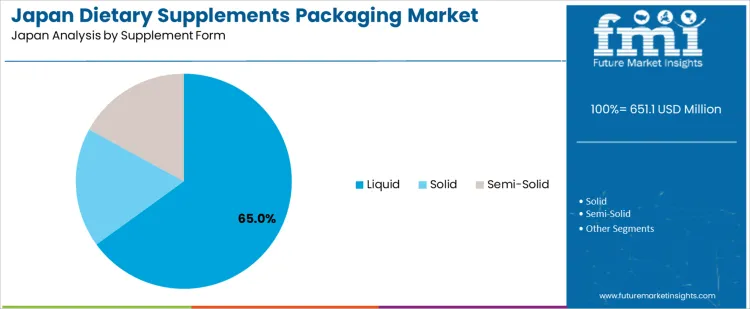
Liquid supplements are the dominant form in the dietary supplements packaging market in Japan, representing 65% of the market share. Liquid supplements, such as vitamins, herbal extracts, and protein drinks, are popular due to their ease of consumption and faster absorption compared to solid forms. Demand for liquid supplements is supported by the growing trend towards convenience and consumer preference for ready-to-drink formulations. Plastic packaging is commonly used for liquid supplements, as it provides secure, leak-proof storage and protection from environmental factors that could compromise product quality.
What is the Key Dynamics for Dietary Supplements Packaging in Japan?
Growth is being shaped by a surge in demand for health and wellness products. As more consumers adopt supplements to support immunity, aging-related needs, or general wellness, the need for safe, reliable packaging has grown. Packaging that preserves freshness, ensures ease of use, and offers convenience for busy lifestyles is increasingly preferred. Compact bottles, pouches, or single-serve formats are gaining popularity. Demand for packaging solutions that support long shelf life and product integrity has risen in response to growing consumption of vitamins, minerals, protein powders, and wellness supplements.
What are the Key Drivers for Dietary Supplements Packaging Demand in Japan?
An aging population and rising health awareness across all age groups are driving demand for dietary supplements and, thus, packaging solutions. The older demographic seeks supplements to support bone health, mobility, general wellness, and longevity, creating a stable demand. Convenience and portability also act as major drivers. Working adults and younger consumers often prefer supplements in flexible packaging, such as pouches, sachets, or compact bottles, that fit busy lifestyles. Growth in online retail and e-commerce has increased demand for packaging that ensures safe delivery, protects products during shipping, and provides tamper-evident seals.
What are the Restraints for Dietary Supplements Packaging Demand in Japan?
Strict regulatory standards and compliance requirements around supplement safety, labeling, and packaging materials can complicate packaging design and manufacturing. Meeting these regulations can raise costs and slow down product launches. High-quality packaging materials, such as resealable containers, child-resistant caps, or moisture protective pouches, increase production costs, which can reduce margins for manufacturers and brands. Consumer sensitivity to price and willingness to pay premium amounts for packaging may limit the adoption of advanced or eco-friendly packaging, particularly among cost-conscious segments. Economic uncertainties or raw material price fluctuations can further restrain the expansion of premium packaging solutions.
What are the Key Trends in Dietary Supplements Packaging in Japan?
A shift toward smart packaging solutions is evident, including tamper evident seals, QR codes or digital authentication features that enhance trust and traceability. Eco friendly and recyclable packaging materials are rising in popularity as environmental awareness increases among both consumers and regulators. Flexible packaging formats such as pouches and sachets are becoming more common due to their portability, convenience, and cost efficiency-especially for powders, single serve, or on the go supplement formats. There is a growing trend of personalization-packaging for smaller portions, age or health targeted supplements, and direct to consumer subscription formats that cater to individual needs.
What is the Regional Demand Outlook for Dietary Supplements Packaging in Japan?
Demand for dietary supplements packaging in Japan is projected to grow steadily, with Kyushu & Okinawa leading the way at a projected CAGR of 5.4%. Kanto follows with a growth rate of 5.0%, while Kansai is expected to grow at 4.4%. Chubu is projected to grow at a rate of 3.9%, while Tohoku and Rest of Japan show more moderate growth, with CAGRs of 3.4% and 3.2%, respectively. The increasing demand for dietary supplements, driven by Japan’s aging population and growing health awareness, is fueling the need for effective and innovative packaging solutions that preserve the quality and efficacy of these products.
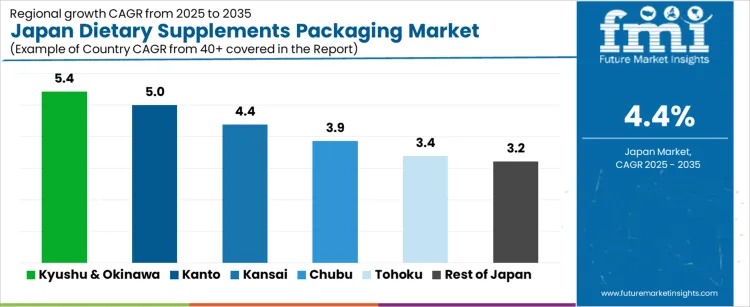
| Region | CAGR (2025-2035) |
|---|---|
| Kyushu & Okinawa | 5.4% |
| Kanto | 5.0% |
| Kansai | 4.4% |
| Chubu | 3.9% |
| Tohoku | 3.4% |
| Rest of Japan | 3.2% |
What is Driving the Growth of Dietary Supplements Packaging in Kyushu & Okinawa?
Kyushu & Okinawa is projected to experience the highest growth in the dietary supplements packaging market, with a projected CAGR of 5.4%. The region’s increasing health consciousness, particularly in the aging population, is a major factor contributing to this growth. As the demand for dietary supplements continues to rise, so does the need for packaging that can preserve the quality of these products, ensuring they remain effective and safe for consumption. Additionally, Kyushu & Okinawa’s focus on eco-friendly packaging solutions is driving innovation in the packaging industry. With a growing number of dietary supplement brands offering sustainable packaging options to meet consumer demand for environmentally conscious products, the market for dietary supplements packaging is expected to expand at a significant rate in the region.
Why is the Dietary Supplements Packaging Market Expanding in Kanto?
In Kanto, the demand for dietary supplements packaging is projected to grow at a CAGR of 5.0%. Kanto, home to Japan's capital Tokyo, has a highly developed healthcare and consumer goods sector, which is driving the growth of dietary supplements. The increasing awareness of health and wellness, coupled with Japan’s aging population, is leading to higher demand for dietary supplements, particularly those targeting chronic health conditions and preventive care. As the dietary supplements market expands, there is a rising demand for packaging solutions that ensure product safety, convenience, and sustainability. Kanto’s advanced logistics infrastructure and consumer-driven trends towards innovation in packaging are contributing to the steady growth of the dietary supplements packaging market.
How is the Dietary Supplements Packaging Market Growing in Kansai?
In Kansai, the dietary supplements packaging market is projected to grow at a CAGR of 4.4%. Kansai, which includes key cities like Osaka and Kyoto, has a strong healthcare infrastructure that is increasingly focusing on wellness products. The region’s aging population, which is more likely to require dietary supplements for managing chronic diseases, is contributing to the rising demand for such products. As Kansai’s consumer market increasingly embraces preventive health measures, there is greater demand for packaging solutions that preserve the quality of supplements. Kansai’s emphasis on sustainability and eco-friendly solutions is also influencing the market, with packaging manufacturers developing more sustainable options to meet consumer expectations for greener products. The demand for effective, convenient, and sustainable packaging solutions is driving the growth of the dietary supplements packaging market in Kansai.
What is Contributing to the Growth of Dietary Supplements Packaging in Chubu?
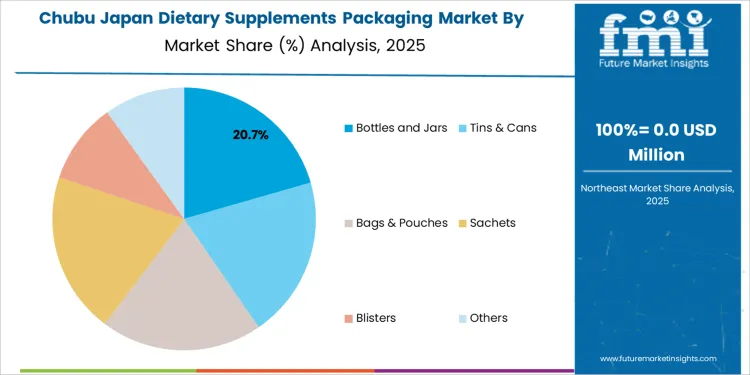
In Chubu, the dietary supplements packaging market is expected to grow at a CAGR of 3.9%. Chubu’s healthcare sector, with cities like Nagoya, is increasingly focusing on health and wellness, driving demand for dietary supplements. As the region’s aging population grows, so does the need for effective packaging solutions for dietary supplements. The demand for packaging that ensures product freshness, protects from contamination, and provides convenience is rising. Additionally, Chubu is witnessing an increased focus on sustainability, which is pushing packaging manufacturers to develop more eco-friendly and biodegradable packaging solutions for dietary supplements. The market is expected to expand steadily in Chubu as more manufacturers and consumers prioritize health and sustainable practices.
What is Influencing the Growth of Dietary Supplements Packaging in Tohoku?
In Tohoku, the dietary supplements packaging market is projected to grow at a CAGR of 3.4%. The region’s aging population, which is increasingly focused on maintaining health and wellness, is driving demand for dietary supplements. As the consumption of supplements rises, there is a growing need for packaging that preserves the integrity of the products. Tohoku’s healthcare providers and supplement manufacturers are looking for packaging solutions that provide ease of use, shelf stability, and enhanced protection. Additionally, Tohoku’s increasing emphasis on environmentally conscious practices is contributing to the adoption of sustainable packaging options. As awareness of the benefits of dietary supplements grows, the demand for effective packaging solutions in Tohoku is expected to continue rising at a moderate pace.
What is Contributing to the Growth of Dietary Supplements Packaging in Rest of Japan?
In Rest of Japan, the dietary supplements packaging market is expected to grow at a more moderate rate of 3.2%. While the demand is smaller compared to major urban centers, there is still a growing interest in dietary supplements, particularly in rural areas where access to healthcare may be limited. As the population becomes more health-conscious and the demand for supplements increases, there is a rising need for packaging that ensures product safety and convenience. Rest of Japan’s healthcare providers and supplement manufacturers are increasingly adopting packaging solutions that extend the shelf life of products while meeting consumer demand for eco-friendly options. As healthcare access improves and consumer awareness rises, the market for dietary supplements packaging in Rest of Japan is expected to grow steadily.
What is the Competitive Landscape for Demand for Dietary Supplements Packaging in Japan?
Demand for dietary supplements packaging in Japan is rising in parallel with growing consumer interest in health, wellness, and preventive care. As more people embrace vitamins, minerals, herbal supplements, protein powders and nutraceuticals, manufacturers and distributors seek packaging that ensures product safety, preserves shelf life, and supports convenience and branding. The shift toward aging population demographics, increased health consciousness, and demand for clean label or premium supplement products reinforce need for reliable, regulatory compliant packaging. The rise of direct to consumer sales, online retail, and exports further boosts demand for packaging solutions that are tamper evident, compliant with hygiene standards, easy to ship, and suitable for domestic and international markets.
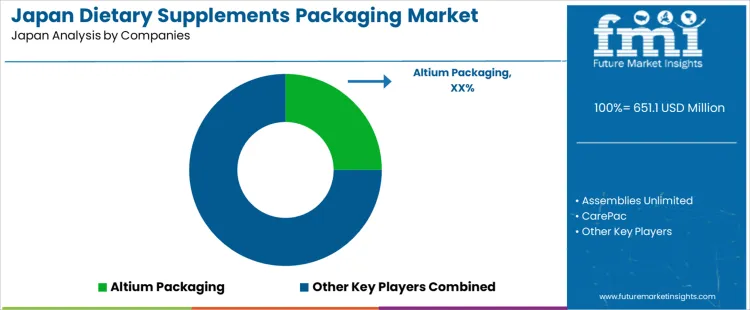
On the supply side, a handful of packaging specialist companies compete to meet this rising need. According to your list, Altium Packaging leads with about 25% share among listed firms. Other significant players include Assemblies Unlimited, CarePac, Comar, and Eagle Flexible Packaging. These firms supply a variety of packaging formats-bottles, pouches, blister packs, dispensing mechanisms and sealing solutions-tailored for dietary supplements. Competition among them is shaped by factors such as quality and safety of packaging materials, compliance with Japanese packaging and food supplement regulations, ability to provide child proof or tamper resistant seals, flexibility in small to large production volumes, and capacity to support branding and differentiation (e.g. eco friendly packaging, premium look, convenient resealable packs). Companies that combine regulatory-compliant packaging, flexible manufacturing capacity, strong quality control, and ability to support brand-oriented packaging design are best positioned to capture growth as demand for dietary supplements and associated packaging increases in Japan.
Key Players of the Dietary Supplements Packaging Industry in Japan
- Altium Packaging
- Assemblies Unlimited
- CarePac
- Comar
- Eagle Flexible Packaging
Scope of the Report
| Items | Details |
|---|---|
| Quantitative Units | USD Million |
| Regions Covered | Japan |
| Material Type | Plastic; Paper & Paperboard; Metal |
| Packaging Format | Bottles & Jars; Tins & Cans; Bags & Pouches; Sachets; Blisters; Others |
| Supplement Form | Liquid; Solid; Semi-Solid |
| Key Companies Profiled | Altium Packaging; Assemblies Unlimited; CarePac; Comar; Eagle Flexible Packaging |
| Additional Attributes | Dollar sales by packaging material and format reflect growing demand driven by rising supplement consumption, especially among aging and health-conscious populations. Plastic packaging and bottles/jars remain dominant due to convenience, shelf-life, and cost. Growth is also supported by increasing use of pouches, sachets, and blister formats for capsules, powders, and single-serve dosing, as supplement variety and formats expand. Sustainability and recyclable/eco-friendly packaging (paper/paperboard, lightweight materials) are gaining interest, influencing material and format mix trends. |
Key Segments in the Demand for Dietary Supplements Packaging in Japan
Material Type
- Plastic
- Paper and Paperboard
- Metal
Packaging Format
- Bottles and Jars
- Tins & Cans
- Bags & Pouches
- Sachets
- Blisters
- Others
Supplement Form
- Liquid
- Solid
- Semi-Solid
Region
- Kyushu & Okinawa
- Kanto
- Kansai
- Chubu
- Tohoku
- Rest of Japan
Frequently Asked Questions
How big is the demand for dietary supplements packaging in Japan in 2025?
The demand for dietary supplements packaging in Japan is estimated to be valued at USD 651.1 million in 2025.
What will be the size of dietary supplements packaging in Japan in 2035?
The market size for the dietary supplements packaging in Japan is projected to reach USD 996.7 million by 2035.
How much will be the demand for dietary supplements packaging in Japan growth between 2025 and 2035?
The demand for dietary supplements packaging in Japan is expected to grow at a 4.4% CAGR between 2025 and 2035.
What are the key product types in the dietary supplements packaging in Japan?
The key product types in dietary supplements packaging in Japan are plastic, paper and paperboard and metal.
Which packaging format segment is expected to contribute significant share in the dietary supplements packaging in Japan in 2025?
In terms of packaging format, bottles and jars segment is expected to command 20.0% share in the dietary supplements packaging in Japan in 2025.
Preview the report firsthand - request a free sample
Get SampleGet the brochure for pricing and purchase details.
Get PDFTable of Content
- Executive Summary
- Japan Market Outlook
- Demand-side Trends
- Supply-side Trends
- Technology Roadmap Analysis
- Analysis and Recommendations
- Market Overview
- Market Coverage / Taxonomy
- Market Definition / Scope / Limitations
- Market Background
- Market Dynamics
- Drivers
- Restraints
- Opportunity
- Trends
- Scenario Forecast
- Demand in Optimistic Scenario
- Demand in Likely Scenario
- Demand in Conservative Scenario
- Opportunity Map Analysis
- Product Life Cycle Analysis
- Supply Chain Analysis
- Investment Feasibility Matrix
- Value Chain Analysis
- PESTLE and Porter’s Analysis
- Regulatory Landscape
- Regional Parent Market Outlook
- Production and Consumption Statistics
- Import and Export Statistics
- Market Dynamics
- Japan Market Analysis 2020 to 2024 and Forecast, 2025 to 2035
- Historical Market Size Value (USD Million) Analysis, 2020 to 2024
- Current and Future Market Size Value (USD Million) Projections, 2025 to 2035
- Y-o-Y Growth Trend Analysis
- Absolute $ Opportunity Analysis
- Japan Market Pricing Analysis 2020 to 2024 and Forecast 2025 to 2035
- Japan Market Analysis 2020 to 2024 and Forecast 2025 to 2035, By Material Type
- Introduction / Key Findings
- Historical Market Size Value (USD Million) Analysis By Material Type , 2020 to 2024
- Current and Future Market Size Value (USD Million) Analysis and Forecast By Material Type , 2025 to 2035
- Plastic
- Paper and Paperboard
- Metal
- Y-o-Y Growth Trend Analysis By Material Type , 2020 to 2024
- Absolute $ Opportunity Analysis By Material Type , 2025 to 2035
- Japan Market Analysis 2020 to 2024 and Forecast 2025 to 2035, By Packaging Format
- Introduction / Key Findings
- Historical Market Size Value (USD Million) Analysis By Packaging Format, 2020 to 2024
- Current and Future Market Size Value (USD Million) Analysis and Forecast By Packaging Format, 2025 to 2035
- Bottles and Jars
- Tins & Cans
- Bags & Pouches
- Sachets
- Blisters
- Others
- Y-o-Y Growth Trend Analysis By Packaging Format, 2020 to 2024
- Absolute $ Opportunity Analysis By Packaging Format, 2025 to 2035
- Japan Market Analysis 2020 to 2024 and Forecast 2025 to 2035, By Supplement Form
- Introduction / Key Findings
- Historical Market Size Value (USD Million) Analysis By Supplement Form, 2020 to 2024
- Current and Future Market Size Value (USD Million) Analysis and Forecast By Supplement Form, 2025 to 2035
- Liquid
- Solid
- Semi-Solid
- Y-o-Y Growth Trend Analysis By Supplement Form, 2020 to 2024
- Absolute $ Opportunity Analysis By Supplement Form, 2025 to 2035
- Market Structure Analysis
- Competition Dashboard
- Competition Benchmarking
- Market Share Analysis of Top Players
- By Regional
- By Material Type
- By Packaging Format
- By Supplement Form
- Competition Analysis
- Competition Deep Dive
- Altium Packaging
- Overview
- Product Portfolio
- Profitability by Market Segments (Product/Age /Sales Channel/Region)
- Sales Footprint
- Strategy Overview
- Marketing Strategy
- Product Strategy
- Channel Strategy
- Assemblies Unlimited
- CarePac
- Comar
- Eagle Flexible Packaging
- Altium Packaging
- Competition Deep Dive
- Assumptions & Acronyms Used
- Research Methodology


