

- Industry Size (2025)
- USD 397.9 Mn
- Forecast (2035)
- USD 558.5 Mn
- CAGR (2025 to 2035)
- 3.5%
Demand for Tea Packaging in Japan Forecast and Outlook 2025 to 2035
Tea packaging demand in Japan stands at USD 397.9 million in 2025 and is projected to reach USD 558.5 million by 2035 at a CAGR of 3.5%. Early growth is anchored in the structural role of packaged tea in daily consumption across households, vending channels, and foodservice. Tea bags account for 42% of total product demand as they align with single-cup convenience and office consumption patterns.
Flexible packaging holds a dominant 65.5% share due to its efficiency in portion control, moisture protection, and shelf presentation. Domestic tea processors rely heavily on standardized pouch and bag formats to support high-volume filling operations. Growth in this phase is shaped more by steady replacement cycles and brand rotation than by expansion in overall tea consumption.
Quick Stats of the Demand for Tea Packaging in Japan
- Demand for Tea Packaging in Japan Value (2025): USD 397.9 million
- Demand for Tea Packaging in Japan Forecast Value (2035): USD 558.5 million
- Demand for Tea Packaging in Japan Forecast CAGR (2025 to 2035): 3.5%
- Demand for Tea Packaging in Japan Leading Product Type: Tea Bags (42%)
- Demand for Tea Packaging in Japan Key Growth Regions: Kyushu & Okinawa, Kanto, Kansai, Chubu, Tohoku, Rest of Japan
- Demand for Tea Packaging in Japan Top Players: FPC Flexible Packaging Corporation, Cascades Inc., Hankuk Package Co. Ltd., Aero-Pack Industries Inc., Detmold Group
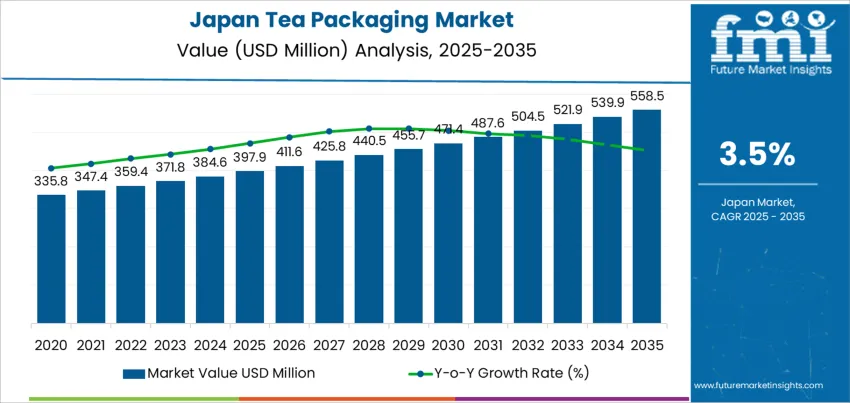
What is the Demand Forecast for Tea Packaging in Japan through 2035?
After 2030, market expansion reflects gradual shifts in packaging format preference rather than sharp increases in unit volumes. Demand rises from about USD 471.4 million in 2030 toward USD 558.5 million by 2035 as premium loose-leaf teas, gift packs, and specialty blends gain wider retail presence. Rigid packaging supports tea pots and premium formats where protection and presentation influence purchasing behavior.
Export-oriented brands also add incremental demand for higher barrier packaging to preserve aroma and freshness over longer shipping distances. Key suppliers serving the Japanese market include FPC Flexible Packaging Corporation, Cascades Inc., Hankuk Package Co Ltd., Aero-Pack Industries Inc., and Detmold Group. Competitive positioning centers on material consistency, seal integrity, print clarity, and alignment with automated filling line requirements across major tea processing regions.
Tea packaging in Japan reflects a balance between deep-rooted consumption traditions and modern retail format evolution, which gives the category a structurally steady but format-sensitive growth profile. Demand increases from USD 397.9 million in 2025 to USD 411.6 million by 2026 and USD 425.8 million by 2027, reaching USD 455.7 million by 2030 and adding USD 57.8 million from the 2025 base. This phase is shaped by rising sales of bottled tea, premium loose-leaf formats, and convenience-driven single-serve packs. Growth is supported by resealable pouches, high-barrier films for aroma protection, and premium paper-based cartons used in gifting segments. Value expansion remains controlled as competition among converters limits rapid price escalation.
From 2030 to 2035, the market expands from USD 455.7 million to USD 558.5 million, adding USD 102.8 million in the second half of the decade. This back weighted acceleration reflects deeper penetration of sustainable packaging formats, higher export-grade presentation standards, and premium branding in matcha, herbal, and functional tea categories. As e commerce tea sales expand and cross-border shipments grow, demand for protective, moisture-resistant, and visually differentiated packaging rises. Tea packaging shifts from a cost-driven container toward a brand-defining interface, raising value density and supporting sustained long-term demand growth across Japans domestic and export-oriented tea industry.
Tea Packaging Industry in Japan Key Takeaways
| Metric | Value |
|---|---|
| Industry Value (2025) | USD 397.9 million |
| Forecast Value (2035) | USD 558.5 million |
| Forecast CAGR (2025 to 2035) | 3.5% |
How Is Demand for Tea Packaging Evolving in the USA?
Demand for tea packaging in the USA reflects shifting consumer habits as tea consumption expands beyond traditional loose-leaf varieties toward convenience-oriented formats like tea bags, ready-to-drink teas, and single-serve sachets. As Americans increasingly consume tea on the go or seek quick prep at home, they favour packaging that offers freshness, portion control, and portability. This fuelled growth in demand for flexible packaging like pouches, as well as rigid containers and sachets particularly for herbal teas, specialty blends, and green tea. Rising interest in premium, specialty, and health-oriented teas also pushed producers to adopt packaging that preserves aroma, extends shelf life, and distinguishes products on store shelves.
Future demand will likely accelerate as consumer preferences steer toward sustainability, premiumisation, and convenience in the tea segment. Growth in organic teas, functional/herbal teas, and ready-to-drink products will expand packaging requirements beyond standard bag formats. Brands may invest more in barrier pouches, resealable packaging, compostable or recyclable materials, and visually differentiated containers to meet eco-conscious consumer expectations.
Distribution via e-commerce and subscription-based tea delivery will increase need for robust mailing-friendly packaging. At the same time, challenges remain: supply-chain pressures on packaging materials, cost pressures for sustainable films, and competition from loose-leaf and bulk tea may moderate adoption. The shape of future demand will depend on how well packaging innovation aligns with evolving tea-drinking habits, sustainability norms, and convenience demands.
How Are Product Type and Packaging Type Structuring the Demand for Tea Packaging in Japan?
The demand for tea packaging in Japan is structured by product type and packaging format. Tea bags account for 42% of total demand, followed by pouches and tea pots used across retail, gifting, and premium presentation segments. By packaging type, flexible packaging represents 65.5% of total consumption, while rigid packaging serves specialty, premium, and institutional applications. Demand behavior is shaped by convenience preference, portion control needs, shelf life protection, aroma retention, and retail display efficiency. These segments reflect how preparation habits, storage requirements, and distribution efficiency guide packaging selection across household consumption, foodservice operations, and specialty tea retail markets in Japan.
Why Do Tea Bags Lead the Tea Packaging Product Type Demand in Japan?
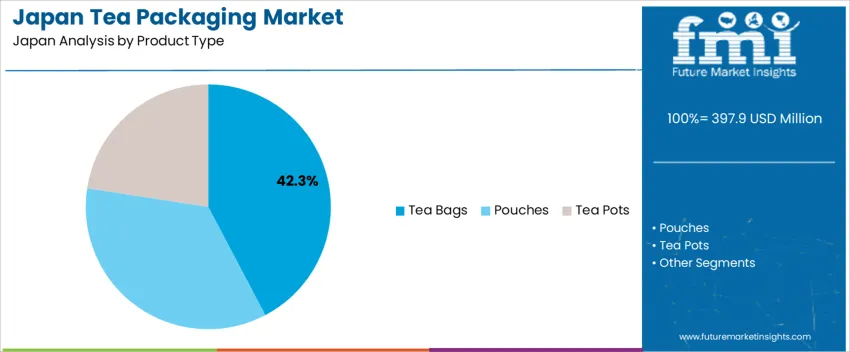
Tea bags account for 42% of total tea packaging demand in Japan due to their strong alignment with convenience driven consumption patterns. Single serve brewing, fast preparation, and consistent flavor extraction make tea bags suitable for home use, office environments, vending operations, and hospitality settings. Consumers favor tea bags for green tea, barley tea, and blended herbal varieties where time efficiency and portion control are prioritized. Their compact format also supports easy storage in small urban kitchens where space efficiency remains important.
Tea bags further support high volume retail distribution through supermarkets and convenience stores that emphasize quick purchase formats. Institutional buyers such as hospitals, schools, and corporate cafeterias rely on tea bags for standardized serving and minimal handling. Automated filling and sealing equipment supports large scale manufacturing with consistent quality control. These preparation efficiency, storage convenience, and institutional compatibility factors sustain tea bags as the leading product type in the Japan tea packaging demand structure.
Why Does Flexible Packaging Dominate the Tea Packaging Type Demand in Japan?
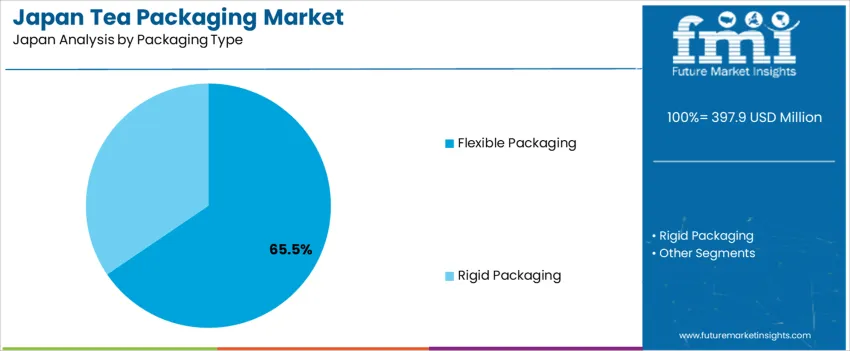
Flexible packaging accounts for 65.5% of total tea packaging demand in Japan due to its strong barrier performance, lightweight structure, and cost efficient manufacturing profile. Flexible packs protect tea leaves and tea bags from moisture, oxygen, and light, which preserves aroma, color, and flavor during extended shelf storage. Stand up pouches, pillow packs, and laminated sachets are widely used for retail tea sales due to their space efficient stacking and reseal functionality.
Flexible packaging also supports high speed automated filling lines, which improves production efficiency for large tea processors. Reduced material usage per unit lowers transport weight and distribution cost across domestic logistics networks. Branding flexibility through wide surface print areas further enhances retail shelf presence. These protection performance, cost efficiency, and merchandising advantages position flexible packaging as the dominant packaging type in the Japan tea packaging demand landscape.
Why Is Tea Packaging in Japan Treated as a Cultural Interface Rather Than a Simple Protective Layer?
Demand for tea packaging in Japan is shaped by its role as the visible extension of product identity and gifting custom rather than only a containment solution. Tea is deeply embedded in daily rituals, seasonal ceremonies, and formal gift exchange. Packaging must communicate refinement, origin, and preparation intent at first glance. Even everyday retail tea carries expectations of order, cleanliness, and aesthetic restraint. This cultural framing means packaging decisions influence brand trust and perceived tea quality as much as leaf grade itself. Packaging functions as a silent host in the Japanese tea experience.
How Do Convenience Stores, Vending Culture, and Portion Control Shape Packaging Formats?
Japan high-density retail structure drives tea packaging toward compact, single-serve, and highly portable formats. Convenience stores depend on rapid turnover of bottled, bagged, and powdered teas optimized for immediate consumption. Vending machines further reinforce rigid format standardization for temperature tolerance and slot efficiency. Portion control plays a central role in both loose-leaf sachets and ready-to-drink packaging, as urban households favor minimal storage and frequent repurchase. These distribution channels create strong demand for packaging that supports speed, portability, and uniform stocking rather than bulk storage.
What Moisture Control, Aroma Protection, and Material Discipline Limit Design Freedom?
Tea packaging in Japan operates under strict functional constraints tied to humidity, aroma preservation, and oxidation sensitivity. High ambient moisture requires superior vapor barriers to prevent flavor degradation and clumping. Aroma protection is essential since tea easily absorbs surrounding odors during storage and transport. At the same time, municipal waste sorting rules restrict material combinations, limiting use of complex laminates. Lightweight films risk puncture and seal failure. These intersecting performance and disposal controls shape a narrow technical window in which tea packaging design must operate.
How Are Seasonal Variations, Premiumization, and Sustainability Reframing Demand Patterns?
Tea packaging demand in Japan shifts seasonally between chilled summer formats and insulated winter offerings, creating rapid packaging changeover cycles. Premium teas rely increasingly on tactile materials, rigid canisters, and minimalist visual language to signal craftsmanship. Sustainability expectations influence downsized packaging, refill systems, and reduced ink coverage rather than radical material substitution. Limited-edition seasonal designs also sustain frequent short-run packaging production. These trends show tea packaging evolving as a dynamic responsiveness tool to season, quality tier, and environmental discipline rather than a fixed-format container category.
What is the Demand for Tea Packaging in Japan by Region?
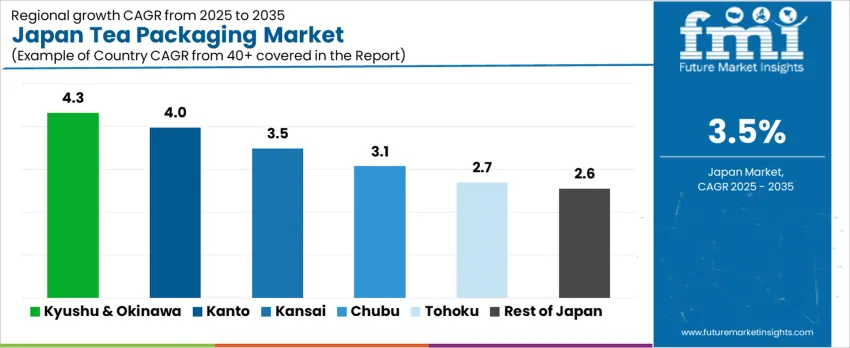
| Region | CAGR (%) |
|---|---|
| Kyushu & Okinawa | 4.3% |
| Kanto | 4.0% |
| Kansai | 3.5% |
| Chubu | 3.1% |
| Tohoku | 2.7% |
| Rest of Japan | 2.6% |
The demand for tea packaging in Japan shows steady regional variation, led by Kyushu & Okinawa at a 4.3% CAGR. This growth is supported by strong regional tea cultivation, rising export of packaged green tea, and steady demand from local beverage processors. Kanto follows at 4.0%, driven by high packaged tea consumption in urban centers, convenience store dominance, and private label beverage production. Kansai records 3.5% growth, supported by traditional tea consumption blended with modern retail formats. Chubu at 3.1% reflects moderate demand linked to regional distribution and food processing activity. Tohoku and Rest of Japan, at 2.7% and 2.6%, show slower growth shaped by lower population density and limited large-scale beverage packaging operations.
How Is Tea Processing Activity Supporting Packaging Growth in Kyushu And Okinawa?
Kyushu and Okinawa records a CAGR of 4.3% through 2035 for tea packaging demand, supported by green tea cultivation, bottled tea production, and regional export packaging activity. Bulk loose tea, tea bags, and ready to drink tea formats require moisture barrier and aroma retention solutions. Local cooperatives rely on flexible pouches and metalized laminates for shelf stability. Tourism linked tea gifting also adds steady decorative packaging demand. Growth remains production driven, with packaging volumes closely aligned to harvest cycles, regional beverage bottling output, and cooperative based processing operations.
- Green tea cultivation anchors primary packaging needs
- Bottled tea production supports continuous packaging flow
- Cooperative processors drive bulk flexible pack usage
- Gift packaging adds seasonal volume uplift
What Is Sustaining Strong Tea Packaging Demand in Kanto?
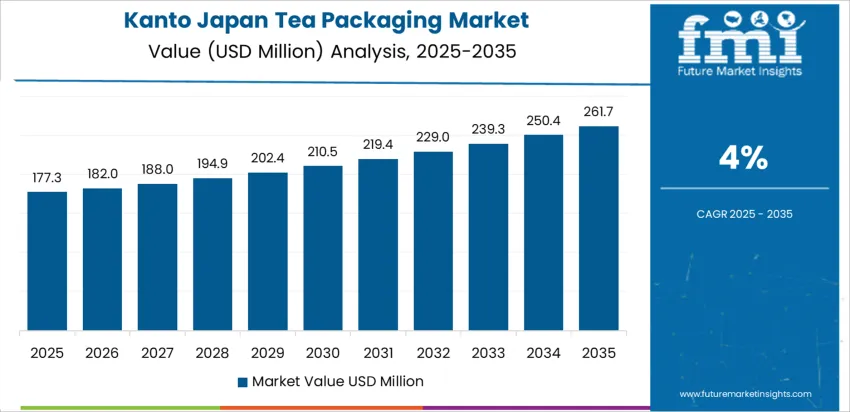
Kanto reflects a CAGR of 4.0% through 2035 for tea packaging demand, driven by dense urban consumption, large scale beverage bottling, and premium tea brand distribution. Ready to drink teas dominate packaging volume through PET bottles, labels, and secondary cartons. Specialty tea brands use paper canisters and multilayer pouches for retail differentiation. High logistics turnover supports frequent replenishment cycles. Packaging demand remains volume intensive and retail driven, shaped by supermarket distribution, vending machine supply chains, and strong daily tea consumption across metropolitan consumer markets.
- Bottled tea dominates regional packaging usage
- Premium brands rely on decorative paper canisters
- Urban logistics supports high refill frequency
- Vending supply chains drive steady container demand
Why Is Kansai Showing Balanced Growth in Tea Packaging Demand?
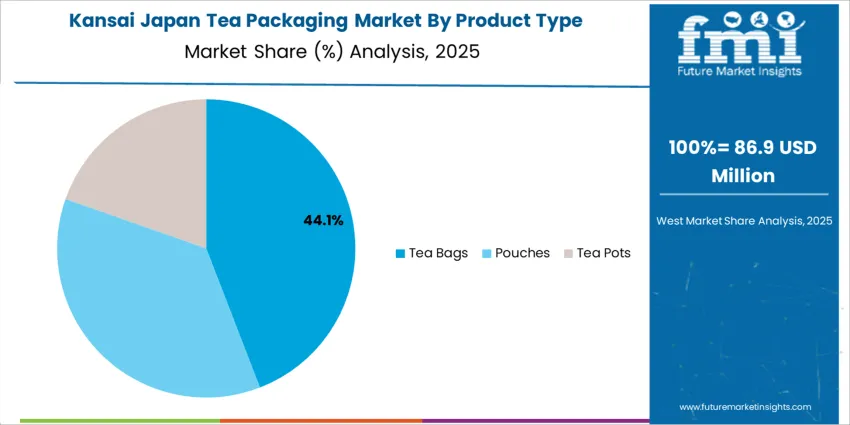
Kansai posts a CAGR of 3.5% through 2035 for tea packaging demand, supported by regional tea consumption, gift tea culture, and steady retail turnover. Loose leaf tea and tea bags remain core product formats, requiring vacuum packs and foil based pouches. Department store gifting supports premium presentation packaging. Small and mid sized packers prefer short production runs with flexible material compatibility. Demand remains replacement driven and seasonally influenced, with consistent procurement linked to holiday gifting cycles, routine household consumption, and stable specialty tea retail activity.
- Loose leaf tea supports vacuum pouch demand
- Gifting culture drives premium outer packaging
- Flexible short batch production suits local packers
- Seasonal festivals influence packaging order volumes
How Is Industrial Beverage Processing Shaping Demand in Chubu?
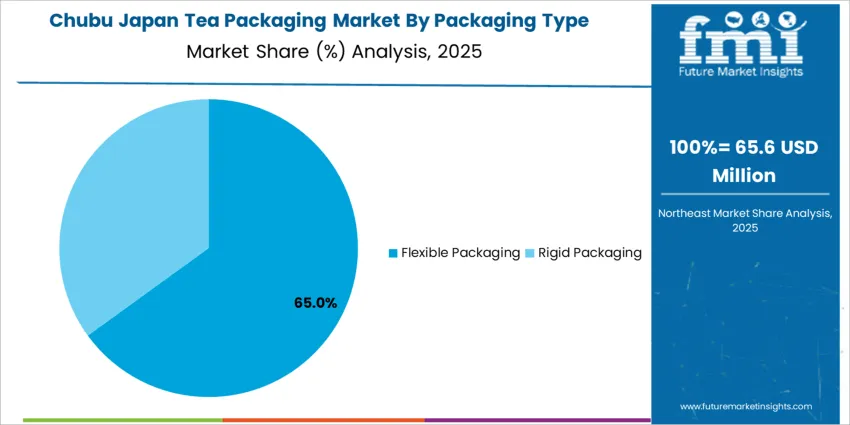
Chubu registers a CAGR of 3.1% through 2035 for tea packaging demand, supported by centralized beverage manufacturing, contract bottling, and export focused tea processing. PET bottles, shrink labels, and corrugated cartons dominate packaging requirements. Large production lines prioritize material consistency, sealing reliability, and label adhesion performance. Export shipments require secondary protective packaging for long distance transport. Demand remains contract driven and throughput focused, with procurement tied to long term bottling agreements and predictable production scheduling across industrial beverage facilities.
- Contract bottling anchors steady packaging throughput
- PET containers dominate beverage format usage
- Export protection drives secondary carton demand
- Long term supply contracts stabilize procurement
What Is Driving Steady Tea Packaging Demand in Tohoku?
Tohoku shows a CAGR of 2.7% through 2035 for tea packaging demand, shaped by small scale tea processing, regional brand distribution, and cooperative production models. Packaged loose tea, powdered tea, and local specialty blends require moisture resistant pouches and simple cartons. Local consumption dominates sales rather than national distribution. Limited factory automation moderates packaging line speeds. Demand remains necessity led and locally anchored, with stable volumes aligned to community based processing, regional retail circulation, and consistent household tea consumption patterns.
- Cooperative processors sustain base packaging demand
- Moisture protection remains a primary material requirement
- Local brands rely on small batch production
- Community retail stabilizes consumption volumes
Why Does the Rest of Japan Maintain Controlled Tea Packaging Growth?
Across the rest of Japan, expansion reflects a CAGR of 2.6% through 2035 for tea packaging demand, supported by municipal level tea sales, institutional catering, and regional beverage supply. Schools, hospitals, and office canteens rely on bulk tea packaging for daily service. Local tea brands focus on functional packaging rather than premium display formats. Distribution distances remain short, reducing heavy secondary packaging needs. Demand stays steady and operationally driven, with procurement centered on cost control, storage efficiency, and reliable aroma protection for routine foodservice and retail supply.
- Institutional catering supports bulk tea pack usage
- Local brands emphasize cost efficient packaging
- Short distribution distances limit heavy secondary packs
- Routine foodservice demand stabilizes long term volume
What Is Driving the Demand for Tea Packaging in Japan and Who Are the Key Players Shaping the Market?
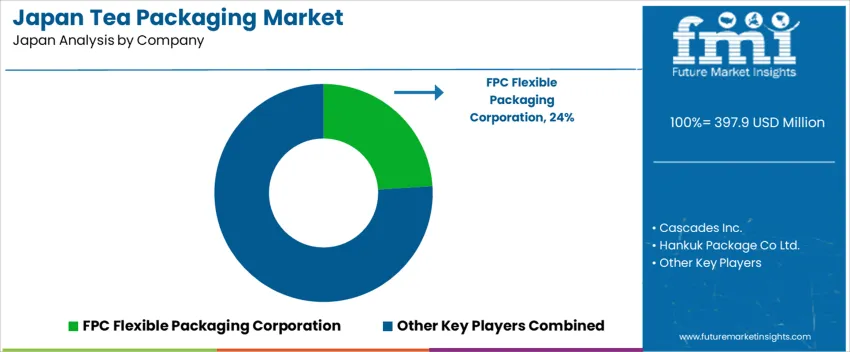
Demand for tea packaging in Japan is increasing as consumers favour convenience, freshness retention, and aesthetic presentation across both traditional teas and modern ready to drink or bagged formats. Tea makers increasingly use flexible pouches, resealable bags, and light resistant packaging to protect aroma, prevent moisture or oxygen exposure, and ensure longer shelf life. Rising interest in premium teas, herbal blends, and specialty products encourages packaging that emphasises quality and presentation. Growing e commerce and direct to consumer sales further support demand for packaging that balances durability, light weight, and ease of transport. Regulatory and consumer pressure toward sustainable materials is also pushing packaging makers to explore recyclable or lower impact films and papers.
Major firms influencing supply of tea packaging materials in Japan include FPC Flexible Packaging Corporation, Cascades Inc., Hankuk Package Co Ltd., Aero Pack Industries Inc., and Detmold Group. These companies offer a variety of packaging solutions - flexible pouches, laminated films, barrier wraps, and custom printed packages - suited to tea bags, loose leaf teas, and specialty tea products. Their capabilities in barrier materials, moisture and light resistant films, and sustainable substrate options make them well positioned to meet evolving manufacturer and consumer needs. Through broad material portfolios, quality control, and supply chain reliability they shape the packaging landscape for Japanese tea producers and brands.
Key Players in Tea Packaging Industry in Japan
- FPC Flexible Packaging Corporation
- Cascades Inc.
- Hankuk Package Co. Ltd.
- Aero-Pack Industries Inc.
- Detmold Group
Scope of the Report
| Items | Values |
|---|---|
| Quantitative Units (2025) | USD million |
| Product Type | Tea Bags, Pouches, Tea Pots |
| Packaging Type | Flexible Packaging, Rigid Packaging |
| Region | Kyushu & Okinawa, Kanto, Kansai, Chubu, Tohoku, Rest of Japan |
| Key Companies Profiled | FPC Flexible Packaging Corporation, Cascades Inc., Hankuk Package Co. Ltd., Aero-Pack Industries Inc., Detmold Group |
| Additional Attributes | Dollar by sales by product type, packaging type, region, barrier protection, aroma preservation, resealability, portion control, shelf visibility, material consistency, automated filling line compatibility, premium presentation, moisture and light resistance |
Tea Packaging Industry in Japan Segmentation
Product Type:
- Tea Bags
- Pouches
- Tea Pots
Packaging Type:
- Flexible Packaging
- Rigid Packaging
Region
- Kyushu & Okinawa
- Kanto
- Kansai
- Chubu
- Tohoku
- Rest of Japan
Frequently Asked Questions
How big is the demand for tea packaging in Japan in 2025?
The demand for tea packaging in Japan is estimated to be valued at USD 397.9 million in 2025.
What will be the size of tea packaging in Japan in 2035?
The market size for the tea packaging in Japan is projected to reach USD 558.5 million by 2035.
How much will be the demand for tea packaging in Japan growth between 2025 and 2035?
The demand for tea packaging in Japan is expected to grow at a 3.5% CAGR between 2025 and 2035.
What are the key product types in the tea packaging in Japan?
The key product types in tea packaging in Japan are tea bags, pouches and tea pots.
Which packaging type segment is expected to contribute significant share in the tea packaging in Japan in 2025?
In terms of packaging type, flexible packaging segment is expected to command 65.5% share in the tea packaging in Japan in 2025.
Preview the report firsthand - request a free sample
Get SampleGet the brochure for pricing and purchase details.
Get PDFTable of Content
- Executive Summary
- Japan Market Outlook
- Demand-side Trends
- Supply-side Trends
- Technology Roadmap Analysis
- Analysis and Recommendations
- Market Overview
- Market Coverage / Taxonomy
- Market Definition / Scope / Limitations
- Market Background
- Market Dynamics
- Drivers
- Restraints
- Opportunity
- Trends
- Scenario Forecast
- Demand in Optimistic Scenario
- Demand in Likely Scenario
- Demand in Conservative Scenario
- Opportunity Map Analysis
- Product Life Cycle Analysis
- Supply Chain Analysis
- Investment Feasibility Matrix
- Value Chain Analysis
- PESTLE and Porter’s Analysis
- Regulatory Landscape
- Regional Parent Market Outlook
- Production and Consumption Statistics
- Import and Export Statistics
- Market Dynamics
- Japan Market Analysis 2020 to 2024 and Forecast, 2025 to 2035
- Historical Market Size Value (USD Million) Analysis, 2020 to 2024
- Current and Future Market Size Value (USD Million) Projections, 2025 to 2035
- Y-o-Y Growth Trend Analysis
- Absolute $ Opportunity Analysis
- Japan Market Pricing Analysis 2020 to 2024 and Forecast 2025 to 2035
- Japan Market Analysis 2020 to 2024 and Forecast 2025 to 2035, By Product Type
- Introduction / Key Findings
- Historical Market Size Value (USD Million) Analysis By Product Type , 2020 to 2024
- Current and Future Market Size Value (USD Million) Analysis and Forecast By Product Type , 2025 to 2035
- Tea Bags
- Pouches
- Tea Pots
- Y-o-Y Growth Trend Analysis By Product Type , 2020 to 2024
- Absolute $ Opportunity Analysis By Product Type , 2025 to 2035
- Japan Market Analysis 2020 to 2024 and Forecast 2025 to 2035, By Packaging Type
- Introduction / Key Findings
- Historical Market Size Value (USD Million) Analysis By Packaging Type, 2020 to 2024
- Current and Future Market Size Value (USD Million) Analysis and Forecast By Packaging Type, 2025 to 2035
- Flexible Packaging
- Rigid Packaging
- Y-o-Y Growth Trend Analysis By Packaging Type, 2020 to 2024
- Absolute $ Opportunity Analysis By Packaging Type, 2025 to 2035
- Market Structure Analysis
- Competition Dashboard
- Competition Benchmarking
- Market Share Analysis of Top Players
- By Regional
- By Product Type
- By Packaging Type
- Competition Analysis
- Competition Deep Dive
- FPC Flexible Packaging Corporation
- Overview
- Product Portfolio
- Profitability by Market Segments (Product/Age /Sales Channel/Region)
- Sales Footprint
- Strategy Overview
- Marketing Strategy
- Product Strategy
- Channel Strategy
- Cascades Inc.
- Hankuk Package Co Ltd.
- Aero‑Pack Industries Inc.
- Detmold Group
- FPC Flexible Packaging Corporation
- Competition Deep Dive
- Assumptions & Acronyms Used
- Research Methodology


