

- Industry Size (2025)
- USD 65.3 Mn
- Forecast (2035)
- USD 84.0 Mn
- CAGR (2025 to 2035)
- 2.6%
Demand for Tea Packaging Machine in Japan Forecast and Outlook 2025 to 2035
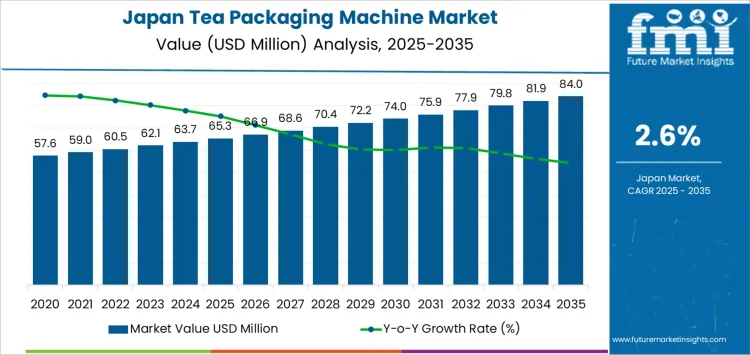
Demand for tea packaging machine in Japan is valued at USD 65.3 million in 2025 and is projected to reach USD 84.0 million by 2035 at a CAGR of 2.6%. The industry is shaped by Japans large-scale production of green tea, bottled tea, and convenience-driven single-serve formats. Form fill seal equipment dominates with a 64% share, reflecting its central role in pouches and sachets used across retail and vending channels.
Pouches account for the largest application share at 35%, followed by bottles and jars at 27% for ready-to-drink tea. Kanto and Chubu hold the highest installation density due to beverage bottling and contract packaging hubs. Key suppliers active in the country include GEA Group, IMA, Teepack Spezialmaschinen, Syntegon Technology, and Sengong Packing Equipment.
Quick Stats of the Demand for Tea Packaging Machine in Japan
- Demand for Tea Packaging Machine in Japan Value (2025): USD 65.3 million
- Demand for Tea Packaging Machine in Japan Forecast Value (2035): USD 84.0 million
- Demand for Tea Packaging Machine in Japan Forecast CAGR (2025 to 2035): 2.6%
- Leading Machine Type in Japan (2025): Form Fill Seal Equipment (64%)
- Key Growth Regions in Japan: Kyushu & Okinawa, Kanto, Kinki, Chubu
- Top Players in Japan: GEA Group AG, I.M.A. Industria Macchine Automatiche S.P.A., Xiamen Sengong Packing Equipment Co. Ltd., Teepack Spezialmaschinen Gmbh & Company Kg, Syntegon Technology GmbH
What is the Demand Forecast for Tea Packaging Machine in Japan through 2035?
After 2030, growth in the tea packaging machine industry in Japan is driven mainly by line upgrades for efficiency, hygiene automation, and format flexibility rather than by new plant construction. Demand shifts toward multi-format machines capable of handling both traditional loose tea packs and modern stick packs for functional and specialty teas. Bottled tea maintains steady equipment replacement cycles linked to high vending machine penetration and export-oriented production.
Cartoning and case packing equipment gains modest traction as secondary packing automation increases in mid-sized factories. Smaller regional producers in Shizuoka, Kagoshima, and Uji accelerate semi-automated upgrades to manage labor shortages. Competitive differentiation increasingly depends on changeover speed, sanitation design, and compatibility with heat-seal films for both dry and liquid tea formats rather than on machine pricing alone.
The demand for tea packaging machine in Japan is valued at USD 65.3 million in 2025 and rises to USD 72.2 million by 2030, reflecting an absolute increase of USD 6.9 million in the first half of the forecast period. The upward movement from USD 57.6 million in 2020 to current levels has been shaped by steady modernization of filling, sealing, and sachet systems used by green tea, hojicha, matcha, and functional tea processors. The Japan tea packaging machine industry is driven by equipment replacement in long-established factories, compact automation upgrades for regional tea brands, and rising outsourcing of packaging to specialized co-packers. Growth in this phase is operational rather than volume-led, supported by efficiency-driven capital expenditure and line-speed optimization.
From 2030 to 2035, demand advances from USD 72.2 million to USD 84.0 million, adding USD 11.8 million over the second half of the outlook. Annual value additions gradually widen from about USD 1.8 million to just over USD 2.1 million by the later years, reflecting wider adoption of automated pouching, single-serve format expansion, and integrated weighing and nitrogen flushing systems. This phase is supported by growth in ready-to-drink tea concentrates, powdered matcha exports, and private-label tea products for overseas markets where packaging precision directly affects shelf life and product acceptance. By 2035, tea packaging machine demand in Japan remains structurally linked to product format diversification and export-grade packaging consistency rather than domestic tea consumption growth alone.
Tea Packaging Machine Industry in Japan Key Takeaways
| Metric | Value |
|---|---|
| Industry Value (2025) | USD 65.3 million |
| Forecast Value (2035) | USD 84.0 million |
| Forecast CAGR (2025 to 2035) | 2.6% |
What Is Driving the Demand for Tea Packaging Machine in Japan?
The demand for tea packaging machine in Japan is rooted in the structure of the domestic tea industry, where product presentation, freshness control, and portion precision carry commercial importance. Historically, tea production relied on semi manual packing for loose leaf, matcha, and specialty blends supplied to local retailers and gift markets.
As distribution shifted toward supermarkets, export channels, and convenience stores, producers required faster, more consistent packaging systems that could protect aroma, prevent moisture exposure, and deliver uniform fills. Growth in bottled tea, pyramid tea bags, and single serve sachets further strengthened the need for automated packaging lines. The strong culture of packaging aesthetics in Japan also reinforced investment in machines capable of high quality sealing, labeling, and traceability integration.
Future demand for tea packaging machine in Japan will be shaped by rising exports of green tea products, growth of functional and wellness tea formats, and automation needs driven by labor constraints. Premiumization trends in matcha, herbal blends, and gift oriented tea packs will require machines that handle delicate powders and specialty materials without product loss.
Ready to drink tea brands will continue upgrading high speed secondary and tertiary packaging lines to meet logistics efficiency targets. Barriers include high capital cost for advanced machinery, long equipment replacement cycles among small tea processors, and technical complexity in handling fine tea powders without contamination. Long term demand will depend on how effectively automation aligns with export growth, premium product positioning, and workforce shortages across the Japanese tea industry.
What Is the Structural Breakdown of the Demand for Tea Packaging Machine in Japan by Machine Type and Operational Deployment?
The demand for tea packaging machine in Japan is segmented by machine type and operational deployment type. By machine type, adoption includes form fill seal equipment, filling and dosing equipment, cartooning equipment, case packing and sealers, and wrapping and bundling equipment. By operational deployment, the same machine categories are used under different production layouts based on scale and automation depth. These segment divisions reflect how Japans tea processors balance packaging speed, sachet precision, export labeling standards, and retail presentation controls. Procurement behavior is shaped by factory automation preferences, labor availability, footprint limitations, and strict hygiene regulations governing beverage and dry food packing operations.
Why Does Form Fill Seal Equipment Dominate the Demand for Tea Packaging Machine in Japan by Primary Machine Type?
Form fill seal equipment accounts for 64% of the demand for tea packaging machine in Japan by primary machine type, reflecting its central role in sachet, pouch, and portion pack production. Consumption intensity is driven by high volume green tea, barley tea, and herbal blend packaging across domestic and export channels. Usage remains stable because single serve tea consumption continues to dominate convenience retail and vending distribution. Procurement is largely capital driven through long term equipment replacement cycles. Price sensitivity remains moderate since uptime reliability, sealing accuracy, and dosing stability outweigh upfront machine cost in production planning.
Form fill seal systems contribute strongly to recurring capital deployment because converters continually upgrade sealing accuracy and throughput to match retail compression and automation targets. Repeat equipment investment remains high due to wear on sealing jaws and dosing units under continuous shifts. Buyers favor standardized platforms to reduce operator training variation and spare part complexity. Margin structure remains compressed for machine suppliers due to competitive bidding among domestic equipment makers. Certification exposure remains high due to hygiene audits and electrical safety compliance. Import reliance remains limited as Japan maintains strong domestic packaging machinery manufacturing capacity for core tea processing requirements.
What Is Driving Form Fill Seal Equipment to Lead the Demand for Tea Packaging Machine in Japan by Operational Deployment?
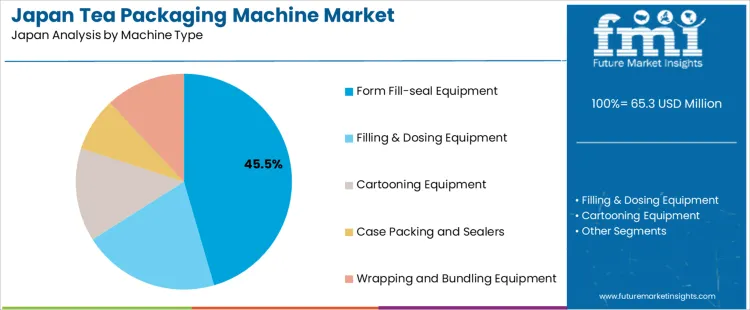
Form fill seal equipment also represents 45.5% of the demand for tea packaging machine in Japan by operational deployment, reflecting its dominance across fully automated tea packaging lines. Consumption per facility remains high in centralized beverage plants where pouch forming, filling, and sealing are integrated into synchronized high speed operations. Usage intensity is sustained by seasonal tea demand cycles and consistent private label packaging schedules. Procurement is tied to multi line automation projects rather than isolated machine upgrades. Price elasticity remains low because line efficiency, reject reduction, and staffing cost control drive capital allocation decisions.
Form fill seal dominance in operational deployment supports stable equipment utilization across three shift production schedules in major tea processing clusters. Repeat usage remains high because downstream cartooning and case packing depend on consistent upstream pouch output. Buyers favor inhouse maintenance capability to reduce downtime rather than relying on contract service networks. Margin recovery remains limited due to extended warranty and service bundling expectations. Certification exposure remains elevated under Japans food equipment sanitation regulations. Import dependence surfaces only for selected high speed dosing modules. Substitution from modular filling stations remains limited where space constraints are minimal.
What Is Driving the Demand for Tea Packaging Machine in Japan Beverage Processing Infrastructure?
Demand for tea packaging machines in Japan is anchored in high-volume green tea production, convenience drink expansion, and strict quality control standards. Bottled tea, tea bags, and powdered tea mixes dominate everyday consumption across retail and vending networks. Producers require machines that deliver consistent fill accuracy, oxygen control, and high-speed output while preserving aroma and color stability. Export-grade packaging for matcha and premium loose-leaf teas also requires precise sealing and contamination prevention. Demand is therefore shaped by continuous beverage throughput, product standardization, and hygiene-driven automation rather than seasonal beverage trends.
How Is Bottled Tea and RTD Expansion Strengthening Equipment Requirements?
Japan massive ready-to-drink tea segment drives continuous investment in high-speed packaging lines. PET bottle filling, aseptic sealing, and secondary packaging require synchronized machine performance to meet output targets across nationwide distribution. Convenience stores and vending channels demand uninterrupted supply, which places pressure on uptime, changeover speed, and preventive maintenance systems. Tea producers also rotate flavors and functional blends at short intervals, raising demand for flexible packaging machines that adapt quickly across formats. This demand is driven by daily consumption volume rather than promotional beverage cycles.
Why Are Premium Tea Exports and Small-Batch Brands Creating Parallel Demand?
Premium matcha, roasted teas, and regional specialty blends for overseas export are strengthening demand for small-batch, high-precision tea packaging machines. These producers prioritize nitrogen flushing, fine-powder dust control, sachet uniformity, and visual presentation. Gift packaging and subscription-based tea brands require machines that support short runs without sacrificing sealing quality. This parallel demand is driven by brand craftsmanship and export compliance rather than by domestic mass retail requirements, creating a dual-demand structure across large-scale and boutique equipment classes.
How Do Capital Cost, Labor Shortages, and Line Integration Restrain Expansion?
Demand for tea packaging machines in Japan faces restraint from high upfront capital cost and limited availability of skilled maintenance technicians. Aging factory workforces increase reliance on automated systems, yet integration with legacy filling and cartoning lines can be technically complex. Smaller regional tea processors delay upgrades due to financing limits and floor-space constraints. In addition, custom machine specifications extend lead times and slow rapid deployment. These factors moderate the pace of equipment replacement despite structurally stable long-term tea production demand.
What is the Demand for Tea Packaging Machine in Japan by Region?
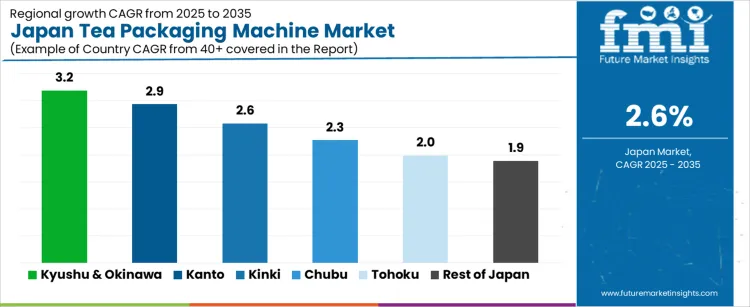
| Region | CAGR (%) |
|---|---|
| Kyushu & Okinawa | 3.2% |
| Kanto | 2.9% |
| Kinki | 2.6% |
| Chubu | 2.3% |
| Tohoku | 2.0% |
| Rest of Japan | 1.9% |
The demand for tea packaging machines in Japan is rising gradually across all regions, led by Kyushu and Okinawa at a 3.2% CAGR. Growth here is supported by strong green tea production, export packaging activity, and modernization of small to mid scale tea processors. Kanto follows at 2.9%, driven by high packaged tea consumption, contract packaging operations, and private label beverage production for convenience retail.
Kinki records 2.6% growth, reflecting steady demand from traditional tea blenders upgrading pouch and sachet lines. Chubu at 2.3% shows moderate uptake linked to regional distribution and co-packing services. Tohoku and the Rest of Japan, at 2.0% and 1.9%, reflect slower growth shaped by smaller processing volumes, aging production assets, and cautious capital investment by local tea manufacturers.
How Is Specialty Tea Processing in Kyushu and Okinawa Driving Packaging Machine Demand?
Demand for tea packaging machines in Kyushu and Okinawa is advancing at a CAGR of 3.2% through 2035, supported by growth in specialty green tea production, herbal tea blends, and tourism driven premium beverage sales. Kagoshima and Okinawa continue to see investment in small batch and export oriented tea processing units focused on foil pouches, sachets, and single serve formats. This region contrasts with Tohoku through stronger emphasis on branded retail and gift tea packaging. Machines are mainly used for vertical form fill seal systems and pyramid tea bag formats.
- Premium tea blends drive packaging upgrades
- Tourism linked gift sales support higher value formats
- Small batch processors influence compact machine demand
- Export focused brands shape equipment specifications
What Is Sustaining Tea Packaging Machine Usage Across High Volume Retail Supply Chains in Kanto?
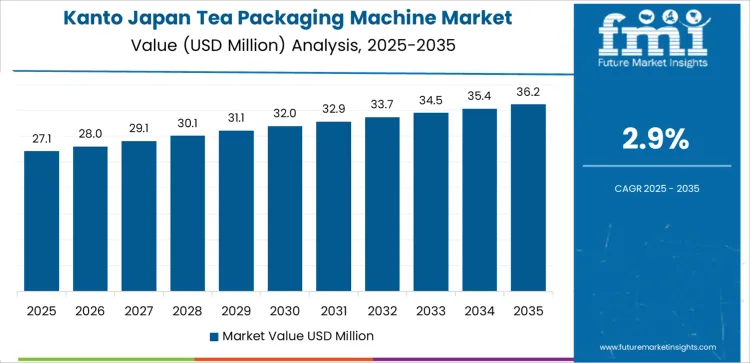
Demand for tea packaging machines in Kanto is expanding at a CAGR of 2.9% through 2035, led by dense supermarket networks, private label bottled tea, and large contract tea processors. Tokyo and surrounding prefectures dominate automated packaging for tea bags, instant tea powders, and ready to drink tea sachets. Kanto differs from Kyushu and Okinawa through stronger dependence on mass retail throughput rather than specialty branding. High speed horizontal and rotary packaging lines remain the primary equipment types supporting volume driven production.
- Private label tea drives continuous machine utilization
- High speed automation sustains stable equipment turnover
- Ready to drink tea formats expand packaging diversity
- Contract processors dominate capital equipment adoption
Why Is Regional Tea Manufacturing Supporting Moderate Packaging Machine Growth in Kinki?
Tea packaging machine demand in Kinki is advancing at a CAGR of 2.6% through 2035, supported by traditional tea processors, regional beverage brands, and specialty tea gift producers. Kyoto and Osaka remain key centers for matcha and loose leaf tea packaging, with steady upgrades from semi-automatic to compact automated units. Kinki contrasts with Kanto through greater reliance on branded heritage tea rather than mass market formats. Machines are used across tin filling, sachet packaging, and premium carton boxing lines.
- Traditional tea processors drive replacement demand
- Matcha formats support specialty packaging systems
- Gift tea production stabilizes premium machine usage
- Regional brands influence equipment customization
How Is Food Manufacturing and Workforce Catering Shaping Tea Packaging Demand in Chubu?
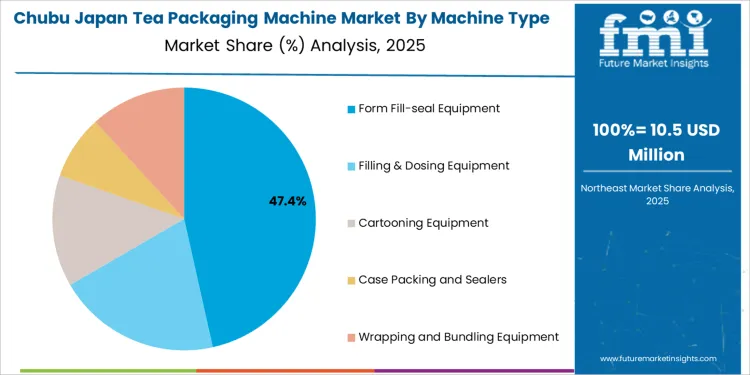
Demand for tea packaging machines in Chubu is progressing at a CAGR of 2.3% through 2035, supported by factory catering supply, regional beverage bottlers, and suburban retail tea sales around Nagoya. This region differs from Kinki through stronger linkage to industrial workforce consumption rather than premium tea branding. Tea packaging machines are primarily deployed for bulk tea bag production, institutional pack formats, and secondary overwrapping for catering distribution. Demand remains cost focused with emphasis on mid speed and durable equipment platforms.
- Factory catering drives bulk tea pack demand
- Institutional packaging supports steady machine runtime
- Suburban retail sustains secondary volume growth
- Cost focused sourcing shapes equipment selection
What Is Sustaining Gradual Tea Packaging Machine Uptake in Tohoku Processing Units?
Tea packaging machine demand in Tohoku is increasing at a CAGR of 2.0% through 2035, supported by regional tea farming, cooperative processing centers, and local beverage producers. Tohoku contrasts with Kanto and Kinki through smaller production scale and limited automation investment. Machines are mainly used for loose leaf packaging, basic tea bag filling, and community brand retail packs. Budget limits and slower capacity expansion continue to restrain rapid equipment replacement despite stable regional tea consumption.
- Cooperative processing centers anchor machine usage
- Loose leaf tea dominates basic packaging formats
- Limited automation slows technology upgrades
- Community brands influence steady procurement cycles
How Do Rural Processing Networks Influence Tea Packaging Machine Demand in the Rest of Japan?
Demand for tea packaging machines in the Rest of Japan is advancing at a CAGR of 1.9% through 2035, shaped by small tea farms, local drying and packing units, and regional consumer beverage distribution. This region differs from Kanto and Chubu through low production concentration and longer equipment replacement cycles. Tea packaging machines are primarily used for pouch filling, paper overwraps, and bulk loose tea packs supplied to local markets and institutional buyers. Procurement remains tied to cooperative funding programs and distributor led equipment access.
- Small tea farms sustain low volume machine usage
- Bulk loose tea dominates regional packaging activity
- Long replacement cycles limit faster demand growth
- Cooperative funding guides equipment purchasing timing
What Is Driving the Demand for Tea Packaging Machine in Japan and Which Suppliers Influence Equipment Selection
The demand for tea packaging machines in Japan is shaped by high domestic consumption of green tea, growth in ready to drink tea formats, and steady export activity in premium loose leaf and powdered matcha products. Ishida holds a central domestic position through multihead weighing and bagging systems widely deployed in tea blending and retail packaging lines. Yamato Scale supports high speed portioning systems used in tea sachet and bulk refill formats.
Fujiseiki supplies vertical form fill seal systems tailored for tea leaves, roasted stems, and powdered blends. GEA Group participates through processed tea handling systems integrated into large beverage plants. Syntegon Technology supplies selected automated solutions for filter tea and sachet packaging used by contract packers serving private labels.
Teepack Spezialmaschinen supports demand through specialty machinery for double chamber tea bag production used by established Japanese tea brands serving domestic and export markets. I.M.A. Industria Macchine Automatiche supplies selected cartoning and secondary packaging systems used in premium boxed tea products. Xiamen Sengong Packing Equipment serves smaller processors through cost focused machines used in regional tea packaging operations.
Procurement in Japan is guided by fill accuracy for fine tea particles, dust control, film sealing integrity, and low oxygen residuals to protect aroma. Buyer preference favors suppliers with domestic service teams, spare parts availability within Japan, and long cycle maintenance programs aligned with seasonal production peaks. Demand visibility tracks bottled tea output, private label expansion, and export volume of specialty green tea products.
Key Players in the Tea Packaging Machine Industry
- GEA Group AG
- I.M.A. Industria Macchine Automatiche S.P.A.
- Xiamen Sengong Packing Equipment Co. Ltd.
- Teepack Spezialmaschinen Gmbh & Company Kg
- Syntegon Technology GmbH.
Scope of the report
| Items | Values |
|---|---|
| Quantitative Units (2025) | USD million |
| Machine Type | Form Fill-seal Equipment, Filling & Dosing Equipment, Cartooning Equipment, Case Packing and Sealers, Wrapping and Bundling Equipment |
| Machine Type (Subcategory) | Form Fill-seal Equipment, Filling & Dosing Equipment, Cartooning Equipment, Case Packing and Sealers, Wrapping and Bundling Equipment |
| Application | Pouches, Bags, Cans, Stick Pack & Sachets, Bottles & Jars |
| Operational Deployment | High Automation Lines, Semi-Automated Lines, Small Batch/Regional Lines |
| End Use | Green Tea, Matcha, Hojicha, Bottled Tea, Functional and Specialty Tea, Export Packaging |
| Regions Covered | Kyushu & Okinawa, Kanto, Kansai, Chubu, Tohoku, Rest of Japan |
| Key Companies Profiled | GEA Group AG, I.M.A. Industria Macchine Automatiche S.P.A., Xiamen Sengong Packing Equipment Co. Ltd., Teepack Spezialmaschinen GmbH & Co. KG, Syntegon Technology GmbH |
| Additional Attributes | Dollar by sales by machine type, application, operational deployment, and region; growth projections through 2035; line upgrade cycles for automation and hygiene; adoption across retail, vending, and export oriented production; integration with nitrogen flushing, weighing, and pouching systems; labor reduction impact; machine changeover speed and sanitation design; precision dosing and film compatibility; domestic versus imported equipment penetration; multi-format handling capability; premium and small-batch tea packaging adoption; seasonal demand variation; service support and spare part availability |
Tea Packaging Machine Industry Segmentation
Machine Type:
- Form Fill-seal Equipment
- Filling & Dosing Equipment
- Cartooning Equipment
- Case Packing and Sealers
- Wrapping and Bundling Equipment
Machine Type (Subcategory):
- Form Fill-seal Equipment
- Filling & Dosing Equipment
- Cartooning Equipment
- Case Packing and Sealers
- Wrapping and Bundling Equipment
Application:
- Pouches
- Bags
- Cans
- Stick Pack & Sachets
- Bottles & Jars
Region
- Kyushu & Okinawa
- Kanto
- Kansai
- Chubu
- Tohoku
- Rest of Japan
Frequently Asked Questions
How big is the demand for tea packaging machine in Japan in 2025?
The demand for tea packaging machine in Japan is estimated to be valued at USD 65.3 million in 2025.
What will be the size of tea packaging machine in Japan in 2035?
The market size for the tea packaging machine in Japan is projected to reach USD 84.0 million by 2035.
How much will be the demand for tea packaging machine in Japan growth between 2025 and 2035?
The demand for tea packaging machine in Japan is expected to grow at a 2.6% CAGR between 2025 and 2035.
What are the key product types in the tea packaging machine in Japan?
The key product types in tea packaging machine in Japan are form fill-seal equipment, filling & dosing equipment, cartooning equipment, case packing and sealers and wrapping and bundling equipment.
Which machine type segment is expected to contribute significant share in the tea packaging machine in Japan in 2025?
In terms of machine type, form fill-seal equipment segment is expected to command 45.5% share in the tea packaging machine in Japan in 2025.
Preview the report firsthand - request a free sample
Get SampleGet the brochure for pricing and purchase details.
Get PDFTable of Content
- Executive Summary
- Japan Market Outlook
- Demand-side Trends
- Supply-side Trends
- Technology Roadmap Analysis
- Analysis and Recommendations
- Market Overview
- Market Coverage / Taxonomy
- Market Definition / Scope / Limitations
- Market Background
- Market Dynamics
- Drivers
- Restraints
- Opportunity
- Trends
- Scenario Forecast
- Demand in Optimistic Scenario
- Demand in Likely Scenario
- Demand in Conservative Scenario
- Opportunity Map Analysis
- Product Life Cycle Analysis
- Supply Chain Analysis
- Investment Feasibility Matrix
- Value Chain Analysis
- PESTLE and Porter’s Analysis
- Regulatory Landscape
- Regional Parent Market Outlook
- Production and Consumption Statistics
- Import and Export Statistics
- Market Dynamics
- Japan Market Analysis 2020 to 2024 and Forecast, 2025 to 2035
- Historical Market Size Value (USD Million) Analysis, 2020 to 2024
- Current and Future Market Size Value (USD Million) Projections, 2025 to 2035
- Y-o-Y Growth Trend Analysis
- Absolute $ Opportunity Analysis
- Japan Market Pricing Analysis 2020 to 2024 and Forecast 2025 to 2035
- Japan Market Analysis 2020 to 2024 and Forecast 2025 to 2035, By Machine Type
- Introduction / Key Findings
- Historical Market Size Value (USD Million) Analysis By Machine Type , 2020 to 2024
- Current and Future Market Size Value (USD Million) Analysis and Forecast By Machine Type , 2025 to 2035
- Form Fill-seal Equipment
- Filling & Dosing Equipment
- Cartooning Equipment
- Case Packing and Sealers
- Wrapping and Bundling Equipment
- Y-o-Y Growth Trend Analysis By Machine Type , 2020 to 2024
- Absolute $ Opportunity Analysis By Machine Type , 2025 to 2035
- Japan Market Analysis 2020 to 2024 and Forecast 2025 to 2035, By Machine Type
- Introduction / Key Findings
- Historical Market Size Value (USD Million) Analysis By Machine Type, 2020 to 2024
- Current and Future Market Size Value (USD Million) Analysis and Forecast By Machine Type, 2025 to 2035
- Form Fill-seal Equipment
- Filling & Dosing Equipment
- Cartooning Equipment
- Case Packing and Sealers
- Wrapping and Bundling Equipment
- Y-o-Y Growth Trend Analysis By Machine Type, 2020 to 2024
- Absolute $ Opportunity Analysis By Machine Type, 2025 to 2035
- Japan Market Analysis 2020 to 2024 and Forecast 2025 to 2035, By Application
- Introduction / Key Findings
- Historical Market Size Value (USD Million) Analysis By Application, 2020 to 2024
- Current and Future Market Size Value (USD Million) Analysis and Forecast By Application, 2025 to 2035
- Pouches
- Bags
- Cans
- Stick Pack & Sachets
- Bottles & Jars
- Y-o-Y Growth Trend Analysis By Application, 2020 to 2024
- Absolute $ Opportunity Analysis By Application, 2025 to 2035
- Market Structure Analysis
- Competition Dashboard
- Competition Benchmarking
- Market Share Analysis of Top Players
- By Regional
- By Machine Type
- By Machine Type
- By Application
- Competition Analysis
- Competition Deep Dive
- GEA Group AG
- Overview
- Product Portfolio
- Profitability by Market Segments (Product/Age /Sales Channel/Region)
- Sales Footprint
- Strategy Overview
- Marketing Strategy
- Product Strategy
- Channel Strategy
- I.M.A. Industria Macchine Automatiche S.P.A.
- Xiamen Sengong Packing Equipment Co. Ltd.
- Teepack Spezialmaschinen Gmbh & Company Kg
- Syntegon Technology GmbH.
- GEA Group AG
- Competition Deep Dive
- Assumptions & Acronyms Used
- Research Methodology


