

- Industry Size (2025)
- USD 470.9 Mn
- Forecast (2035)
- USD 647.1 Mn
- CAGR (2025 to 2035)
- 3.2%
Demand for Tea Packaging Machine in USA 2025 to 2035
The USA tea packaging machine demand is valued at USD 470.9 million in 2025 and is projected to reach USD 647.1 million by 2035, registering a CAGR of 3.2%. Growth is supported by rising consumption of premium and specialty tea formats, increased penetration of ready-to-brew portion packs, and upgrades in packaging automation across food processing units. Efficiency improvements in pack sealing and handling also contribute to equipment modernization.
Form fill-seal equipment leads usage due to its high productivity, flexible configuration for different tea bag formats, and strong sealing integrity for aroma protection. Manufacturers prioritize machinery that supports biodegradable filter papers, minimizes material waste, and integrates quality control technologies to maintain product consistency. The shift toward single-serve convenience and innovative pouch designs further strengthens reliance on automated form fill-seal systems.
Quick Stats for USA Tea Packaging Machine Demand
- USA Tea Packaging Machine Sales Value (2025): USD 470.9 million
- USA Tea Packaging Machine Forecast Value (2035): USD 647.1 million
- USA Tea Packaging Machine Forecast CAGR (2025 to 2035): 3.2%
- Leading Machine Type in USA Tea Packaging Machine Demand: Form Fill-Seal Equipment
- Key Growth Regions in USA Tea Packaging Machine Demand: West USA, South USA, Northeast USA
- Top Players in USA Tea Packaging Machine Demand: GEA Group AG, I.M.A. Industria Macchine Automatiche S.P.A., Xiamen Sengong Packing Equipment Co. Ltd., Teepack Spezialmaschinen GmbH & Co. KG, Syntegon Technology GmbH
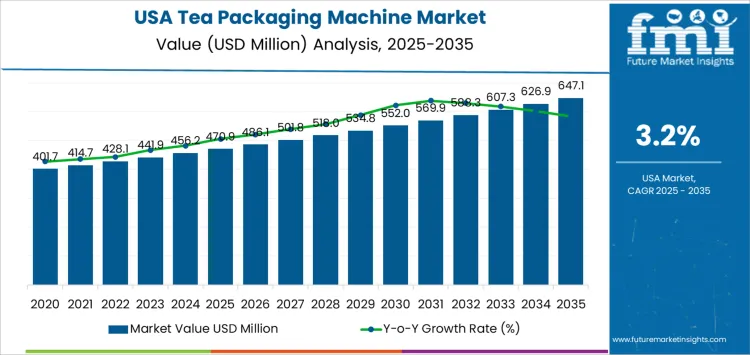
What is the Growth Forecast for Tea Packaging Machine Industry in USA through 2035?
The West, South, and Northeast regions demonstrate elevated adoption due to concentrated tea processing activities and higher investment in advanced packaging plants. Key players include GEA Group AG, I.M.A. Industria Macchine Automatiche S.P.A., Xiamen Sengong Packing Equipment Co. Ltd., Teepack Spezialmaschinen GmbH & Co. KG, and Syntegon Technology GmbH. Their strategies focus on digital monitoring capabilities, faster changeovers, and supporting sustainable packaging materials to align with evolving consumer and regulatory priorities.
Demand for tea packaging machines in the United States shows consistent expansion, yet signs indicate that future growth will progress at a controlled pace. The installed base across major tea producers and co-packers is already substantial because tea consumption has long been a mature category in the US beverage landscape. Many large facilities have fully automated primary and secondary packaging lines, which reduces incremental machine purchases and shifts demand toward upgrades rather than new installations.
Saturation approaches fastest in commodity tea formats such as standard tea bags because efficiency levels are already optimized. Replacement cycles become the primary driver for machine procurement. Technical support, maintenance contracts, and retrofit kits contribute more revenue than new unit orders in fully mature segments.
Growth opportunities persist in premium formats that have not reached saturation. These include pyramid bags, biodegradable sachets, and single-serve applications influenced by sustainability regulations and shifting consumer tastes. Smaller specialty brands entering the industry create localized demand for compact and modular automated systems. Saturation levels vary by format, but the category is transitioning from high-growth adoption to steady replacement-based purchasing, indicating a late-stage positioning in the US automation lifecycle.
USA Tea Packaging Machine Key Takeaways
| Metric | Value |
|---|---|
| USA Tea Packaging Machine Sales Value (2025) | USD 470.9 million |
| USA Tea Packaging Machine Forecast Value (2035) | USD 647.1 million |
| USA Tea Packaging Machine Forecast CAGR (2025-2035) | 3.2% |
Why is the Demand for Tea Packaging Machines in the USA Growing?
Demand for tea packaging machines in the USA is increasing because consumer interest in premium teas, herbal blends and wellness focused beverages continues to rise. Retail brands require automated equipment that can package tea accurately while protecting aroma and product freshness. Packaging machines help ensure consistent fill levels, reliable sealing and efficient production, which is important for manufacturers competing in both supermarket and online channels.
Growth in specialty tea production and private label offerings supports investment in machinery that can handle diverse formats such as tea bags, pyramid sachets and flexible pouches. Many producers also seek systems compatible with recyclable or compostable packaging films to align with sustainability goals. Direct to consumer subscription models and snack sized tea pack introductions increase demand for flexible packaging solutions with fast changeover capabilities. Constraints include high upfront costs for advanced automation and the need for skilled operators. Small scale tea companies may rely on semi-automated machines until production volume increases. Industry fluctuations in packaging material prices may also influence timing of equipment investments.
Which Machine Types and Applications Lead Demand for Tea Packaging Machines in the USA?
Demand for tea packaging machines in the United States is supported by high consumption of ready-packaged tea across retail, foodservice, and private-label brands. Brands focus on automation to reduce labor dependency, ensure sanitation, and maintain precise volume fill consistency. Growth aligns with bagged and portion-packed tea formats preferred for convenience and freshness retention. Investments emphasize equipment adaptability for flavored teas and botanicals with varying particle sizes.
By Machine Type, Form Fill-Seal Equipment Dominates Demand
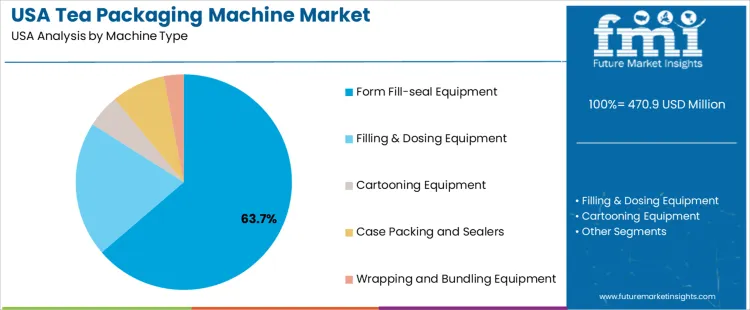
Form fill-seal (FFS) equipment holds 63.7%, driven by its ability to conduct pouch forming, dosing, filling, and sealing in a single continuous unit. It suits automated, high-speed tea production for major consumer packaged goods brands seeking reduced operational costs and material waste. Filling & dosing machinery represents 20.3%, supporting high-accuracy tea leaf measurement for premium blends. Case packing and sealers account for 8.0%, reflecting demand for downstream automation and pallet-ready shipments. Cartooning machines hold 5.0%, used in boxed tea SKU formats, while wrapping and bundling machines represent 3.0%, primarily for multipack creation. Equipment choices center on throughput needs, automation intensity, and compliance with hygiene standards in USA food packaging environments.
Key Points:
- FFS systems enable integrated, high-speed production efficiencies
- Dosing precision supports premium blend consistency
- Secondary packaging automation expands multipack and retail readiness
By Application, Pouches Hold the Largest Share
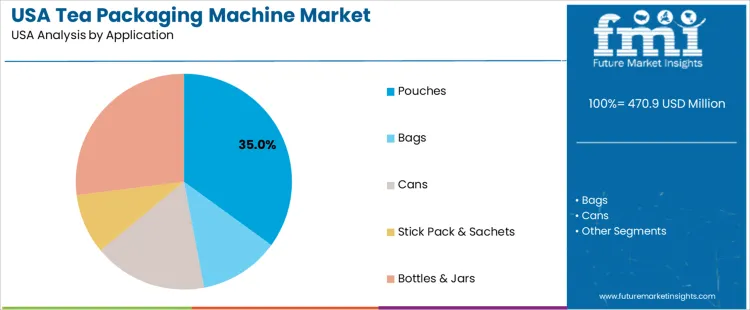
Pouches account for 35.0%, supported by lightweight flexible packaging and air-tight sealing that maintains aroma and quality. Bottles and jars represent 27.0%, driven by specialty and loose-leaf tea packaging formats prominent in USA retail. Cans hold 17.0%, adopted for decorative storage and product differentiation. Bags represent 12.0%, including traditional tea bags used across both private-label and branded channels. Stick packs and sachets represent 9.0%, growing through single-serve convenience and on-the-go consumption. Application adoption trends reflect consumer preference for portable portion sizes and sustainability-oriented packaging shifts within the USA beverage segment.
Key Points:
- Pouches reflect lower material consumption and freshness protection
- Bottles and jars support premium and gift-oriented teas
- Sachet-based formats grow with single-serve tea demand
What are the Drivers, Restraints, and Key Trends of the Demand for Tea Packaging Machines in the USA?
Expansion of specialty tea products, growth of automated packaging in beverage manufacturing and increased focus on hygiene and product protection drive demand.
In the United States, tea consumption continues to expand beyond traditional black tea into green, herbal and functional blends that require precise packaging for freshness and branding. Domestic tea producers and co-packers invest in automated machines that can handle pyramid bags, sachets and portioned pouches with faster throughput for retail and foodservice channels. Consumers expect airtight, tamper-protected packaging that maintains aroma and ingredient integrity throughout distribution.
Automation supports consistent sealing and filling accuracy, allowing manufacturers to meet labeling standards and reduce labor dependency. Growth of private-label and regional tea brands increases procurement of mid-scale packaging systems that can accommodate varied product lines. These industry dynamics support steady demand across small, medium and large tea-processing facilities in the United States.
High capital investment, maintenance requirements and slow adoption among small artisanal producers restrain demand.
Tea packaging machines represent a significant upfront cost, and smaller companies may delay automation until volume justifies equipment upgrades. Operators must train staff to manage filling tolerances, sealing controls and multi-format changeovers, which adds ongoing expense. Some artisanal brands prefer manual or semi-automatic packaging to preserve hand-crafted positioning and control batch sizes. Manufacturers managing diverse tea types may face slower line changeovers that affect productivity in early automation stages. These economic and operational considerations moderate widespread installation across emerging brands.
Shift toward flexible packaging formats, increased use of digital printing and rising demand for eco-friendly packaging materials define key trends.
Stand-up pouches and single-serve filter bags grow in popularity due to convenience and strong retail presentation, encouraging adoption of packaging machines with wider format capabilities. Digital printing integration allows frequent design changes for seasonal flavors and online direct-to-consumer sales. Tea companies evaluate compostable sachets, paper-based materials and reduced-plastic packaging to align with sustainability commitments, increasing the need for equipment that handles new substrates without compromising seal quality. Automated quality-control sensors support precise weight inspection for loose-leaf and powdered teas. These developments indicate consistent, automation-driven demand for tea packaging machines across the United States supported by product differentiation and modern packaging standards.
Analysis of the Demand for Tea Packaging Machines in the USA by Region
Demand for tea packaging machines in the United States is rising as tea consumption broadens through herbal blends, ready-to-brew sachets, specialty loose-leaf offerings, and wellness-aligned functional infusions. Automation and precision-packaging adoption continue to grow across beverage processors, co-packers, and private-label manufacturers. Equipment buyers focus on seal-integrity performance, lightweight material compatibility, sustainable packaging support, and digital control systems for multi-SKU operations. West USA leads growth at 3.7% CAGR, followed by South USA (3.3%), Northeast USA (3.0%), and Midwest USA (2.6%), reflecting differences in operational automation maturity, specialty tea demand, and regional manufacturing infrastructure.
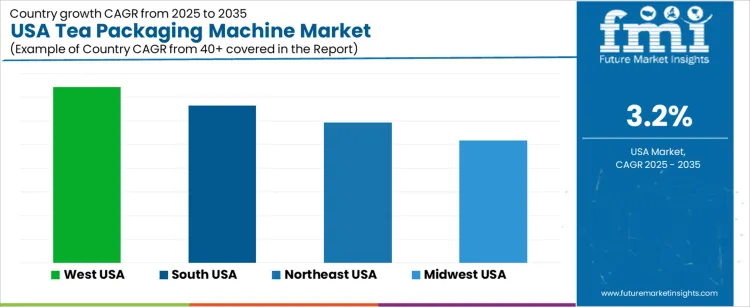
| Region | CAGR (2025-2035) |
|---|---|
| West USA | 3.7% |
| South USA | 3.3% |
| Northeast USA | 3.0% |
| Midwest USA | 2.6% |
How is the West USA driving demand for tea packaging machines?
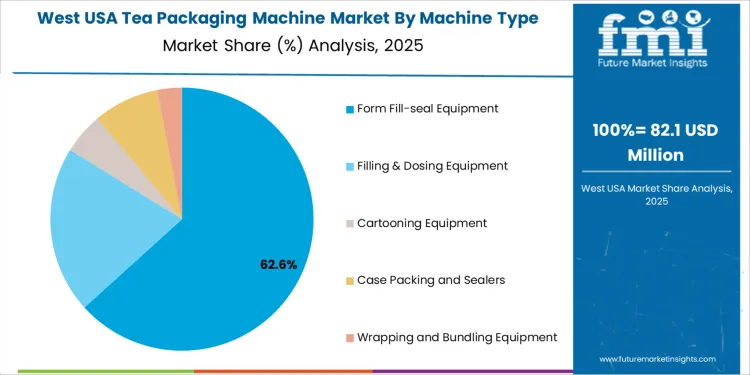
The West USA grows at 3.7% CAGR, driven by strong specialty tea production and distribution hubs in California, Washington, and Arizona. Manufacturers focus on sustainability-aligned equipment that supports compostable tea bags, recyclable mono-material films, and reduced-waste pouch-format conversion. Premium tea brands rely on advanced filling and nitrogen-flushing systems to maintain aroma retention and leaf integrity.
E-commerce growth expands demand for flexible packaging formats, boosting investments in small-batch automated systems with fast changeovers. Equipment buyers evaluate IoT-enabled diagnostics for maintenance planning and real-time quality monitoring.
- Specialty tea brands advancing premium packaging requirements
- Automation adoption improving throughput and labor efficiency
- Tech-integrated machinery assisting predictive maintenance
- Support for sustainable materials driving upgrades
How is the South USA shaping procurement behavior?
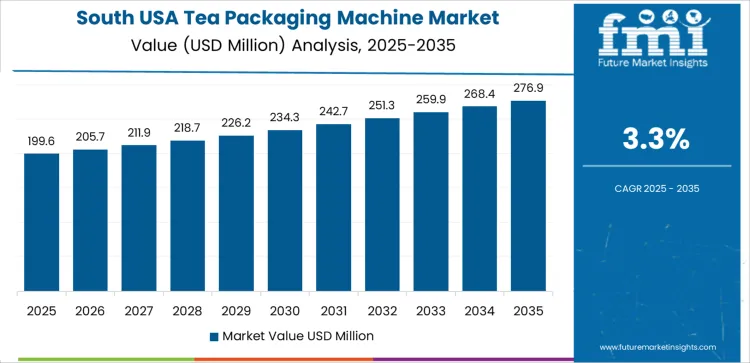
South USA expands at 3.3% CAGR, influenced by growing co-packing operations and strong retail distribution across Texas, Florida, and Georgia. Large tea bottling and packaging facilities optimize equipment for steady-volume output using standardized formats. Buyers favor machines accommodating both economy teas and functional blends packaged in pouches, bags, and sticks. Workforce-efficiency imperatives encourage automated feeding and continuous sealing systems. Regional logistics infrastructure supports multi-state shipments of packaged beverages and dry tea, requiring packaging durability evaluations.
- Co-packing expansions driving equipment modernization
- Retail-friendly formats encouraging machine versatility
- Focus on high-output sealing and filling speed
- Distribution corridors enabling scalable production
How is the Northeast USA maintaining category momentum?
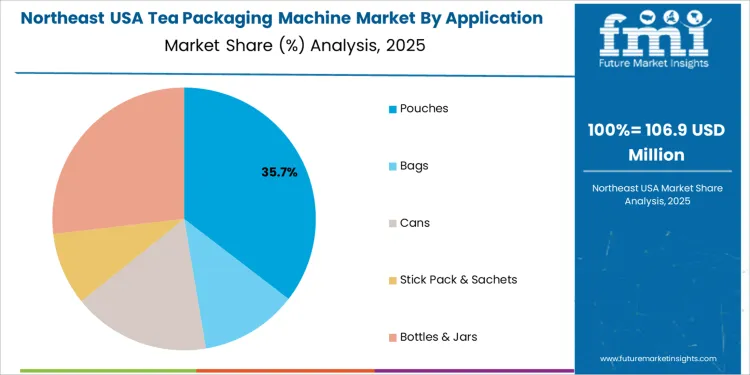
Northeast USA grows at 3.0% CAGR, supported by artisanal and wellness-tea brands concentrated in New York, New Jersey, and Massachusetts. Compact manufacturing sites favor automated vertical form-fill-seal equipment for space efficiency. Producers seek packaging that enhances premium appearance for boutique retail environments while preserving product freshness. Healthcare-focused and herbal formulations emphasize airtight pouches and precise dose control during filling. Buyers value machinery capable of reliable quick-switch operations for diverse blends targeting niche consumers.
- Small-footprint plants benefiting from compact automation
- Premium product focus supporting package innovation
- Freshness protection shaping sealing and flushing needs
- Agile changeovers supporting multi-blend strategies
How is the Midwest USA contributing to long-term utilization?
Midwest USA grows at 2.6% CAGR, driven by mainstream tea and grocery-private-label packaging in Illinois, Ohio, and Michigan. Companies prioritize durable form-fill-seal systems optimized for high-volume SKU repetition rather than frequent line changes. Frozen-logistics access enables regional distribution to national retail chains. Buyers evaluate consistent sealing performance for efficient pallet stacking and shelf-life preservation. Cost-efficiency and proven machine reliability dominate procurement decisions in a competitive food-processing landscape.
- Mainstream retail tea driving stable packaging volumes
- Cost-focused equipment planning influencing purchase cycles
- Form-fill-seal durability ensuring long-term operation
- Strong distribution networks supporting national placements
How is competitive positioning structured among suppliers of tea-packaging machines in the United States, and which firms appear to lead demand?
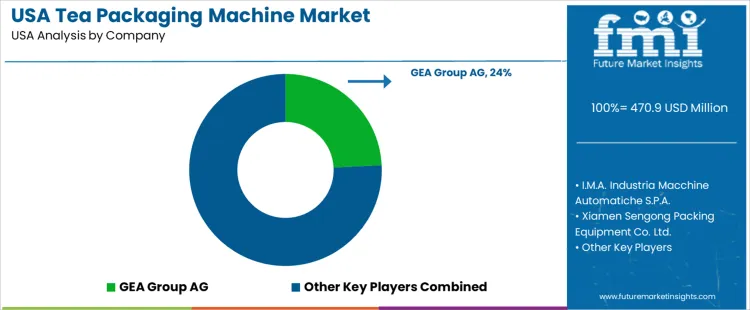
Competitive positioning in the United States tea-packaging machinery segment depends heavily on manufacturers’ ability to meet US food-safety standards, high-speed throughput, flexible packaging formats, and integration with automated processing lines. Lead-time reliability, spare-part availability, and service support in North America also strongly influence buyer selection, especially for packers operating large or high-mix production runs.
GEA Group AG holds an estimated 24.2% share. Its strength lies in supplying advanced packaging lines capable of handling both loose-leaf and bagged tea formats. Its machines’ compliance with hygiene standards and configurable line layouts support major tea-brand clients requiring high output and frequent format changes.
I.M.A. Industria Macchine Automatiche S.P.A. competes through modular bagging machines and sachet-filling solutions that suit mid-size packers and private-label producers. Its flexibility in format (pyramid bags, stick packs, flow wrap) makes it a common choice for companies switching between loose tea, bagged tea, and blends. Syntegon Technology GmbH (formerly Bosch Packaging) serves buyers needing turnkey packaging lines with integrated weighing, sealing, and code-printing a benefit for packers prioritizing regulatory compliance and traceability.
Teepack Spezialmaschinen GmbH & Co. KG focuses on specialized tea-bagging technology including string-and-tag bag machinery, used by premium and artisanal tea producers targeting niche USA markets. Xiamen Sengong Packing Equipment Co. Ltd. supplies entry-level to mid-tier bagging machines, often chosen by smaller or regional tea-packaging operations that value lower capital cost and simpler mechanical designs.
Competitive advantage currently depends on machine reliability, ease of format changeover, maintenance support, and compliance with FDA and food-safety regulations. Suppliers offering flexible, scalable, and service-supported systems stand best positioned to serve growing USA demand for both large-scale and artisanal tea packaging.
Key Players in USA Tea Packaging Machine Demand
- GEA Group AG
- I.M.A. Industria Macchine Automatiche S.P.A.
- Xiamen Sengong Packing Equipment Co. Ltd.
- Teepack Spezialmaschinen Gmbh & Company Kg
- Syntegon Technology GmbH.
Scope of the Report
| Items | Values |
|---|---|
| Quantitative Units | USD million |
| Machine Type | Form Fill-Seal Equipment, Filling & Dosing Equipment, Cartooning Equipment, Case Packing and Sealers, Wrapping and Bundling Equipment |
| Application | Pouches, Bags, Cans, Stick Pack & Sachets, Bottles & Jars |
| Regions Covered | West USA, South USA, Northeast USA, Midwest USA |
| Key Companies Profiled | GEA Group AG, I.M.A. Industria Macchine Automatiche S.P.A., Xiamen Sengong Packing Equipment Co. Ltd., Teepack Spezialmaschinen GmbH & Co. KG, Syntegon Technology GmbH |
| Additional Attributes | Dollar sales by machine type and application categories; regional CAGR and adoption variations across automated tea packaging lines; demand growth in specialty tea and single-serve stick formats; focus on dosing accuracy, nitrogen flushing, and aroma-preservation technologies; machine integration with smart controls and robotic case handling; competitive positioning of European and Asian OEMs in USA packaging automation. |
USA Tea Packaging Machine Demand by Segments
Machine Type:
- Form Fill-seal Equipment
- Filling & Dosing Equipment
- Cartooning Equipment
- Case Packing and Sealers
- Wrapping and Bundling Equipment
Application:
- Pouches
- Bags
- Cans
- Stick Pack & Sachets
- Bottles & Jars
Region:
- West USA
- South USA
- Northeast USA
- Midwest USA
Frequently Asked Questions
How big is the demand for tea packaging machine in USA in 2025?
The demand for tea packaging machine in USA is estimated to be valued at USD 470.9 million in 2025.
What will be the size of tea packaging machine in USA in 2035?
The market size for the tea packaging machine in USA is projected to reach USD 647.1 million by 2035.
How much will be the demand for tea packaging machine in USA growth between 2025 and 2035?
The demand for tea packaging machine in USA is expected to grow at a 3.2% CAGR between 2025 and 2035.
What are the key product types in the tea packaging machine in USA?
The key product types in tea packaging machine in USA are form fill-seal equipment, filling & dosing equipment, cartooning equipment, case packing and sealers and wrapping and bundling equipment.
Which application segment is expected to contribute significant share in the tea packaging machine in USA in 2025?
In terms of application, pouches segment is expected to command 35.0% share in the tea packaging machine in USA in 2025.
Preview the report firsthand - request a free sample
Get SampleGet the brochure for pricing and purchase details.
Get PDFTable of Content
- Executive Summary
- USA Market Outlook
- Demand-side Trends
- Supply-side Trends
- Technology Roadmap Analysis
- Analysis and Recommendations
- Market Overview
- Market Coverage / Taxonomy
- Market Definition / Scope / Limitations
- Market Background
- Market Dynamics
- Drivers
- Restraints
- Opportunity
- Trends
- Scenario Forecast
- Demand in Optimistic Scenario
- Demand in Likely Scenario
- Demand in Conservative Scenario
- Opportunity Map Analysis
- Product Life Cycle Analysis
- Supply Chain Analysis
- Investment Feasibility Matrix
- Value Chain Analysis
- PESTLE and Porter’s Analysis
- Regulatory Landscape
- Regional Parent Market Outlook
- Production and Consumption Statistics
- Import and Export Statistics
- Market Dynamics
- USA Market Analysis 2020 to 2024 and Forecast, 2025 to 2035
- Historical Market Size Value (USD Million) Analysis, 2020 to 2024
- Current and Future Market Size Value (USD Million) Projections, 2025 to 2035
- Y-o-Y Growth Trend Analysis
- Absolute $ Opportunity Analysis
- USA Market Pricing Analysis 2020 to 2024 and Forecast 2025 to 2035
- USA Market Analysis 2020 to 2024 and Forecast 2025 to 2035, By Machine Type
- Introduction / Key Findings
- Historical Market Size Value (USD Million) Analysis By Machine Type , 2020 to 2024
- Current and Future Market Size Value (USD Million) Analysis and Forecast By Machine Type , 2025 to 2035
- Form Fill-seal Equipment
- Filling & Dosing Equipment
- Cartooning Equipment
- Case Packing and Sealers
- Wrapping and Bundling Equipment
- Y-o-Y Growth Trend Analysis By Machine Type , 2020 to 2024
- Absolute $ Opportunity Analysis By Machine Type , 2025 to 2035
- USA Market Analysis 2020 to 2024 and Forecast 2025 to 2035, By Application
- Introduction / Key Findings
- Historical Market Size Value (USD Million) Analysis By Application, 2020 to 2024
- Current and Future Market Size Value (USD Million) Analysis and Forecast By Application, 2025 to 2035
- Pouches
- Bags
- Cans
- Stick Pack & Sachets
- Bottles & Jars
- Y-o-Y Growth Trend Analysis By Application, 2020 to 2024
- Absolute $ Opportunity Analysis By Application, 2025 to 2035
- Market Structure Analysis
- Competition Dashboard
- Competition Benchmarking
- Market Share Analysis of Top Players
- By Regional
- By Machine Type
- By Application
- Competition Analysis
- Competition Deep Dive
- GEA Group AG
- Overview
- Product Portfolio
- Profitability by Market Segments (Product/Age /Sales Channel/Region)
- Sales Footprint
- Strategy Overview
- Marketing Strategy
- Product Strategy
- Channel Strategy
- I.M.A. Industria Macchine Automatiche S.P.A.
- Xiamen Sengong Packing Equipment Co. Ltd.
- Teepack Spezialmaschinen Gmbh & Company Kg
- Syntegon Technology GmbH.
- GEA Group AG
- Competition Deep Dive
- Assumptions & Acronyms Used
- Research Methodology


