

- Industry Size (2025)
- USD 273.7 Mn
- Forecast (2035)
- USD 404.2 Mn
- CAGR (2025 to 2035)
- 4.0%
Demand for Packaging Coating in Japan Forecast and Outlook 2025 to 2035
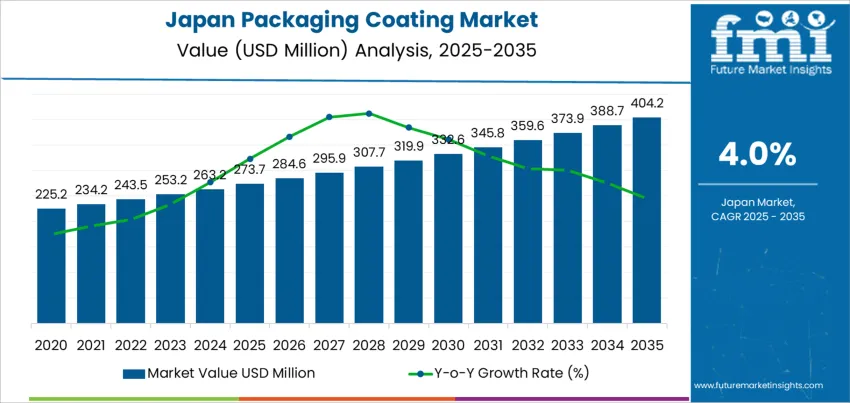
Demand for packaging coating in Japan is valued at USD 273.7 million in 2025 and is projected to reach USD 404.2 million by 2035 at a CAGR of 4.0%. Early growth is shaped by steady output from food, beverage, and pharmaceutical packaging converters that depend on coatings for moisture resistance, heat sealing, and surface protection. Paperboard cartons, flexible packs, and metal containers account for most early demand as coatings support barrier performance and line efficiency.
Domestic food processors emphasize coating reliability to maintain shelf life across chilled, frozen, and ambient products. Urban packaging hubs serving Tokyo, Osaka, and Nagoya concentrate a large share of coating consumption due to dense manufacturing and distribution activity.
Quick Stats of the Demand for Packaging Coatings in Japan
- Demand for Packaging Coatings in Japan Value (2025): USD 273.7 million
- Demand for Packaging Coatings in Japan Forecast Value (2035): USD 404.2 million
- Demand for Packaging Coatings in Japan Forecast CAGR (2025 to 2035): 4.0%
- Demand for Packaging Coatings in Japan Leading Coating Type: Epoxy Thermoset (24%)
- Demand for Packaging Coatings in Japan Key Growth Regions: Kyushu & Okinawa, Kanto, Kansai, Chubu, Tohoku, Rest of Japan
- Demand for Packaging Coatings in Japan Top Players: Akzo Nobel N.V., PPG Industries, Inc., Sherwin Williams Company, Axalta Coating Systems, RPM International Inc.
What is the Demand Forecast for Packaging Coating in Japan through 2035?
After 2030, market expansion reflects performance upgrading rather than sharp increases in packaging volumes. Demand rises from about USD 332.6 million in 2030 toward USD 404.2 million by 2035 as converters adopt higher-function coatings for oil resistance, heat stability, and improved printability. Ready meals, convenience foods, and premium confectionery add value through more demanding surface protection requirements.
Export-oriented packaging also contributes incremental demand through longer transit durability standards. Supplier competition centers on formulation consistency, fast curing performance, and compatibility with high-speed coating and printing lines. Long-term supply agreements between coating producers and large packaging groups shape procurement patterns across Japan, with pricing influenced by resin inputs, energy costs, and coating application yields rather than short-term packaging order fluctuations.
Packaging coatings in Japan derive demand from substrate performance requirements rather than from packaging volume alone, making their growth closely linked to barrier enhancement, print protection, and surface functionality upgrades. Demand increases from USD 273.7 million in 2025 to USD 295.9 million by 2028 and reaches USD 319.9 million by 2030, adding USD 46.2 million from the 2025 base. This phase reflects steady application across food cartons, flexible packs, pharmaceutical blisters, and beverage containers where moisture resistance, grease control, and scuff protection are essential. Growth is supported by the expansion of ready-to-eat foods, private-label packaging, and export-grade presentation standards rather than basic packaging output.
From 2030 to 2035, the market expands from USD 319.9 million to USD 404.2 million, adding USD 84.3 million in the second half of the decade. This back weighted acceleration reflects stronger penetration of high-barrier, water-based, and functional coatings replacing traditional laminations. Higher use in frozen foods, medical devices, and premium consumer goods raises coating weight per unit. As converters pursue lighter structures with enhanced performance, packaging coatings shift from secondary surface treatments to core performance-enabling layers, sustaining long-term demand growth across Japans food, pharmaceutical, and consumer packaging industries.
Packaging Coating Industry in Japan Key Takeaways
| Metric | Value |
|---|---|
| Industry Value (2025) | USD 273.7 million |
| Forecast Value (2035) | USD 404.2 million |
| Forecast CAGR (2025 to 2035) | 4.0% |
What Is Powering Growth in Demand for Packaging Coatings in Japan?
Demand for packaging coatings in Japan has increased as manufacturers and brand owners respond to stricter requirements around food safety, shelf life, and product quality. Consumers expect packaged foods, beverages, pharmaceuticals, and cosmetics to retain freshness, resist moisture or oxygen ingress, and present a hygienic, appealing finish. Coatings that provide barriers against water vapor, oxygen, grease, and contaminants help meet these needs, especially for perishable items, ready-to-eat meals, and long-shelf-life products. As packaging formats diversified including flexible pouches, multilayer films, and rigid containers demand for functional coatings that deliver sealability, chemical resistance, and printability rose accordingly.
Looking ahead, growth in Japan’s demand for packaging coatings will hinge on sustainability pressures, regulatory shifts, and evolving consumer preferences rather than simple volume growth. Coatings that are water-based, low-VOC, recyclable, or bio-derived will become more important as businesses strive to meet circular-economy goals and waste-reduction mandates. Innovation in barrier and active-packaging coatings such as moisture-resistant, antioxidant, or compostable coatings will extend use beyond traditional food and beverage packaging into personal care, pharmaceuticals, and e-commerce shipments subject to longer transport. At the same time, cost of raw materials, regulatory compliance, and technical challenges in balancing barrier performance with recyclability or biodegradability may restrict how quickly the market evolves.
How Are Coating Type and Application Structuring the Demand for Packaging Coatings in Japan?
The demand for packaging coatings in Japan is structured by coating type and application category. Epoxy thermoset coatings account for 24% of total demand, followed by urethane, UV curable, BPA free, and soft touch UV curable and urethane systems. By application, food cans represent 20.0% of total consumption, followed by beverage cans, caps and closures, aerosols and tubes, industrial packaging, promotional packaging, and specialty packaging. Demand behavior is shaped by corrosion resistance needs, regulatory compliance, surface durability, and product interaction safety. These segments reflect how functional protection requirements and end use packaging conditions guide coating selection across metal packaging, rigid containers, and specialty printed packaging formats in Japan.
Why Do Epoxy Thermoset Coatings Lead the Packaging Coating Type Demand in Japan?
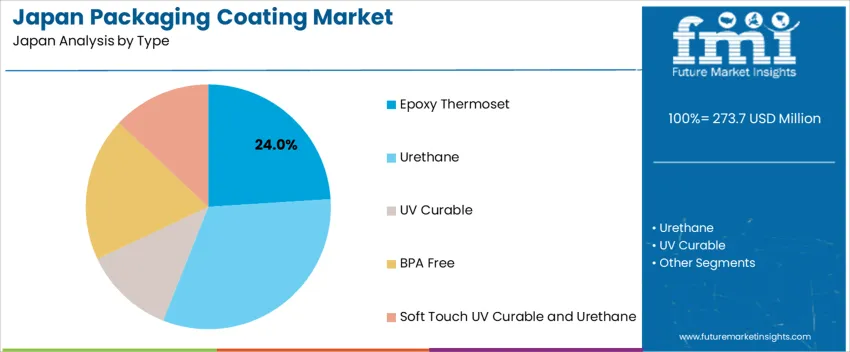
Epoxy thermoset coatings account for 24% of total packaging coating demand in Japan due to their strong adhesion, chemical resistance, and suitability for metal packaging substrates. These coatings are widely used for interior lining of food and beverage cans where resistance to acidic, saline, and fatty contents is required to prevent metal corrosion and product contamination. Epoxy thermosets cure into hard, durable films that withstand high temperature sterilization processes used in retort packaging and thermal preservation.
Epoxy coatings also provide reliable barrier performance against oxygen and moisture ingress, which supports long shelf life in canned foods and beverages. Processing stability across high speed coating lines further supports large scale can be manufacturing operations. Long standing manufacturing familiarity and predictable performance continue to sustain their industrial preference. These barrier reliability, thermal stability, and processing compatibility factors position epoxy thermoset coatings as the leading coating type within the Japan packaging coating demand structure.
Why Do Food Cans Dominate Packaging Coating Application Demand in Japan?
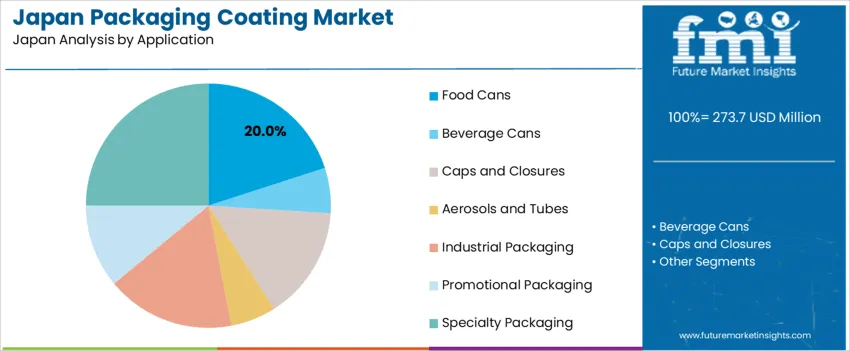
Food cans account for 20.0% of total packaging coating demand in Japan due to the country’s high consumption of canned seafood, vegetables, ready meals, and preserved foods. Coatings are essential to prevent direct contact between food and metal surfaces, which reduces corrosion, flavor alteration, and health risk. Japan’s food safety standards require strict control over material migration and chemical stability inside food containers, which sustains continuous demand for compliant coating systems.
Food can production operates at very high unit volumes to serve supermarkets, convenience stores, disaster preparedness stockpiles, and institutional catering. Frequent product rotation and long shelf life requirements demand consistent coating performance across extended storage and transport cycles. Automated can manufacturing lines rely on coatings that cure rapidly and uniformly at scale. These food safety priorities, preservation needs, and production volume intensity position food cans as the dominant application segment in the Japan packaging coating demand landscape.
Why Is Packaging Coating in Japan Treated as a Surface-Control Technology Rather Than a Decorative Layer?
Demand for packaging coating in Japan is driven by surface performance control rather than by visual enhancement. Coatings are required to manage moisture resistance, heat tolerance, friction behavior, and chemical stability across tightly automated filling and sealing lines. Even slight surface inconsistency can cause machine stoppage or seal failure in high-speed operations. Retail presentation also depends on glare control, fingerprint resistance, and clean-edge finishes. These functional expectations position packaging coatings as production-critical interface layers between material and machine rather than as post-process aesthetic treatments.
How Do Ready-to-Eat Foods, Beverage Filling, and Pharmaceutical Packaging Shape Usage Patterns?
Japan large ready-to-eat food sector creates constant demand for coatings that protect against oil migration, steam exposure, and condensation during heating and chilled storage. Beverage packaging depends on coatings for internal corrosion control and labeling adhesion on cans and bottles. Pharmaceutical packaging uses coatings for barrier consistency, chemical inertness, and tight printing accuracy for regulatory text. These industries operate under zero-tolerance for surface failure due to safety and brand risk. Their combined volume anchors steady, specification-driven demand for specialized coating systems.
What Recycling Discipline, Material Restrictions, and Process Compatibility Limit Coating Choices?
Packaging coating demand in Japan operates inside strict recycling and waste separation systems that restrict multilayer complexity. Certain coating chemistries interfere with fiber recovery in paper packaging, which reduces acceptance in municipal recycling streams. Heat-curing requirements must align with existing production line energy limits and speed settings. Solvent emissions are tightly regulated, which narrows formulation flexibility. Lightweight substrates also limit coating thickness tolerance. These environmental and processing constraints tightly bound the design space for packaging coatings despite rising performance expectations.
How Are High-Clarity Surfaces, Functional Barriers, and Automation Integration Redefining Demand?
Future demand in Japan is shifting toward coatings that provide both optical clarity and functional protection in a single layer. Anti-fog coatings are expanding in chilled food packaging. Slip-control coatings improve handling in robotic packing lines. Oxygen- and aroma-barrier coatings support shelf-life extension without foil layers. UV-curable systems reduce energy load and floor space for drying. These trends show packaging coatings evolving into highly engineered surface systems that synchronize with automation, recyclability discipline, and product protection requirements.
What is the Demand for Packaging Coating in Japan by Region?
| Region | CAGR (%) |
|---|---|
| Kyushu & Okinawa | 5.0% |
| Kanto | 4.6% |
| Kansai | 4.0% |
| Chubu | 3.5% |
| Tohoku | 3.1% |
| Rest of Japan | 2.9% |
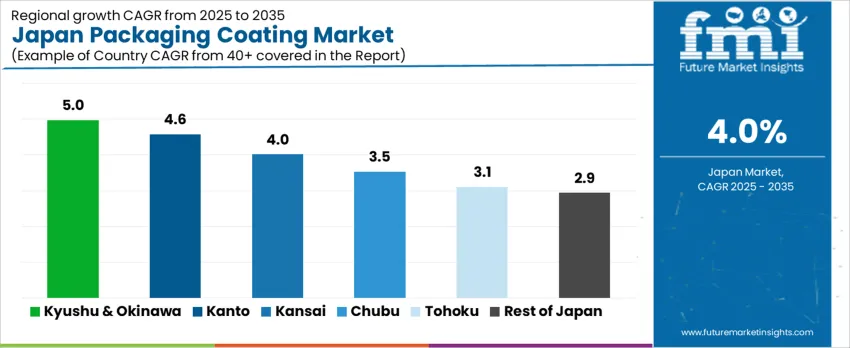
The demand for packaging coating in Japan is expanding steadily across all regions, with Kyushu & Okinawa leading at a 5.0% CAGR. Growth in this region is supported by strong food processing activity, rising export packaging requirements, and increasing use of coated materials for moisture and barrier protection. Kanto follows at 4.6%, driven by dense concentrations of packaged food, beverage, and pharmaceutical manufacturers that require high performance coated packaging. Kansai records 4.0% growth, supported by steady demand from consumer goods and industrial packaging users. Chubu at 3.5% reflects moderate uptake linked to automotive and electronics packaging needs. Tohoku and Rest of Japan, at 3.1% and 2.9%, show slower growth shaped by lower industrial density and smaller scale packaging operations.
How Is Food and Beverage Output Supporting Coating Demand in Kyushu And Okinawa?
Packaging coating usage in Kyushu and Okinawa is growing at a CAGR of 5.0% through 2035 for packaging coating demand, supported by expanding food processing, beverage bottling, and frozen seafood packaging. Coatings are widely applied for moisture resistance, grease control, and shelf stability in cartons, trays, and flexible packs. Export oriented seafood packaging strengthens demand for barrier and anti corrosion coatings. Tourism linked foodservice packaging also adds steady secondary volume. Demand remains production driven, with procurement aligned to stable plant throughput and consistent output across regional food and beverage manufacturing hubs.
- Seafood and frozen food packaging anchors coating demand
- Beverage bottling supports carton and label coating usage
- Export packaging drives higher barrier coating adoption
- Tourism related foodservice adds secondary demand
What Is Sustaining Strong Packaging Coating Consumption in Kanto?
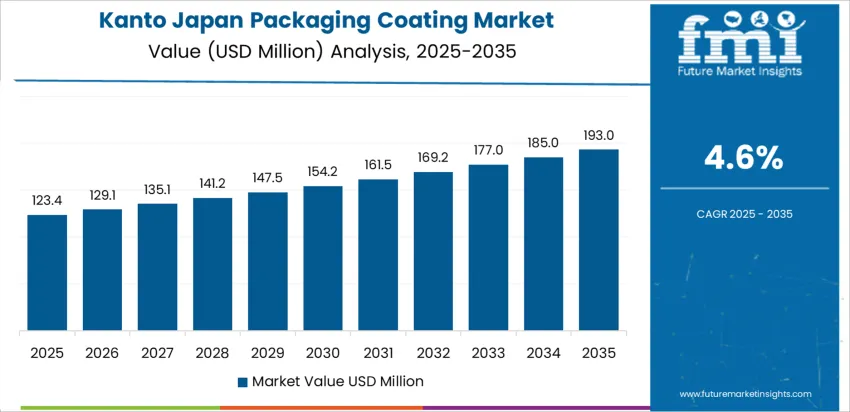
Urban consumer goods intensity in Kanto supports a CAGR of 4.6% through 2035 for packaging coating demand, driven by dense retail distribution, national brand manufacturing, and pharmaceutical secondary packaging. Folding cartons, labels, and blister packs rely on protective and print enhancing coatings. High packaging turnover sustains frequent coating reorders. Pharmaceutical packaging emphasizes chemical resistance and surface clarity. Demand remains scale driven and quality focused, shaped by large volume brand owners, high speed converting lines, and strong regulatory compliance needs across metropolitan packaging supply chains.
- Retail carton production drives continuous coating usage
- Pharmaceutical packaging supports specialty coating demand
- High converting speeds sustain frequent material turnover
- Regulatory compliance shapes product specification
Why Is Kansai Showing Balanced Growth in Packaging Coating Demand?
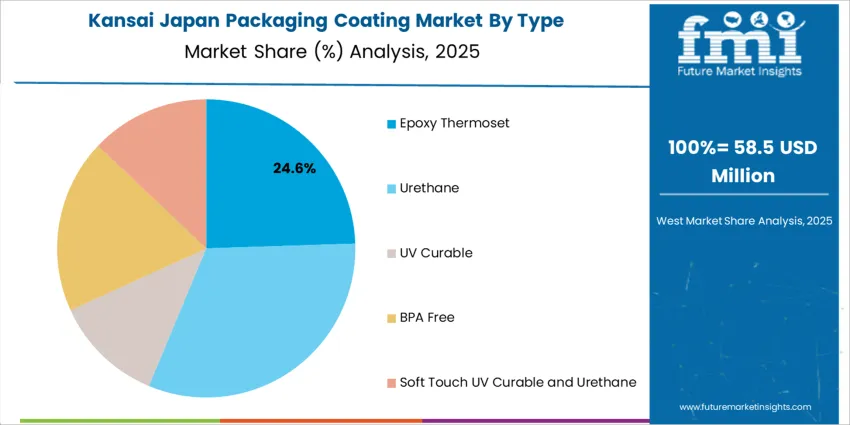
Regional brand manufacturing diversity in Kansai supports a CAGR of 4.0% through 2035 for packaging coating demand, shaped by confectionery packaging, homecare products, and flexible food packaging. Water based coatings dominate applications for sustainability and odor control. Small and mid sized converters rely on adaptable coating systems for short production runs. Department store private labels support decorative and protective surface finishes. Demand remains replacement driven rather than capacity driven, with steady procurement aligned to stable consumer goods output and regional brand packaging activity.
- Confectionery packaging supports decorative coating usage
- Water based coatings dominate food contact applications
- Mid sized converters favor flexible coating systems
- Private labels sustain steady decorative packaging demand
How Is Industrial Packaging Output Shaping Growth in Chubu?
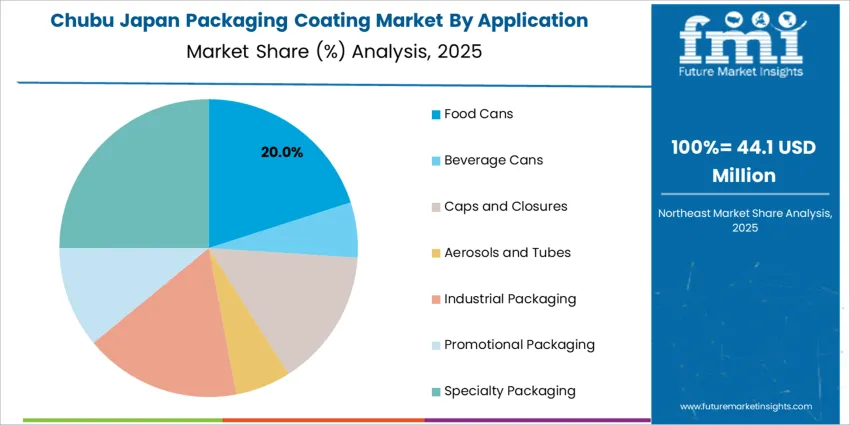
Manufacturing concentration in Chubu supports a CAGR of 3.5% through 2035 for packaging coating demand, driven by automotive component packaging, industrial goods wrapping, and centralized contract packaging. Corrosion resistant coatings are applied to export cartons and protective wraps. Large converters prioritize abrasion resistance and stacking durability. Export focused shipment requirements influence coating formulation choices. Demand remains contract driven and production aligned, with procurement guided by long term packaging supply programs serving automotive, machinery, and industrial parts manufacturers.
- Export packaging requires abrasion resistant coatings
- Automotive components drive protective surface demand
- Large converters rely on consistent coating performance
- Long term supply programs stabilize procurement
What Is Guiding Moderate Packaging Coating Growth in Tohoku?
Regional food self sufficiency and light manufacturing in Tohoku supports a CAGR of 3.1% through 2035 for packaging coating demand, shaped by frozen foods, agricultural produce packaging, and cooperative brand distribution. Moisture barrier coatings are applied to cartons and trays for extended shelf life. Small packaging lines dominate production. Local consumption absorbs most packaged goods. Demand remains necessity driven and locally anchored, with steady procurement linked to seasonal food output, cooperative packaging programs, and gradual modernization of regional converting capacity.
- Frozen food packaging supports moisture barrier demand
- Cooperative brands drive stable carton coating usage
- Small packaging lines dominate regional output
- Seasonal food cycles shape procurement timing
Why Does the Rest of Japan Show Slower Yet Stable Coating Demand?
Community level packaging production across the rest of Japan reflects a CAGR of 2.9% through 2035 for packaging coating demand, supported by municipal food processors, regional beverage distributors, and small label converters. Coating applications focus on basic moisture protection, ink adhesion, and surface durability. Automation levels remain modest. Distribution distances are short, limiting advanced protective requirements. Demand stays stable and function driven, guided by routine food supply packaging, local retail circulation, and essential labeling needs rather than high performance industrial packaging applications.
- Municipal food packaging anchors basic coating demand
- Ink adhesion coatings dominate label applications
- Modest automation limits high speed coating growth
- Local retail circulation stabilizes long term usage
What Is Driving the Demand for Packaging Coatings in Japan and Who Are the Key Companies Supplying Them?
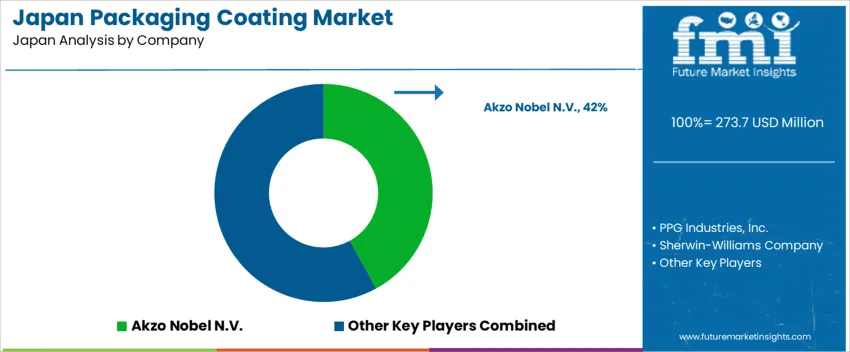
Demand for packaging coatings in Japan is growing because manufacturers across food, beverage, pharmaceuticals, and consumer goods sectors need packaging that offers barrier protection, durability, and visual quality. Coatings protect contents from moisture, oxygen, and contamination essential in a humid climate and for products like prepared meals, pharmaceuticals, and cosmetics. Increased online retail, home delivery, and longer supply chains raise the need for packaging that resists damage during transport. Rising regulatory and consumer pressure for safer, low VOC, recyclable or compostable packaging pushes brands to adopt modern coating technologies that balance performance with environmental compliance.
Major companies supplying packaging coatings to the Japanese market include Akzo Nobel N.V., PPG Industries, Inc., Sherwin Williams Company, Axalta Coating Systems, and RPM International Inc. These firms provide a wide range of coating chemistries including water based, acrylic, epoxy, and solvent free systems suited for flexible films, pouches, cartons, cans, and rigid containers. Their research and development capabilities support evolving requirements for barrier performance, adhesion, printability, and environmental compliance. Through global supply networks and technical expertise, these companies enable Japanese packaging firms to meet functional requirements, regulatory standards, and consumer expectations simultaneously.
Key Players in Packaging Coatings Industry in Japan
- Akzo Nobel N.V.
- PPG Industries, Inc.
- Sherwin Williams Company
- Axalta Coating Systems
- RPM International Inc.
Scope of the Report
| Items | Values |
|---|---|
| Quantitative Units (2025) | USD million |
| Type | Epoxy Thermoset, Urethane, UV Curable, BPA Free, Soft Touch UV Curable and Urethane |
| Application | Food Cans, Beverage Cans, Caps and Closures, Aerosols and Tubes, Industrial Packaging, Promotional Packaging, Specialty Packaging |
| End User | Food and Beverages, Cosmetics, Pharmaceuticals, Consumer Electronics, Automotive Components |
| Region | Kyushu & Okinawa, Kanto, Kinki, Chubu, Tohoku, Rest of Japan |
| Key Companies Profiled | Akzo Nobel N.V., PPG Industries, Inc., Sherwin Williams Company, Axalta Coating Systems, RPM International Inc. |
| Additional Attributes | Dollar by sales by coating type, application, and end-use sector. Includes epoxy thermoset vs urethane demand split, UV curable adoption, food and beverage packaging share, pharmaceutical coating requirements, metal can vs flexible substrate application, barrier performance metrics, moisture resistance, print adhesion and durability, curing speed and energy consumption, VOC and solvent content, environmental compliance, recyclability and compostability adoption, high-speed production line compatibility, export vs domestic demand, seasonal peak usage, line efficiency, and coating weight per unit. Supplier competition, supply agreements, resin input cost, and process compatibility also shape adoption and procurement decisions across Japanese packaging converters and brand owners. |
Packaging Coatings Industry in Japan Segmentation
Type:
- Epoxy Thermoset
- Urethane
- UV Curable
- BPA Free
- Soft Touch UV Curable and Urethane
Application:
- Food Cans
- Beverage Cans
- Caps and Closures
- Aerosols and Tubes
- Industrial Packaging
- Promotional Packaging
- Specialty Packaging
End User:
- Food and Beverages
- Cosmetics
- Pharmaceuticals
- Consumer Electronics
- Automotive Components
Region
- Kyushu & Okinawa
- Kanto
- Kansai
- Chubu
- Tohoku
- Rest of Japan
Frequently Asked Questions
How big is the demand for packaging coating in Japan in 2025?
The demand for packaging coating in Japan is estimated to be valued at USD 273.7 million in 2025.
What will be the size of packaging coating in Japan in 2035?
The market size for the packaging coating in Japan is projected to reach USD 404.2 million by 2035.
How much will be the demand for packaging coating in Japan growth between 2025 and 2035?
The demand for packaging coating in Japan is expected to grow at a 4.0% CAGR between 2025 and 2035.
What are the key product types in the packaging coating in Japan?
The key product types in packaging coating in Japan are epoxy thermoset, urethane, uv curable, bpa free and soft touch uv curable and urethane.
Which application segment is expected to contribute significant share in the packaging coating in Japan in 2025?
In terms of application, food cans segment is expected to command 20.0% share in the packaging coating in Japan in 2025.
Preview the report firsthand - request a free sample
Get SampleGet the brochure for pricing and purchase details.
Get PDFTable of Content
- Executive Summary
- Japan Market Outlook
- Demand-side Trends
- Supply-side Trends
- Technology Roadmap Analysis
- Analysis and Recommendations
- Market Overview
- Market Coverage / Taxonomy
- Market Definition / Scope / Limitations
- Market Background
- Market Dynamics
- Drivers
- Restraints
- Opportunity
- Trends
- Scenario Forecast
- Demand in Optimistic Scenario
- Demand in Likely Scenario
- Demand in Conservative Scenario
- Opportunity Map Analysis
- Product Life Cycle Analysis
- Supply Chain Analysis
- Investment Feasibility Matrix
- Value Chain Analysis
- PESTLE and Porter’s Analysis
- Regulatory Landscape
- Regional Parent Market Outlook
- Production and Consumption Statistics
- Import and Export Statistics
- Market Dynamics
- Japan Market Analysis 2020 to 2024 and Forecast, 2025 to 2035
- Historical Market Size Value (USD Million) Analysis, 2020 to 2024
- Current and Future Market Size Value (USD Million) Projections, 2025 to 2035
- Y-o-Y Growth Trend Analysis
- Absolute $ Opportunity Analysis
- Japan Market Pricing Analysis 2020 to 2024 and Forecast 2025 to 2035
- Japan Market Analysis 2020 to 2024 and Forecast 2025 to 2035, By Type
- Introduction / Key Findings
- Historical Market Size Value (USD Million) Analysis By Type , 2020 to 2024
- Current and Future Market Size Value (USD Million) Analysis and Forecast By Type , 2025 to 2035
- Epoxy Thermoset
- Urethane
- UV Curable
- BPA Free
- Soft Touch UV Curable and Urethane
- Y-o-Y Growth Trend Analysis By Type , 2020 to 2024
- Absolute $ Opportunity Analysis By Type , 2025 to 2035
- Japan Market Analysis 2020 to 2024 and Forecast 2025 to 2035, By Application
- Introduction / Key Findings
- Historical Market Size Value (USD Million) Analysis By Application, 2020 to 2024
- Current and Future Market Size Value (USD Million) Analysis and Forecast By Application, 2025 to 2035
- Food Cans
- Beverage Cans
- Caps and Closures
- Aerosols and Tubes
- Industrial Packaging
- Promotional Packaging
- Specialty Packaging
- Y-o-Y Growth Trend Analysis By Application, 2020 to 2024
- Absolute $ Opportunity Analysis By Application, 2025 to 2035
- Japan Market Analysis 2020 to 2024 and Forecast 2025 to 2035, By End User
- Introduction / Key Findings
- Historical Market Size Value (USD Million) Analysis By End User, 2020 to 2024
- Current and Future Market Size Value (USD Million) Analysis and Forecast By End User, 2025 to 2035
- Food and Beverages
- Cosmetics
- Pharmaceuticals
- Consumer Electronics
- Automotive Components
- Y-o-Y Growth Trend Analysis By End User, 2020 to 2024
- Absolute $ Opportunity Analysis By End User, 2025 to 2035
- Market Structure Analysis
- Competition Dashboard
- Competition Benchmarking
- Market Share Analysis of Top Players
- By Regional
- By Type
- By Application
- By End User
- Competition Analysis
- Competition Deep Dive
- Akzo Nobel N.V.
- Overview
- Product Portfolio
- Profitability by Market Segments (Product/Age /Sales Channel/Region)
- Sales Footprint
- Strategy Overview
- Marketing Strategy
- Product Strategy
- Channel Strategy
- PPG Industries, Inc.
- Sherwin-Williams Company
- Axalta Coating Systems
- RPM International Inc.
- Akzo Nobel N.V.
- Competition Deep Dive
- Assumptions & Acronyms Used
- Research Methodology


