

- Industry Size (2026)
- USD 57.0 Mn
- Forecast (2036)
- USD 87.2 Mn
- CAGR (2026 to 2036)
- 4.7%
Demand for Polyurea Coatings in Japan Forecast and Outlook 2026 to 2036
The demand for polyurea coatings in Japan is valued at USD 57.0 million in 2026 and is projected to reach USD 87.2 million by 2036, reflecting a CAGR of 4.7%. The rise from USD 41.7 million in 2020 to USD 57.0 million in 2026 is supported by steady use across construction, industrial flooring, and transport equipment protection. Pure polyurea leads early demand due to fast curing and consistent film strength, while hybrid formulations maintain defined roles in cost sensitive applications requiring broad surface compatibility.
From 2027 onward, demand increases from USD 57.6 million to USD 69.3 million by 2031, then reaches USD 87.2 million by 2036 through incremental annual growth. Building and construction remains the primary segment as waterproofing, roof lining, and structural protection continue to rely on high durability coatings. Industrial facilities contribute stable volumes tied to equipment maintenance and containment structures. Automotive and transport applications expand gradually as lightweight components require abrasion resistance. Long term demand reflects routine project cycles, regulated safety standards, and measured adoption across refurbishment activities in Japan.
Quick Stats of the Demand for Polyurea Coatings in Japan:
- Demand for Polyurea Coatings in Japan Value (2026): USD 57.0 million
- Demand for Polyurea Coatings in Japan Forecast Value (2036): USD 87.2 million
- Demand for Polyurea Coatings in Japan Forecast CAGR (2026-2036): 4.7%
- Demand for Polyurea Coatings in Japan Leading Product Type: Pure Polyurea (60%)
- Demand for Polyurea Coatings in Japan Key Growth Regions: Kyushu & Okinawa, Kanto, Kansai
- Demand for Polyurea Coatings in Japan Top Players: ArmorThane, Rhino Linings, SPI, Teknos Group, Nukote International
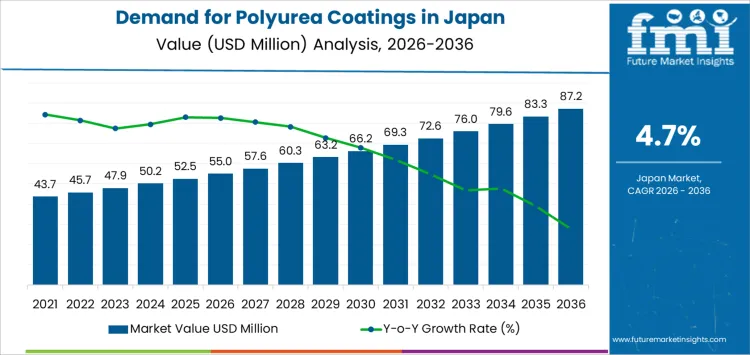
What is the Growth Forecast for Polyurea Coatings in Japan through 2036?
Between 2026 and 2031, demand for polyurea coatings in Japan increases from USD 57.0 million to USD 66.2 million, reflecting a gain of USD 9.2 million across five years. Growth in this phase is shaped by protective coating requirements across infrastructure repair, industrial flooring, and water management facilities. Earlier demand centered on selective high durability applications, while near term expansion reflects broader adoption in bridge rehabilitation, containment structures, and warehouse flooring. Improved curing efficiency and rising contractor familiarity support consistent usage across public works and industrial maintenance programs.
From 2031 to 2036, demand rises from USD 66.2 million to USD 87.2 million, adding USD 21.0 million during the period. Growth accelerates as durable membrane systems gain wider use in tunnels, coastal structures, chemical storage facilities, and heavy duty equipment protection. Earlier uptake was driven by individual project specifications, while later expansion reflects systematic inclusion in long term asset maintenance plans and lifecycle extension strategies. Broader deployment in transportation infrastructure, cold storage facilities, and manufacturing plants strengthens volume stability, supported by performance consistency in moisture rich and high abrasion environments common across Japan’s industrial and civil engineering projects.
Polyurea Coatings Industry in Japan Key Takeaways
| Metric | Value |
|---|---|
| Industry Value (2026) | USD 57.0 million |
| Forecast Value (2036) | USD 87.2 million |
| Forecast CAGR (2026-2036) | 4.7% |
What Is Driving the Demand for Polyurea Coatings in Japan from 2026 to 2036?
Demand for polyurea coatings in Japan has expanded as infrastructure owners and industrial users sought durable protective finishes for concrete, steel, and engineered surfaces. Applications in bridges, tunnels, wastewater treatment plants, and industrial flooring drove uptake because polyurea offered rapid cure, moisture tolerance, and abrasion resistance. Maintenance and repair programmes in ports, utilities, and chemical plants supported replacement cycles. Buyers valued film toughness, chemical resistance, and short downtime during application. Specification practices followed performance criteria set by engineering standards and client risk tolerance. Demand aligned with steady public infrastructure investment and industrial refurbishment programmes.
From 2026 to 2036 demand is expected to strengthen with stricter corrosion control standards, expansion of heavy industrial facilities, and broader use in waterproofing and secondary containment. Growth in renewable energy installations, such as solar and wind foundations, raises demand for protective coatings able to withstand cyclic temperature changes and UV exposure. Urban redevelopment and seismic retrofit projects incorporate polyurea for floor coatings and splash zones. Procurement decisions reflect long term life-cycle cost, environmental compliance, and contractor expertise. Expansion of specialised applicator networks and training enhances market reach. Forecast demand is supported by performance specification growth in public works, industrial construction, and asset protection programmes nationwide.
What Is the Demand for Polyurea Coatings in Japan by Product Type and Application for 2026 to 2036?
The demand for polyurea coatings in Japan from 2026 to 2036 is shaped by waterproofing needs, surface protection requirements, and industrial upgrading across infrastructure and manufacturing sites. Pure polyurea leads by product type due to rapid curing, high elongation properties, and strong adhesion on concrete and metal surfaces. Building and construction leads by application because large structural assets require long-lasting protective layers for roofs, basements, tanks, and exposed surfaces. Procurement is driven by contractors, industrial applicators, and facility managers. Import reliance remains present for prepolymers and specialty isocyanates. Substitution pressure exists from epoxy and polyurethane coatings. Demand stability is supported by long maintenance cycles and infrastructure rehabilitation projects.
Why does pure polyurea account for 60% of the demand for polyurea coatings in Japan by product type from 2026 to 2036?
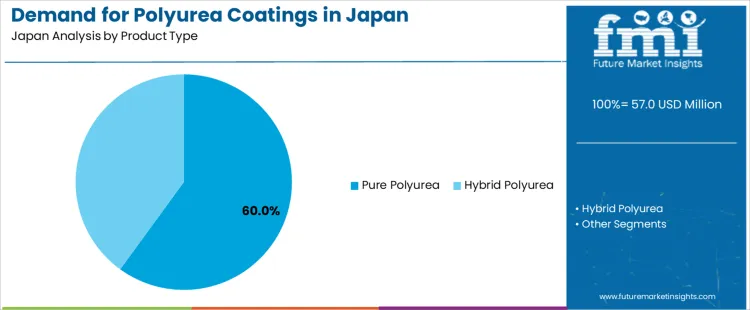
Pure polyurea accounts for 60% of the demand for polyurea coatings in Japan by product type due to its fast reactivity, high chemical resistance, and suitability for environments with continuous moisture exposure. Consumption intensity is driven by structures requiring seamless membranes and flexible coating performance. Usage remains stable because pure polyurea tolerates temperature variation, supports high crack-bridging capability, and cures quickly on active job sites. Procurement is led by contractors specializing in roofs, tunnels, water tanks, and marine structures.
Demand for pure polyurea remains consistent between 2026 and 2036 due to rehabilitation programs and protective requirements in transportation hubs and industrial facilities. Repeat utilization remains predictable because recoating cycles follow multi-year intervals. Buyers favor formulations with minimal overspray, stable mix ratios, and consistent sprayability. Margin structure remains steady under established relationships between contractors and coating suppliers. Regulatory exposure centers on VOC guidelines and worker safety standards. Import reliance persists for specialized curing agents and high-performance polyamine blends. Substitution pressure from hybrid polyurea remains limited where demanding performance environments require higher elasticity and chemical resistance.
Why does building and construction represent 50.0% of the demand for polyurea coatings in Japan by application?
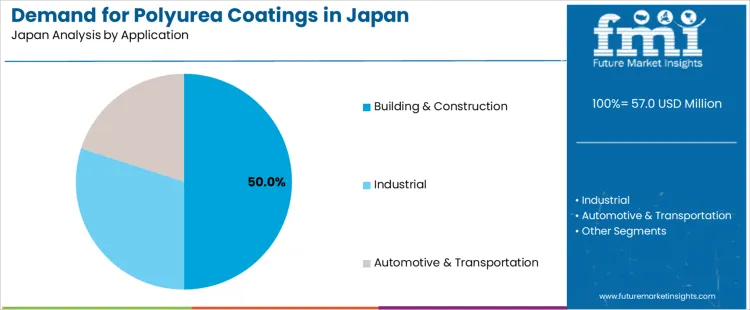
Building and construction represents 50.0% of the demand for polyurea coatings in Japan by application due to broad usage in waterproofing, structural protection, and surface reinforcement. Consumption intensity is driven by roofs, parking decks, underground facilities, and water containment structures where long-term barrier performance is required. Usage remains stable as construction sites adopt fast-curing coatings to reduce downtime and enhance protection on varied substrates. Procurement is dominated by contractors, real estate maintenance teams, and infrastructure project managers.
Demand from building and construction remains predictable from 2026 to 2036 due to renovation cycles and steady investments in public and private infrastructure. Repeat utilization remains reliable as buildings require periodic coating upgrades. Buyers favor spray-applied systems that create uniform layers with minimal surface imperfections. Margin structure remains controlled under project-based pricing. Regulatory exposure focuses on environmental standards and coating safety compliance. Import reliance persists for raw materials with specific reactivity profiles. Substitution pressure from polyurethane and bituminous coatings remains limited where rapid curing and long-term elasticity are essential.
What Is Driving the Demand for Polyurea Coatings in Japan Across Infrastructure, Industrial Assets, and Moisture-Sensitive Facilities?
Demand for polyurea coatings in Japan grows through the need to protect concrete, steel, and composite substrates exposed to moisture, abrasion, and chemical drift. Tunnels, bridges, and wastewater tanks rely on fast-curing membranes that allow short shutdown windows. Manufacturers value seamless coatings that resist thermal cycling across coastal and inland climates. Cold storage sites use polyurea to reduce condensation damage. Earthquake resilience programs also support adoption due to crack-bridging behavior that preserves structural continuity.
How Are Public Infrastructure Renewal Cycles Shaping Polyurea Adoption in Japan?
Japan continues long-term renewal of tunnels, expressways, and port structures built during earlier construction waves. These assets require rapid resurfacing and water ingress control to avoid prolonged lane closures. Polyurea’s fast return-to-service profile suits night-time and holiday maintenance windows common in densely populated regions. Railway operators use polyurea for platform edge waterproofing and vibration-exposed structures. Water utilities apply it inside tanks and channels where traditional coatings cure too slowly. Procurement teams favor systems that perform under variable humidity and temperature swings. Demand aligns with scheduled municipal upgrades, seismic reinforcement tasks, and surface performance requirements unique to Japan’s infrastructure load.
Why Are Industrial Plants, Storage Facilities, and Logistics Sites Increasing Use of Polyurea in Japan?
Industrial and logistics sites apply polyurea to floors, containment areas, and loading zones exposed to forklift abrasion, chemical spills, and temperature fluctuation. Electronics, pharmaceutical, and food plants prefer monolithic surfaces that clean quickly and avoid microbial retention. Cold logistics hubs near major ports use polyurea to prevent freeze-thaw cracking and moisture seepage beneath insulated panels. Truck depots install impact-resistant coatings on ramps and bays to reduce concrete repairs. Demand rises through facility durability needs, strict hygiene compliance, and tight maintenance budgets that cannot tolerate extended shutdowns. These conditions reflect Japan’s high-intensity industrial throughput and year-round warehousing operations.
What is the Demand for Polyurea Coatings in Japan by Region?
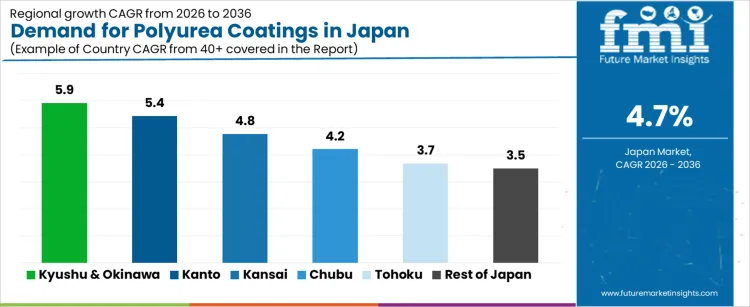
| Region | CAGR (%) |
|---|---|
| Kyushu & Okinawa | 5.9% |
| Kanto | 5.4% |
| Kansai | 4.8% |
| Chubu | 4.2% |
| Tohoku | 3.7% |
| Rest of Japan | 3.5% |
The demand for polyurea coatings in Japan is increasing steadily across construction, infrastructure, and industrial maintenance segments, led by Kyushu and Okinawa at a 5.9% CAGR. Growth in this region is supported by strong activity in port facilities, waterproofing projects, and protective coating applications in humid coastal environments. Kanto follows at 5.4%, driven by extensive urban redevelopment, bridge and tunnel rehabilitation, and widespread use in commercial building protection. Kansai records 4.8% growth, reflecting consistent demand from industrial plants, storage facilities, and transport infrastructure upgrades. Chubu at 4.2% shows moderate uptake linked to automotive manufacturing facilities and chemical processing units. Tohoku and the Rest of Japan, at 3.7% and 3.5%, reflect slower growth shaped by fewer large scale infrastructure projects and more conservative adoption of advanced coating technologies.
How Are Infrastructure Projects Advancing Polyurea Coating Adoption in Kyushu and Okinawa?
Demand for polyurea coatings in Kyushu and Okinawa is increasing at a CAGR of 5.9% from 2026 to 2036, supported by protective coating needs across waterfront structures, logistics sites, and commercial buildings. Polyurea is applied to resist moisture, abrasion, and chemical exposure in environments shaped by island climate conditions. Construction firms use polyurea for rapid curing and high durability in repair work. Facility managers adopt the material for long term asset upkeep. Regional demand reflects ongoing maintenance cycles, steady tourism linked development, and consistent application across industrial floors, storage structures, and equipment surfaces requiring tough protective layers against environmental stress.
- Coastal structures use polyurea for moisture resistance
- Industrial floors rely on impact resistant coatings
- Repair projects benefit from rapid curing performance
Why Are High Density Assets Supporting Polyurea Coating Demand in Kanto?
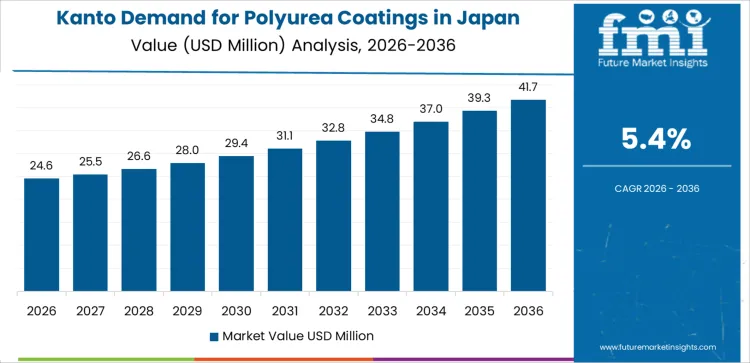
Demand for polyurea coatings in Kanto is progressing at a CAGR of 5.4% from 2026 to 2036, driven by extensive industrial zones, heavy commercial infrastructure, and transportation facilities. Polyurea is selected for rapid application, strong adhesion, and durability across warehouses, bridges, and utility structures. Facility operators adopt coatings to manage wear across high traffic surfaces and exterior elements exposed to weathering. Replacement schedules reflect structural aging patterns and planned maintenance programs. Kanto’s broad commercial footprint sustains ongoing demand as asset managers prioritize protective solutions that support long operational life and reduced downtime during refurbishment activities across diverse building and infrastructure categories.
- Warehouses use polyurea for high traffic surfaces
- Bridges benefit from protective coating layers
- Utility structures require durable surface protection
How Are Industrial Processes Guiding Polyurea Usage in Kansai?
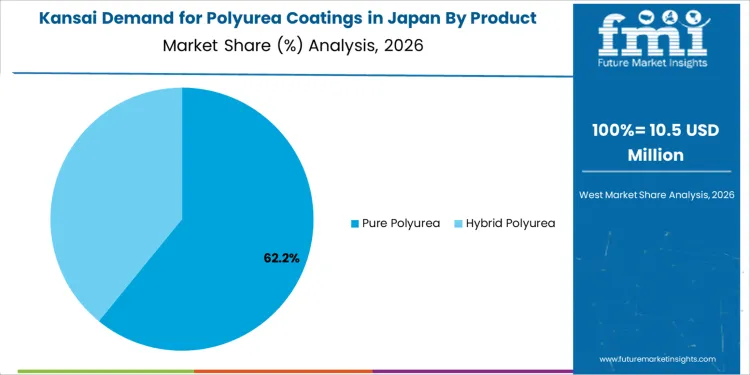
Demand for polyurea coatings in Kansai is rising at a CAGR of 4.8% from 2026 to 2036, supported by machinery plants, chemical handling zones, and commercial facilities. Polyurea serves as a protective barrier for floors, tanks, and equipment surfaces exposed to abrasion and chemical contact. Adoption patterns mirror industrial workflow intensity and inspection schedules. Plants apply coatings to strengthen operational resilience and extend surface life. Kansai facilities value polyurea for consistent performance and ease of integration into planned maintenance routines. Growth reflects steady refurbishment activity across production lines, storage areas, and utility spaces requiring durable protective treatments.
- Machinery plants use polyurea for abrasion resistance
- Chemical areas rely on protective coating barriers
- Equipment surfaces benefit from durable finishes
What Is Supporting Polyurea Coating Requirements Across Chubu Facilities?
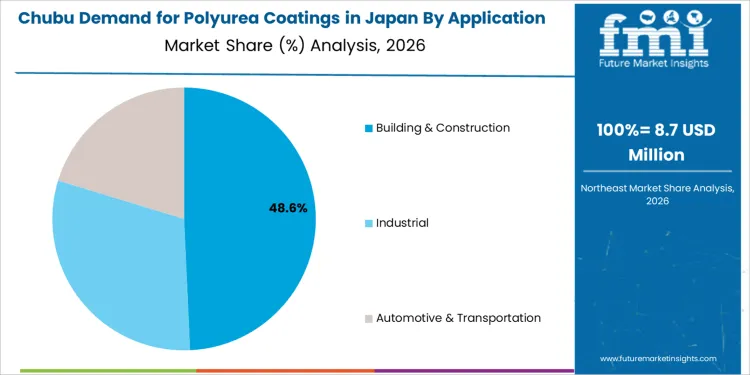
Demand for polyurea coatings in Chubu is moving at a CAGR of 4.2% from 2026 to 2036, supported by automotive manufacturing sites, engineering facilities, and distribution centers. Polyurea is used to reinforce floors, loading zones, and equipment housings exposed to mechanical loads. Plants adopt coatings during renovation cycles to maintain safe, durable surfaces. Warehouses apply polyurea for impact resistance in high movement zones. Demand reflects continuous operations across industrial corridors where protective layers extend service life of structural elements. Chubu’s manufacturing output maintains interest in coatings that provide rapid return to service, predictable durability, and cost stable maintenance profiles.
- Automotive plants apply coatings for floor protection
- Warehouses use polyurea in loading areas
- Engineering sites reinforce equipment surfaces
How Are Regional Conditions Shaping Polyurea Coating Adoption in Tohoku?
Demand for polyurea coatings in Tohoku is advancing at a CAGR of 3.7% from 2026 to 2036, supported by cold climate building needs, municipal infrastructure upkeep, and agricultural facility maintenance. Polyurea offers resilience against temperature variation, moisture exposure, and physical wear. Local authorities use coatings on utility structures, water facilities, and public spaces. Agricultural operations apply polyurea to protect storage areas and processing surfaces. Replacement cycles align with seasonal usage patterns and structural inspections. Regional demand reflects practical consideration of environmental conditions and the need for coatings that maintain performance under shifting temperature and moisture levels across diverse facility types.
- Municipal structures use polyurea for long term protection
- Agricultural sites apply coatings to storage surfaces
- Cold climate variation shapes coating selection
Which Factors Sustain Polyurea Coating Use Across Rest of Japan?
Demand for polyurea coatings in Rest of Japan is growing at a CAGR of 3.5% from 2026 to 2036, supported by community infrastructure, small manufacturing units, and local commercial buildings. Polyurea is valued for its fast curing performance, protective strength, and suitability for varied surface types. Facilities adopt coatings to enhance durability of floors, walls, and equipment exposed to regular wear. Replacement depends on building age, localized industrial activity, and maintenance budgets. Adoption stays steady across smaller regions where operators seek simple, reliable methods to extend surface longevity and control upkeep costs across practical, everyday facility environments.
- Community buildings use polyurea for surface reinforcement
- Small factories apply coatings to working areas
- Local warehouses protect floors with durable layers
What Is Driving the Demand for Polyurea Coatings in Japan and Which Companies Shape Industrial and Infrastructure Adoption?
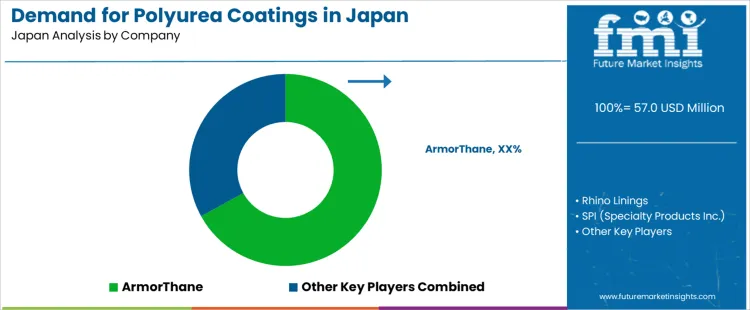
The demand for polyurea coatings in Japan is shaped by infrastructure renewal, strict waterproofing standards, and long service life requirements across transport and industrial facilities. Domestic applicators drive most deployments through bridge decks, tunnels, water tanks, and chemical plant surfaces that require fast curing and high abrasion resistance. Teknos Group supports demand through imported polyurea systems supplied to construction firms and maintenance contractors. ArmorThane participates through spray applied protective coatings used in marine structures, industrial flooring, and machinery protection. Rhino Linings reaches Japanese users through distributors serving automotive beds, construction sites, and municipal facilities seeking quick return to service. SPI and Nukote International supply high performance systems used in large containment projects, tank linings, and corrosion control programs across key industrial prefectures.
Project selection in Japan is governed by curing speed, chemical resistance, elongation performance, and adhesion on concrete or metal surfaces exposed to varied climates. Buyers emphasize low downtime for critical assets, predictable application results, and long term durability under high humidity and coastal conditions. Contractors rely on suppliers that offer equipment training, field support, and technical documentation in Japanese. Usage spans tunnels, port structures, parking decks, wastewater plants, and manufacturing floors. Demand visibility tracks public works revitalization, industrial tank refurbishment, expansion of logistics hubs, and consistent investment in protective coatings for high traffic and high load environments.
Key Players in the Polyurea Coatings Industry in Japan
- ArmorThane
- Rhino Linings
- SPI (Specialty Products Inc.)
- Teknos Group
- Nukote International
Scope of the Report
| Items | Values |
|---|---|
| Quantitative Units (2026) | USD million |
| Product Type | Pure Polyurea; Hybrid Polyurea |
| Application | Building and Construction; Industrial; Automotive and Transportation |
| End Users | Contractors; Industrial Applicators; Facility Managers; Infrastructure Maintenance Teams |
| Regions Covered | Kyushu and Okinawa; Kanto; Kansai; Chubu; Tohoku; Rest of Japan |
| Countries Covered | Japan |
| Key Companies Profiled | ArmorThane; Rhino Linings; SPI (Specialty Products Inc.); Teknos Group; Nukote International |
| Additional Attributes | Dollar sales by product type and application; pure polyurea use in moisture heavy environments; hybrid systems in cost sensitive projects; import reliance for prepolymers and specialty isocyanates; substitution pressure from epoxy and polyurethane coatings; contractor capability influencing adoption; spray equipment requirements; specified performance criteria for waterproofing, abrasion resistance, and chemical protection; demand shaped by infrastructure renewal cycles and industrial floor refurbishment. |
Polyurea Coatings Industry in Japan Segmentation
Product Type:
- Pure Polyurea
- Hybrid Polyurea
Application:
- Building & Construction
- Industrial
- Automotive & Transportation
Region:
- Kyushu & Okinawa
- Kanto
- Kansai
- Chubu
- Tohoku
- Rest of Japan
Frequently Asked Questions
How big is the demand for polyurea coatings in Japan in 2026?
The demand for polyurea coatings in Japan is estimated to be valued at USD 57.0 million in 2026.
What will be the size of polyurea coatings in Japan in 2036?
The market size for the polyurea coatings in Japan is projected to reach USD 87.2 million by 2036.
How much will be the demand for polyurea coatings in Japan growth between 2026 and 2036?
The demand for polyurea coatings in Japan is expected to grow at a 4.7% CAGR between 2026 and 2036.
What are the key product types in the polyurea coatings in Japan?
The key product types in polyurea coatings in Japan are pure polyurea and hybrid polyurea.
Which application segment is expected to contribute significant share in the polyurea coatings in Japan in 2026?
In terms of application, building & construction segment is expected to command 50.0% share in the polyurea coatings in Japan in 2026.
Preview the report firsthand - request a free sample
Get SampleGet the brochure for pricing and purchase details.
Get PDFTable of Content
- Executive Summary
- Japan Market Outlook
- Demand-side Trends
- Supply-side Trends
- Technology Roadmap Analysis
- Analysis and Recommendations
- Market Overview
- Market Coverage / Taxonomy
- Market Definition / Scope / Limitations
- Market Background
- Market Dynamics
- Drivers
- Restraints
- Opportunity
- Trends
- Scenario Forecast
- Demand in Optimistic Scenario
- Demand in Likely Scenario
- Demand in Conservative Scenario
- Opportunity Map Analysis
- Product Life Cycle Analysis
- Supply Chain Analysis
- Investment Feasibility Matrix
- Value Chain Analysis
- PESTLE and Porter’s Analysis
- Regulatory Landscape
- Regional Parent Market Outlook
- Production and Consumption Statistics
- Import and Export Statistics
- Market Dynamics
- Japan Market Analysis 2020 to 2024 and Forecast, 2025 to 2035
- Historical Market Size Value (USD Million) Analysis, 2020 to 2024
- Current and Future Market Size Value (USD Million) Projections, 2025 to 2035
- Y-o-Y Growth Trend Analysis
- Absolute $ Opportunity Analysis
- Japan Market Pricing Analysis 2020 to 2024 and Forecast 2025 to 2035
- Japan Market Analysis 2020 to 2024 and Forecast 2025 to 2035, By Product Type
- Introduction / Key Findings
- Historical Market Size Value (USD Million) Analysis By Product Type , 2020 to 2024
- Current and Future Market Size Value (USD Million) Analysis and Forecast By Product Type , 2025 to 2035
- Pure Polyurea
- Hybrid Polyurea
- Y-o-Y Growth Trend Analysis By Product Type , 2020 to 2024
- Absolute $ Opportunity Analysis By Product Type , 2025 to 2035
- Japan Market Analysis 2020 to 2024 and Forecast 2025 to 2035, By Application
- Introduction / Key Findings
- Historical Market Size Value (USD Million) Analysis By Application, 2020 to 2024
- Current and Future Market Size Value (USD Million) Analysis and Forecast By Application, 2025 to 2035
- Building & Construction
- Industrial
- Automotive & Transportation
- Y-o-Y Growth Trend Analysis By Application, 2020 to 2024
- Absolute $ Opportunity Analysis By Application, 2025 to 2035
- Market Structure Analysis
- Competition Dashboard
- Competition Benchmarking
- Market Share Analysis of Top Players
- By Regional
- By Product Type
- By Application
- Competition Analysis
- Competition Deep Dive
- ArmorThane
- Overview
- Product Portfolio
- Profitability by Market Segments (Product/Age /Sales Channel/Region)
- Sales Footprint
- Strategy Overview
- Marketing Strategy
- Product Strategy
- Channel Strategy
- Rhino Linings
- SPI (Specialty Products Inc.)
- Teknos Group
- Nukote International
- ArmorThane
- Competition Deep Dive
- Assumptions & Acronyms Used
- Research Methodology


