

- Industry Size (2026)
- USD 648 Mn
- Forecast (2036)
- USD 997 Mn
- CAGR (2026 to 2036)
- 4.4%
Demand for Green Packaging Film in Japan Size, Market Forecast and Outlook By FMI
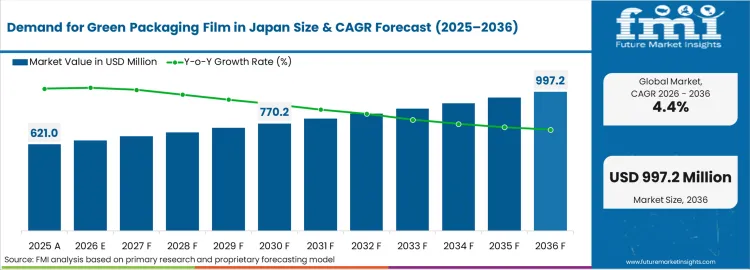
The demand for green packaging film in japan was valued at USD 648 million in 2025, rising to USD 648 million in 2026 and forecast to reach USD 997 million by 2036 at a CAGR of 4.4%. Food accounts for 34% of the end use segment in 2026, reflecting entrenched procurement specifications among primary buyer categories. Based on FMI analysis, absolute market expansion of USD 349 million over the forecast decade will be distributed unevenly, with specification-driven sub-segments and high-growth geographies capturing a disproportionate share of incremental value.
FMI analysts observe that structural demand for the demand for green packaging film in japan is shaped by regulatory compliance timelines, technology adoption curves, and procurement policy shifts that operate independently of short-term economic conditions. Plastic Resource Circulation Act Compliance Obligations establishes the volume baseline for the forecast period, while retail and food service sustainability procurement commitments is redirecting capital allocation within the sector toward higher-specification product tiers. FMI is of the opinion that producers aligning capacity investment with these structural forces will generate above-market revenue growth while incumbents relying on legacy product lines face progressive margin compression.
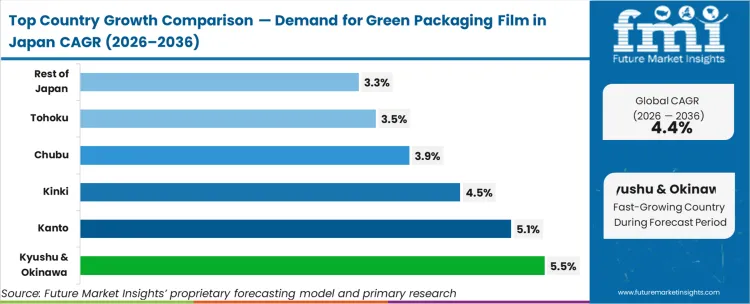
Regional performance diverges materially across the demand for green packaging film in japan forecast horizon. Kyushu and Okinawa at 5.5% CAGR and Kanto at 5.1% CAGR lead the expansion trajectory, driven by policy-backed demand creation and growing institutional procurement volumes. Kinki at 4.5% and Chubu at 3.9% represent mid-growth markets where established regulatory frameworks support steady adoption. Tohoku at 3.5%, Rest of Japan at 3.3% reflect mature or lower-growth trajectories where replacement demand and compliance-driven purchasing govern procurement decisions.
Summary of Demand for Green Packaging Film in Japan
- Demand for Green Packaging Film in Japan Definition
- The demand for green packaging film in japan encompasses biodegradable and compostable flexible packaging films manufactured from bio-based polymers including polylactic acid, starch blends, polybutylene adipate terephthalate, and polyhydroxyalkanoates, supplied to Japanese food, beverage, personal care, and pharmaceutical packaging converters and brand owners.
- Demand Drivers in the Market
- Plastic Resource Circulation Act Compliance Obligations: Japan's Plastic Resource Circulation Act enacted in April 2022 mandates that retailers, food service operators, and manufacturers reduce single-use plastic volume, creating procurement obligations that are accelerating conversion from conventional film to certified compostable alternatives across food and beverage packaging lines.
- Retail and Food Service Sustainability Procurement Commitments: Major Japanese convenience store chains and supermarket operators have published sourcing targets for bio-based and compostable packaging by 2030, generating forward purchase commitments that provide volume certainty for domestic film manufacturers.
- Kanto and Kyushu Regional Industrial Park Development: Greenfield food processing and pharmaceutical manufacturing facilities in Kyushu and Kanto industrial zones are specifying green packaging film from project inception rather than retrofitting, embedding bio-based film in new production line designs.
- Key Segments Analyzed in the FMI Report
- Food: 34% share in 2026, driven by established procurement specifications that favour this configuration for its cost efficiency, processing consistency, and performance alignment with primary end-use requirements.
- Poly Lactic Acid: the leading application category in 2026, anchored by institutional buyers operating under defined procurement cycles and volume commitments that generate predictable replacement demand across covered geographies.
- Kyushu and Okinawa: 5.5% CAGR through 2036, the fastest-growing geography in the covered market, supported by policy-driven demand creation and expanding end-user industry capacity.
- Analyst Opinion at FMI
- Ismail Sutaria, Principal Consultant for Packaging observe that, FMI analysts note that the demand for green packaging film in japan is entering a period where volume growth at the commodity end of the product spectrum is being compressed by regional competition and pricing pressure, while upper-tier sub-segments are expanding margins through specification-driven differentiation and compliance-related switching costs. Buyers consolidating vendor relationships will concentrate purchasing with producers demonstrating certified performance credentials and supply continuity, placing mid-tier suppliers without technical differentiation at structural disadvantage. The Kyushu and Okinawa and Kanto growth rates are grounded in verifiable policy commitments and documented end-user industry expansion, making both geographies priority targets for capacity investment through the medium term.
- Strategic Implications / Executive Takeaways
- Align capacity investment and distribution infrastructure with the Kyushu and Okinawa and Kanto growth trajectories, where CAGR outperformance relative to the market average reflects durable structural demand rather than cyclical activity.
- Develop certified product lines capable of meeting tightening specification and compliance requirements in Kinki, where replacement-cycle buyers are willing to pay premium pricing for documented performance credentials.
- Establish dual-source input arrangements for critical raw materials to reduce supply concentration risk in geographies experiencing simultaneous rapid domestic demand growth and export competition.
Demand for Green Packaging Film in Japan Key Takeaways
| Metric | Details |
|---|---|
| Industry Size (2026) | USD 648 million |
| Industry Value (2036) | USD 997 million |
| CAGR (2026-2036) | 4.4% |
| Source | Future Market Insights, 2026 |
Demand for Green Packaging Film in Japan Definition
The demand for green packaging film in japan covers biodegradable and compostable flexible packaging films manufactured from bio-based polymers including polylactic acid, starch blends, polybutylene adipate terephthalate, and polyhydroxyalkanoates, supplied to Japanese food, beverage, personal care, and pharmaceutical packaging converters and brand owners. Products within scope are differentiated by material grade, dimensional specifications, and end-use performance requirements that govern procurement decisions across industrial, institutional, and commercial buyer segments. As per FMI, market boundaries are defined by functional end-use characteristics and certified performance parameters rather than by manufacturing process designation alone.
Demand for Green Packaging Film in Japan Inclusions
Market scope includes polylactic acid films, starch-blend films, PBAT-based flexible packaging, PHA films, other certified compostable or biodegradable packaging films in bag, wrapping, pouch, and liner product forms distributed within Japan. All products within scope are evaluated across the full segmentation taxonomy and geographic coverage framework applied in the FMI analysis.
Demand for Green Packaging Film in Japan Exclusions
The scope excludes conventional polyethylene and polypropylene films without biodegradable certification, paper-based flexible packaging not incorporating bio-polymer film layers, rigid bio-based plastic containers, and imported green packaging film consumed outside Japan. Products that do not satisfy the functional, material, or certification criteria defined by the market taxonomy are omitted from all revenue and volume calculations.
Demand for Green Packaging Film in Japan Research Methodology
- Primary Research: Structured interviews were conducted with procurement directors, product engineers, and commercial managers across manufacturer, distributor, and end-user organizations in all covered geographies to map decision criteria, specification requirements, and pricing dynamics.
- Desk Research: Secondary data collection aggregated national trade statistics, regulatory filings, company annual reports, investor presentations, standards body publications, and peer-reviewed technical research relevant to the covered market.
- Market-Sizing and Forecasting: A bottom-up revenue model was constructed from verified unit shipment benchmarks and average selling price data, validated against top-down total addressable market estimates anchored to observable industry benchmarks from allowed primary sources.
- Data Validation and Update Cycle: Forecast outputs are cross-referenced against publicly reported company revenue guidance and validated through a secondary round of primary outreach. Data is refreshed on a rolling basis as new regulatory filings and corporate disclosures become available.
Why is the Demand for Green Packaging Film in Japan Growing?
Demand for green packaging film in Japan is increasing because consumer goods companies, food manufacturers and retailers are transitioning toward materials that reduce environmental impact while supporting product protection and shelf life. Japanese consumers show strong preference for packaging aligned with recycling and waste-reduction goals, which encourages adoption of films that use recycled content, bio-based feedstocks or downgauged structures to reduce total plastic volume. Convenience stores, supermarkets and online grocery platforms also drive this shift as they expand private-label products that highlight sustainability features. Green films that are compatible with existing PET or polyethylene recycling streams are favored because they allow companies to improve environmental performance without major equipment changes.
Government policies promoting circular economy principles support investments in packaging that can be collected, sorted and reprocessed within Japan’s infrastructure. Food manufacturers choose sustainable barrier films for fresh and frozen items to maintain quality while addressing environmental concerns. Constraints include higher material cost for advanced sustainable films, technical challenges in moisture-sensitive applications and limited commercial availability of certified bio-based resins. Smaller brands may postpone transitions until pricing stabilizes and recycling systems expand further.
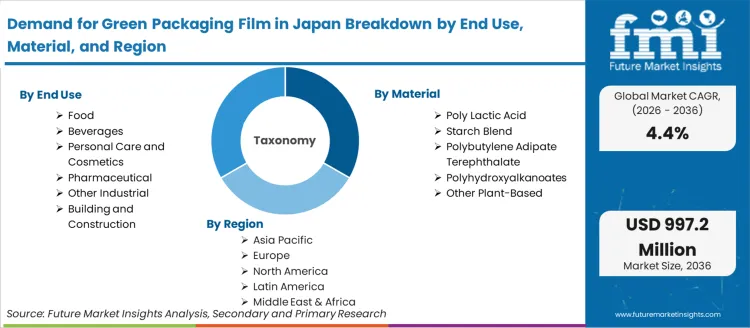
Which Product Types, Materials, and End Uses Lead Demand for Green Packaging Film in Japan?
Demand for green packaging film in Japan reflects sustainability policies, consumer waste-reduction expectations, and brand adoption of bio-based packaging formats. Domestic packaging users prioritize compostability, lightweight structure, and reduced fossil-based resin content. Procurement decisions consider compatibility with food-contact standards, print clarity, and mechanical strength across cold-chain and ambient distribution. Japanese manufacturers emphasize recycling alignment and material innovation that supports low-carbon product portfolios.
By Product Type, Bags Hold the Largest Share
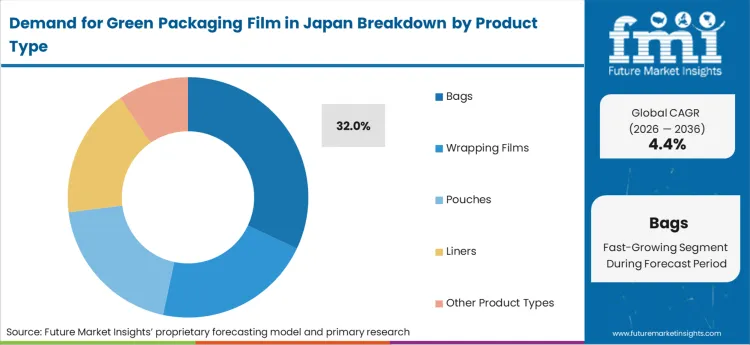
Bags represent 32.0%, driven by widespread usage in retail packaging, household storage, and flexible food containers. Japanese users prioritize lightweight performance and reliable sealing for portioned items. Wrapping films account for 25.0%, supporting pallet protection and direct-food wrapping in supermarkets. Pouches hold 21.0%, valued for extended shelf life and print customization, while liners represent 14.0%, serving industrial containment applications. Other product types total 8.0%, used in niche packaging needs. Product choice reflects mechanical strength expectations, labeling compatibility, and ecofriendly commitments across Japan’s packaged goods supply chains.
Key points:
- Bags dominate everyday retail and food packaging.
- Wrapping films support logistic and freshness requirements.
- Pouches gain traction in premium packaged goods.
By Material, Poly Lactic Acid (PLA) Holds the Largest Share
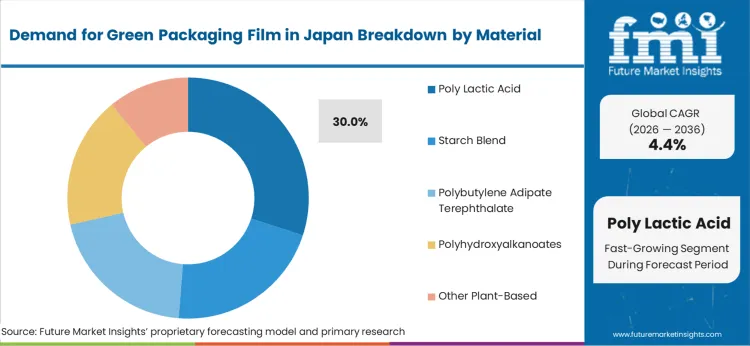
PLA represents 30.0%, driven by transparency, rigidity, and food-contact compliance. Starch-blend materials hold 26.0%, valued for rapid biodegradation in controlled waste systems. PBAT accounts for 18.0%, selected for flexibility in high-strain packaging. PHA represents 15.0%, applied where full marine and soil biodegradation is required. Other plant-based materials total 11.0%, serving specific barrier or process-compatibility needs. Material preference in Japan reflects production scalability, product clarity, and alignment with national recycling guidance for bio-based solutions used in mainstream consumer packaging.
Key points:
- PLA dominates transparent and food-grade films.
- Starch blends expand with compostability demand.
- PBAT supports higher ductility in flexible packaging.
By End Use, Food Holds the Largest Share
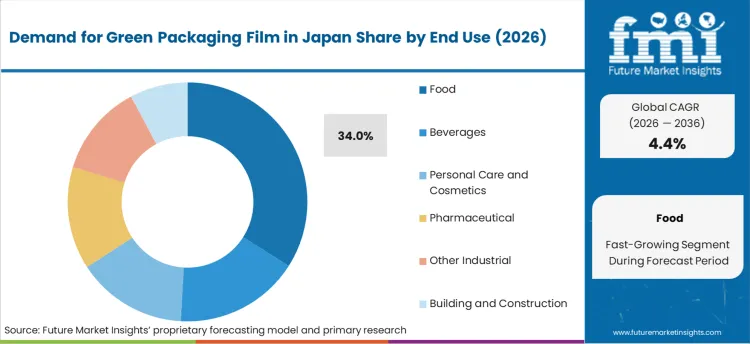
Food applications represent 34.0%, based on continuous packaged-food consumption and strict hygiene standards in Japanese retail. Beverages hold 22.0%, especially for secondary packaging or protective wrapping. Personal care and cosmetics represent 17.0%, where brand sustainability claims influence packaging decisions. Pharmaceuticals account for 13.0%, applying bio-based films for product integrity and regulatory compliance. Other industrial uses total 9.0%, followed by building and construction at 5.0% where durability is essential. End-use patterns in Japan reflect established packaging infrastructure and consumer preference for low-impact, high-quality material performance.
Key points:
- Food packaging leads due to strict handling expectations.
- Personal care and pharmaceutical adoption reflects brand ecofriendly goals.
- Industrial uptake aligns with waste-reduction policies.
What are the Drivers, Restraints, and Key Trends of the Demand for Green Packaging Film in Japan?
Expansion of circular-economy policies, retailer expectations for reduced plastic waste and rising demand for recyclable packaging in grocery distribution are driving demand.
In Japan, green packaging film gains momentum as national programs such as resource recycling targets encourage manufacturers to shift toward materials with lower environmental impact. Major supermarket chains and convenience stores require suppliers to reduce single-use plastics in ready-to-eat meals, produce and household goods, creating demand for recyclable and bio-based films. Packaging converters located in Kanto, Kansai and Tokai regions increase production of lightweight films to meet transportation efficiency goals linked to long-distance distribution systems. Consumers in urban prefectures show growing interest in products that minimize plastic volume and offer clear end-of-life pathways through existing waste-collection networks, reinforcing sustained domestic usage of green film formats.
Cost sensitivity among food manufacturers, performance limitations in moisture-prone applications and uneven recycling infrastructure restrain adoption.
Bio-based and recyclable films often carry higher pricing than traditional polyolefins, limiting uptake among smaller food producers with narrow margins. Some green films provide weaker heat-seal or moisture-barrier properties, making adoption more difficult in categories such as chilled foods and sauces that dominate Japanese convenience-store sales. Film-recycling access varies by municipality, and differences in processing methods reduce clarity for both manufacturers and consumers about disposal requirements. These structural constraints contribute to cautious and gradual expansion across packaging categories.
Shift toward monomaterial polyethylene structures, increased integration of recycled content and rising adoption in export-oriented food lines define key trends.
Japanese film producers are prioritizing monomaterial designs that align with mechanical recycling capabilities used by regional waste-processing operators. Food manufacturers are testing post-consumer recycled content in film structures for non-contact layers, supporting circularity without compromising safety compliance. Export-oriented brands in confectionery, snacks and instant foods use green films to meet overseas sustainability expectations, strengthening competitiveness in foreign retail channels. Fulfillment centers supplying online grocery and meal-kit services introduce lighter and easier-to-separate films to reduce household disposal complexity. These trends indicate a steady transition toward environmentally aligned packaging films within Japan.
Analysis of the Demand for Green Packaging Film in Japan by Region
Demand for green packaging films in Japan reflects ecofriendly commitments, circular material adoption, and retail preferences for reduced-waste packaging. Food processors, consumer-goods manufacturers, and logistics providers influence procurement patterns across Japan. Kyushu & Okinawa leads at 5.5%, followed by Kanto (5.1%), Kinki (4.5%), Chubu (3.9%), Tohoku (3.5%), and Rest of Japan (3.3%).
.webp "Top Country Growth Comparison Demand For Green Packaging Film In Japan Cagr (2026 2036)")
| Region | CAGR (2025-2035) |
|---|---|
| Kyushu & Okinawa | 5.5% |
| Kanto | 5.1% |
| Kinki | 4.5% |
| Chubu | 3.9% |
| Tohoku | 3.5% |
| Rest of Japan | 3.3% |
How is Kyushu & Okinawa driving demand for green packaging films?
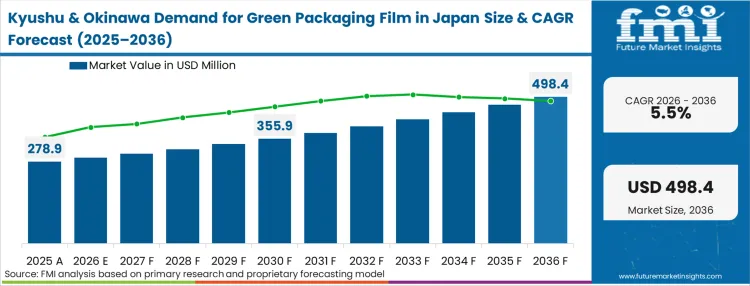
Kyushu & Okinawa records 5.5% CAGR, influenced by agricultural product packaging, seafood handling, and retail distribution upgrades prioritizing sustainability outcomes. Fresh produce and processed food suppliers introduce recyclable and bio-based films to maintain shelf life across humid storage environments. Tourism-linked consumption encourages compact film-wrapped goods that meet convenience needs while lowering environmental impact. Regional logistics centers favor lightweight films that reduce waste volumes in municipal recovery systems with capacity limitations. Retailers evaluate film clarity and sealing strength to maintain product hygiene during handling in busy store formats. Procurement teams align film adoption with cost efficiency and compliance with evolving packaging ecofriendly goals set by regional retail groups.
- Agricultural and seafood packaging requiring moisture-barrier films
- Tourism consumption supporting convenience film applications
- Waste-reduction requirements influencing packaging choices
- Retail procurement aligning with sustainability planning
How is Kanto shaping demand for green packaging films?
Kanto expands at 5.1% CAGR, led by Tokyo and Yokohama food manufacturers adopting recyclable mono-material films for high-turnover packaged goods. Large urban populations create continuous requirements for snack and ready-meal packaging aligned with retail ecofriendly commitments. Distribution networks favor lightweight and mechanically recyclable films that integrate into established sorting processes. Pharmaceutical and personal-care suppliers adopt films that maintain product security while lowering material intensity in secondary packaging. Local governance programs encouraging plastic reduction influence design practices and label spacing requirements. Procurement focuses on film performance during rapid filling cycles in automated production lines.
- Dense consumer demand accelerating sustainable film usage
- Automated filling sites driving film consistency requirements
- Recycling infrastructure shaping material specification
- Policy-linked packaging changes targeting material reduction
How is Kinki influencing demand for green packaging films?
Kinki posts 4.5% CAGR, guided by Osaka and Kyoto consumer-goods distribution and retail merchandising formats prioritizing recyclable packaging displays. Packaged food suppliers shift from mixed-material laminates to simplified structures supporting mechanical recovery without performance loss. Retailers apply sustainability scoring systems to evaluate packaging suitability across high-traffic stores. E-commerce activity increases demand for protective films with reduced resin use. Standardization programs encourage substitution of high-barrier films only where shelf-life compliance requires it.
- Retail evaluation models influencing packaging formats
- Film simplification supporting recyclability goals
- E-commerce growth driving protective lightweight films
- Standardization improving cost control in high-volume uses
How is Chubu contributing to demand for green packaging films?
Chubu grows at 3.9% CAGR, shaped by manufacturing clusters in Aichi and Shizuoka supplying packaged foods for national distribution. Sustainability preferences influence film selection where packaging must maintain sealing reliability through multi-stop transport. Industrial buyers assess film compatibility with existing machinery to avoid retrofit delays. Automotive supply chains introduce recyclable films for component protection to streamline waste handling in assembly plants. Procurement teams monitor mechanical strength and film stiffness to safeguard product integrity during warehouse storage.
- Food supply chains reinforcing durable recyclable film use
- Transport-related handling influencing film strength needs
- Automotive packaging applying recovery-friendly formats
- Focus on operational continuity during packaging transition
How is Tohoku shaping demand for green packaging films?
Tohoku advances at 3.5% CAGR, supported by agricultural and processed-food packers operating seasonal volumes requiring moisture-resistant films with reduced resin content. Distributed populations create wider shipping routes where film toughness influences product handling. Public programs encourage reduced-waste packaging in coastal areas with strict disposal rules. Retailers adopt transparent films designed for efficient shelf inspection and extended product visibility.
- Seasonal food packaging shaping film characteristics
- Wider transport routes requiring higher durability
- Waste-disposal oversight supporting recyclable film adoption
- Clear films aiding product verification and inventory control
How is the Rest of Japan adopting green packaging films?
Rest of Japan records 3.3% CAGR, reflecting small-scale manufacturing and regional retail channels transitioning gradually toward recyclable film formats. Food specialty producers evaluate bio-based materials where supply volumes are secure. Film usage focuses on minimal waste, portability, and consistent handling in local distribution networks. Municipal recycling differences influence adoption speed, requiring alignment with local collection rules to ensure recovery rates.
- Small manufacturing requiring cost stability
- Portability needs guiding lightweight film formats
- Variation in recycling access shaping usage pace
- Retailers monitoring shelf handling and waste outcomes
What is the competitive landscape of demand for green packaging film in Japan?
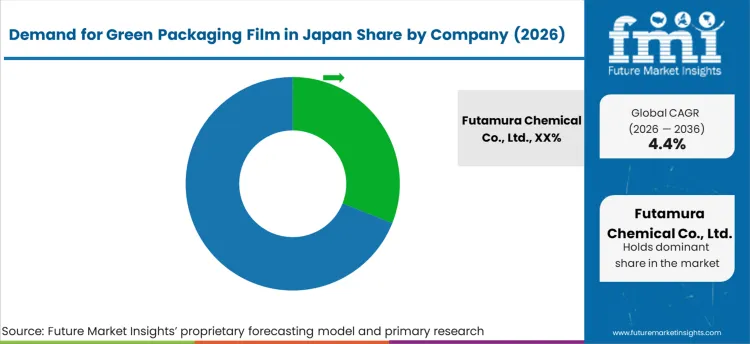
Demand for green packaging film in Japan is shaped by suppliers developing bio-based, compostable, and recyclable films for food packaging and controlled retail applications. Futamura Chemical Co., Ltd. holds about 31.0% share, supported by cellulose-film technology used in Japanese food packaging where consistent barrier stability and print quality are required. Its films align with certified compostable standards and predictable machinability in domestic converting lines. Toyobo Co., Ltd. maintains strong participation through polyester and bio-oriented films used in flexible packaging where transparency, sealing reliability, and downgauged material usage are priorities. DNP supports major Japanese food brands with recyclable barrier-film systems that deliver controlled oxygen and moisture performance during distribution.
Unitika Ltd. contributes stable presence in PLA-based and specialty films applied in fresh-food packaging, balancing durability and reduced resource consumption. Taghleef Industries, through its Japan activity, provides specialty solutions for labels and flexible packaging that require mechanical stability and responsible resin selection. Competition in Japan focuses on barrier reliability, composability certification, recyclability compatibility, forming efficiency, and secure domestic supply chains. Demand continues in applications where green packaging materials support food-quality protection and compliance with Japan’s evolving environmental-packaging objectives.
Key Players in Japan Green Packaging Film Demand
- Futamura Chemical Co., Ltd.
- Toyobo Co., Ltd.
- Dai Nippon Printing Co., Ltd. (DNP)
- Unitika Ltd.
- Taghleef Industries
Scope of the Report
| Metric | Value |
|---|---|
| Quantitative Units | USD 648 million to USD 997 million, at a CAGR of 4.4% |
| Market Definition | Demand for Green Packaging Film in Japan encompasses biodegradable and compostable flexible packaging films manufactured from bio-based polymers including polylactic acid, starch blends, polybutylene adipate terephthalate, and polyhydroxyalkanoates, supplied to Japanese food, beverage, personal care, and pharmaceutical packaging converters and brand owners. |
| Segmentation | End Use (Food, Beverages, Personal Care and Cosmetics, Pharmaceutical, Other Industrial, Building and Construction); Material (Poly Lactic Acid, Starch Blend, Polybutylene Adipate Terephthalate, Polyhydroxyalkanoates, Other Plant-Based); Product Type (Bags, Wrapping Films, Pouches, Liners, Other Product Types) |
| Regions Covered | North America, Latin America, Europe, East Asia, South Asia, Oceania, Middle East and Africa |
| Countries Covered | Kyushu and Okinawa, Kanto, Kinki, Chubu, Tohoku, Rest of Japan, and 40 plus countries |
| Key Companies Profiled | Futamura Chemical Co., Ltd., Toyobo Co., Ltd., Dai Nippon Printing Co., Ltd. (DNP), Unitika Ltd., Taghleef Industries |
| Forecast Period | 2026 to 2036 |
| Approach | Bottom-up revenue modeling anchored to verified shipment and pricing benchmarks, with scenario adjustments for regulatory, policy, and macroeconomic inputs |
Japan Green Packaging Film Demand by Segments
Product Type:
- Bags
- Wrapping Films
- Pouches
- Liners
- Other Product Types
Material:
- Poly Lactic Acid (PLA)
- Starch Blend
- Polybutylene Adipate Terephthalate (PBAT)
- Polyhydroxyalkanoates (PHA)
- Other Plant-Based
End Use:
- Food
- Beverages
- Personal Care and Cosmetics
- Pharmaceutical
- Other Industrial
- Building and Construction
Region:
- Kyushu & Okinawa
- Kanto
- Kinki
- Chubu
- Tohoku
- Rest of Japan
Bibliography
- 1. Ministry of the Environment, Government of Japan. (2024, March). Plastic Resource Circulation Act: Implementation status report and FY2024 compliance targets. MoE Japan.
- 2. Ministry of Economy, Trade and Industry, Government of Japan. (2024, February). Bioplastics roadmap 2030: Market development and production targets. METI.
- 3. Japan BioPlastics Association. (2024, April). JBPA certification statistics: Certified compostable and bio-based film products 2023. JBPA.
- 4. Japan External Trade Organization. (2024, June). Packaging industry trends in Japan: Sustainability procurement and material shift data. JETRO.
- 5. Cabinet Office, Government of Japan. (2024, January). Green growth strategy: Packaging sector targets and compliance monitoring framework. Cabinet Office.
- 6. Kyushu Bureau of Economy, Trade and Industry. (2024, May). Kyushu industrial park investment report: Food processing and manufacturing sector expansion. Kyushu BETI.
This bibliography is provided for reader reference. The full FMI report contains the complete reference list with primary research documentation.
Frequently Asked Questions
How large is the Demand for Green Packaging Film in Japan in 2026?
The demand for green packaging film in japan is estimated at USD 648 million in 2026, based on FMI proprietary bottom-up revenue modeling and primary research validation.
What will the Demand for Green Packaging Film in Japan size be by 2036?
FMI projects the demand for green packaging film in japan to reach USD 997 million by 2036, supported by sustained demand across primary end-use segments and covered geographies.
What is the CAGR for the Demand for Green Packaging Film in Japan between 2026 and 2036?
The demand for green packaging film in japan is projected to grow at a CAGR of 4.4% between 2026 and 2036.
Which end use leads in 2026?
Food is estimated to hold 34% of the end use segment in 2026, driven by established procurement preference and performance alignment with primary end-use requirements.
Which geography shows the fastest growth in the Demand for Green Packaging Film in Japan?
Kyushu and Okinawa registers the highest CAGR at 5.5% through 2036, driven by policy-backed demand creation and expanding end-user industry capacity.
What is the leading application in the Demand for Green Packaging Film in Japan?
Poly Lactic Acid is the leading application category in 2026, anchored by institutional procurement cycles and volume commitments that generate predictable replacement demand.
What is included in the scope of this report?
The scope includes polylactic acid films, starch-blend films, PBAT-based flexible packaging, PHA films, other certified compostable or biodegradable packaging films in bag, wrapping, pouch, and liner product forms distributed within Japan. Products are analyzed across all major segments and geographies defined in the FMI market framework.
How does FMI validate the Demand for Green Packaging Film in Japan forecast?
FMI applies a bottom-up methodology anchored to verified unit shipment data and average selling price benchmarks, cross-referenced against top-down market estimates and validated through primary interviews with manufacturers, distributors, and end users.
Preview the report firsthand - request a free sample
Get SampleGet the brochure for pricing and purchase details.
Get PDFTable of Content
- Executive Summary
- Global Market Outlook
- Demand-side Trends
- Supply-side Trends
- Technology Roadmap Analysis
- Analysis and Recommendations
- Market Overview
- Market Coverage / Taxonomy
- Market Definition / Scope / Limitations
- Research Methodology
- Chapter Orientation
- Analytical Lens and Working Hypotheses
- Market Structure, Signals, and Trend Drivers
- Benchmarking and Cross-market Comparability
- Market Sizing, Forecasting, and Opportunity Mapping
- Research Design and Evidence Framework
- Desk Research Programme (Secondary Evidence)
- Company Annual and Sustainability Reports
- Peer-reviewed Journals and Academic Literature
- Corporate Websites, Product Literature, and Technical Notes
- Earnings Decks and Investor Briefings
- Statutory Filings and Regulatory Disclosures
- Technical White Papers and Standards Notes
- Trade Journals, Industry Magazines, and Analyst Briefs
- Conference Proceedings, Webinars, and Seminar Materials
- Government Statistics Portals and Public Data Releases
- Press Releases and Reputable Media Coverage
- Specialist Newsletters and Curated Briefings
- Sector Databases and Reference Repositories
- FMI Internal Proprietary Databases and Historical Market Datasets
- Subscription Datasets and Paid Sources
- Social Channels, Communities, and Digital Listening Inputs
- Additional Desk Sources
- Expert Input and Fieldwork (Primary Evidence)
- Primary Modes
- Qualitative Interviews and Expert Elicitation
- Quantitative Surveys and Structured Data Capture
- Blended Approach
- Why Primary Evidence is Used
- Field Techniques
- Interviews
- Surveys
- Focus Groups
- Observational and In-context Research
- Social and Community Interactions
- Stakeholder Universe Engaged
- C-suite Leaders
- Board Members
- Presidents and Vice Presidents
- R&D and Innovation Heads
- Technical Specialists
- Domain Subject-matter Experts
- Scientists
- Physicians and Other Healthcare Professionals
- Governance, Ethics, and Data Stewardship
- Research Ethics
- Data Integrity and Handling
- Primary Modes
- Tooling, Models, and Reference Databases
- Desk Research Programme (Secondary Evidence)
- Data Engineering and Model Build
- Data Acquisition and Ingestion
- Cleaning, Normalisation, and Verification
- Synthesis, Triangulation, and Analysis
- Quality Assurance and Audit Trail
- Market Background
- Market Dynamics
- Drivers
- Restraints
- Opportunity
- Trends
- Scenario Forecast
- Demand in Optimistic Scenario
- Demand in Likely Scenario
- Demand in Conservative Scenario
- Opportunity Map Analysis
- Product Life Cycle Analysis
- Supply Chain Analysis
- Investment Feasibility Matrix
- Value Chain Analysis
- PESTLE and Porter’s Analysis
- Regulatory Landscape
- Regional Parent Market Outlook
- Production and Consumption Statistics
- Import and Export Statistics
- Market Dynamics
- Global Market Analysis 2021 to 2025 and Forecast, 2026 to 2036
- Historical Market Size Value (USD Million) Analysis, 2021 to 2025
- Current and Future Market Size Value (USD Million) Projections, 2026 to 2036
- Y-o-Y Growth Trend Analysis
- Absolute $ Opportunity Analysis
- Global Market Pricing Analysis 2021 to 2025 and Forecast 2026 to 2036
- Global Market Analysis 2021 to 2025 and Forecast 2026 to 2036, By End Use
- Introduction / Key Findings
- Historical Market Size Value (USD Million) Analysis By End Use , 2021 to 2025
- Current and Future Market Size Value (USD Million) Analysis and Forecast By End Use , 2026 to 2036
- Food
- Beverages
- Personal Care and Cosmetics
- Pharmaceutical
- Other Industrial
- Building and Construction
- Food
- Y-o-Y Growth Trend Analysis By End Use , 2021 to 2025
- Absolute $ Opportunity Analysis By End Use , 2026 to 2036
- Global Market Analysis 2021 to 2025 and Forecast 2026 to 2036, By Material
- Introduction / Key Findings
- Historical Market Size Value (USD Million) Analysis By Material, 2021 to 2025
- Current and Future Market Size Value (USD Million) Analysis and Forecast By Material, 2026 to 2036
- Poly Lactic Acid
- Starch Blend
- Polybutylene Adipate Terephthalate
- Polyhydroxyalkanoates
- Other Plant-Based
- Poly Lactic Acid
- Y-o-Y Growth Trend Analysis By Material, 2021 to 2025
- Absolute $ Opportunity Analysis By Material, 2026 to 2036
- Global Market Analysis 2021 to 2025 and Forecast 2026 to 2036, By Product Type
- Introduction / Key Findings
- Historical Market Size Value (USD Million) Analysis By Product Type, 2021 to 2025
- Current and Future Market Size Value (USD Million) Analysis and Forecast By Product Type, 2026 to 2036
- Bags
- Wrapping Films
- Pouches
- Liners
- Other Product Types
- Bags
- Y-o-Y Growth Trend Analysis By Product Type, 2021 to 2025
- Absolute $ Opportunity Analysis By Product Type, 2026 to 2036
- Global Market Analysis 2021 to 2025 and Forecast 2026 to 2036, By Region
- Introduction
- Historical Market Size Value (USD Million) Analysis By Region, 2021 to 2025
- Current Market Size Value (USD Million) Analysis and Forecast By Region, 2026 to 2036
- North America
- Latin America
- Western Europe
- Eastern Europe
- East Asia
- South Asia and Pacific
- Middle East & Africa
- Market Attractiveness Analysis By Region
- North America Market Analysis 2021 to 2025 and Forecast 2026 to 2036, By Country
- Historical Market Size Value (USD Million) Trend Analysis By Market Taxonomy, 2021 to 2025
- Market Size Value (USD Million) Forecast By Market Taxonomy, 2026 to 2036
- By Country
- USA
- Canada
- Mexico
- By End Use
- By Material
- By Product Type
- By Country
- Market Attractiveness Analysis
- By Country
- By End Use
- By Material
- By Product Type
- Key Takeaways
- Latin America Market Analysis 2021 to 2025 and Forecast 2026 to 2036, By Country
- Historical Market Size Value (USD Million) Trend Analysis By Market Taxonomy, 2021 to 2025
- Market Size Value (USD Million) Forecast By Market Taxonomy, 2026 to 2036
- By Country
- Brazil
- Chile
- Rest of Latin America
- By End Use
- By Material
- By Product Type
- By Country
- Market Attractiveness Analysis
- By Country
- By End Use
- By Material
- By Product Type
- Key Takeaways
- Western Europe Market Analysis 2021 to 2025 and Forecast 2026 to 2036, By Country
- Historical Market Size Value (USD Million) Trend Analysis By Market Taxonomy, 2021 to 2025
- Market Size Value (USD Million) Forecast By Market Taxonomy, 2026 to 2036
- By Country
- Germany
- UK
- Italy
- Spain
- France
- Nordic
- BENELUX
- Rest of Western Europe
- By End Use
- By Material
- By Product Type
- By Country
- Market Attractiveness Analysis
- By Country
- By End Use
- By Material
- By Product Type
- Key Takeaways
- Eastern Europe Market Analysis 2021 to 2025 and Forecast 2026 to 2036, By Country
- Historical Market Size Value (USD Million) Trend Analysis By Market Taxonomy, 2021 to 2025
- Market Size Value (USD Million) Forecast By Market Taxonomy, 2026 to 2036
- By Country
- Russia
- Poland
- Hungary
- Balkan & Baltic
- Rest of Eastern Europe
- By End Use
- By Material
- By Product Type
- By Country
- Market Attractiveness Analysis
- By Country
- By End Use
- By Material
- By Product Type
- Key Takeaways
- East Asia Market Analysis 2021 to 2025 and Forecast 2026 to 2036, By Country
- Historical Market Size Value (USD Million) Trend Analysis By Market Taxonomy, 2021 to 2025
- Market Size Value (USD Million) Forecast By Market Taxonomy, 2026 to 2036
- By Country
- China
- Japan
- South Korea
- By End Use
- By Material
- By Product Type
- By Country
- Market Attractiveness Analysis
- By Country
- By End Use
- By Material
- By Product Type
- Key Takeaways
- South Asia and Pacific Market Analysis 2021 to 2025 and Forecast 2026 to 2036, By Country
- Historical Market Size Value (USD Million) Trend Analysis By Market Taxonomy, 2021 to 2025
- Market Size Value (USD Million) Forecast By Market Taxonomy, 2026 to 2036
- By Country
- India
- ASEAN
- Australia & New Zealand
- Rest of South Asia and Pacific
- By End Use
- By Material
- By Product Type
- By Country
- Market Attractiveness Analysis
- By Country
- By End Use
- By Material
- By Product Type
- Key Takeaways
- Middle East & Africa Market Analysis 2021 to 2025 and Forecast 2026 to 2036, By Country
- Historical Market Size Value (USD Million) Trend Analysis By Market Taxonomy, 2021 to 2025
- Market Size Value (USD Million) Forecast By Market Taxonomy, 2026 to 2036
- By Country
- Kingdom of Saudi Arabia
- Other GCC Countries
- Turkiye
- South Africa
- Other African Union
- Rest of Middle East & Africa
- By End Use
- By Material
- By Product Type
- By Country
- Market Attractiveness Analysis
- By Country
- By End Use
- By Material
- By Product Type
- Key Takeaways
- Key Countries Market Analysis
- USA
- Pricing Analysis
- Market Share Analysis, 2025
- By End Use
- By Material
- By Product Type
- Canada
- Pricing Analysis
- Market Share Analysis, 2025
- By End Use
- By Material
- By Product Type
- Mexico
- Pricing Analysis
- Market Share Analysis, 2025
- By End Use
- By Material
- By Product Type
- Brazil
- Pricing Analysis
- Market Share Analysis, 2025
- By End Use
- By Material
- By Product Type
- Chile
- Pricing Analysis
- Market Share Analysis, 2025
- By End Use
- By Material
- By Product Type
- Germany
- Pricing Analysis
- Market Share Analysis, 2025
- By End Use
- By Material
- By Product Type
- UK
- Pricing Analysis
- Market Share Analysis, 2025
- By End Use
- By Material
- By Product Type
- Italy
- Pricing Analysis
- Market Share Analysis, 2025
- By End Use
- By Material
- By Product Type
- Spain
- Pricing Analysis
- Market Share Analysis, 2025
- By End Use
- By Material
- By Product Type
- France
- Pricing Analysis
- Market Share Analysis, 2025
- By End Use
- By Material
- By Product Type
- India
- Pricing Analysis
- Market Share Analysis, 2025
- By End Use
- By Material
- By Product Type
- ASEAN
- Pricing Analysis
- Market Share Analysis, 2025
- By End Use
- By Material
- By Product Type
- Australia & New Zealand
- Pricing Analysis
- Market Share Analysis, 2025
- By End Use
- By Material
- By Product Type
- China
- Pricing Analysis
- Market Share Analysis, 2025
- By End Use
- By Material
- By Product Type
- Japan
- Pricing Analysis
- Market Share Analysis, 2025
- By End Use
- By Material
- By Product Type
- South Korea
- Pricing Analysis
- Market Share Analysis, 2025
- By End Use
- By Material
- By Product Type
- Russia
- Pricing Analysis
- Market Share Analysis, 2025
- By End Use
- By Material
- By Product Type
- Poland
- Pricing Analysis
- Market Share Analysis, 2025
- By End Use
- By Material
- By Product Type
- Hungary
- Pricing Analysis
- Market Share Analysis, 2025
- By End Use
- By Material
- By Product Type
- Kingdom of Saudi Arabia
- Pricing Analysis
- Market Share Analysis, 2025
- By End Use
- By Material
- By Product Type
- Turkiye
- Pricing Analysis
- Market Share Analysis, 2025
- By End Use
- By Material
- By Product Type
- South Africa
- Pricing Analysis
- Market Share Analysis, 2025
- By End Use
- By Material
- By Product Type
- USA
- Market Structure Analysis
- Competition Dashboard
- Competition Benchmarking
- Market Share Analysis of Top Players
- By Regional
- By End Use
- By Material
- By Product Type
- Competition Analysis
- Competition Deep Dive
- Futamura Chemical Co., Ltd.
- Overview
- Product Portfolio
- Profitability by Market Segments (Product/Age /Sales Channel/Region)
- Sales Footprint
- Strategy Overview
- Marketing Strategy
- Product Strategy
- Channel Strategy
- Toyobo Co., Ltd.
- Dai Nippon Printing Co., Ltd. (DNP)
- Value (USD Million)ika Ltd.
- Taghleef Industries
- Futamura Chemical Co., Ltd.
- Competition Deep Dive
- Assumptions & Acronyms Used


