

- Market Size (2026)
- USD 6.3 Bn
- Forecast (2036)
- USD 11.3 Bn
- CAGR (2026 to 2036)
- 6.0%
Frosting, Toppings, and Decorations Market Size, Market Forecast and Outlook By FMI
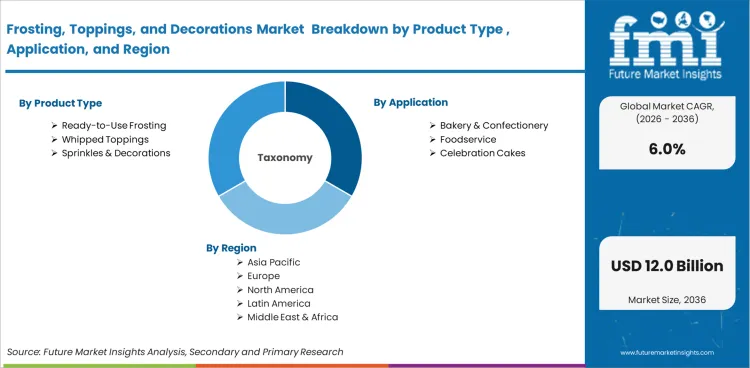
The frosting, toppings, and decorations market is expected to expand from USD 6.3 billion in 2026 to USD 11.3 billion by 2036. The market is anticipated to register a 6.0% CAGR during the forecast period. Ready-to-use frosting is likely to lead product type with a 30.0% share, while bakery and confectionery is projected to account for 28.0% share of application revenue in 2026.
Summary of the Frosting, Toppings, and Decorations Market
- Demand and Growth Drivers
- Celebration-led bakery purchases are expected to keep frosting and decoration use active across cakes and dessert counters.
- Home baking occasions are likely to support steady retail movement for ready frosting tubs and smaller decor packs.
- Café dessert menus are anticipated to increase use of toppings that improve finish without raising preparation time.
- Product and Segment View
- Ready-to-use frosting is expected to lead the product type segment due to its fit with quick bakery finishing needs.
- Bakery and confectionery is likely to remain the main application base because cakes and sweet baked goods need repeat finishing inputs.
- Retail is anticipated to support wider household access as supermarkets keep decorating products visible during routine bakery shopping.
- Geography and Competitive Outlook
- India is expected to lead country-level expansion as bakery chains and online cake ordering widen product use.
- China is likely to record steady expansion as branded bakeries increase use of toppings and premium inclusions.
- Companies with stronger bakery reach and stable product performance are anticipated to defend share across professional supply routes.
- Analyst Opinion
- Nandini Roy Choudhury, Principal Consultant for Food and Beverage at FMI, suggests, “The frosting, toppings, and decorations market is moving toward suppliers that can combine convenience with reliable bakery performance. Ready-to-use formats are likely to gain advantage as bakeries and households look for finishing products that reduce preparation effort while keeping visual quality consistent.”
- Frosting, Toppings, and Decorations Market Value Analysis
- The frosting, toppings, and decorations market is moving from basic cake finishing toward convenience-led bakery presentation.
- Industry value is likely to rise as ready frosting and decor packs become more common in household baking.
- Retail movement is expected to improve as celebration packs and seasonal decorating lines gain shelf visibility.
- Spending is anticipated to be supported by bakery chains that need stable toppings for repeat cake and dessert output.
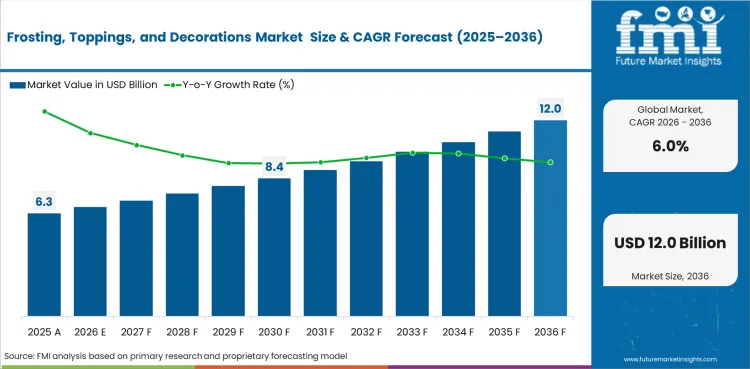
Key Takeaways, Market Size, and Forecast
| Metric | Value |
|---|---|
| Market Size (2026) | USD 6.3 Billion |
| Market Size (2036) | USD 11.3 Billion |
| CAGR (2026–2036) | 6.0% |
| Leading Product Type (2026) | Ready-To-Use Frosting |
| Ready-To-Use Frosting Share (2026) | 30.0% |
| Leading Application (2026) | Bakery And Confectionery |
| Bakery And Confectionery Share (2026) | 28.0% |
| Fastest-Growing Country | India |
| India CAGR | 6.2% |
Frosting, Toppings, and Decorations Market Key Takeaways
| Parameter | Details |
|---|---|
| Market value (2026) | USD 6.3 billion |
| Forecast value (2036) | USD 11.3 billion |
| CAGR (2026 to 2036) | 6.0% |
| Estimated market value (2025) | USD 5.7 billion |
| Incremental opportunity | USD 5.0 billion |
| Leading product type | Ready-to-Use Frosting - 30% |
| Leading application | Bakery & Confectionery - 28% |
| Leading sales channel | Retail - 26% |
Source: Future Market Insights, 2026.
Ready-made frosting systems and decor packs are gaining steady use because bakeries need products that cut finishing time and keep appearance consistent. Retail shelves are also carrying more celebration packs and home baking kits as consumers buy decorating inputs for birthdays and seasonal baking. . Product mix is shifting toward convenience and premium visual appeal.India and China rise faster because bakery chains and dessert stores are adding new outlets, while Japan and South Korea are growing at a steady pace in more mature retail settings.
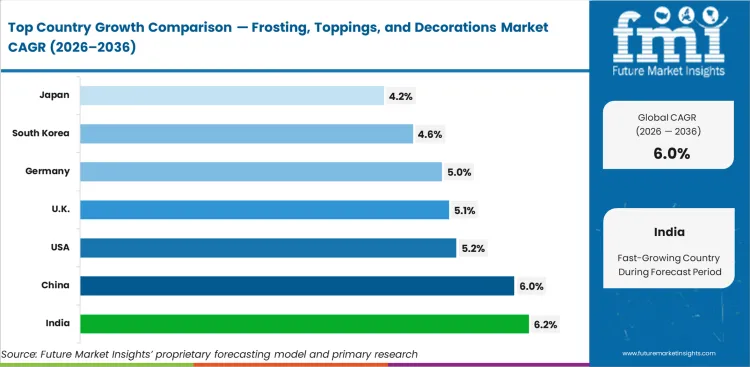
India is projected at 6.2% CAGR through 2036 as bakery chains and online cake orders keep decor use active. China is likely to scale at 6.0% CAGR because branded bakeries and dessert shops are widening use of toppings and inclusions. The U.S. is estimated at 5.2% CAGR as grocery baking aisles and celebration cake demand remain broad. The U.K. is anticipated at 5.1% CAGR as home baking and seasonal decor packs keep turnover stable. Germany is expected at 5.0% CAGR, while South Korea is placed at 4.6% CAGR and Japan at 4.2% CAGR in more mature dessert retail systems.
Frosting, Toppings, and Decorations Market Definition
The frosting, toppings, and decorations industry covers edible finishing products used on cakes, pastries, cookies, desserts, and related bakery items. It includes ready-to-use frosting, whipped toppings, decor pieces, fondants, icings, inclusions, and similar lines sold for commercial bakery use and home baking use. These products support texture and appearance during product preparation.
Frosting, Toppings, and Decorations Market Inclusions
decorIndustry scope includes standard and premium frosting formats, whipped toppings, sprinkles, decorative inclusions, fondants, icings, plant-based toppings, and private label decor lines. Sales through retail stores, direct bakery supply, modern trade, specialty outlets, distributors, online routes, and club channels are included. Commercial bakery use, celebration use, café dessert use, and home baking use are counted when the product serves as an edible finishing line.
Frosting, Toppings, and Decorations Market Exclusions
decorFresh fruit toppings prepared at the point of service are outside scope. Non-edible cake decor tools and packaging items are excluded. Base baking ingredients such as flour, sugar, and butter are not counted unless they are sold as a frosting or decoration product. Industrial bakery machinery and display equipment stay outside the study boundary.
Frosting, Toppings, and Decorations Market Research Methodology
- Primary Research: FMI analysts conducted interviews with bakery ingredient sourcing heads, confectionery product managers, cake decoration suppliers, foodservice dessert teams, and retail baking aisle executives across North America, Europe, and Asia-Pacific.
- Desk Research: Data collection aggregated bakery and confectionery association statistics, retail baking ingredient sales data, foodservice dessert trend reports, trade flow records, and company disclosures to establish baseline parameters.
- Market Sizing and Forecasting: Baseline values derive from a bottom-up aggregation of frosting, topping, and decoration demand across retail, bakery and confectionery, foodservice, and specialty baking use. Country-level consumption trends and product mix shifts are then applied to project demand through 2036.
- Data validation and update cycle: Projections are tested against retail channel movement, bakery ingredient demand trends, confectionery usage patterns, and supplier activity updates through a quarterly refresh schedule.
Why Is the Frosting, Toppings, and Decorations Market Growing?
- Celebration-led bakery demand keeps frosting and decor use active across cakes, cupcakes, and plated desserts.
- Retail shelves carry more home decorating packs as seasonal baking and gifting support repeat purchases.
- Premium inclusions and plant-based toppings are widening shelf mix in urban bakery and café formats.
Demand for frosting, toppings, and decoration products is rising due to consistent bakery output and dessert presentation. Cakes and sweet baked items need finishing products that improve appearance without adding long preparation time. Bakeries prefer formats that spread easily and stay stable in storage. Whipped topping concentrates and ready-to-roll icings support this preference because they reduce prep time and keep product output more uniform across busy bakery counters.
decorRetail demand supports industry expansion as well. Home bakers now buy more decorating lines for birthdays and small party occasions. This pattern supports value movement across ready-to-use frosting and smaller decor packs sold through grocery and online routes. Icing sugar and related baking ingredients follow the same demand pattern because they support both basic and premium finishing lines.
Segmental Analysis
- Ready-to-Use Frosting is expected to lead the product type segment with 30% share in 2026.
- Bakery & Confectionery is projected to lead the end use segment with 28% share in 2026.
- Retail is anticipated to lead the sales channel segment with 26% share in 2026 .
- Sugar-Based is expected to lead the ingredient base segment with 42% share in 2026.
- Tubs & Cups are projected to lead the packaging format segment with 34% share in 2026 as they support easy storage and repeat household use.
- Mass Market is likely to lead the price positioning segment with 52% share in 2026 because everyday celebration baking and routine dessert use still account for most volume.
Segment outlook in this industry reflects ease of use and route-to-shelf strength. Product type defines texture and finish style. Application reflects the volume pulled by bakeries and celebration orders. Sales channel influences how widely these products move across household purchases and commercial supply. Core lines still lead overall demand, while premium and plant-based lines add extra value in urban and specialist outlets.
Insights into the Product Type Segment
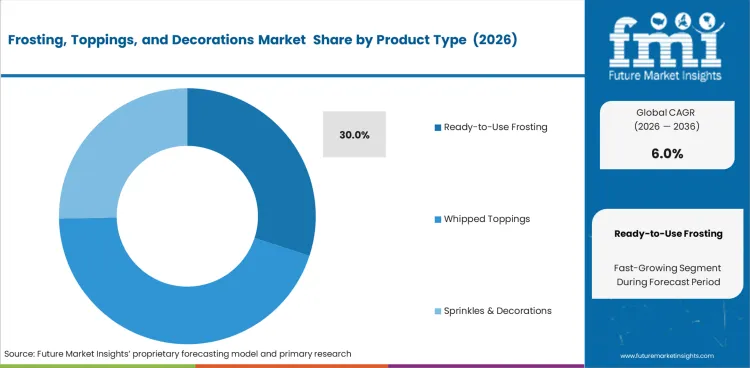
Ready-to-use frosting is expected to account for 30% share of the product type segment in 2026 because bakery teams want products that save labor and support quick cake finishing. Home baking ingredients and bakery mixes also support steady demand for easy finishing products sold to consumers who want quick decorating results. Whipped toppings and sprinkles add range across bakery counters, while plant-based lines widen retail shelves.
Insights into the Application Segment
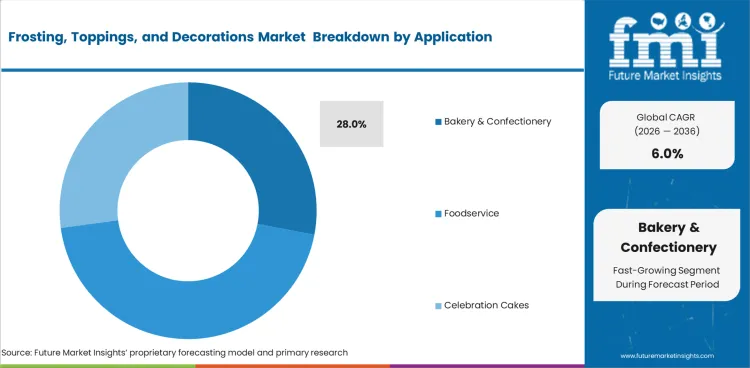
Foodservice and celebration cakes add steady demand. Specialty bakers and dessert shops support premium textures and visual detail. Visual presentation carries clear value in celebration and gifting purchases. Bakery & Confectionery is anticipated to represent 28% share of the application segment in 2026 as cakes, cookies, and sweet bakery lines remain the largest end users of frosting and decorations.
Insights into the Sales Channel Segment
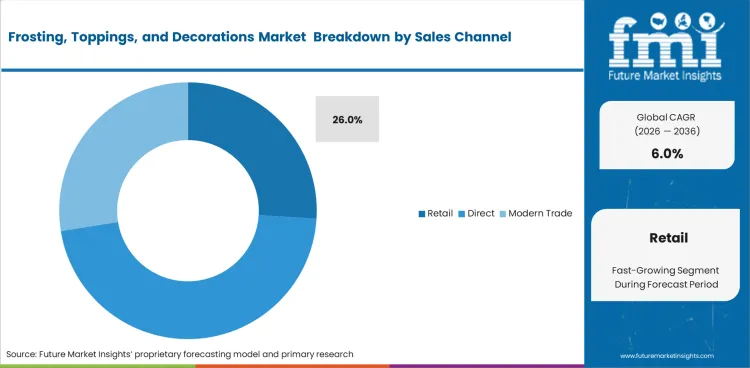
decorRetail is likely to hold 26% share of the sales channel segment in 2026 as supermarkets and grocery chains make decorating products easy to find during routine baking purchases. Direct supply remains important for bakeries with steady input needs. Modern trade and online routes gain visibility as consumers buy decor packs for planned celebration shopping. Specialty outlets and distributors serve premium and bulk demand with a tighter product mix.
Insights into the Ingredient Base Segment
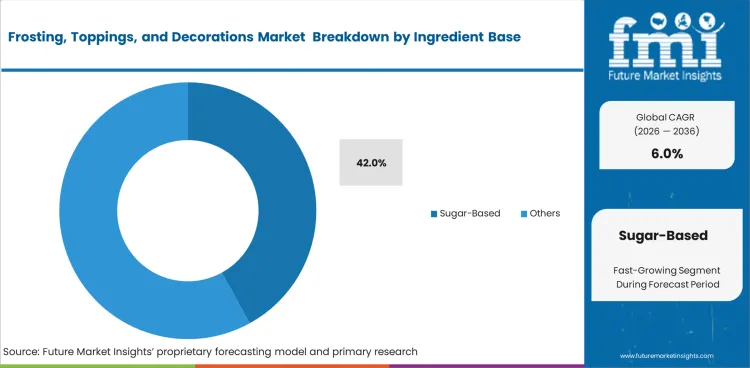
Sugar-Based is expected to lead the ingredient base segment with 42% share in 2026 as it remains the standard base for frosting, toppings, and decorative mixes across mainstream product lines. It supports the sweetness and structure most buyers expect in cakes and sweet bakery products. Fat-based and cream-led formats keep solid use in whipped and premium applications. Plant-based options are expanding from a smaller base as product choice widens in health-focused baking lines.
Insights into the Packaging Format Segment
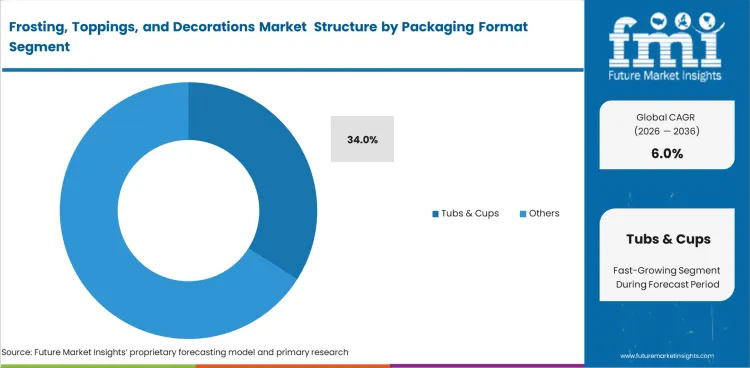
Tubs & Cups are projected to account for 34% share of the packaging format segment in 2026 as they offer easy reseal use and clean storage for households and bakery counters. This format works well for ready-to-use frosting and repeat decoration use in small batches. Pouches are gaining shelf presence in squeeze and drizzle applications. Bulk packs remain important for foodservice and commercial bakery volume demand.
Insights into the Price Positioning Segment
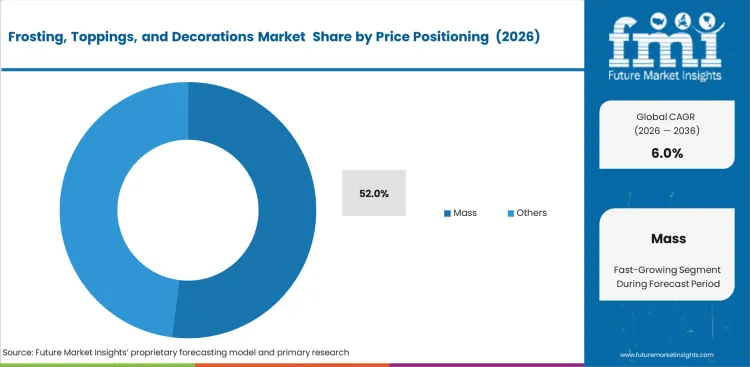
Mass Market is likely to represent 52% share of the price positioning segment in 2026 because most product movement is observed from standard birthday cakes and home baking needs. Buyers in this segment focus on taste, appearance, and affordable pack size. Premium lines continue to rise through specialty decoration and gifting occasions. Private label and value tiers stay active in retail as price-sensitive households manage baking spend.
What Are the Drivers, Restraints, and Key Trends in the Frosting, Toppings, and Decorations Market?
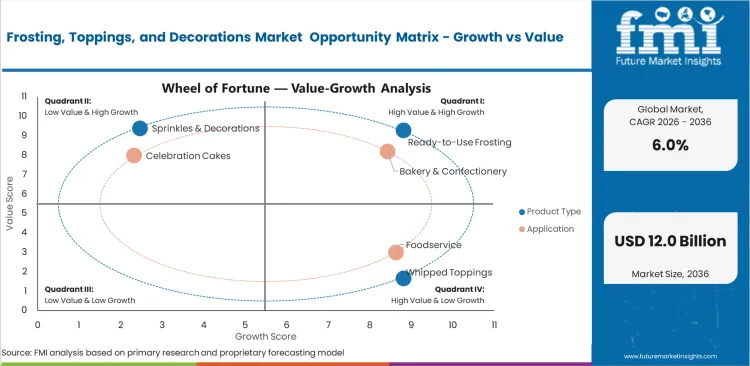
- Retail baking demand supports steady movement as consumers keep buying cakes and decorating supplies for parties and festive occasions.
- Sugar along with dairy,
- Plant-based toppings and premium inclusions are widening product mix across bakery counters and urban dessert stores.
The industry is growing from repeat bakery demand instead of a seasonal or other major factor. Cakes and sweet bakery products need finishing inputs across daily sales and celebration orders which keeps volume stable in product lines with easy handling and stable shelf life. Café dessert sales and home baking activity further add steady demand for sprinkles and ready-to-use frosting.
Retail Baking Demand
Retail baking demand remains the clearest growth driver. Grocery aisles now carry more decorating packs and smaller frosting tubs for home baking use. Celebration cakes also garner demand in bakeries and dessert shops, which keeps commercial volume strong for easy finishing products. Retail shelves in the United States and Europe also reward convenience and presentation during bakery purchases.
Input Cost Pressure
Input cost pressure is one of the significant restraint for standard product lines. Frosting and topping suppliers face movement hurdles in sugar and packaging costs. Price-sensitive retail lines cannot always absorb sudden cost increases without affecting volume. Private label lines often react first because shoppers compare prices closely in standard frosting and decor packs. Suppliers need a balanced mix across value packs and premium lines which limits industry growth.
Premium and Plant-Based Shift
Manufacturers in the industry are Premium and plant-based products are shaping new product development approach. Premium inclusions help bakeries raise ticket value through stronger color and visual finish. Plant-based toppings gain shelf space as consumers look for dairy-free or lighter product options. Related work in food coating ingredients and bakery emulsions supports product development tied to texture and appearance in sweet bakery lines.
Analysis of Frosting, Toppings, and Decorations Market by Key Countries
- India is expected to rise at 6.2% CAGR through 2036 because bakery chains and online cake ordering continues to drive demand for ready-made frosting and decorations
- China is projected to post 6.0% CAGR through 2036 as branded bakeries and dessert stores promote use of toppings and inclusions across urban outlets.
- The USA is likely to grow at 5.2% CAGR through 2036 because retail baking aisles and celebration cake demand in the country is propelling regular household sales..
.webp "Top Country Growth Comparison Frosting, Toppings, And Decorations Market Cagr (2026 2036)")
| Country | CAGR |
|---|---|
| USA | 5.2% |
| Germany | 5.0% |
| UK | 5.1% |
| India | 6.2% |
| China | 6.0% |
| Japan | 4.2% |
| South Korea | 4.6% |
Source: Future Market Insights competitive analysis, 2026.
India and China are witnessing rapid expansion as bakery chains and celebration consumer become. The USA and the UK keep steady growth through strong retail distribution. Germany benefits from mature bakery habits. Japan and South Korea move below the global pace because dessert retail is already well developed and volume growth is more measured. Country differences come mainly from outlet expansion and celebration culture instead of basic product awareness.
Demand Outlook for Frosting, Toppings, and Decorations in the United States
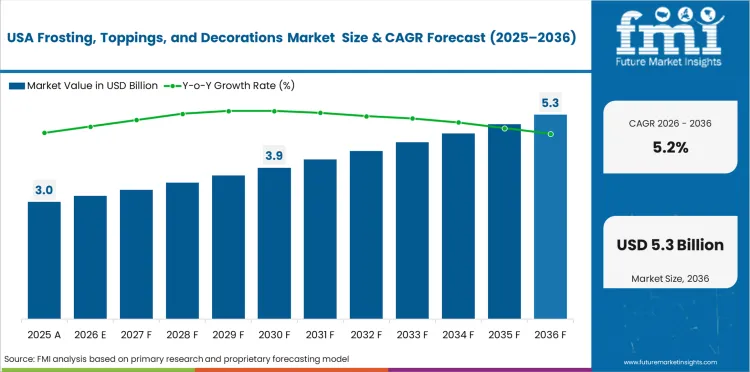
The USA market is expected to advance at 5.2% CAGR through 2036 as grocery baking aisles and celebration cakes continues to propel the use of ready-made frosting lines broad. Large retail chains provide strong visibility for tubs and specialty toppers among others. Birthdays and holiday baking activity support repeat household purchases. Wilton and Rich Products benefit from this steady base because branded decorating solutions remain visible in regular shopping trips.
- Retail baking kits stay active in seasonal and party-led shopping.
- Celebration cake demand supports repeat frosting and sprinkle purchases.
- Mass retail visibility helps standard lines sustain strong turnover.
Industry Analysis of Frosting, Toppings, and Decorations in Germany
Bakery counters value appearance and texture because visual finish supports pricing in cakes and sweet pastries. Demand stays balanced between commercial bakery use and packaged retail lines sold for home preparation. Puratos and CSM Ingredients remain visible because bakery professionals need reliable texture and stable application across a broad mix of sweet baked items. Germany is expected to register 5.0% CAGR through 2036 as premium pastry culture and organized retail keep steady movement in whipped toppings, icings, and inclusions.
- Premium pastry sales support steady topping and inclusion demand.
- Organized retail keeps home baking lines visible across major stores.
- Commercial bakers prefer stable texture and easy handling properties.
Sales Analysis of Frosting, Toppings, and Decorations in the United Kingdom
decorThe UK industry is likely to increase at 5.1% CAGR through 2036 as home baking and celebration cakes keep retail decor packs in regular use. Grocery stores and online supply routes support demand for frosting tubs and decorative toppings. Seasonal baking during holidays and family event supports the package sales across the year. Wilton and other retail-facing brands stay visible because simple decorating products appeal to beginners and regular home bakers.
- Holiday baking supports strong movement in themed decor packs.
- Online supply routes add reach for home decorators and small bakers.
- Celebration cakes keep frosting and topper demand steady through the year.
Demand Outlook for Frosting, Toppings, and Decorations in India
Celebration spending keeps cakes central to birthdays and weddings, which supports strong demand for ready-to-use frosting and inclusions. Organized retail is also widening access to small decor packs for home bakers. The industry expansion in India is set to expand at 6.2% CAGR through 2036 as bakery chains and online cake delivery influences the increase in demand for frosting use among consumers. Rich Products and Dawn Foods benefit from this setting because bakery operators need easy finishing products that work well across fast-moving store formats.
- Cake delivery growth supports steady use of ready-made finishing products.
- Festival and wedding demand keeps decor movement active across cities.
- Small retail packs widen access for home bakers and hobby users.
In-Depth Analysis of Frosting, Toppings, and Decorations in China
China is forecast to post 6.0% CAGR through 2036 as branded bakeries and dessert stores keep adding outlets in large cities and newer urban clusters. Visual presentation remains central to celebration cakes and premium sweet bakery lines. That keeps demand active for whipped toppings, premium inclusions, and decorative packs that improve finish without long prep time. Barry Callebaut and Puratos stay well placed because bakery and dessert operators look for premium appearance and stable product performance.
- Urban bakery chains widen use of premium toppings and inclusions.
- Dessert store growth supports more decoration use across plated products.
- Premium appearance helps bakeries raise value in celebration purchases.
Industry Analysis of Frosting, Toppings, and Decorations in Japan
Demand stays centered on portion-led cakes and neat finishing instead of rapid outlet expansion. Japan is expected to rise at 4.2% CAGR through 2036 as dessert retail and bakery culture remain strong yet mature. Product use stays steady across whipped toppings and icings, with modest support from premium dessert formats. Puratos and Barry Callebaut remain visible in premium bakery and confectionery support because visual refinement and product consistency carry weight in this mature sweet goods setting.
- Portion-led bakery demand supports stable topping and icing movement.
- Premium dessert formats add modest value lift across mature outlets.
- Clean finish and product consistency remain central to repeat use.
Demand Outlook for Frosting, Toppings, and Decorations in South Korea
South Korea is likely to grow at 4.6% CAGR through 2036 as café culture and celebration cake demand keep decoration lines active across urban bakery formats. Consumers show steady interest in visually strong cakes and desserts. That supports movement in whipped toppings and premium inclusions. Retail packs remain visible for home use, although the market base is more mature than in India or China. Dawn Foods and other professional supply brands benefit as cafés and bakeries look for easy finishing products that support quick service and attractive display.
- Café dessert culture keeps premium finishing products in regular use.
- Celebration cake demand supports steady topping and inclusion turnover.
- Retail decor packs remain visible for home users in urban centers.
- Competitive Landscape of Frosting, Toppings, and Decorations Market
- The industry is moderately concentrated with a small group of large bakery supply companies and several regional decor specialists.
- Leading companies compete on product breadth, texture stability, and strong bakery and retail reach.
- Room remains for specialist suppliers in premium inclusions and plant-based toppings, plus local celebration decor assortments.
Competitive Landscape
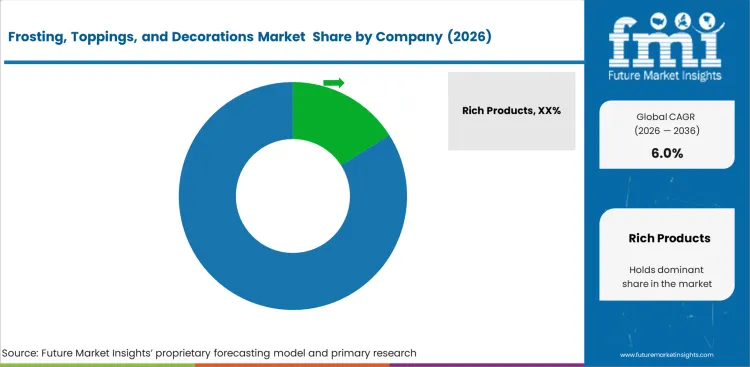
Companies that supply frosting and decor lines across bakery outlets and retail shelves hold a stronger position than firms with a narrow range. Rich Products remains prominent in whipped toppings and bakery finishing support. Puratos adds strength through bakery and patisserie reach. Barry Callebaut supports premium inclusions and decorative chocolate applications. Dawn Foods and CSM Ingredients stay visible through professional bakery supply and regional bakery relationships.
decorRetail-facing brands and professional bakery suppliers serve different demand pockets. Wilton remains strong in consumer decorating lines because simple pouches and tools work well for home bakers and small celebration orders. Professional suppliers hold an edge in larger bakery accounts because they support stable texture and repeat output across stores. Private label growth still adds pressure in standard lines, especially in retail frosting and decor packs sold through mass channels.
Premium lines and plant-based options create room for product differentiation. Suppliers that add visual appeal without making bakery handling harder can improve mix and defend shelf space. In July 2025 Wilton launched ready-to-use decorating icing pouches with four built-in piping tips, which show that ease of use and faster decoration still guide product development.
Major Industry Players
The industry includes global bakery supply groups, retail-facing decorating brands, and regional suppliers with focused product lines.
- Global Player: Rich Products, Puratos, Barry Callebaut, and Dawn Foods lead this group because they combine broad product lines and strong bakery relationships across many countries.
- Regional Player: Wilton and CSM Ingredients lead this group because they hold solid positions in consumer decorating lines or bakery ingredient supply without matching the full global spread of the largest multi-line groups.
- Emerging Players: Other regional suppliers and private label manufacturers remain important because local taste and seasonal decor themes create room for smaller firms with faster shelf response.
Competitive Benchmarking: Frosting, Toppings, and Decorations Market
| Company | Product Breadth | Bakery Reach | Channel Strength | Footprint |
|---|---|---|---|---|
| Rich Products | High | High | Strong | Global |
| Puratos | High | High | Strong | Global |
| Barry Callebaut | High | Medium | Strong | Global |
| Dawn Foods | Medium | High | Strong | Multi-region |
| Wilton | Medium | High | Moderate | North America |
| CSM Ingredients | Medium | Medium | Moderate | Europe |
| Regional Suppliers | Low | Medium | Low | Regional |
Source: Future Market Insights competitive analysis, 2026.
Key Developments in Frosting, Toppings, and Decorations Market
- In May 2025, Puratos presented three innovations at iba 2025, including a bakery improver and a reworked brioche concept.
- In July 2025, Wilton launched ready-to-use decorating icing pouches in the USA with four built-in piping tips.
- In November 2025, CSM Ingredients launched Nuaré which is a carob-based cocoa alternative range for bakery and ice cream use.
Key Players in the Frosting, Toppings, and Decorations Market
- Major Global Players
- Rich Products
- Puratos
- Barry Callebaut
- Dawn Foods
- Key Emerging Players and Regional Suppliers
- Wilton
- CSM Ingredients
- Other Regional Suppliers
Scope of the Report
| Metric | Value |
|---|---|
| Quantitative Units | USD 6.3 billion in 2026 to USD 11.3 billion by 2036 at a CAGR of 6.0% |
| Market Definition | The frosting, toppings, and decorations market covers edible finishing products used to improve appearance, texture, and flavor across cakes, pastries, cookies, desserts, and related sweet bakery lines. |
| Segmentation |
|
| Regions Covered | North America, Europe, South Asia, East Asia, Latin America, and Middle East & Africa |
| Countries Covered | USA, Germany, UK, India, China, Japan, South Korea, and 30 plus countries |
| Key Companies Profiled | Rich Products, Puratos, Wilton, Barry Callebaut, Dawn Foods, CSM Ingredients, and other regional suppliers |
| Forecast Period | 2026 to 2036 |
| Approach | Hybrid bottom-up and top-down methodology built from the user data set, product mix, channel spread, country demand patterns, and competitive positioning. |
Source: Future Market Insights competitive analysis, 2026.
Frosting, Toppings, and Decorations Market by Segments
Frosting, Toppings, and Decorations Market Segmented as Product Type:
- Ready-to-Use Frosting
- Whipped Toppings
- Sprinkles & Decorations
- Fondants & Icings
- Premium Inclusions
- Plant-Based Toppings
- Private Label Décor
Frosting, Toppings, and Decorations Market Classified by Application:
- Bakery & Confectionery
- Foodservice
- Celebration Cakes
- Specialty Bakers
- Desserts
- Health-Conscious Consumers
- Mass Market
Frosting, Toppings, and Decorations Market Classified by Sales Channel:
- Retail
- Direct
- Modern Trade
- Specialty
- Distributors
- Online
- Clubs / Wholesale
Frosting, Toppings, and Decorations Market by Region and Country:
- North America - USA
- Europe - Germany, UK
- South Asia - India
- East Asia - China, Japan, South Korea
Bibliography
- Barry Callebaut. (2026, February 3). Top chocolate confectionery trends 2026 & beyond. Barry Callebaut Group.
- CSM Ingredients. (2025, November 18). CSM Ingredients, a Nexture company, opens a new £3 million customer‑focused product development centre in the UK. CSM Ingredients.
- Dawn Foods. (2025, April 3). Dawn Foods unveils new products to meet seasonal flavor demand. Dawn Foods.
- Puratos. (2024, October 10). Puratos launches new plant‑based, whippable Ambiante chocolate flavor for toppings and fillings. Puratos Group.
- U.S. Department of Agriculture, Foreign Agricultural Service. (2026). Food processing ingredients annual. U.S. Department of Agriculture.
- U.S. Department of Agriculture, Foreign Agricultural Service. (2025, January 16). Baking ingredients market update 2025. U.S. Department of Agriculture.
- U.S. Department of Agriculture, Foreign Agricultural Service. (2024, September 30). Retail foods annual. USA Department of Agriculture.
Bibliography is provided for reader reference.
This Report Addresses
- Revenue sizing and forecast assessment for the industry from 2026 to 2036.
- Segment analysis across product type, application, and sales channel.
- Country growth review for the USA and Germany, plus the UK, India, China, Japan, and South Korea.
- Competitive assessment covering large bakery supply groups, retail-facing brands, and regional suppliers.
- Review of celebration demand, home baking activity, and bakery chain expansion.
- Evaluation of premium inclusions and plant-based toppings, plus retail channel movement.
Frequently Asked Questions
How large is the industry in 2026?
The industry is estimated at USD 6.3 billion in 2026 based on the value set used for this study.
What is the forecast size by 2036?
The industry is projected to reach USD 11.3 billion by 2036 as bakery demand and celebration-led use keep improving.
What growth rate is expected from 2026 to 2036?
The industry is expected to expand at a CAGR of 6.0% over the forecast period from 2026 to 2036.
Which product type leads the study?
Ready-to-Use Frosting leads product type and is expected to account for 30% share in 2026.
Which application leads the study?
Bakery & Confectionery leads application with an estimated 28% share in 2026 because cakes and pastries need regular finishing support.
Which sales route leads the study?
Retail leads sales channels with an estimated 26% share in 2026 because grocery shelves account for the largest volume of routine purchases.
Which country is projected to grow the fastest?
India is expected to rise at a 6.2% CAGR through 2036.
Preview the report firsthand - request a free sample
Get SampleGet the brochure for pricing and purchase details.
Get PDFTable of Content
- Executive Summary
- Global Market Outlook
- Demand-side Trends
- Supply-side Trends
- Technology Roadmap Analysis
- Analysis and Recommendations
- Market Overview
- Market Coverage / Taxonomy
- Market Definition / Scope / Limitations
- Research Methodology
- Chapter Orientation
- Analytical Lens and Working Hypotheses
- Market Structure, Signals, and Trend Drivers
- Benchmarking and Cross-market Comparability
- Market Sizing, Forecasting, and Opportunity Mapping
- Research Design and Evidence Framework
- Desk Research Programme (Secondary Evidence)
- Company Annual and Sustainability Reports
- Technical White Papers and Standards Notes
- Trade Journals, Industry Magazines, and Analyst Briefs
- Conference Proceedings, Webinars, and Seminar Materials
- Government Statistics Portals and Public Data Releases
- Press Releases and Reputable Media Coverage
- Specialist Newsletters and Curated Briefings
- Sector Databases and Reference Repositories
- FMI Internal Proprietary Databases and Historical Market Datasets
- Subscription Datasets and Paid Sources
- Social Channels, Communities, and Digital Listening Inputs
- Additional Desk Sources
- Expert Input and Fieldwork (Primary Evidence)
- Primary Modes
- Qualitative Interviews and Expert Elicitation
- Quantitative Surveys and Structured Data Capture
- Blended Approach
- Why Primary Evidence is Used
- Field Techniques
- Interviews
- Surveys
- Focus Groups
- Observational and In-context Research
- Social and Community Interactions
- Stakeholder Universe Engaged
- C-suite Leaders
- Board Members
- Market Dynamics
- Drivers
- Restraints
- Opportunity
- Trends
- Scenario Forecast
- Demand in Optimistic Scenario
- Demand in Likely Scenario
- Demand in Conservative Scenario
- Opportunity Map Analysis
- Product Life Cycle Analysis
- Supply Chain Analysis
- Investment Feasibility Matrix
- Value Chain Analysis
- PESTLE and Porter’s Analysis
- Regulatory Landscape
- Regional Parent Market Outlook
- Production and Consumption Statistics
- Import and Export Statistics
- Global Market Analysis 2021 to 2025 and Forecast, 2026 to 2036
- Historical Market Size Value (USD Million) Analysis, 2021 to 2025
- Current and Future Market Size Value (USD Million) Projections, 2026 to 2036
- Y-o-Y Growth Trend Analysis
- Absolute $ Opportunity Analysis
- Global Market Pricing Analysis 2021 to 2025 and Forecast 2026 to 2036
- Global Market Analysis 2021 to 2025 and Forecast 2026 to 2036, By Product Type
- Introduction / Key Findings
- Historical Market Size Value (USD Million) Analysis By Product Type , 2021 to 2025
- Current and Future Market Size Value (USD Million) Analysis and Forecast By Product Type , 2026 to 2036
- Heptahydrate
- Monohydrate
- Anhydrous
- Heptahydrate
- Y-o-Y Growth Trend Analysis By Product Type , 2021 to 2025
- Absolute $ Opportunity Analysis By Product Type , 2026 to 2036
- Global Market Analysis 2021 to 2025 and Forecast 2026 to 2036, By Grade
- Introduction / Key Findings
- Historical Market Size Value (USD Million) Analysis By Grade, 2021 to 2025
- Current and Future Market Size Value (USD Million) Analysis and Forecast By Grade, 2026 to 2036
- Industrial Grade
- Food Grade
- Agriculture Grade
- Industrial Grade
- Y-o-Y Growth Trend Analysis By Grade, 2021 to 2025
- Absolute $ Opportunity Analysis By Grade, 2026 to 2036
- Global Market Analysis 2021 to 2025 and Forecast 2026 to 2036, By End User
- Introduction / Key Findings
- Historical Market Size Value (USD Million) Analysis By End User, 2021 to 2025
- Current and Future Market Size Value (USD Million) Analysis and Forecast By End User, 2026 to 2036
- Agriculture
- Chemicals
- Pulp & Paper
- Agriculture
- Y-o-Y Growth Trend Analysis By End User, 2021 to 2025
- Absolute $ Opportunity Analysis By End User, 2026 to 2036
- Global Market Analysis 2021 to 2025 and Forecast 2026 to 2036, By Form
- Introduction / Key Findings
- Historical Market Size Value (USD Million) Analysis By Form, 2021 to 2025
- Current and Future Market Size Value (USD Million) Analysis and Forecast By Form, 2026 to 2036
- Solid
- Liquid
- Solid
- Y-o-Y Growth Trend Analysis By Form, 2021 to 2025
- Absolute $ Opportunity Analysis By Form, 2026 to 2036
- Global Market Analysis 2021 to 2025 and Forecast 2026 to 2036, By Region
- Introduction
- Historical Market Size Value (USD Million) Analysis By Region, 2021 to 2025
- Current Market Size Value (USD Million) Analysis and Forecast By Region, 2026 to 2036
- North America
- Latin America
- Western Europe
- Eastern Europe
- East Asia
- South Asia and Pacific
- Middle East & Africa
- Market Attractiveness Analysis By Region
- North America Market Analysis 2021 to 2025 and Forecast 2026 to 2036, By Country
- Historical Market Size Value (USD Million) Trend Analysis By Market Taxonomy, 2021 to 2025
- Market Size Value (USD Million) Forecast By Market Taxonomy, 2026 to 2036
- By Country
- USA
- Canada
- Mexico
- By Product Type
- By Grade
- By End User
- By Form
- By Country
- Market Attractiveness Analysis
- By Country
- By Product Type
- By Grade
- By End User
- By Form
- Key Takeaways
- Latin America Market Analysis 2021 to 2025 and Forecast 2026 to 2036, By Country
- Historical Market Size Value (USD Million) Trend Analysis By Market Taxonomy, 2021 to 2025
- Market Size Value (USD Million) Forecast By Market Taxonomy, 2026 to 2036
- By Country
- Brazil
- Chile
- Rest of Latin America
- By Product Type
- By Grade
- By End User
- By Form
- By Country
- Market Attractiveness Analysis
- By Country
- By Product Type
- By Grade
- By End User
- By Form
- Key Takeaways
- Western Europe Market Analysis 2021 to 2025 and Forecast 2026 to 2036, By Country
- Historical Market Size Value (USD Million) Trend Analysis By Market Taxonomy, 2021 to 2025
- Market Size Value (USD Million) Forecast By Market Taxonomy, 2026 to 2036
- By Country
- Germany
- UK
- Italy
- Spain
- France
- Nordic
- BENELUX
- Rest of Western Europe
- By Product Type
- By Grade
- By End User
- By Form
- By Country
- Market Attractiveness Analysis
- By Country
- By Product Type
- By Grade
- By End User
- By Form
- Key Takeaways
- Eastern Europe Market Analysis 2021 to 2025 and Forecast 2026 to 2036, By Country
- Historical Market Size Value (USD Million) Trend Analysis By Market Taxonomy, 2021 to 2025
- Market Size Value (USD Million) Forecast By Market Taxonomy, 2026 to 2036
- By Country
- Russia
- Poland
- Hungary
- Balkan & Baltic
- Rest of Eastern Europe
- By Product Type
- By Grade
- By End User
- By Form
- By Country
- Market Attractiveness Analysis
- By Country
- By Product Type
- By Grade
- By End User
- By Form
- Key Takeaways
- East Asia Market Analysis 2021 to 2025 and Forecast 2026 to 2036, By Country
- Historical Market Size Value (USD Million) Trend Analysis By Market Taxonomy, 2021 to 2025
- Market Size Value (USD Million) Forecast By Market Taxonomy, 2026 to 2036
- By Country
- China
- Japan
- South Korea
- By Product Type
- By Grade
- By End User
- By Form
- By Country
- Market Attractiveness Analysis
- By Country
- By Product Type
- By Grade
- By End User
- By Form
- Key Takeaways
- South Asia and Pacific Market Analysis 2021 to 2025 and Forecast 2026 to 2036, By Country
- Historical Market Size Value (USD Million) Trend Analysis By Market Taxonomy, 2021 to 2025
- Market Size Value (USD Million) Forecast By Market Taxonomy, 2026 to 2036
- By Country
- India
- ASEAN
- Australia & New Zealand
- Rest of South Asia and Pacific
- By Product Type
- By Grade
- By End User
- By Form
- By Country
- Market Attractiveness Analysis
- By Country
- By Product Type
- By Grade
- By End User
- By Form
- Key Takeaways
- Middle East & Africa Market Analysis 2021 to 2025 and Forecast 2026 to 2036, By Country
- Historical Market Size Value (USD Million) Trend Analysis By Market Taxonomy, 2021 to 2025
- Market Size Value (USD Million) Forecast By Market Taxonomy, 2026 to 2036
- By Country
- Kingdom of Saudi Arabia
- Other GCC Countries
- Turkiye
- South Africa
- Other African Union
- Rest of Middle East & Africa
- By Product Type
- By Grade
- By End User
- By Form
- By Country
- Market Attractiveness Analysis
- By Country
- By Product Type
- By Grade
- By End User
- By Form
- Key Takeaways
- Key Countries Market Analysis
- USA
- Pricing Analysis
- Market Share Analysis, 2025
- By Product Type
- By Grade
- By End User
- By Form
- Canada
- Pricing Analysis
- Market Share Analysis, 2025
- By Product Type
- By Grade
- By End User
- By Form
- Mexico
- Pricing Analysis
- Market Share Analysis, 2025
- By Product Type
- By Grade
- By End User
- By Form
- Brazil
- Pricing Analysis
- Market Share Analysis, 2025
- By Product Type
- By Grade
- By End User
- By Form
- Chile
- Pricing Analysis
- Market Share Analysis, 2025
- By Product Type
- By Grade
- By End User
- By Form
- Germany
- Pricing Analysis
- Market Share Analysis, 2025
- By Product Type
- By Grade
- By End User
- By Form
- UK
- Pricing Analysis
- Market Share Analysis, 2025
- By Product Type
- By Grade
- By End User
- By Form
- Italy
- Pricing Analysis
- Market Share Analysis, 2025
- By Product Type
- By Grade
- By End User
- By Form
- Spain
- Pricing Analysis
- Market Share Analysis, 2025
- By Product Type
- By Grade
- By End User
- By Form
- France
- Pricing Analysis
- Market Share Analysis, 2025
- By Product Type
- By Grade
- By End User
- By Form
- India
- Pricing Analysis
- Market Share Analysis, 2025
- By Product Type
- By Grade
- By End User
- By Form
- ASEAN
- Pricing Analysis
- Market Share Analysis, 2025
- By Product Type
- By Grade
- By End User
- By Form
- Australia & New Zealand
- Pricing Analysis
- Market Share Analysis, 2025
- By Product Type
- By Grade
- By End User
- By Form
- China
- Pricing Analysis
- Market Share Analysis, 2025
- By Product Type
- By Grade
- By End User
- By Form
- Japan
- Pricing Analysis
- Market Share Analysis, 2025
- By Product Type
- By Grade
- By End User
- By Form
- South Korea
- Pricing Analysis
- Market Share Analysis, 2025
- By Product Type
- By Grade
- By End User
- By Form
- Russia
- Pricing Analysis
- Market Share Analysis, 2025
- By Product Type
- By Grade
- By End User
- By Form
- Poland
- Pricing Analysis
- Market Share Analysis, 2025
- By Product Type
- By Grade
- By End User
- By Form
- Hungary
- Pricing Analysis
- Market Share Analysis, 2025
- By Product Type
- By Grade
- By End User
- By Form
- Kingdom of Saudi Arabia
- Pricing Analysis
- Market Share Analysis, 2025
- By Product Type
- By Grade
- By End User
- By Form
- Turkiye
- Pricing Analysis
- Market Share Analysis, 2025
- By Product Type
- By Grade
- By End User
- By Form
- South Africa
- Pricing Analysis
- Market Share Analysis, 2025
- By Product Type
- By Grade
- By End User
- By Form
- USA
- Market Structure Analysis
- Competition Dashboard
- Competition Benchmarking
- Market Share Analysis of Top Players
- By Regional
- By Product Type
- By Grade
- By End User
- By Form
- Competition Analysis
- Competition Deep Dive
- K+S Aktiengesellschaft
- Overview
- Product Portfolio
- Profitability by Market Segments (Product/Age /Sales Channel/Region)
- Sales Footprint
- Strategy Overview
- Marketing Strategy
- Product Strategy
- Channel Strategy
- Giles Chemical
- PQ Corporation
- Mani Agro Chem Pvt. Ltd.
- Mag Products India Private Limited
- Laizhou City Laiyu Chemical Co., Ltd
- K+S Aktiengesellschaft
- Competition Deep Dive
- Primary Modes
- Assumptions & Acronyms Used
- Desk Research Programme (Secondary Evidence)


