

- Market Size (2026)
- USD 160.0 Mn
- Forecast (2036)
- USD 348.6 Mn
- CAGR (2026 to 2036)
- 8.1%
Biodegradable Spray Tank Line-Cleaning Chemistry Market Size, Market Forecast and Outlook By FMI
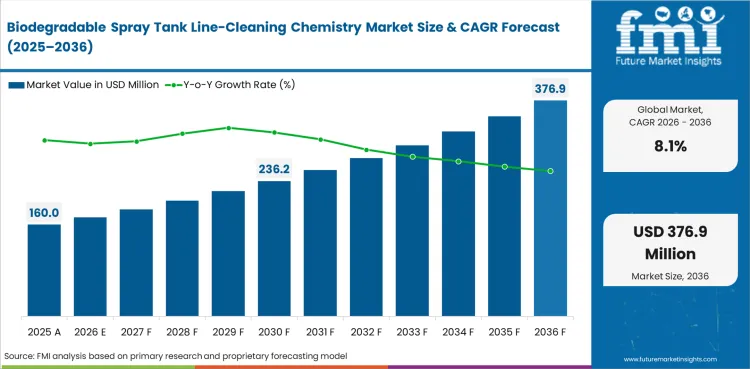
Biodegradable spray tank line-cleaning chemistry market was valued at USD 148.0 million in 2025. Market value is set to reach USD 160.0 million by 2026-end and grow at a CAGR of 8.1% between 2026-2036 to reach USD 348.6 million by 2036. Liquid concentrates are expected to dominate the form segment with 68.0%, while row crops are expected to lead the end-use crop segment with 41.0%.
Summary of the Biodegradable Spray Tank Line-Cleaning Chemistry Market
- Demand and Growth Drivers
- Tank cleanout demand gains pace as herbicide programs become more complex and crop injury risk from carryover stays commercially relevant.
- Biodegradable positioning attracts interest across stewardship-led input programs and cleaner ingredient preferences.
- Application value is higher across professional sprayers handling repeated chemistry changes during one season.
- Product and Segment View
- Residue removers lead product demand because full-system washout starts with dried-on and oily deposit removal.
- Alkaline and surfactant-led blends hold a larger role because vulnerable pesticide residues often break down faster under high-pH rinse conditions.
- Liquid concentrates lead commercial use because dosing, storage, and field handling stay simpler for applicators and dealers.
- Geography and Competitive Outlook
- India, China, and Brazil show faster percentage expansion due to crop-protection intensity growth and wider mechanized spraying.
- United States keeps a large value base due to mature spray programs, service networks, and stronger applicator discipline.
- Competition depends on residue-cleaning depth and full-system compatibility.
- Analyst Opinion
- Nikhil Kaitwade, Principal Analyst states, 'Commercial uptake is expected to rise across programs using more sensitive herbicide rotations, since applicators place higher value on cleanout reliability, lower residue risk, and equipment-safe chemistry.'
- Biodegradable Spray Tank Line-Cleaning Chemistry Market Value Analysis
- The biodegradable spray tank line-cleaning chemistry market is developing as a specialty spray-support category with repeat in-season purchase potential.
- Category value depends on crop-protection programs where residue carryover can create higher commercial loss than the cleaner cost itself.
- Product pricing is above plain water-rinse practice. Spending stays justified in professional spray programs that prioritize cleaner system turnaround and lower complaint exposure.
- The market is smaller than the broader agricultural adjuvant space. Its relevance is increasing in operations with frequent chemistry switching and tighter spray hygiene needs.
Key Takeaways
- Market value reached USD 148.0 million in 2025.
- Market value is projected at USD 348.6 million by 2036.
- Forecast period points to 8.1% CAGR.
- Incremental opportunity from 2026 to 2036 stands at USD 188.6 million.
- Liquid concentrates are projected to account for 68.0% share in the form segment in 2026.
- India (10.4%) and China (9.7%) are two of the fastest growing markets in the world.
Biodegradable Spray Tank Line-Cleaning Chemistry Market Definition
Biodegradable spray tank line-cleaning chemistry covers formulated cleaners and decontaminators used in agricultural spraying systems. These products remove pesticide and fertilizer residues from tanks, hoses, booms, filters, screens, and nozzles. Product value comes from residue removal, pH adjustment, deposit dispersal, oily-film breakup, and carryover reduction.
Biodegradable Spray Tank Line-Cleaning Chemistry Market Inclusions
Scope includes biodegradable and partly biobased tank cleaners, spray system cleaners, decontaminators, and residue removers. Coverage also includes rinse aids and neutralizer-type products sold for agricultural spraying systems. End-use coverage spans row crops, vegetables, orchards, vineyards, turf, and ornamental spray programs. Related alignment also extends to the Agricultural Activator Adjuvant Market and Low Foaming Surfactants Market. Coverage also aligns with the Bio-Based Nonionic Surfactants Market across renewable surfactant-based formulation routes.
Biodegradable Spray Tank Line-Cleaning Chemistry Market Exclusions
Scope excludes standard drift reducers, spreaders, stickers, penetrants, crop oils, and standalone defoamers. Household cleaning sprays and industrial degreasers outside agricultural spray equipment also stay outside scope. General Trigger Sprayer Market hardware does not form part of direct market calculations. Broad pesticide, fertilizer, and non-cleanout adjuvant demand also stays outside direct market value.
Biodegradable Spray Tank Line-Cleaning Chemistry Market Research Methodology
Primary Research: Interviews with ag-input distributors, applicators, product managers, and spray-support chemistry participants.
Desk Research: Product labels, extension guidance, regulatory references, public technical documents, and company product pages.
Market sizing and forecasting: Bottom-up and parent-ratio approach using active spray-support chemistry demand, applicator use logic, and country-level crop-protection intensity.
Data validation: Cross-checking through product-use relevance, country growth signals, and competitor participation.
Why is the Biodegradable Spray Tank Line-Cleaning Chemistry Market Growing?
- Spray programs now involve more chemistry switches across one machine during one season.
- Sensitive crop rotations increase the penalty from residue carryover in tanks, hoses, and nozzles.
- Biodegradable and lower-toxicity positioning adds appeal across stewardship-focused input programs.
Crop injury risk is a direct commercial driver for this category. A plain rinse can leave dried residue and trapped chemistry inside lines and screens. One bad carryover event can damage the next application round. Applicators place value on cleanout chemistry with stronger residue breakup and easier system flushing.
Broader use of the agricultural sprayers market and more demanding herbicide programs support repeat use. Full-system washout gains greater relevance across custom operators and large farms running fast application windows. Downtime and re-cleaning labor can erode season economics.
Safer-ingredient preference adds another layer of support. Applications increasingly compare cleaning performance with operator handling profile and storage practicality.
Market Segmentation Analysis
- Residue removers are projected to lead the function type segment with 31.0% in 2026 because applicators first look for residue lift and carryover control across full-system washout.
- Alkaline blends are projected to lead the chemistry base segment with 34.0% in 2026 because high-pH cleaning helps break down vulnerable pesticide residues and supports faster rinse cycles.
- Plant-based surfactants are projected to lead the biobased feedstock segment with 29.0% in 2026 because biodegradable positioning usually starts with surfactant replacement rather than full reformulation.
- Liquid concentrates are projected to lead the form segment with 68.0% in 2026 because dilution, storage, and field handling stay easier for operators and dealers.
- Tank interior is projected to lead the application point segment with 36.0% in 2026 because visible deposits and trapped rinsate usually begin inside the main vessel before lines and nozzles are flushed.
- Self-propelled units are projected to lead the sprayer platform segment with 33.0% in 2026 because large professional machines handle more chemistry changes and longer spray runs.
- Row crops are projected to lead the end-use crop segment with 41.0% in 2026 because broad-acre herbicide programs create repeated cleanout needs across one season.
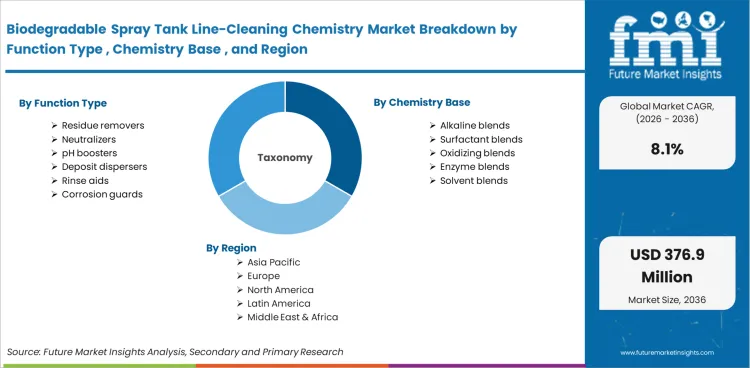
The market for biodegradable spray tank line-cleaning chemistry is divided into groups based on function type, chemistry base, biobased feedstock, form, application point, sprayer platform, end-use crop, and region. There are Residue Removers, Neutralizers, pH Boosters, Deposit Dispersers, Rinse Aids, and Corrosion Guards under function type. By chemistry base, the market includes Alkaline Blends, Surfactant Blends, Oxidizing Blends, Enzyme Blends, and Solvent Blends. By biobased feedstock, it includes Plant-based Surfactants, Sugar-based Chelates, Fermentation Actives, and Hybrid Bio-blends. By form, the market covers Liquid Concentrates, Water-soluble Powders, Water-soluble Packs, and Gel Liquids. By application point, the market includes Tank Interior, Lines, Hoses, Booms, Filters, Nozzles, and Induction Bowls. By sprayer platform, it covers Self-propelled, Trailed, Mounted, Backpack, Airblast, and Drone Support. By end-use crop, the market includes Row Crops, Vegetables, Orchards, Vineyards, Turf, and Ornamentals.
Insights into the Function Type Segment
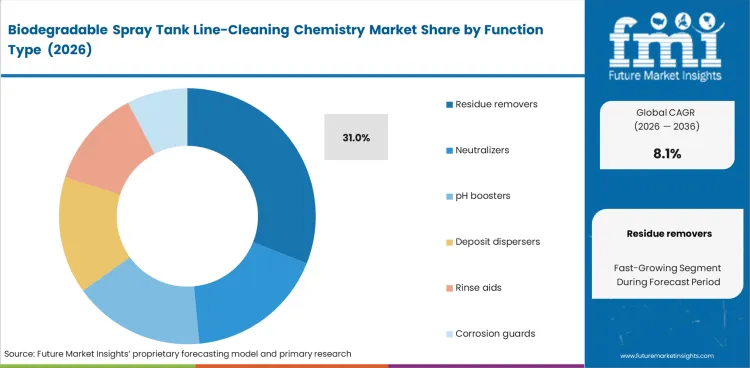
- Residue removers are expected to account for 31.0% share in 2026 because primary value starts with removal of dried deposits and trapped chemical carryover.
- Neutralizers and pH boosters still hold relevance across specific herbicide cleanout routines. Residue-lift performance stays the first priority in routine system cleaning.
Insights into the Chemistry Base Segment
- Alkaline blends are expected to account for 34.0% share in 2026 because elevated pH supports degradation of vulnerable crop-protection residues during washout.
- Surfactant blends add broad support across oily debris release and hose cleaning, especially in systems exposed to repeated tank mixing.
Insights into the Biobased Feedstock Segment
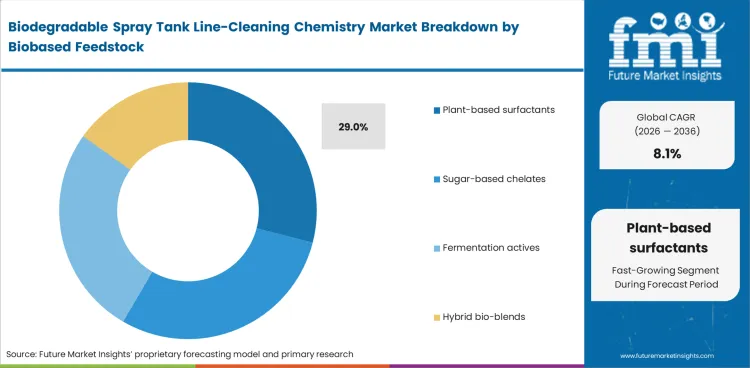
- Plant-based surfactants are expected to account for 29.0% share in 2026 because biodegradable product design most often begins with renewable surfactant systems and lower-concern ingredient selection.
- Sugar-based chelates and hybrid bio-blends keep a smaller role. Formulation interest is rising alongside the fertilizer additives market.
Insights into the Form Segment
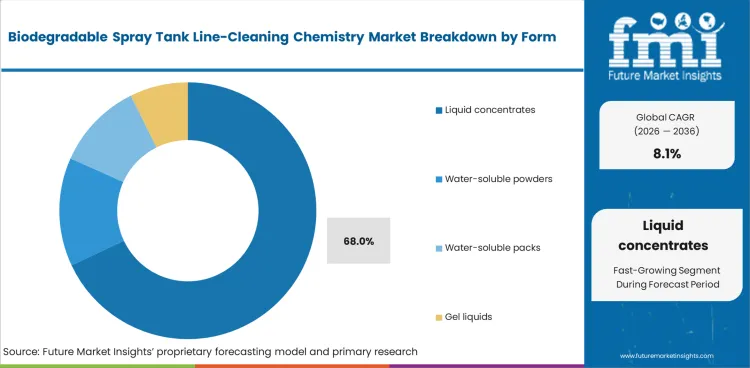
- Liquid concentrates are expected to account for 68.0% share in 2026 because dosing and field dilution work better in commercial spray systems.
- Water-soluble powders and packs keep niche use in selected programs, though speed and handling ease favor liquid delivery systems.
Insights into the Application Point Segment
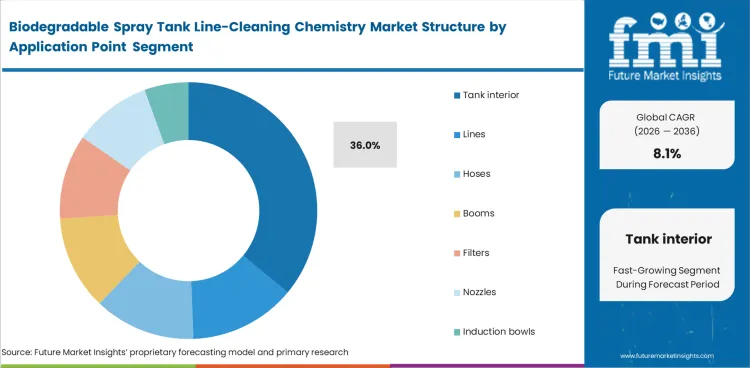
- Tank interior is expected to account for 36.0% share in 2026 because visible deposits and leftover rinsate usually collect first inside the main vessel before later flushing stages.
- need targeted attention since trapped residue in narrow parts can contaminate later spray rounds even after the tank looks clean.
Insights into the Sprayer Platform Segment
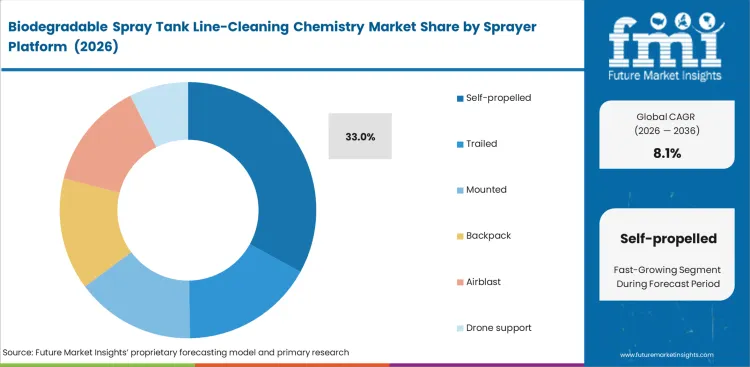
- Self-propelled units are expected to account for 33.0% share in 2026 because larger professional machines run longer schedules and more product switches across one season.
- Trailed and mounted sprayers still support broad High-utilization commercial fleets generate stronger repeat cleaner use.
Insights into the End-use Crop Segment
- Row crops are expected to account for 41.0% share in 2026 because large-acre herbicide programs create more frequent cleanout cycles and higher carryover exposure.
- Vegetables and orchards support cleaner demand, especially in sensitive crops requiring tighter spray hygiene and lower residue risk.
Biodegradable Spray Tank Line-Cleaning Chemistry Market Drivers, Restraints, and Opportunities
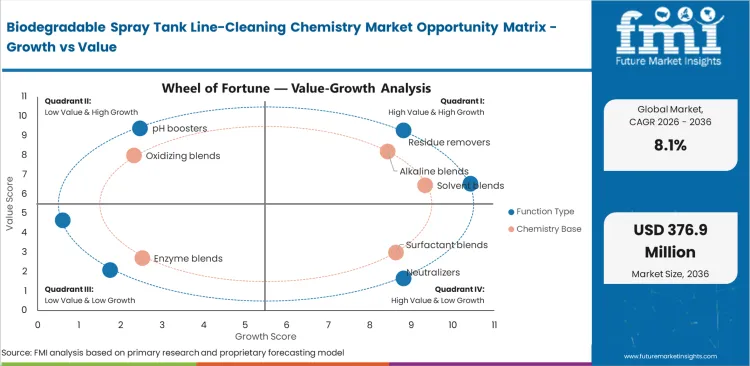
- Driver: Crop-switch risk supports regular cleanout chemistry use.
- Restraint: Water-rinse habit and price sensitivity can limit premium cleaner adoption.
- Opportunity: Biobased surfactant systems and equipment-safe formulations can widen category appeal.
Growth logic comes from residue-risk prevention rather than discretionary use. Restraint comes from entrenched low-cost cleaning habits and uneven user awareness across smaller operators. Opportunity lies in stronger efficacy claims and simpler dosing in professional spray programs that value lower residue carryover and better equipment compatibility.
Residue Carryover and Crop Injury Prevention
Carryover prevention drives category value. FAO reported 3.73 million tonnes of pesticide use in agriculture in 2023, while total pesticides trade value reached USD 42.8 billion, reflecting the scale of global spray activity feeding repeat cleanout need. LSU AgCenter states, 'the pesticide label often contains information regarding the type of tank cleaner required for proper cleaning of chemical residue from spray equipment' and also states 'Wash all parts of the sprayer that can come into contact with crops to prevent further injury or damage.'
Analysis of Biodegradable Spray Tank Line-Cleaning Chemistry Market By Key Countries
.webp "Top Country Growth Comparison Biodegradable Spray Tank Line Cleaning Chemistry Market Cagr (2026 2036)")
| Country | CAGR |
|---|---|
| India | 10.4% |
| China | 9.7% |
| Brazil | 8.9% |
| Spain | 8.3% |
| United States | 7.2% |
| Canada | 6.8% |
| Netherlands | 6.4% |
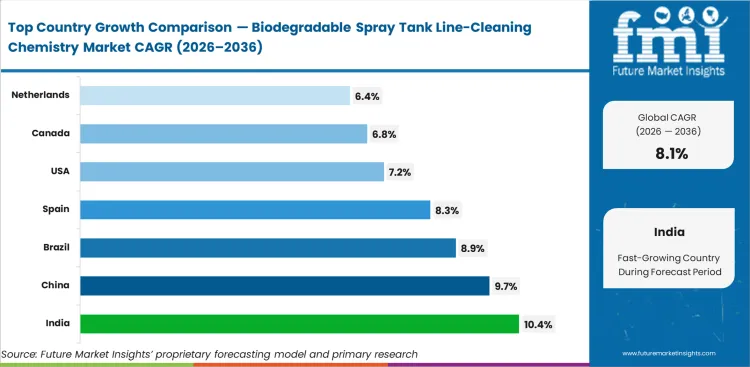
Source: FMI analysis based on primary research and proprietary forecasting model
Biodegradable Spray Tank Line-Cleaning Chemistry Market Cagr Analysis By Country
- India is projected to advance at a CAGR of 10.4% because mechanized crop-protection programs are expanding and spray-intensity is rising across commercial farming.
- China is projected to expand at a CAGR of 9.7% due to a broad pesticide-use base and stronger modernization of application practice.
- Brazil is forecast to record a CAGR of 8.9% because large herbicide programs and repeated sprayer reuse support routine cleanout demand across broad-acre acreage.
- Spain is set to post a CAGR of 8.3%, supported by export horticulture, orchard depth, and stronger spray hygiene needs in sensitive crop systems.
- United States is expected to register a CAGR of 7.2%, backed by a mature professional sprayer base, dealer support, and stronger cleanout familiarity.
- Canada is likely to progress at a CAGR of 6.8% from an established broad-acre base, with steady cleanout demand and slower percentage expansion.
- Netherlands is anticipated to register growth at a CAGR of 6.4% over the forecast period because spray-management practice is already more mature and field-use scale is smaller than larger crop-protection markets.
Country spread indicates balanced demand across fast-growing mechanization centers and established spraying markets.
Demand Outlook for Biodegradable Spray Tank Line-Cleaning Chemistry in India
India shows strong growth potential from a smaller professional cleanout base and wider use of spray equipment across commercial crops. Demand for biodegradable spray tank line-cleaning chemistry in India is anticipated to rise at a CAGR of 10.4% through 2036, due to higher crop-protection use and better access through dealer networks. Supplier potential is improving across large farms and export-focused crop programs.
- Use of mechanized spraying is rising.
- More crop programs need tank switching.
- Dealer support can improve product awareness.
Future Outlook for Biodegradable Spray Tank Line-Cleaning Chemistry in China
China has a large crop-protection base and is improving spray practices across farm operations. Sales of biodegradable spray tank line-cleaning chemistry in China are expected to increase at a CAGR of 9.7% during the forecast period, supported by higher spray activity and stronger focus on residue control. Market value is higher across operators handling frequent product changes and larger spray volumes.
- Large spray use supports repeat demand.
- Residue control is getting more focus.
- Standard products can help supplier expansion.
Opportunity Analysis of Biodegradable Spray Tank Line-Cleaning Chemistry in Brazil
Brazil holds strong market potential due to large-scale herbicide use and repeated sprayer use during peak farm periods. The biodegradable spray tank line-cleaning chemistry market in Brazil is poised to expand at a CAGR of 8.9% from 2026 to 2036, driven by repeated equipment use and stronger focus on carryover control. Product demand is improving across growers and service operators aiming to reduce complaints and downtime.
- Broad-acre herbicide use supports demand.
- Tight spray windows favor faster cleaning.
- Service operators can support product adoption.
In-depth Analysis of Biodegradable Spray Tank Line-Cleaning Chemistry in Spain
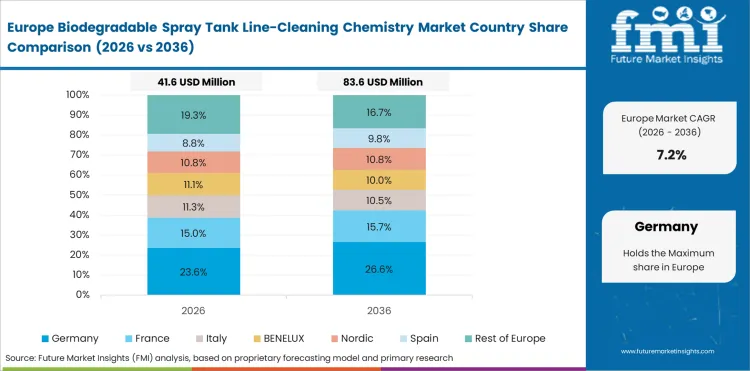
Spain benefits from intensive horticulture and stronger export-linked crop standards. Spain is set to record a CAGR of 8.3% in biodegradable spray tank line-cleaning chemistry during the assessment period, due to specialty-crop spray hygiene needs and repeated tank switching. Supplier value is higher across fruit and vineyard programs needing closer residue control.
- Specialty crops need careful cleanout.
- Export pressure supports cleaner spray systems.
- Vineyard and orchard use adds demand.
Sales Analysis of Biodegradable Spray Tank Line-Cleaning Chemistry in the United States
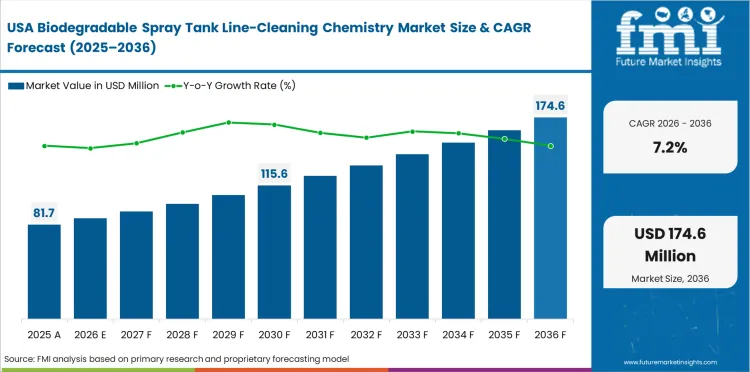
United States has a large commercial base due to mature herbicide programs and broad dealer support. Biodegradable spray tank line-cleaning chemistry adoption in the United States is likely to advance at a CAGR of 7.2% by 2036, driven by steady sprayer cleaning practices and a large base of professional equipment. Competition stays active across service support and performance claims.
- Installed sprayer base is large.
- Dealer channels support repeat demand.
- Proven performance affects buying choice.
Demand Outlook for Biodegradable Spray Tank Line-Cleaning Chemistry in Canada
Canada has broad-acre spraying and a careful approach to herbicide program management. Canada is projected to witness 6.8% CAGR in the biodegradable spray tank line-cleaning chemistry market through 2036, supported by large-field spray cycles and crop-injury prevention needs. Demand is attractive across operators looking for full-system flushing and low-foam handling.
- Broad-acre use supports repeat cleaning.
- Residue control matters in crop rotations.
- Foam control helps field handling.
Competitive Landscape and Strategic Positioning
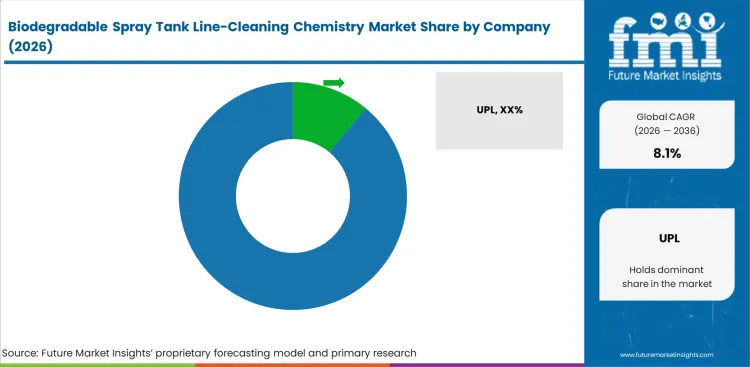
- Competition is led by agricultural adjuvant specialists and large ag-retail input platforms with dedicated utility modifiers and tank cleaners.
- Leading suppliers gain advantage from dealer reach, technical support, and stronger credibility in crop-protection programs.
- Entry barriers come from efficacy proof, residue-removal reliability, label support, and applicator trust.
Large suppliers matter because tank cleaning is rarely treated as a stand-alone technical decision. Applicators usually buy inside a wider relationship covering adjuvants and drift control support. A broad portfolio improves shelf presence and field conversion.
Smaller specialists can still compete with strong technical fit and cleaner-specific positioning. Applicator confidence depends on field reliability and clear residue-removal messaging, across tanks and lines
Key Companies in the Biodegradable Spray Tank Line-Cleaning Chemistry Market
Key global companies leading the biodegradable spray tank line-cleaning chemistry market include:
- Broad ag-retail and crop-input groups such as Loveland Products / Nutrien Ag Solutions, Helena Agri-Enterprises, and WinField United.
- Adjuvant and spray-system specialists such as Precision Laboratories and Wilbur-Ellis Company.
- Input suppliers with active cleaner positioning such as BRANDT and UPL.
Competitive Benchmarking: Biodegradable Spray Tank Line-Cleaning Chemistry
| Company | Spray System Cleaning Depth | Adjuvant Portfolio Breadth | Channel Reach | Geographic Footprint |
|---|---|---|---|---|
| Loveland Products / Nutrien Ag Solutions | High | High | Strong | Multi-region |
| Helena Agri-Enterprises | High | High | Strong | North America |
| WinField United | Medium | High | Strong | North America |
| Precision Laboratories | High | Medium | Medium | North America |
| Wilbur-Ellis Company | High | High | Strong | North America |
| BRANDT | Medium | High | Medium | Multi-region |
| UPL | Medium | Medium | Strong | Global |
Source: Future Market Insights competitive analysis, 2026. Ratings reflect relative positioning based on spray system cleaning depth, adjuvant portfolio breadth, and channel reach.
Key Developments in Biodegradable Spray Tank Line-Cleaning Chemistry
- In February 2024, Precision Laboratories introduced NEXUM™ NG, a deposition aid designed to improve spray deposition and coverage while reducing driftable fines. This development reflects broader supplier focus on spray-support chemistries that improve field performance and application efficiency.
- In June 2025, Advanta Seeds, part of UPL Group, announced the strategic acquisition of key corn assets from K-Adriatica. This development strengthens UPL’s agricultural input platform and supports wider channel reach across adjacent farm-input categories.
- In March 2026, Helena introduced new herbicides at 2026 Commodity Classic, expanding its crop-protection portfolio and strengthening its relevance across spray application programs.
Key Players in the Biodegradable Spray Tank Line-Cleaning Chemistry:
Major Global Players:
- UPL
- Loveland Products / Nutrien Ag Solutions
- BRANDT
Emerging Players/Startups
- Precision Laboratories
- WinField United
Report Scope and Coverage
| Parameter | Details |
|---|---|
| Quantitative Units | USD Million |
| Market Definition | Biodegradable chemistry used for spray tank, line, hose, boom, filter, screen, and nozzle cleanout in agricultural spraying systems |
| Regions Covered | North America, Latin America, Europe, Asia Pacific |
| Countries Covered | India, China, Brazil, Spain, United States, Canada, Netherlands |
| Key Companies Profiled | Loveland Products / Nutrien Ag Solutions, Helena Agri-Enterprises, WinField United, Precision Laboratories, Wilbur-Ellis Company, BRANDT, UPL |
| Forecast Period | 2026 - 2036 |
| Approach | Primary interviews, desk research, label review, extension guidance review, and FMI forecasting model |
Biodegradable Spray Tank Line-Cleaning Chemistry Market by Segments
Biodegradable Spray Tank Line-Cleaning Chemistry Market Segmented by Function Type:
- Residue removers
- Neutralizers
- pH boosters
- Deposit dispersers
- Rinse aids
- Corrosion guards
Biodegradable Spray Tank Line-Cleaning Chemistry Market Segmented by Chemistry Base:
- Alkaline blends
- Surfactant blends
- Oxidizing blends
- Enzyme blends
- Solvent blends
Biodegradable Spray Tank Line-Cleaning Chemistry Market Segmented by Biobased Feedstock:
- Plant-based surfactants
- Sugar-based chelates
- Fermentation actives
- Hybrid bio-blends
Biodegradable Spray Tank Line-Cleaning Chemistry Market Segmented by Form:
- Liquid concentrates
- Water-soluble powders
- Water-soluble packs
- Gel liquids
Biodegradable Spray Tank Line-Cleaning Chemistry Market Segmented by Application Point:
- Tank interior
- Lines
- Hoses
- Booms
- Filters
- Nozzles
- Induction bowls
Biodegradable Spray Tank Line-Cleaning Chemistry Market Segmented by Sprayer Platform:
- Self-propelled
- Trailed
- Mounted
- Backpack
- Airblast
- Drone support
Biodegradable Spray Tank Line-Cleaning Chemistry Market Segmented by End Use Crop:
- Row crops
- Vegetables
- Orchards
- Vineyards
- Turf
- Ornamentals
Biodegradable Spray Tank Line-Cleaning Chemistry Market Segmented by Region:
- North America
- USA
- Canada
- Mexico
- Latin America
- Brazil
- Chile
- Rest of Latin America
- Western Europe
- Germany
- UK
- Italy
- Spain
- France
- Nordic
- BENELUX
- Rest of Western Europe
- Eastern Europe
- Russia
- Poland
- Hungary
- Balkan & Baltic
- Rest of Eastern Europe
- East Asia
- China
- Japan
- South Korea
- South Asia and Pacific
- India
- ASEAN
- Australia & New Zealand
- Rest of South Asia and Pacific
- Middle East & Africa
- Kingdom of Saudi Arabia
- Other GCC Countries
- Turkiye
- South Africa
- Other African Union
- Rest of Middle East & Africa
Research Sources and Bibliography
- Muhammad Umer, Abid Naseer, Mustansar Mubeen, Yasir Iftikhar, Rafia Umer, Ayesha Akram, Muhammad Tanveer Altaf, Essam H. Ibrahim, Ahmed Ezzat Ahmed, and Mingzheng Duan. (2025, November 17). Pesticide residue detection techniques for increasing productivity and yield: recent progress and future outlooks.
- Food and Agriculture Organization of the United Nations. (2025, July 15). Pesticides use and trade. 1990-2023.
- U.S. Department of Agriculture National Agricultural Statistics Service. (2024, February 13). USDA releases 2022 Census of Agriculture data.
- U.S. Environmental Protection Agency. (2026, February 10). Safer Choice.
- William Waltman, Ronald E. Strahan, Maria Bampasidou, Alessandro Holzapfel, and Kathryn Fontenot. (2024, July 22). Mitigating Herbicide Damage to Specialty Crops: Pesticide Tank Cleaning Notes and Procedures.
This Report Answers
- What is current value for biodegradable spray tank line-cleaning chemistry?
- What growth rate is projected from 2026 to 2036?
- Which product form leads demand?
- Which end-use crop contributes the highest share?
- Which countries show faster growth across the forecast period?
- Which commercial factors support repeat demand?
- Which constraints can limit adoption?
- Which company groups shape competition?
- Which product capabilities matter most for field conversion?
- Which application points create stronger cleaner demand?
- Which buyer groups are more likely to use premium cleanout chemistry?
- Which adjacent FMI markets link naturally with this category?
Frequently Asked Questions
What is biodegradable spray tank line-cleaning chemistry market value in 2026?
Market value is estimated at USD 160.0 million in 2026.
What size is projected for 2036?
Market value is projected to reach USD 348.6 million by 2036.
What CAGR is projected for this market?
Forecast period indicates 8.1% CAGR from 2026 to 2036.
Forecast period indicates 8.1% CAGR from 2026 to 2036.
Residue carryover can damage later spray rounds, create crop injury, and add labor, rinse time, and complaint risk.
What segment leads product form demand?
Liquid concentrates lead because field dilution and system flush use stay simpler for applicators.
Liquid concentrates lead because field dilution and system flush use stay simpler for applicators.
Row crops lead due to high spray frequency and repeated chemistry changes.
How does biodegradable positioning help sales?
Lower-toxicity and safer-ingredient preference can improve acceptance across stewardship-focused buying decisions.
What restrains wider adoption?
Water-rinse habit, price sensitivity, and uneven awareness across smaller operators can reduce cleaner use.
Which countries rank among faster-growth markets?
India, China, Brazil, and Spain show stronger percentage growth across this forecast period.
How do buyers compare competing products?
Buyers usually compare residue-removal depth, foam control, full-system compatibility, dosing ease, and dealer support.
Preview the report firsthand - request a free sample
Get SampleGet the brochure for pricing and purchase details.
Get PDFTable of Content
- Executive Summary
- Global Market Outlook
- Demand-side Trends
- Supply-side Trends
- Technology Roadmap Analysis
- Analysis and Recommendations
- Market Overview
- Market Coverage / Taxonomy
- Market Definition / Scope / Limitations
- Research Methodology
- Chapter Orientation
- Analytical Lens and Working Hypotheses
- Market Structure, Signals, and Trend Drivers
- Benchmarking and Cross-market Comparability
- Market Sizing, Forecasting, and Opportunity Mapping
- Research Design and Evidence Framework
- Desk Research Programme (Secondary Evidence)
- Company Annual and Sustainability Reports
- Peer-reviewed Journals and Academic Literature
- Corporate Websites, Product Literature, and Technical Notes
- Earnings Decks and Investor Briefings
- Statutory Filings and Regulatory Disclosures
- Technical White Papers and Standards Notes
- Trade Journals, Industry Magazines, and Analyst Briefs
- Conference Proceedings, Webinars, and Seminar Materials
- Government Statistics Portals and Public Data Releases
- Press Releases and Reputable Media Coverage
- Specialist Newsletters and Curated Briefings
- Sector Databases and Reference Repositories
- FMI Internal Proprietary Databases and Historical Market Datasets
- Subscription Datasets and Paid Sources
- Social Channels, Communities, and Digital Listening Inputs
- Additional Desk Sources
- Expert Input and Fieldwork (Primary Evidence)
- Primary Modes
- Qualitative Interviews and Expert Elicitation
- Quantitative Surveys and Structured Data Capture
- Blended Approach
- Why Primary Evidence is Used
- Field Techniques
- Interviews
- Surveys
- Focus Groups
- Observational and In-context Research
- Social and Community Interactions
- Stakeholder Universe Engaged
- C-suite Leaders
- Board Members
- Presidents and Vice Presidents
- R&D and Innovation Heads
- Technical Specialists
- Domain Subject-matter Experts
- Scientists
- Physicians and Other Healthcare Professionals
- Governance, Ethics, and Data Stewardship
- Research Ethics
- Data Integrity and Handling
- Primary Modes
- Tooling, Models, and Reference Databases
- Desk Research Programme (Secondary Evidence)
- Data Engineering and Model Build
- Data Acquisition and Ingestion
- Cleaning, Normalisation, and Verification
- Synthesis, Triangulation, and Analysis
- Quality Assurance and Audit Trail
- Market Background
- Market Dynamics
- Drivers
- Restraints
- Opportunity
- Trends
- Scenario Forecast
- Demand in Optimistic Scenario
- Demand in Likely Scenario
- Demand in Conservative Scenario
- Opportunity Map Analysis
- Product Life Cycle Analysis
- Supply Chain Analysis
- Investment Feasibility Matrix
- Value Chain Analysis
- PESTLE and Porter’s Analysis
- Regulatory Landscape
- Regional Parent Market Outlook
- Production and Consumption Statistics
- Import and Export Statistics
- Market Dynamics
- Global Market Analysis 2021 to 2025 and Forecast, 2026 to 2036
- Historical Market Size Value (USD Million) Analysis, 2021 to 2025
- Current and Future Market Size Value (USD Million) Projections, 2026 to 2036
- Y-o-Y Growth Trend Analysis
- Absolute $ Opportunity Analysis
- Global Market Pricing Analysis 2021 to 2025 and Forecast 2026 to 2036
- Global Market Analysis 2021 to 2025 and Forecast 2026 to 2036, By Function Type
- Introduction / Key Findings
- Historical Market Size Value (USD Million) Analysis By Function Type , 2021 to 2025
- Current and Future Market Size Value (USD Million) Analysis and Forecast By Function Type , 2026 to 2036
- Residue removers
- Neutralizers
- pH boosters
- Deposit dispersers
- Rinse aids
- Corrosion guards
- Residue removers
- Y-o-Y Growth Trend Analysis By Function Type , 2021 to 2025
- Absolute $ Opportunity Analysis By Function Type , 2026 to 2036
- Global Market Analysis 2021 to 2025 and Forecast 2026 to 2036, By Chemistry Base
- Introduction / Key Findings
- Historical Market Size Value (USD Million) Analysis By Chemistry Base, 2021 to 2025
- Current and Future Market Size Value (USD Million) Analysis and Forecast By Chemistry Base, 2026 to 2036
- Alkaline blends
- Surfactant blends
- Oxidizing blends
- Enzyme blends
- Solvent blends
- Alkaline blends
- Y-o-Y Growth Trend Analysis By Chemistry Base, 2021 to 2025
- Absolute $ Opportunity Analysis By Chemistry Base, 2026 to 2036
- Global Market Analysis 2021 to 2025 and Forecast 2026 to 2036, By Biobased Feedstock
- Introduction / Key Findings
- Historical Market Size Value (USD Million) Analysis By Biobased Feedstock, 2021 to 2025
- Current and Future Market Size Value (USD Million) Analysis and Forecast By Biobased Feedstock, 2026 to 2036
- Plant-based surfactants
- Sugar-based chelates
- Fermentation actives
- Hybrid bio-blends
- Plant-based surfactants
- Y-o-Y Growth Trend Analysis By Biobased Feedstock, 2021 to 2025
- Absolute $ Opportunity Analysis By Biobased Feedstock, 2026 to 2036
- Global Market Analysis 2021 to 2025 and Forecast 2026 to 2036, By Form
- Introduction / Key Findings
- Historical Market Size Value (USD Million) Analysis By Form, 2021 to 2025
- Current and Future Market Size Value (USD Million) Analysis and Forecast By Form, 2026 to 2036
- Liquid concentrates
- Water-soluble powders
- Water-soluble packs
- Gel liquids
- Liquid concentrates
- Y-o-Y Growth Trend Analysis By Form, 2021 to 2025
- Absolute $ Opportunity Analysis By Form, 2026 to 2036
- Global Market Analysis 2021 to 2025 and Forecast 2026 to 2036, By Application Point
- Introduction / Key Findings
- Historical Market Size Value (USD Million) Analysis By Application Point, 2021 to 2025
- Current and Future Market Size Value (USD Million) Analysis and Forecast By Application Point, 2026 to 2036
- Tank interior
- Lines
- Hoses
- Booms
- Filters
- Nozzles
- Induction bowls
- Tank interior
- Y-o-Y Growth Trend Analysis By Application Point, 2021 to 2025
- Absolute $ Opportunity Analysis By Application Point, 2026 to 2036
- Global Market Analysis 2021 to 2025 and Forecast 2026 to 2036, By Sprayer Platform
- Introduction / Key Findings
- Historical Market Size Value (USD Million) Analysis By Sprayer Platform, 2021 to 2025
- Current and Future Market Size Value (USD Million) Analysis and Forecast By Sprayer Platform, 2026 to 2036
- Self-propelled
- Trailed
- Mounted
- Backpack
- Airblast
- Drone support
- Self-propelled
- Y-o-Y Growth Trend Analysis By Sprayer Platform, 2021 to 2025
- Absolute $ Opportunity Analysis By Sprayer Platform, 2026 to 2036
- Global Market Analysis 2021 to 2025 and Forecast 2026 to 2036, By End-use
- Introduction / Key Findings
- Historical Market Size Value (USD Million) Analysis By End-use, 2021 to 2025
- Current and Future Market Size Value (USD Million) Analysis and Forecast By End-use, 2026 to 2036
- Row crops
- Vegetables
- Orchards
- Vineyards
- Turf
- Ornamentals
- Row crops
- Y-o-Y Growth Trend Analysis By End-use, 2021 to 2025
- Absolute $ Opportunity Analysis By End-use, 2026 to 2036
- Global Market Analysis 2021 to 2025 and Forecast 2026 to 2036, By Region
- Introduction
- Historical Market Size Value (USD Million) Analysis By Region, 2021 to 2025
- Current Market Size Value (USD Million) Analysis and Forecast By Region, 2026 to 2036
- North America
- Latin America
- Western Europe
- Eastern Europe
- East Asia
- South Asia and Pacific
- Middle East & Africa
- Market Attractiveness Analysis By Region
- North America Market Analysis 2021 to 2025 and Forecast 2026 to 2036, By Country
- Historical Market Size Value (USD Million) Trend Analysis By Market Taxonomy, 2021 to 2025
- Market Size Value (USD Million) Forecast By Market Taxonomy, 2026 to 2036
- By Country
- USA
- Canada
- Mexico
- By Function Type
- By Chemistry Base
- By Biobased Feedstock
- By Form
- By Application Point
- By Sprayer Platform
- By End-use
- By Country
- Market Attractiveness Analysis
- By Country
- By Function Type
- By Chemistry Base
- By Biobased Feedstock
- By Form
- By Application Point
- By Sprayer Platform
- By End-use
- Key Takeaways
- Latin America Market Analysis 2021 to 2025 and Forecast 2026 to 2036, By Country
- Historical Market Size Value (USD Million) Trend Analysis By Market Taxonomy, 2021 to 2025
- Market Size Value (USD Million) Forecast By Market Taxonomy, 2026 to 2036
- By Country
- Brazil
- Chile
- Rest of Latin America
- By Function Type
- By Chemistry Base
- By Biobased Feedstock
- By Form
- By Application Point
- By Sprayer Platform
- By End-use
- By Country
- Market Attractiveness Analysis
- By Country
- By Function Type
- By Chemistry Base
- By Biobased Feedstock
- By Form
- By Application Point
- By Sprayer Platform
- By End-use
- Key Takeaways
- Western Europe Market Analysis 2021 to 2025 and Forecast 2026 to 2036, By Country
- Historical Market Size Value (USD Million) Trend Analysis By Market Taxonomy, 2021 to 2025
- Market Size Value (USD Million) Forecast By Market Taxonomy, 2026 to 2036
- By Country
- Germany
- UK
- Italy
- Spain
- France
- Nordic
- BENELUX
- Rest of Western Europe
- By Function Type
- By Chemistry Base
- By Biobased Feedstock
- By Form
- By Application Point
- By Sprayer Platform
- By End-use
- By Country
- Market Attractiveness Analysis
- By Country
- By Function Type
- By Chemistry Base
- By Biobased Feedstock
- By Form
- By Application Point
- By Sprayer Platform
- By End-use
- Key Takeaways
- Eastern Europe Market Analysis 2021 to 2025 and Forecast 2026 to 2036, By Country
- Historical Market Size Value (USD Million) Trend Analysis By Market Taxonomy, 2021 to 2025
- Market Size Value (USD Million) Forecast By Market Taxonomy, 2026 to 2036
- By Country
- Russia
- Poland
- Hungary
- Balkan & Baltic
- Rest of Eastern Europe
- By Function Type
- By Chemistry Base
- By Biobased Feedstock
- By Form
- By Application Point
- By Sprayer Platform
- By End-use
- By Country
- Market Attractiveness Analysis
- By Country
- By Function Type
- By Chemistry Base
- By Biobased Feedstock
- By Form
- By Application Point
- By Sprayer Platform
- By End-use
- Key Takeaways
- East Asia Market Analysis 2021 to 2025 and Forecast 2026 to 2036, By Country
- Historical Market Size Value (USD Million) Trend Analysis By Market Taxonomy, 2021 to 2025
- Market Size Value (USD Million) Forecast By Market Taxonomy, 2026 to 2036
- By Country
- China
- Japan
- South Korea
- By Function Type
- By Chemistry Base
- By Biobased Feedstock
- By Form
- By Application Point
- By Sprayer Platform
- By End-use
- By Country
- Market Attractiveness Analysis
- By Country
- By Function Type
- By Chemistry Base
- By Biobased Feedstock
- By Form
- By Application Point
- By Sprayer Platform
- By End-use
- Key Takeaways
- South Asia and Pacific Market Analysis 2021 to 2025 and Forecast 2026 to 2036, By Country
- Historical Market Size Value (USD Million) Trend Analysis By Market Taxonomy, 2021 to 2025
- Market Size Value (USD Million) Forecast By Market Taxonomy, 2026 to 2036
- By Country
- India
- ASEAN
- Australia & New Zealand
- Rest of South Asia and Pacific
- By Function Type
- By Chemistry Base
- By Biobased Feedstock
- By Form
- By Application Point
- By Sprayer Platform
- By End-use
- By Country
- Market Attractiveness Analysis
- By Country
- By Function Type
- By Chemistry Base
- By Biobased Feedstock
- By Form
- By Application Point
- By Sprayer Platform
- By End-use
- Key Takeaways
- Middle East & Africa Market Analysis 2021 to 2025 and Forecast 2026 to 2036, By Country
- Historical Market Size Value (USD Million) Trend Analysis By Market Taxonomy, 2021 to 2025
- Market Size Value (USD Million) Forecast By Market Taxonomy, 2026 to 2036
- By Country
- Kingdom of Saudi Arabia
- Other GCC Countries
- Turkiye
- South Africa
- Other African Union
- Rest of Middle East & Africa
- By Function Type
- By Chemistry Base
- By Biobased Feedstock
- By Form
- By Application Point
- By Sprayer Platform
- By End-use
- By Country
- Market Attractiveness Analysis
- By Country
- By Function Type
- By Chemistry Base
- By Biobased Feedstock
- By Form
- By Application Point
- By Sprayer Platform
- By End-use
- Key Takeaways
- Key Countries Market Analysis
- USA
- Pricing Analysis
- Market Share Analysis, 2025
- By Function Type
- By Chemistry Base
- By Biobased Feedstock
- By Form
- By Application Point
- By Sprayer Platform
- By End-use
- Canada
- Pricing Analysis
- Market Share Analysis, 2025
- By Function Type
- By Chemistry Base
- By Biobased Feedstock
- By Form
- By Application Point
- By Sprayer Platform
- By End-use
- Mexico
- Pricing Analysis
- Market Share Analysis, 2025
- By Function Type
- By Chemistry Base
- By Biobased Feedstock
- By Form
- By Application Point
- By Sprayer Platform
- By End-use
- Brazil
- Pricing Analysis
- Market Share Analysis, 2025
- By Function Type
- By Chemistry Base
- By Biobased Feedstock
- By Form
- By Application Point
- By Sprayer Platform
- By End-use
- Chile
- Pricing Analysis
- Market Share Analysis, 2025
- By Function Type
- By Chemistry Base
- By Biobased Feedstock
- By Form
- By Application Point
- By Sprayer Platform
- By End-use
- Germany
- Pricing Analysis
- Market Share Analysis, 2025
- By Function Type
- By Chemistry Base
- By Biobased Feedstock
- By Form
- By Application Point
- By Sprayer Platform
- By End-use
- UK
- Pricing Analysis
- Market Share Analysis, 2025
- By Function Type
- By Chemistry Base
- By Biobased Feedstock
- By Form
- By Application Point
- By Sprayer Platform
- By End-use
- Italy
- Pricing Analysis
- Market Share Analysis, 2025
- By Function Type
- By Chemistry Base
- By Biobased Feedstock
- By Form
- By Application Point
- By Sprayer Platform
- By End-use
- Spain
- Pricing Analysis
- Market Share Analysis, 2025
- By Function Type
- By Chemistry Base
- By Biobased Feedstock
- By Form
- By Application Point
- By Sprayer Platform
- By End-use
- France
- Pricing Analysis
- Market Share Analysis, 2025
- By Function Type
- By Chemistry Base
- By Biobased Feedstock
- By Form
- By Application Point
- By Sprayer Platform
- By End-use
- India
- Pricing Analysis
- Market Share Analysis, 2025
- By Function Type
- By Chemistry Base
- By Biobased Feedstock
- By Form
- By Application Point
- By Sprayer Platform
- By End-use
- ASEAN
- Pricing Analysis
- Market Share Analysis, 2025
- By Function Type
- By Chemistry Base
- By Biobased Feedstock
- By Form
- By Application Point
- By Sprayer Platform
- By End-use
- Australia & New Zealand
- Pricing Analysis
- Market Share Analysis, 2025
- By Function Type
- By Chemistry Base
- By Biobased Feedstock
- By Form
- By Application Point
- By Sprayer Platform
- By End-use
- China
- Pricing Analysis
- Market Share Analysis, 2025
- By Function Type
- By Chemistry Base
- By Biobased Feedstock
- By Form
- By Application Point
- By Sprayer Platform
- By End-use
- Japan
- Pricing Analysis
- Market Share Analysis, 2025
- By Function Type
- By Chemistry Base
- By Biobased Feedstock
- By Form
- By Application Point
- By Sprayer Platform
- By End-use
- South Korea
- Pricing Analysis
- Market Share Analysis, 2025
- By Function Type
- By Chemistry Base
- By Biobased Feedstock
- By Form
- By Application Point
- By Sprayer Platform
- By End-use
- Russia
- Pricing Analysis
- Market Share Analysis, 2025
- By Function Type
- By Chemistry Base
- By Biobased Feedstock
- By Form
- By Application Point
- By Sprayer Platform
- By End-use
- Poland
- Pricing Analysis
- Market Share Analysis, 2025
- By Function Type
- By Chemistry Base
- By Biobased Feedstock
- By Form
- By Application Point
- By Sprayer Platform
- By End-use
- Hungary
- Pricing Analysis
- Market Share Analysis, 2025
- By Function Type
- By Chemistry Base
- By Biobased Feedstock
- By Form
- By Application Point
- By Sprayer Platform
- By End-use
- Kingdom of Saudi Arabia
- Pricing Analysis
- Market Share Analysis, 2025
- By Function Type
- By Chemistry Base
- By Biobased Feedstock
- By Form
- By Application Point
- By Sprayer Platform
- By End-use
- Turkiye
- Pricing Analysis
- Market Share Analysis, 2025
- By Function Type
- By Chemistry Base
- By Biobased Feedstock
- By Form
- By Application Point
- By Sprayer Platform
- By End-use
- South Africa
- Pricing Analysis
- Market Share Analysis, 2025
- By Function Type
- By Chemistry Base
- By Biobased Feedstock
- By Form
- By Application Point
- By Sprayer Platform
- By End-use
- USA
- Market Structure Analysis
- Competition Dashboard
- Competition Benchmarking
- Market Share Analysis of Top Players
- By Regional
- By Function Type
- By Chemistry Base
- By Biobased Feedstock
- By Form
- By Application Point
- By Sprayer Platform
- By End-use
- Competition Analysis
- Competition Deep Dive
- UPL
- Overview
- Product Portfolio
- Profitability by Market Segments (Product/Age /Sales Channel/Region)
- Sales Footprint
- Strategy Overview
- Marketing Strategy
- Product Strategy
- Channel Strategy
- Loveland Products / Nutrien Ag Solutions
- BRANDT
- Precision Laboratories
- WinField Value (USD Million)ed
- UPL
- Competition Deep Dive
- Assumptions & Acronyms Used


