

- Industry Size (2025)
- USD 215.2 Mn
- Forecast (2035)
- USD 329.5 Mn
- CAGR (2025 to 2035)
- 4.4%
Demand for Dibutyl Ether in Japan Forecast and Outlook 2026 to 2036
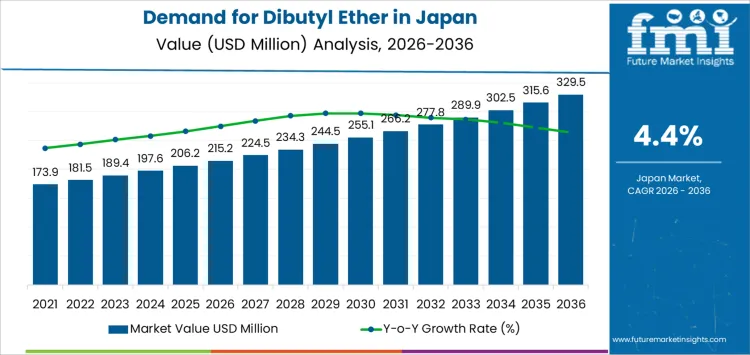
The demand for dibutyl ether in Japan is valued at USD 215.2 million in 2026 and is projected to reach USD 329.5 million by 2036, reflecting a CAGR of 4.4%. Growth from USD 166.6 million in 2020 to USD 215.2 million in 2026 is supported by steady use in pesticide manufacturing, specialty chemical production, and organic synthesis. Anhydrous 99.3 percent purity holds the leading share due to higher suitability for precision reactions, while food industry applications contribute measured supplemental demand.
From 2027 onward, values rise from USD 224.5 million to USD 266.2 million by 2031, then advance to USD 329.5 million by 2036 through incremental yearly growth. Specialty chemicals maintain stable procurement as dibutyl ether supports reaction control and solvent roles in varied formulations. Organic synthesis remains a consistent contributor across research and industrial environments. Food sector usage stays modest but steady. Long term movement reflects production stability, process optimization, and consistent industrial consumption across Japan.
Quick Stats of the Demand for Dibutyl Ether in Japan
- Dibutyl Ether Demand in Japan Value (2026): USD 215.2 million
- Dibutyl Ether Demand in Japan Forecast Value (2036): USD 329.5 million
- Dibutyl Ether Demand in Japan Forecast CAGR (2026-2036): 4.4%
- Dibutyl Ether Leading Purity Type: Anhydrous 99.3% (55%)
- Dibutyl Ether Key Growth Regions: Kyushu & Okinawa, Kanto, Kansai
- Dibutyl Ether Top Players: Hridaan Pharma Chem, TCI Chemicals, Shanghai Terppon Chemical Co. Ltd, Shenzhen VTOLO Industrial Co. Ltd, Merck Schuchardt OHG
What is the Growth Forecast for Dibutyl Ether in Japan through 2036?
Between 2026 and 2031, demand for dibutyl ether in Japan increases from USD 215.2 million to USD 255.1 million, a rise of USD 39.9 million across five years. Growth in this stage reflects broader use of high-purity solvents in pharmaceutical synthesis, resin formulation, and specialty chemical processing. Earlier demand was anchored in niche laboratory and production applications, while the near-term period shows widening integration within multi-step synthesis routes. Greater emphasis on reaction consistency and controlled evaporation characteristics strengthens procurement across mid-sized chemical manufacturers.
From 2031 to 2036, demand advances from USD 255.1 million to USD 329.5 million, adding USD 74.4 million and establishing a more accelerated path. Expansion is shaped by diversified utilization in agrochemical intermediates, high-performance coatings, and fine chemical production lines requiring predictable solvent behavior at scale. Earlier increases were tied to incremental industrial consumption, whereas the later period reflects structured capacity additions, improved supply chain reliability, and stronger alignment with process optimization efforts across Japan’s specialized chemical sector. Enhanced purity requirements and consistent batch reproducibility further reinforce its role in advanced manufacturing workflows.
Dibutyl Ether Industry in Japan Key Takeaways
| Metric | Value |
|---|---|
| Industry Value (2026) | USD 215.2 million |
| Forecast Value (2036) | USD 329.5 million |
| Forecast CAGR (2026-2036) | 4.4% |
What Is Driving the Demand for Dibutyl Ether in Japan from 2026 to 2036?
Demand for dibutyl ether in Japan has reflected its role as a specialty solvent and chemical intermediate in industrial formulations. Manufacturers used dibutyl ether in coatings, adhesives, and extraction processes where moderate solvent strength and controlled evaporation were required. Prior use in laboratory and industrial applications depended on stable supply, compatibility with existing chemical processes, and adherence to regulatory handling standards. Procurement decisions emphasised material purity, batch consistency, and compliance with domestic chemical safety requirements. Industrial users valued dibutyl ether when alternatives did not meet specific solvency or process criteria within coating and resin systems.
From 2026 to 2036 demand is expected to align with shifts in specialty chemical production and regulatory controls on volatile organic compounds. Growth in precision coatings, electronics assembly, and fine chemical sectors may support steady use where dibutyl ether’s properties remain unmatched in niche formulations. Users in extractive separation and polymer additives continue to evaluate performance against emerging low-emissions alternatives. Procurement reflects balancing functional performance, occupational safety, and environmental compliance in solvent selection. Demand also depends on availability of compliant storage and handling infrastructure, and industry adoption of greener solvent technologies where possible across chemical processing, industrial maintenance, and formulated product lines nationwide.
What Is the Demand for Dibutyl Ether in Japan by Purity Type and Application for 2026 to 2036?
The demand for dibutyl ether in Japan from 2026 to 2036 is shaped by expanding agrochemical output, rising interest in high-purity solvents, and steady growth in specialty chemical synthesis. Anhydrous 99.3% purity leads due to its suitability for controlled manufacturing environments. Manufacturing pesticides holds the largest application share as producers require stable, low-moisture solvents to maintain formulation consistency and performance across diverse crop protection products.
Why does anhydrous 99.3% purity account for 55% of the demand for dibutyl ether in Japan by purity type from 2026 to 2036?
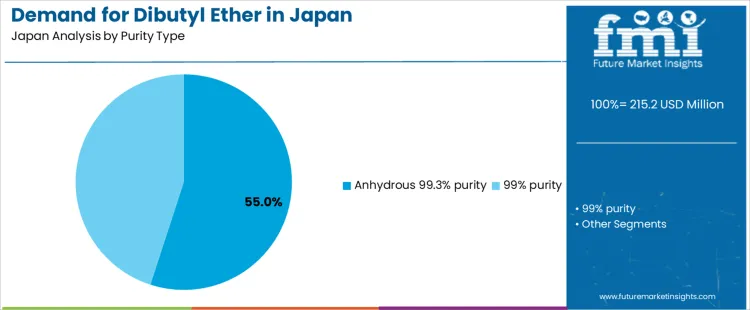
Anhydrous 99.3% purity accounts for 55% of the demand for dibutyl ether in Japan because key users require tight control over moisture levels during reactions involving sensitive intermediates. Consumption rises in agrochemical, pharmaceutical, and industrial synthesis plants that operate under low-tolerance specifications. Usage remains steady since high-purity grades deliver consistent evaporation behavior and predictable solvation strength. Procurement is guided by buyers who prioritize purity certification and batch uniformity to support repeat processing outcomes. Price sensitivity stays moderate as purity directly influences reaction yield and downstream costs. Specification control focuses on moisture limits, peroxide stability, and distillation consistency. Demand continues through 2026 to 2036 as high-purity solvents remain integral to facilities targeting reproducible reaction conditions and clean recovery cycles.
Why does manufacturing pesticides represent 30.0% of the demand for dibutyl ether in Japan by application?
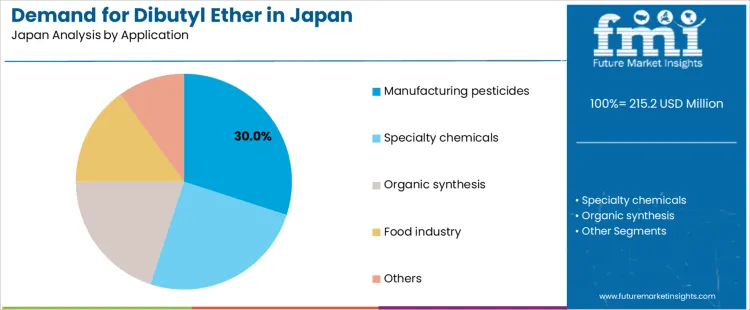
Manufacturing pesticides represents 30.0% of the demand for dibutyl ether in Japan because producers rely on this solvent for stable dispersion and efficient formation of active ingredients. Consumption is strong across insecticide and herbicide lines that require controlled volatility and uniform blending characteristics. Usage remains steady since dibutyl ether maintains compatibility with a wide range of technical-grade ingredients used in crop protection. Procurement is driven by formulators who favor solvents offering reliable distillation performance and minimal residue formation. Price sensitivity remains moderate as solvent selection influences reaction precision and batch throughput. Specification control emphasizes purity, odor neutrality, and consistent solubility behavior under production temperatures. Demand remains predictable from 2026 to 2036 as agriculture suppliers maintain regular output cycles across domestic and export-oriented pesticide production.
How Is Demand for Dibutyl Ether in Japan Developing Across Local Industrial and Laboratory Settings?
Demand reflects its use in Japanese chemical plants, analytical laboratories, and extraction facilities that rely on stable solvents for routine operations. Resin manufacturers in Osaka and Aichi use dibutyl ether in selective synthesis steps that require controlled evaporation. University laboratories employ it in pilot reactions linked to materials research supported by prefectural programs. Small extraction units in Shizuoka and Kanagawa use it for aroma compound processing. These activities sustain steady local interest shaped by Japan’s production habits and research workflows.
Which Local Industrial Practices Are Driving Demand for Dibutyl Ether in Japan?
Drivers arise from synthesis routines in regional chemical clusters. Plants in Yokohama and Osaka use dibutyl ether for reactions where narrow boiling behavior improves separation, which supports precise production runs. Resin lines in Aichi adopt it during intermediate stages to maintain consistent film properties. Fragrance processors in Shizuoka rely on it during extraction work tied to domestic flavor houses. University labs funded through local research grants use it during scale up trials. These settings create locally grounded pull based on practical needs within Japan’s industrial and academic processes.
What Local Constraints Are Limiting Broader Use of Dibutyl Ether in Japan?
Barriers reflect facility specific rules, storage limits, and procurement patterns. Rural plants with compact solvent rooms choose higher volume alternatives that reduce container turnover, which narrows dibutyl ether purchases. Some laboratories follow internal safety guidelines that restrict low flash point solvents, which limits routine use. Extraction units in smaller prefectures prefer solvents supported by long standing supplier contracts to avoid delivery gaps. Municipal waste handling rules in dense urban areas set stricter disposal procedures for ethers, which discourages adoption in labs with limited compliance staff. These factors shape slower expansion across regions with constrained operations.
What is the Demand for Dibutyl Ether in Japan by Region?
| Region | CAGR (%) |
|---|---|
| Kyushu & Okinawa | 5.4% |
| Kanto | 5.0% |
| Kansai | 4.4% |
| Chubu | 3.9% |
| Tohoku | 3.4% |
| Rest of Japan | 3.2% |
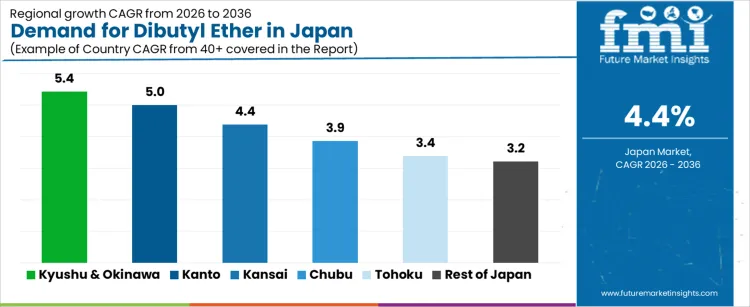
The demand for dibutyl ether in Japan is rising steadily across chemical processing, pharmaceuticals, flavors and fragrance production, and specialized industrial applications. Kyushu and Okinawa lead at a 5.4% CAGR, supported by active chemical clusters, expanding solvent usage in manufacturing, and consistent growth in fine chemical production. Kanto follows at 5.0%, driven by strong demand from pharmaceutical formulators, research laboratories, and diverse industrial users operating within the region. Kansai records 4.4% growth, reflecting stable consumption by chemical producers and materials manufacturers. Chubu at 3.9% shows moderate uptake shaped by automotive related chemical demand and solvent based processing industries. Tohoku and the Rest of Japan, at 3.4% and 3.2%, reflect slower adoption linked to smaller industrial bases, fewer chemical plants, and limited dependence on specialized ether solvents.
How Are Industrial and Laboratory Uses Supporting Dibutyl Ether Demand in Kyushu and Okinawa?
Demand for dibutyl ether in Kyushu and Okinawa is rising at a CAGR of 5.4% from 2026 to 2036 as chemical plants, laboratories, and manufacturing sites rely on this solvent for extraction, synthesis, and processing tasks. Facilities use dibutyl ether in controlled operations requiring stable evaporation and consistent purity. Research laboratories incorporate it into analytical and preparatory procedures. Regional distributors maintain steady stock levels aligned with regular procurement cycles. Growth reflects continuous use across small and mid sized industries that depend on predictable solvent performance.
- Plants use solvent for extraction and synthesis
- Laboratories rely on dibutyl ether for procedures
- Distributors support stable regional supply
What Drives Dibutyl Ether Consumption Across Kanto?
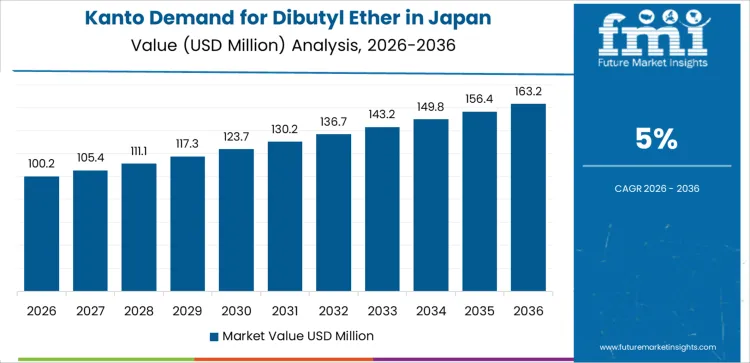
Demand for dibutyl ether in Kanto is progressing at a CAGR of 5.0% from 2026 to 2036 as dense industrial zones and research hubs incorporate this solvent into varied processes. Chemical producers rely on dibutyl ether for controlled reactions. Laboratories use it for preparation steps in organic analysis. Retail chemical suppliers manage frequent replenishment reflecting metropolitan consumption levels. Growth aligns with wide industrial activity and strong research output across the region.
- Producers integrate solvent into routine operations
- Laboratories apply ether in organic workflows
- Suppliers manage rapid stock rotation
How Is Application Variety Supporting Dibutyl Ether Demand in Kansai?
Demand for dibutyl ether in Kansai is increasing at a CAGR of 4.4% from 2026 to 2036 as industrial facilities and laboratories rely on this solvent for consistent performance in extraction and processing tasks. Manufacturers use dibutyl ether where controlled volatility improves operational handling. Laboratories adopt it for compound preparation and purification. Retail distributors follow stable ordering cycles tied to regional industrial demand. Growth reflects balanced activity across chemical, research, and specialty production environments.
- Manufacturers use solvent for controlled operations
- Laboratories integrate ether into daily workflows
- Distributors maintain predictable supply cycles
Which Conditions Shape Dibutyl Ether Demand Across Chubu?
Demand for dibutyl ether in Chubu is trending at a CAGR of 3.9% from 2026 to 2036 as chemical producers and research groups incorporate this solvent into targeted processes. Facilities use it for reaction setups requiring dependable evaporation characteristics. Laboratories apply dibutyl ether during extraction routines. Retail chemical outlets maintain measured inventory aligned with regional procurement habits. Growth continues as industrial clusters rely on stable solvent qualities for continuous operation.
- Producers rely on ether for reaction preparation
- Laboratories apply it in extraction tasks
- Retailers maintain steady inventory levels
How Do Regional Industry Patterns Influence Dibutyl Ether Use in Tohoku?
Demand for dibutyl ether in Tohoku is moving at a CAGR of 3.4% from 2026 to 2036 as smaller industrial facilities and laboratories use the solvent for essential processing and testing functions. Providers adopt dibutyl ether for tasks requiring consistent volatility and predictable performance. Retail distributors follow regular procurement cycles shaped by modest but steady consumption. Growth reflects practical industrial needs and ongoing research activity across regional institutions.
- Facilities use solvent for routine applications
- Laboratories rely on predictable solvent behavior
- Distributors follow steady ordering patterns
What Maintains Dibutyl Ether Demand Across Rest of Japan?
Demand for dibutyl ether in Rest of Japan is advancing at a CAGR of 3.2% from 2026 to 2036 as regional industries and laboratories use the solvent for extraction, synthesis, and formulation tasks. Facilities adopt dibutyl ether for controlled operations requiring stable evaporation. Retail suppliers manage modest but steady stock movement. Growth reflects reliable consumption across dispersed industrial zones where practical solvent performance supports routine workflows.
- Facilities integrate ether into routine processes
- Laboratories apply solvent for preparation work
- Suppliers manage modest regional stock cycles
What Is Driving the Demand for Dibutyl Ether in Japan and Which Companies Shape Chemical Supply
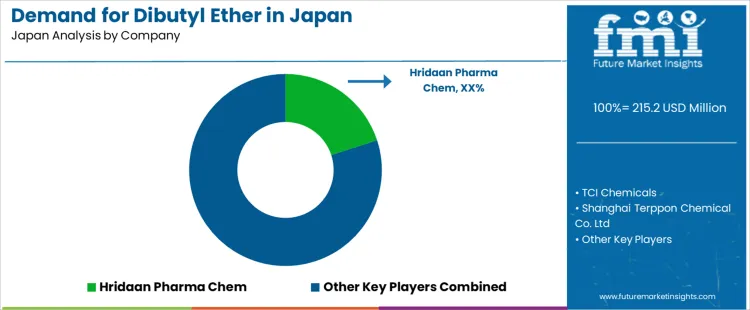
The demand for dibutyl ether in Japan is shaped by its use as a solvent in pharmaceuticals, fine chemicals, specialty coatings, and laboratory synthesis. Domestic distributors anchor most circulation through imports aligned with local purity and safety standards. TCI Chemicals holds a central role by supplying high purity laboratory and pilot scale volumes used in research institutes and chemical development labs. Merck Schuchardt OHG reaches Japan through global reagent channels that support analytical testing and formulation trials. Hridaan Pharma Chem, Shanghai Terppon Chemical Co Ltd, and Shenzhen VTOLO Industrial Co Ltd participate through bulk and semi bulk shipments handled by Japanese trading firms serving pharmaceutical intermediates, fragrance intermediates, and industrial chemistry. Demand is driven by steady research activity and ongoing solvent replacement programs in formulation work.
Selection in Japan is governed by purity grade, peroxide stability, low moisture content, and documentation aligned with domestic chemical safety requirements. Buyers in pharmaceutical manufacturing focus on batch consistency and validated impurity profiles suitable for regulated synthesis steps. Coatings and specialty chemical firms emphasize evaporation rate and compatibility with existing solvent blends. Laboratories prefer materials with clear labeling and stable packaging for longer shelf life. Procurement aligns with project cycles in process development, flavor and fragrance formulation, and polymer research.
Key Players in the Dibutyl Ether Industry in Japan
- Hridaan Pharma Chem
- TCI Chemicals
- Shanghai Terppon Chemical Co. Ltd
- Shenzhen VTOLO Industrial Co. Ltd
- Merck Schuchardt OHG
Scope of the Report
| Items | Values |
|---|---|
| Quantitative Units (2026) | USD million |
| Purity Type | Anhydrous 99.3% purity; 99% purity |
| Application | Manufacturing pesticides; Specialty chemicals; Organic synthesis; Food industry; Others |
| Regions Covered | Kyushu & Okinawa; Kanto; Kansai; Chubu; Tohoku; Rest of Japan |
| Countries Covered | Japan |
| Key Companies Profiled | Hridaan Pharma Chem; TCI Chemicals; Shanghai Terppon Chemical Co. Ltd; Shenzhen VTOLO Industrial Co. Ltd; Merck Schuchardt OHG |
| Additional Attributes | Dollar by sales across purity types and application categories; industrial solvent workflows; high purity handling requirements; laboratory extraction and synthesis routines; evaporation and solvation performance characteristics; regulated chemical storage protocols; production cycle alignment; documentation and impurity profile considerations; supply chain and reagent sourcing patterns. |
Dibutyl Ether Industry in Japan Segmentation
Purity Type:
- Anhydrous 99.3% purity
- 99% purity
Application:
- Manufacturing pesticides
- Specialty chemicals
- Organic synthesis
- Food industry
- Others
Region:
- Kyushu & Okinawa
- Kanto
- Kansai
- Chubu
- Tohoku
- Rest of Japan
Frequently Asked Questions
How big is the demand for dibutyl ether in Japan in 2026?
The demand for dibutyl ether in Japan is estimated to be valued at USD 215.2 million in 2026.
What will be the size of dibutyl ether in Japan in 2036?
The market size for the dibutyl ether in Japan is projected to reach USD 329.5 million by 2036.
How much will be the demand for dibutyl ether in Japan growth between 2026 and 2036?
The demand for dibutyl ether in Japan is expected to grow at a 4.4% CAGR between 2026 and 2036.
What are the key product types in the dibutyl ether in Japan?
The key product types in dibutyl ether in Japan are anhydrous 99.3% purity and 99% purity.
Which application segment is expected to contribute significant share in the dibutyl ether in Japan in 2026?
In terms of application, manufacturing pesticides segment is expected to command 30.0% share in the dibutyl ether in Japan in 2026.
Preview the report firsthand - request a free sample
Get SampleGet the brochure for pricing and purchase details.
Get PDFTable of Content
- Executive Summary
- Japan Market Outlook
- Demand-side Trends
- Supply-side Trends
- Technology Roadmap Analysis
- Analysis and Recommendations
- Market Overview
- Market Coverage / Taxonomy
- Market Definition / Scope / Limitations
- Market Background
- Market Dynamics
- Drivers
- Restraints
- Opportunity
- Trends
- Scenario Forecast
- Demand in Optimistic Scenario
- Demand in Likely Scenario
- Demand in Conservative Scenario
- Opportunity Map Analysis
- Product Life Cycle Analysis
- Supply Chain Analysis
- Investment Feasibility Matrix
- Value Chain Analysis
- PESTLE and Porter’s Analysis
- Regulatory Landscape
- Regional Parent Market Outlook
- Production and Consumption Statistics
- Import and Export Statistics
- Market Dynamics
- Japan Market Analysis 2020 to 2024 and Forecast, 2025 to 2035
- Historical Market Size Value (USD Million) Analysis, 2020 to 2024
- Current and Future Market Size Value (USD Million) Projections, 2025 to 2035
- Y-o-Y Growth Trend Analysis
- Absolute $ Opportunity Analysis
- Japan Market Pricing Analysis 2020 to 2024 and Forecast 2025 to 2035
- Japan Market Analysis 2020 to 2024 and Forecast 2025 to 2035, By Purity Type
- Introduction / Key Findings
- Historical Market Size Value (USD Million) Analysis By Purity Type , 2020 to 2024
- Current and Future Market Size Value (USD Million) Analysis and Forecast By Purity Type , 2025 to 2035
- Anhydrous 99.3% purity
- 99% purity
- Y-o-Y Growth Trend Analysis By Purity Type , 2020 to 2024
- Absolute $ Opportunity Analysis By Purity Type , 2025 to 2035
- Japan Market Analysis 2020 to 2024 and Forecast 2025 to 2035, By Application
- Introduction / Key Findings
- Historical Market Size Value (USD Million) Analysis By Application, 2020 to 2024
- Current and Future Market Size Value (USD Million) Analysis and Forecast By Application, 2025 to 2035
- Manufacturing pesticides
- Specialty chemicals
- Organic synthesis
- Food industry
- Others
- Y-o-Y Growth Trend Analysis By Application, 2020 to 2024
- Absolute $ Opportunity Analysis By Application, 2025 to 2035
- Market Structure Analysis
- Competition Dashboard
- Competition Benchmarking
- Market Share Analysis of Top Players
- By Regional
- By Purity Type
- By Application
- Competition Analysis
- Competition Deep Dive
- Hridaan Pharma Chem
- Overview
- Product Portfolio
- Profitability by Market Segments (Product/Age /Sales Channel/Region)
- Sales Footprint
- Strategy Overview
- Marketing Strategy
- Product Strategy
- Channel Strategy
- TCI Chemicals
- Shanghai Terppon Chemical Co. Ltd
- Shenzhen VTOLO Industrial Co. Ltd
- Merck Schuchardt OHG
- Hridaan Pharma Chem
- Competition Deep Dive
- Assumptions & Acronyms Used
- Research Methodology


