

- Industry Size (2025)
- USD 1.6 Bn
- Forecast (2035)
- USD 2.7 Bn
- CAGR (2025 to 2035)
- 5.5%
Demand for Dibutyl Ether in USA 2025 to 2035
The demand for dibutyl ether in USA is valued at USD 1.6 billion in 2025 and is projected to reach USD 2.7 billion by 2035, reflecting a CAGR of 5.5%. Growth is supported by increased usage of dibutyl ether as a solvent and reaction medium in pharmaceutical synthesis, specialty chemicals production, and laboratory applications. Expansion of fine chemical manufacturing and ongoing investment in process scale-up activities strengthen consumption across research and industrial settings.
Anhydrous 99.3% purity leads adoption because high-purity grades ensure consistent reactivity, low moisture interference, and reliable performance in moisture-sensitive organic synthesis. Buyers prioritize stable distillation quality, reduced peroxide formation, and compatibility with controlled manufacturing environments. Demand intensifies in applications requiring stringent purity specifications to maintain reproducible chemical outcomes.
The West, South, and Northeast regions reflect strong uptake due to concentrated pharmaceutical, biotech, and chemical research clusters. Key suppliers serving USA demand include Hridaan Pharma Chem, TCI Chemicals, Shanghai Terppon Chemical Co. Ltd, Shenzhen VTOLO Industrial Co. Ltd, and Merck Schuchardt OHG. Their strategies focus on purity assurance, safe packaging, and supply continuity for both bulk chemical users and laboratory-scale customers requiring dependable solvent performance.
Quick Stats for USA Dibutyl Ether Demand
- USA Dibutyl Ether Sales Value (2025): USD 1.6 billion
- USA Dibutyl Ether Forecast Value (2035): USD 2.7 billion
- USA Dibutyl Ether Forecast CAGR (2025-2035): 5.5%
- Leading Purity Segment: Anhydrous 99.3% purity
- Key Growth Regions: West USA, South USA, Northeast USA
- Top Suppliers Serving USA Demand: Hridaan Pharma Chem; TCI Chemicals; Shanghai Terppon Chemical Co., Ltd; Shenzhen VTOLO Industrial Co., Ltd; Merck Schuchardt OHG
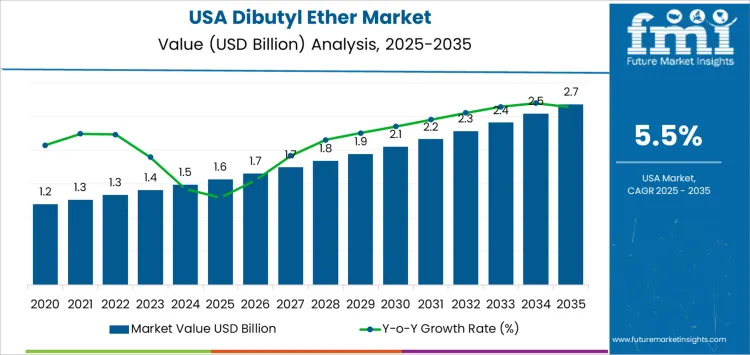
What is the Growth Forecast for Dibutyl Ether Industry in USA through 2035?
The acceleration and deceleration pattern for dibutyl ether demand in the United States reflects shifts linked to solvent usage, production cycles, and regulatory conditions. Early acceleration emerges as industrial users incorporate dibutyl ether into formulated products requiring controlled volatility and compatibility with specific reaction environments. This phase shows steady momentum because adoption aligns with established manufacturing routines across chemical synthesis, coatings, and laboratory applications. Procurement volumes rise as producers stabilize formulations that rely on this solvent class.
A deceleration phase appears when users adjust solvent portfolios in response to regulatory evaluations targeting emissions, worker exposure limits, and hazardous air pollutant thresholds. Substitution assessments introduce pauses in procurement as firms validate alternative solvents for selected processes. These evaluations produce a measurable flattening in the demand curve. Subsequent acceleration reappears in niche applications where dibutyl ether maintains functional advantages that support reaction efficiency or product stability. These segments create renewed demand intensity, although growth remains concentrated rather than broad.
A secondary deceleration emerges during periods of raw material price fluctuation, which influences purchasing schedules and inventory planning. Users moderate ordering frequency during cost volatility, generating temporary softening in the curve. The overall pattern alternates between functional acceleration driven by application-specific value and deceleration shaped by regulatory and economic adjustments.
USA Dibutyl Ether Key Takeaways
| Metric | Value |
|---|---|
| USA Dibutyl Ether Sales Value (2025) | USD 1.6 billion |
| USA Dibutyl Ether Forecast Value (2035) | USD 2.7 billion |
| USA Dibutyl Ether Forecast CAGR (2025-2035) | 5.5% |
Why is the Demand for Dibutyl Ether in USA Growing?
Demand for dibutyl ether in the United States grows due to rising consumption across pharmaceuticals, specialty chemicals, and laboratory applications that require a stable, low polarity solvent. Synthesis of active pharmaceutical ingredients depends on solvents that support controlled reaction conditions, and dibutyl ether fits process requirements for specific extraction and purification steps. Contract manufacturing organizations operate continuous production lines that use dibutyl ether in reaction workflows involving organometallic reagents. Growth in research activity across biotechnology, materials science, and catalysis strengthens procurement of high purity solvent grades.
Industrial formulations involving coatings, adhesives, and lubricant additives incorporate dibutyl ether due to its solvency balance, evaporation profile, and compatibility with resin systems. Expansion of custom chemical synthesis in small and mid-sized facilities increases the need for reproducible solvent behavior during batch operations. Laboratory environments maintain steady use in extraction tasks and moisture sensitive reactions. Supply chains for fine chemicals stabilize due to broader distributor networks that manage consistent availability of ether solvents. Regulatory focus on controlled handling and storage promotes standardized container systems adopted by industrial and laboratory users across the country.
Which Purity Type and Application Segments Lead Demand for Dibutyl Ether in USA?
Demand for dibutyl ether in the USA is shaped by requirements for high-purity solvents, process consistency, and compatibility with chemical synthesis operations. Buyers evaluate purity, stability, and performance in controlled reaction environments. Adoption reflects its role in extraction, formulation, and synthesis workflows across pesticides, specialty chemicals, food processing, and laboratory applications. Distribution aligns with purity-sensitive production systems and industrial solvent standards.
By Purity Type, Anhydrous 99.3% Purity Accounts for the Largest Share of Demand
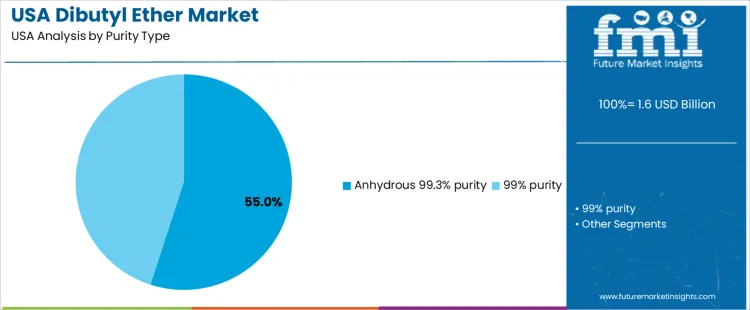
Anhydrous 99.3% purity holds 55.0%, making it the leading purity segment in USA dibutyl ether usage. This grade supports reactions requiring minimal moisture interference and stable solvent performance in precision synthesis environments. Facilities rely on high-purity solvent streams to maintain consistency in pesticide intermediates, fine-chemical production, and moisture-sensitive reactions. The 99% purity grade holds 45.0%, serving applications where slight moisture presence does not disrupt reaction pathways or extraction performance. This grade is used across general synthesis tasks, formulation blending, and less sensitive industrial workflows. Purity distribution reflects process-stringency requirements and tolerance levels across chemical production lines.
Key Points:
- Anhydrous grade supports moisture-sensitive synthesis.
- 99% purity suits general industrial and laboratory workflows.
- Selection depends on reaction tolerance and purity needs.
- Distribution aligns with precision chemical processing.
By Application, Manufacturing Pesticides Represents the Largest Segment
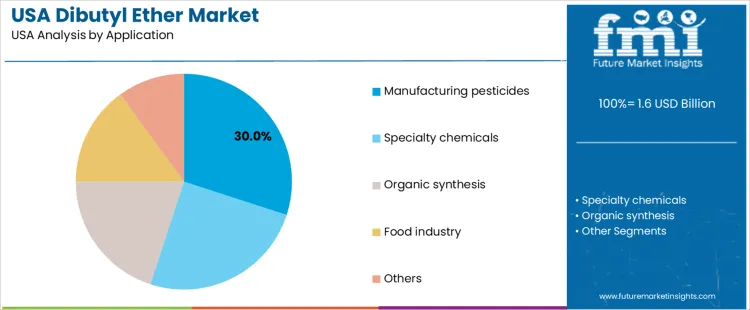
Manufacturing pesticides holds 30.0%, making it the leading application segment for dibutyl ether in the USA. Solvent performance supports extraction, formulation stability, and intermediate production processes within regulated pesticide manufacturing. Specialty chemicals hold 25.0%, reflecting demand across fine-chemical synthesis and performance-driven formulations. Organic synthesis holds 20.0%, used in controlled laboratory and industrial reactions requiring predictable solvent behavior. The food industry holds 15.0%, supporting flavor extraction, solvent-assisted processing, and regulated additive preparation. Others hold 10.0%, covering diverse low-volume applications. Distribution reflects functional solvent requirements and regulatory expectations across industrial and processing environments.
Key Points:
- Pesticide production relies on stable solvent behavior.
- Specialty chemicals require consistent reaction performance.
- Organic synthesis uses dibutyl ether for controlled reactions.
- Application demand reflects formulation and processing needs.
What are the Key Dynamics in the Dibutyl Ether Industry?
Chemical processing demand, solvent performance, and manufacturing applications are driving consumption.
Demand increases as US chemical producers use dibutyl ether as a solvent in controlled reactions requiring low water miscibility and stable boiling characteristics. Pharmaceutical manufacturers integrate the solvent into specific synthesis stages that depend on predictable evaporation behaviour. Laboratories rely on dibutyl ether for extraction procedures used in analytical workflows. Industrial facilities incorporate the solvent into fragrance compounds and specialty intermediates. Growth in fine chemical production supports consistent procurement of high-purity solvents. Regional chemical clusters in Texas and Louisiana maintain steady consumption due to established petrochemical infrastructure. Contract manufacturers adopt solvents that meet process consistency standards during scale-up operations.
Price sensitivity, handling constraints, and regulatory obligations restrain broader adoption.
Procurement teams face cost fluctuations created by variable availability of alcohol-based feedstocks used in dibutyl ether production. Facilities observe strict handling protocols due to the solvent’s flammability rating, which increases spending on ventilation, storage, and fire-safety equipment. Smaller manufacturers limit usage when hazardous material training requirements raise operational workload. Environmental regulations governing volatile organic compounds influence solvent selection in several states. Disposal procedures add cost when facilities manage spent solvent streams that require compliant treatment. Laboratories with limited space reduce inventory of specialty solvents that present additional safety considerations. Buyers prefer alternatives when projects emphasize low-emission criteria.
Process optimization, purity requirements, and sector-specific standardization shape current trends.
US pharmaceutical producers request dibutyl ether grades with tighter impurity control to support sensitive synthesis routes. Chemical firms evaluate solvent recovery systems that reduce waste generation and improve material utilization. Laboratories adopt pre-packaged solvent formats that lower contamination risk during analytical procedures. Fragrance and flavour manufacturers incorporate dibutyl ether into formulations that depend on consistent olfactory behaviour across production cycles. Contract development organizations introduce procurement protocols that standardize solvent specifications for multi-client operations. Industrial buyers assess digital tracking systems that document solvent usage across batches. Regional producers expand supply agreements that stabilize availability during high-demand periods.
Analysis of the Demand for Dibutyl Ether in the USA by Region
Demand for dibutyl ether in the USA is rising due to its expanding use as a solvent in chemical processing, pharmaceutical synthesis, and specialized industrial applications. West USA records a CAGR of 6.3% supported by strong activity in chemical formulation and research-driven industries. South USA shows a 5.7% CAGR driven by large-scale production sites and consistent adoption across petrochemical operations. Northeast USA posts a 5.1% CAGR due to its concentration of pharmaceutical and laboratory facilities. Midwest USA holds a 4.4% CAGR supported by stable manufacturing demand and steady utilization of solvents across industrial processing environments.
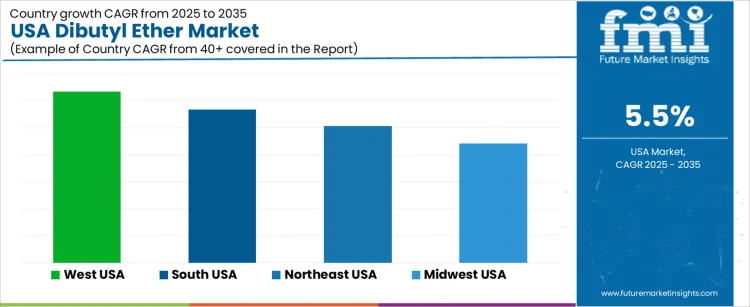
| Region | CAGR (2025-2035) |
|---|---|
| West USA | 6.3% |
| South USA | 5.7% |
| Northeast USA | 5.1% |
| Midwest USA | 4.4% |
How is the West USA driving demand for Dibutyl Ether?
West USA drives demand through its strong presence of chemical formulation firms, research laboratories, and specialty manufacturing units that rely on controlled solvent properties. The region’s CAGR of 6.3% reflects consistent usage in formulation work involving organic synthesis, extraction, and reaction processing where dibutyl ether offers stability and compatibility. Pharmaceutical and biotech activities across the region support steady procurement due to its role in specific synthesis pathways. Industrial users rely on it for blending tasks requiring predictable evaporation behavior. Regulatory compliance frameworks across the region reinforce structured solvent-handling practices, which sustain continuous circulation of high-purity solvent grades.
- Strong base of chemical and research facilities
- Usage in organic synthesis and solvent extraction
- Stable procurement by pharmaceutical operations
- Consistent demand for high-purity industrial solvents
How is the South USA driving demand for Dibutyl Ether?
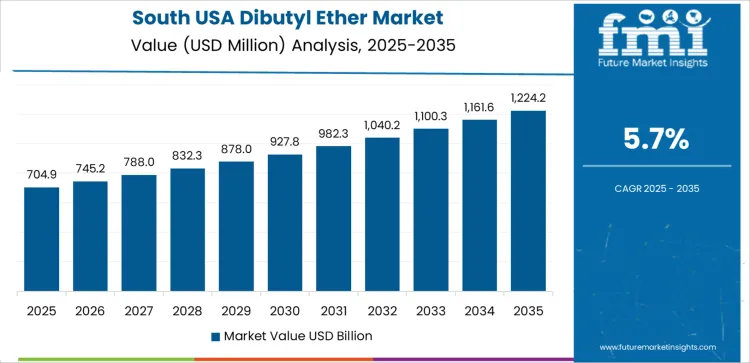
South USA supports rising demand due to its extensive petrochemical, chemical processing, and industrial-production landscape. The region’s CAGR of 5.7% reflects continuous utilization of dibutyl ether in reaction chemistry, intermediate production, and solvent-assisted blending activities. Large-scale industrial plants maintain predictable procurement cycles for solvents used in controlled processing conditions. Pharmaceutical manufacturing clusters across the region utilize dibutyl ether for synthesis and purification tasks requiring stable solvent characteristics. Strong logistics networks support easy distribution of solvent materials across major industrial corridors.
- Strong petrochemical and chemical-processing footprint
- Routine solvent use in reaction chemistry
- Pharmaceutical synthesis using stable solvent systems
- Efficient logistics supporting steady regional supply
How is the Northeast USA driving demand for Dibutyl Ether?
Northeast USA drives demand through its concentration of pharmaceutical companies, laboratories, and specialty-chemical firms that rely on high-grade solvents. The region’s CAGR of 5.1% reflects steady requirements for dibutyl ether in synthesis, formulation, and analytical workflows. Research institutions maintain regular usage for extraction tasks and controlled reaction environments requiring consistent solvent performance. Pharmaceutical operators use dibutyl ether in intermediate production and purification stages. Dense industrial and research activity ensures continuous handling of solvents aligned with established quality and safety protocols.
- Concentration of pharmaceutical and research activities
- Use in synthesis and purification tasks
- Stable demand from analytical and formulation workflows
- Structured solvent-handling and safety protocols
How is the Midwest USA driving demand for Dibutyl Ether?
Midwest USA maintains stable demand due to its broad manufacturing base, chemical-processing activity, and industrial applications requiring reliable solvents. The region’s CAGR of 4.4% reflects regular use of dibutyl ether in reaction processes, blending operations, and extraction tasks across industrial facilities. Manufacturing plants depend on consistent solvent behavior to support controlled production lines involving chemical intermediates. Regional laboratories and small-scale chemical operators maintain predictable procurement for research and applied industrial tasks. Established supply channels support steady availability across production hubs.
- Wide industrial and manufacturing presence
- Routine use in reaction and blending operations
- Steady procurement by laboratories
- Established distribution channels for solvent supply
What is the competitive landscape of the demand for dibutyl ether in the USA?
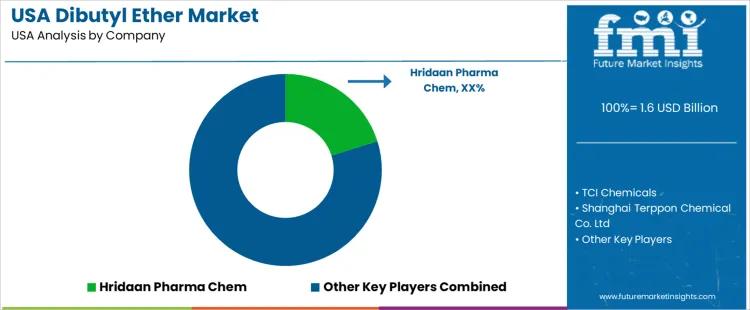
Demand for dibutyl ether in the USA aligns with usage in pharmaceutical synthesis, solvent systems, specialty intermediates, and laboratory applications requiring controlled evaporation behavior and selective solvency. Buyers evaluate purity grades, moisture content, batch consistency, and compatibility with reaction conditions across fine chemicals, research laboratories, and formulation environments. Procurement teams emphasize stable import channels, documented quality assurance, regulatory conformity, and reliable lead times supported by established global supply networks. Distribution structure reflects a mix of domestic chemical suppliers and international producers serving the USA through authorized distributors.
Hridaan Pharma Chem holds an estimated 20.2% share. Its position reflects export-driven supply relationships supporting pharmaceutical and specialty chemical buyers sourcing medium-volume solvent requirements. TCI Chemicals maintains strong visibility in the USA through domestic warehousing and catalog-based distribution offering high-purity reagents used in research and analytical workflows. Shanghai Terppon Chemical Co. Ltd supplies industrial and laboratory grades through import channels serving intermediates manufacturers and contract synthesis operations.
Shenzhen VTOLO Industrial Co. Ltd participates through bulk and semi-bulk shipments supporting distributors handling fine organic solvents. Merck Schuchardt OHG operates through the global Merck network providing high-purity chemical reagents used across pharmaceutical research, chemical development, and academic laboratories. Competitive positioning in the USA reflects purity assurance, import reliability, distributor networks, and technical documentation supporting specialized solvent procurement.
Key Players in USA Dibutyl Ether Demand
- Hridaan Pharma Chem
- TCI Chemicals
- Shanghai Terppon Chemical Co. Ltd
- Shenzhen VTOLO Industrial Co. Ltd
- Merck Schuchardt OHG
Scope of the Report
| Items | Values |
|---|---|
| Quantitative Units | USD billion |
| Purity Type | Anhydrous 99.3% purity, 99% purity |
| Application | Manufacturing pesticides, Specialty chemicals, Organic synthesis, Food industry, Others |
| Regions Covered | West USA, South USA, Northeast USA, Midwest USA |
| Key Companies Profiled | Hridaan Pharma Chem, TCI Chemicals, Shanghai Terppon Chemical Co. Ltd, Shenzhen VTOLO Industrial Co. Ltd, Merck Schuchardt OHG |
| Additional Attributes | Dollar sales by purity grade and application segments; adoption trends across West, South, Northeast, and Midwest USA; demand for dibutyl ether in pesticide formulation, organic synthesis, and food-grade solvent functions; competitive landscape of solvent and specialty chemical suppliers; integration of dibutyl ether in manufacturing workflows involving extraction, reaction media, and specialty chemical production. |
USA Dibutyl Ether Demand by Segments
Purity Type:
- Anhydrous 99.3% purity
- 99% purity
Application:
- Manufacturing pesticides
- Specialty chemicals
- Organic synthesis
- Food industry
- Others
Region:
- West USA
- South USA
- Northeast USA
- Midwest USA
Frequently Asked Questions
How big is the demand for dibutyl ether in USA in 2025?
The demand for dibutyl ether in USA is estimated to be valued at USD 1.6 billion in 2025.
What will be the size of dibutyl ether in USA in 2035?
The market size for the dibutyl ether in USA is projected to reach USD 2.7 billion by 2035.
How much will be the demand for dibutyl ether in USA growth between 2025 and 2035?
The demand for dibutyl ether in USA is expected to grow at a 5.5% CAGR between 2025 and 2035.
What are the key product types in the dibutyl ether in USA?
The key product types in dibutyl ether in USA are anhydrous 99.3% purity and 99% purity.
Which application segment is expected to contribute significant share in the dibutyl ether in USA in 2025?
In terms of application, manufacturing pesticides segment is expected to command 30.0% share in the dibutyl ether in USA in 2025.
Preview the report firsthand - request a free sample
Get SampleGet the brochure for pricing and purchase details.
Get PDFTable of Content
- Executive Summary
- USA Market Outlook
- Demand-side Trends
- Supply-side Trends
- Technology Roadmap Analysis
- Analysis and Recommendations
- Market Overview
- Market Coverage / Taxonomy
- Market Definition / Scope / Limitations
- Market Background
- Market Dynamics
- Drivers
- Restraints
- Opportunity
- Trends
- Scenario Forecast
- Demand in Optimistic Scenario
- Demand in Likely Scenario
- Demand in Conservative Scenario
- Opportunity Map Analysis
- Product Life Cycle Analysis
- Supply Chain Analysis
- Investment Feasibility Matrix
- Value Chain Analysis
- PESTLE and Porter’s Analysis
- Regulatory Landscape
- Regional Parent Market Outlook
- Production and Consumption Statistics
- Import and Export Statistics
- Market Dynamics
- USA Market Analysis 2020 to 2024 and Forecast, 2025 to 2035
- Historical Market Size Value (USD Million) Analysis, 2020 to 2024
- Current and Future Market Size Value (USD Million) Projections, 2025 to 2035
- Y-o-Y Growth Trend Analysis
- Absolute $ Opportunity Analysis
- USA Market Pricing Analysis 2020 to 2024 and Forecast 2025 to 2035
- USA Market Analysis 2020 to 2024 and Forecast 2025 to 2035, By Purity Type
- Introduction / Key Findings
- Historical Market Size Value (USD Million) Analysis By Purity Type , 2020 to 2024
- Current and Future Market Size Value (USD Million) Analysis and Forecast By Purity Type , 2025 to 2035
- Anhydrous 99.3% purity
- 99% purity
- Y-o-Y Growth Trend Analysis By Purity Type , 2020 to 2024
- Absolute $ Opportunity Analysis By Purity Type , 2025 to 2035
- USA Market Analysis 2020 to 2024 and Forecast 2025 to 2035, By Application
- Introduction / Key Findings
- Historical Market Size Value (USD Million) Analysis By Application, 2020 to 2024
- Current and Future Market Size Value (USD Million) Analysis and Forecast By Application, 2025 to 2035
- Manufacturing pesticides
- Specialty chemicals
- Organic synthesis
- Food industry
- Others
- Y-o-Y Growth Trend Analysis By Application, 2020 to 2024
- Absolute $ Opportunity Analysis By Application, 2025 to 2035
- Market Structure Analysis
- Competition Dashboard
- Competition Benchmarking
- Market Share Analysis of Top Players
- By Regional
- By Purity Type
- By Application
- Competition Analysis
- Competition Deep Dive
- Hridaan Pharma Chem
- Overview
- Product Portfolio
- Profitability by Market Segments (Product/Age /Sales Channel/Region)
- Sales Footprint
- Strategy Overview
- Marketing Strategy
- Product Strategy
- Channel Strategy
- TCI Chemicals
- Shanghai Terppon Chemical Co. Ltd
- Shenzhen VTOLO Industrial Co. Ltd
- Merck Schuchardt OHG
- Hridaan Pharma Chem
- Competition Deep Dive
- Assumptions & Acronyms Used
- Research Methodology


