

- Industry Size (2026)
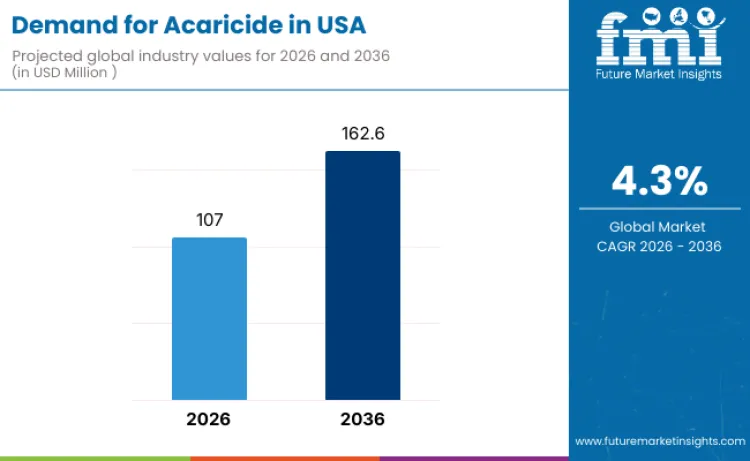
- USD 107.0 Mn
- Forecast (2036)
- USD 162.6 Mn
- CAGR (2026 to 2036)
- 4.3%
Demand for Acaricide in USA (2026-2036)
Demand for Acaricide in USA is valued at USD 107.0 million in 2026 and is expected to reach USD 162.6 million by 2036, reflecting a CAGR of 4.3%. Demand expands due to rising incidence of mite infestations across horticulture, field crops, and livestock production systems. Increasing resistance to conventional chemistries and tighter regulatory scrutiny on synthetic pesticides support gradual shift toward safer and residue-compliant solutions.
Natural acaricides lead product-type usage because plant-based and biologically derived formulations offer lower toxicity, reduced resistance development, and compatibility with integrated pest management programs. Growers adopt botanical extracts, microbial actives, and mineral-based solutions to protect crops while meeting organic and sustainable farming requirements. Improvements in formulation stability and field efficacy strengthen acceptance across commercial agriculture.
Quick Stats for Demand for Acaricide in USA
- USA Acaricide Sales Value (2026): USD 107.0 million
- USA Acaricide Forecast Value (2036): USD 162.6 million
- USA Acaricide Forecast CAGR (2026 to 2036): 4.3%
- Leading Product Type in USA Demand: Natural acaricides
- Key Growth Regions in USA Demand: West USA, South USA, Northeast USA, Midwest USA
- Top Players in USA Demand: Bayer, Syngenta, FMC Corporation, BASF, Corteva Agriscience
West USA, South USA, Northeast USA, and Midwest USA represent key growth regions supported by diversified crop patterns, large-scale farming operations, and climate conditions favorable to mite proliferation. Bayer, Syngenta, FMC Corporation, BASF, and Corteva Agriscience anchor competitive activity through expanded biological portfolios, targeted acaricide development, and distribution networks aligned with evolving regulatory and agronomic requirements across USA agriculture.
USA Acaricide Key Takeaways
| Metric | Value |
|---|---|
| USA Acaricide Sales Value (2026) | USD 107.0 million |
| USA Acaricide Forecast Value (2036) | USD 162.6 million |
| USA Acaricide Forecast CAGR (2026-2036) | 4.3% |
How Are the Segments Classified in the Demand for Acaricide in the USA?
Demand for acaricides in the USA is shaped by livestock health management, parasite resistance concerns, and regulatory oversight on chemical use. Buyers evaluate efficacy against mite species, residue compliance, application safety, and compatibility with integrated pest management programs. Adoption patterns reflect emphasis on animal health protection, controlled agricultural usage, and gradual inclusion of lower-toxicity options across regulated USA production systems.
Which Product Type Accounts for the Largest Share of Demand in the USA?
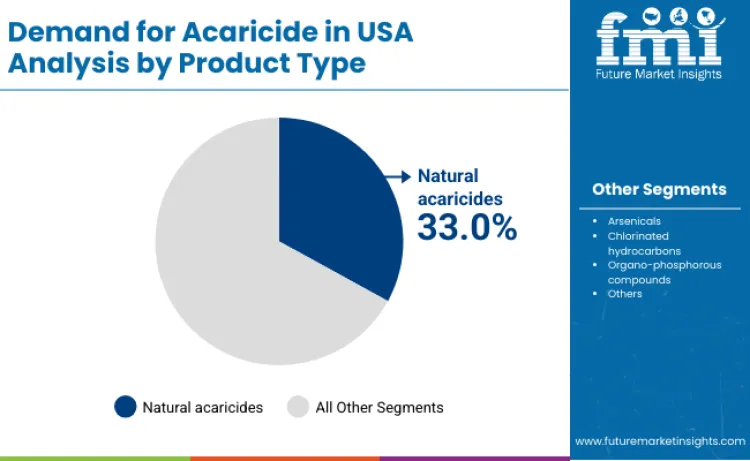
Natural acaricides hold 33.0%, making them the leading product-type segment in the USA. These formulations are favored for lower residue risk, compatibility with organic practices, and reduced toxicity profiles. Arsenicals, chlorinated hydrocarbons, and organo-phosphorous compounds remain in use under controlled conditions where efficacy requirements outweigh substitution feasibility. Other product types support niche applications and legacy use cases. Product-type distribution reflects growing preference for natural options within regulatory constraints and resistance-management strategies.
Key Points:
- Natural acaricides lead due to residue and safety considerations.
- Synthetic classes persist under controlled, regulated use.
- Product choice reflects resistance management and compliance needs.
Which Application Accounts for the Largest Share of Demand in the USA?
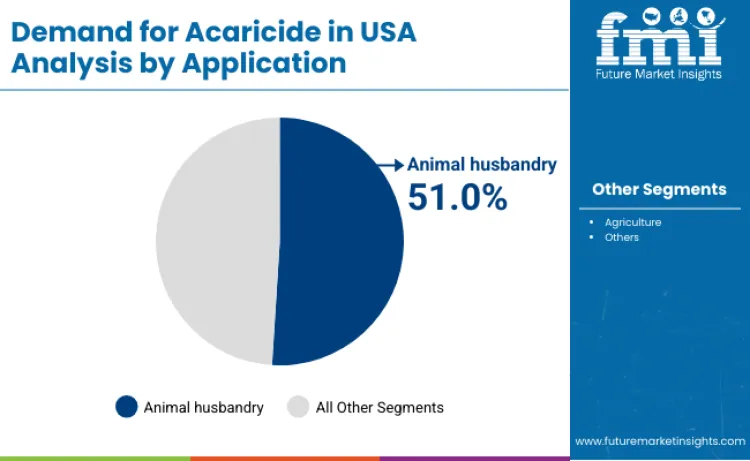
Animal husbandry holds 51.0%, making it the leading application segment in the USA. Livestock operations rely on acaricides to control mites affecting animal health, productivity, and disease transmission. Treatments are applied across cattle, poultry, and companion animal systems with strict residue and welfare requirements. Agricultural applications use acaricides to protect crops from mite-related yield losses. Other applications include household and institutional pest control under regulated use. Application distribution reflects dominant demand from livestock health management within USA operations.
Key Points:
- Animal husbandry drives majority demand due to health protection needs.
- Livestock treatments follow strict residue and welfare standards.
- Agriculture represents a secondary, regulated use segment.
What are the Key Dynamics in the Acaricide Industry in USA?
Demand increases across agriculture, animal health, and structural pest control activities in the USA. Acaricides are used to manage mites affecting crops, livestock, companion animals, and stored products. Usage aligns with crop protection programs, veterinary treatment protocols, and integrated pest management practices. Consumption remains regulated due to residue limits, environmental considerations, and resistance management requirements across US farming and animal health systems.
How do crop protection needs and livestock health management drive demand in USA?
The USA fruit, vegetable, and nut growers apply acaricides to control spider mites that reduce yield and quality under warm and dry conditions. Greenhouse and specialty crop operations depend on targeted miticides to protect high-value produce. Livestock producers use acaricides to manage ticks and mites that affect cattle, poultry, and swine health. Veterinary applications include treatments for companion animals against mange and ear mites. Expansion of protected agriculture and intensive livestock systems increases treatment frequency. Extension services promote acaricide use within integrated pest management programs to maintain efficacy and minimise economic losses across major agricultural regions.
How do resistance concerns, regulatory oversight, and environmental constraints influence demand stability?
Mite resistance to commonly used active ingredients requires rotation strategies that limit repeated application of single products. EPA registration requirements impose strict evaluation of environmental impact, worker exposure, and residue levels. Several active substances face usage restrictions affecting application timing and crop coverage. Growers adopt biological controls and non-chemical methods to reduce chemical dependency. Cost sensitivity affects adoption among small farms. Weather variability influences infestation pressure, creating demand fluctuations. Compliance with pollinator protection and water-quality standards increases management complexity. Demand remains steady in essential agricultural and veterinary uses while growth faces constraints from resistance management and regulatory scrutiny within the USA.
How Is Demand for Acaricides in the USA Evolving by Region?
Demand for acaricides in the USA is increasing steadily due to persistent mite pressure across agriculture, livestock management, and horticulture, alongside rising resistance-management requirements. West USA leads with a 4.9% CAGR, supported by specialty crops, orchards, and greenhouse cultivation. South USA follows at 4.4%, driven by year-round pest pressure in row crops, fruits, and livestock operations. Northeast USA records a 3.9% CAGR, shaped by orchard management, controlled-environment agriculture, and regulatory-compliant pest control. Midwest USA posts a 3.4% CAGR, reflecting seasonal crop cycles and integrated pest management adoption. Regional variation reflects climate conditions, crop diversity, resistance patterns, and regulatory intensity across the USA.
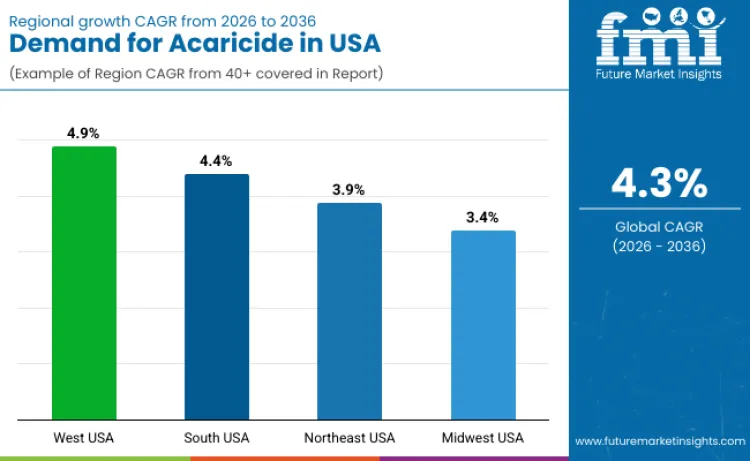
| Region | CAGR (2026-2036) |
|---|---|
| West USA | 4.9% |
| South USA | 4.4% |
| Northeast USA | 3.9% |
| Midwest USA | 3.4% |
How is West USA driving demand for Acaricides?
West USA demand is driven by high-value specialty crops, permanent orchards, vineyards, and greenhouse operations requiring precise mite control. The region’s CAGR of 4.9% reflects consistent use of selective acaricides in fruits, nuts, vegetables, and ornamental plants. Growers prioritize products targeting spider mites while preserving beneficial insects. Greenhouse and protected-cultivation systems increase reliance on miticides compatible with controlled environments. Resistance management programs encourage rotation among chemical classes, supporting repeat but diversified usage. Demand favors liquid formulations and products compatible with drip irrigation and foliar application. Regulatory scrutiny influences preference for reduced-toxicity and residue-compliant solutions.
- Specialty crops and permanent orchard applications
- Greenhouse and protected-cultivation usage
- Emphasis on selective, resistance-managed products
- Preference for residue-compliant formulations
How is South USA driving demand for Acaricides?
South USA demand is shaped by warm climates, extended growing seasons, and continuous pest pressure. The region’s CAGR of 4.4% reflects widespread use of acaricides across cotton, soybeans, fruits, vegetables, and livestock operations. High humidity and temperature accelerate mite reproduction, increasing treatment frequency. Livestock producers apply acaricides for tick and mite control to support herd health. Large-scale farming operations favor cost-effective formulations suitable for aerial and ground spraying. Resistance development influences adoption of combination products and rotational strategies. Demand remains volume-driven, supported by large acreage and intensive pest-management programs.
- Year-round mite pressure in row and specialty crops
- Livestock tick and mite control applications
- High treatment frequency due to climatic conditions
- Cost-efficient formulations for large-scale spraying
How is Northeast USA driving demand for Acaricides?
Northeast USA demand reflects regulated pest control, orchard-focused agriculture, and expanding controlled-environment farming. The region’s CAGR of 3.9% is supported by acaricide use in apples, berries, vineyards, and greenhouse vegetables. Growers adopt integrated pest management programs combining biological controls with targeted chemical treatments. Regulatory frameworks emphasize residue limits and application timing, influencing product selection. Smaller farm sizes increase reliance on high-efficacy formulations with lower application frequency. Demand favors specialty acaricides aligned with compliance requirements rather than broad-spectrum products.
- Orchard and vineyard pest management
- Integration within IPM programs
- Regulatory-driven product selection
- Demand for high-efficacy, low-application products
How is Midwest USA driving demand for Acaricides?
Midwest USA demand is moderate and seasonally driven, reflecting row-crop agriculture and rotational pest-management practices. The region’s CAGR of 3.4% reflects use of acaricides in corn, soybeans, and forage crops during peak infestation periods. Cooler climates limit year-round mite pressure, reducing treatment frequency compared with southern regions. Growers rely on threshold-based applications integrated with broader pest-control strategies. Cost sensitivity influences adoption, favoring established active ingredients with proven performance. Demand growth remains stable, supported by replacement usage and gradual expansion of resistance-management awareness.
- Seasonal mite control in row crops
- Threshold-based application practices
- Cost-sensitive product selection
- Stable demand tied to crop cycles
What is the competitive landscape of demand for acaricides in the USA?
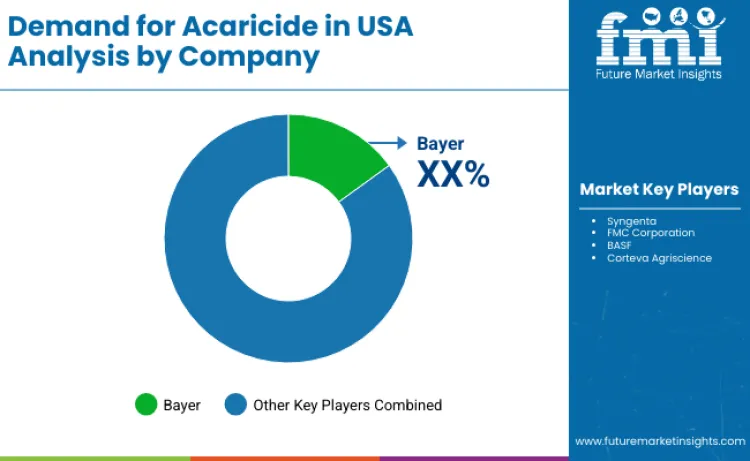
Demand for acaricides in the USA is shaped by control requirements across crop protection, livestock health, turf management, and household pest control. Usage depends on efficacy against resistant mite populations, crop and animal safety profiles, residue compliance, and alignment with integrated pest management programs. Buyers evaluate active ingredient spectrum, formulation stability, application flexibility, and re-entry intervals across agricultural and non-agricultural settings. Procurement teams prioritize suppliers with EPA registrations, strong distribution coverage, and technical stewardship supporting resistance management. Trend in the USA market reflects increased pressure from resistance development, tighter residue tolerances, and growing adoption of targeted chemistries and biological-compatible solutions.
Bayer operates a broad acaricide portfolio serving USA specialty crops, row crops, and animal health applications, supported by extensive regulatory and field-trial infrastructure. Syngenta maintains strong presence through miticide products used in fruits, vegetables, and greenhouse production systems requiring precise control. FMC Corporation supplies acaricides aligned with resistance-rotation strategies and modern application practices across USA agriculture. BASF participates with acaricide and insecticide solutions integrated into crop protection programs emphasizing efficacy and environmental compatibility. Corteva Agriscience supports demand through crop-protection portfolios used by USA growers managing mite pressure within integrated programs. Competitive positioning in the USA reflects regulatory approvals, formulation performance, resistance-management support, and distribution strength across agricultural, veterinary, and consumer channels.
Key Players in USA Acaricide Demand
- Bayer
- Syngenta
- FMC Corporation
- BASF
- Corteva Agriscience
Scope of the Report
| Items | Values |
|---|---|
| Quantitative Units | USD million |
| Product Type | Natural; Arsenicals; Chlorinated hydrocarbons; Organo-phosphorous compounds; Others |
| Application | Animal husbandry; Agriculture; Others |
| Regions Covered | West USA; South USA; Northeast USA; Midwest USA |
| Key Companies Profiled | Bayer; Syngenta; FMC Corporation; BASF; Corteva Agriscience |
| Additional Attributes | Dollar sales segmented by product type and application; agriculture remains primary usage due to mite control in crops; animal husbandry demand linked to livestock parasite management; regulatory constraints reduce arsenical use; shift toward organo-phosphorous and bio-based solutions; demand patterns vary by crop intensity and livestock density across USA regions. |
USA Acaricide Demand by Segments
Product Type:
- Natural
- Arsenicals
- Chlorinated hydrocarbons
- Organo-phosphorous compounds
- Others
Application:
- Animal husbandry
- Agriculture
- Others
Region:
- West USA
- South USA
- Northeast USA
- Midwest USA
Frequently Asked Questions
How big is the demand for acaricide in USA in 2026?
The demand for acaricide in USA is estimated to be valued at USD 107.0 million in 2026.
What will be the size of acaricide demand in USA in 2036?
The demand size for acaricide in USA is projected to reach USD 162.6 million by 2036.
How much will the demand for acaricide in USA grow between 2026 and 2036?
The demand for acaricide in USA is expected to grow at a 4.3% CAGR between 2026 and 2036.
What are the key product types in the acaricide demand in USA?
The key product types in acaricide demand in USA include natural and synthetic acaricides.
Which application segment is expected to contribute a significant share in the acaricide demand in USA in 2026?
In terms of application, animal husbandry segment is expected to command 51.0% share in the acaricide demand in USA in 2026.
Preview the report firsthand - request a free sample
Get SampleGet the brochure for pricing and purchase details.
Get PDFTable of Content
- Executive Summary
- USA Market Outlook
- Demand-side Trends
- Supply-side Trends
- Technology Roadmap Analysis
- Analysis and Recommendations
- Market Overview
- Market Coverage / Taxonomy
- Market Definition / Scope / Limitations
- Market Background
- Market Dynamics
- Drivers
- Restraints
- Opportunity
- Trends
- Scenario Forecast
- Demand in Optimistic Scenario
- Demand in Likely Scenario
- Demand in Conservative Scenario
- Opportunity Map Analysis
- Product Life Cycle Analysis
- Supply Chain Analysis
- Investment Feasibility Matrix
- Value Chain Analysis
- PESTLE and Porter’s Analysis
- Regulatory Landscape
- Regional Parent Market Outlook
- Production and Consumption Statistics
- Import and Export Statistics
- USA Acaricide Demand Analysis 2020 to 2024 and Forecast, 2025 to 2035
- Historical Market Size Value (USD Million) Analysis, 2020 to 2024
- Current and Future Market Size Value (USD Million) Projections, 2025 to 2035
- Y-o-Y Growth Trend Analysis
- Absolute $ Opportunity Analysis
- USA Acaricide Demand Pricing Analysis 2020 to 2024 and Forecast 2025 to 2035
- USA Acaricide Demand Analysis 2020 to 2024 and Forecast 2025 to 2035, By Product Type
- Introduction / Key Findings
- Historical Market Size Value (USD Million) Analysis By Product Type, 2020 to 2024
- Current and Future Market Size Value (USD Million) Analysis and Forecast By Product Type, 2025 to 2035
- Natural
- Arsenicals
- Chlorinated hydrocarbons
- Organo-phosphorous compounds
- Others
- Y-o-Y Growth Trend Analysis By Product Type, 2020 to 2024
- Absolute $ Opportunity Analysis By Product Type, 2025 to 2035
- USA Acaricide Demand Analysis 2020 to 2024 and Forecast 2025 to 2035, By Application
- Introduction / Key Findings
- Historical Market Size Value (USD Million) Analysis By Application, 2020 to 2024
- Current and Future Market Size Value (USD Million) Analysis and Forecast By Application, 2025 to 2035
- Animal husbandry
- Agriculture
- Others
- Y-o-Y Growth Trend Analysis By Application, 2020 to 2024
- Absolute $ Opportunity Analysis By Application, 2025 to 2035
- Market Structure Analysis
- Competition Dashboard
- Competition Benchmarking
- Market Share Analysis of Top Players
- By Regional
- By Product Type
- By Application
- Competition Analysis
- Competition Deep Dive
- Bayer
- Overview
- Product Portfolio
- Profitability by Market Segments (Product / Sales Channel / Region)
- Sales Footprint
- Strategy Overview
- Marketing Strategy
- Product Strategy
- Channel Strategy
- Syngenta
- FMC Corporation
- BASF
- Corteva Agriscience
- Bayer
- Assumptions & Acronyms Used
- Research Methodology


