

- Industry Size (2026)
- USD 845.56 Mn
- Forecast (2036)
- USD 1726.58 Mn
- CAGR (2026 to 2036)
- 7.4%
Biodegradable Bone Graft Polymers Market Size, Market Forecast and Outlook By FMI
The biodegradable bone graft polymers market was valued at USD 787.30 million in 2025, projected to reach USD 845.56 million in 2026, and is forecast to expand to USD 1726.58 million by 2036 at a 7.4% CAGR. Expanding orthopedic surgical volumes, aging population demographics across developed economies, and clinical preference shifts toward resorbable graft materials over permanent metallic hardware are fueling procurement of biodegradable polymer substrates. Hospital procurement committees increasingly specify polymer-based graft options that eliminate secondary implant removal procedures, reducing total episode-of-care costs and surgical scheduling burden.
Summary of Biodegradable Bone Graft Polymers Market
- The market is on track to reach USD 1726.58 million by 2036.
- Growth is pegged at a 7.4% CAGR over the 2026 to 2036 forecast window.
- As of 2025, the market was valued at USD 787.30 million.
- Cumulative incremental value across the forecast stands at USD 881.02 million.
- Synthetic polymers lead by Polymer with 61.0% share in 2026.
- Joint Reconstruction leads by Application with 35.0% share in 2026.
- Demand is rising as orthopedic surgeons increasingly prefer resorbable graft materials that eliminate secondary hardware removal procedures and reduce total episode-of-care costs.
- Among key countries, China leads at 10.0% CAGR, followed by India at 9.3%, Germany at 8.5%, France at 7.8%, the UK at 7.0%, the USA at 6.3%, and Brazil at 5.6%.
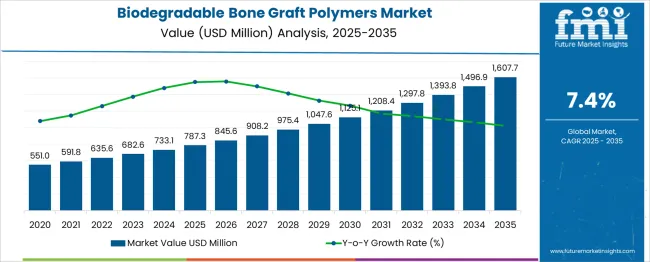
Biodegradable Bone Graft Polymers Market Key Takeaways
| Metric | Details |
|---|---|
| Industry Size (2026) | USD 845.56 million |
| Industry Value (2036) | USD 1726.58 million |
| CAGR (2026-2036) | 7.4% |
Source: Future Market Insights, 2026
The orthopedic biomaterials sector is experiencing a material transition where surgeons and hospital procurement teams are re-evaluating the total cost of bone defect management. Permanent metallic fixation systems, while mechanically reliable, impose secondary removal procedures that consume operating theater capacity and generate additional complication risks. FMI analysts observe that polylactic acid, polyglycolic acid, and polycaprolactone-based graft systems now satisfy the mechanical load requirements for non-weight-bearing and semi-weight-bearing defect repair, enabling clinical adoption in spine fusion, craniomaxillofacial reconstruction, and dental ridge augmentation. Collagen and chitosan-derived natural polymer grafts are gaining traction in applications requiring enhanced osteoconductivity, particularly where surgeons need the graft to serve as a scaffold for native bone ingrowth rather than provide prolonged structural support.
China sets a 10.0% CAGR trajectory, supported by public hospital orthopedic department expansion programs and domestic manufacturer investment in absorbable polymer graft development. India tracks at 9.3%, driven by rising spine surgery volumes in private hospital chains and national medical device manufacturing incentive schemes. Germany maintains an 8.5% pace, anchored by advanced polymer processing clusters and clinical trial infrastructure for novel biodegradable formulations. France registers 7.8%, supported by national health insurance reimbursement pathway updates for resorbable graft products. The UK records 7.0%, maintained by NHS musculoskeletal service procurement framework renewals. The USA sustains 6.3%, reflecting mature joint reconstruction demand and FDA 510(k) clearance pathways for polymer graft devices. Brazil registers 5.6%, propelled by SUS orthopedic service modernization and growing private-sector spinal surgery adoption.
Biodegradable Bone Graft Polymers Market Definition
Biodegradable bone graft polymers are resorbable synthetic and natural polymer substrates engineered to serve as temporary scaffolds for bone defect repair and regeneration. The category encompasses synthetic polymers including polylactic acid (PLA), polyglycolic acid (PGA), and polycaprolactone (PCL), as well as natural polymers including chitosan and collagen. These materials are designed to provide initial mechanical support and osteoconductive properties, then progressively degrade through hydrolysis as native bone tissue replaces the graft scaffold.
Biodegradable Bone Graft Polymers Market Inclusions
Market scope includes all biodegradable polymer-based bone graft substitutes, scaffold systems, and composite graft materials certified for orthopedic, craniomaxillofacial, spine, and dental applications. Coverage extends to global and regional market sizes, forecast period 2026 to 2036, segmentation by polymer type and application, reimbursement pathway analysis, and clinical adoption trend mapping.
Biodegradable Bone Graft Polymers Market Exclusions
The scope excludes permanent metallic bone fixation implants, autograft tissue harvesting instruments, allograft tissue banking and processing services, and demineralized bone matrix products without polymer scaffold components. Stand-alone growth factor biologics not integrated with polymer delivery systems are also excluded.
Biodegradable Bone Graft Polymers Market Research Methodology
- Primary Research: Analysts engaged with orthopedic device procurement managers, spine and joint reconstruction surgeons, and biomaterial regulatory affairs specialists to map the clinical decision gates triggering polymer graft adoption.
- Desk Research: Data collection phases aggregated orthopedic device regulatory filing databases, national surgical volume registries, reimbursement code coverage data, and company investor presentations from leading polymer graft manufacturers.
- Market-Sizing and Forecasting: Baseline values derive from a bottom-up aggregation of biodegradable polymer graft shipment volumes, applying indication-specific surgical volume growth rates and clinical adoption penetration curves to project future demand.
- Data Validation and Update Cycle: Projections are tested against publicly reported expenditure guidance from leading industry participants, cross-referenced with regulatory filing data and trade association statistics to maintain forecast accuracy.
Why is the Biodegradable Bone Graft Polymers Market Growing?
The biodegradable bone graft polymers market is witnessing sustained momentum, driven by increasing demand for bioresorbable materials in orthopedic applications and the rising focus on post-surgical biocompatibility. Healthcare providers are increasingly favoring synthetic polymers due to their controlled degradation rates, structural versatility, and reduced risk of disease transmission.
Clinical emphasis on tissue regeneration without the need for secondary removal surgeries is enhancing the adoption of these materials in orthopedic, dental, and trauma-based grafting procedures. Furthermore, regulatory support for safer, non-toxic materials and ongoing innovation in polymer chemistry are expanding the scope for next-generation solutions.
With a growing patient pool and expanding orthopedic procedural volume globally, the market is expected to evolve rapidly with a focus on synthetic, high-performance bioresorbables.
Segmental Analysis
The biodegradable bone graft polymers market is segmented by polymer and application and geographic regions. By polymer of the biodegradable bone graft polymers market is divided into Synthetic, PLA, PG, PCL, Natural, Chitosan, and Collagen. In terms of application of the biodegradable bone graft polymers market is classified into Joint reconstruction, Spine, Craniomaxillofacial, Orthorbiologics, Dental, and Others. Regionally, the biodegradable bone graft polymers industry is classified into North America, Latin America, Western Europe, Eastern Europe, Balkan & Baltic Countries, Russia & Belarus, Central Asia, East Asia, South Asia & Pacific, and the Middle East & Africa.
Insights into the Synthetic Polymer Segment
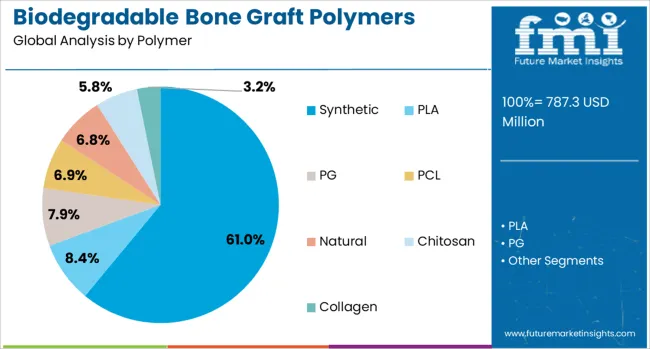
Synthetic polymers are projected to contribute 61.0% of the total revenue in the biodegradable bone graft polymers market by 2026, positioning them as the leading polymer type. Their dominance stems from their reliable manufacturing consistency, tailored degradation timelines, and absence of immunogenic risks, which are critical factors in bone regeneration.
Materials such as polylactic acid (PLA), polyglycolic acid (PGA), and their copolymers are extensively used due to their ability to support osteoconductivity and scaffold integration. Enhanced control over mechanical strength and resorption rates has enabled synthetic polymers to meet clinical performance standards across diverse patient profiles.
Their scalable production, coupled with favorable cost dynamics and strong clinical evidence, has reinforced their leadership in orthopedic and maxillofacial applications.
Insights into the Joint Reconstruction Application Segment
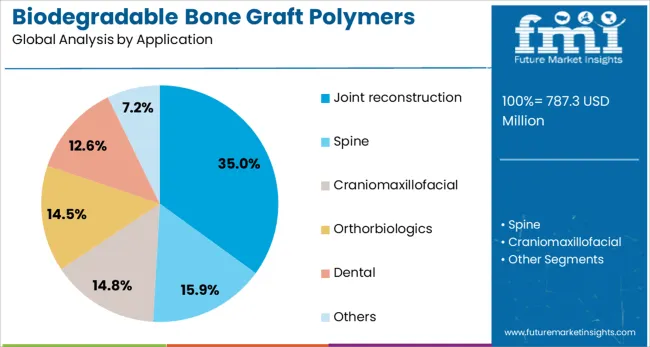
Joint reconstruction is estimated to account for 35.0% of the market revenue in 2026, making it the top application in the biodegradable bone graft polymers landscape. This leadership is attributed to the rising incidence of degenerative joint diseases, sports-related injuries, and age-related orthopedic complications.
Biodegradable polymers provide temporary scaffolding for new bone formation in joint repair, eliminating the need for implant removal surgeries and minimizing long-term complications. Clinical preference for minimally invasive procedures, especially in knee, hip, and shoulder reconstructions, is accelerating the adoption of resorbable materials.
Furthermore, orthopedic device manufacturers are increasingly integrating biodegradable polymers into bioactive implants, enhancing recovery outcomes and driving continued application in joint-related interventions.
What are the Drivers, Restraints, and Key Trends of the Biodegradable Bone Graft Polymers Market?
The biodegradable bone graft polymers market is expanding due to growing demand for biocompatible and resorbable materials in orthopedic and dental surgeries. Growth in 2024 and 2025 was driven by the increased adoption of minimally invasive procedures and polymer-based scaffolds for tissue regeneration. Opportunities are significant in custom 3D-printed grafts and hybrid composites designed for enhanced mechanical strength. Key trends include bioactive polymer formulations, controlled drug release systems, and integration with regenerative medicine solutions. However, high manufacturing costs, complex regulatory approvals, and variable material performance under load conditions continue to restrain widespread adoption.
Increasing Orthopedic and Dental Procedures Driving Growth
The primary growth driver is the rising prevalence of bone fractures, dental implants, and reconstructive surgeries requiring resorbable graft materials. In 2024 and 2025, biodegradable polymers such as polylactic acid (PLA) and polyglycolic acid (PGA) were widely used to reduce secondary surgeries associated with metallic implants. Surgeons increasingly preferred polymer-based scaffolds for their ability to degrade naturally while supporting bone regeneration. Adoption was further supported by research advancements in bioactive additives that accelerate healing. These developments confirm that demand for patient-friendly and resorbable solutions continues to shape the market trajectory globally.
Opportunities in 3D Printing and Hybrid Composite Materials
Significant opportunities exist in additive manufacturing and high-performance composite graft systems. In 2025, 3D-printed biodegradable bone grafts customized for patient anatomy gained momentum, particularly in maxillofacial and spinal surgeries. Hybrid composites combining biodegradable polymers with ceramic fillers such as hydroxyapatite demonstrated improved osteoconductivity and mechanical stability, creating new application segments. Emerging markets with expanding healthcare infrastructure presented strong growth potential for cost-efficient polymer graft systems. These patterns suggest that manufacturers focusing on innovation and scalable customization are positioned to capture substantial share in the evolving medical device landscape.
Bioactive Polymers and Drug-Loaded Grafts Leading Trends
Emerging trends highlight the development of bioactive polymers capable of enhancing bone regeneration and incorporating therapeutic functionalities. In 2024, companies introduced biodegradable grafts integrated with localized drug delivery systems to reduce infection risk and accelerate healing. Research-driven innovations aimed at incorporating growth factors into polymer matrices gained clinical interest for improving bone remodeling outcomes. Additionally, demand for grafts compatible with robotic-assisted surgeries underscored a move toward precision-driven solutions. These trends indicate a clear shift toward multifunctional and performance-optimized materials tailored for complex orthopedic and dental applications.
High Costs and Regulatory Barriers Limiting Market Expansion
Market restraints include elevated costs of biodegradable polymers, stringent regulatory approval processes, and variability in mechanical performance under load-bearing conditions. In 2024 and 2025, price-sensitive healthcare systems in emerging markets faced adoption challenges due to the premium pricing of advanced grafts. Long approval timelines for novel polymer formulations delayed commercialization, reducing overall innovation speed. Structural limitations in heavy-load orthopedic surgeries created additional clinical restrictions. These factors underline the importance of cost optimization, accelerated regulatory pathways, and material engineering improvements to enable broader adoption in global healthcare settings.
Analysis of Biodegradable Bone Graft Polymers Market By Key Countries
.webp "Top Country Growth Comparison Biodegradable Bone Graft Polymers Market Cagr (2026 2036)")
| Country | CAGR |
|---|---|
| China | 10.0% |
| India | 9.3% |
| Germany | 8.5% |
| France | 7.8% |
| UK | 7.0% |
| USA | 6.3% |
| Brazil | 5.6% |
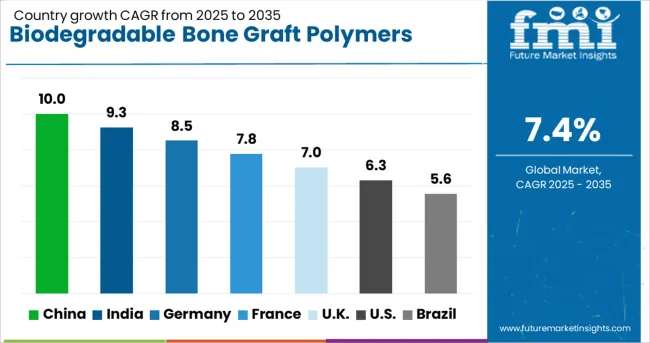
The global biodegradable bone graft polymers market is projected to grow at 7.4% CAGR during 2026-2036. China leads with 10.0% CAGR, supported by growing orthopedic surgeries and expansion of advanced healthcare infrastructure. India follows at 9.3%, driven by rising trauma cases and increasing medical tourism. Germany posts 8.5% CAGR, emphasizing R&D for high-performance bioresorbable materials in implants. The United Kingdom grows at 7.0%, while the United States records 6.3%, reflecting steady demand in mature healthcare systems prioritizing biocompatible and FDA-approved solutions. Asia-Pacific dominates due to rising surgical volumes, while Europe and North America lead in technological innovation and regulatory compliance. This report includes insights on 40+ countries; the top markets are shown here for reference.
Growth Analysis of Biodegradable Bone Graft Polymers Market in China
The biodegradable bone graft polymers market in China is forecasted to grow at 10.0% CAGR, driven by rising orthopedic and dental procedures across major cities. Increased investment in advanced surgical techniques and minimally invasive procedures boosts demand for bioresorbable grafting materials. Local manufacturers partner with global biotech firms to produce high-purity polymers, ensuring compliance with international standards. Growing adoption in trauma reconstruction and spinal surgeries accelerates market expansion.
- Trauma and spinal surgeries dominate demand for bioresorbable graft polymers.
- Collaborations with global biotech firms enhance polymer innovation capabilities.
- Government-backed healthcare reforms support large-scale adoption in hospitals.
Demand Forecast for Biodegradable Bone Graft Polymers Market in India
The biodegradable bone graft polymers market in India is expected to grow at 9.3% CAGR, fueled by a surge in joint replacement surgeries and fracture repair cases. Growth in medical tourism, particularly for orthopedic procedures, strengthens demand for cost-effective bioresorbable implants. Manufacturers introduce advanced polymers that promote faster healing and minimize secondary surgeries. E-commerce-enabled hospital supply chains improve product accessibility, enhancing adoption in tier-2 and tier-3 cities.
- Medical tourism drives demand for advanced bioresorbable grafting materials.
- E-commerce platforms streamline hospital procurement for orthopedic implants.
- Affordable polymer solutions dominate high-volume orthopedic surgery segments.
Analysis of Biodegradable Bone Graft Polymers Market in Germany
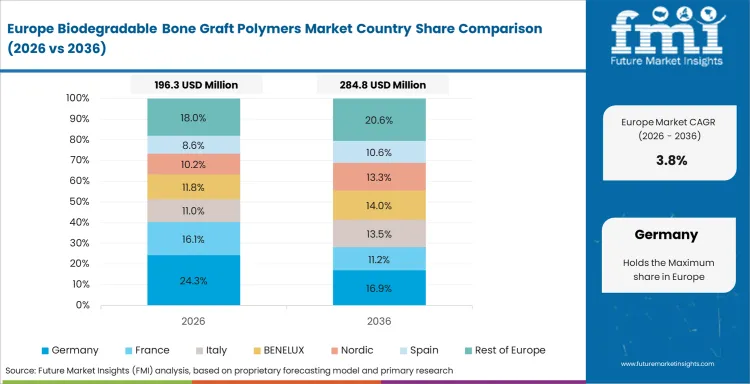
The biodegradable bone graft polymers market in Germany is projected to grow at 8.5% CAGR, driven by increasing preference for sustainable and biocompatible materials in orthopedic implants. Stringent EU regulations accelerate R&D on bio-based and patient-specific grafting solutions. Adoption of 3D-printed biodegradable polymers for complex bone reconstruction procedures strengthens Germany’s leadership in surgical innovation. Hospitals integrate advanced imaging and digital surgical planning tools to optimize graft placement and performance.
- 3D-printed biodegradable polymers dominate complex bone reconstruction procedures.
- EU regulatory compliance accelerates bio-based polymer innovation for implants.
- Digital surgical planning tools increase precision in graft integration.
Demand Forecast for Biodegradable Bone Graft Polymers Market in United Kingdom
The biodegradable bone graft polymers market in the United Kingdom is forecasted to grow at 7.0% CAGR, supported by rising adoption of minimally invasive surgeries and advanced implant materials. Leading hospitals adopt composite graft systems combining polymers with bioactive molecules to enhance healing efficiency. Personalized implants produced through additive manufacturing gain traction, particularly in trauma and dental reconstruction applications. Government funding for orthopedic research further stimulates the introduction of novel graft technologies.
- Composite graft systems combining polymers and bioactive molecules gain demand.
- Additive manufacturing supports patient-specific orthopedic solutions.
- Government-backed research programs accelerate adoption of advanced biomaterials.
Biodegradable Bone Graft Polymers Market Growth Outlook in the United States
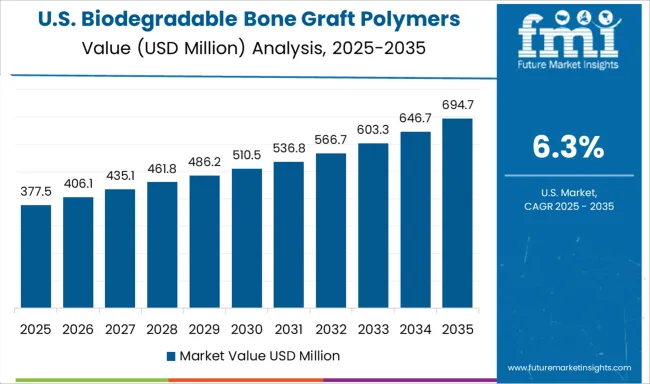
The biodegradable bone graft polymers market in the United States is projected to grow at 6.3% CAGR, reflecting stable demand in a mature healthcare ecosystem. Increasing orthopedic and dental implant procedures strengthen adoption of FDA-approved bioresorbable materials. Manufacturers focus on developing next-generation graft polymers with controlled degradation rates for better patient outcomes. Integration of smart biomaterials embedded with growth factors enhances adoption in regenerative medicine. Strong presence of leading medical device firms accelerates commercialization of high-performance biodegradable implants.
- FDA-approved graft polymers dominate adoption in orthopedic and dental procedures.
- Controlled-degradation polymers improve long-term patient recovery outcomes.
- Smart biomaterials with growth factor integration gain traction in regenerative medicine.
Competitive Landscape of Biodegradable Bone Graft Polymers Market
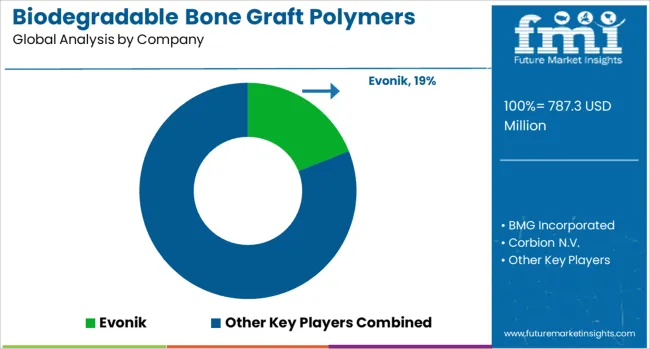
The biodegradable bone graft polymers market is dominated by Evonik, which secures its leadership through advanced polymer solutions for orthopedic and spinal applications, emphasizing biocompatibility, controlled degradation rates, and mechanical strength. Evonik strengthens its dominance with strong R&D capabilities, global manufacturing facilities, and partnerships with medical device companies to support next-generation graft technologies. Key players such as Corbion N.V., Medtronic, Zimmer Biomet, and NuVasive maintain significant market shares by integrating bioresorbable polymers into surgical implants, bone scaffolds, and regenerative products that meet stringent regulatory standards. These companies prioritize innovation in material science and ensure clinical reliability to serve the expanding orthopedic and trauma care segments. Emerging players including BMG Incorporated, Foster Corporation, KLS Martin, Polysciences, and Lactel Absorbable Polymers are enhancing competitiveness by developing niche polymer formulations for custom bone graft applications, focusing on patient-specific requirements and minimally invasive procedures. Their strategies include offering tailored resorption profiles, improving osteoconductivity, and optimizing manufacturing for additive-based and composite implant solutions. Market growth is being driven by the rising prevalence of bone disorders, increasing demand for bioresorbable alternatives to metal implants, and advancements in 3D printing for personalized graft design. Continuous innovation in polymer chemistry and integration of drug delivery functionalities are expected to shape competitive dynamics, reinforcing opportunities for both established leaders and emerging innovators globally.
Key Developments in Biodegradable Bone Graft Polymers Market
In January 2025, Evonik broadened its MedResorb™ PLA polymer portfolio in Europe with new high-strength formulations designed for trauma and orthopedic implants. These advanced blends improve mechanical strength and offer optimized degradation profiles, supporting more effective and predictable bone repair outcomes in clinical applications.
Scope of the Report
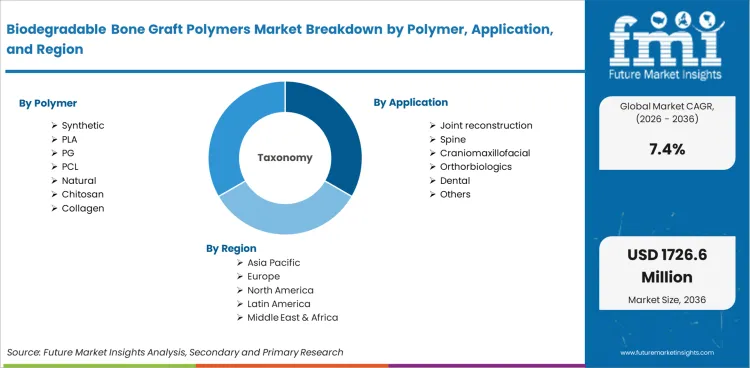
| Metric | Value |
|---|---|
| Quantitative Units | USD 845.56 million to USD 1726.58 million, at a CAGR of 7.4% |
| Market Definition | Biodegradable bone graft polymers are resorbable synthetic and natural polymer substrates engineered to serve as temporary scaffolds for bone defect repair and regeneration. The category encompasses synthetic polymers including polylactic acid (PLA), polyglycolic acid (PGA), and polycaprolactone (PCL), as well as natural polymers including chitosan and collagen. |
| Polymer Segmentation | Synthetic (PLA, PG, PCL), Natural (Chitosan, Collagen) |
| Application Segmentation | Joint Reconstruction, Spine, Craniomaxillofacial, Orthobiologics, Dental, Others |
| Regions Covered | North America, Latin America, Europe, East Asia, South Asia, Oceania, Middle East & Africa |
| Countries Covered | China, India, Germany, France, UK, USA, Brazil, and 40 plus countries |
| Key Companies Profiled | Evonik, BMG Incorporated, Corbion N.V., Foster Corporation, KLS Martin, Lactel Absorbable Polymers, Medtronic, NuVasive, Polysciences, Zimmer Biomet |
| Forecast Period | 2026 to 2036 |
| Approach | Forecasting models apply a hybrid bottom-up and top-down methodology starting with installed base metrics and production volumes, cross-validated against industry expenditure data and regulatory compliance adoption rates. |
Biodegradable Bone Graft Polymers Market by Segments
Polymer:
- Synthetic
- PLA
- PG
- PCL
- Natural
- Chitosan
- Collagen
Application:
- Joint reconstruction
- Spine
- Craniomaxillofacial
- Orthorbiologics
- Dental
- Others
Region:
- North America
- USA
- Canada
- Mexico
- Latin America
- Brazil
- Chile
- Rest of Latin America
- Western Europe
- Germany
- UK
- Italy
- Spain
- France
- Nordic
- BENELUX
- Rest of Western Europe
- Eastern Europe
- Russia
- Poland
- Hungary
- Balkan & Baltic
- Rest of Eastern Europe
- East Asia
- China
- Japan
- South Korea
- South Asia and Pacific
- India
- ASEAN
- Australia & New Zealand
- Rest of South Asia and Pacific
- Middle East & Africa
- Kingdom of Saudi Arabia
- Other GCC Countries
- Turkiye
- South Africa
- Other African Union
- Rest of Middle East & Africa
Bibliography
- 1. World Health Organization. (2024). Global atlas of medical devices: orthopedic implant categories. WHO.
- 2. Organisation for Economic Co-operation and Development. (2024). Health at a Glance: hip and knee replacement procedure volumes. OECD.
- 3. USA Food and Drug Administration. (2024). 510(k) premarket notification database: orthopedic polymer devices. FDA.
- 4. European Commission. (2017). Regulation (EU) 2017/745 on medical devices. Official Journal of the European Union.
- 5. International Organization for Standardization. (2018). ISO 10993-1:2018 Biological evaluation of medical devices. ISO.
- 6. Zimmer Biomet Holdings, Inc. (2024). Annual Report 2024. Zimmer Biomet.
This bibliography is provided for reader reference. The full Future Market Insights report contains the complete reference list with primary research documentation.
Frequently Asked Questions
How large is the demand for Biodegradable Bone Graft Polymers in the global market in 2026?
Demand for Biodegradable Bone Graft Polymers in the global market is estimated to be valued at USD 845.56 million in 2026.
What will be the market size of Biodegradable Bone Graft Polymers in the global market by 2036?
Market size for Biodegradable Bone Graft Polymers is projected to reach USD 1726.58 million by 2036.
What is the expected demand growth for Biodegradable Bone Graft Polymers in the global market between 2026 and 2036?
Demand for Biodegradable Bone Graft Polymers is expected to grow at a CAGR of 7.4% between 2026 and 2036.
Which Polymer is poised to lead global sales by 2026?
Synthetic accounts for 61% share in 2026 as the leading polymer category in the biodegradable bone graft polymers market.
How is the role of Joint Reconstruction in driving Biodegradable Bone Graft Polymers adoption in 2026?
Joint Reconstruction represents 35% of application share in the biodegradable bone graft polymers market in 2026.
What is driving demand in China?
China is projected to grow at a CAGR of 10% during 2026 to 2036, representing the fastest-growing national market.
What does the market forecast represent?
The market forecast represents a model-based projection built on defined industry, regulatory, and supply chain assumptions for strategic planning purposes.
How does FMI build and validate the Biodegradable Bone Graft Polymers forecast?
Forecasting models apply a hybrid bottom-up methodology starting with global production and procurement metrics, cross-validated against industry expenditure volumes and regulatory compliance adoption data.
Preview the report firsthand - request a free sample
Get SampleGet the brochure for pricing and purchase details.
Get PDFTable of Content
- Executive Summary
- Global Market Outlook
- Demand-side Trends
- Supply-side Trends
- Technology Roadmap Analysis
- Analysis and Recommendations
- Chapter Orientation
- Analytical Lens and Working Hypotheses
- Market Structure, Signals, and Trend Drivers
- Benchmarking and Cross-market Comparability
- Market Sizing, Forecasting, and Opportunity Mapping
- Research Design and Evidence Framework
- Desk Research Programme (Secondary Evidence)
- Company Annual and Sustainability Reports
- Peer-reviewed Journals and Academic Literature
- Corporate Websites, Product Literature, and Technical Notes
- Earnings Decks and Investor Briefings
- Statutory Filings and Regulatory Disclosures
- Technical White Papers and Standards Notes
- Trade Journals, Industry Magazines, and Analyst Briefs
- Conference Proceedings, Webinars, and Seminar Materials
- Government Statistics Portals and Public Data Releases
- Press Releases and Reputable Media Coverage
- Specialist Newsletters and Curated Briefings
- Sector Databases and Reference Repositories
- FMI Internal Proprietary Databases and Historical Market Datasets
- Subscription Datasets and Paid Sources
- Social Channels, Communities, and Digital Listening Inputs
- Additional Desk Sources
- Social and Community Interactions
- Desk Research Programme (Secondary Evidence)
- Stakeholder Universe Engaged
- C-suite Leaders
- Board Members
- Presidents and Vice Presidents
- R&D and Innovation Heads
- Technical Specialists
- Domain Subject-matter Experts
- Scientists
- Physicians and Other Healthcare Professionals
- Governance, Ethics, and Data Stewardship
- Research Ethics
- Data Integrity and Handling
- Tooling, Models, and Reference Databases
- Data Engineering and Model Build
- Data Acquisition and Ingestion
- Cleaning, Normalisation, and Verification
- Synthesis, Triangulation, and Analysis
- Quality Assurance and Audit Trail
- Market Background
- Market Dynamics
- Drivers
- Restraints
- Opportunity
- Trends
- Scenario Forecast
- Demand in Optimistic Scenario
- Demand in Likely Scenario
- Demand in Conservative Scenario
- Opportunity Map Analysis
- Product Life Cycle Analysis
- Supply Chain Analysis
- Investment Feasibility Matrix
- Value Chain Analysis
- PESTLE and Porter’s Analysis
- Regulatory Landscape
- Regional Parent Market Outlook
- Production and Consumption Statistics
- Import and Export Statistics
- Market Dynamics
- Global Market Analysis 2021 to 2025 and Forecast, 2026 to 2036
- Historical Market Size Value (USD Million) Analysis, 2021 to 2025
- Current and Future Market Size Value (USD Million) Projections, 2026 to 2036
- Y-o-Y Growth Trend Analysis
- Absolute $ Opportunity Analysis
- Global Market Pricing Analysis 2021 to 2025 and Forecast 2026 to 2036
- Global Market Analysis 2021 to 2025 and Forecast 2026 to 2036, By Polymer
- Introduction / Key Findings
- Historical Market Size Value (USD Million) Analysis By Polymer , 2021 to 2025
- Current and Future Market Size Value (USD Million) Analysis and Forecast By Polymer , 2026 to 2036
- Synthetic
- PLA
- PG
- PCL
- Natural
- Chitosan
- Collagen
- Synthetic
- Y-o-Y Growth Trend Analysis By Polymer , 2021 to 2025
- Absolute $ Opportunity Analysis By Polymer , 2026 to 2036
- Global Market Analysis 2021 to 2025 and Forecast 2026 to 2036, By Application
- Introduction / Key Findings
- Historical Market Size Value (USD Million) Analysis By Application, 2021 to 2025
- Current and Future Market Size Value (USD Million) Analysis and Forecast By Application, 2026 to 2036
- Joint reconstruction
- Spine
- Craniomaxillofacial
- Orthorbiologics
- Dental
- Others
- Joint reconstruction
- Y-o-Y Growth Trend Analysis By Application, 2021 to 2025
- Absolute $ Opportunity Analysis By Application, 2026 to 2036
- Global Market Analysis 2021 to 2025 and Forecast 2026 to 2036, By Region
- Introduction
- Historical Market Size Value (USD Million) Analysis By Region, 2021 to 2025
- Current Market Size Value (USD Million) Analysis and Forecast By Region, 2026 to 2036
- North America
- Latin America
- Western Europe
- Eastern Europe
- East Asia
- South Asia and Pacific
- Middle East & Africa
- Market Attractiveness Analysis By Region
- North America Market Analysis 2021 to 2025 and Forecast 2026 to 2036, By Country
- Historical Market Size Value (USD Million) Trend Analysis By Market Taxonomy, 2021 to 2025
- Market Size Value (USD Million) Forecast By Market Taxonomy, 2026 to 2036
- By Country
- USA
- Canada
- Mexico
- By Polymer
- By Application
- By Country
- Market Attractiveness Analysis
- By Country
- By Polymer
- By Application
- Key Takeaways
- Latin America Market Analysis 2021 to 2025 and Forecast 2026 to 2036, By Country
- Historical Market Size Value (USD Million) Trend Analysis By Market Taxonomy, 2021 to 2025
- Market Size Value (USD Million) Forecast By Market Taxonomy, 2026 to 2036
- By Country
- Brazil
- Chile
- Rest of Latin America
- By Polymer
- By Application
- By Country
- Market Attractiveness Analysis
- By Country
- By Polymer
- By Application
- Key Takeaways
- Western Europe Market Analysis 2021 to 2025 and Forecast 2026 to 2036, By Country
- Historical Market Size Value (USD Million) Trend Analysis By Market Taxonomy, 2021 to 2025
- Market Size Value (USD Million) Forecast By Market Taxonomy, 2026 to 2036
- By Country
- Germany
- UK
- Italy
- Spain
- France
- Nordic
- BENELUX
- Rest of Western Europe
- By Polymer
- By Application
- By Country
- Market Attractiveness Analysis
- By Country
- By Polymer
- By Application
- Key Takeaways
- Eastern Europe Market Analysis 2021 to 2025 and Forecast 2026 to 2036, By Country
- Historical Market Size Value (USD Million) Trend Analysis By Market Taxonomy, 2021 to 2025
- Market Size Value (USD Million) Forecast By Market Taxonomy, 2026 to 2036
- By Country
- Russia
- Poland
- Hungary
- Balkan & Baltic
- Rest of Eastern Europe
- By Polymer
- By Application
- By Country
- Market Attractiveness Analysis
- By Country
- By Polymer
- By Application
- Key Takeaways
- East Asia Market Analysis 2021 to 2025 and Forecast 2026 to 2036, By Country
- Historical Market Size Value (USD Million) Trend Analysis By Market Taxonomy, 2021 to 2025
- Market Size Value (USD Million) Forecast By Market Taxonomy, 2026 to 2036
- By Country
- China
- Japan
- South Korea
- By Polymer
- By Application
- By Country
- Market Attractiveness Analysis
- By Country
- By Polymer
- By Application
- Key Takeaways
- South Asia and Pacific Market Analysis 2021 to 2025 and Forecast 2026 to 2036, By Country
- Historical Market Size Value (USD Million) Trend Analysis By Market Taxonomy, 2021 to 2025
- Market Size Value (USD Million) Forecast By Market Taxonomy, 2026 to 2036
- By Country
- India
- ASEAN
- Australia & New Zealand
- Rest of South Asia and Pacific
- By Polymer
- By Application
- By Country
- Market Attractiveness Analysis
- By Country
- By Polymer
- By Application
- Key Takeaways
- Middle East & Africa Market Analysis 2021 to 2025 and Forecast 2026 to 2036, By Country
- Historical Market Size Value (USD Million) Trend Analysis By Market Taxonomy, 2021 to 2025
- Market Size Value (USD Million) Forecast By Market Taxonomy, 2026 to 2036
- By Country
- Kingdom of Saudi Arabia
- Other GCC Countries
- Turkiye
- South Africa
- Other African Union
- Rest of Middle East & Africa
- By Polymer
- By Application
- By Country
- Market Attractiveness Analysis
- By Country
- By Polymer
- By Application
- Key Takeaways
- Key Countries Market Analysis
- USA
- Pricing Analysis
- Market Share Analysis, 2025
- By Polymer
- By Application
- Canada
- Pricing Analysis
- Market Share Analysis, 2025
- By Polymer
- By Application
- Mexico
- Pricing Analysis
- Market Share Analysis, 2025
- By Polymer
- By Application
- Brazil
- Pricing Analysis
- Market Share Analysis, 2025
- By Polymer
- By Application
- Chile
- Pricing Analysis
- Market Share Analysis, 2025
- By Polymer
- By Application
- Germany
- Pricing Analysis
- Market Share Analysis, 2025
- By Polymer
- By Application
- UK
- Pricing Analysis
- Market Share Analysis, 2025
- By Polymer
- By Application
- Italy
- Pricing Analysis
- Market Share Analysis, 2025
- By Polymer
- By Application
- Spain
- Pricing Analysis
- Market Share Analysis, 2025
- By Polymer
- By Application
- France
- Pricing Analysis
- Market Share Analysis, 2025
- By Polymer
- By Application
- India
- Pricing Analysis
- Market Share Analysis, 2025
- By Polymer
- By Application
- ASEAN
- Pricing Analysis
- Market Share Analysis, 2025
- By Polymer
- By Application
- Australia & New Zealand
- Pricing Analysis
- Market Share Analysis, 2025
- By Polymer
- By Application
- China
- Pricing Analysis
- Market Share Analysis, 2025
- By Polymer
- By Application
- Japan
- Pricing Analysis
- Market Share Analysis, 2025
- By Polymer
- By Application
- South Korea
- Pricing Analysis
- Market Share Analysis, 2025
- By Polymer
- By Application
- Russia
- Pricing Analysis
- Market Share Analysis, 2025
- By Polymer
- By Application
- Poland
- Pricing Analysis
- Market Share Analysis, 2025
- By Polymer
- By Application
- Hungary
- Pricing Analysis
- Market Share Analysis, 2025
- By Polymer
- By Application
- Kingdom of Saudi Arabia
- Pricing Analysis
- Market Share Analysis, 2025
- By Polymer
- By Application
- Turkiye
- Pricing Analysis
- Market Share Analysis, 2025
- By Polymer
- By Application
- South Africa
- Pricing Analysis
- Market Share Analysis, 2025
- By Polymer
- By Application
- USA
- Market Structure Analysis
- Competition Dashboard
- Competition Benchmarking
- Market Share Analysis of Top Players
- By Regional
- By Polymer
- By Application
- Competition Analysis
- Competition Deep Dive
- Evonik
- Overview
- Product Portfolio
- Profitability by Market Segments (Product/Age /Sales Channel/Region)
- Sales Footprint
- Strategy Overview
- Marketing Strategy
- Product Strategy
- Channel Strategy
- BMG Incorporated
- Corbion N.V.
- Foster Corporation
- KLS Martin
- Lactel Absorbable Polymers
- Medtronic
- NuVasive
- Polysciences
- Zimmer Biomet
- Evonik
- Competition Deep Dive
- Assumptions & Acronyms Used


