

- Industry Size (2026)
- USD 187.0 Mn
- Forecast (2036)
- USD 357.8 Mn
- CAGR (2026 to 2036)
- 6.7%
Compostable Cotton Swab Market Size, Market Forecast and Outlook By FMI
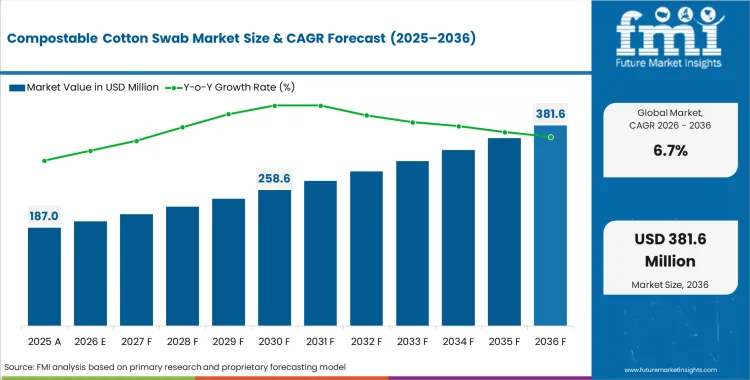
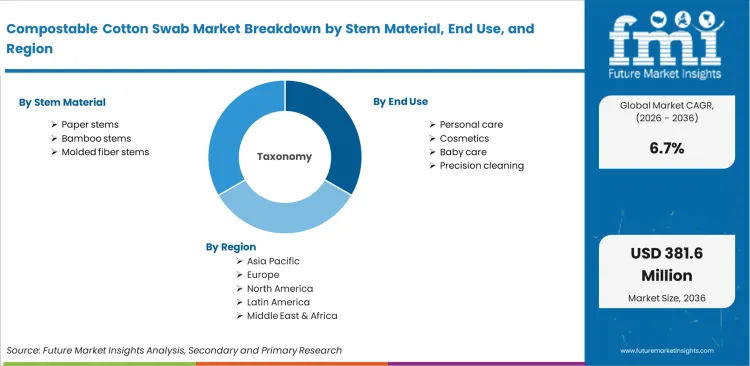
The compostable cotton swab market crossed a valuation of USD 175.3 million in 2025. Demand is poised to cross USD 187.0 million in 2026 at a CAGR of 6.7% during this forecast period. Sustained investment carries total industry valuation to USD 357.8 million through 2036 as global retail chains enforce strict compliance deadlines to eliminate plastic stems from their inventories.
Summary of Compostable Cotton Swab Market
- The market is forecast to reach USD 357.8 million by 2036.
- The market is expected to grow at a CAGR of 6.7% from 2026 to 2036.
- The market was estimated at USD 175.3 million in 2025.
- The market represents an incremental opportunity of USD 170.0 million over the forecast period.
- Paper stem products lead by material type with a 48.0% share in 2026.
- Personal care applications dominate with a 54.0% share in 2026.
- E-commerce distribution accounts for 34.0% share in 2026.
- Industrial compostable certification leads with a 46.0% share in 2026.
- India is the fastest-growing market at 8.2%, followed by Australia at 7.5% and Germany at 7.3%.
- The market is driven by regulatory bans on plastic stems, rising demand for eco-friendly hygiene products, and increased availability of certified compostable alternatives.
- Key companies in the market include The Humble Co., Simply Gentle Organic, Organyc, HYDROPHIL, Bamboovement, BOCOTON, and Pearl Packaging.
Store-level assortment decisions are increasingly influenced by tighter environmental rules. Brands risk losing shelf access across Europe and Asia when products continue using conventional plastic stems. Suppliers are being pushed to shift toward plastic-free cotton swab formats to protect retail contracts and maintain category presence. Natural input availability remains less predictable, which creates stock pressure for smaller brands trying to keep shipments steady. Packaging performance is also becoming more important in this transition. Natural tissue and hygiene formats require stronger moisture control so stems do not soften before purchase, as weak packaging discipline can leave damaged goods on display and reduce retail confidence.
Municipal disposal systems also play a direct role in adoption. Demand for eco-friendly cotton swabs improves when local waste programs allow disposal through household green-bin systems. Clear and consistent labeling reduces consumer uncertainty at the point of disposal. Once sorting rules become easier to follow, daily disposal habits tend to align more closely with product claims. Retailers gain more confidence in stocking larger volumes when compostability instructions match local collection systems and product performance remains reliable through disposal.
Stringent national restrictions on single-use plastic formats are expected to support an 8.2% CAGR for the cotton swabs market in India during 2026 to 2036. Retail-led replacement of conventional cotton buds with compostable alternatives is likely to help Australia record 7.5% CAGR over the forecast period. Germany is projected to expand at a CAGR of 7.3% through 2036, supported by well-established domestic composting infrastructure. Local pharmacy and private-label shifts toward paper alternatives are expected to help the cotton swabs market in the United Kingdom grow at 7.0% CAGR during 2026 to 2036. France is forecast to register 6.9% CAGR over the same period, reflecting tighter eco-labeling enforcement across consumer goods categories. State-level plastic restrictions remain uneven in the United States, yet demand is still likely to advance at a CAGR of 6.1% through 2036. Japan is anticipated to post 5.4% CAGR during the forecast period as domestic brands gradually incorporate natural fibers into premium beauty lines. Differences in municipal sorting capability continue to shape the pace of adoption across these markets.
Segmental Analysis
Compostable Cotton Swab Market Analysis by Stem Material
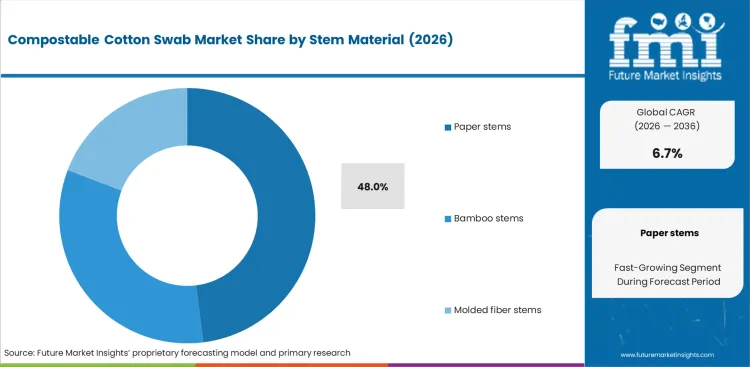
Factory equipment limits dictate exactly which fiber types replace plastic lines first. Plant operators face almost zero downtime when switching existing high-speed wrapping machines to run compressed paper. Paper stems are estimated to account for an anticipated 48.0% share in 2026, as they closely mimic the tensile strength of legacy plastics. Brands specifying biodegradable packaging formats strongly prefer paper because it keeps the visual profile uniform inside retail cartons. Retail buyers lock in massive supply contracts for tightly wound paper sticks to guarantee consistent shelf displays. Shipping these items requires strict humidity controls during ocean freight to stop fibers from turning soft before reaching store shelves.
- Equipment Calibration: High-speed wrapping machines process compressed paper without requiring expensive retooling or line shutdowns. Plant operators avoid massive capital expenditures while maintaining output quotas.
- Tensile Testing: Rigidity limits determine whether a paper stem survives aggressive consumer usage without bending. Sourcing units reject batches failing basic pressure tests.
- Moisture Vulnerability: Ambient humidity softens paper stems long before they reach store shelves. Logistics planners must mandate climate-controlled shipping containers to preserve structural integrity.
Compostable Cotton Swab Market Analysis by End Use
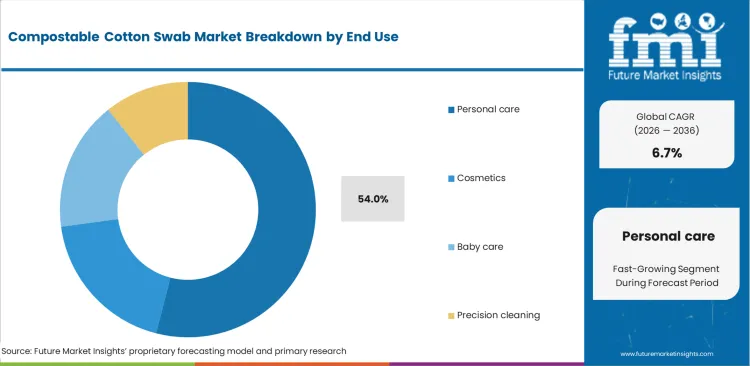
Daily bathroom routines burn through bulk applicator boxes at highly predictable rates. Basic hygiene tasks tolerate slightly softer stems than precision beauty applications, allowing formulators to use lower-grade fibers and cut overall production costs. Market data shows ear wax removal products heavily influence this massive daily volume. Retail buyers allocate their best shelf space to these household basics because they drive consistent foot traffic into stores. Reflecting this relentless consumer demand, the personal care segment is projected to secure a projected 54.0% share in 2026 without requiring specialized rigid stems. Automated delivery subscriptions further lock in this recurring revenue stream by bypassing local retail shelves entirely.
- Volume Velocity: Daily bathroom routines burn through bulk boxes at highly predictable rates. Retail buyers depend on fast turnover to maximize shelf profitability.
- Rigidity Requirements: Basic hygiene tasks tolerate slightly softer stems than compostable cotton swabs for baby care or precision cosmetic application. Formulators utilize lower-grade fibers here to optimize overall production costs.
- Subscription Models: Direct-to-consumer platforms push these basics through automated delivery schedules. Brands capture recurring revenue streams while locking out local retail competitors.
Compostable Cotton Swab Market Analysis by Distribution
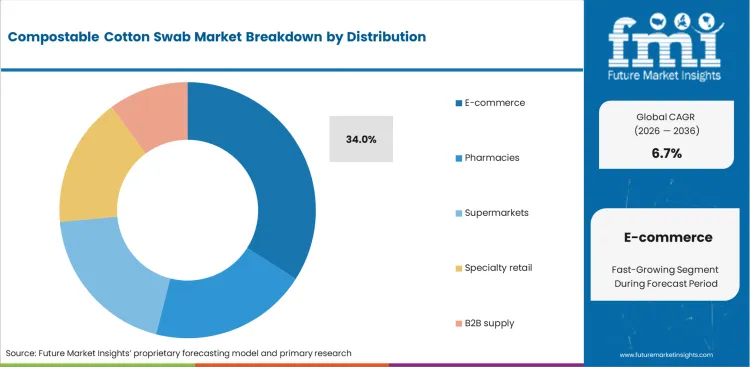
Digital storefronts allow brands to explain complex environmental certifications fully before shoppers commit to a purchase. E-commerce is anticipated to capture a forecasted 34.0% of the market in 2026, driven by younger demographics seeking verified plastic-free household goods. Online algorithms automatically suggest these items alongside personal care packaging formats that highlight zero-waste credentials. Direct fulfillment easily bypasses crowded physical shelves while locking in recurring subscription deliveries. Shipping fragile cardboard boxes individually often results in crushed deliveries if fulfillment centers fail to reinforce outward packaging.
- Storytelling Space: Digital platforms provide infinite room to explain complex environmental certifications. Shoppers educate themselves fully before initiating transactions.
- Algorithmic Bundling: Online carts suggest items alongside other plastic-free bathroom basics automatically. Digital marketers leverage adjacencies to increase average order values.
- Crush Risks: Individual parcel shipping routinely damages thin cardboard swab boxes in transit. Fulfillment centers face high return rates if they fail to reinforce outward packaging.
Compostable Cotton Swab Market Analysis by Certification
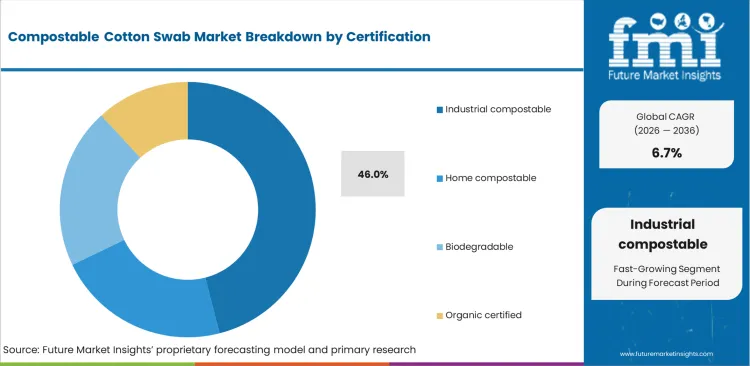
City sorting rules decide which environmental labels matter at the household level. Local green bins feed directly into massive regional processing plants operating at temperatures high enough to break down dense molded fibers. Industrial compostable certification is poised to garner 46.0% share in 2026, as brands actively align their claims with existing urban infrastructure. Commercial buyers pay premium prices for compostable foodservice packaging standards to maintain approved vendor status across their supply chains. Most households still toss bathroom waste into standard trash cans, causing many certified items to rot slowly in conventional landfills regardless of the label.
- Infrastructure Alignment: City green bins connect households directly to high-heat processing centers. Brands utilize existing pathways to validate environmental claims.
- Sorting Confusion: Consumers rarely separate bathroom waste into distinct degradable bins. Municipalities struggle capturing specific items for proper high-heat processing.
- Premium Costs: Attaining recognized compostable swab certification standards requires expensive third-party laboratory testing. Sourcing departments absorb testing fees to maintain approved vendor status.
Compostable Cotton Swab Market Analysis by Pack Format
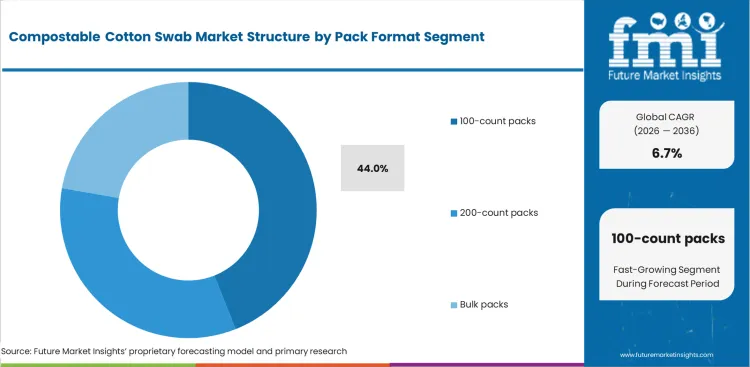
Standard medicine cabinets perfectly fit very specific box geometries, pushing supermarkets to favor formats that maximize brand variety on a single shelf. Shoppers perceive mid-sized boxes as the baseline standard for bathroom freshness and physical organization. Packing natural stems tightly together prevents them from absorbing ambient moisture, acting as a natural structural brace during international shipping. Market data indicates the 100-count pack category is likely to account for an expected 44.0% share in 2026, satisfying both consumer storage limits and retail display constraints. Manufacturers deliberately use product density inside these specific hygiene packaging boxes to reduce transit damage.
- Shelf Geometry: Standard retail displays perfectly fit multiple rows of specific box sizes. Supermarkets maximize return on physical space by rejecting awkwardly shaped bulk containers.
- Cabinet Constraints: Household bathrooms lack deep storage for massive bulk purchases. Buyers purchase smaller boxes repeatedly to keep vanity spaces organized.
- Density Protection: Tightly packed stems support each other against crushing impacts during transport. Manufacturing specialists use product mass as internal bracing to reduce shipping damage.
Compostable Cotton Swab Market Drivers, Restraints, and Opportunities
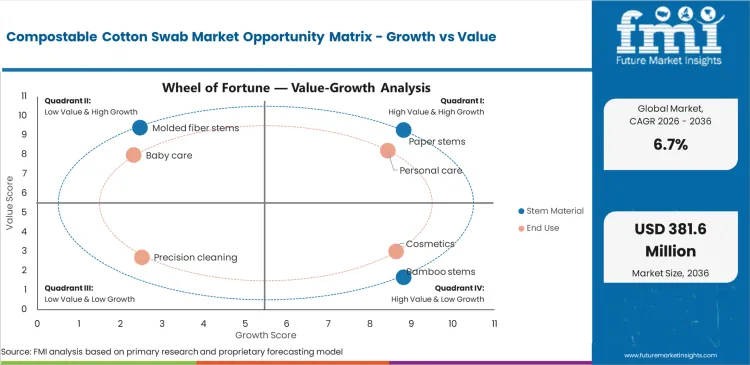
Retail store bans on plastic buds force manufacturers to change their production lines immediately. Supermarkets and pharmacies across Europe and Asia face heavy fines if they keep selling standard plastic stems. Retail chains clearing out old stock create huge, sudden orders for plastic-free disposable hygiene products. Factories securing these rush orders often lock in long-term supply contracts with major stores. Companies that already import raw vegetal natural fiber easily step in to handle this extra demand. Fast-approaching legal deadlines force brands to skip usual testing phases and launch paper or bamboo options straight to store shelves.
Ocean shipping ruins large volumes of finished goods because natural stems absorb moisture easily. Paper and bamboo act like sponges in damp cargo holds. Factories must pay extra for climate-controlled shipping containers to stop products from turning soft before they reach stores. Adding moisture-absorbing packets inside boxes helps slightly, but extra packaging goes against the core goal of reducing waste. Production groups constantly balance keeping the stems rigid while strictly following environmental rules.
- Hospitality shifts: Hotel chains need to remove standard plastics from guest bathrooms completely. Commercial suppliers win big contracts by offering natural swabs alongside compostable and biodegradable refuse bags for room cleaning.
- Beauty clinic tools: High-end makeup application requires rigid sticks and specially shaped tips. Brands earn higher profit margins by designing strong bamboo tools for premium organic cosmetics use.
- Domestic farming waste: Unpredictable ocean freight costs constantly cut into factory profits. Supply networks solve this by building local supply chains that turn nearby farm waste into usable swab stems.
Regional Analysis
Based on regional analysis, Compostable Cotton Swab Market is segmented into Asia-Pacific, Europe, North America & Latin America, and Middle-East across 40 plus countries. Local waste management rules and retail restrictions dictate how fast different areas adopt plastic-free hygiene tools. Regions with strict government bans see rapid transitions, while areas relying on voluntary retail pledges experience slower shifts.
.webp "Top Country Growth Comparison Compostable Cotton Swab Market Cagr (2026 2036)")
| Country | CAGR (2026 to 2036) |
|---|---|
| India | 8.2% |
| Australia | 7.5% |
| Germany | 7.3% |
| United Kingdom | 7.0% |
| France | 6.9% |
| United States | 6.1% |
| Japan | 5.4% |
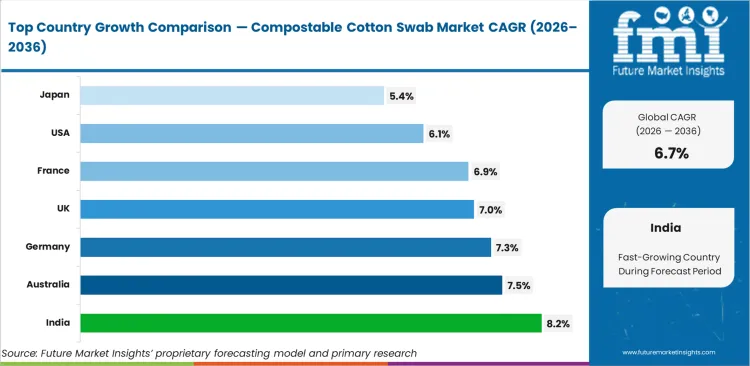
Source: Future Market Insights (FMI) analysis, based on proprietary forecasting model and primary research
Asia-Pacific Compostable Cotton Swab Market Analysis
Strict national mandates targeting single-use plastics reshape Asian manufacturing hubs profoundly. Massive production facilities are replacing legacy plastic lines to process natural fibers at scale. Local availability of raw materials like bamboo gives domestic producers distinct cost advantages over western competitors. Supply planners prioritize securing long-term agricultural contracts to feed high-speed lines and keep export pricing highly competitive. Consumers across these countries are increasingly aware of plastic pollution, forcing brands to adapt quickly. Retail networks actively clear out non-compliant stock to avoid sudden regulatory fines.
- India: Stringent national bans on plastic buds force massive domestic transitions across the entire supply chain. The compostable cotton swab market in India is set to rise at an 8.2% CAGR through 2036, as retail buyers clear out old inventory and replace it entirely with localized paper alternatives. Domestic producers capture immense volume by matching legacy price points directly on store shelves. Local manufacturing capabilities allow brands to bypass expensive import routes. Shoppers accept the new materials readily because the visual difference remains minimal. Suppliers find immediate success when they partner directly with large regional supermarket chains.
- Australia: Demand for compostable cotton swabs in Australia is likely to grow at a CAGR of 7.5% during 2026 to 2036. Retail sustainability standards are tightening, which is pushing more shelf space toward products with clearer environmental positioning. Consumer acceptance is also improving as compostable hygiene items become more familiar in everyday household use. State-level restrictions on conventional plastic formats are expected to keep supporting this shift. Brands with credible material claims and reliable supply are likely to hold a stronger position across supermarket and pharmacy channels.
- Japan: Premium beauty brands slowly integrate high-quality natural fibers into specialized applicator lines to maintain their luxury positioning. Consumers demand flawless aesthetic performance regardless of the underlying material, which helps Japan post a steady CAGR of 5.4% in natural stem swabs by 2036. Strict quality control protocols slow initial adoption but guarantee long-term brand loyalty once established. Cosmetic clinics use these verified natural stems to align with their internal sustainability pledges. Manufacturers invest heavily in rigid bamboo formats to ensure precision tools do not bend during critical application steps. High domestic standards successfully block low-quality imports from flooding retail shelves.
FMI’s report includes China, South Korea, and Southeast Asian nations. Regional export dominance relies heavily on maintaining steady access to raw bamboo forests and fermentation based bioplastic building blocks for health and hygiene products to support global supply chains.
Europe Compostable Cotton Swab Market Analysis
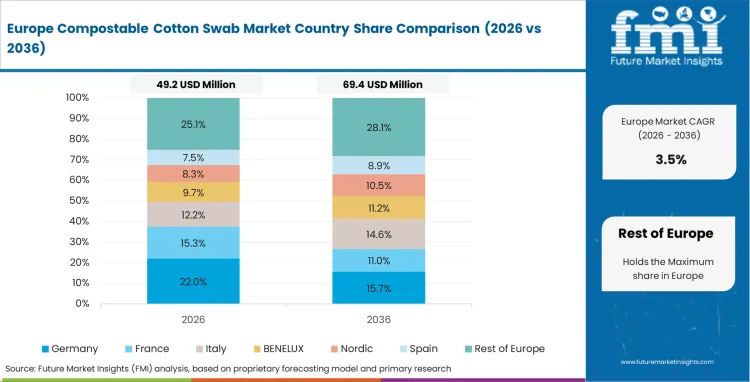
Established municipal green-waste infrastructure allows European countries to validate environmental claims easily. Households already possess multiple specific bins for different waste types. Preexisting sorting behavior makes transitions to biodegradable hygiene tools virtually frictionless. Sourcing departments focus heavily on securing strict eco-labels required to enter premium pharmacy chains. The primary focus shifts from convincing consumers to try products toward proving exact degradation timelines to regulatory bodies. Commercial buyers simply will not authorize purchase orders without proper third-party documentation.
- Germany: Deep-rooted domestic composting facilities easily process millions of used stems weekly. Brands leverage this infrastructure to prove their products actually degrade as advertised, leading the produce market in Germany to see sales grow at an anticipated CAGR of 7.3% over this forecast period. Local manufacturers dominate premium retail tiers by highlighting their immediate proximity to certified testing labs. Consumers actively seek out the industrial compostable badges on packaging before making purchase decisions. Domestic supply chains operate smoothly without relying heavily on distant material imports.
- United Kingdom: Major pharmacy chains replace entire store-brand inventories with paper-stemmed alternatives to stay ahead of public sentiment. The compostable cotton swab market in the UK is expected to register a predicted CAGR of 7.0% through 2036 because corporate buyers strictly enforce packaging redesigns that eliminate plastic windows on boxes. High-footfall retail locations drive massive recurring volumes for compliant suppliers. Health and beauty retailers view this transition as a baseline requirement for doing business rather than a premium feature. Consumer demand remains stable as long as the structural integrity of the paper stems matches historical plastic performance.
- France: Compostable cotton swab sales in France are projected to rise at a CAGR of 6.9% during 2026 to 2036, supported by strict labeling requirements across the category. Clear compliance standards are raising the threshold for market participation, especially where biodegradability claims require reliable product validation. This environment gives compliant brands a stronger position against low-credibility imports. Consumer trust also improves when disposal and material claims are clearly supported. Local manufacturers are therefore focusing on stem durability and moisture resistance so products remain stable through storage and transit.
FMI estimates that stricter standards for disposable hygiene products are helping align regulatory treatment across the European trading bloc. Coverage in the report also includes Italy, Spain, and the Nordic countries.
North America & Latin America Compostable Cotton Swab Market Analysis
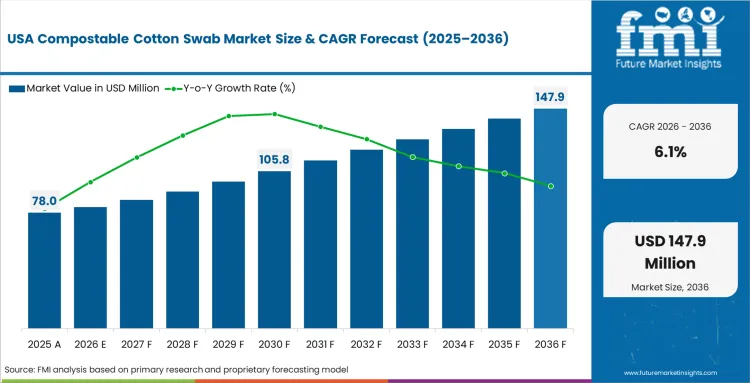
Fragmented state and local regulations create complex compliance maps for brands operating across North and South America. Certain municipalities enforce strict bans while neighboring regions maintain no restrictions at all. Retailers operating national chains demand universal compliance to simplify internal logistics. Such a dynamic pushes entire retail sectors toward natural fibers even in areas without legal mandates. Brands struggle communicating accurate disposal instructions when city capabilities vary wildly from one postal code to the next.
- United States: Massive retail conglomerates dictate packaging standards for vast regional territories. Demand tracking the compostable cotton swab market in the US is anticipated to rise at an expected CAGR of 6.1% through 2036 as brands scramble to comply with retailer mandates and maintain shelf visibility. The lack of unified municipal composting forces many of these products into standard landfills despite their degradable design. Manufacturers focus primarily on securing the front-end sale through eco-friendly branding. Commercial buyers prioritize bulk pricing parity with plastic rather than worrying about end-of-life disposal realities.
Competitive Aligners for Market Players
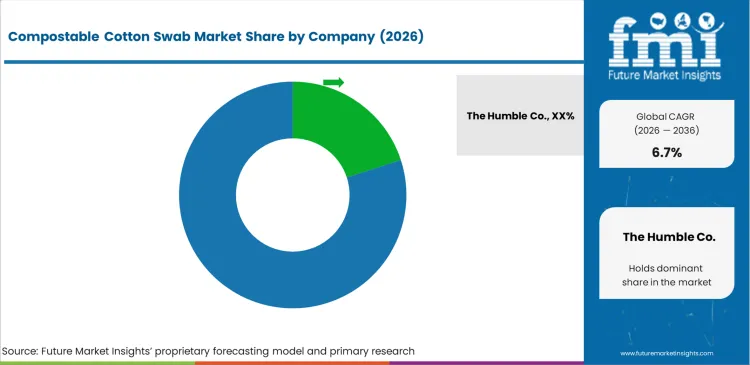
Competition in this consumable category is shaped largely by contract manufacturing. Only a small number of consumer brands control the large extrusion and wrapping lines needed to produce efficiently, which leaves most of the category dependent on outside manufacturing partners. Reliable production access across major Asian and European facilities often matters more than brand visibility when supply is tight. Vendor selection in compostable cotton swabs usually comes down to steady quality, low defect rates, and strong moisture control during ocean transit. Suppliers that secure dependable mill partnerships are generally in a stronger position to keep stick quality consistent and avoid disruption at retail level.
Established suppliers benefit from relationships that have taken years to build. Long-standing access to pulp and fiber trading networks makes it easier for them to manage raw material swings and maintain volume commitments when conditions tighten. Smaller entrants tend to feel pressure faster when compostable cotton bud prices rise or container space becomes harder to secure. Alternative agricultural waste fibers offer a practical route for newer suppliers trying to reduce that exposure. Higher-priced organic and specialty channels can also support better margin recovery while production costs are still settling.
Retailers rarely want private-label hygiene supply tied to one large producer. Splitting orders across several mid-sized manufacturers helps them protect pricing flexibility and reduce supply risk at the same time. That purchasing pattern creates space for regional producers with dependable local output. Manufacturers that can pair domestic fulfillment with nearby tissue-paper conversion capacity are often better placed to shorten lead times, reduce freight uncertainty, and keep landed costs more manageable.
Key Players in Compostable Cotton Swab Market
- The Humble Co.
- Simply Gentle Organic
- Organyc
- HYDROPHIL
- Bamboovement
- BOCOTON
- Pearl Packaging
Scope of the Report
| Metric | Value |
|---|---|
| Quantitative Units | USD 187.0 million to USD 357.8 million, at a CAGR of 6.7% |
| Market Definition | Products within this sector are ear and cosmetic cleaning tools manufactured entirely without petroleum-derived plastics. Stems consist of materials that naturally break down under specific environmental conditions. Tips feature natural fibers designed to decompose alongside main structural components. |
| Segmentation | Stem material, End use, Distribution, Certification, Pack format |
| Regions Covered | Asia-Pacific, Europe, North America & Latin America, Middle-East, Africa |
| Countries Covered | India, Germany, United Kingdom, Australia, France, United States, Japan, China, South Korea, Italy, Spain, Canada, Brazil, Mexico |
| Key Companies Profiled | The Humble Co., Simply Gentle Organic, Organyc, HYDROPHIL, Bamboovement, BOCOTON, Pearl Packaging |
| Forecast Period | 2026 to 2036 |
| Approach | Retail checkout scanning data for personal care consumables forms baseline metrics. |
Source: Future Market Insights (FMI) analysis, based on proprietary forecasting model and primary research
Segments
Stem Material
- Paper stems
- Bamboo stems
- Molded fiber stems
End Use
- Personal care
- Cosmetics
- Baby care
- Precision cleaning
Distribution
- E-commerce
- Pharmacies
- Supermarkets
- Specialty retail
- B2B supply
Certification
- Industrial compostable
- Home compostable
- Biodegradable
- Organic certified
Pack Format
- 100-count packs
- 200-count packs
- Bulk packs
Regions
- Asia Pacific
- India
- China
- Japan
- South Korea
- Indonesia
- Australia
- New Zealand
- ASEAN
- Rest of Asia Pacific
- Europe
- Germany
- Italy
- France
- United Kingdom
- Spain
- Benelux
- Nordics
- Central & Eastern Europe
- Rest of Europe
- North America
- United States
- Canada
- Mexico
- Latin America
- Brazil
- Argentina
- Chile
- Rest of Latin America
- Middle East & Africa
- Kingdom of Saudi Arabia
- United Arab Emirates
- South Africa
- Turkey
- Rest of Middle East & Africa
Bibliography
- Blue Environment. (2025). National waste and resource recovery report 2024. Department of Climate Change, Energy, the Environment and Water.
- Cai, C., Liu, Z., Li, F., & Yang, Z. (2025). Upgrading cotton-based resources for regenerated cellulose fibers, functional fibers, smart textiles, and other high-value uses. Carbohydrate Polymers, 368, 124195.
- Dennis, R. (2024). Review of Single-use and Other Plastic Products (Waste Avoidance) Act 2020: Report. Government of South Australia.
- Department for Environment, Food & Rural Affairs. (2025). The Environmental Protection (Plastic Straws, Cotton Buds and Stirrers) (England) Regulations 2020: Post implementation review. GOV.UK.
- Elkamel, H., Taşar, Ş., Duranay, N., & Yılgın, M. (2025). Evaluation of textile industry wastes: Cellulose recovery from cotton/polyester blend shearing waste. Waste Management, 203, 114850.
This bibliography is provided for reader reference. The full FMI report contains the complete reference list with primary source documentation.
This Report Addresses
- Paper stems dominance driven by high-speed equipment compatibility.
- Retail delisting threats accelerating natural fiber adoption timelines.
- Industrial compostable certifications aligning with municipal processing infrastructure.
- Moisture vulnerability risks destroying international shipping containers.
- Personal care routines generating massive daily consumable volumes.
- Indian plastic bans forcing localized agricultural fiber sourcing.
- 100-count pack formats maximizing supermarket shelf geometry.
- Contract manufacturing concentrating production power among major mills.
Frequently Asked Questions
What is the market size of compostable cotton swabs?
Total market valuation is expected to reach USD 357.8 million as global retail chains enforce strict compliance deadlines eliminating plastic stems.
What is the compostable cotton swab forecast 2036?
Sales are poised to record an anticipatesd CAGR of 6.7% driven by aggressive retail-led phase-out commitments across multiple continents.
Why do paper stems hold a leading position?
Compressed paper mimics plastic tensile strength perfectly, allowing plant operators to use existing high-speed wrapping machines without expensive retooling.
Are bamboo cotton swabs better than paper stem swabs?
Brands utilizing bamboo secure stronger structural rigidity for precision cosmetics, though they face higher raw material import costs compared to paper.
Why does the personal care segment generate the most volume?
Daily bathroom hygiene routines burn through bulk boxes at highly predictable rates, ensuring fast turnover for retailers.
What slows down widespread adoption of these products?
Ambient humidity during ocean transit frequently softens natural stems, causing catastrophic defect rates before boxes even reach store shelves.
Why do industrial compostable certifications dominate?
City green bins connect households directly to high-heat regional processing plants capable of breaking down dense molded fibers quickly.
Are compostable cotton swabs really compostable at home?
Most consumers fail to separate bathroom waste accurately, resulting in certified products slowly rotting inside conventional landfill environments rather than breaking down effectively.
How does India compare to Australia in terms of growth?
India predicted to expand faster at an anticipated 8.2% CAGR due to localized manufacturing absorbing demand, while Australia likely to tracks at an estimated 7.5% driven by supermarket sustainability pledges.
Why do 100-count packs account for the largest share?
This specific box geometry maximizes supermarket shelf space while perfectly fitting standard household medicine cabinets.
How do e-commerce distribution channels function differently?
Digital storefronts allow brands to explain complex environmental certifications fully before consumers commit to purchasing decisions.
Is the compostable hygiene products sector fragmented?
The sector remains concentrated at the manufacturing level where incumbents lock in exclusive supply agreements with massive Asian mills.
How do large retail networks maintain price leverage?
Purchasing units deliberately split massive orders across multiple mid-sized manufacturers to prevent single producers from dictating wholesale terms.
Why are hospitality transitions considered a major opportunity?
Hotel chains facing immense pressure to eliminate in-room plastics provide massive, recurring B2B contracts for compliant suppliers.
What is the role of agricultural waste in future production?
Manufacturers establish localized supply networks using agricultural byproducts to buffer against volatile international shipping costs.
Which material is best for compostable cotton swabs in cosmetics?
High-end beauty tools demand unique tip shapes and highly rigid bamboo stems to ensure flawless aesthetic performance during precision makeup application.
How do municipalities impact adoption speed?
Variations in local sorting capabilities determine whether natural stems actually reach high-heat facilities or end up in standard trash streams.
Why do pharmacy chains switch to paper stems completely?
Purchasing units recognize paper options easily replace legacy store-brand items while satisfying impending compostable cotton swab regulation.
What packaging adaptations are required for natural stems?
Manufacturers must implement distinct moisture-control mechanisms inside cartons to prevent fiber degradation during long transit times.
How do compostable buds vs plastic cotton buds compare operationally?
Natural stems require specialized extrusion processes and climate-controlled shipping that legacy plastic manufacturing plants cannot accommodate easily.
Why is localized production becoming more critical?
Brands actively seek domestic manufacturing partners to bypass unpredictable international shipping routes and calculate total landed costs accurately.
Who are the key companies in compostable cotton swabs?
Major players driving innovation include The Humble Co., Simply Gentle Organic, Organyc, HYDROPHIL, Bamboovement, BOCOTON, and Pearl Packaging.
Preview the report firsthand - request a free sample
Get SampleGet the brochure for pricing and purchase details.
Get PDFTable of Content
- Executive Summary
- Global Market Outlook
- Demand-side Trends
- Supply-side Trends
- Technology Roadmap Analysis
- Analysis and Recommendations
- Market Overview
- Market Coverage / Taxonomy
- Market Definition / Scope / Limitations
- Research Methodology
- Chapter Orientation
- Analytical Lens and Working Hypotheses
- Market Structure, Signals, and Trend Drivers
- Benchmarking and Cross-market Comparability
- Market Sizing, Forecasting, and Opportunity Mapping
- Research Design and Evidence Framework
- Desk Research Programme (Secondary Evidence)
- Company Annual and Sustainability Reports
- Peer-reviewed Journals and Academic Literature
- Corporate Websites, Product Literature, and Technical Notes
- Earnings Decks and Investor Briefings
- Statutory Filings and Regulatory Disclosures
- Technical White Papers and Standards Notes
- Trade Journals, Industry Magazines, and Analyst Briefs
- Conference Proceedings, Webinars, and Seminar Materials
- Government Statistics Portals and Public Data Releases
- Press Releases and Reputable Media Coverage
- Specialist Newsletters and Curated Briefings
- Sector Databases and Reference Repositories
- FMI Internal Proprietary Databases and Historical Market Datasets
- Subscription Datasets and Paid Sources
- Social Channels, Communities, and Digital Listening Inputs
- Additional Desk Sources
- Expert Input and Fieldwork (Primary Evidence)
- Primary Modes
- Qualitative Interviews and Expert Elicitation
- Quantitative Surveys and Structured Data Capture
- Blended Approach
- Why Primary Evidence is Used
- Field Techniques
- Interviews
- Surveys
- Focus Groups
- Observational and In-context Research
- Social and Community Interactions
- Stakeholder Universe Engaged
- C-suite Leaders
- Board Members
- Presidents and Vice Presidents
- R&D and Innovation Heads
- Technical Specialists
- Domain Subject-matter Experts
- Scientists
- Physicians and Other Healthcare Professionals
- Governance, Ethics, and Data Stewardship
- Research Ethics
- Data Integrity and Handling
- Primary Modes
- Tooling, Models, and Reference Databases
- Desk Research Programme (Secondary Evidence)
- Data Engineering and Model Build
- Data Acquisition and Ingestion
- Cleaning, Normalisation, and Verification
- Synthesis, Triangulation, and Analysis
- Quality Assurance and Audit Trail
- Market Background
- Market Dynamics
- Drivers
- Restraints
- Opportunity
- Trends
- Scenario Forecast
- Demand in Optimistic Scenario
- Demand in Likely Scenario
- Demand in Conservative Scenario
- Opportunity Map Analysis
- Product Life Cycle Analysis
- Supply Chain Analysis
- Investment Feasibility Matrix
- Value Chain Analysis
- PESTLE and Porter’s Analysis
- Regulatory Landscape
- Regional Parent Market Outlook
- Production and Consumption Statistics
- Import and Export Statistics
- Market Dynamics
- Global Market Analysis 2021 to 2025 and Forecast, 2026 to 2036
- Historical Market Size Value (USD Million) Analysis, 2021 to 2025
- Current and Future Market Size Value (USD Million) Projections, 2026 to 2036
- Y-o-Y Growth Trend Analysis
- Absolute $ Opportunity Analysis
- Global Market Pricing Analysis 2021 to 2025 and Forecast 2026 to 2036
- Global Market Analysis 2021 to 2025 and Forecast 2026 to 2036, By Stem Material
- Introduction / Key Findings
- Historical Market Size Value (USD Million) Analysis By Stem Material , 2021 to 2025
- Current and Future Market Size Value (USD Million) Analysis and Forecast By Stem Material , 2026 to 2036
- Paper stems
- Bamboo stems
- Molded fiber stems
- Paper stems
- Y-o-Y Growth Trend Analysis By Stem Material , 2021 to 2025
- Absolute $ Opportunity Analysis By Stem Material , 2026 to 2036
- Global Market Analysis 2021 to 2025 and Forecast 2026 to 2036, By End Use
- Introduction / Key Findings
- Historical Market Size Value (USD Million) Analysis By End Use, 2021 to 2025
- Current and Future Market Size Value (USD Million) Analysis and Forecast By End Use, 2026 to 2036
- Personal care
- Cosmetics
- Baby care
- Precision cleaning
- Personal care
- Y-o-Y Growth Trend Analysis By End Use, 2021 to 2025
- Absolute $ Opportunity Analysis By End Use, 2026 to 2036
- Global Market Analysis 2021 to 2025 and Forecast 2026 to 2036, By Distribution
- Introduction / Key Findings
- Historical Market Size Value (USD Million) Analysis By Distribution, 2021 to 2025
- Current and Future Market Size Value (USD Million) Analysis and Forecast By Distribution, 2026 to 2036
- E-commerce
- Pharmacies
- Supermarkets
- Specialty retail
- B2B supply
- E-commerce
- Y-o-Y Growth Trend Analysis By Distribution, 2021 to 2025
- Absolute $ Opportunity Analysis By Distribution, 2026 to 2036
- Global Market Analysis 2021 to 2025 and Forecast 2026 to 2036, By Certification
- Introduction / Key Findings
- Historical Market Size Value (USD Million) Analysis By Certification, 2021 to 2025
- Current and Future Market Size Value (USD Million) Analysis and Forecast By Certification, 2026 to 2036
- Industrial compostable
- Home compostable
- Biodegradable
- Organic certified
- Industrial compostable
- Y-o-Y Growth Trend Analysis By Certification, 2021 to 2025
- Absolute $ Opportunity Analysis By Certification, 2026 to 2036
- Global Market Analysis 2021 to 2025 and Forecast 2026 to 2036, By Pack Format
- Introduction / Key Findings
- Historical Market Size Value (USD Million) Analysis By Pack Format, 2021 to 2025
- Current and Future Market Size Value (USD Million) Analysis and Forecast By Pack Format, 2026 to 2036
- 100-count packs
- 200-count packs
- Bulk packs
- 100-count packs
- Y-o-Y Growth Trend Analysis By Pack Format, 2021 to 2025
- Absolute $ Opportunity Analysis By Pack Format, 2026 to 2036
- Global Market Analysis 2021 to 2025 and Forecast 2026 to 2036, By Region
- Introduction
- Historical Market Size Value (USD Million) Analysis By Region, 2021 to 2025
- Current Market Size Value (USD Million) Analysis and Forecast By Region, 2026 to 2036
- North America
- Latin America
- Western Europe
- Eastern Europe
- East Asia
- South Asia and Pacific
- Middle East & Africa
- Market Attractiveness Analysis By Region
- North America Market Analysis 2021 to 2025 and Forecast 2026 to 2036, By Country
- Historical Market Size Value (USD Million) Trend Analysis By Market Taxonomy, 2021 to 2025
- Market Size Value (USD Million) Forecast By Market Taxonomy, 2026 to 2036
- By Country
- USA
- Canada
- Mexico
- By Stem Material
- By End Use
- By Distribution
- By Certification
- By Pack Format
- By Country
- Market Attractiveness Analysis
- By Country
- By Stem Material
- By End Use
- By Distribution
- By Certification
- By Pack Format
- Key Takeaways
- Latin America Market Analysis 2021 to 2025 and Forecast 2026 to 2036, By Country
- Historical Market Size Value (USD Million) Trend Analysis By Market Taxonomy, 2021 to 2025
- Market Size Value (USD Million) Forecast By Market Taxonomy, 2026 to 2036
- By Country
- Brazil
- Chile
- Rest of Latin America
- By Stem Material
- By End Use
- By Distribution
- By Certification
- By Pack Format
- By Country
- Market Attractiveness Analysis
- By Country
- By Stem Material
- By End Use
- By Distribution
- By Certification
- By Pack Format
- Key Takeaways
- Western Europe Market Analysis 2021 to 2025 and Forecast 2026 to 2036, By Country
- Historical Market Size Value (USD Million) Trend Analysis By Market Taxonomy, 2021 to 2025
- Market Size Value (USD Million) Forecast By Market Taxonomy, 2026 to 2036
- By Country
- Germany
- UK
- Italy
- Spain
- France
- Nordic
- BENELUX
- Rest of Western Europe
- By Stem Material
- By End Use
- By Distribution
- By Certification
- By Pack Format
- By Country
- Market Attractiveness Analysis
- By Country
- By Stem Material
- By End Use
- By Distribution
- By Certification
- By Pack Format
- Key Takeaways
- Eastern Europe Market Analysis 2021 to 2025 and Forecast 2026 to 2036, By Country
- Historical Market Size Value (USD Million) Trend Analysis By Market Taxonomy, 2021 to 2025
- Market Size Value (USD Million) Forecast By Market Taxonomy, 2026 to 2036
- By Country
- Russia
- Poland
- Hungary
- Balkan & Baltic
- Rest of Eastern Europe
- By Stem Material
- By End Use
- By Distribution
- By Certification
- By Pack Format
- By Country
- Market Attractiveness Analysis
- By Country
- By Stem Material
- By End Use
- By Distribution
- By Certification
- By Pack Format
- Key Takeaways
- East Asia Market Analysis 2021 to 2025 and Forecast 2026 to 2036, By Country
- Historical Market Size Value (USD Million) Trend Analysis By Market Taxonomy, 2021 to 2025
- Market Size Value (USD Million) Forecast By Market Taxonomy, 2026 to 2036
- By Country
- China
- Japan
- South Korea
- By Stem Material
- By End Use
- By Distribution
- By Certification
- By Pack Format
- By Country
- Market Attractiveness Analysis
- By Country
- By Stem Material
- By End Use
- By Distribution
- By Certification
- By Pack Format
- Key Takeaways
- South Asia and Pacific Market Analysis 2021 to 2025 and Forecast 2026 to 2036, By Country
- Historical Market Size Value (USD Million) Trend Analysis By Market Taxonomy, 2021 to 2025
- Market Size Value (USD Million) Forecast By Market Taxonomy, 2026 to 2036
- By Country
- India
- ASEAN
- Australia & New Zealand
- Rest of South Asia and Pacific
- By Stem Material
- By End Use
- By Distribution
- By Certification
- By Pack Format
- By Country
- Market Attractiveness Analysis
- By Country
- By Stem Material
- By End Use
- By Distribution
- By Certification
- By Pack Format
- Key Takeaways
- Middle East & Africa Market Analysis 2021 to 2025 and Forecast 2026 to 2036, By Country
- Historical Market Size Value (USD Million) Trend Analysis By Market Taxonomy, 2021 to 2025
- Market Size Value (USD Million) Forecast By Market Taxonomy, 2026 to 2036
- By Country
- Kingdom of Saudi Arabia
- Other GCC Countries
- Turkiye
- South Africa
- Other African Union
- Rest of Middle East & Africa
- By Stem Material
- By End Use
- By Distribution
- By Certification
- By Pack Format
- By Country
- Market Attractiveness Analysis
- By Country
- By Stem Material
- By End Use
- By Distribution
- By Certification
- By Pack Format
- Key Takeaways
- Key Countries Market Analysis
- USA
- Pricing Analysis
- Market Share Analysis, 2025
- By Stem Material
- By End Use
- By Distribution
- By Certification
- By Pack Format
- Canada
- Pricing Analysis
- Market Share Analysis, 2025
- By Stem Material
- By End Use
- By Distribution
- By Certification
- By Pack Format
- Mexico
- Pricing Analysis
- Market Share Analysis, 2025
- By Stem Material
- By End Use
- By Distribution
- By Certification
- By Pack Format
- Brazil
- Pricing Analysis
- Market Share Analysis, 2025
- By Stem Material
- By End Use
- By Distribution
- By Certification
- By Pack Format
- Chile
- Pricing Analysis
- Market Share Analysis, 2025
- By Stem Material
- By End Use
- By Distribution
- By Certification
- By Pack Format
- Germany
- Pricing Analysis
- Market Share Analysis, 2025
- By Stem Material
- By End Use
- By Distribution
- By Certification
- By Pack Format
- UK
- Pricing Analysis
- Market Share Analysis, 2025
- By Stem Material
- By End Use
- By Distribution
- By Certification
- By Pack Format
- Italy
- Pricing Analysis
- Market Share Analysis, 2025
- By Stem Material
- By End Use
- By Distribution
- By Certification
- By Pack Format
- Spain
- Pricing Analysis
- Market Share Analysis, 2025
- By Stem Material
- By End Use
- By Distribution
- By Certification
- By Pack Format
- France
- Pricing Analysis
- Market Share Analysis, 2025
- By Stem Material
- By End Use
- By Distribution
- By Certification
- By Pack Format
- India
- Pricing Analysis
- Market Share Analysis, 2025
- By Stem Material
- By End Use
- By Distribution
- By Certification
- By Pack Format
- ASEAN
- Pricing Analysis
- Market Share Analysis, 2025
- By Stem Material
- By End Use
- By Distribution
- By Certification
- By Pack Format
- Australia & New Zealand
- Pricing Analysis
- Market Share Analysis, 2025
- By Stem Material
- By End Use
- By Distribution
- By Certification
- By Pack Format
- China
- Pricing Analysis
- Market Share Analysis, 2025
- By Stem Material
- By End Use
- By Distribution
- By Certification
- By Pack Format
- Japan
- Pricing Analysis
- Market Share Analysis, 2025
- By Stem Material
- By End Use
- By Distribution
- By Certification
- By Pack Format
- South Korea
- Pricing Analysis
- Market Share Analysis, 2025
- By Stem Material
- By End Use
- By Distribution
- By Certification
- By Pack Format
- Russia
- Pricing Analysis
- Market Share Analysis, 2025
- By Stem Material
- By End Use
- By Distribution
- By Certification
- By Pack Format
- Poland
- Pricing Analysis
- Market Share Analysis, 2025
- By Stem Material
- By End Use
- By Distribution
- By Certification
- By Pack Format
- Hungary
- Pricing Analysis
- Market Share Analysis, 2025
- By Stem Material
- By End Use
- By Distribution
- By Certification
- By Pack Format
- Kingdom of Saudi Arabia
- Pricing Analysis
- Market Share Analysis, 2025
- By Stem Material
- By End Use
- By Distribution
- By Certification
- By Pack Format
- Turkiye
- Pricing Analysis
- Market Share Analysis, 2025
- By Stem Material
- By End Use
- By Distribution
- By Certification
- By Pack Format
- South Africa
- Pricing Analysis
- Market Share Analysis, 2025
- By Stem Material
- By End Use
- By Distribution
- By Certification
- By Pack Format
- USA
- Market Structure Analysis
- Competition Dashboard
- Competition Benchmarking
- Market Share Analysis of Top Players
- By Region
- By Stem Material
- By End Use
- By Distribution
- By Certification
- By Pack Format
- Competition Analysis
- Competition Deep Dive
- The Humble Co.
- Overview
- Product Portfolio
- Profitability by Market Segments (Product/Age /Sales Channel/Region)
- Sales Footprint
- Strategy Overview
- Marketing Strategy
- Product Strategy
- Channel Strategy
- Simply Gentle Organic
- Organyc
- HYDROPHIL
- Bamboovement
- BOCOTON
- Pearl Packaging
- The Humble Co.
- Competition Deep Dive
- Assumptions & Acronyms Used


